Overview
Exponents are one of the most fundamental and frequently tested concepts in GMAT Quantitative Reasoning. They represent repeated multiplication and form the backbone of numerous mathematical operations that appear throughout the exam. Understanding exponents is not merely about memorizing rules—it requires developing an intuitive grasp of how powers behave under different operations, how they interact with roots and logarithms, and how they can be manipulated to simplify complex expressions efficiently.
The GMAT tests exponents in multiple contexts: pure arithmetic problems, algebraic manipulations, word problems involving exponential growth or decay, and data sufficiency questions where recognizing exponent properties can quickly determine whether information is sufficient. Questions may appear straightforward, asking students to simplify expressions, or they may embed exponent rules within more complex scenarios involving inequalities, equations, or number properties. The ability to work fluently with exponents often separates high scorers from average performers because these questions reward both conceptual understanding and computational efficiency.
Within the broader landscape of Quantitative Reasoning, exponents connect intimately with several other critical topics. They are essential for understanding scientific notation, working with roots and radicals (which are fractional exponents), solving exponential equations, and analyzing geometric and exponential sequences. Exponents also appear in questions involving prime factorization, divisibility rules, and number properties. Mastering GMAT exponents provides a foundation for tackling approximately 15-20% of Quantitative questions directly and supports problem-solving in many additional areas indirectly.
Learning Objectives
- [ ] Identify exponents in mathematical expressions and real-world contexts
- [ ] Explain the fundamental properties and rules governing exponent operations
- [ ] Apply exponent rules to simplify complex expressions efficiently
- [ ] Evaluate expressions with negative and fractional exponents accurately
- [ ] Solve equations involving exponential terms
- [ ] Recognize when exponent properties can eliminate answer choices in GMAT questions
- [ ] Convert between exponential and radical notation fluently
Prerequisites
- Basic arithmetic operations: Multiplication and division form the foundation of exponent operations, as exponents represent repeated multiplication
- Order of operations (PEMDAS): Understanding the sequence in which mathematical operations are performed is essential for correctly evaluating expressions with exponents
- Integer properties: Knowledge of positive, negative, and zero integers helps predict how exponents affect different base values
- Fraction operations: Many exponent problems involve fractional bases or fractional exponents, requiring comfort with fraction multiplication and division
Why This Topic Matters
Exponents appear in real-world applications across finance, science, and technology. Compound interest calculations use exponential functions to determine investment growth. Population models employ exponential growth and decay to predict demographic changes. Computer science uses powers of 2 extensively in data storage and algorithm analysis. Understanding exponents enables professionals to model and analyze phenomena that change multiplicatively rather than additively.
On the GMAT specifically, exponent questions appear in approximately 15-20% of Quantitative Reasoning problems. They manifest in multiple question types: Problem Solving questions that require direct calculation or simplification, Data Sufficiency questions where recognizing exponent properties determines sufficiency, and integrated reasoning scenarios involving exponential relationships. The exam frequently combines exponents with other topics such as inequalities (comparing exponential expressions), algebra (solving exponential equations), and number properties (using prime factorization with exponents).
Common question patterns include: simplifying expressions with multiple exponent rules applied sequentially, comparing the relative size of exponential expressions, solving for unknown exponents or bases, working with negative and fractional exponents, and recognizing when expressions are equivalent despite different appearances. The GMAT particularly favors questions that test whether students truly understand exponent properties rather than just memorizing formulas—for instance, asking whether x² > x (which depends on whether x is between 0 and 1, equal to 0 or 1, or greater than 1).
Core Concepts
Definition and Basic Notation
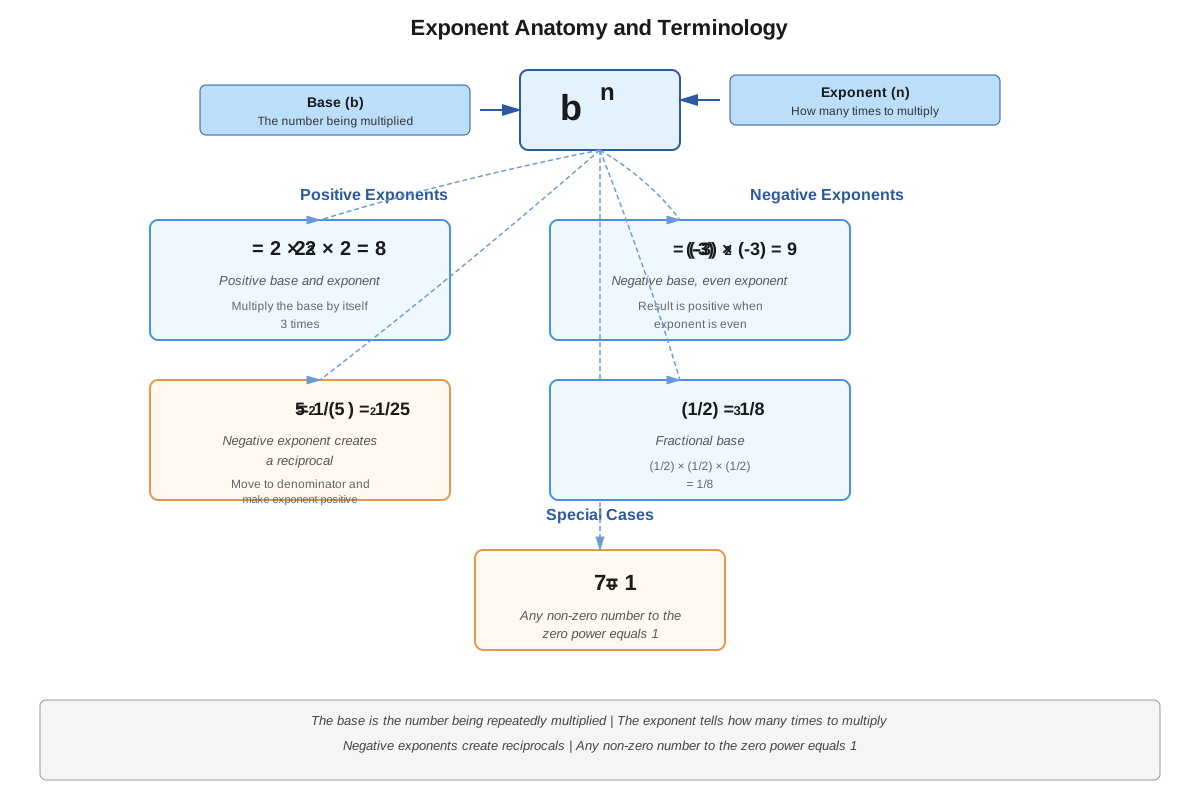
An exponent (also called a power or index) indicates how many times a number, called the base, is multiplied by itself. In the expression b^n, b represents the base and n represents the exponent. For example, 2^5 means 2 × 2 × 2 × 2 × 2 = 32. The exponent tells us the number of times the base appears as a factor in the multiplication.
The terminology is important: 2^5 is read as "two to the fifth power" or "two to the fifth." When the exponent is 2, we say "squared" (e.g., 3^2 is "three squared"), and when the exponent is 3, we say "cubed" (e.g., 4^3 is "four cubed").
Fundamental Exponent Rules
Understanding and applying exponent rules efficiently is crucial for GMAT success. These rules allow for simplification of complex expressions and quick calculation.
Product Rule (Multiplication with Same Base)
When multiplying exponential expressions with the same base, add the exponents:
b^m × b^n = b^(m+n)Example: 2^3 × 2^4 = 2^(3+4) = 2^7 = 128
This rule works because 2^3 × 2^4 = (2×2×2) × (2×2×2×2) = 2^7
Quotient Rule (Division with Same Base)
When dividing exponential expressions with the same base, subtract the exponents:
b^m ÷ b^n = b^(m-n)Example: 5^6 ÷ 5^2 = 5^(6-2) = 5^4 = 625
This works because 5^6 ÷ 5^2 = (5×5×5×5×5×5) ÷ (5×5) = 5^4
Power Rule (Power Raised to a Power)
When raising an exponential expression to another power, multiply the exponents:
(b^m)^n = b^(m×n)Example: (3^2)^4 = 3^(2×4) = 3^8 = 6,561
This occurs because (3^2)^4 means 3^2 × 3^2 × 3^2 × 3^2, which equals 3^8
Power of a Product Rule
When raising a product to a power, distribute the exponent to each factor:
(ab)^n = a^n × b^nExample: (2×5)^3 = 2^3 × 5^3 = 8 × 125 = 1,000
Power of a Quotient Rule
When raising a quotient to a power, distribute the exponent to both numerator and denominator:
(a/b)^n = a^n / b^nExample: (3/4)^2 = 3^2 / 4^2 = 9/16
Special Exponent Cases
Zero Exponent
Any non-zero base raised to the power of zero equals 1:
b^0 = 1 (where b ≠ 0)Example: 5^0 = 1, (-3)^0 = 1, (1/2)^0 = 1
This follows from the quotient rule: b^n ÷ b^n = b^(n-n) = b^0, and since any number divided by itself equals 1, b^0 = 1.
Note: 0^0 is undefined in most mathematical contexts.
Negative Exponents
A negative exponent indicates the reciprocal of the base raised to the positive exponent:
b^(-n) = 1 / b^nExample: 2^(-3) = 1 / 2^3 = 1/8
This also follows from the quotient rule: 1 ÷ 2^3 = 2^0 ÷ 2^3 = 2^(0-3) = 2^(-3)
Negative exponents frequently appear in GMAT questions, and recognizing them quickly is essential. Remember that moving an exponential term from numerator to denominator (or vice versa) changes the sign of the exponent.
Fractional Exponents
Fractional exponents represent roots:
b^(1/n) = ⁿ√b (the nth root of b)
b^(m/n) = ⁿ√(b^m) = (ⁿ√b)^m
Example: 8^(1/3) = ³√8 = 2, because 2^3 = 8
Example: 16^(3/4) = ⁴√(16^3) = ⁴√4096 = 8, or alternatively (⁴√16)^3 = 2^3 = 8
The GMAT frequently tests the equivalence between exponential and radical notation, expecting students to convert fluidly between forms.
Comparing Exponential Expressions
Understanding how exponents affect the magnitude of expressions is critical for inequality problems and data sufficiency questions.
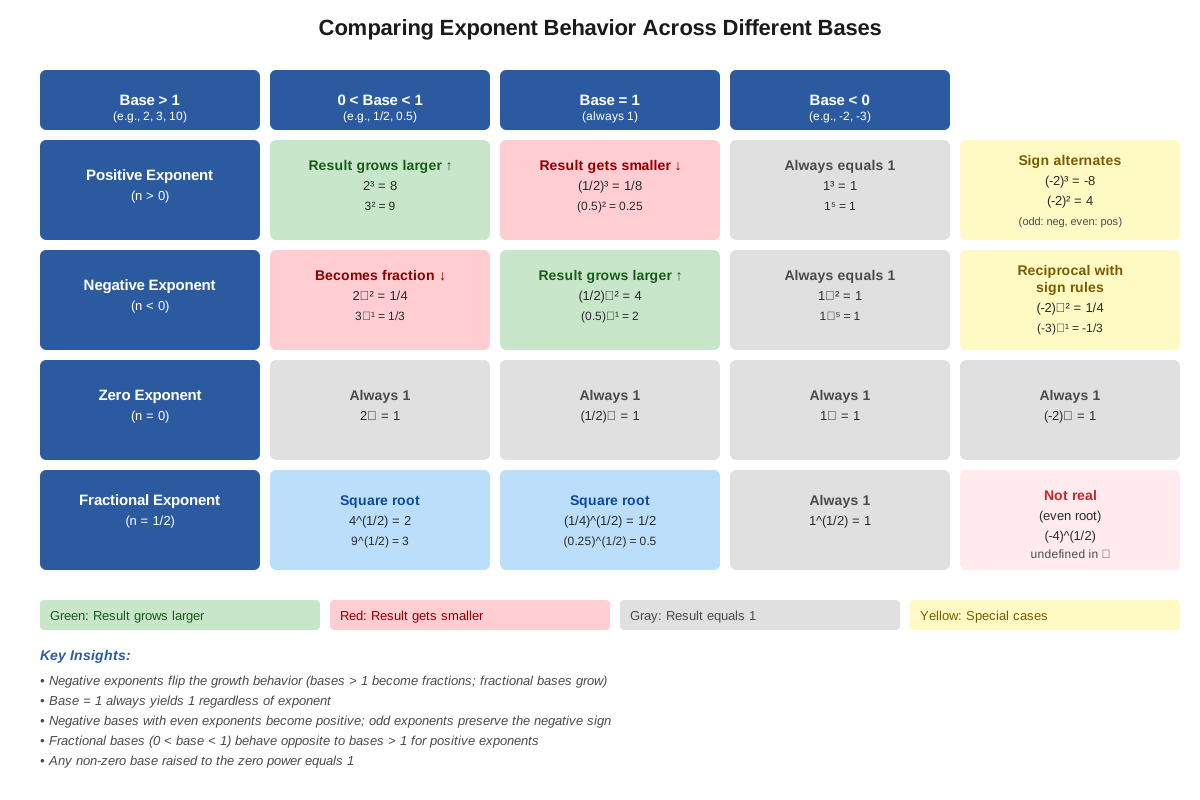
When the base is greater than 1: Larger exponents produce larger values. For example, if b > 1, then b^3 > b^2 > b^1.
When the base is between 0 and 1: Larger exponents produce smaller values. For example, (1/2)^3 = 1/8 < (1/2)^2 = 1/4 < (1/2)^1 = 1/2.
When the base is 1: The result is always 1 regardless of the exponent (1^n = 1 for any n).
When the base is 0: The result is 0 for any positive exponent (0^n = 0 for n > 0).
When the base is negative: The result depends on whether the exponent is even (positive result) or odd (negative result). For example, (-2)^3 = -8, but (-2)^4 = 16.
Exponential Equations
Solving equations with exponents often requires making the bases the same on both sides, then equating the exponents:
If b^m = b^n (where b ≠ 0, 1, or -1), then m = n.
Example: If 2^x = 2^5, then x = 5.
Example: If 3^(2x+1) = 3^7, then 2x + 1 = 7, so 2x = 6, and x = 3.
Sometimes expressions need to be rewritten with common bases:
Example: If 4^x = 8, rewrite as (2^2)^x = 2^3, which gives 2^(2x) = 2^3, so 2x = 3, and x = 3/2.
Concept Relationships
The exponent rules form an interconnected system where each rule derives logically from the definition of exponents as repeated multiplication. The product rule (adding exponents when multiplying) and quotient rule (subtracting exponents when dividing) are inverse operations, just as multiplication and division are inverse operations. The power rule (multiplying exponents when raising a power to a power) extends the product rule to repeated applications of the same base.
Negative exponents connect directly to the quotient rule—they represent what happens when you subtract a larger exponent from a smaller one. This relationship also connects exponents to the concept of reciprocals and fraction operations. Fractional exponents bridge exponents and radicals, showing that roots are simply another way of expressing certain exponential operations. This connection is crucial because GMAT questions often require converting between forms to simplify expressions.
The relationship map flows as follows:
Basic Definition (repeated multiplication) → Product Rule (adding exponents) → Quotient Rule (subtracting exponents) → Zero Exponent (special case of quotient rule) → Negative Exponents (extension of quotient rule) → Power Rule (repeated application of product rule) → Fractional Exponents (inverse of power rule, connecting to roots)
These concepts also connect to prerequisite knowledge: integer properties determine how exponents affect sign and magnitude, fraction operations are essential for working with fractional exponents and fractional bases, and order of operations determines the sequence in which exponent operations are performed in complex expressions.
Looking forward, mastery of exponents enables progression to logarithms (which are inverse operations of exponents), exponential functions and sequences, scientific notation, and polynomial operations. Exponents also appear in formulas for compound interest, geometric sequences, and probability calculations involving repeated independent events.
High-Yield Facts
⭐ Any non-zero number raised to the power of zero equals 1: b^0 = 1 (where b ≠ 0)
⭐ When multiplying with the same base, add exponents: b^m × b^n = b^(m+n)
⭐ When dividing with the same base, subtract exponents: b^m ÷ b^n = b^(m-n)
⭐ A negative exponent means reciprocal: b^(-n) = 1/b^n
⭐ When raising a power to a power, multiply exponents: (b^m)^n = b^(m×n)
- A fractional exponent represents a root: b^(1/n) = ⁿ√b
- When raising a product to a power, distribute the exponent: (ab)^n = a^n × b^n
- When raising a quotient to a power, distribute the exponent: (a/b)^n = a^n/b^n
- For bases greater than 1, larger exponents yield larger values
- For bases between 0 and 1, larger exponents yield smaller values
- An even exponent always produces a non-negative result
- An odd exponent preserves the sign of the base
- 1 raised to any power equals 1: 1^n = 1
- (-1)^n equals 1 if n is even, and -1 if n is odd
- To solve exponential equations, express both sides with the same base and equate exponents
Quick check — test yourself on Exponents so far.
Try Flashcards →Common Misconceptions
Misconception: When adding exponential expressions, you add the exponents (e.g., 2^3 + 2^4 = 2^7)
Correction: Exponents are only added when multiplying expressions with the same base, not when adding them. 2^3 + 2^4 = 8 + 16 = 24, which does not equal 2^7 = 128. Addition of exponential expressions requires calculating each term separately first.
Misconception: The power rule applies when multiplying different bases (e.g., 2^3 × 3^3 = 6^6)
Correction: When multiplying expressions with different bases but the same exponent, you multiply the bases and keep the exponent: 2^3 × 3^3 = (2×3)^3 = 6^3 = 216, not 6^6. The power rule (b^m)^n = b^(m×n) only applies when raising a power to another power.
Misconception: A negative base raised to any power is negative (e.g., (-2)^4 = -16)
Correction: The sign of the result depends on whether the exponent is even or odd. An even exponent produces a positive result: (-2)^4 = (-2)×(-2)×(-2)×(-2) = 16. An odd exponent produces a negative result: (-2)^3 = -8. This distinction is critical for inequality problems.
Misconception: Negative exponents make the entire expression negative (e.g., 2^(-3) = -8)
Correction: Negative exponents indicate reciprocals, not negative values. 2^(-3) = 1/2^3 = 1/8, which is positive. The negative sign in the exponent affects the position (numerator vs. denominator), not the sign of the result.
Misconception: Zero raised to any power equals zero (e.g., 0^0 = 0)
Correction: While 0^n = 0 for any positive exponent n, 0^0 is undefined in most mathematical contexts. Additionally, 0 raised to a negative exponent is undefined because it would require division by zero (0^(-n) = 1/0^n = 1/0).
Misconception: Fractional exponents can be ignored or simplified incorrectly (e.g., 8^(2/3) = 8^2 ÷ 8^3)
Correction: A fractional exponent b^(m/n) means the nth root of b raised to the mth power: 8^(2/3) = (³√8)^2 = 2^2 = 4, or equivalently ³√(8^2) = ³√64 = 4. The numerator is the power, and the denominator is the root.
Misconception: The product rule works when bases are different (e.g., 2^3 × 3^3 = 5^6)
Correction: The product rule (adding exponents) only applies when the bases are identical. When bases differ but exponents are the same, multiply the bases: 2^3 × 3^3 = (2×3)^3 = 6^3. When both bases and exponents differ, calculate each term separately.
Worked Examples
Example 1: Simplifying Complex Exponential Expressions
Problem: Simplify the expression: (2^5 × 2^(-3)) / (2^4 × 2^(-6))
Solution:
Step 1: Apply the product rule to the numerator by adding exponents with the same base.
- Numerator: 2^5 × 2^(-3) = 2^(5+(-3)) = 2^2
Step 2: Apply the product rule to the denominator.
- Denominator: 2^4 × 2^(-6) = 2^(4+(-6)) = 2^(-2)
Step 3: Apply the quotient rule by subtracting the denominator's exponent from the numerator's exponent.
- 2^2 / 2^(-2) = 2^(2-(-2)) = 2^(2+2) = 2^4
Step 4: Calculate the final value.
- 2^4 = 16
Answer: 16
Connection to Learning Objectives: This problem demonstrates the application of multiple exponent rules (product rule, quotient rule, and negative exponents) in sequence, which is exactly how the GMAT tests exponent mastery. It requires identifying exponents in complex expressions and applying rules systematically.
Example 2: Solving an Exponential Equation
Problem: If 9^(x+1) = 27^(2x-1), what is the value of x?
Solution:
Step 1: Express both sides using the same base. Notice that both 9 and 27 are powers of 3.
- 9 = 3^2
- 27 = 3^3
Step 2: Rewrite the equation using base 3.
- (3^2)^(x+1) = (3^3)^(2x-1)
Step 3: Apply the power rule (multiply exponents).
- 3^(2(x+1)) = 3^(3(2x-1))
- 3^(2x+2) = 3^(6x-3)
Step 4: Since the bases are equal, the exponents must be equal.
- 2x + 2 = 6x - 3
Step 5: Solve for x.
- 2 + 3 = 6x - 2x
- 5 = 4x
- x = 5/4
Verification: Substitute x = 5/4 back into the original equation.
- Left side: 9^(5/4+1) = 9^(9/4) = (3^2)^(9/4) = 3^(9/2)
- Right side: 27^(2(5/4)-1) = 27^(5/2-1) = 27^(3/2) = (3^3)^(3/2) = 3^(9/2) ✓
Answer: x = 5/4
Connection to Learning Objectives: This problem requires explaining how exponent properties work (converting to common bases), identifying exponential patterns, and applying the power rule and equation-solving techniques. It represents a high-difficulty GMAT problem type that combines multiple concepts.
Example 3: Comparing Exponential Expressions
Problem: Which is greater: 3^40 or 4^30?
Solution:
Step 1: Recognize that direct calculation is impractical. Look for a way to compare using exponent properties.
Step 2: Try to express both numbers with a common exponent. Find a common multiple of 40 and 30, which is 120.
Step 3: Rewrite both expressions with exponent 120.
- 3^40 = (3^40)^1 = (3^(40/3))^3 ≈ ... This approach is getting complicated.
Alternative approach using the power rule:
- 3^40 = (3^4)^10 = 81^10
- 4^30 = (4^3)^10 = 64^10
Step 4: Now both expressions have the same exponent (10), so compare the bases.
- Since 81 > 64, we have 81^10 > 64^10
Answer: 3^40 > 4^30
Connection to Learning Objectives: This problem demonstrates strategic application of exponent rules to make comparisons without extensive calculation—a key GMAT skill. It shows how identifying the right transformation (finding a common exponent) enables efficient problem-solving.
Exam Strategy
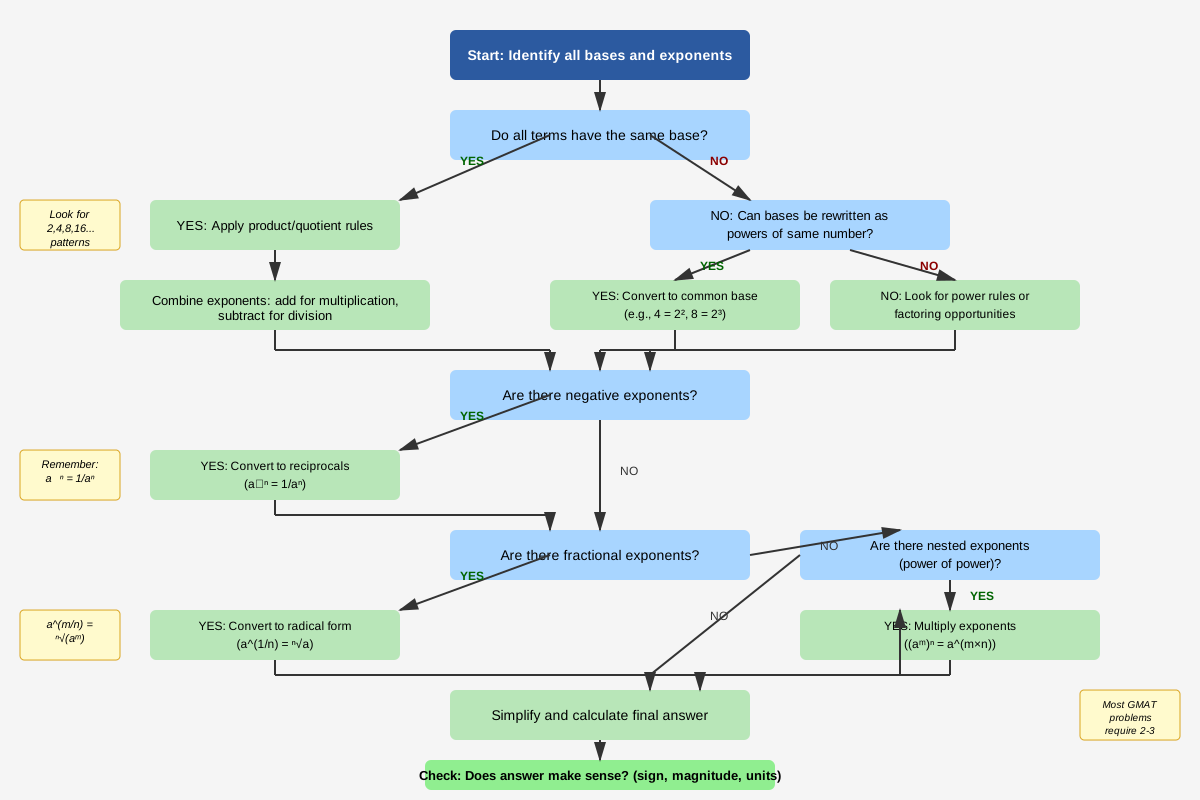
When approaching GMAT questions involving exponents, follow this systematic process:
Step 1: Identify the exponent structure. Scan the problem for exponential expressions and note whether bases are the same or different, whether exponents are positive, negative, zero, or fractional, and whether the problem involves equations, inequalities, or simplification.
Step 2: Look for common bases. Many GMAT problems become dramatically simpler when you express all terms using the same base. Numbers like 4, 8, 16, 32 can all be expressed as powers of 2. Similarly, 9, 27, 81 are powers of 3, and 25, 125 are powers of 5.
Step 3: Apply rules systematically. Don't try to do multiple steps mentally. Write out each application of an exponent rule. The GMAT rewards accuracy over speed, and exponent problems are particularly prone to sign errors and calculation mistakes.
Trigger words and phrases to watch for:
- "Simplify" or "express in simplest form" → Apply exponent rules to reduce the expression
- "Solve for" with exponential equations → Convert to common bases and equate exponents
- "Which is greater" with exponential expressions → Look for ways to make exponents or bases comparable
- "In terms of" → Express one variable using exponents of another
- Data Sufficiency: "Is x > y?" where x and y are exponential → Consider different cases (base > 1, base between 0 and 1, negative bases)
Process-of-elimination tips:
- If answer choices have different forms (some with negative exponents, some with positive), convert all to the same form to compare
- Eliminate answers that have incorrect signs (positive vs. negative)
- For expressions with fractional exponents, eliminate answers that don't properly represent roots
- Test special values (like x = 0, 1, -1, 2) to eliminate impossible answers
- In Data Sufficiency, if a statement provides information about an exponent but not the base (or vice versa), it's often insufficient because exponential behavior depends on both
Time allocation advice:
- Straightforward simplification problems: 1-1.5 minutes
- Exponential equations requiring base conversion: 2-2.5 minutes
- Complex problems combining exponents with other topics: 2.5-3 minutes
- Data Sufficiency with exponents: 2-2.5 minutes (but don't rush—these often have subtle traps)
Exam Tip: When you see a problem with multiple exponent operations, write out each step. The most common errors occur when students try to combine multiple rules mentally and mix up when to add vs. multiply exponents.
Memory Techniques
MADSPM - Mnemonic for remembering when to add, subtract, or multiply exponents:
- Multiply (same base) → Add exponents
- Divide (same base) → Subtract exponents
- Power to power → Multiply exponents
"Negative means flip" - For negative exponents, visualize flipping the fraction:
- If in the numerator, flip to denominator: a^(-n) = 1/a^n
- If in the denominator, flip to numerator: 1/a^(-n) = a^n
"Fraction exponent = Root and Power" - For fractional exponents b^(m/n):
- Bottom (denominator) = Root (take the nth root)
- Top (numerator) = Power (raise to the mth power)
- Example: 8^(2/3) → Bottom 3 = cube root, Top 2 = square → (³√8)^2 = 2^2 = 4
"Zero makes One" - Any base (except zero) raised to the zero power equals one. Visualize the exponent "zeroing out" the base to the multiplicative identity (1).
"Even/Odd Sign Rule" - For negative bases:
- Even exponent → Positive result (even number of negative signs cancel)
- Odd exponent → Negative result (odd number of negative signs leaves one)
Visualization for comparing exponentials: Picture exponential growth as a ladder. When the base is greater than 1, each step up (increasing exponent) makes the ladder taller. When the base is between 0 and 1, each step up makes the ladder shorter (approaching zero).
Summary
Exponents represent repeated multiplication and are governed by systematic rules that enable efficient manipulation of exponential expressions. The core rules—adding exponents when multiplying with the same base, subtracting when dividing, and multiplying when raising a power to a power—derive logically from the definition of exponents and form the foundation for all exponent operations. Special cases including zero exponents (which equal 1), negative exponents (which represent reciprocals), and fractional exponents (which represent roots) extend these basic rules and frequently appear in GMAT questions. Success with exponents requires both memorizing these rules and understanding when and how to apply them, particularly in converting expressions to common bases, solving exponential equations, and comparing exponential expressions. The GMAT tests exponents both directly through simplification and equation-solving problems and indirectly through integration with inequalities, number properties, and word problems. Mastery requires recognizing that exponential behavior depends critically on the base value—whether it's greater than 1, between 0 and 1, equal to 1, or negative—and that even vs. odd exponents produce fundamentally different results with negative bases.
Key Takeaways
- Exponent rules are systematic: Add exponents when multiplying (same base), subtract when dividing (same base), multiply when raising a power to a power
- Negative exponents mean reciprocals, not negative numbers: b^(-n) = 1/b^n
- Any non-zero base to the zero power equals 1: This is one of the most frequently tested special cases
- Fractional exponents connect to roots: b^(m/n) = ⁿ√(b^m), enabling conversion between exponential and radical notation
- Base value determines exponential behavior: Bases greater than 1 grow with larger exponents; bases between 0 and 1 shrink with larger exponents
- Convert to common bases: Most complex exponent problems simplify dramatically when all terms share the same base
- Sign depends on even vs. odd exponents: Even exponents produce non-negative results; odd exponents preserve the base's sign
Related Topics
Roots and Radicals: Since fractional exponents represent roots (b^(1/n) = ⁿ√b), mastering exponents provides the foundation for working with radical expressions, simplifying roots, and rationalizing denominators. Understanding the equivalence between exponential and radical notation is essential for advanced algebra problems.
Logarithms: Logarithms are the inverse operation of exponents. If b^x = y, then log_b(y) = x. Understanding exponent properties directly translates to understanding logarithm properties, making logarithmic equations and expressions more accessible.
Scientific Notation: Scientific notation expresses very large or very small numbers using powers of 10 (e.g., 3.2 × 10^8). Fluency with exponent rules, particularly multiplication and division with powers of 10, is essential for working with scientific notation efficiently.
Exponential Growth and Decay: Word problems involving compound interest, population growth, radioactive decay, and other real-world phenomena use exponential functions. Understanding exponent properties enables solving these applied problems.
Sequences and Series: Geometric sequences involve terms with constant ratios, which can be expressed using exponents (a, ar, ar^2, ar^3, ...). Mastering exponents is prerequisite for working with geometric sequences and their sums.
Practice CTA
Now that you've mastered the core concepts of exponents, it's time to solidify your understanding through practice. Attempt the practice questions to test your ability to identify, explain, and apply exponent rules under exam conditions. Use the flashcards to reinforce the key rules and special cases until they become automatic. Remember, exponents appear in 15-20% of GMAT Quantitative questions—your investment in mastering this topic will pay dividends throughout the exam. Focus on accuracy first, then build speed as the rules become second nature. You've got this!
Sign up free to keep reading
Create a free AnvayaPrep account to finish this GMAT guide on Exponents — plus flashcards and practice questions.