Overview
Variable constraints represent one of the most critical analytical skills tested in GMAT Data Sufficiency questions. At its core, understanding variable constraints means recognizing the limitations, boundaries, and relationships that govern how variables can behave within a mathematical or logical system. When the GMAT presents a Data Sufficiency problem, the question fundamentally asks whether the given statements provide enough constraints to determine a unique value or relationship for the unknown variables.
GMAT variable constraints appear in approximately 40-50% of Data Sufficiency questions, making this topic essential for achieving a competitive score. These constraints can take many forms: equations that limit possible values, inequalities that establish ranges, conditions that restrict variable types (such as "integer" or "positive"), or logical relationships that create dependencies between variables. The ability to quickly identify what constraints exist, what additional constraints are needed, and whether sufficient constraints have been provided separates high scorers from average performers.
Within the broader Data Insights section, variable constraints serve as the foundation for evaluating sufficiency. Every Data Sufficiency question ultimately tests whether you can determine if the constraints provided are adequate to answer the question definitively. This topic connects directly to algebraic reasoning, number properties, and logical analysis—all core competencies measured throughout the GMAT. Mastering variable constraints enables students to approach Data Sufficiency systematically rather than through trial-and-error, dramatically improving both accuracy and speed.
Learning Objectives
- [ ] Identify variable constraints in GMAT Data Sufficiency questions
- [ ] Explain how variable constraints determine sufficiency of information
- [ ] Apply variable constraints to solve GMAT questions efficiently
- [ ] Distinguish between sufficient and insufficient constraint systems
- [ ] Evaluate how combining multiple constraints affects sufficiency
- [ ] Recognize implicit constraints embedded in problem statements
- [ ] Determine the minimum number of constraints needed for unique solutions
Prerequisites
- Basic algebra: Understanding variables, equations, and inequalities is essential because variable constraints are expressed through these mathematical tools
- Number properties: Knowledge of integers, primes, even/odd numbers, and positive/negative distinctions helps identify implicit constraints that restrict variable values
- Data Sufficiency format: Familiarity with the standard answer choices (A, B, C, D, E) and the two-statement structure allows focus on constraint analysis rather than format confusion
- Systems of equations: Understanding when multiple equations can solve for multiple unknowns provides the foundation for recognizing sufficient constraint systems
Why This Topic Matters
Variable constraints represent the logical backbone of quantitative reasoning in business, finance, and data analysis. In real-world applications, professionals constantly work with incomplete information and must determine whether they have sufficient data to make decisions. A financial analyst evaluating investment options must know whether available market data constrains possible outcomes enough to recommend action. Operations managers optimizing supply chains must identify which variables are fixed (constraints) and which remain flexible. The GMAT tests this analytical skill because it directly predicts success in business school coursework and professional decision-making.
On the GMAT specifically, variable constraints appear in 15-20 questions per exam, distributed across Data Sufficiency and some Problem Solving questions. The exam tests this concept with medium to high difficulty, making it a significant score differentiator. Questions typically present 1-3 variables with partial information, requiring test-takers to determine whether the constraints provided (or combinations thereof) sufficiently determine the answer.
Common question patterns include: determining whether two equations sufficiently constrain two unknowns; evaluating whether inequality constraints narrow possibilities to a unique answer; assessing whether additional conditions (like "x is an integer") provide the necessary constraint; and recognizing when constraints are redundant versus complementary. The GMAT frequently disguises constraints within word problems, requiring translation from verbal descriptions to mathematical relationships before sufficiency can be evaluated.
Core Concepts
Understanding Variable Constraints
A variable constraint is any condition, equation, inequality, or restriction that limits the possible values a variable can assume. In mathematical terms, constraints reduce the solution space—the set of all possible values—for one or more variables. Without constraints, a variable could theoretically take any value from negative infinity to positive infinity. Each constraint narrows this range, and sufficiency is achieved when the solution space contains exactly one value (for "what is the value" questions) or when the question can be answered definitively (for "yes/no" questions).
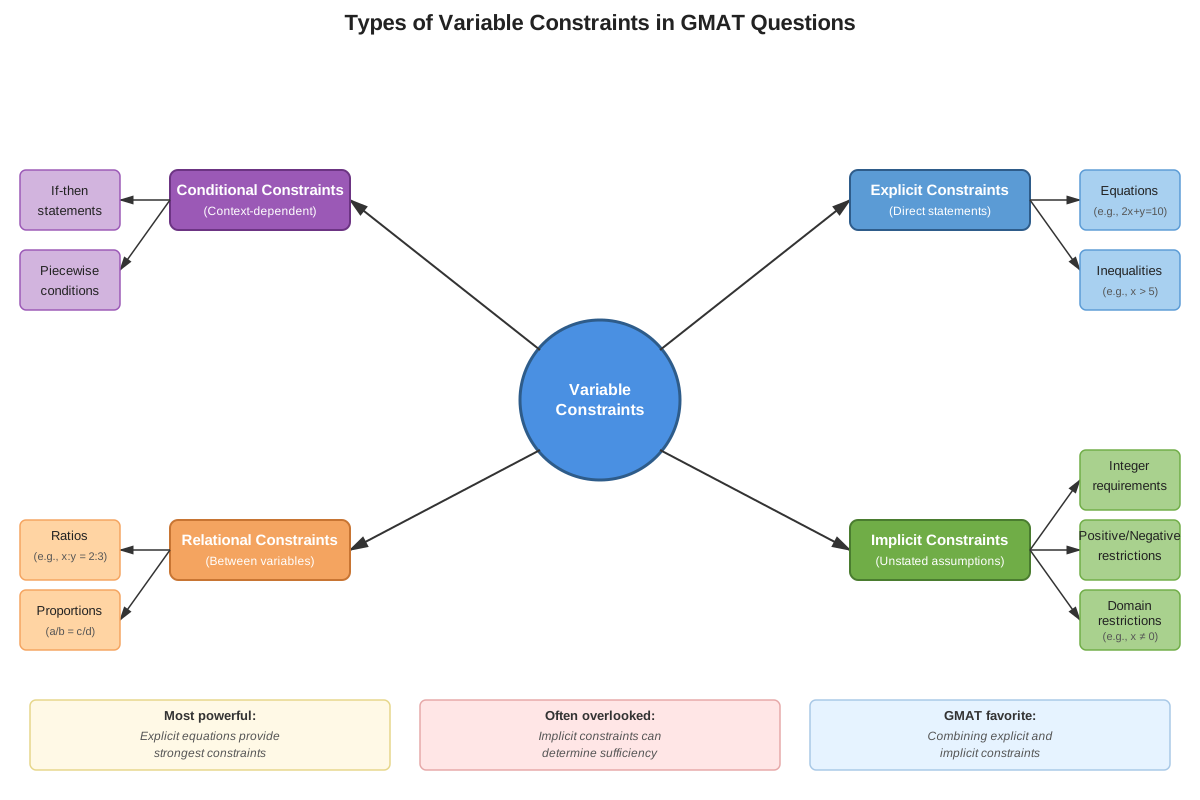
Constraints manifest in several forms:
Explicit constraints are directly stated mathematical relationships. An equation like "2x + 3y = 12" constrains x and y to lie along a specific line. An inequality such as "x > 5" constrains x to the right half of the number line. These are immediately recognizable as constraints.
Implicit constraints are embedded within problem context or variable definitions. When a problem states "n is the number of students," this implicitly constrains n to be a positive integer—you cannot have -3 students or 4.7 students. Similarly, "the probability of event A" implicitly constrains the value to the range [0, 1]. Recognizing implicit constraints is crucial because they often provide the additional limitation needed for sufficiency.
Conditional constraints depend on other factors. A statement like "if x is even, then y = 3" creates a constraint on y only when x satisfies a particular condition. These require careful logical analysis to determine their impact on sufficiency.
Counting Constraints vs. Counting Variables
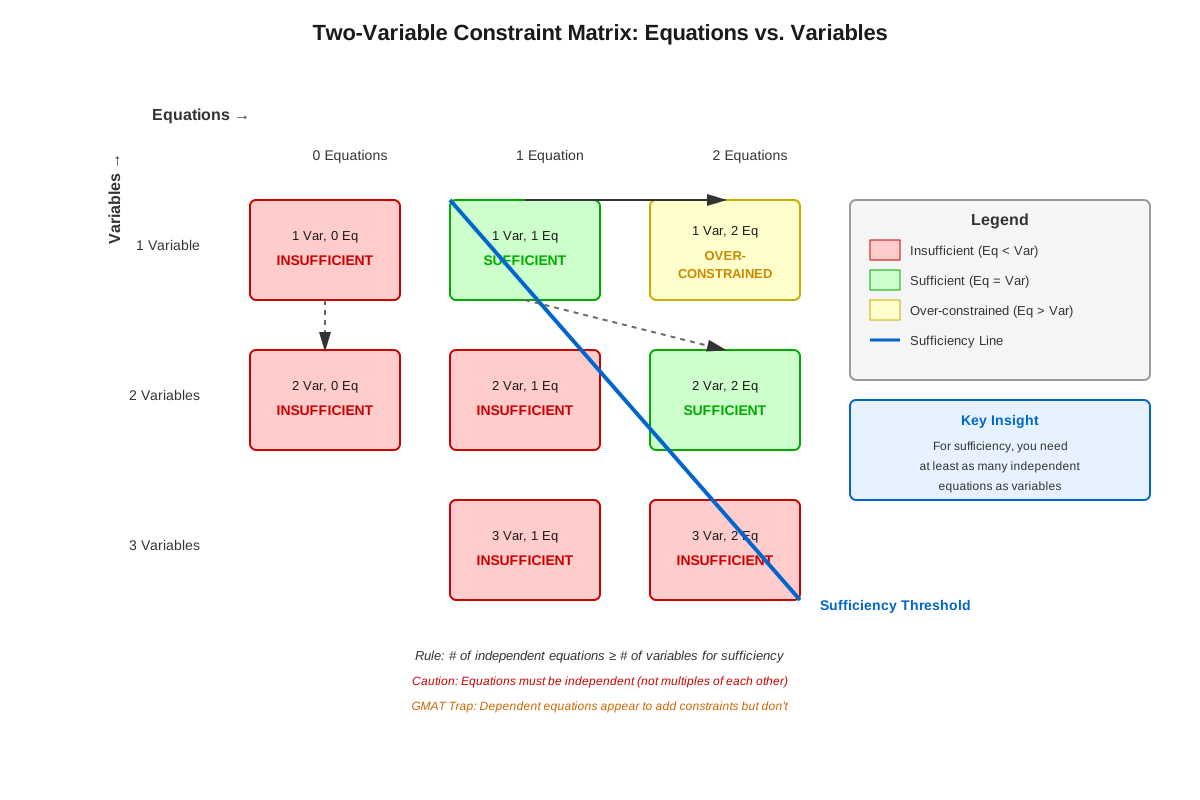
A fundamental principle in algebra states that to solve for n distinct variables uniquely, you generally need n independent constraints (typically n independent equations). This principle underlies much of Data Sufficiency reasoning:
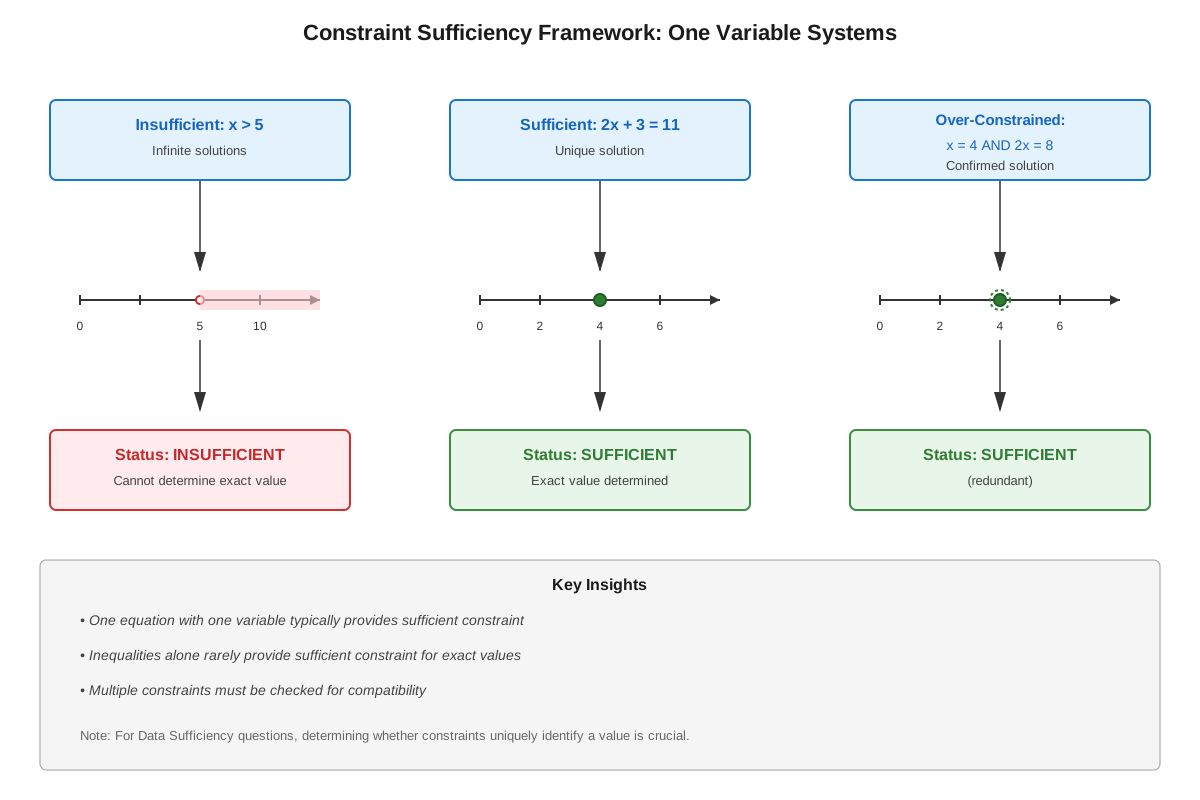
- One variable, one constraint: To determine a unique value for x, you typically need one equation involving x
- Two variables, two constraints: To determine unique values for both x and y, you typically need two independent equations
- Three variables, three constraints: And so forth
However, this principle has important exceptions and nuances:
| Scenario | Constraints Needed | Example |
|---|---|---|
| Linear equations, unique solution | n independent equations for n variables | 2x + y = 5 and x - y = 1 → unique x, y |
| Nonlinear equations | May need fewer than n equations | x² + y² = 0 → unique solution (0,0) |
| Integer constraints | May need fewer equations | x + y = 3 with x, y positive integers → only 2 solutions |
| Yes/No questions | May not need unique values | "Is x > 0?" may be answerable without knowing x exactly |
| Inequality constraints | Typically insufficient alone | x > 5 doesn't give unique x value |
Independence of Constraints
Two constraints are independent if neither can be derived from the other. Independence is critical because redundant constraints don't add information. Consider:
- Independent: "x + y = 10" and "x - y = 2" (these provide different information)
- Dependent: "x + y = 10" and "2x + 2y = 20" (the second is just the first multiplied by 2)
In Data Sufficiency, Statement (1) and Statement (2) are always independent of each other (by GMAT design), but when combined, you must verify they don't contradict each other. If they contradict, the answer is typically (E) because no consistent solution exists.
Constraint Types in Data Sufficiency
Equality constraints (equations) are the strongest type because they specify exact relationships. A single equation with one variable typically provides sufficient constraint: "3x = 15" uniquely determines x = 5.
Inequality constraints establish ranges but rarely provide unique values alone. "x > 5" tells us x could be 5.1, 6, 100, or any value greater than 5. However, inequalities become powerful when combined: "x > 5" and "x < 6" together constrain x to the interval (5, 6), and if we add "x is an integer," we get the unique value x = 5... wait, there's no integer strictly between 5 and 6, so this would actually be insufficient. This illustrates the importance of careful analysis.
Type constraints restrict variables to specific categories: integers, positive numbers, even numbers, prime numbers, etc. These often provide the "missing piece" that makes a statement sufficient. For example, "x² = 4" alone gives x = ±2 (insufficient for "what is x?"), but adding "x > 0" constrains to x = 2 (sufficient).
Functional constraints describe how variables relate through functions or operations. "y = f(x)" constrains y based on x's value. In Data Sufficiency, understanding whether a function is one-to-one (each input produces unique output) versus many-to-one affects sufficiency analysis.
Sufficiency Analysis Framework
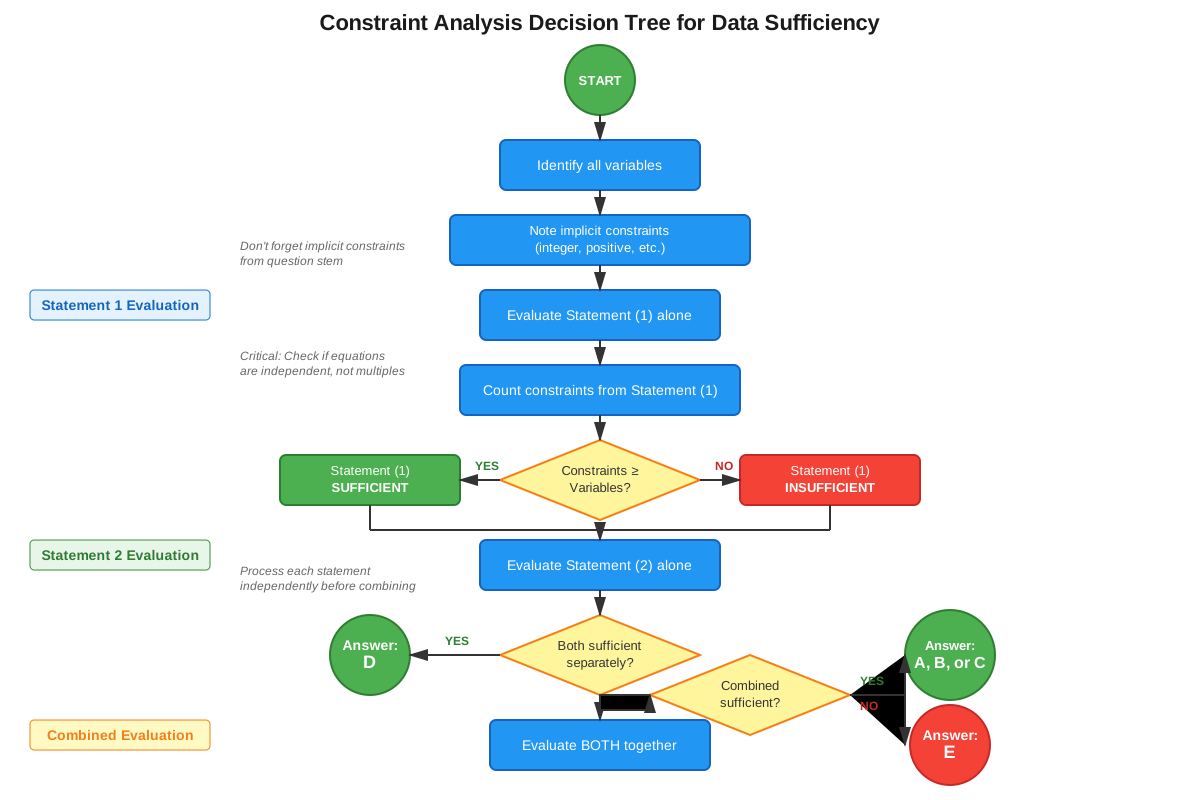
When evaluating whether constraints are sufficient, follow this systematic approach:
- Identify the question target: What exactly must be determined? A unique value? A yes/no answer? A relationship?
- Count and classify variables: How many unknowns exist? What implicit constraints apply (positive, integer, etc.)?
- Analyze Statement (1) alone: What constraints does it provide? Combined with implicit constraints, is this sufficient?
- Analyze Statement (2) alone: Same process, independently of Statement (1)
- If needed, analyze combined statements: Do they provide enough independent constraints? Do they contradict?
- Select the appropriate answer choice: Based on which statement(s) provide sufficiency
Special Cases in Constraint Analysis
Absolute value constraints create multiple possibilities. "|x| = 5" means x = 5 or x = -5, requiring additional constraints to determine which.
Quadratic and higher-order constraints often yield multiple solutions. "x² = 9" gives x = ±3. The constraint "x² - 5x + 6 = 0" factors to (x-2)(x-3) = 0, yielding x = 2 or x = 3.
Ratio and proportion constraints may seem to provide relationships but often lack absolute scale. "x/y = 2" tells us x is twice y, but without additional constraints, infinite pairs satisfy this: (2,1), (4,2), (6,3), etc.
Modular arithmetic constraints like "n leaves remainder 3 when divided by 5" create infinite solution sets (n = 3, 8, 13, 18, ...) unless combined with range constraints.
Concept Relationships
Variable constraints form the analytical foundation that connects to virtually every other Data Sufficiency concept. The relationship flows as follows:
Problem Statement → Implicit Constraints → Explicit Constraints (Statements 1 & 2) → Sufficiency Evaluation → Answer Selection
Within this topic, understanding basic constraint types (equality, inequality, type) leads to recognizing constraint independence, which enables counting constraints versus variables, which ultimately determines sufficiency. Each concept builds on the previous: you cannot evaluate independence without first identifying constraints, and you cannot determine sufficiency without understanding independence.
Variable constraints connect backward to prerequisite topics: algebraic manipulation skills enable you to recognize when constraints are equivalent or independent; number properties knowledge reveals implicit constraints (like "n is prime" severely limiting possible values); systems of equations provide the mathematical framework for understanding when multiple constraints yield unique solutions.
Variable constraints connect forward to advanced Data Sufficiency topics: recognizing constraints enables efficient statement evaluation; understanding sufficiency patterns improves speed; constraint analysis underlies geometric Data Sufficiency (where figures provide visual constraints) and word problem translation (where verbal descriptions must be converted to mathematical constraints).
The relationship map: Identify Constraints → Classify Constraint Types → Assess Independence → Count Constraints vs. Variables → Evaluate Sufficiency → Select Answer
Quick check — test yourself on Variable constraints so far.
Try Flashcards →High-Yield Facts
⭐ To uniquely determine n variables, you typically need n independent constraints (equations), though exceptions exist for nonlinear equations and integer restrictions
⭐ Implicit constraints (like "n is a positive integer") often provide the critical additional limitation that makes a statement sufficient
⭐ Inequality constraints alone rarely provide unique values but become powerful when combined with other constraints or when answering yes/no questions
⭐ For yes/no Data Sufficiency questions, a statement is sufficient if it always gives the same answer (always yes or always no), even without determining exact values
⭐ Two equations that are multiples of each other are dependent (redundant) and count as only one constraint
- Absolute value equations and even-power equations (like x² = 16) typically yield two solutions, requiring additional constraints to determine which
- Type constraints (integer, positive, even, prime) dramatically reduce solution spaces and frequently determine sufficiency
- When combining statements, verify they don't contradict each other; contradictory statements mean no solution exists
- Ratio and proportion statements provide relationships but not absolute values unless combined with additional constraints
- The constraint "x ≠ 0" or similar exclusions are often crucial for determining whether expressions are defined or operations are valid
Common Misconceptions
Misconception: If you have two equations, you can always solve for two variables uniquely.
Correction: The equations must be independent (not multiples or combinations of each other) and consistent (not contradictory). The equations "x + y = 5" and "2x + 2y = 10" are dependent and provide only one constraint, insufficient for two variables.
Misconception: Inequality constraints are never sufficient by themselves.
Correction: For yes/no questions, a single inequality can be sufficient. If the question asks "Is x > 10?" and a statement says "x > 15," this is sufficient (the answer is always yes). Additionally, inequalities combined with type constraints can yield unique values: "5 < x < 7" with "x is an integer" gives x = 6 uniquely.
Misconception: More information is always better; combining statements always increases sufficiency.
Correction: Statements can contradict each other, making the combined information insufficient. Additionally, if each statement alone is sufficient, you don't need to combine them—the answer is (D), not (C).
Misconception: Implicit constraints don't matter much in Data Sufficiency.
Correction: Implicit constraints are frequently the determining factor in sufficiency. Recognizing that "the number of people" must be a non-negative integer, or that "probability" must be between 0 and 1, often provides the crucial additional constraint that makes a statement sufficient.
Misconception: If you can't solve for exact values, the statement is insufficient.
Correction: For yes/no questions, you don't need exact values—you need consistent answers. If a statement allows x to be 3, 4, or 5, but all these values give "yes" to the question "Is x < 10?", the statement is sufficient despite not determining x exactly.
Misconception: Quadratic equations always give two solutions, so they're always insufficient for determining a unique value.
Correction: Some quadratic equations have only one solution (like x² = 0 giving x = 0, or (x-3)² = 0 giving x = 3). Additionally, when combined with other constraints like "x > 0," a quadratic may yield a unique solution even when it has two mathematical roots.
Worked Examples
Example 1: Integer Constraints as the Key
Question: What is the value of x?
Statement (1): x² - 7x + 12 = 0
Statement (2): x is a prime number
Solution:
Analyzing Statement (1) alone:
The equation x² - 7x + 12 = 0 can be factored:
(x - 3)(x - 4) = 0
This gives x = 3 or x = 4. We have two possible values, so we cannot determine a unique value for x. Statement (1) alone is INSUFFICIENT.
Analyzing Statement (2) alone:
"x is a prime number" constrains x to the set {2, 3, 5, 7, 11, 13, ...}, but provides no specific value. Statement (2) alone is INSUFFICIENT.
Analyzing both statements together:
From Statement (1), x = 3 or x = 4.
From Statement (2), x must be prime.
Among our two possibilities, 3 is prime but 4 is not (4 = 2 × 2).
Therefore, x must equal 3.
Both statements together are SUFFICIENT.
Answer: (C)
Key Learning: This example demonstrates how a type constraint (prime number) can provide the additional limitation needed when an equation yields multiple solutions. The implicit constraint in Statement (2) eliminated one of the two possibilities from Statement (1), resulting in a unique value.
Example 2: Yes/No Question with Inequality Constraints
Question: Is xy > 0?
Statement (1): x > 3
Statement (2): y < -2
Solution:
Understanding the question:
"Is xy > 0?" asks whether the product of x and y is positive. This occurs when both variables have the same sign (both positive or both negative).
Analyzing Statement (1) alone:
x > 3 tells us x is positive, but provides no information about y. If y is positive, then xy > 0 (yes). If y is negative, then xy < 0 (no). We get different answers depending on y's value. Statement (1) alone is INSUFFICIENT.
Analyzing Statement (2) alone:
y < -2 tells us y is negative, but provides no information about x. If x is positive, then xy < 0 (no). If x is negative, then xy > 0 (yes). We get different answers depending on x's value. Statement (2) alone is INSUFFICIENT.
Analyzing both statements together:
From Statement (1): x > 3, so x is positive.
From Statement (2): y < -2, so y is negative.
When x is positive and y is negative, their product xy is negative.
Therefore, xy > 0? No, always.
Since we can definitively answer "no" in all cases, both statements together are SUFFICIENT.
Answer: (C)
Key Learning: For yes/no questions, sufficiency doesn't require finding exact values—it requires being able to answer consistently. Here, two inequality constraints that were individually insufficient became sufficient when combined because they constrained the signs of both variables, allowing us to determine the sign of their product. This example also illustrates that "sufficient" means we can answer definitively, whether that answer is yes or no.
Exam Strategy
When approaching GMAT Data Sufficiency questions involving variable constraints, implement this systematic strategy:
Step 1: Decode the question stem carefully. Identify exactly what must be determined and note all implicit constraints. If the question asks "What is the value of n?" where n represents "the number of employees," immediately recognize that n must be a positive integer—this implicit constraint may be crucial.
Step 2: Count variables and identify what's needed. Before looking at the statements, determine how many unknowns exist and what type of constraints would theoretically suffice. For two variables, you'll typically need two independent equations. For a yes/no question, you need constraints that consistently determine the answer.
Step 3: Analyze Statement (1) in isolation. Completely ignore Statement (2) at this stage. Identify all constraints Statement (1) provides, combine with implicit constraints from the question stem, and determine sufficiency. Avoid the temptation to peek at Statement (2).
Step 4: Analyze Statement (2) in isolation. Now completely forget Statement (1) and repeat the analysis. This discipline prevents confusion and ensures accurate evaluation.
Step 5: Only if necessary, combine statements. If both statements were insufficient alone, analyze them together. Check for independence (do they provide different information?) and consistency (do they contradict?).
Trigger words and phrases to watch for:
- "Integer," "positive," "even," "prime" → Type constraints that may provide sufficiency
- "Distinct," "different" → Constraints that eliminate certain possibilities
- "At least," "at most," "between" → Range constraints
- "Ratio," "proportion," "times as much" → Relationship constraints that may lack absolute scale
- "Remainder," "divisible by" → Modular constraints creating periodic solutions
Process-of-elimination tips:
- Eliminate (A) if Statement (1) alone is insufficient
- Eliminate (B) if Statement (2) alone is insufficient
- Eliminate (D) if either statement alone is insufficient
- Eliminate (C) if the statements contradict each other when combined
- Choose (E) only when both statements together still don't provide sufficiency
Time allocation: Spend 15-20 seconds understanding the question and identifying implicit constraints, 30-40 seconds on each statement individually, and 20-30 seconds combining if necessary. If you're spending more than 2 minutes total, make your best educated guess and move on—Data Sufficiency rewards efficiency.
Exam Tip: For yes/no questions, remember that "sufficient" means you can answer consistently (always yes or always no), not that you need to find exact values. This distinction frequently determines the correct answer.
Memory Techniques
Mnemonic for Constraint Types - "EIFT":
- Equality (equations - strongest constraints)
- Inequality (ranges - need combinations)
- Functional (relationships between variables)
- Type (integer, positive, prime - often the key)
Visualization for Independence: Picture two ropes pulling a point. If they pull in different directions, they're independent and can fix the point's location (sufficient). If they pull in the same or opposite directions along the same line, they're dependent and the point can slide (insufficient).
Acronym for Sufficiency Analysis - "ICAS":
- Identify all constraints (explicit and implicit)
- Count variables vs. constraints
- Assess independence
- Solve or determine sufficiency
The "Same Sign Rule" for products: Remember that xy > 0 when x and y have the Same Sign (both positive or both negative). This helps quickly evaluate inequality questions involving products.
The "n for n" principle: N independent constraints for N variables (with exceptions for nonlinear equations and type constraints). This quick check helps you rapidly assess whether you're in the ballpark of sufficiency.
Summary
Variable constraints represent the fundamental analytical framework for GMAT Data Sufficiency questions. A constraint is any condition that limits possible variable values—equations, inequalities, type restrictions, or logical conditions. Sufficiency is achieved when constraints narrow the solution space adequately to answer the question definitively. The core principle states that n independent constraints typically determine n variables uniquely, though important exceptions exist for nonlinear equations, integer restrictions, and yes/no questions. Implicit constraints embedded in problem context (like "number of people" implying positive integers) frequently provide the critical limitation that determines sufficiency. Successful Data Sufficiency performance requires systematically identifying all constraints, assessing their independence, counting constraints versus variables, and evaluating whether the question can be answered consistently. For yes/no questions, exact values aren't necessary—only consistent answers matter. Mastering variable constraints transforms Data Sufficiency from guesswork into systematic analysis, dramatically improving both accuracy and speed.
Key Takeaways
- Variable constraints are conditions that limit possible values; sufficiency requires enough constraints to answer the question definitively
- The general principle is n independent constraints for n variables, but nonlinear equations, integer restrictions, and yes/no questions create important exceptions
- Implicit constraints (positive, integer, prime, etc.) are frequently the determining factor in sufficiency and must never be overlooked
- For yes/no questions, sufficiency means answering consistently (always yes or always no), not necessarily finding exact values
- Inequality constraints alone rarely provide unique values but become powerful when combined with other constraints or when answering yes/no questions
- Independence of constraints is critical—redundant constraints don't add information, and contradictory constraints mean no solution exists
- Systematic analysis (evaluate Statement 1 alone, then Statement 2 alone, then combine only if necessary) prevents errors and improves efficiency
Related Topics
Systems of Linear Equations: Building on variable constraints, this topic explores techniques for solving multiple equations simultaneously and recognizing when systems have unique solutions, infinite solutions, or no solutions—directly applicable to evaluating sufficiency.
Inequalities and Absolute Values: Deepens understanding of inequality constraints and how absolute value creates multiple cases, requiring careful constraint analysis to determine sufficiency.
Number Properties in Data Sufficiency: Explores how properties like divisibility, prime factorization, and even/odd characteristics create implicit constraints that frequently determine sufficiency.
Geometric Data Sufficiency: Applies constraint analysis to geometric figures, where visual information provides constraints on lengths, angles, and areas.
Mastering variable constraints provides the analytical foundation for all these advanced topics, making this concept essential for Data Sufficiency excellence.
Practice CTA
Now that you understand variable constraints, it's time to cement your mastery through practice. Attempt the practice questions designed specifically for this topic, focusing on systematically identifying constraints, assessing independence, and evaluating sufficiency. Use the flashcards to reinforce key principles and constraint types. Remember: Data Sufficiency rewards systematic analysis over intuition. Each practice question you complete strengthens your analytical framework and builds the pattern recognition that leads to top scores. You've learned the concepts—now apply them with confidence!
Sign up free to keep reading
Create a free AnvayaPrep account to finish this GMAT guide on Variable constraints — plus flashcards and practice questions.