Overview
Histograms are one of the most frequently tested graphical representations in the GMAT Data Insights section. Unlike bar charts that display categorical data, histograms display the distribution of continuous numerical data by grouping values into intervals called bins or classes. Understanding how to read, interpret, and extract quantitative information from histograms is essential for success on the GMAT, as these questions test both your ability to analyze visual data and perform calculations based on frequency distributions.
The GMAT uses GMAT histograms to assess multiple competencies simultaneously: reading comprehension of visual data, numerical reasoning, and the ability to make inferences from grouped data. Questions involving histograms often require you to calculate measures of central tendency, determine percentages, identify ranges, or compare distributions. These questions appear regularly in the Data Insights section and are considered medium-to-high difficulty because they combine visual interpretation with quantitative analysis.
Histograms connect to broader Data Insights concepts including statistical analysis, data visualization, and probability. They serve as a foundation for understanding frequency distributions, which appear across various question types in the GMAT. Mastering histograms enables you to tackle more complex graphics interpretation questions and builds the analytical skills necessary for multi-source reasoning problems where multiple data representations must be synthesized.
Learning Objectives
- [ ] Identify histograms and distinguish them from other graphical representations
- [ ] Explain the components and structure of histograms, including bins, frequencies, and axes
- [ ] Apply histogram interpretation skills to solve GMAT questions involving frequency distributions
- [ ] Calculate statistical measures (mean, median, mode, range) from histogram data
- [ ] Determine percentages and proportions of data within specified intervals
- [ ] Analyze cumulative frequencies and make comparative judgments between distributions
Prerequisites
- Basic arithmetic operations: Essential for calculating frequencies, percentages, and totals from histogram data
- Understanding of averages and ranges: Necessary for computing statistical measures from grouped data
- Familiarity with coordinate systems: Required to read x-axis (data values) and y-axis (frequencies) correctly
- Percentage calculations: Critical for determining proportions of data within specific bins
- Basic statistical terminology: Understanding terms like frequency, distribution, and interval aids comprehension
Why This Topic Matters
Histograms appear in real-world business contexts constantly—from analyzing sales distributions across regions to understanding customer age demographics, from quality control in manufacturing to financial performance metrics. Business professionals use histograms to identify patterns, detect outliers, and make data-driven decisions. The GMAT tests histogram interpretation because it reflects the analytical skills required in graduate business education and professional practice.
On the GMAT, histogram questions appear in approximately 15-20% of Data Insights questions, making them high-yield content for test preparation. These questions typically appear in two formats: standalone Graphics Interpretation questions where you must complete statements about the histogram, and as part of Multi-Source Reasoning questions where histogram data must be integrated with other information sources. The difficulty level ranges from medium to hard, with harder questions requiring multiple calculation steps or asking about less obvious features of the distribution.
Common GMAT histogram scenarios include: employee salary distributions within companies, test score distributions across student populations, sales data grouped by revenue ranges, age distributions of survey respondents, and time-to-completion data for various tasks. Questions often ask you to identify the interval containing the median, calculate what percentage of observations fall within a certain range, determine the minimum possible mean, or compare characteristics between different groups shown in multiple histograms.
Core Concepts
Structure and Components of Histograms
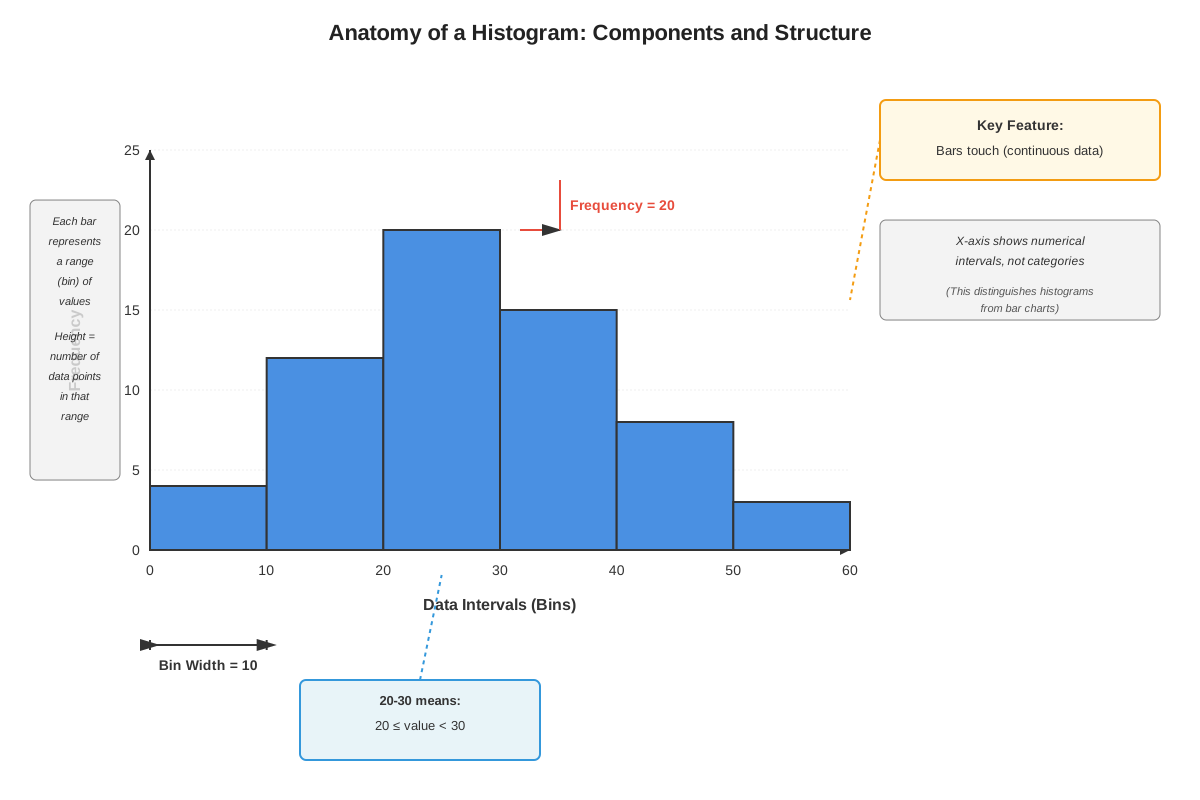
A histogram is a graphical representation of the frequency distribution of continuous numerical data. The horizontal axis (x-axis) represents the range of data values divided into consecutive intervals called bins or classes, while the vertical axis (y-axis) represents the frequency (count) or relative frequency (percentage) of observations falling within each bin. Unlike bar charts, the bars in a histogram are adjacent with no gaps between them, reflecting the continuous nature of the underlying data.
Each rectangular bar in a histogram has a width corresponding to the bin width or class interval and a height corresponding to the frequency of observations in that interval. The area of each bar is proportional to the frequency it represents. Understanding this relationship is crucial because GMAT questions may present histograms with unequal bin widths, requiring careful attention to both dimensions.
Reading Histogram Axes
The x-axis displays the data range divided into intervals. These intervals may be written in several formats:
- Inclusive notation: [0-10], [10-20], [20-30]
- Boundary notation: 0-10, 10-20, 20-30
- Midpoint labels: 5, 15, 25 (representing intervals centered on these values)
The y-axis shows either absolute frequency (the actual count of observations) or relative frequency (the proportion or percentage of total observations). GMAT questions will clearly label which type is used, but you must pay attention because calculations differ significantly between the two.
Interpreting Frequency and Distribution
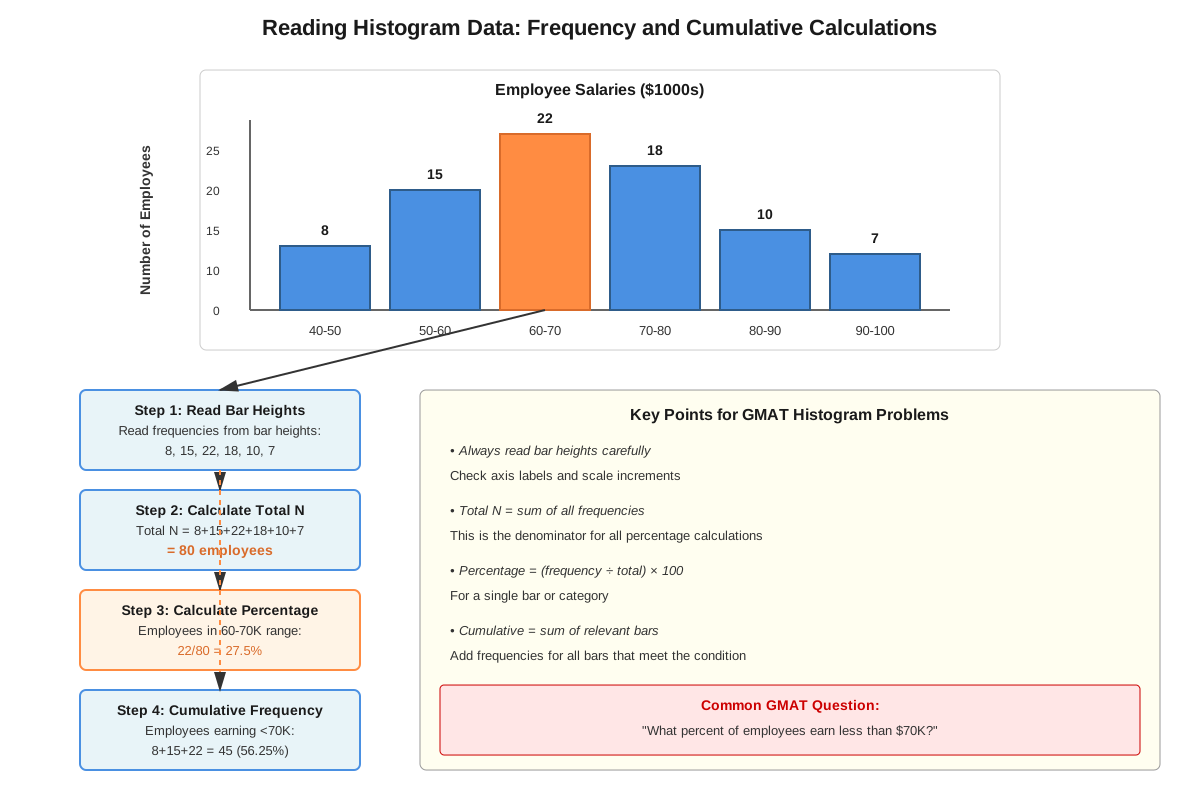
The frequency of a bin tells you how many data points fall within that interval. To find the total number of observations in a dataset, sum the frequencies of all bins. This total is essential for calculating percentages and proportions.
The shape of the distribution provides valuable information:
- Symmetric distributions have roughly equal frequencies on both sides of a central peak
- Right-skewed (positively skewed) distributions have a longer tail extending toward higher values
- Left-skewed (negatively skewed) distributions have a longer tail extending toward lower values
- Uniform distributions show approximately equal frequencies across all bins
- Bimodal distributions display two distinct peaks, suggesting two subgroups in the data
Calculating Statistical Measures from Histograms
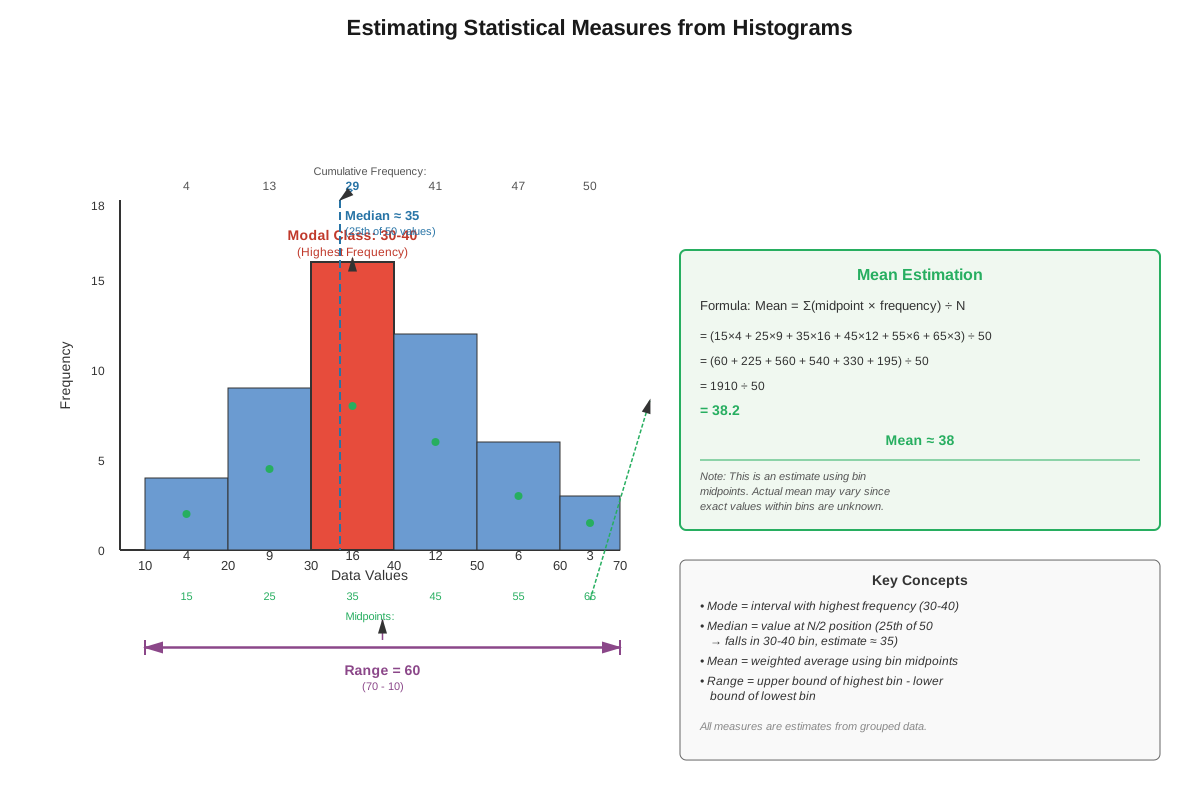
Range: The difference between the upper boundary of the highest bin containing data and the lower boundary of the lowest bin containing data.
Mode: The bin with the highest frequency represents the modal class. The mode is typically reported as the interval itself, though some questions may ask for the midpoint of the modal class.
Median: The value that divides the distribution in half. To find the median from a histogram:
- Calculate the total frequency (N)
- Find N/2
- Identify which bin contains the (N/2)th observation by cumulating frequencies from left to right
- The median lies within that bin
Mean: Calculating the exact mean from a histogram is impossible without knowing individual values, but you can estimate it using bin midpoints:
- Find the midpoint of each bin
- Multiply each midpoint by its frequency
- Sum these products
- Divide by the total frequency
This gives an approximate mean assuming data is evenly distributed within each bin.
Cumulative Frequency Analysis
Cumulative frequency represents the total number of observations up to and including a particular bin. This concept is crucial for:
- Finding percentiles and quartiles
- Determining what percentage of data falls below or above a certain value
- Identifying the median location
To create cumulative frequencies, start with the leftmost bin and progressively add each bin's frequency to the running total.
Comparing Multiple Histograms
GMAT questions may present two or more histograms for comparison. Key comparison strategies include:
- Comparing total frequencies (sample sizes)
- Comparing shapes of distributions
- Comparing measures of central tendency
- Comparing spread or variability
- Identifying which distribution has more observations in specific ranges
| Feature | Histogram A | Histogram B | Comparison |
|---|---|---|---|
| Total Frequency | Sum all bars | Sum all bars | Which dataset is larger? |
| Central Tendency | Locate peak/balance point | Locate peak/balance point | Which has higher typical values? |
| Spread | Range of non-zero bins | Range of non-zero bins | Which is more variable? |
| Shape | Symmetric/skewed | Symmetric/skewed | How do distributions differ? |
Concept Relationships
The core concepts within histogram interpretation build upon each other hierarchically. Structure and components form the foundation—you must first understand what histograms are and how they're constructed before you can extract information from them. This foundational knowledge leads directly to reading histogram axes, which is the mechanical skill of translating visual information into numerical data.
Once you can read the axes accurately, you progress to interpreting frequency and distribution, which involves understanding what the heights and patterns mean in context. This interpretation skill enables calculating statistical measures, which requires combining visual information with mathematical operations. The most advanced skill is cumulative frequency analysis, which builds on all previous concepts to answer questions about proportions and percentiles.
These histogram concepts connect to prerequisite knowledge of basic statistics and graphing. The arithmetic operations you use to calculate totals and percentages are fundamental math skills applied in a visual context. Understanding averages and ranges from basic statistics translates directly to estimating means and identifying ranges in histograms.
Histograms also connect forward to more advanced Data Insights topics. The frequency distribution concepts you learn here apply to probability questions, where you might calculate the probability of randomly selecting an observation from a particular range. The comparative analysis skills used with multiple histograms prepare you for multi-source reasoning questions where you must synthesize information from various data representations.
Concept Flow: Identify histogram structure → Read axes accurately → Interpret frequencies → Calculate statistics → Perform cumulative analysis → Apply to complex GMAT scenarios
High-Yield Facts
⭐ The total number of observations equals the sum of all bin frequencies (when frequency, not relative frequency, is shown on the y-axis)
⭐ The median is located in the bin where the cumulative frequency first reaches or exceeds 50% of the total
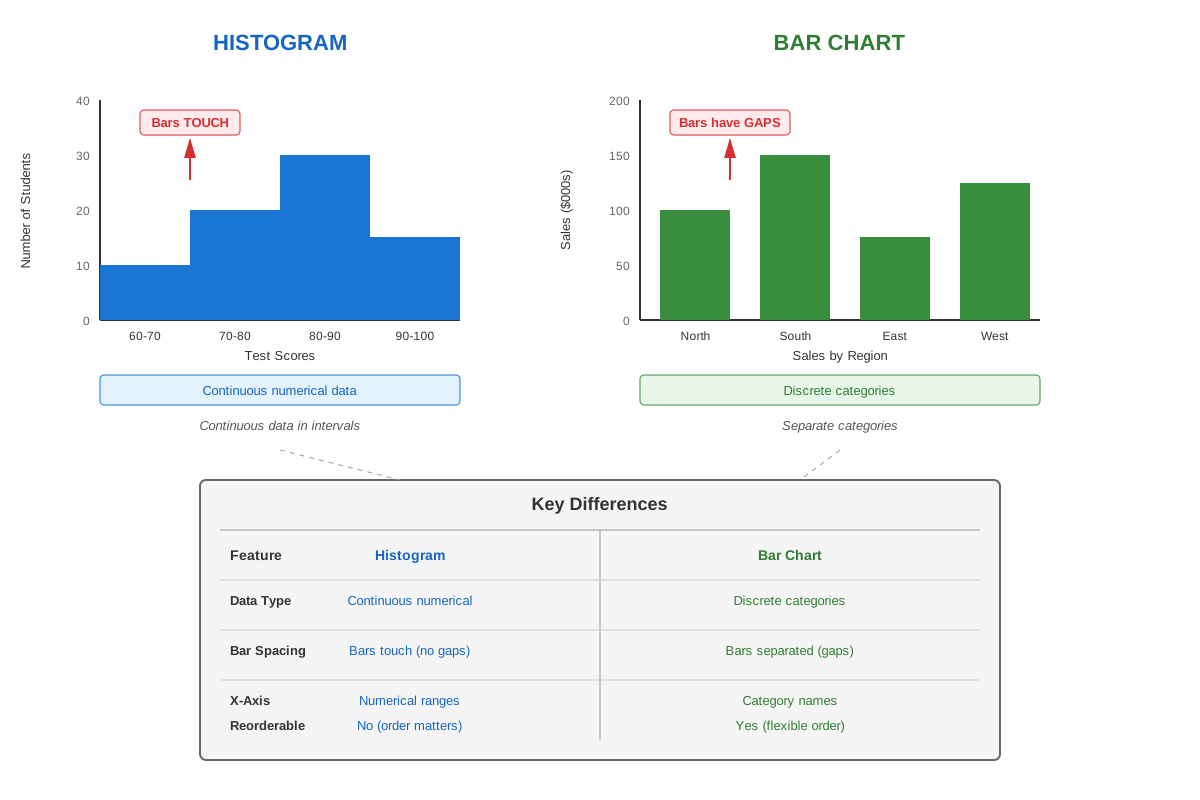
⭐ Adjacent bars in histograms have no gaps because the data is continuous, unlike bar charts for categorical data
⭐ The modal class is the bin with the highest frequency, not necessarily where the mean or median is located
⭐ To calculate what percentage of data falls within a range, sum the frequencies of relevant bins and divide by total frequency
- The range of the data is determined by the lowest and highest bins that contain observations, not by all bins shown on the graph
- When bin widths are unequal, you cannot compare frequencies by height alone—you must consider the area of each bar
- The mean of a histogram can only be estimated using bin midpoints; the exact mean cannot be determined without individual data values
- A right-skewed distribution has its mean greater than its median; a left-skewed distribution has its mean less than its median
- Histograms can display either absolute frequencies (counts) or relative frequencies (percentages/proportions)—always check the y-axis label
- The sum of relative frequencies (when shown as proportions) always equals 1.0 or 100%
- To find how many observations fall between two values, identify all bins that overlap with that range and sum their frequencies
Quick check — test yourself on Histograms so far.
Try Flashcards →Common Misconceptions
Misconception: Histograms and bar charts are the same thing and can be used interchangeably.
Correction: Histograms display continuous numerical data with adjacent bars (no gaps), while bar charts display categorical data with separated bars. The x-axis of a histogram represents a numerical scale with ordered intervals, whereas bar chart categories have no inherent numerical order.
Misconception: The tallest bar in a histogram always contains the mean.
Correction: The tallest bar represents the mode (most frequent interval), not the mean. The mean is the balance point of the distribution and may fall in a different bin, especially in skewed distributions. In right-skewed distributions, the mean is typically to the right of the mode.
Misconception: You can determine the exact value of any individual data point from a histogram.
Correction: Histograms show only grouped data—you know how many observations fall within each interval, but you cannot determine individual values. This is why calculating the exact mean is impossible; you can only estimate it using bin midpoints.
Misconception: If a histogram shows 10 bins, and one bin has a frequency of 20, then 20% of the data is in that bin.
Correction: The percentage is calculated by dividing the bin's frequency by the total frequency of all bins, not by the number of bins. If the total frequency is 150, then 20/150 = 13.3% of data is in that bin, not 20%.
Misconception: The median is always located at the midpoint of the x-axis range.
Correction: The median is the value that divides the data in half by frequency, not by the range of values. In skewed distributions, the median will be closer to the side with more concentrated data. You must use cumulative frequency to locate the median, not the visual midpoint of the graph.
Misconception: Empty bins (with zero frequency) should be ignored when calculating the range.
Correction: While empty bins don't affect frequency calculations, the range is determined by the span from the lowest to highest bins that contain data. However, be careful—some GMAT questions may ask about the range of possible values versus the range of observed values.
Worked Examples
Example 1: Calculating Percentages and Identifying the Median
Problem: A histogram shows the distribution of test scores for 200 students. The bins and frequencies are:
- 60-70: 20 students
- 70-80: 40 students
- 80-90: 70 students
- 90-100: 70 students
Questions:
(a) What percentage of students scored below 80?
(b) In which interval does the median score fall?
Solution:
(a) To find the percentage scoring below 80, we need students in the 60-70 and 70-80 bins:
- Students below 80 = 20 + 40 = 60 students
- Total students = 200
- Percentage = (60/200) × 100% = 30%
Answer: 30% of students scored below 80.
(b) To find the median interval, we need to locate the 100th student (since N/2 = 200/2 = 100):
- Cumulative frequency after 60-70: 20 students
- Cumulative frequency after 70-80: 20 + 40 = 60 students
- Cumulative frequency after 80-90: 60 + 70 = 130 students
The 100th student falls in the 80-90 interval because the cumulative frequency first exceeds 100 in this bin.
Answer: The median score falls in the 80-90 interval.
Connection to Learning Objectives: This example demonstrates applying histogram interpretation to calculate percentages (LO 3) and using cumulative frequency to determine the median location (LO 4).
Example 2: Estimating the Mean and Comparing Distributions
Problem: Two companies surveyed their employees about years of experience. Company A has 100 employees, and Company B has 150 employees. Their experience distributions are shown in histograms:
Company A:
- 0-5 years: 30 employees
- 5-10 years: 40 employees
- 10-15 years: 20 employees
- 15-20 years: 10 employees
Company B:
- 0-5 years: 45 employees
- 5-10 years: 60 employees
- 10-15 years: 30 employees
- 15-20 years: 15 employees
Questions:
(a) Estimate the mean years of experience for Company A.
(b) Which company has a higher percentage of employees with 10 or more years of experience?
Solution:
(a) To estimate the mean, use the midpoint of each interval:
- Midpoints: 2.5, 7.5, 12.5, 17.5 years
- Products: (2.5 × 30) + (7.5 × 40) + (12.5 × 20) + (17.5 × 10)
- Products: 75 + 300 + 250 + 175 = 800
- Estimated mean = 800/100 = 8.0 years
Answer: The estimated mean experience at Company A is 8.0 years.
(b) For Company A:
- Employees with 10+ years = 20 + 10 = 30
- Percentage = (30/100) × 100% = 30%
For Company B:
- Employees with 10+ years = 30 + 15 = 45
- Percentage = (45/150) × 100% = 30%
Answer: Both companies have the same percentage (30%) of employees with 10 or more years of experience.
Connection to Learning Objectives: This example demonstrates calculating statistical measures from histograms (LO 4), determining percentages within specified intervals (LO 5), and making comparative judgments between distributions (LO 6).
Exam Strategy
When approaching GMAT histograms questions, follow this systematic process:
Step 1: Identify what the axes represent (2-3 seconds)
- Read the x-axis label to understand what variable is being measured
- Check the y-axis to determine if it shows frequency (count) or relative frequency (percentage)
- Note the scale and intervals on both axes
Step 2: Calculate the total if needed (5-10 seconds)
- If the y-axis shows frequency, sum all bar heights to get the total number of observations
- If the y-axis shows relative frequency, the total is 100% (or 1.0 if shown as proportions)
- Write this total down—you'll likely need it for multiple calculations
Step 3: Identify what the question is asking (10-15 seconds)
- Look for trigger words: "percentage," "median," "mode," "range," "at least," "at most," "between"
- Determine if you need a single calculation or multiple steps
- Note whether the question asks about a specific interval or requires comparing intervals
Exam Tip: Questions asking "what percentage" or "what fraction" always require you to divide by the total. Questions asking "how many" require only summing relevant frequencies.
Trigger words and their meanings:
- "At least X": Sum frequencies for X and all higher bins
- "Less than X": Sum frequencies for all bins below X (not including X)
- "Between X and Y": Sum frequencies for all bins that overlap this range
- "Modal class": Find the bin with the highest frequency
- "Median": Use cumulative frequency to find the middle observation
Process-of-elimination strategies:
- Eliminate answers that exceed 100% or the total frequency
- Eliminate answers that fall outside the possible range shown on the histogram
- For median questions, eliminate intervals that clearly contain less than half the cumulative frequency
- For percentage questions, estimate first: if a bin looks like about 1/4 of the total, the answer should be near 25%
Time allocation:
- Simple frequency or percentage questions: 60-90 seconds
- Questions requiring median or mean estimation: 90-120 seconds
- Comparison questions involving multiple histograms: 120-150 seconds
- If a question requires more than 2 minutes, flag it and return later
Common calculation shortcuts:
- To find percentages quickly, look for frequencies that are simple fractions of the total (e.g., if total is 200, a frequency of 50 is exactly 25%)
- When estimating means, start with the visual center of mass—where would the distribution balance?
- For cumulative frequency, write down running totals as you go rather than recalculating each time
Memory Techniques
HISTOGRAM mnemonic for the analysis process:
- Height shows frequency
- Intervals are on x-axis
- Sum all bars for total
- Tallest bar is the mode
- Order matters (continuous data)
- Gaps between bars don't exist
- Range spans lowest to highest
- Area represents frequency
- Median needs cumulative count
"SCAM" for Statistical Calculations:
- Sum frequencies for total
- Cumulative frequency finds median
- Average uses midpoints
- Mode is the tallest bar
Visualization strategy: Picture the histogram as a physical structure made of blocks. To find the median, imagine removing blocks one at a time from both ends simultaneously until you reach the middle block. The interval containing that middle block is where the median falls.
"No Gaps, Continuous Maps": Remember that histograms have no gaps between bars because they map continuous data. This distinguishes them from bar charts and helps you identify histograms quickly.
The "50% Rule" for medians: The median is always in the bin where cumulative frequency first crosses the 50% mark. Visualize a horizontal line at 50% of the total—the first bin that reaches or crosses this line contains the median.
Summary
Histograms are essential graphical tools for representing frequency distributions of continuous numerical data, appearing regularly in GMAT Data Insights questions. Success with histograms requires understanding their structure (adjacent bars representing consecutive intervals, with height indicating frequency), accurately reading both axes (noting whether frequency or relative frequency is displayed), and performing calculations involving totals, percentages, and statistical measures. The key to mastering GMAT histogram questions is systematic analysis: always identify what the axes represent, calculate the total number of observations, and use cumulative frequency when locating the median. Remember that the tallest bar represents the mode, the median requires cumulative frequency analysis, and the mean can only be estimated using interval midpoints. Distinguishing histograms from bar charts (continuous versus categorical data, adjacent versus separated bars) and understanding distribution shapes (symmetric, skewed, bimodal) enables you to extract maximum information efficiently. Practice identifying trigger words in questions, apply appropriate calculation strategies, and use process of elimination to verify answers against the visual representation.
Key Takeaways
- Histograms display continuous data with adjacent bars; the y-axis shows frequency or relative frequency, and the x-axis shows consecutive numerical intervals
- Always calculate the total frequency first by summing all bar heights (when absolute frequency is shown) as this is needed for percentage calculations
- The median is located in the bin where cumulative frequency first reaches or exceeds 50% of the total observations
- The mode is the interval with the highest frequency (tallest bar), which may differ from where the mean or median is located
- To find percentages within a range, sum the relevant bin frequencies and divide by the total frequency
- The mean can only be estimated from a histogram by using interval midpoints multiplied by frequencies
- Distinguish histograms from bar charts: histograms have no gaps between bars and represent continuous numerical data, not categories
Related Topics
Box Plots and Quartiles: After mastering histograms, box plots provide another way to visualize distributions, focusing on quartiles, median, and outliers. Understanding histogram-based median calculation prepares you for interpreting box plot components.
Cumulative Frequency Graphs: These graphs plot cumulative frequencies directly, making percentile calculations more straightforward. The skills you develop reading histograms transfer directly to interpreting cumulative frequency curves.
Probability Distributions: Histograms serve as the foundation for understanding probability distributions. The relative frequency histogram is essentially a discrete probability distribution, connecting Data Insights to quantitative reasoning.
Standard Deviation and Variance: Once you understand how data is distributed in histograms, you can progress to measuring spread quantitatively through standard deviation, which describes how dispersed the data is around the mean.
Multi-Source Reasoning: Histograms frequently appear alongside tables, text passages, and other graphics in complex multi-source questions. Mastering histogram interpretation enables you to synthesize information across multiple data representations efficiently.
Practice CTA
Now that you've mastered the fundamentals of histogram interpretation, it's time to solidify your understanding through practice. Attempt the practice questions to apply these concepts to realistic GMAT scenarios, and use the flashcards to reinforce key facts and formulas. Remember, histogram questions are high-yield content—investing time in practice now will pay dividends on test day. Focus on accuracy first, then build speed as the patterns become more familiar. You've got this!
Sign up free to keep reading
Create a free AnvayaPrep account to finish this GMAT guide on Histograms — plus flashcards and practice questions.