Overview
Standard deviation is one of the most important statistical measures tested on the GMAT Quantitative Reasoning section. It quantifies the amount of variation or dispersion in a set of data values, providing insight into how spread out numbers are from their mean (average). While the GMAT rarely requires students to calculate standard deviation from scratch using the full formula, understanding what standard deviation represents and how to compare standard deviations across different data sets is absolutely essential for success on the exam.
The concept of gmat standard deviation appears frequently in Data Sufficiency and Problem Solving questions, often integrated with other statistical concepts like mean, median, range, and variance. Questions typically test whether students understand that standard deviation measures spread, can identify which data set has greater variability, and can determine what happens to standard deviation when data is transformed (such as adding a constant to every value or multiplying every value by a factor). The GMAT expects test-takers to have conceptual mastery rather than computational prowess with this topic.
Standard deviation connects fundamentally to the broader Statistics and Probability unit within Quantitative Reasoning. It builds upon understanding of mean and median, relates closely to the concept of variance (standard deviation is the square root of variance), and provides context for interpreting data distributions. Mastering standard deviation enables students to analyze data sets more comprehensively and forms the foundation for understanding normal distributions and probability concepts that occasionally appear on more challenging GMAT questions.
Learning Objectives
- [ ] Identify standard deviation as a measure of data dispersion
- [ ] Explain what standard deviation represents conceptually and how it differs from other measures of spread
- [ ] Apply standard deviation concepts to GMAT questions involving data analysis and comparison
- [ ] Determine how transformations (adding, subtracting, multiplying, dividing) affect standard deviation
- [ ] Compare standard deviations across multiple data sets without calculation
- [ ] Recognize when standard deviation is zero and what this indicates about a data set
Prerequisites
- Mean (arithmetic average): Standard deviation measures spread around the mean, making understanding of average calculation essential
- Basic arithmetic operations: Manipulating data sets requires comfort with addition, subtraction, multiplication, and division
- Set notation and data representation: Standard deviation applies to sets of numbers, requiring familiarity with how data is presented
- Concept of distance: Standard deviation represents average distance from the mean, so spatial reasoning helps with conceptual understanding
Why This Topic Matters
Standard deviation appears in approximately 5-8% of GMAT Quantitative Reasoning questions, making it a high-yield topic that can directly impact your score. Beyond the exam, standard deviation is fundamental to business analytics, finance, quality control, and risk assessment—all areas relevant to MBA students and business professionals. Understanding variability in data helps managers make informed decisions about everything from inventory management to investment portfolios.
On the GMAT, standard deviation most commonly appears in three question formats: (1) Data Sufficiency questions asking whether you have enough information to determine or compare standard deviations, (2) Problem Solving questions requiring conceptual understanding of how standard deviation changes with data transformations, and (3) integrated questions combining standard deviation with mean, median, or range. The exam rarely asks for actual calculation of standard deviation using the formula, instead focusing on conceptual understanding and comparative reasoning.
Questions often present scenarios involving test scores, sales figures, temperature readings, or other business-relevant data sets. The GMAT may ask you to identify which of two data sets has greater variability, determine what happens to standard deviation when all values are increased by 10, or assess whether given information is sufficient to calculate standard deviation. Recognizing these patterns and understanding the underlying principles allows for quick, confident responses.
Core Concepts
Definition and Meaning
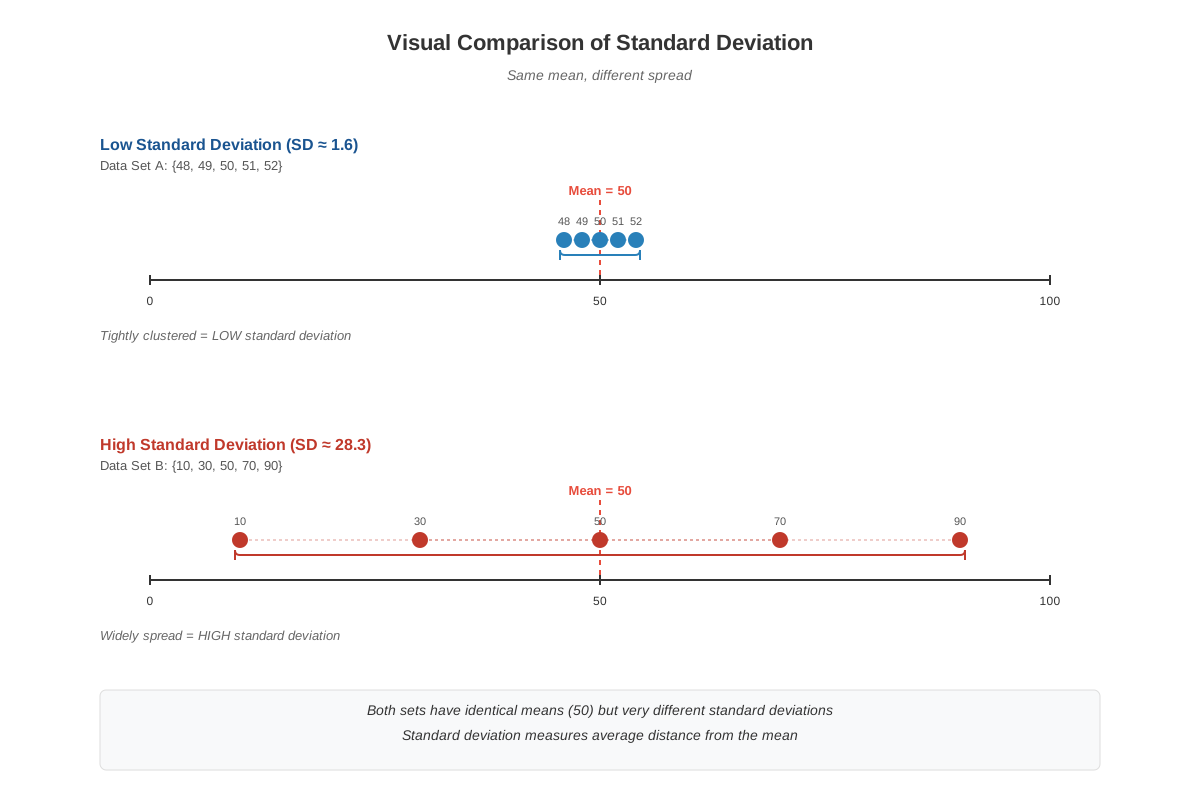
Standard deviation is a statistical measure that quantifies the amount of variation or dispersion in a set of numerical values. Specifically, it measures how far, on average, each data point deviates from the mean of the data set. A low standard deviation indicates that data points tend to cluster closely around the mean, while a high standard deviation indicates that data points are spread out over a wider range of values.
The standard deviation is always a non-negative number and is expressed in the same units as the original data. For example, if measuring test scores (in points), the standard deviation is also in points. If all values in a data set are identical, the standard deviation equals zero because there is no variation whatsoever.
The Standard Deviation Formula
While the GMAT rarely requires full calculation, understanding the formula provides conceptual insight:
σ = √[Σ(xi - μ)² / n]Where:
- σ (sigma) represents the standard deviation
- xi represents each individual value in the data set
- μ (mu) represents the mean of the data set
- n represents the number of values
- Σ (sigma) means "sum of"
The formula reveals that standard deviation involves: (1) finding the difference between each value and the mean, (2) squaring these differences (making all values positive and emphasizing larger deviations), (3) averaging these squared differences, and (4) taking the square root (returning to the original units).
Relationship to Variance
Variance is the square of the standard deviation (σ²). While variance is also a measure of spread, standard deviation is more commonly used because it's in the same units as the original data, making it more interpretable. On the GMAT, understanding this relationship helps when questions involve both concepts: if you know the variance, you can find standard deviation by taking the square root, and vice versa.
Comparing Standard Deviations
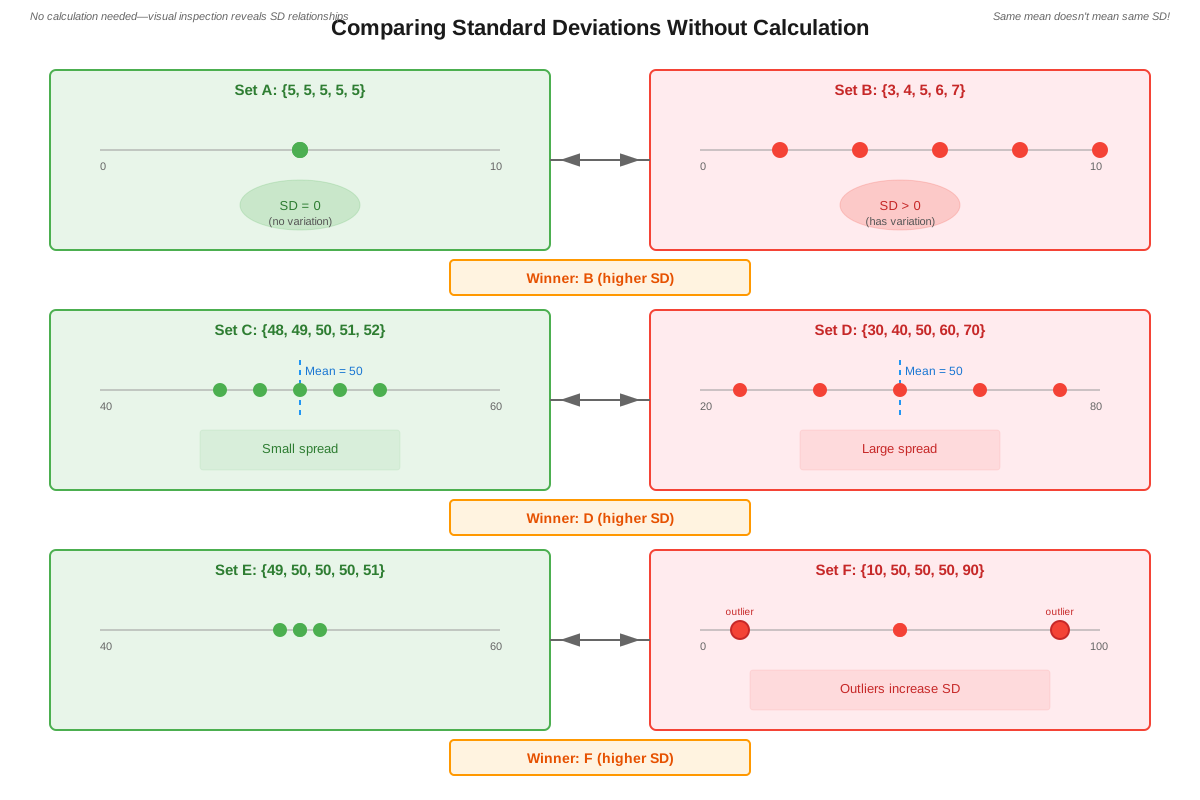
The GMAT frequently tests the ability to compare standard deviations across data sets without calculation. Key principles include:
| Comparison Scenario | Standard Deviation Relationship |
|---|---|
| All values identical | SD = 0 (no variation) |
| Values more spread out | Larger SD |
| Values clustered near mean | Smaller SD |
| Greater range of values | Generally larger SD (but not always) |
| More outliers or extreme values | Larger SD |
Consider two data sets: Set A = {5, 5, 5, 5, 5} and Set B = {1, 3, 5, 7, 9}. Both have a mean of 5, but Set A has zero standard deviation (no variation) while Set B has positive standard deviation because values vary from the mean.
Effects of Data Transformations
Understanding how operations on data affect standard deviation is crucial for GMAT success:
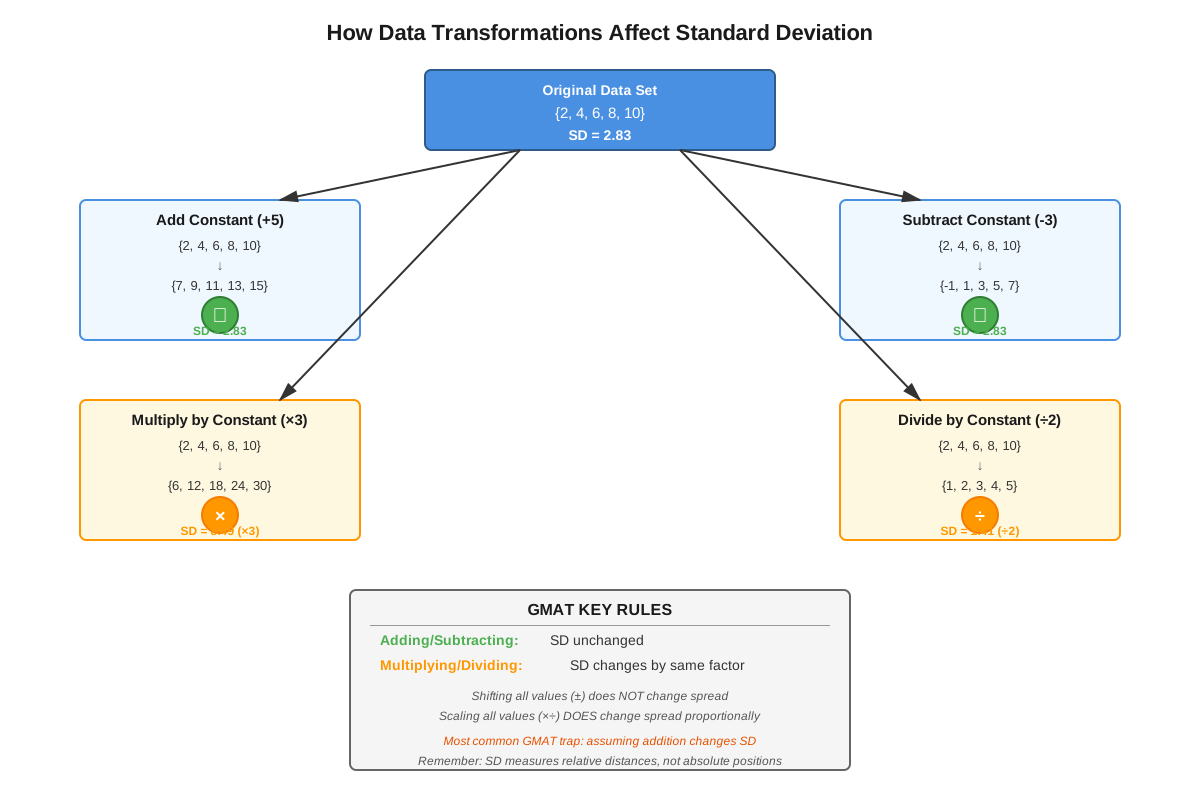
Adding or Subtracting a Constant: When you add or subtract the same number to/from every value in a data set, the standard deviation remains unchanged. This is because you're shifting all values equally without changing the spread. For example, if Set A = {2, 4, 6} has a certain standard deviation, then Set B = {12, 14, 16} (adding 10 to each value) has the exact same standard deviation.
Multiplying or Dividing by a Constant: When you multiply or divide every value by the same positive number, the standard deviation is multiplied or divided by that same number. If Set A = {2, 4, 6} has standard deviation σ, then Set B = {4, 8, 12} (multiplying by 2) has standard deviation 2σ.
Combining Data Sets: When combining two data sets, the standard deviation of the combined set depends on the means and standard deviations of both sets, as well as their sizes. This is complex and rarely tested directly, but understanding that you cannot simply average the two standard deviations is important.
Standard Deviation and the Normal Distribution
While the GMAT doesn't heavily test normal distribution, understanding the connection helps with conceptual questions. In a normal (bell-shaped) distribution:
- Approximately 68% of values fall within one standard deviation of the mean
- Approximately 95% fall within two standard deviations
- Approximately 99.7% fall within three standard deviations
This relationship helps interpret what standard deviation means practically: a larger standard deviation means data is more spread out from the center.
Calculating Standard Deviation: A Simplified Example
For a simple data set {2, 4, 6}:
- Calculate the mean: (2 + 4 + 6) / 3 = 4
- Find each deviation from the mean: (2-4) = -2, (4-4) = 0, (6-4) = 2
- Square each deviation: (-2)² = 4, (0)² = 0, (2)² = 4
- Average the squared deviations: (4 + 0 + 4) / 3 = 8/3
- Take the square root: √(8/3) ≈ 1.63
This process illustrates why standard deviation measures average distance from the mean.
Concept Relationships
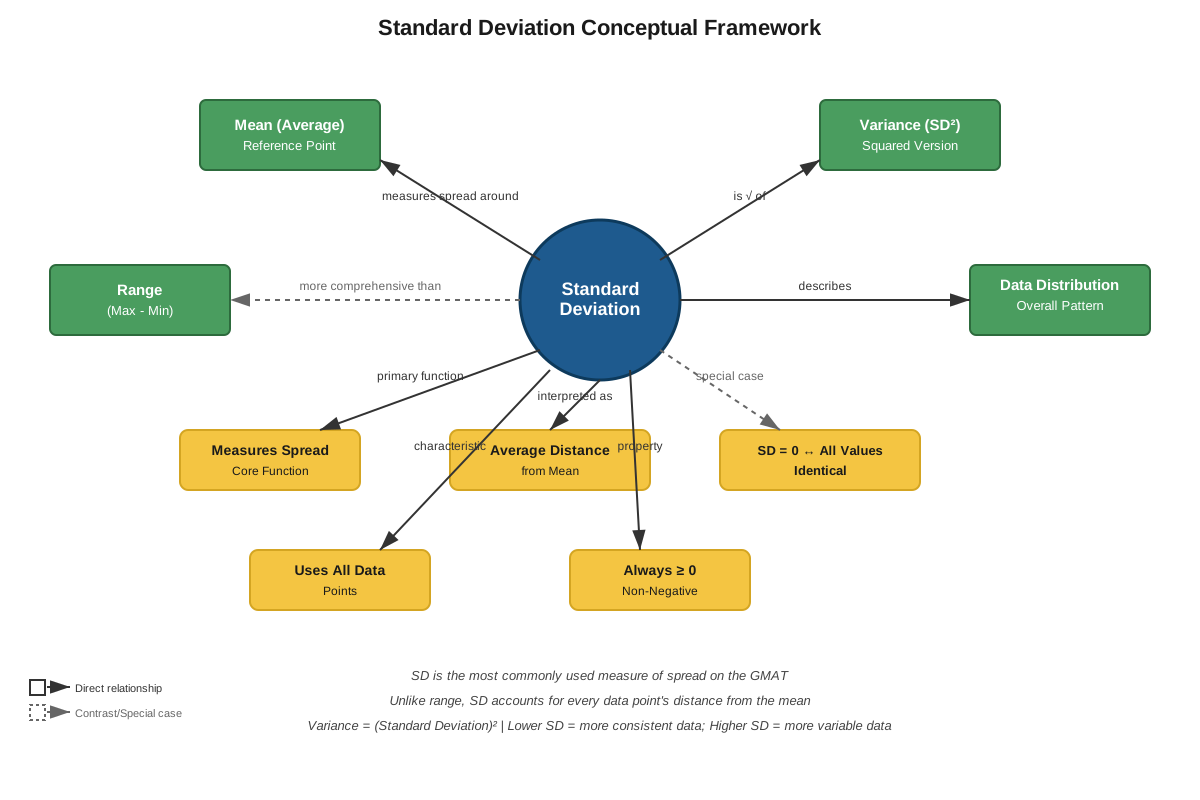
Standard deviation sits at the intersection of several statistical concepts. It fundamentally depends on the mean → without knowing the mean, you cannot calculate standard deviation. The relationship flows: Data Set → Mean Calculation → Deviation Measurement → Standard Deviation.
Standard deviation relates to variance through a simple mathematical transformation: Variance → Square Root → Standard Deviation. This bidirectional relationship means understanding one concept reinforces the other.
When comparing measures of spread, standard deviation connects to range (maximum minus minimum), but they measure different aspects: Range measures total spread between extremes, while Standard Deviation measures average spread from the center. A data set can have a large range but small standard deviation if most values cluster near the mean with only one or two outliers.
The concept also connects to data transformations: Original Data Set → Apply Transformation → New Standard Deviation (following specific rules). Understanding these transformation rules enables quick problem-solving without calculation.
Finally, standard deviation provides context for interpreting individual data points: Data Point + Mean + Standard Deviation → Assessment of Typicality. A value many standard deviations from the mean is unusual, while a value within one standard deviation is typical.
High-Yield Facts
⭐ Standard deviation measures the average distance of data points from the mean, quantifying spread or dispersion
⭐ Adding or subtracting the same constant to every value in a data set does NOT change the standard deviation
⭐ Multiplying or dividing every value by a constant multiplies or divides the standard deviation by that same constant
⭐ Standard deviation equals zero if and only if all values in the data set are identical
⭐ A larger standard deviation indicates greater variability; a smaller standard deviation indicates values cluster more closely around the mean
- Standard deviation is always non-negative (zero or positive, never negative)
- Standard deviation is the square root of variance (σ = √variance)
- Standard deviation is expressed in the same units as the original data
- Two data sets can have the same mean but very different standard deviations
- Range and standard deviation both measure spread but are not interchangeable; range only considers extremes while standard deviation considers all values
- The GMAT rarely requires calculating standard deviation using the full formula; conceptual understanding is key
- In a normal distribution, approximately 68% of values fall within one standard deviation of the mean
- Standard deviation is affected by outliers; extreme values increase standard deviation
- You cannot determine standard deviation from mean and range alone without knowing the actual data distribution
- When comparing data sets, the one with values more spread out from its mean has the larger standard deviation
Quick check — test yourself on Standard deviation so far.
Try Flashcards →Common Misconceptions
Misconception: Standard deviation and range are the same thing or always proportional.
Correction: Range only measures the difference between maximum and minimum values, while standard deviation measures average spread from the mean considering all data points. Two sets with identical ranges can have very different standard deviations depending on how values are distributed.
Misconception: Adding 10 to every value in a data set increases the standard deviation by 10.
Correction: Adding (or subtracting) a constant to every value shifts the entire distribution but does not change the spread. The standard deviation remains exactly the same because the distances between values and their mean are unchanged.
Misconception: A larger data set automatically has a larger standard deviation.
Correction: The number of values in a data set does not determine standard deviation; spread determines it. A set of 100 values clustered tightly around the mean has a smaller standard deviation than a set of 5 values spread far apart.
Misconception: Standard deviation can be negative if values are below the mean.
Correction: Standard deviation is always non-negative because the calculation involves squaring deviations (making them positive) before averaging and taking the square root. Even if all values are negative numbers, the standard deviation is still positive (or zero if all values are identical).
Misconception: If two data sets have the same mean, they must have the same standard deviation.
Correction: Mean and standard deviation measure different properties. Sets {1, 5, 9} and {5, 5, 5} both have mean = 5, but the first has positive standard deviation while the second has standard deviation = 0.
Misconception: You can calculate the standard deviation of a combined data set by averaging the standard deviations of the individual sets.
Correction: Standard deviations do not average linearly. The standard deviation of a combined set depends on the means, standard deviations, and sizes of both sets in a complex way. You cannot simply average them.
Misconception: Multiplying all values by 2 doubles the variance.
Correction: Multiplying all values by 2 doubles the standard deviation but quadruples the variance (since variance = SD²). If original SD = σ, new SD = 2σ, so new variance = (2σ)² = 4σ².
Worked Examples
Example 1: Comparing Standard Deviations
Question: Set A consists of the values {10, 20, 30, 40, 50}. Set B consists of the values {28, 29, 30, 31, 32}. Both sets have the same mean of 30. Which set has the larger standard deviation?
Solution:
Step 1: Understand what we're comparing. Both sets have mean = 30, so we need to determine which has values more spread out from 30.
Step 2: Examine Set A. The values range from 10 to 50, with deviations from the mean of:
- 10 is 20 units below the mean
- 20 is 10 units below the mean
- 30 is 0 units from the mean
- 40 is 10 units above the mean
- 50 is 20 units above the mean
Step 3: Examine Set B. The values range from 28 to 32, with deviations from the mean of:
- 28 is 2 units below the mean
- 29 is 1 unit below the mean
- 30 is 0 units from the mean
- 31 is 1 unit above the mean
- 32 is 2 units above the mean
Step 4: Compare the spreads. Set A has values that deviate by up to 20 units from the mean, while Set B has values that deviate by at most 2 units from the mean.
Answer: Set A has the larger standard deviation because its values are much more spread out from the mean (30) compared to Set B, whose values cluster tightly around the mean.
Connection to Learning Objectives: This example demonstrates identifying and comparing standard deviations conceptually without calculation, applying the principle that greater spread means larger standard deviation.
Example 2: Effect of Data Transformations
Question: A data set has a mean of 50 and a standard deviation of 8. If 15 is added to every value in the data set, and then every resulting value is multiplied by 3, what are the new mean and standard deviation?
Solution:
Step 1: Identify the original parameters.
- Original mean = 50
- Original standard deviation = 8
Step 2: Apply the first transformation (adding 15 to every value).
- When adding a constant to every value, the mean increases by that constant, but standard deviation remains unchanged
- New mean after adding 15: 50 + 15 = 65
- Standard deviation after adding 15: 8 (unchanged)
Step 3: Apply the second transformation (multiplying every value by 3).
- When multiplying every value by a constant, both mean and standard deviation are multiplied by that constant
- New mean after multiplying by 3: 65 × 3 = 195
- New standard deviation after multiplying by 3: 8 × 3 = 24
Step 4: State the final answer.
Answer: The new mean is 195 and the new standard deviation is 24.
Key Insight: This problem tests understanding of transformation rules. Adding/subtracting affects mean but not standard deviation; multiplying/dividing affects both mean and standard deviation proportionally.
Connection to Learning Objectives: This example applies standard deviation concepts to determine how transformations affect the measure, a common GMAT question type that tests conceptual understanding rather than calculation ability.
Exam Strategy
When approaching gmat standard deviation questions, first determine whether the question asks for conceptual understanding or actual calculation. The vast majority of GMAT questions test concepts, not computation. Look for these trigger phrases:
Trigger Words and Phrases:
- "Which data set has greater variability?" → Compare spreads conceptually
- "What is the standard deviation?" → Usually answerable through logic, not calculation
- "If each value is increased by..." → Apply transformation rules
- "Is the standard deviation greater than X?" → Often in Data Sufficiency; consider what information determines SD
- "More/less consistent" → Consistency relates inversely to standard deviation
Process-of-Elimination Tips:
- Eliminate answer choices that violate transformation rules (e.g., if a constant is added, eliminate choices showing changed SD)
- For comparison questions, eliminate choices that contradict visual spread (if one set is obviously more spread out, it must have larger SD)
- In Data Sufficiency, eliminate statements that provide only mean or range without distribution information
- Eliminate negative values immediately—standard deviation cannot be negative
Time Allocation:
- Conceptual questions: 1-1.5 minutes (quick application of rules)
- Data Sufficiency with standard deviation: 2 minutes (requires careful analysis of what information is sufficient)
- Complex transformation questions: 2 minutes (multiple steps but no heavy calculation)
Approach Framework:
- Identify what the question asks (comparison, transformation, calculation, sufficiency)
- Recall relevant rules (transformation effects, relationship to spread)
- Apply rules systematically
- Verify answer makes intuitive sense (larger spread = larger SD)
Exam Tip: If a question seems to require extensive calculation of standard deviation using the formula, you're likely missing a conceptual shortcut. Step back and look for patterns or transformation rules.
Memory Techniques
Mnemonic for Transformation Rules - "ASMD":
- Add/Subtract: Standard deviation Stays the same
- Multiply/Divide: Standard deviation Moves (changes by the same factor)
Visualization Strategy:
Picture data points as dots on a number line with the mean as a central flag. Standard deviation represents how far, on average, the dots are from the flag. If you slide all dots left or right together (adding/subtracting), the flag moves too, but distances stay the same. If you stretch or compress the line (multiplying/dividing), distances change proportionally.
Acronym for Standard Deviation Properties - "SPREAD":
- Square root of variance
- Positive or zero (never negative)
- Remains unchanged when adding/subtracting constants
- Equals zero when all values identical
- Affected by multiplication/division
- Distance from mean (average)
Memory Hook for Zero Standard Deviation:
"No variety, no deviation" - If all values are the same (no variety), standard deviation is zero.
Conceptual Anchor:
Think of standard deviation as measuring "consistency." Low SD = high consistency (values similar to each other). High SD = low consistency (values vary widely). This helps with business context questions about performance consistency, quality control, etc.
Summary
Standard deviation is a fundamental statistical measure that quantifies the spread or dispersion of data around the mean. On the GMAT, success with standard deviation questions depends primarily on conceptual understanding rather than computational ability. The key principles include recognizing that standard deviation measures average distance from the mean, understanding that adding or subtracting constants leaves standard deviation unchanged while multiplying or dividing changes it proportionally, and being able to compare standard deviations across data sets by assessing relative spread. Standard deviation equals zero only when all values are identical, and it is always non-negative. The measure connects closely to variance (standard deviation is the square root of variance) and provides crucial context for interpreting data variability in business and statistical contexts. GMAT questions typically test whether students can identify which data set has greater variability, determine how transformations affect standard deviation, or assess whether given information is sufficient to calculate or compare standard deviations. Mastering these concepts enables quick, confident responses to this high-yield topic.
Key Takeaways
- Standard deviation measures the average distance of data points from the mean, quantifying how spread out values are
- Adding or subtracting a constant to all values does NOT change standard deviation; multiplying or dividing DOES change it proportionally
- Standard deviation equals zero if and only if all values in the data set are identical (no variation)
- Greater spread from the mean always means larger standard deviation; values clustered near the mean mean smaller standard deviation
- The GMAT tests conceptual understanding of standard deviation far more than computational ability—focus on transformation rules and comparative reasoning
- Standard deviation is always non-negative and is expressed in the same units as the original data
- Two data sets can have identical means but vastly different standard deviations depending on how values are distributed
Related Topics
Variance: The square of standard deviation, variance is another measure of spread that appears occasionally on the GMAT. Mastering standard deviation makes understanding variance straightforward since they measure the same property in different units.
Mean, Median, and Mode: These measures of central tendency complement standard deviation (a measure of spread). Together, they provide a complete picture of data distribution, and GMAT questions often integrate these concepts.
Range and Interquartile Range: Other measures of spread that compare and contrast with standard deviation. Understanding the differences helps with questions asking about data variability.
Normal Distribution: Standard deviation plays a crucial role in describing normal distributions, where specific percentages of data fall within one, two, or three standard deviations of the mean.
Data Interpretation: Standard deviation is essential for analyzing charts, graphs, and tables that present statistical information, a common GMAT question type in both Quantitative and Integrated Reasoning sections.
Practice CTA
Now that you've mastered the conceptual foundations of standard deviation, it's time to reinforce your learning through active practice. Attempt the practice questions to apply transformation rules, compare data sets, and tackle Data Sufficiency scenarios. Use the flashcards to drill the high-yield facts and transformation rules until they become automatic. Remember, standard deviation questions are highly predictable on the GMAT—consistent practice with these concepts will translate directly into points on test day. You've built the foundation; now solidify it through application!
Sign up free to keep reading
Create a free AnvayaPrep account to finish this GMAT guide on Standard deviation — plus flashcards and practice questions.