Overview
Multi-source calculations represent a critical component of the GMAT Data Insights section, requiring test-takers to synthesize quantitative information from multiple tabs, tables, charts, and text passages to perform accurate computations. Unlike traditional problem-solving questions that present all necessary information in a single location, GMAT multi-source calculations demand that students navigate between different data sources, identify relevant information, reconcile potentially conflicting data, and execute mathematical operations that draw from these disparate sources. This question type tests not only computational ability but also information management, critical reading, and analytical reasoning skills.
The importance of multi-source calculations on the GMAT cannot be overstated. These questions typically appear in the Multi-Source Reasoning format, where students encounter 2-3 tabs of information (text, tables, graphs, or emails) followed by several questions that require integrating data across these sources. The calculations themselves may range from basic arithmetic to more complex percentage changes, ratios, weighted averages, or compound growth calculations. What distinguishes these problems is the cognitive load of managing multiple information streams simultaneously while maintaining accuracy in mathematical execution.
Within the broader Data Insights framework, multi-source calculations bridge several competencies: they require the data interpretation skills tested in Table Analysis and Graphics Interpretation questions, the logical reasoning demanded by Two-Part Analysis, and the quantitative proficiency essential to Quantitative Reasoning. Mastering this topic builds a foundation for handling the integrated reasoning challenges that mirror real-world business scenarios, where decision-makers must synthesize information from financial statements, market research reports, operational data, and strategic communications to make informed calculations and projections.
Learning Objectives
- [ ] Identify Multi-source calculations in GMAT Data Insights questions
- [ ] Explain the structure and requirements of Multi-source calculations
- [ ] Apply Multi-source calculations to GMAT questions with accuracy and efficiency
- [ ] Navigate efficiently between multiple data sources to locate relevant information
- [ ] Reconcile apparent discrepancies or complementary data across different sources
- [ ] Execute multi-step calculations that require synthesizing information from 2+ sources
- [ ] Verify calculation results against contextual constraints provided across multiple tabs
Prerequisites
- Basic arithmetic operations: Essential for executing the actual calculations once relevant data is identified
- Percentage calculations and conversions: Many multi-source problems involve percentage changes, growth rates, or proportional relationships
- Reading comprehension skills: Understanding context from text passages is crucial for interpreting numerical data correctly
- Table and graph interpretation: Students must extract accurate values from various data visualization formats
- Unit conversion and dimensional analysis: Different sources may present data in different units requiring conversion
Why This Topic Matters
Multi-source calculations reflect authentic business and analytical scenarios where professionals must integrate information from multiple reports, databases, and communications to make quantitative decisions. In corporate environments, analysts regularly combine data from financial statements, market research, operational metrics, and strategic plans—exactly the skill set tested by these GMAT questions. This real-world applicability makes the topic particularly valuable for business school preparation, as it mirrors case study analysis and data-driven decision-making central to MBA curricula.
From an exam perspective, multi-source calculations appear with high frequency in the Data Insights section, typically comprising 15-20% of the questions in this portion of the GMAT. These questions often carry significant weight because they test multiple competencies simultaneously: reading comprehension, data interpretation, quantitative reasoning, and attention to detail. The GMAT presents these questions in sets, with 2-4 questions following a single multi-source prompt, making efficient navigation and accurate initial data extraction particularly valuable for time management.
Common manifestations include business scenarios with financial data across multiple years (requiring year-over-year calculations), market analysis with demographic breakdowns in different formats, operational scenarios with cost and revenue data in separate sources, and strategic planning situations where assumptions in text must be applied to numerical data in tables. The exam frequently tests whether students can identify which source contains the relevant information, extract accurate values, recognize when data from multiple sources must be combined, and execute calculations without computational errors under time pressure.
Core Concepts
Structure of Multi-Source Reasoning Questions
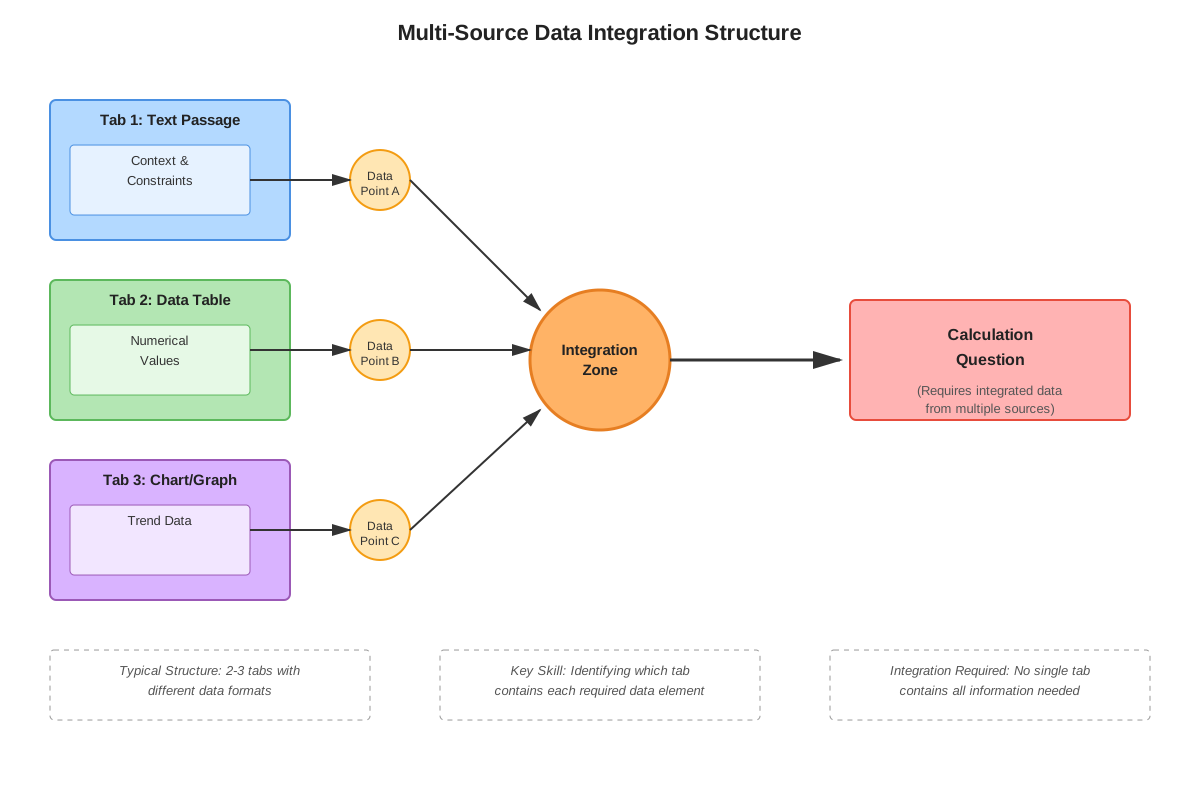
Multi-source calculations appear within the Multi-Source Reasoning format, which presents information across 2-3 tabbed pages. Each tab may contain different types of information: prose passages describing context or assumptions, tables with numerical data, charts or graphs displaying trends, emails or memos providing additional details, or mixed formats combining text and data. The questions following these tabs require students to reference specific sources, often necessitating multiple tab switches during problem-solving.
The typical structure includes:
- An introductory screen explaining the scenario
- Multiple tabs labeled with descriptive titles (e.g., "Financial Data," "Market Research," "Email from CFO")
- A series of questions that may be multiple-choice, yes/no/cannot determine, or other Data Insights formats
- Questions specifically requiring calculations based on data from two or more tabs
Information Integration Strategies
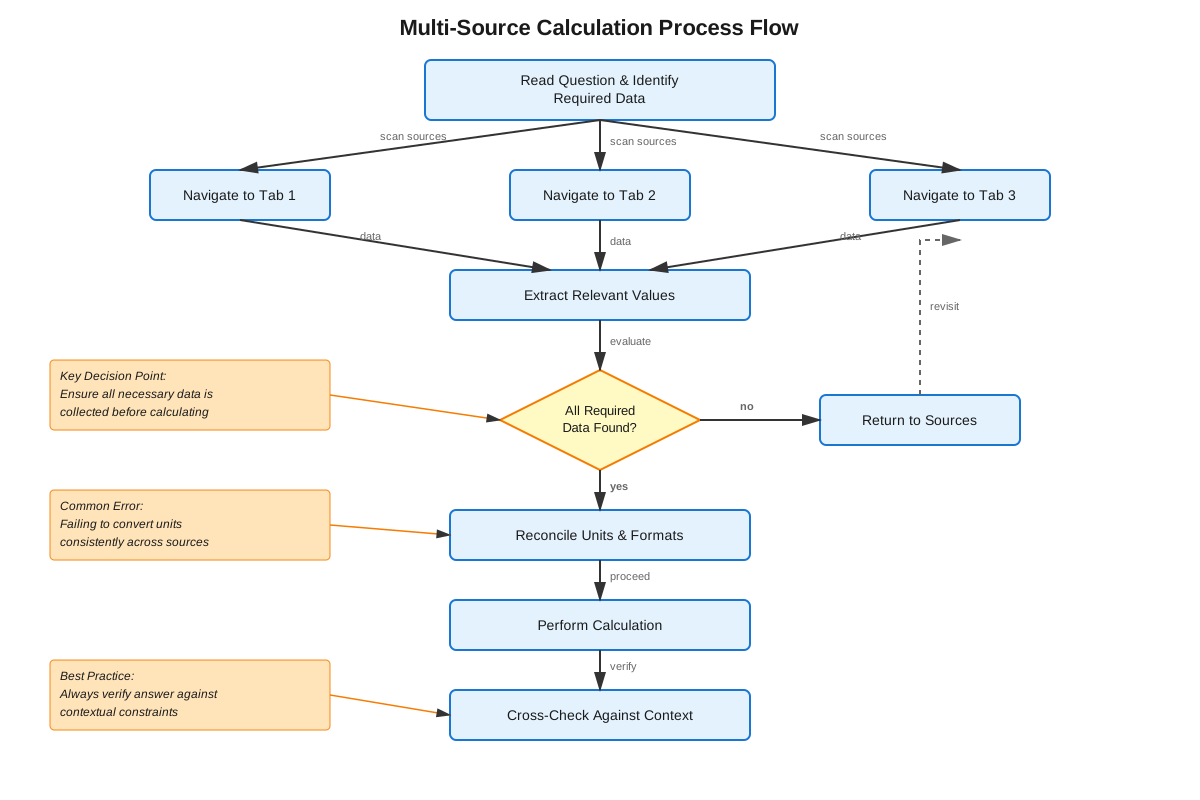
Successful multi-source calculations depend on systematic information integration. This process involves four key phases:
Phase 1: Orientation - Quickly scan all tabs to understand what type of information each contains and create a mental map of data location. Note which tabs contain numerical data versus contextual information.
Phase 2: Question Analysis - Carefully read the question to identify exactly what calculation is required and which variables or data points are needed. Determine whether the question requires data from a single source or multiple sources.
Phase 3: Data Extraction - Navigate to the relevant tab(s) and locate the specific values needed. Pay attention to units, time periods, categories, and any footnotes or qualifications that might affect the data.
Phase 4: Calculation and Verification - Perform the required computation, then verify the result makes sense given the context provided across all sources. Check whether the answer aligns with any constraints or expectations mentioned in the text passages.
Types of Calculations Across Sources
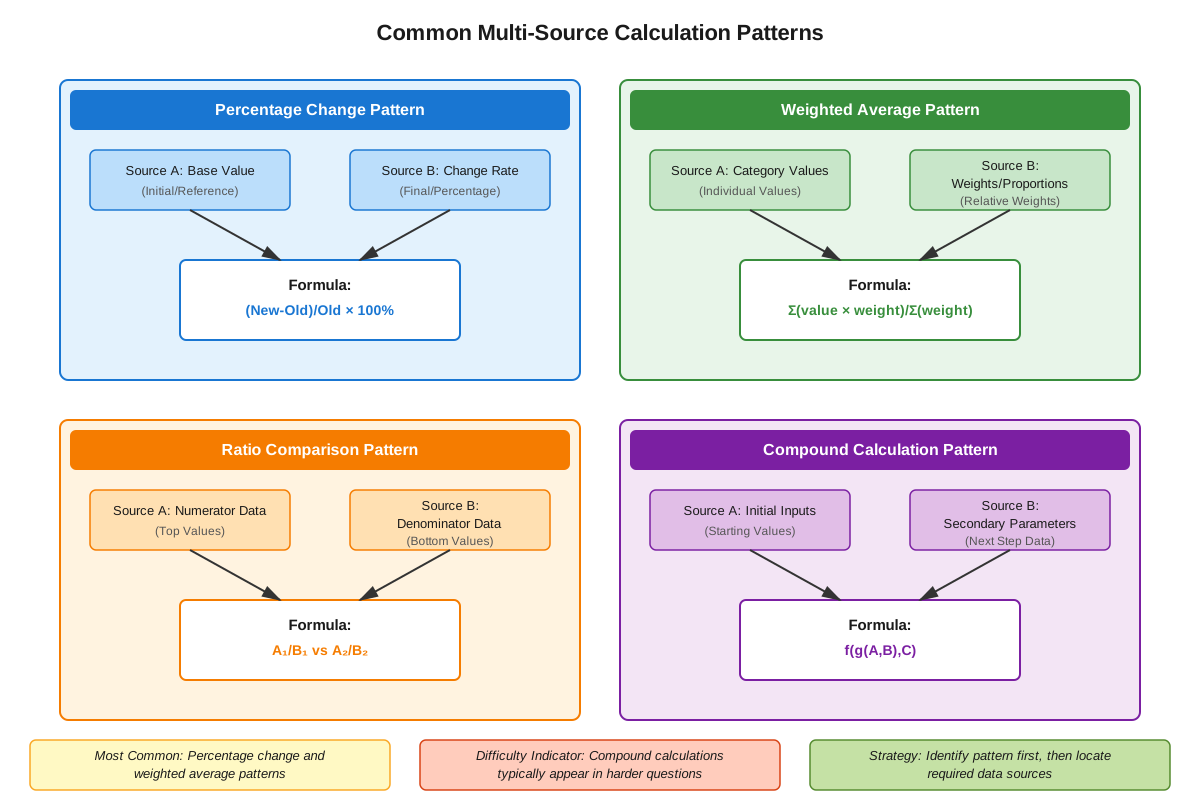
Multi-source calculations on the GMAT typically fall into several categories:
| Calculation Type | Description | Common Sources Required |
|---|---|---|
| Comparative Analysis | Calculating differences, ratios, or percentage changes between values from different sources | Two data tables or a table and a graph |
| Weighted Calculations | Computing weighted averages or totals where weights come from one source and values from another | Text passage (weights/proportions) + data table (values) |
| Conditional Calculations | Applying conditions or assumptions stated in one source to data in another | Email/memo (conditions) + financial table (data) |
| Multi-step Synthesis | Performing sequential calculations where intermediate results from one source feed into calculations using another source | Multiple tables or table + text with formulas |
| Reconciliation | Identifying or resolving apparent discrepancies between sources | Two or more sources with overlapping information |
Data Source Navigation Efficiency
Time management in multi-source calculations requires efficient navigation protocols. Rather than randomly switching between tabs, successful test-takers develop systematic approaches:
- Tab labeling strategy: Mentally or physically note what each tab contains during initial orientation
- Minimize switching: When a question requires multiple data points from the same tab, extract all needed information in a single visit
- Pattern recognition: Identify which types of questions typically require which combinations of sources
- Contextual anchoring: Use text passages to understand the framework before diving into numerical data
Common Calculation Operations
The actual mathematical operations in multi-source calculations typically include:
- Percentage calculations: Finding percentage increases/decreases, calculating percentages of totals, or converting between percentages and absolute values
- Ratio and proportion: Determining ratios between values from different sources or applying proportional relationships
- Aggregation: Summing or averaging values that appear in different locations
- Rate calculations: Computing rates (speed, productivity, growth) using distance/quantity from one source and time from another
- Algebraic manipulation: Setting up and solving equations where different variables come from different sources
Accuracy Maintenance Across Sources
Accuracy maintenance becomes challenging when working with multiple sources because:
- Different sources may use different units (thousands vs. millions, percentages vs. decimals)
- Time periods may vary across sources (quarterly vs. annual data)
- Categories may be defined differently in different sources
- Rounding conventions may differ between sources
Successful test-takers develop verification habits:
- Always check units before calculating
- Verify that time periods align or adjust accordingly
- Confirm that categories being compared are truly equivalent
- Look for footnotes or qualifications that might affect interpretation
Concept Relationships
Multi-source calculations build directly upon foundational data interpretation skills. The relationship flows as follows:
Basic Data Interpretation → enables → Single-Source Calculations → expands to → Multi-Source Data Location → combines with → Cross-Source Integration → culminates in → Multi-Source Calculations
Within the topic itself, the core concepts are interconnected: Structure Understanding provides the framework for Information Integration Strategies, which guide Data Source Navigation Efficiency. These navigation skills enable accurate Data Extraction, which must be combined with Accuracy Maintenance protocols to execute the various Types of Calculations Across Sources successfully.
The topic also connects forward to more advanced Data Insights skills. Mastering multi-source calculations prepares students for complex scenario analysis, where they must not only calculate but also evaluate implications, make predictions, or assess the sufficiency of information—all while managing multiple data streams. The skills developed here transfer directly to business school case studies and professional analytical work.
High-Yield Facts
⭐ Multi-source calculations always require information from at least two different tabs or data sources to complete the computation.
⭐ The most common error in multi-source calculations is using data from the wrong time period or category when sources contain similar but distinct information.
⭐ Questions explicitly stating "according to the information in both the table and the email" signal that both sources contain essential data for the calculation.
⭐ When sources present data in different units (e.g., thousands vs. millions), unit conversion is always required before calculation.
⭐ Approximately 60% of multi-source calculation questions require a two-step process: first extracting data from multiple sources, then performing the actual computation.
- Text passages in multi-source sets often contain assumptions, conditions, or formulas that must be applied to numerical data in other tabs.
- The GMAT frequently places distracting information in sources—data that appears relevant but isn't needed for the specific calculation requested.
- Multi-source calculations may require reconciling data presented in different formats (e.g., a percentage in text and an absolute value in a table).
- Questions asking for "the difference between" or "the ratio of" values almost always require data from separate sources.
- Time-based calculations (growth rates, year-over-year changes) typically require extracting values from different rows or columns representing different time periods.
- When a calculation seems impossible with the given data, check whether a formula or conversion factor is provided in a text passage on another tab.
- Multi-source questions often test whether students can identify when data from one source makes data from another source unnecessary or redundant.
Quick check — test yourself on Multi-source calculations so far.
Try Flashcards →Common Misconceptions
Misconception: All necessary information for a calculation will be in the same tab or source.
Correction: Multi-source calculations by definition require integrating information from multiple tabs. Always check whether the question references multiple sources or whether the calculation logically requires data that wouldn't all appear in one location.
Misconception: The first number encountered that matches the question's description is the correct value to use.
Correction: Multiple sources often contain similar-looking data for different categories, time periods, or conditions. Always verify that the specific value extracted matches all qualifications mentioned in the question (correct year, correct product category, correct region, etc.).
Misconception: If two sources provide data on the same topic, they must be presenting the same information in different formats.
Correction: Different sources may present complementary rather than redundant information. For example, one source might show revenue while another shows costs, or one might show totals while another shows breakdowns by category. Both may be needed for the calculation.
Misconception: Text passages are just context and don't contain information needed for calculations.
Correction: Text passages frequently contain critical quantitative information such as growth rates, assumptions, formulas, conversion factors, or conditions that must be applied to data in tables or graphs. Always read text passages carefully for numerical information or calculation instructions.
Misconception: The calculation itself will be complex and time-consuming.
Correction: The challenge in multi-source calculations is typically information management rather than computational complexity. Once the correct data is identified and extracted, the actual calculation is usually straightforward arithmetic. The GMAT tests reasoning and integration skills more than advanced mathematical operations.
Misconception: All tabs must be used to answer each question.
Correction: While multi-source calculations require multiple sources, not every question uses every tab. Some questions may only need two of three available sources. Part of the skill is identifying which sources are relevant to each specific question.
Worked Examples
Example 1: Revenue Growth Calculation
Scenario: A multi-source reasoning set presents three tabs:
- Tab 1 (Company Overview): Text describing that TechCorp operates in three regions: North America, Europe, and Asia. The text states that Asia revenue grew by 15% from 2022 to 2023.
- Tab 2 (2022 Financial Data): Table showing 2022 revenues: North America $450M, Europe $320M, Asia $280M
- Tab 3 (2023 Financial Data): Table showing 2023 revenues: North America $475M, Europe $340M, Asia [value not shown]
Question: What was TechCorp's total revenue in 2023, in millions of dollars?
Solution Process:
Step 1 - Analyze the question: We need total 2023 revenue, which requires summing all three regional revenues for 2023.
Step 2 - Identify required data sources:
- Tab 3 provides two of the three 2023 values directly (North America and Europe)
- Tab 3 does not show Asia 2023 revenue
- Tab 1 provides the growth rate for Asia (15%)
- Tab 2 provides the 2022 Asia revenue base
Step 3 - Calculate missing Asia 2023 revenue:
- 2022 Asia revenue: $280M (from Tab 2)
- Growth rate: 15% (from Tab 1)
- 2023 Asia revenue = $280M × (1 + 0.15) = $280M × 1.15 = $322M
Step 4 - Calculate total 2023 revenue:
- North America: $475M (from Tab 3)
- Europe: $340M (from Tab 3)
- Asia: $322M (calculated)
- Total = $475M + $340M + $322M = $1,137M
Answer: $1,137 million
Key Learning Points: This example demonstrates the classic multi-source calculation pattern where one value must be calculated using information from two sources (growth rate from text, base value from a table) before completing the final calculation using a third source (other regional values from a different table).
Example 2: Weighted Average Across Sources
Scenario: A multi-source reasoning set presents:
- Tab 1 (Product Mix): Email from sales director stating: "Our revenue breakdown is 40% Product A, 35% Product B, and 25% Product C."
- Tab 2 (Profit Margins): Table showing profit margins: Product A 22%, Product B 18%, Product C 28%
Question: What is the company's overall profit margin based on the current product mix?
Solution Process:
Step 1 - Recognize calculation type: This is a weighted average calculation where weights (revenue proportions) come from Tab 1 and values (profit margins) come from Tab 2.
Step 2 - Extract weights from Tab 1:
- Product A: 40% of revenue (weight = 0.40)
- Product B: 35% of revenue (weight = 0.35)
- Product C: 25% of revenue (weight = 0.25)
Step 3 - Extract values from Tab 2:
- Product A margin: 22%
- Product B margin: 18%
- Product C margin: 28%
Step 4 - Calculate weighted average:
Overall margin = (0.40 × 22%) + (0.35 × 18%) + (0.25 × 28%)
= 8.8% + 6.3% + 7.0%
= 22.1%
Step 5 - Verify reasonableness: The result (22.1%) falls between the lowest margin (18%) and highest margin (28%), and is closer to Product A's margin (22%) since Product A has the highest weight. This confirms the calculation is reasonable.
Answer: 22.1%
Key Learning Points: This example illustrates how multi-source calculations often require applying a framework or formula from one source (the weighted average concept implied by "based on the current product mix") to data distributed across multiple sources. The weights and values are deliberately separated to test information integration skills.
Exam Strategy
When approaching multi-source calculations on the GMAT, implement this systematic strategy:
Initial Orientation (30-45 seconds): Before reading any questions, quickly scan all tabs to create a mental inventory. Note which tabs contain primarily text versus data, and what general topics each covers. This investment prevents repeated re-orientation during questions.
Question-First Approach: Read the question completely before diving into sources. Identify exactly what is being asked and what type of calculation is required. This focus prevents getting lost in irrelevant data.
Trigger Word Recognition: Watch for phrases that signal multi-source requirements:
- "According to both..." or "Using information from the table and the email..."
- "Based on the assumptions described in..." (signals text passage contains calculation parameters)
- "What is the difference between..." (often requires values from different sources)
- "If the growth rate mentioned..." (signals a rate from one source applied to data from another)
Systematic Data Extraction: When you identify a needed value, note not just the number but its context (year, category, unit). Write down extracted values with labels to prevent confusion when switching between sources.
Unit Verification Protocol: Before calculating, verify that all values use compatible units. If one source shows values in thousands and another in millions, convert before computing. This single check prevents the majority of calculation errors.
Process of Elimination for Multi-Source Questions:
- Eliminate answers that would be impossible given constraints mentioned in text passages
- Eliminate answers that fall outside the range of values shown in the data sources
- If a calculation requires data from Source A and Source B, eliminate answers that could be obtained using only Source A or only Source B
Time Allocation: Allocate approximately 2.5-3 minutes per multi-source calculation question. If a question requires more than 3 minutes, flag it and move on—these questions appear in sets, so you'll have context when you return.
Verification Shortcut: After calculating, quickly check whether your answer makes logical sense given the business context. If the question asks for profit and your answer exceeds revenue, you've made an error.
Memory Techniques
MIDAS Mnemonic for multi-source calculation approach:
- Map all sources (initial orientation)
- Identify what the question asks
- Determine which sources are needed
- Acquire data from each source
- Synthesize and calculate
The "Two-Tab Rule": Remember that if you can answer a multi-source calculation using only one tab, you've likely missed something. This mental check helps catch errors where students overlook a necessary second source.
Unit Conversion Visualization: Picture a "unit bridge" connecting different sources. Before crossing the bridge (performing the calculation), ensure all travelers (data points) are wearing the same uniform (using the same units).
The "Context-Data Sandwich": Visualize text passages as the bread and data tables as the filling. Just as you need both bread slices and filling for a complete sandwich, you often need both context (from text) and numbers (from tables) for a complete calculation.
STAR Method for Source Navigation:
- Scan question for source clues
- Tab to the first relevant source
- Acquire needed data
- Repeat for additional sources
Summary
Multi-source calculations represent a sophisticated integration of quantitative reasoning and information management skills essential for GMAT Data Insights success. These questions require test-takers to navigate between multiple tabs containing text passages, tables, graphs, and other data formats, extracting relevant information from each source and synthesizing it into accurate calculations. The primary challenge lies not in computational complexity but in managing cognitive load while maintaining accuracy across disparate information streams. Success requires systematic orientation to understand what each source contains, careful question analysis to identify which sources are needed, meticulous attention to units and categories when extracting data, and disciplined verification to ensure calculations align with contextual constraints. The most common pitfalls include using data from incorrect time periods or categories, failing to convert units when sources use different scales, and overlooking critical assumptions or formulas embedded in text passages. By developing efficient navigation protocols, implementing systematic data extraction procedures, and maintaining awareness of the multi-source nature of these questions, students can transform what initially appears as information overload into a manageable, methodical problem-solving process that consistently yields correct answers.
Key Takeaways
- Multi-source calculations always require integrating information from at least two different tabs or sources—if you can answer using one source, verify you haven't missed something
- The primary challenge is information management and integration, not mathematical complexity; the actual calculations are typically straightforward once correct data is identified
- Always verify units, time periods, and categories match across sources before performing calculations; unit mismatches are the most common source of errors
- Text passages frequently contain essential quantitative information (growth rates, assumptions, formulas) that must be applied to numerical data in tables or graphs
- Systematic orientation to all sources before attempting questions saves time and reduces cognitive load during problem-solving
- Watch for trigger phrases like "according to both," "using information from," or "based on the assumptions described in" that explicitly signal multi-source requirements
- Verification should check both mathematical accuracy and logical consistency with the business context provided across all sources
Related Topics
Table Analysis: Builds the foundation for extracting accurate data from complex tables, a skill essential when tables appear as one of multiple sources in multi-source calculations. Mastering table analysis improves speed and accuracy in the data extraction phase.
Graphics Interpretation: Develops skills for reading charts and graphs that often appear as one source in multi-source sets. Understanding how to extract precise values from visual representations enables efficient data gathering.
Two-Part Analysis: Shares the multi-dimensional reasoning required for multi-source calculations, as both question types require considering multiple variables or constraints simultaneously. The logical framework developed in two-part analysis transfers to identifying which sources contain which needed information.
Quantitative Reasoning - Percentages and Ratios: Provides the computational foundation for the most common calculation types in multi-source questions. Strengthening these fundamental skills increases calculation speed and accuracy.
Reading Comprehension - Business Passages: Enhances the ability to quickly extract key information from text passages, which often contain critical assumptions or parameters for multi-source calculations. Improved reading efficiency directly impacts multi-source performance.
Practice CTA
Now that you've mastered the concepts and strategies for multi-source calculations, it's time to put your knowledge into action. Attempt the practice questions designed specifically for this topic, focusing on implementing the systematic approach outlined in this guide. Use the flashcards to reinforce high-yield facts and common patterns. Remember, multi-source calculations reward methodical preparation—each practice question you complete strengthens your information integration skills and builds the confidence needed to excel on test day. Your ability to synthesize information from multiple sources is not just a GMAT skill; it's a fundamental business competency that will serve you throughout your MBA and professional career.
Sign up free to keep reading
Create a free AnvayaPrep account to finish this GMAT guide on Multi-source calculations — plus flashcards and practice questions.