Overview
Ratios in tables represent one of the most frequently tested concepts in the GMAT Data Insights section, particularly within Table Analysis questions. This topic requires students to extract numerical information from tabular data and establish proportional relationships between different categories, rows, or columns. Unlike simple arithmetic calculations, ratio problems in tables demand careful attention to what is being compared, proper unit alignment, and the ability to manipulate proportions to answer complex multi-step questions.
The GMAT consistently tests GMAT ratios in tables because this skill mirrors real-world business scenarios where executives must analyze financial statements, compare departmental performance metrics, or evaluate market share data presented in tabular format. Students who master this topic gain a significant advantage on the exam, as ratio questions often appear in combination with other analytical skills such as percentage calculations, rate comparisons, and trend analysis. The ability to quickly identify the relevant data points, set up correct ratio relationships, and perform accurate calculations under time pressure separates high scorers from average performers.
Within the broader Data Insights framework, ratios in tables serve as a foundational skill that connects to multiple question types including Multi-Source Reasoning, Graphics Interpretation, and Two-Part Analysis. Understanding how to work with ratios in tabular format enables students to tackle more complex problems involving compound ratios, proportional reasoning across multiple variables, and comparative analysis of large datasets. This topic builds upon basic ratio concepts while adding the complexity of data extraction and interpretation from structured tables.
Learning Objectives
- [ ] Identify ratios in tables by locating relevant data points and determining appropriate comparison relationships
- [ ] Explain ratios in tables by articulating the relationship between compared quantities and their units
- [ ] Apply ratios in tables to GMAT questions by solving multi-step problems involving proportional reasoning
- [ ] Distinguish between part-to-part and part-to-whole ratios within tabular data
- [ ] Convert between different ratio representations (simplified form, fraction form, percentage form) using table data
- [ ] Synthesize information from multiple rows or columns to establish complex ratio relationships
- [ ] Evaluate the validity of ratio-based conclusions drawn from incomplete or ambiguous table data
Prerequisites
- Basic ratio concepts: Understanding the fundamental definition of ratios as comparisons between quantities is essential for recognizing these relationships in table format
- Fraction operations: Ability to simplify, multiply, and divide fractions enables manipulation of ratio expressions derived from table data
- Table reading skills: Familiarity with interpreting rows, columns, headers, and cell values ensures accurate data extraction
- Unit awareness: Recognition of measurement units and their conversions prevents errors when establishing proportional relationships
- Basic algebra: Comfort with variables and solving simple equations facilitates setting up and solving ratio problems from tables
Why This Topic Matters
In real-world business contexts, professionals constantly analyze tabular data to make strategic decisions. Financial analysts compare revenue ratios across quarters, marketing managers evaluate customer acquisition costs relative to lifetime value, and operations directors assess productivity ratios between departments. The GMAT tests ratios in tables because this skill directly translates to the analytical demands of graduate business education and professional management roles.
From an exam perspective, ratio questions appear in approximately 15-20% of Data Insights questions, making this a high-frequency topic that significantly impacts overall scores. Table Analysis questions specifically feature ratios in roughly 40% of cases, often combined with sorting functionality that requires students to identify ratio relationships before manipulating the table. The GMAT favors this topic because it efficiently tests multiple competencies simultaneously: data extraction, numerical reasoning, proportional thinking, and attention to detail.
Common question formats include: comparing ratios across different categories within a table, determining which row or column exhibits the highest or lowest ratio, calculating missing values based on given ratios, and evaluating true/false statements about ratio relationships. Questions frequently require students to work with ratios involving totals, subtotals, and individual categories, testing the ability to distinguish between part-to-part and part-to-whole relationships. The exam also tests ratio concepts through questions asking students to identify equivalent ratios, scale proportions up or down, or determine the impact of changing one variable on a ratio relationship.
Core Concepts
Understanding Ratios in Tabular Context
Ratios in tables represent the quantitative relationship between two or more values extracted from cells within a structured data display. Unlike standalone ratio problems, table-based ratios require an additional step of data identification and extraction before establishing the proportional relationship. The fundamental principle remains comparing one quantity to another, but the complexity increases because students must navigate headers, row labels, column labels, and potentially multiple data categories.
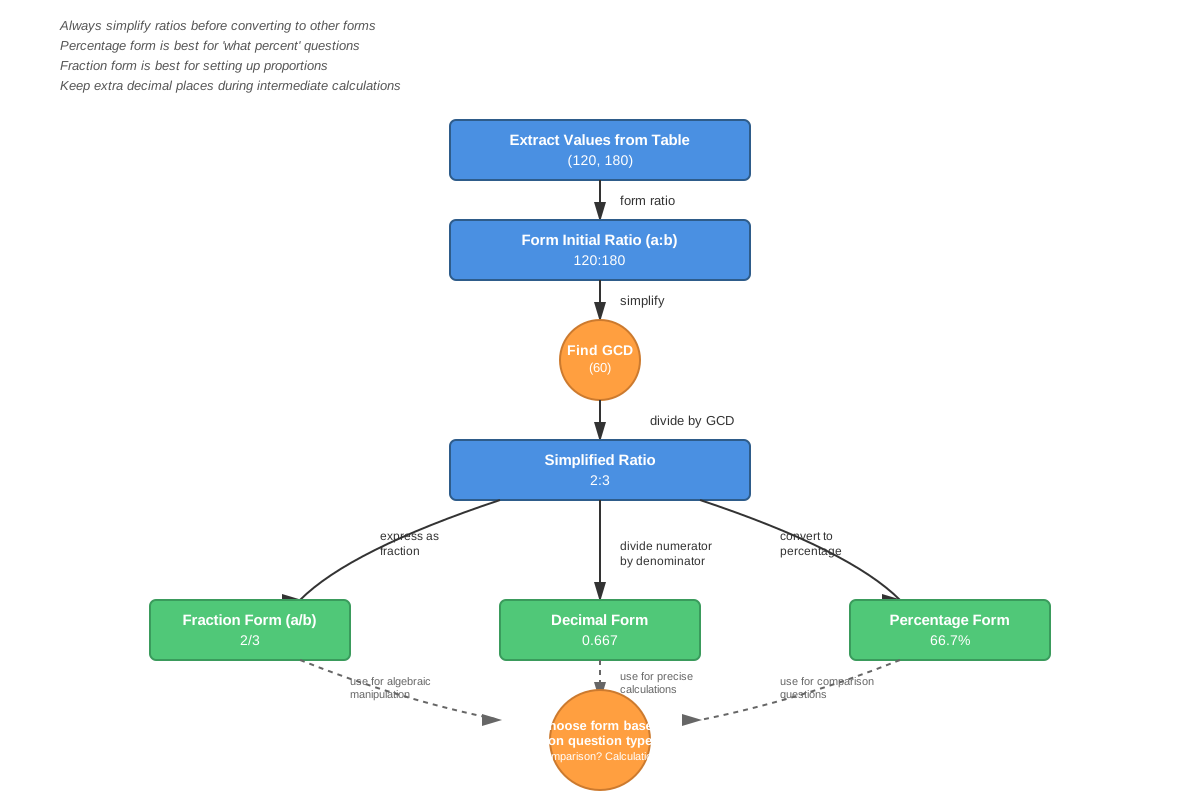
A ratio can be expressed in several forms: as a fraction (3/4), using colon notation (3:4), in simplified form (3 to 4), or as a decimal (0.75). When working with tables, maintaining awareness of which form best serves the problem-solving process is crucial. For instance, when comparing multiple ratios from different rows, converting all ratios to decimal form often facilitates quick comparison.
Part-to-Part vs. Part-to-Whole Ratios
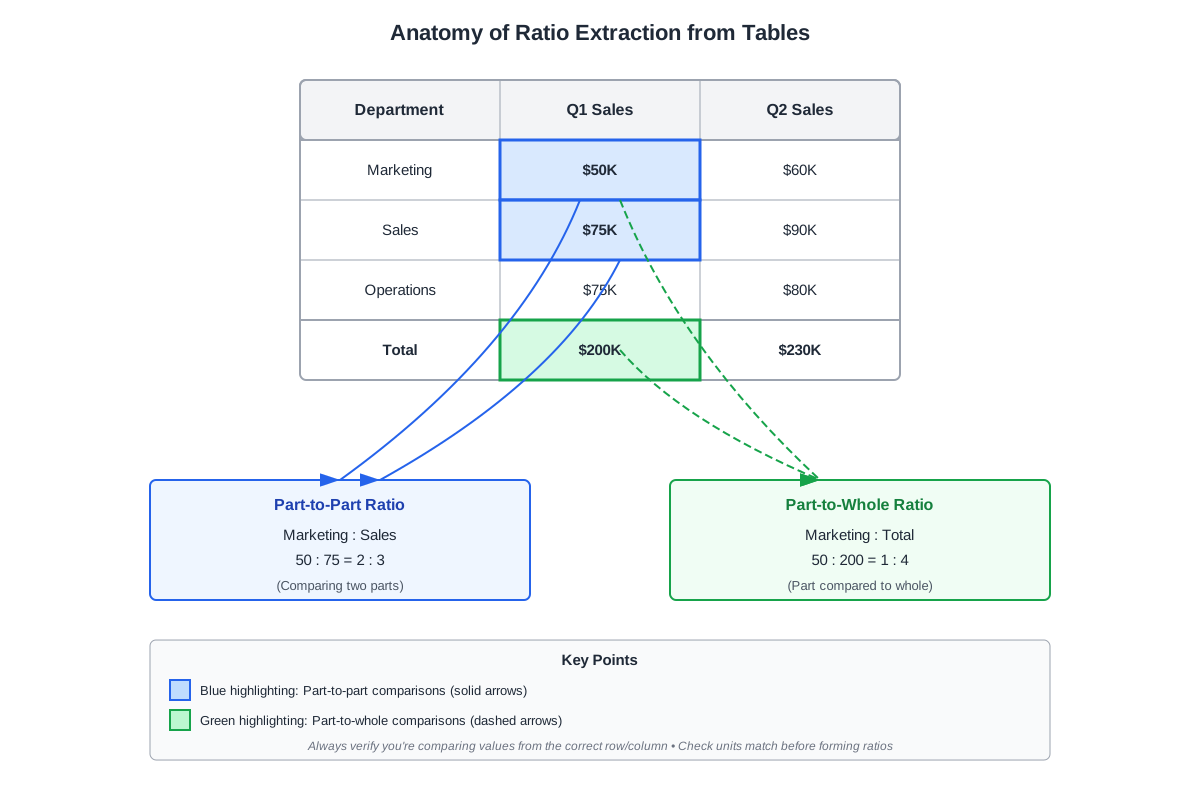
This distinction represents a critical concept that the GMAT frequently tests. Part-to-part ratios compare two components within a larger whole, such as the ratio of male employees to female employees in a department. If a table shows 60 male employees and 40 female employees, the part-to-part ratio is 60:40, which simplifies to 3:2.
Part-to-whole ratios compare one component to the total, functioning similarly to fractions or percentages. Using the same example, the part-to-whole ratio of male employees to total employees would be 60:100 or 3:5. This distinction matters enormously because misidentifying the type of ratio leads to incorrect problem setup and wrong answers.
| Ratio Type | Example from Table | Expression | Simplified |
|---|---|---|---|
| Part-to-Part | Males to Females | 60:40 | 3:2 |
| Part-to-Whole | Males to Total | 60:100 | 3:5 |
| Part-to-Whole | Females to Total | 40:100 | 2:5 |
Extracting Ratio Components from Tables
The process of identifying ratio components requires systematic table navigation. First, locate the relevant row(s) and column(s) by carefully reading headers and labels. Second, verify that the units match or can be appropriately converted. Third, extract the numerical values while noting any footnotes or special conditions. Fourth, establish which values form the numerator and denominator based on the question's wording.
Consider a table showing quarterly sales data for three products. To find the ratio of Product A sales in Q1 to Product B sales in Q2, students must locate the intersection of "Product A" row with "Q1" column, then separately locate "Product B" row with "Q2" column. The ratio would be expressed as (Product A, Q1) : (Product B, Q2).
Compound Ratios and Multiple Comparisons
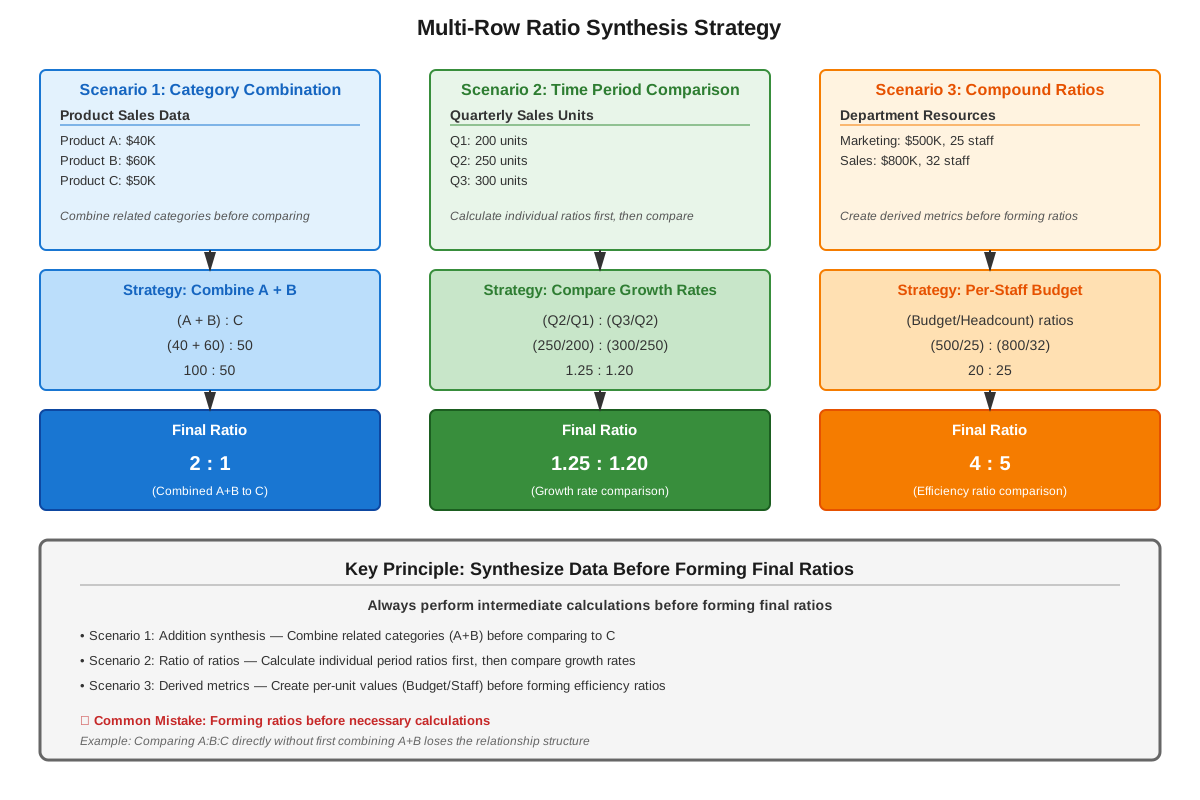
Compound ratios involve three or more quantities in a single relationship, such as A:B:C = 2:3:5. In tables, these often appear when comparing multiple categories simultaneously. For example, a table might show sales figures for three regions, and a question might ask for the ratio of Region 1 to Region 2 to Region 3 sales.
When working with compound ratios from tables, the key technique involves finding a common basis for comparison. If the table shows Region 1 with 120 units, Region 2 with 180 units, and Region 3 with 300 units, the compound ratio is 120:180:300. Dividing all terms by the greatest common divisor (60) yields the simplified form 2:3:5.
Ratio Calculations and Manipulations
Several calculation types frequently appear in GMAT table ratio questions:
- Simplification: Reducing ratios to lowest terms by dividing both components by their greatest common divisor
- Scaling: Multiplying or dividing ratio terms to find equivalent ratios with specific values
- Finding missing values: Using given ratios and one known value to calculate unknown quantities
- Ratio comparison: Determining which of several ratios is largest or smallest by converting to common denominators or decimal form
- Percentage conversion: Expressing ratios as percentages by dividing and multiplying by 100
For example, if a table shows Department A has a budget of $240,000 and Department B has $360,000, the ratio is 240,000:360,000 = 2:3. If asked what Department A's budget would be if the ratio changed to 3:4 while Department B remained at $360,000, students would set up the proportion: 3/4 = x/360,000, solving to find x = $270,000.
Common Table Structures and Ratio Patterns
GMAT tables typically present data in several standard formats:
- Cross-tabulation tables: Show relationships between two categorical variables with values at intersections
- Time-series tables: Display data across multiple time periods (years, quarters, months)
- Hierarchical tables: Present totals, subtotals, and individual categories in nested structure
- Comparative tables: Show the same metrics across different groups, regions, or products
Each structure presents unique challenges for ratio identification. In hierarchical tables, students must carefully distinguish between using subtotals versus individual line items. In time-series tables, ratio questions often involve comparing growth rates or period-over-period changes. Cross-tabulation tables frequently test the ability to establish ratios between different cell combinations.
Concept Relationships
The concepts within ratios in tables form an interconnected hierarchy. Basic ratio identification serves as the foundation, enabling students to locate and extract relevant numerical values. This skill leads directly to distinguishing ratio types (part-to-part vs. part-to-whole), which determines the correct problem setup. Both of these foundational skills feed into ratio calculations and manipulations, where students perform the mathematical operations needed to answer questions.
Compound ratios represent an advanced application that builds upon basic ratio identification and calculation skills, requiring students to work with three or more quantities simultaneously. Ratio comparison techniques connect back to calculation skills while also requiring understanding of equivalent forms and common denominators.
The relationship to prerequisite topics is equally important. Basic ratio concepts provide the theoretical foundation, while fraction operations supply the computational tools. Table reading skills enable the data extraction phase, and unit awareness prevents setup errors. These prerequisites combine to support all aspects of working with ratios in tables.
Looking forward, mastery of ratios in tables enables progression to more complex Data Insights topics including rate problems in tables, percentage change analysis, and multi-source reasoning questions that require synthesizing ratio information from multiple data displays. The logical flow is: Data Extraction → Ratio Identification → Ratio Type Classification → Calculation Setup → Mathematical Manipulation → Answer Verification.
High-Yield Facts
⭐ Part-to-part ratios compare two components within a whole, while part-to-whole ratios compare one component to the total
⭐ Always verify that units match before establishing a ratio relationship from table data
⭐ Simplified ratios maintain the same proportional relationship as unsimplified ratios (6:9 = 2:3)
⭐ To compare multiple ratios quickly, convert all to decimal form or find a common denominator
⭐ The order matters in ratios: 3:5 is different from 5:3
- When a question asks for "the ratio of A to B," A becomes the numerator and B becomes the denominator
- Compound ratios (A:B:C) can be manipulated by multiplying or dividing all terms by the same number
- If a ratio is given as 2:3 and one actual value is known, the other can be calculated using proportional reasoning
- Ratios can be expressed as fractions, and all fraction operations apply to ratio manipulations
- The sum of parts in a part-to-part ratio does not necessarily equal the whole unless all components are included
- Cross-multiplication is the most efficient technique for solving ratio equations with one unknown
- When tables include totals and subtotals, carefully identify which values to use in ratio calculations
Quick check — test yourself on Ratios in tables so far.
Try Flashcards →Common Misconceptions
Misconception: All ratios in a table should be simplified to lowest terms before making comparisons.
Correction: While simplification helps with understanding, comparing ratios often works better by converting to decimals or finding a common denominator. Simplification is useful for final answers but not always necessary for intermediate steps.
Misconception: The ratio of A to B is the same as the ratio of B to A.
Correction: Ratios are directional and order-dependent. The ratio of A to B (A:B) is the reciprocal of the ratio of B to A (B:A). If A:B = 2:3, then B:A = 3:2. Always pay careful attention to the question's wording.
Misconception: When a table shows percentages, these can be directly used as ratio components.
Correction: Percentages represent part-to-whole relationships and must be converted appropriately. If comparing two percentages from the same base, the ratio of the percentages equals the ratio of the actual values. However, if the bases differ, percentages cannot be directly compared without converting to actual values first.
Misconception: In a compound ratio A:B:C = 2:3:5, the value of A is 2, B is 3, and C is 5.
Correction: The numbers in a ratio represent relative proportions, not actual values. If A:B:C = 2:3:5, the actual values are 2x, 3x, and 5x for some multiplier x. To find actual values, additional information is needed.
Misconception: Adding the same number to both parts of a ratio maintains the proportional relationship.
Correction: Ratios are multiplicative relationships, not additive. If A:B = 2:3, then (A+1):(B+1) ≠ 2:3. Only multiplying or dividing both parts by the same non-zero number preserves the ratio. This is a frequent trap in GMAT questions.
Misconception: The largest number in a table always appears in the largest ratio.
Correction: Ratio magnitude depends on the relationship between two numbers, not their absolute values. A ratio of 100:200 (1:2 = 0.5) is smaller than a ratio of 50:60 (5:6 ≈ 0.833), even though 100 and 200 are larger absolute numbers.
Worked Examples
Example 1: Multi-Step Ratio Comparison
Problem: A company's quarterly sales table shows the following data:
| Product | Q1 Sales | Q2 Sales | Q3 Sales |
|---|---|---|---|
| Alpha | $120,000 | $150,000 | $180,000 |
| Beta | $80,000 | $100,000 | $140,000 |
| Gamma | $200,000 | $250,000 | $280,000 |
Question: In which quarter is the ratio of Beta sales to Gamma sales the highest?
Solution:
Step 1: Identify the relevant data points. We need Beta and Gamma sales for each quarter.
Step 2: Calculate the ratio for each quarter:
- Q1: Beta:Gamma = 80,000:200,000 = 80:200 = 2:5 = 0.4
- Q2: Beta:Gamma = 100,000:250,000 = 100:250 = 2:5 = 0.4
- Q3: Beta:Gamma = 140,000:280,000 = 140:280 = 1:2 = 0.5
Step 3: Compare the ratios. Converting to decimals makes comparison straightforward: 0.4, 0.4, and 0.5.
Step 4: Identify the highest ratio. Q3 has the highest ratio at 0.5 (or 1:2).
Answer: Q3
Key Learning Points: This problem demonstrates the importance of calculating ratios for each comparison point separately and converting to a common form (decimals) for easy comparison. Notice that even though Gamma's sales increased each quarter, the ratio changed because Beta's sales increased at different rates.
Example 2: Finding Missing Values Using Ratios
Problem: A university enrollment table shows the following:
| Department | Undergraduate | Graduate | Total |
|---|---|---|---|
| Engineering | 450 | 180 | 630 |
| Business | 600 | ? | 900 |
| Sciences | 520 | 130 | 650 |
The ratio of undergraduate to graduate students in the Business department is the same as in the Engineering department. How many graduate students are in the Business department?
Solution:
Step 1: Identify the known ratio. In Engineering, Undergraduate:Graduate = 450:180.
Step 2: Simplify the ratio: 450:180 = 45:18 = 5:2 (dividing by 90).
Step 3: Set up the proportion for Business department. If the ratio is 5:2, and undergraduate students = 600, then:
5/2 = 600/x, where x is the number of graduate students.
Step 4: Solve for x using cross-multiplication:
5x = 2 × 600
5x = 1,200
x = 240
Step 5: Verify using the total: 600 + 240 = 840, but the table shows total = 900. This reveals an inconsistency in the problem setup, suggesting we should verify our ratio interpretation.
Step 6: Alternative verification - check if the given total is correct: If the ratio must be 5:2 and undergraduates = 600, then graduates must be 240. The sum would be 840, not 900. This indicates either the total is incorrect in the table or the ratio condition cannot be met.
Answer: Based on the ratio condition, 240 graduate students (though this conflicts with the stated total of 900).
Key Learning Points: This example illustrates the importance of verifying answers against all given information and recognizing when table data might contain inconsistencies. In actual GMAT questions, all data will be consistent, but the verification step remains crucial. The problem also demonstrates how to use known ratios to find missing values through proportional reasoning.
Exam Strategy
When approaching GMAT questions involving ratios in tables, follow this systematic process:
Step 1: Read the question carefully before examining the table. Identify exactly what ratio is being requested and note the specific wording ("ratio of A to B" means A:B, not B:A).
Step 2: Locate the relevant data in the table. Use headers, row labels, and column labels to find the exact cells needed. Watch for questions that require data from multiple rows or columns.
Step 3: Verify units and ensure comparability. Check that values use the same units or convert as necessary. A common trap involves mixing thousands and millions, or different time periods.
Step 4: Determine the ratio type. Classify as part-to-part or part-to-whole, as this determines the denominator. Questions using words like "of the total" or "as a percentage" typically indicate part-to-whole ratios.
Step 5: Set up the ratio before calculating. Write out the ratio in fraction form to avoid errors. This extra second prevents reversing numerator and denominator.
Trigger words and phrases to watch for:
- "Ratio of A to B" → A is numerator, B is denominator
- "For every" → indicates ratio relationship
- "Compared to" → signals comparison/ratio
- "Times as much" → multiplicative relationship
- "Proportion" → often indicates part-to-whole ratio
Process-of-elimination tips:
- Eliminate answers that reverse the ratio direction
- Eliminate answers with incorrect units
- For ratio comparison questions, eliminate any answer that doesn't match the calculated decimal or simplified form
- Watch for answer choices that use totals when components are needed, or vice versa
Time allocation advice:
- Spend 15-20 seconds reading and understanding the question
- Spend 20-30 seconds locating data in the table
- Spend 30-45 seconds calculating the ratio
- Reserve 10-15 seconds for verification
For Table Analysis questions specifically, use the sorting functionality strategically. If asked to identify which row has the highest ratio, consider sorting by one of the relevant columns first to narrow down candidates, then calculate ratios only for the top few rows.
Memory Techniques
Mnemonic for ratio setup: "Question Order = Ratio Order"
Whatever appears first in the question phrase "ratio of A to B" goes first (numerator) in your ratio setup. This prevents the common error of reversing components.
Visualization strategy: The Ratio Rectangle
When working with part-to-part ratios, visualize a rectangle divided into sections. If the ratio is 2:3, imagine a rectangle split into 2 parts and 3 parts. The total is 5 parts. This visual helps distinguish part-to-part (2:3) from part-to-whole (2:5 or 3:5).
Acronym: LEVER for ratio problem-solving
- Locate the relevant data in the table
- Establish which type of ratio (part-to-part or part-to-whole)
- Verify units match
- Express the ratio in appropriate form
- Reduce or calculate as needed
Memory aid for comparison: "Decimal Decides"
When comparing multiple ratios, remember that converting to decimal form provides the quickest path to identifying the largest or smallest ratio. The phrase "Decimal Decides" reminds you to convert before comparing.
Conceptual anchor: "Ratios are Recipes"
Think of ratios like cooking recipes. A recipe calling for 2 cups flour to 3 cups water maintains the same proportions whether you make one batch (2:3) or ten batches (20:30). This analogy reinforces that ratios represent proportional relationships that scale uniformly.
Summary
Ratios in tables represent a high-yield GMAT Data Insights topic that combines data extraction skills with proportional reasoning. Success requires the ability to navigate tabular structures, identify relevant numerical values, distinguish between part-to-part and part-to-whole relationships, and perform accurate ratio calculations. The key challenges involve correctly interpreting question wording to set up ratios in the proper direction, ensuring unit consistency, and choosing the most efficient calculation method for comparison problems. Students must recognize that ratios represent relative relationships rather than absolute values, and that these relationships can be expressed in multiple equivalent forms (fractions, decimals, simplified ratios). The GMAT tests this topic frequently because it mirrors real-world business analysis scenarios and efficiently assesses multiple competencies simultaneously. Mastery requires systematic problem-solving approaches, careful attention to detail during data extraction, and fluency with ratio manipulations including simplification, scaling, and conversion between forms.
Key Takeaways
- Ratios in tables require two distinct skills: accurate data extraction from tabular format and correct proportional reasoning with the extracted values
- Part-to-part ratios compare components within a whole (A:B), while part-to-whole ratios compare one component to the total (A:Total) — misidentifying the type leads to incorrect answers
- Ratio order matters critically: "the ratio of A to B" means A:B (A in numerator), not B:A; always follow the question's exact wording
- Convert ratios to decimal form for quick comparison when evaluating which of several ratios is largest or smallest
- Ratios are multiplicative relationships: only multiplying or dividing both components by the same number preserves the proportional relationship; adding or subtracting changes the ratio
- Verify units before establishing ratios — mixing thousands with millions, or different time periods, creates incorrect proportional relationships
- Use the LEVER approach systematically: Locate data, Establish ratio type, Verify units, Express appropriately, Reduce or calculate as needed
Related Topics
Percentages in Tables: Building on ratio concepts, percentage calculations represent part-to-whole relationships expressed as portions of 100. Mastering ratios in tables provides the foundation for percentage change analysis and comparative percentage problems.
Rate Problems in Tables: Rates represent special ratios involving time or other continuous measures. Understanding basic ratio manipulation in tables enables progression to more complex rate calculations including speed, productivity, and efficiency metrics.
Proportional Reasoning Across Data Sources: Multi-Source Reasoning questions often require establishing ratio relationships between data presented in different formats (tables, graphs, text). Mastery of table-based ratios is essential for these integrated reasoning challenges.
Weighted Averages and Ratio Applications: Many weighted average problems require establishing ratios between different groups or categories before calculating combined averages. The ratio skills developed here directly support these more complex calculations.
Practice CTA
Now that you've mastered the core concepts of ratios in tables, it's time to solidify your understanding through active practice. The practice questions and flashcards designed for this topic will challenge you to apply these concepts under timed conditions, helping you build the speed and accuracy needed for test day. Remember, the difference between understanding a concept and mastering it lies in repeated application. Each practice problem you complete strengthens your pattern recognition and calculation efficiency. Approach the practice materials with confidence — you now have the conceptual framework and strategic tools to tackle any ratio question the GMAT presents. Your investment in mastering this high-yield topic will pay dividends across multiple question types in the Data Insights section!
Sign up free to keep reading
Create a free AnvayaPrep account to finish this GMAT guide on Ratios in tables — plus flashcards and practice questions.