Overview
Paired answers represent a distinctive question format within the GMAT Data Insights section, specifically appearing in the Two-Part Analysis question type. Unlike traditional multiple-choice questions where test-takers select a single answer, paired answer questions require students to select two related answers simultaneously—one from each of two columns—that together satisfy the conditions presented in the problem. This format tests not only quantitative or verbal reasoning skills in isolation, but also the ability to understand interdependent relationships between variables, constraints, or logical conditions.
The GMAT paired answers format is essential because it mirrors real-world business decision-making scenarios where multiple factors must be optimized simultaneously. For instance, a manager might need to determine both the optimal production quantity and pricing strategy, where each decision affects the other. These questions assess integrated reasoning skills by requiring test-takers to evaluate how two separate but related components work together to meet specified criteria. The format demands careful attention to the relationship between the two answer choices and how they collectively satisfy all given conditions.
Within the broader Data Insights section, paired answers represent one of the most challenging question formats because they require multidimensional thinking. Students must not only solve for individual variables but also verify that their selected pair works together harmoniously. This topic connects to other Data Insights concepts such as table analysis, graphics interpretation, and multi-source reasoning, as paired answer questions often incorporate data from tables, graphs, or text passages. Mastering this format is crucial for achieving a competitive GMAT score, as these questions appear regularly and carry significant weight in the Data Insights section.
Learning Objectives
- [ ] Identify paired answers in GMAT Two-Part Analysis questions
- [ ] Explain the structure and requirements of paired answer questions
- [ ] Apply paired answer strategies to solve GMAT questions efficiently
- [ ] Analyze the interdependent relationship between the two answer components
- [ ] Evaluate multiple answer combinations systematically to find the correct pair
- [ ] Distinguish between independent and dependent variable relationships in paired contexts
- [ ] Synthesize information from multiple sources to determine both components of a paired answer
Prerequisites
- Basic algebra and equation solving: Essential for manipulating variables and solving systems of equations that often appear in quantitative paired answer questions
- Reading comprehension skills: Required to understand complex problem statements that describe the relationship between the two answer components
- Logical reasoning fundamentals: Necessary to evaluate conditional statements and determine which answer pairs satisfy all given constraints
- Data interpretation abilities: Important for extracting relevant information from tables, charts, or text that inform both answer selections
- Understanding of business concepts: Helpful for contextualizing real-world scenarios involving cost, revenue, profit, or resource allocation
Why This Topic Matters
Paired answer questions represent approximately 15-20% of the Data Insights section on the GMAT, making them a high-frequency question type that significantly impacts overall scores. Business schools value the skills tested by these questions because they reflect the complex, multi-variable decision-making required in management roles. Real-world applications include simultaneous optimization problems such as determining both production levels and pricing strategies, allocating resources across multiple departments while staying within budget constraints, or selecting complementary team members with different skill sets.
In professional contexts, managers rarely make decisions in isolation. A marketing director might need to determine both advertising spend and expected return on investment, where each figure constrains and informs the other. Financial analysts must simultaneously consider risk and return when building portfolios. Operations managers balance production capacity with inventory costs. The paired answer format directly simulates these interconnected decision-making scenarios.
On the GMAT, paired answer questions typically appear in several formats: quantitative problems requiring two numerical solutions, verbal reasoning questions asking for two logical conclusions, or mixed questions combining quantitative and qualitative elements. Common scenarios include finding two values that satisfy a system of equations, identifying two statements that together complete an argument, selecting two data points that meet specified criteria, or determining two variables that optimize a business outcome. The format's versatility means students must be prepared to apply paired answer strategies across diverse content areas, from pure mathematics to business case analysis.
Core Concepts
Structure of Paired Answer Questions
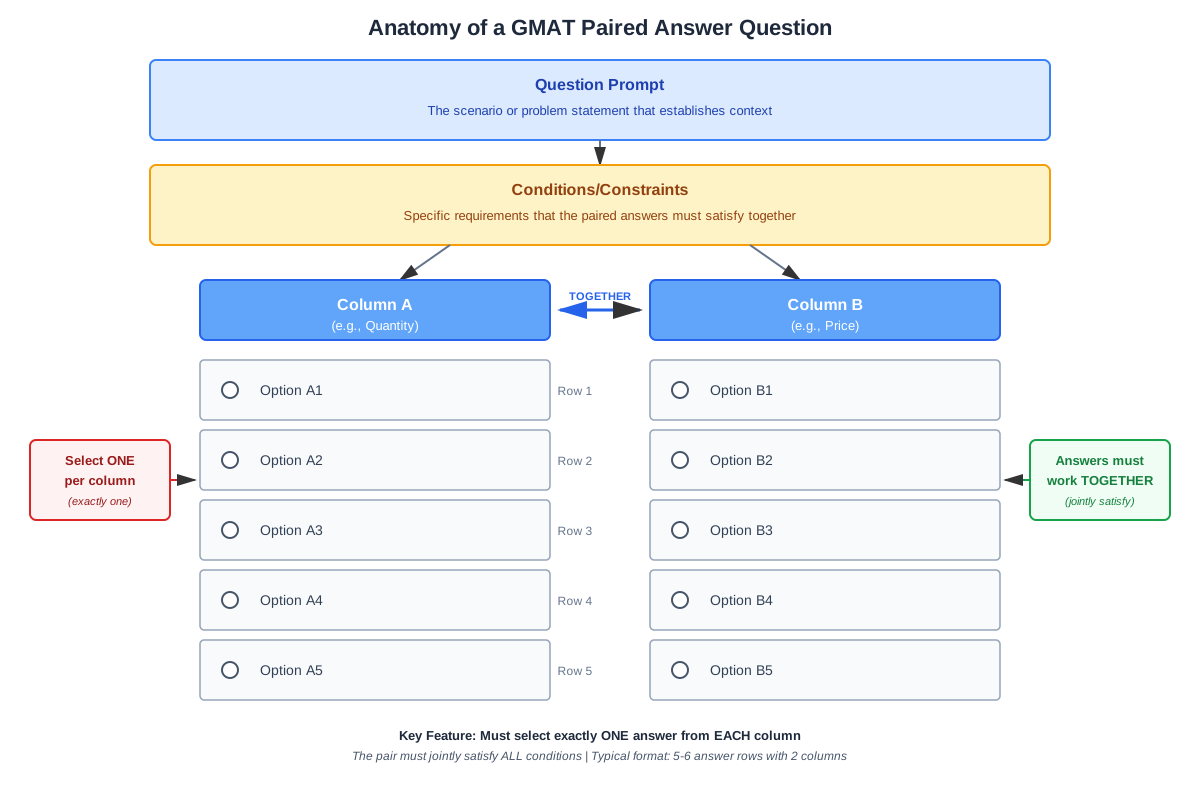
Paired answers in GMAT Two-Part Analysis questions follow a consistent structural format. The question presents a scenario, problem statement, or data set, followed by a prompt that asks test-takers to select two answers that together satisfy specified conditions. The answer choices are organized in a table with three columns: the leftmost column lists the answer options (typically 5-6 choices), while the two rightmost columns represent the two components that must be selected. Test-takers click one bubble in each of the two columns, selecting exactly one answer for each component.
The critical feature distinguishing paired answers from other question types is the interdependence between the two selections. The correct answer for the first component often constrains or determines what the correct answer for the second component must be, and vice versa. This interdependence requires test-takers to think systematically about how the two answers work together rather than solving for each independently.
Types of Paired Answer Relationships
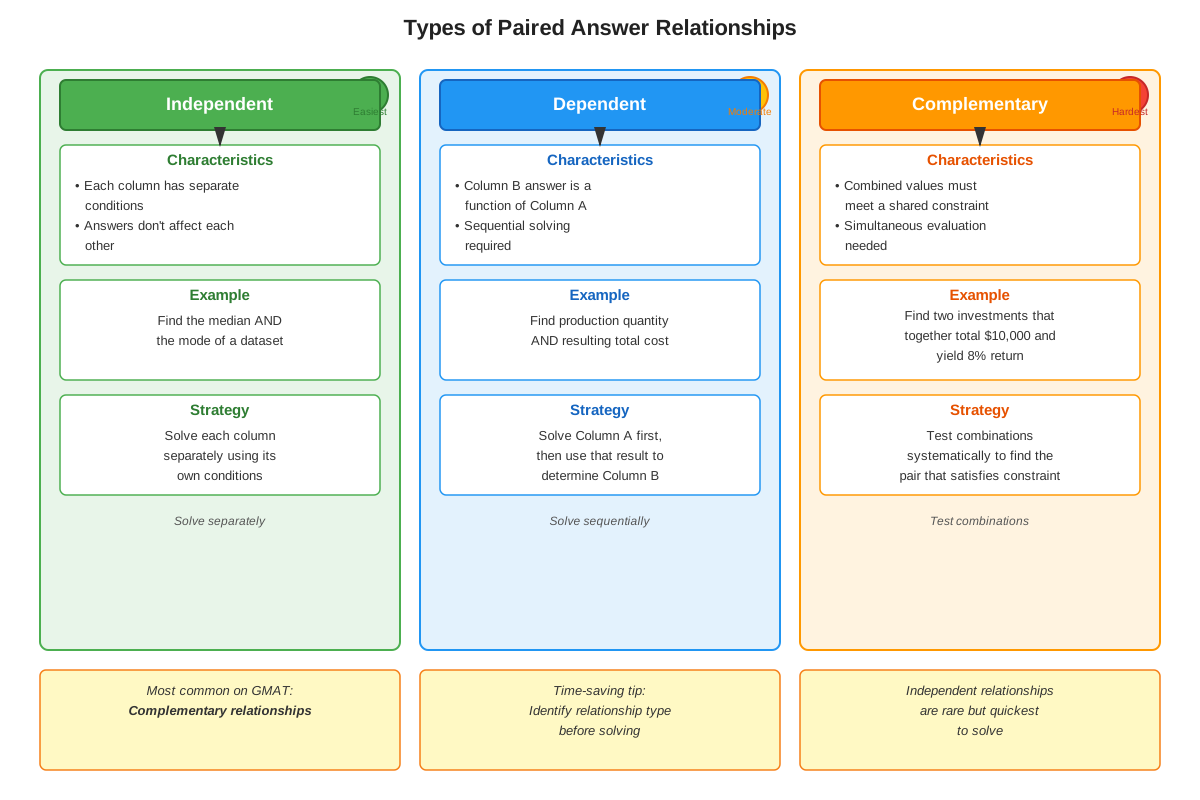
Paired answer questions exhibit several distinct relationship patterns between the two components:
Complementary relationships occur when the two answers must work together to achieve a complete solution. For example, a question might ask for two products that together maximize profit while staying within a budget constraint. Neither answer alone satisfies the condition; only the specific pair meets all requirements.
Sequential relationships appear when the first answer logically or mathematically precedes the second. For instance, a question might ask for both the cause of a business problem (first component) and the appropriate solution (second component). The second answer must logically follow from the first.
Comparative relationships require selecting two values that maintain a specific relationship to each other, such as finding two quantities where one is exactly twice the other, or identifying two time periods where one shows higher performance than the other.
Constraint-based relationships involve selecting two answers that together satisfy multiple simultaneous constraints. For example, finding two investment amounts that together equal a total budget while also meeting minimum allocation requirements for each category.
Solution Strategies for Paired Answers
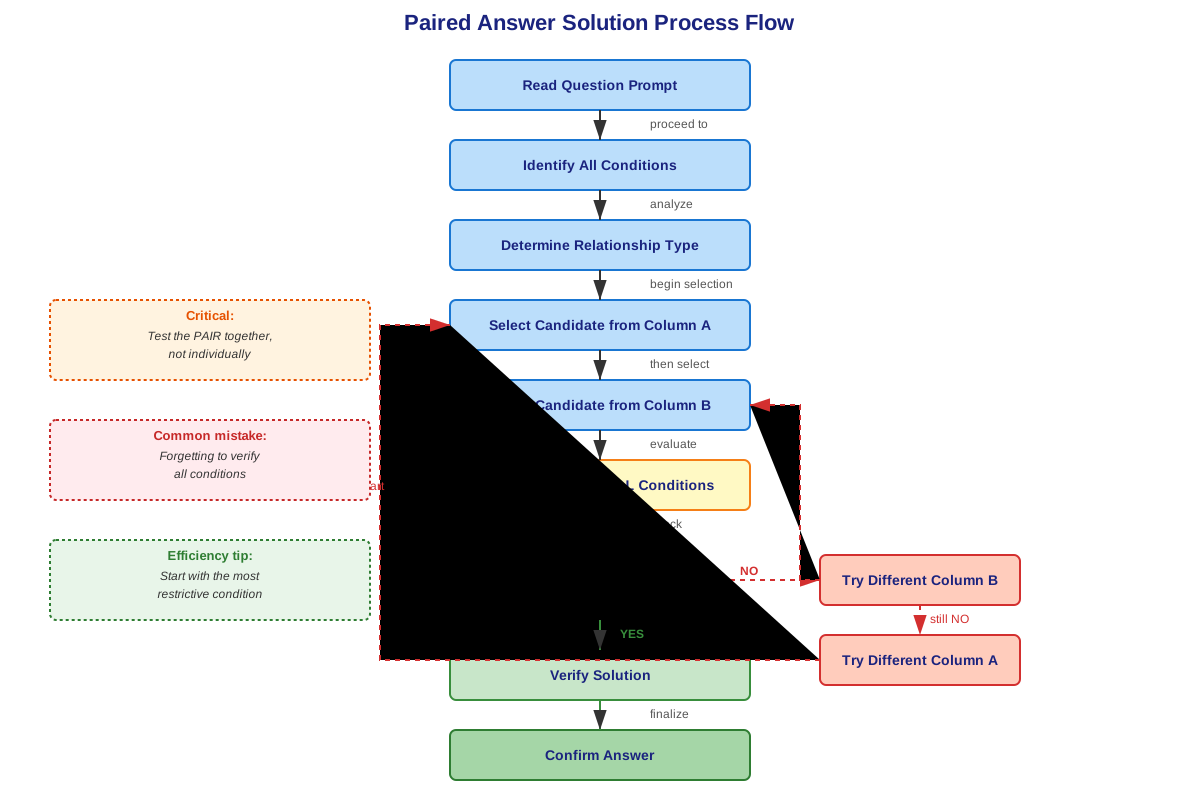
The most effective approach to paired answer questions involves systematic evaluation rather than random trial and error. Begin by carefully reading the problem statement to identify all constraints, conditions, and relationships that the answer pair must satisfy. List these requirements explicitly to ensure nothing is overlooked.
Next, determine whether the two components are independent or dependent. Independent components can be solved separately and then verified together, while dependent components require solving for one variable in terms of the other. For dependent relationships, often solving for one component first will significantly narrow the possibilities for the second component.
When evaluating answer choices, use a process of elimination approach. Test each potential answer for the first component against the stated conditions. If an option violates any constraint, eliminate it immediately. For remaining viable options, determine which second-component answers could potentially pair with each first-component answer. This systematic approach prevents wasting time on impossible combinations.
For quantitative paired answer questions, algebraic manipulation often provides the most efficient solution path. Set up equations representing the relationships and constraints, then solve the system of equations. The solutions directly indicate which answer pair is correct. This approach is faster and more reliable than testing each possible combination.
Common Question Formats
Quantitative paired answers typically involve finding two numerical values that satisfy mathematical relationships. These might include:
- Two variables in a system of linear equations
- Two quantities that together meet budget or resource constraints
- Two values that optimize an objective function (maximize profit, minimize cost)
- Two measurements that maintain a specified ratio or proportion
Verbal paired answers require selecting two logical or textual components, such as:
- Two statements that together complete an argument
- Two assumptions that underlie a conclusion
- Two pieces of evidence that support different aspects of a claim
- Two factors that explain a business outcome
Mixed paired answers combine quantitative and qualitative elements:
- A numerical value and a categorical choice (e.g., production quantity and product type)
- A data point and an interpretation of that data
- A calculation result and a business recommendation based on that result
Verification and Double-Checking
After selecting a paired answer, always verify that both components together satisfy all stated conditions. This verification step is crucial because the GMAT often includes trap answers where each component individually seems reasonable but the pair together violates a constraint. Check each requirement systematically:
- Does the first component alone meet its individual constraints?
- Does the second component alone meet its individual constraints?
- Do the two components together satisfy all relational requirements?
- Have all conditions mentioned in the problem been addressed?
This verification process takes only 15-30 seconds but prevents costly errors that result from overlooking subtle requirements in the problem statement.
Concept Relationships
The core concepts within paired answers are hierarchically organized. Understanding the structure of paired answer questions forms the foundation, as recognizing the format allows test-takers to activate appropriate solution strategies. This structural understanding leads directly to identifying types of paired answer relationships, which determines the specific approach needed for each question.
The relationship types (complementary, sequential, comparative, and constraint-based) directly inform which solution strategies are most effective. For example, recognizing a sequential relationship suggests solving for the first component before the second, while identifying a constraint-based relationship indicates that setting up a system of equations may be most efficient.
Solution strategies connect to common question formats because different formats (quantitative, verbal, mixed) require adapted versions of the core strategies. Quantitative formats emphasize algebraic manipulation, while verbal formats prioritize logical reasoning, but both use the same underlying systematic evaluation approach.
Finally, all concepts converge on verification and double-checking, which serves as the quality control step ensuring that the selected pair actually satisfies all requirements. This creates a complete problem-solving cycle: Structure recognition → Relationship identification → Strategy selection → Format-specific application → Verification.
This topic connects to prerequisite knowledge of algebra (for solving systems of equations), logical reasoning (for evaluating conditional statements), and data interpretation (for extracting relevant information). It also relates to other Data Insights topics such as Table Analysis (which may provide data for paired answer questions) and Multi-Source Reasoning (which may present information across multiple sources that inform both answer components).
High-Yield Facts
⭐ Paired answer questions require selecting exactly one answer from each of two columns, with both selections working together to satisfy all stated conditions.
⭐ The two components in a paired answer are typically interdependent, meaning the correct choice for one component constrains or determines the correct choice for the other.
⭐ Approximately 15-20% of Data Insights questions use the paired answer format, making it a high-frequency question type.
⭐ Systematic evaluation of constraints is more efficient than testing all possible answer combinations, which could require checking up to 25-36 combinations.
⭐ Verification that both components together satisfy all conditions is essential, as trap answers often include pairs where each component individually seems correct but together violate a constraint.
- Paired answer questions can involve purely quantitative, purely verbal, or mixed content requiring both numerical and logical reasoning.
- The answer table typically presents 5-6 options in the leftmost column, with two selection columns to the right.
- For quantitative problems, setting up and solving a system of equations often provides the fastest solution path.
- Common relationship types include complementary (working together), sequential (one follows the other), comparative (maintaining a specific relationship), and constraint-based (satisfying multiple simultaneous conditions).
- Time management is crucial: spending more than 2.5-3 minutes on a single paired answer question may compromise performance on other questions.
- Elimination strategies work effectively by first removing options that violate individual constraints before testing combinations.
- Business context questions often involve optimizing two related variables such as price and quantity, cost and revenue, or resource allocation across two categories.
Quick check — test yourself on Paired answers so far.
Try Flashcards →Common Misconceptions
Misconception: The two answer components can be solved completely independently without considering their relationship.
Correction: While some components may be partially independent, paired answer questions specifically test the ability to recognize and work with interdependent relationships. The correct answer pair must satisfy conditions that involve both components together, not just individual constraints.
Misconception: Testing all possible answer combinations is the most reliable approach.
Correction: With 5-6 answer options, testing all combinations (25-36 possibilities) is time-prohibitive. Systematic constraint evaluation and elimination strategies are far more efficient and equally reliable.
Misconception: If one component of a selected pair satisfies its individual constraints, that component must be correct.
Correction: An answer component may satisfy individual constraints but still be incorrect if it cannot pair with any option in the second column to satisfy the relational constraints. Both individual and relational constraints must be met.
Misconception: The answer options are always listed in numerical or alphabetical order, providing clues to the correct answer.
Correction: The GMAT deliberately randomizes answer order to prevent pattern-based guessing. The position of an answer in the list provides no information about its correctness.
Misconception: Paired answer questions always involve two numbers or two text statements, but never mix quantitative and qualitative elements.
Correction: Mixed paired answer questions frequently appear, requiring selection of one numerical value and one categorical choice, or one calculation and one interpretation. Test-takers must be prepared for all format variations.
Misconception: The first column always represents the "first" step or component chronologically or logically.
Correction: The column labels define what each component represents, not their order. Sometimes the second column represents a prerequisite or cause, while the first column represents a result or effect. Always read the column headers carefully.
Worked Examples
Example 1: Quantitative Paired Answer
Problem: A company produces two products, A and B. Product A requires 2 hours of labor and generates $50 profit per unit. Product B requires 3 hours of labor and generates $70 profit per unit. The company has 120 hours of labor available. In the table below, select the number of units of Product A that should be produced in the first column, and select the number of units of Product B that should be produced in the second column, such that all available labor is used and total profit is maximized.
| Option | Product A Units | Product B Units |
|---|---|---|
| 0 | ○ | ○ |
| 10 | ○ | ○ |
| 20 | ○ | ○ |
| 30 | ○ | ○ |
| 40 | ○ | ○ |
| 60 | ○ | ○ |
Solution Process:
Step 1: Identify the constraints and objective.
- Constraint: 2A + 3B = 120 (total labor hours)
- Objective: Maximize profit = 50A + 70B
Step 2: Recognize this as a constraint-based relationship where both answers must satisfy the labor equation while maximizing profit.
Step 3: Determine which product generates more profit per labor hour.
- Product A: $50 profit ÷ 2 hours = $25 per hour
- Product B: $70 profit ÷ 3 hours = $23.33 per hour
Step 4: Since Product A generates more profit per labor hour, we want to maximize A production. However, we must use all 120 hours.
Step 5: Test the highest A values to see which allows using exactly 120 hours:
- If A = 60: 2(60) + 3B = 120 → 120 + 3B = 120 → B = 0 ✓ (uses all labor)
- If A = 40: 2(40) + 3B = 120 → 80 + 3B = 120 → B = 13.33 ✗ (not an option)
- If A = 30: 2(30) + 3B = 120 → 60 + 3B = 120 → B = 20 ✓ (uses all labor)
Step 6: Compare profits:
- A = 60, B = 0: Profit = 50(60) + 70(0) = $3,000
- A = 30, B = 20: Profit = 50(30) + 70(20) = $1,500 + $1,400 = $2,900
Step 7: Verify the answer (A = 60, B = 0):
- Labor used: 2(60) + 3(0) = 120 ✓
- All labor used ✓
- Profit maximized ✓
Answer: Product A = 60 units, Product B = 0 units
This example demonstrates the importance of recognizing that "maximize profit" doesn't necessarily mean producing both products—sometimes the optimal solution involves focusing entirely on the more efficient option.
Example 2: Mixed Paired Answer
Problem: A retail chain is analyzing sales data for two store locations. Store X had revenue of $500,000 and expenses of $350,000. Store Y had revenue of $450,000 and expenses of $280,000. The company wants to identify which store had the higher profit margin and which store should receive additional investment based on having the higher absolute profit. In the table below, select the store with the higher profit margin in the first column and the store that should receive additional investment in the second column.
| Option | Higher Profit Margin | Investment Priority |
|---|---|---|
| Store X | ○ | ○ |
| Store Y | ○ | ○ |
| Neither | ○ | ○ |
| Both | ○ | ○ |
Solution Process:
Step 1: Calculate profit for each store.
- Store X profit: $500,000 - $350,000 = $150,000
- Store Y profit: $450,000 - $280,000 = $170,000
Step 2: Calculate profit margin (profit ÷ revenue) for each store.
- Store X margin: $150,000 ÷ $500,000 = 0.30 = 30%
- Store Y margin: $170,000 ÷ $450,000 = 0.378 = 37.8%
Step 3: Identify which store has higher profit margin.
- Store Y has the higher profit margin (37.8% > 30%)
Step 4: Identify which store has higher absolute profit (investment priority criterion).
- Store Y has higher absolute profit ($170,000 > $150,000)
Step 5: Verify both components together.
- First component: Store Y has higher profit margin ✓
- Second component: Store Y should receive investment (higher absolute profit) ✓
- Both components point to Store Y ✓
Answer: Higher Profit Margin = Store Y, Investment Priority = Store Y
This example illustrates a comparative relationship where both components happen to point to the same store, but the reasoning for each is different (margin percentage vs. absolute profit amount). Test-takers must calculate both metrics separately and not assume the answers will differ.
Exam Strategy
When approaching GMAT paired answer questions, begin by investing 20-30 seconds in careful reading of the problem statement and column headers. The column headers define exactly what each component represents, and misinterpreting these labels is a common source of errors. Underline or mentally note all constraints, conditions, and requirements that the answer pair must satisfy.
Trigger words that signal paired answer questions include: "select one option in each column," "together satisfy," "simultaneously meet," "both components must," and "in combination with." These phrases indicate that the two answers are interdependent and must be evaluated as a unit.
For quantitative paired answers, immediately assess whether setting up equations would be efficient. If the problem involves numerical relationships, constraints, or optimization, algebraic manipulation is usually faster than testing combinations. Write out the constraint equations and solve systematically. If the algebra becomes complex, switch to strategic testing of answer choices, starting with extreme values (highest/lowest options) which often reveal patterns.
For verbal paired answers, identify the logical relationship between the two components. Are they cause and effect? Premise and conclusion? Problem and solution? Understanding this relationship helps predict what type of answer to look for in each column. Use process of elimination aggressively—if a first-column option cannot logically pair with any second-column option, eliminate it immediately.
Time allocation is critical: aim to complete paired answer questions in 2.5-3 minutes maximum. If approaching the 3-minute mark without a clear solution path, make an educated guess and move forward. These questions are designed to be time-consuming, and spending 4-5 minutes on one question jeopardizes performance on easier questions later.
Use a systematic checking pattern: After selecting a potential answer pair, verify it against each stated condition in sequence. Create a mental checklist: "Does this satisfy constraint 1? Constraint 2? The relationship requirement?" This structured verification prevents overlooking subtle conditions.
Watch for trap answers where each component individually seems correct but together they violate a constraint. The GMAT deliberately includes these to catch test-takers who don't verify the pair as a unit. Also beware of answers that satisfy most but not all conditions—partial correctness earns zero points.
Memory Techniques
PAIRED acronym for approaching these questions:
- Problem statement: Read carefully and identify all constraints
- Answer relationship: Determine if components are independent or dependent
- Identify: Note what each column represents
- Reduce: Eliminate options that violate individual constraints
- Evaluate: Test remaining combinations systematically
- Double-check: Verify the selected pair satisfies all conditions
Visualization strategy: Picture the two answer components as puzzle pieces that must fit together perfectly. Each piece has edges (constraints) that must align. A piece might look correct individually, but if its edges don't align with any piece in the other column, it cannot be part of the solution.
The "Both-Together" reminder: Before finalizing any paired answer, mentally say "both together" and verify that the pair as a unit satisfies all requirements. This simple phrase triggers the verification step that prevents the most common errors.
Constraint checklist mnemonic: Use "I-R-T" (Individual, Relational, Total) to remember the three levels of verification:
- Individual: Does each component meet its own constraints?
- Relational: Do the components maintain the required relationship to each other?
- Total: Does the pair together satisfy all global conditions?
Summary
Paired answers represent a distinctive GMAT Data Insights question format requiring test-takers to select two interdependent answers that together satisfy specified conditions. These questions appear in the Two-Part Analysis section and test the ability to think multidimensionally about related variables, constraints, and logical relationships. Success requires recognizing the structural format, identifying the type of relationship between components (complementary, sequential, comparative, or constraint-based), and applying systematic solution strategies rather than random testing. The most efficient approach involves careful constraint identification, strategic elimination of impossible options, and algebraic manipulation for quantitative problems. Verification that both components together satisfy all conditions is essential, as trap answers often include pairs where each component individually seems correct but together violate requirements. Mastering paired answers requires practice with diverse question formats including purely quantitative, purely verbal, and mixed problems, along with disciplined time management to complete questions within 2.5-3 minutes while maintaining accuracy.
Key Takeaways
- Paired answer questions require selecting two interdependent answers that together satisfy all stated conditions, not just individual constraints
- Systematic constraint evaluation and elimination strategies are far more efficient than testing all possible answer combinations
- The relationship between components (complementary, sequential, comparative, or constraint-based) determines the optimal solution approach
- For quantitative problems, setting up and solving equations is usually faster than trial-and-error testing
- Verification that both components together meet all requirements is the critical final step that prevents costly errors
- Time management is essential: aim for 2.5-3 minutes per question maximum to maintain overall section pacing
- Trap answers frequently include pairs where each component individually seems reasonable but together violate a subtle constraint
Related Topics
Table Analysis in Data Insights: Many paired answer questions present data in table format that must be analyzed to determine the correct answer pair. Mastering table analysis skills enhances efficiency in extracting relevant information for paired answer questions.
Multi-Source Reasoning: This advanced Data Insights format often combines paired answer questions with information distributed across multiple tabs or sources, requiring synthesis of data before selecting the answer pair.
Systems of Equations: Strong algebra skills in solving systems of linear equations directly support quantitative paired answer questions, as many involve finding two values that simultaneously satisfy multiple equations.
Optimization Problems: Business scenarios involving maximizing profit, minimizing cost, or optimizing resource allocation frequently appear in paired answer format, making optimization problem-solving skills highly transferable.
Logical Reasoning and Argument Structure: Verbal paired answer questions often require identifying premises, conclusions, assumptions, or evidence, making logical reasoning skills essential for these question variants.
Practice CTA
Now that you understand the structure, strategies, and common patterns in paired answer questions, it's time to apply this knowledge through deliberate practice. Work through the practice questions associated with this topic, focusing on implementing the systematic approach outlined in this guide. Pay special attention to verifying that your selected pairs satisfy all conditions together, not just individually. Use the flashcards to reinforce key concepts and relationship types until recognizing them becomes automatic. Remember that paired answer questions reward methodical thinking and careful verification—skills that improve rapidly with focused practice. Each question you complete builds pattern recognition that will serve you throughout the Data Insights section. Approach your practice with confidence, knowing that mastering this high-yield question format will significantly boost your GMAT score!
Sign up free to keep reading
Create a free AnvayaPrep account to finish this GMAT guide on Paired answers — plus flashcards and practice questions.