Overview
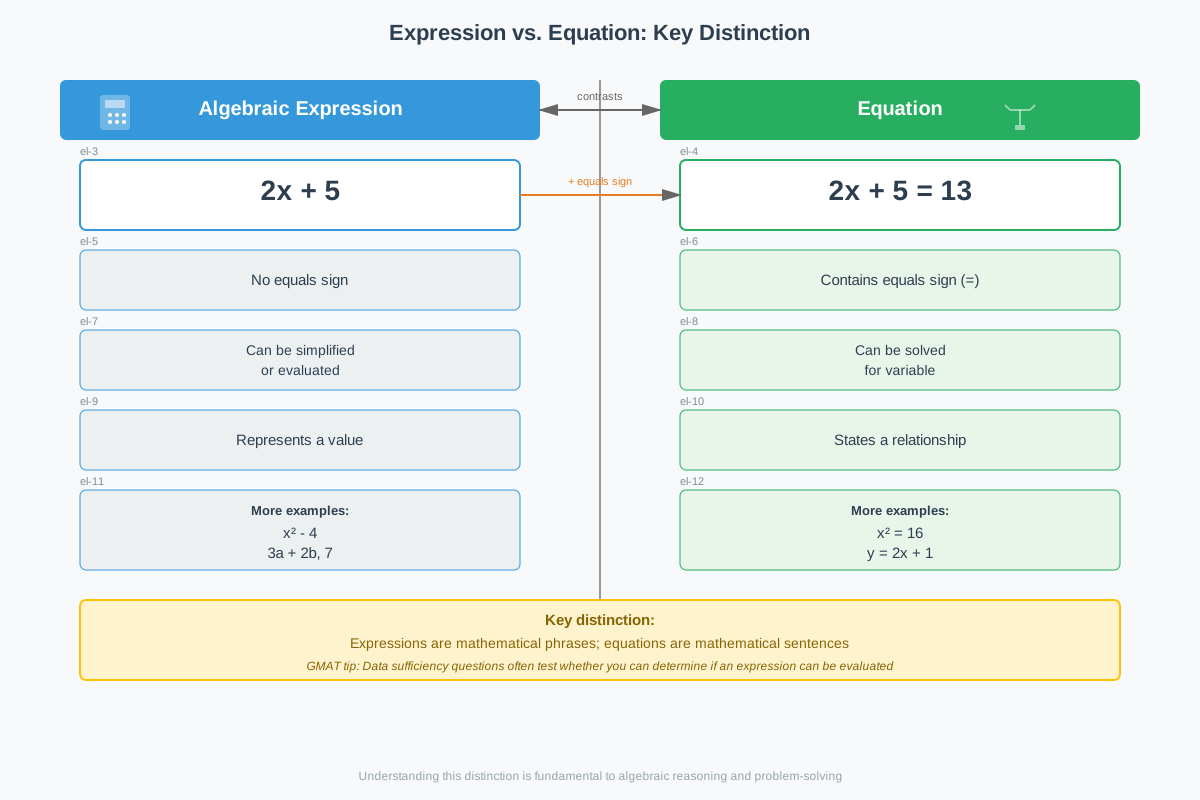
Algebraic expressions form the foundation of algebra on the GMAT Quantitative Reasoning section. These mathematical phrases combine variables, constants, and operations to represent quantities and relationships without using an equals sign. Unlike equations, which assert equality between two expressions, algebraic expressions stand alone as mathematical statements that can be simplified, evaluated, or manipulated. Mastering algebraic expressions is essential because they appear in approximately 30-40% of GMAT Quantitative questions, either directly or as components of more complex problems involving equations, inequalities, word problems, and data sufficiency questions.
Understanding GMAT algebraic expressions requires more than memorizing formulas—it demands the ability to recognize patterns, simplify complex expressions efficiently, and translate word problems into mathematical language. The GMAT tests these skills through various question formats, including problem-solving questions that require simplification or evaluation, and data sufficiency questions that test whether you can determine if an expression can be evaluated with given information. The ability to work fluently with algebraic expressions directly impacts performance on questions involving functions, sequences, coordinate geometry, and even some statistics problems.
The relationship between algebraic expressions and other Quantitative Reasoning concepts is fundamental and pervasive. Expressions serve as building blocks for equations and inequalities, provide the framework for understanding functions and their transformations, and enable the translation of real-world scenarios into mathematical models. Strong command of algebraic expressions accelerates problem-solving across multiple GMAT topics, making this one of the highest-yield areas for focused study and practice.
Learning Objectives
- [ ] Identify algebraic expressions in various forms and contexts
- [ ] Explain the components and structure of algebraic expressions
- [ ] Apply algebraic expressions to GMAT questions efficiently
- [ ] Simplify complex algebraic expressions using appropriate techniques
- [ ] Evaluate algebraic expressions for given variable values
- [ ] Translate word problems into algebraic expressions accurately
- [ ] Recognize equivalent forms of algebraic expressions
Prerequisites
- Basic arithmetic operations: Addition, subtraction, multiplication, and division form the operational foundation for manipulating algebraic expressions
- Order of operations (PEMDAS): Essential for correctly simplifying and evaluating expressions with multiple operations
- Integer properties: Understanding positive/negative numbers, even/odd properties, and prime numbers helps in factoring and simplification
- Fraction and decimal operations: Many algebraic expressions involve rational coefficients requiring fluent fraction manipulation
- Exponent rules: Basic understanding of powers and roots is necessary for working with polynomial expressions
Why This Topic Matters
Algebraic expressions represent one of the most practical mathematical tools used across business, economics, and data analysis—fields central to MBA programs and business careers. In real-world applications, expressions model revenue functions, cost structures, growth rates, and optimization problems. Business analysts regularly construct algebraic expressions to represent relationships between variables like price and demand, or investment and return.
On the GMAT specifically, algebraic expressions appear in approximately 12-15 questions per exam across both problem-solving and data sufficiency formats. The test makers favor this topic because it efficiently assesses logical reasoning, pattern recognition, and mathematical fluency simultaneously. Questions involving algebraic expressions typically appear at all difficulty levels, from 500-level questions testing basic simplification to 700+ level questions requiring sophisticated manipulation and insight.
Common GMAT question types featuring algebraic expressions include: simplification problems requiring you to reduce complex expressions to simplest form; evaluation problems providing variable values and asking for numerical results; translation problems requiring conversion of word problems into expressions; equivalence problems testing whether you can recognize that different-looking expressions are identical; and data sufficiency questions asking whether given information allows you to determine an expression's value. The versatility of this topic means that improving your expression-handling skills yields dividends across multiple question categories.
Core Concepts
Definition and Components
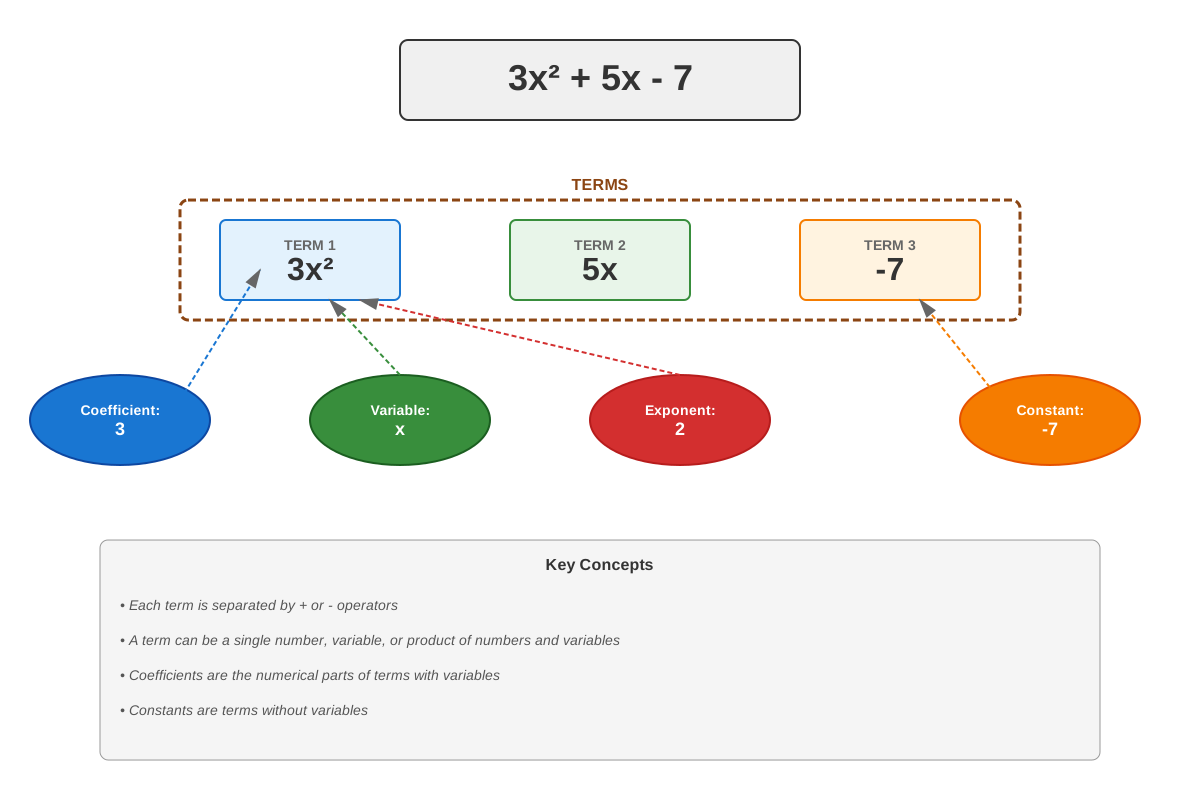
An algebraic expression is a mathematical phrase that combines numbers (constants), letters (variables), and operations (addition, subtraction, multiplication, division, exponentiation) without an equals sign. The fundamental components include:
- Variables: Letters representing unknown or changing quantities (typically x, y, z, a, b, c)
- Constants: Fixed numerical values (integers, fractions, decimals)
- Coefficients: Numbers multiplied by variables (in 5x, the coefficient is 5)
- Terms: Parts of an expression separated by addition or subtraction (3x² + 2x - 7 has three terms)
- Operators: Mathematical operations connecting terms (+, -, ×, ÷, exponents)
For example, in the expression 4x² - 3xy + 7y - 2, there are four terms: 4x² (with coefficient 4), -3xy (with coefficient -3), 7y (with coefficient 7), and -2 (the constant term).
Types of Algebraic Expressions
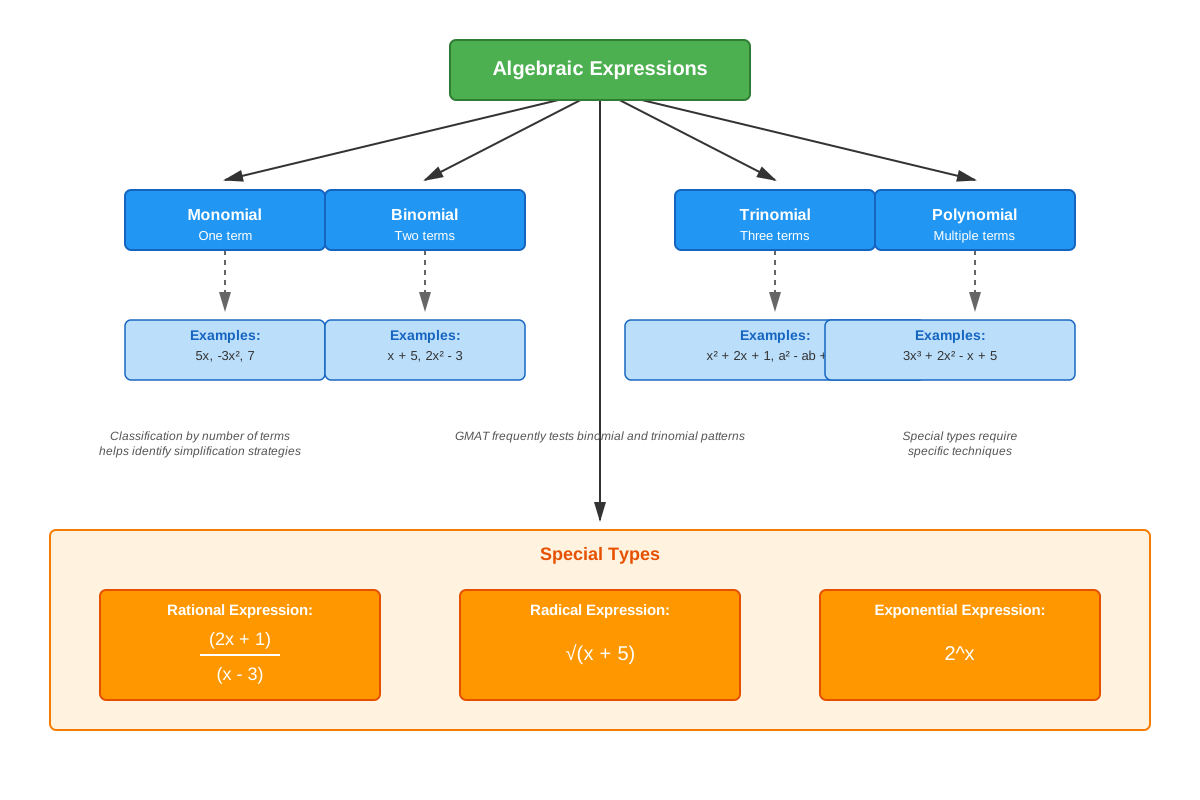
Monomials consist of a single term, such as 5x, -3y², or 7. These are the simplest expressions and serve as building blocks for more complex forms.
Binomials contain exactly two terms connected by addition or subtraction, such as 3x + 4 or x² - 9. Binomials frequently appear in GMAT questions involving factoring and special products.
Trinomials have three terms, commonly appearing as quadratic expressions like x² + 5x + 6 or 2a² - 3ab + b².
Polynomials are expressions with one or more terms involving variables with non-negative integer exponents. The expression 4x³ - 2x² + 7x - 1 is a polynomial of degree 3 (the highest exponent).
Simplifying Algebraic Expressions
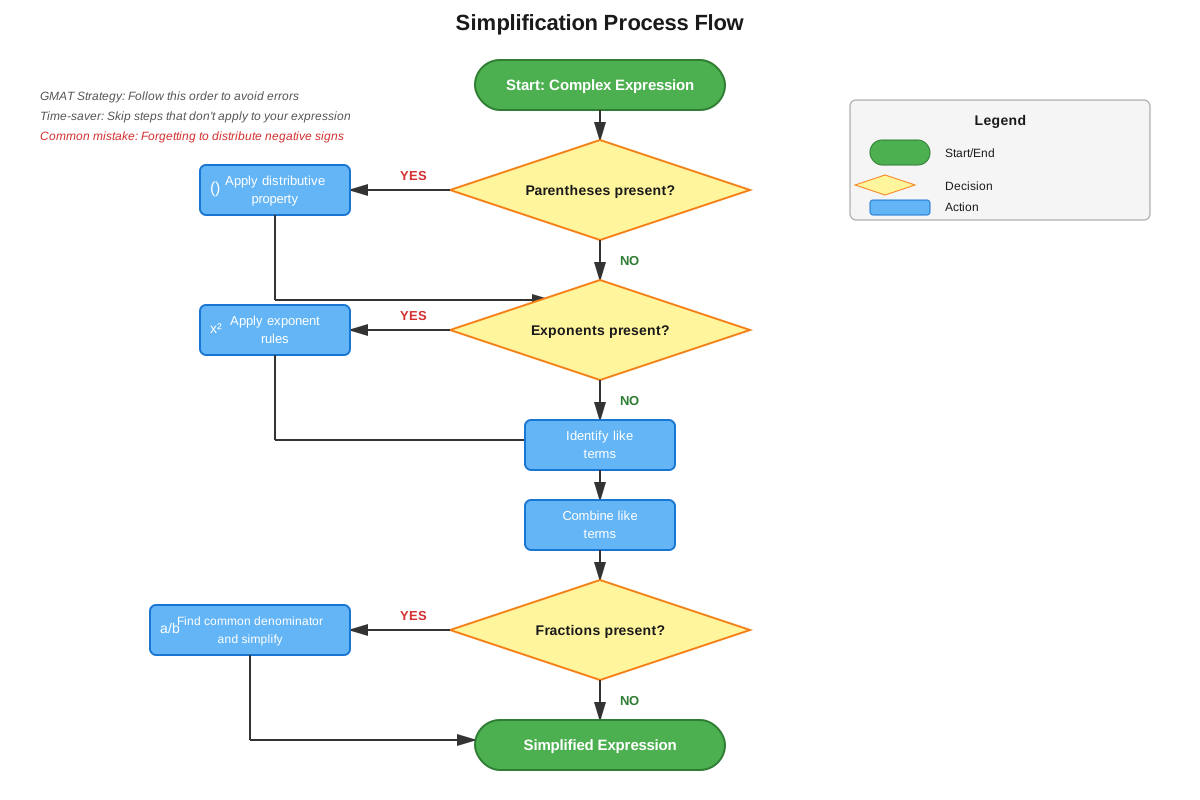
Simplification involves reducing expressions to their most compact form by combining like terms and applying algebraic properties. Like terms have identical variable parts with the same exponents. For instance, 3x² and -5x² are like terms, but 3x² and 3x are not.
The simplification process follows these steps:
- Remove parentheses using the distributive property
- Identify like terms (same variables with same exponents)
- Combine coefficients of like terms
- Arrange terms in standard form (descending exponent order)
Example: Simplify 3(2x - 4) + 5x - 2(x + 3)
- Step 1: 6x - 12 + 5x - 2x - 6
- Step 2: Identify like terms: 6x, 5x, -2x (x terms) and -12, -6 (constants)
- Step 3: (6 + 5 - 2)x + (-12 - 6) = 9x - 18
Evaluating Algebraic Expressions
Evaluation means finding the numerical value of an expression when specific values are substituted for variables. The process requires careful attention to order of operations and sign conventions.
Steps for evaluation:
- Substitute given values for each variable
- Apply order of operations (PEMDAS)
- Simplify to a single numerical value
Example: Evaluate 2x² - 3xy + y² when x = -2 and y = 3
- Substitute: 2(-2)² - 3(-2)(3) + (3)²
- Calculate: 2(4) - 3(-6) + 9
- Simplify: 8 + 18 + 9 = 35
Special Products and Factoring Patterns
The GMAT frequently tests recognition of special algebraic patterns that allow rapid simplification:
| Pattern Name | Expanded Form | Factored Form |
|---|---|---|
| Difference of Squares | a² - b² | (a + b)(a - b) |
| Perfect Square Trinomial | a² + 2ab + b² | (a + b)² |
| Perfect Square Trinomial | a² - 2ab + b² | (a - b)² |
| Sum of Cubes | a³ + b³ | (a + b)(a² - ab + b²) |
| Difference of Cubes | a³ - b³ | (a - b)(a² + ab + b²) |
Recognizing these patterns saves significant time on the GMAT. For instance, seeing x² - 16 should immediately trigger recognition as (x + 4)(x - 4) rather than requiring manual factoring.
The Distributive Property
The distributive property states that a(b + c) = ab + ac. This fundamental property enables both expansion (removing parentheses) and factoring (creating parentheses). On the GMAT, the distributive property appears in various forms:
- Single term distribution: 3(x + 4) = 3x + 12
- Binomial multiplication (FOIL): (x + 2)(x + 3) = x² + 3x + 2x + 6 = x² + 5x + 6
- Reverse distribution (factoring): 6x + 9 = 3(2x + 3)
Combining and Simplifying Rational Expressions
Rational expressions are fractions containing algebraic expressions in numerator, denominator, or both. Simplification requires finding common denominators and factoring:
Example: Simplify (x² - 4)/(x + 2)
- Factor numerator: (x + 2)(x - 2)/(x + 2)
- Cancel common factors: x - 2 (for x ≠ -2)
When adding or subtracting rational expressions, find the least common denominator (LCD) first, then combine numerators.
Concept Relationships
The concepts within algebraic expressions build hierarchically and interconnect extensively. Understanding terms and coefficients → enables → identification of like terms → which allows → simplification through combination. Similarly, mastering the distributive property → enables → expansion of products → and → factoring of expressions → which facilitates → recognition of special products.
The relationship between simplification and evaluation is bidirectional: simplifying before evaluation reduces computational complexity, while understanding evaluation helps verify whether simplification was performed correctly. Both skills depend on fluent application of order of operations.
Algebraic expressions connect to prerequisite topics through their operational foundation: arithmetic operations provide the computational rules, exponent laws govern how terms with powers combine, and fraction operations determine how rational expressions simplify. Looking forward, algebraic expressions enable progression to equations (expressions set equal to each other), inequalities (expressions with inequality relationships), functions (expressions defining input-output relationships), and word problems (real-world scenarios requiring expression translation).
The pattern recognition skills developed through special products and factoring directly transfer to quadratic equations, polynomial division, and coordinate geometry problems involving parabolas and other curves. Understanding how to manipulate expressions algebraically is prerequisite for optimization problems, rate problems, and mixture problems—all high-frequency GMAT question types.
Quick check — test yourself on Algebraic expressions so far.
Try Flashcards →High-Yield Facts
⭐ An algebraic expression contains variables, constants, and operations but no equals sign; once you add an equals sign, it becomes an equation
⭐ Like terms must have identical variable parts with identical exponents; only coefficients can differ
⭐ The difference of squares pattern (a² - b²) = (a + b)(a - b) appears in approximately 15% of GMAT algebra questions
⭐ When evaluating expressions with negative values, always use parentheses around substituted values to avoid sign errors
⭐ The distributive property works in both directions: expanding a(b + c) = ab + ac and factoring ab + ac = a(b + c)
- Terms are separated by addition or subtraction operations, not by multiplication or division
- The degree of a polynomial is determined by the highest exponent on any variable
- Coefficients of 1 are typically not written (x means 1x), but coefficients of -1 must show the negative sign (-x)
- When combining like terms, only coefficients are added or subtracted; the variable part remains unchanged
- Perfect square trinomials always have the form a² ± 2ab + b², where the middle term is twice the product of the square roots of the first and last terms
- In rational expressions, you can only cancel factors, never terms that are added or subtracted
- The order of terms in an expression doesn't affect its value due to the commutative property (3x + 5 = 5 + 3x)
- Expressions with even exponents always yield non-negative results when evaluated with real numbers
- Factoring is the reverse process of expansion; both use the distributive property
Common Misconceptions
Misconception: Like terms can have different exponents as long as they have the same variable → Correction: Like terms must have identical variable parts with identical exponents. The terms 3x² and 5x are not like terms because the exponents differ (2 vs. 1), so they cannot be combined through addition or subtraction.
Misconception: When distributing a negative sign, only the first term inside parentheses becomes negative → Correction: A negative sign (or negative coefficient) distributes to every term inside parentheses. For -(3x - 4), the result is -3x + 4, not -3x - 4. Both terms change sign.
Misconception: You can cancel terms across addition in a fraction, such as simplifying (x + 3)/x to 3 → Correction: You can only cancel common factors, not terms connected by addition or subtraction. The expression (x + 3)/x cannot be simplified by canceling x because x is a term in the numerator, not a factor of the entire numerator.
Misconception: (a + b)² equals a² + b² → Correction: (a + b)² = a² + 2ab + b². The middle term 2ab is essential and frequently forgotten. For example, (x + 3)² = x² + 6x + 9, not x² + 9.
Misconception: When substituting negative values, the negative sign doesn't affect exponents → Correction: When substituting a negative value for a variable with an exponent, parentheses are essential. If x = -2, then x² = (-2)² = 4, but -x² = -(2)² = -4. The placement of the negative sign relative to the exponent matters critically.
Misconception: All algebraic expressions can be simplified to a single term → Correction: Expressions can only be simplified by combining like terms. If no like terms exist, the expression is already in simplest form. The expression 3x² + 5x - 2 cannot be simplified further because it contains no like terms.
Misconception: Coefficients and exponents can be combined when multiplying terms → Correction: When multiplying terms with the same base, add exponents but multiply coefficients. For 3x² · 4x³, the result is 12x⁵ (multiply 3 × 4 = 12, add exponents 2 + 3 = 5), not 12x⁶ or 7x⁵.
Worked Examples
Example 1: Simplification and Evaluation
Problem: Simplify the expression 2(3x - 4) - 3(x - 2) + 5x, then evaluate when x = -1.
Solution:
Step 1: Apply the distributive property to remove parentheses
- 2(3x - 4) = 6x - 8
- -3(x - 2) = -3x + 6
- Expression becomes: 6x - 8 - 3x + 6 + 5x
Step 2: Identify and group like terms
- x terms: 6x - 3x + 5x
- Constant terms: -8 + 6
Step 3: Combine like terms
- x terms: (6 - 3 + 5)x = 8x
- Constants: -8 + 6 = -2
- Simplified expression: 8x - 2
Step 4: Evaluate for x = -1
- Substitute: 8(-1) - 2
- Calculate: -8 - 2 = -10
Answer: The simplified expression is 8x - 2, which equals -10 when x = -1.
Connection to Learning Objectives: This example demonstrates identification of algebraic expressions, application of simplification techniques, and evaluation with substitution—addressing three core learning objectives simultaneously.
Example 2: Pattern Recognition and Factoring
Problem: A GMAT data sufficiency question asks: "What is the value of x² - y²?"
Statement (1): x + y = 7
Statement (2): x - y = 3
Solution:
Step 1: Recognize the target expression as a difference of squares
- x² - y² = (x + y)(x - y)
Step 2: Analyze Statement (1) alone
- Provides x + y = 7
- Need both factors to evaluate (x + y)(x - y)
- Insufficient alone
Step 3: Analyze Statement (2) alone
- Provides x - y = 3
- Need both factors to evaluate (x + y)(x - y)
- Insufficient alone
Step 4: Combine both statements
- (x + y)(x - y) = (7)(3) = 21
- Can determine the value of x² - y²
- Sufficient together
Answer: C (Both statements together are sufficient, but neither alone is sufficient)
Key Insight: Recognizing the difference of squares pattern immediately reveals what information is needed, transforming a potentially complex problem into simple multiplication. Without this pattern recognition, test-takers might attempt to solve for x and y individually—a much more time-consuming approach.
Connection to Learning Objectives: This example shows how identifying special forms of algebraic expressions and applying pattern recognition enables efficient problem-solving on GMAT questions, particularly in data sufficiency format.
Exam Strategy
When approaching GMAT questions involving algebraic expressions, begin by identifying the expression type and recognizing any special patterns. Scan for difference of squares, perfect square trinomials, or common factoring opportunities before attempting manual manipulation. This pattern recognition often reduces complex problems to simple arithmetic.
Trigger words and phrases that signal algebraic expression questions include: "simplify," "evaluate when," "express in terms of," "which of the following is equivalent to," "factor," "expand," and "combine." In data sufficiency questions, phrases like "determine the value of the expression" or "what is the value of" indicate you need to assess whether given information allows evaluation.
For process of elimination, recognize that incorrect answer choices often result from common errors: forgetting to distribute negative signs, incorrectly combining unlike terms, or making sign errors when substituting negative values. If your answer doesn't match any choice, check these common mistakes before recalculating from scratch. On data sufficiency questions, eliminate choices systematically: if Statement (1) alone is insufficient, eliminate A and D immediately; if Statement (2) alone is insufficient, eliminate B.
Time allocation for expression problems should average 1.5-2 minutes. If simplification becomes algebraically complex after 30 seconds, look for alternative approaches: substituting simple numbers (like 0, 1, or -1) to test answer choices, or recognizing that the question might be testing pattern recognition rather than computational skill. For data sufficiency questions involving expressions, spend 15-20 seconds identifying what the expression needs (specific values, relationships, or factored forms) before analyzing the statements.
Exam Tip: On problem-solving questions, if you're asked to simplify an expression and the answer choices look very different from each other, you can often substitute a simple value for the variable and eliminate choices that don't match. This "plug-in" strategy works when answer choices are algebraic expressions themselves.
Memory Techniques
FOIL for binomial multiplication: First, Outer, Inner, Last terms. When multiplying (a + b)(c + d), multiply First terms (ac), Outer terms (ad), Inner terms (bc), Last terms (bd), then combine.
"DOTS" for Difference Of Two Squares: When you see a² - b², think Difference Of Two Squares = (a + b)(a - b). The acronym reminds you this pattern factors into a sum and difference.
"Please Excuse My Dear Aunt Sally" (PEMDAS) for order of operations: Parentheses, Exponents, Multiplication/Division (left to right), Addition/Subtraction (left to right). Essential for correct evaluation.
Visualization strategy for like terms: Imagine like terms as identical containers that can be stacked together. The terms 3x² and 5x² are identical containers (both x² containers) holding different amounts (3 vs. 5), so they stack to make 8x². But 3x² and 5x are different-shaped containers that cannot stack.
"Same Variables, Same Powers, Combine the Towers": A rhyme to remember that like terms must have identical variables with identical exponents, and when combining them, you add or subtract only the coefficients (the "towers" of numbers in front).
The Parentheses Protection Rule: When substituting negative numbers, always wrap them in parentheses. Think of parentheses as protective shields that prevent sign errors. If x = -3, write (-3)² not -3² to ensure correct evaluation.
Summary
Algebraic expressions are mathematical phrases combining variables, constants, and operations without equals signs, forming the foundation for approximately 30-40% of GMAT Quantitative questions. Mastery requires three core competencies: identification of expression types and components, simplification through combining like terms and applying the distributive property, and evaluation by substituting values and following order of operations. The most critical skill for GMAT success is recognizing special patterns—particularly the difference of squares (a² - b²) and perfect square trinomials (a² ± 2ab + b²)—which transform complex problems into simple calculations. Common pitfalls include incorrectly combining unlike terms, failing to distribute negative signs to all terms, and making sign errors when substituting negative values. Efficient problem-solving requires systematic approaches: remove parentheses first, identify and combine like terms, recognize factoring opportunities, and verify results by substitution. Strong command of algebraic expressions enables progression to equations, inequalities, functions, and word problems, making this topic one of the highest-yield areas for GMAT preparation.
Key Takeaways
- Algebraic expressions contain variables, constants, and operations but no equals sign; they can be simplified and evaluated but not "solved"
- Like terms must have identical variable parts with identical exponents; only coefficients are combined when simplifying
- The difference of squares pattern (a² - b² = (a + b)(a - b)) appears frequently on the GMAT and enables rapid simplification
- The distributive property works bidirectionally: expanding removes parentheses (a(b + c) = ab + ac) while factoring creates them (ab + ac = a(b + c))
- When substituting negative values, always use parentheses to prevent sign errors: if x = -2, write (-2)² = 4, not -2² = -4
- Pattern recognition is more valuable than computational skill; identifying special forms saves significant time
- In data sufficiency questions, determine what information the expression needs before analyzing the statements
Related Topics
Equations and Inequalities: Building on algebraic expressions, equations set two expressions equal while inequalities compare them. Mastering expressions provides the manipulation skills needed to solve for unknown variables efficiently.
Functions: Functions are special algebraic expressions that define relationships between inputs and outputs. Understanding expression evaluation directly transfers to function evaluation and transformation problems.
Word Problem Translation: Many GMAT word problems require translating verbal descriptions into algebraic expressions before solving. Strong expression skills enable accurate mathematical modeling of real-world scenarios.
Quadratic Expressions and Equations: Quadratic expressions (degree 2 polynomials) represent a specialized category requiring additional factoring techniques and solution methods, building directly on general expression manipulation skills.
Coordinate Geometry: Algebraic expressions define lines, parabolas, and other geometric figures in the coordinate plane. Expression manipulation enables solving intersection problems and analyzing geometric relationships algebraically.
Practice CTA
Now that you've mastered the fundamentals of algebraic expressions, it's time to solidify your understanding through active practice. Attempt the practice questions to apply these concepts under test-like conditions, and use the flashcards to reinforce pattern recognition and key formulas. Remember, the GMAT rewards not just knowledge but speed and accuracy—skills developed only through deliberate practice. Each problem you solve strengthens your algebraic intuition and builds the confidence needed for test day success. Start practicing now to transform these concepts from theoretical knowledge into automatic problem-solving skills!
Sign up free to keep reading
Create a free AnvayaPrep account to finish this GMAT guide on Algebraic expressions — plus flashcards and practice questions.