Overview
Function notation is a fundamental algebraic concept that appears frequently on the GMAT Quantitative Reasoning section. At its core, function notation provides a standardized mathematical language for expressing relationships between variables, where one quantity depends on another. Rather than writing equations in traditional form, function notation uses symbols like f(x), g(t), or h(n) to represent these relationships efficiently and precisely. This notation system allows test-makers to create sophisticated problems that test multiple algebraic skills simultaneously, making it a high-yield topic for serious GMAT preparation.
Understanding GMAT function notation is essential because it serves as the foundation for numerous question types that appear across the Quantitative section. These questions may ask students to evaluate functions at specific values, compose multiple functions together, interpret unusual function definitions, or work with piecewise functions. The GMAT frequently uses function notation to disguise relatively straightforward algebraic manipulations, testing whether students can translate between different mathematical representations. Students who master this topic gain a significant advantage, as function problems often appear intimidating but become manageable once the underlying patterns are recognized.
Function notation connects deeply to broader Quantitative Reasoning concepts including algebraic manipulation, substitution, equation solving, and pattern recognition. It also serves as a bridge to more advanced topics like sequences, coordinate geometry, and data sufficiency questions involving variable relationships. The ability to work fluently with functions demonstrates mathematical maturity and abstract reasoning skills that the GMAT explicitly tests, making this topic both practically important for scoring well and conceptually central to the exam's assessment goals.
Learning Objectives
- [ ] Identify function notation in GMAT problems and distinguish it from standard algebraic expressions
- [ ] Explain the meaning and components of function notation, including domain, range, and function rules
- [ ] Apply function notation to solve GMAT questions involving evaluation, composition, and manipulation
- [ ] Evaluate functions at specific numerical and algebraic inputs with accuracy
- [ ] Compose multiple functions and simplify the resulting expressions
- [ ] Interpret non-standard function definitions and symbolic operations unique to GMAT problems
- [ ] Solve inverse function problems and determine when functions are invertible
Prerequisites
- Basic algebraic manipulation: Essential for substituting values into function expressions and simplifying results
- Order of operations (PEMDAS): Required to correctly evaluate complex function expressions with nested operations
- Equation solving: Necessary when finding input values that produce specific outputs or solving for unknowns within functions
- Substitution techniques: The fundamental skill underlying all function evaluation problems
- Exponent and radical rules: Frequently appear in function definitions and must be applied correctly during evaluation
Why This Topic Matters
Function notation represents one of the most versatile mathematical tools tested on the GMAT. In real-world applications, functions model countless relationships: business revenue as a function of price, population growth as a function of time, or cost structures as functions of production volume. The ability to work with functional relationships translates directly to quantitative reasoning skills valued in business school and professional contexts, from financial modeling to operations analysis.
On the GMAT specifically, function notation appears in approximately 10-15% of Quantitative Reasoning questions, making it a high-frequency topic that cannot be ignored. These questions span both Problem Solving and Data Sufficiency formats, with difficulty levels ranging from medium to very hard. Function problems often serve as "separator questions" that distinguish high scorers from average performers, as they require both technical skill and conceptual understanding.
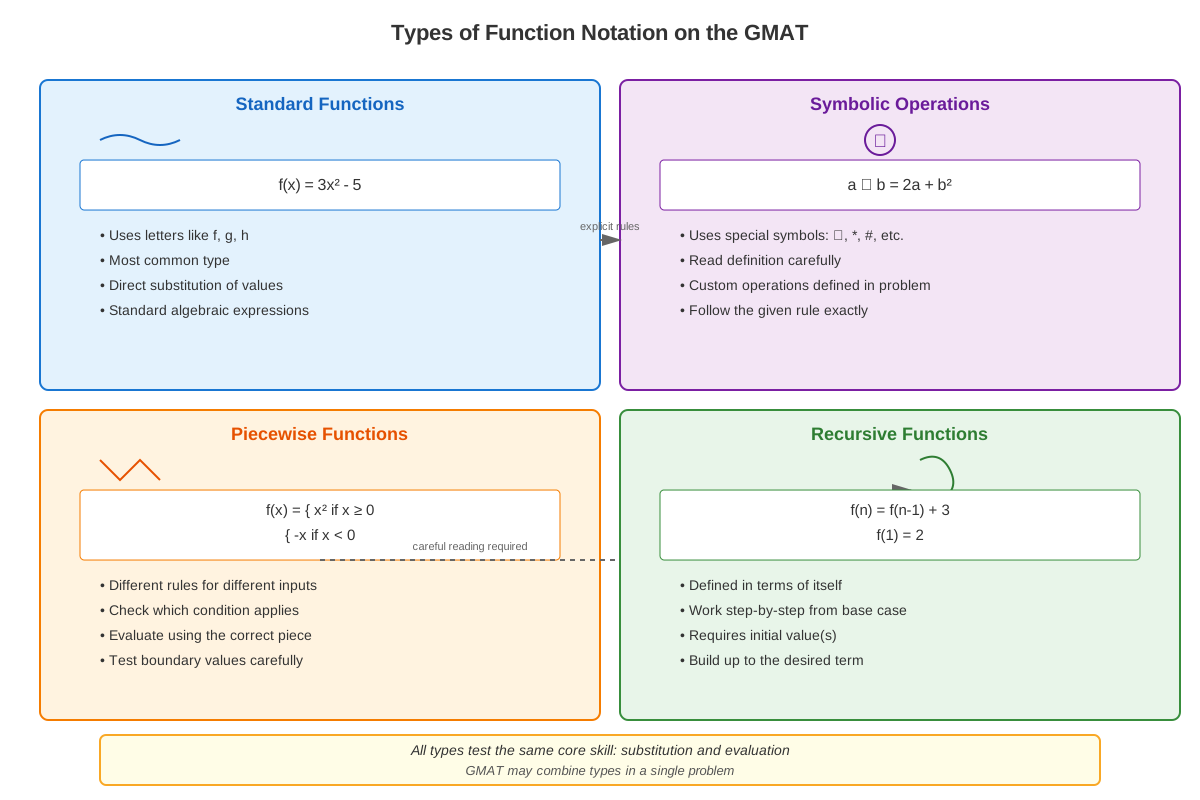
The GMAT presents function notation in several characteristic ways: defining custom operations using unusual symbols (like a ⊗ b = a² + 2b), asking for function composition f(g(x)), testing piecewise functions with different rules for different input ranges, or embedding functions within word problems about sequences or patterns. The exam also frequently combines function notation with other topics like inequalities, absolute values, or coordinate geometry, creating multi-step problems that test integrated mathematical reasoning. Recognizing these patterns and developing systematic approaches to function problems provides a significant strategic advantage on test day.
Core Concepts
Basic Function Notation Structure
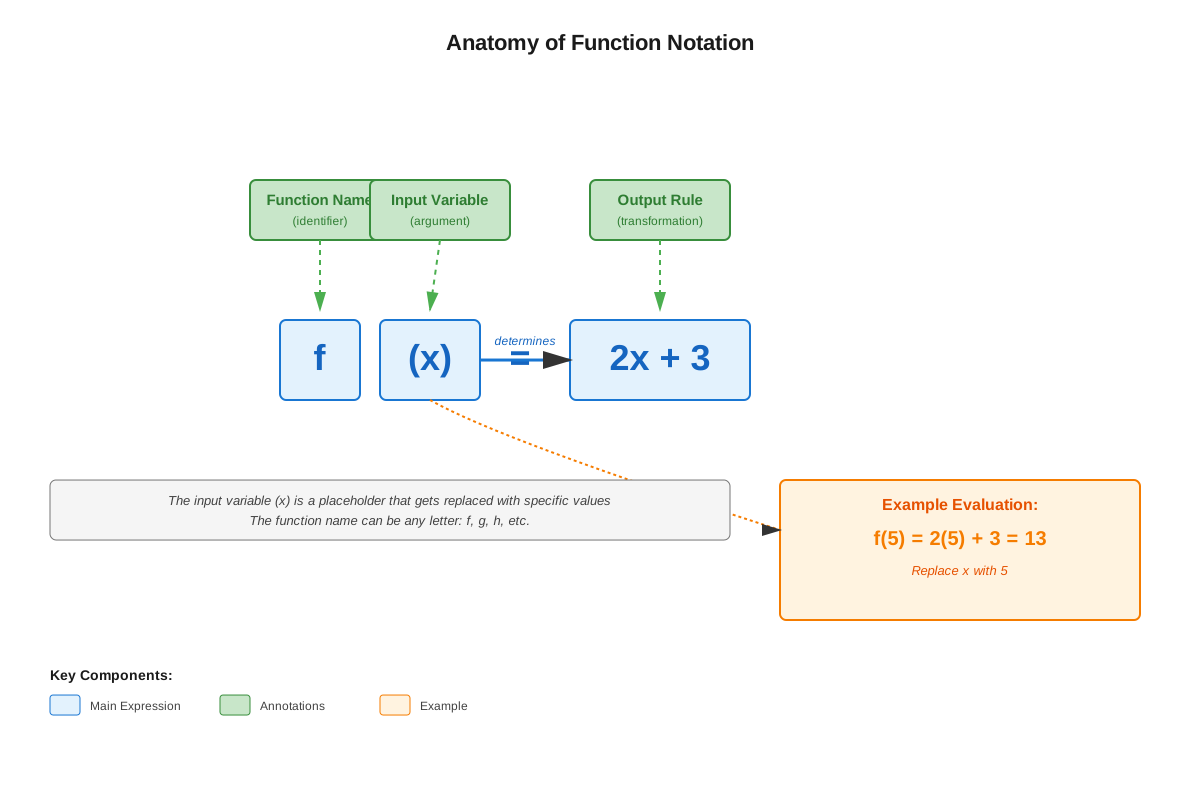
Function notation uses the format f(x) to represent a rule that assigns each input value x to exactly one output value. The letter f names the function (though any letter can be used: g, h, F, etc.), while the variable in parentheses indicates the input. The expression f(x) is read as "f of x" and represents the output value when x is the input.
For example, if f(x) = 2x + 3, this defines a function where the output equals twice the input plus three. To evaluate f(5), substitute 5 for every occurrence of x: f(5) = 2(5) + 3 = 10 + 3 = 13. The key principle is that the variable in parentheses is a placeholder that can be replaced with any value or expression.
Function Evaluation
Function evaluation involves substituting a specific value or expression for the input variable and simplifying. This is the most fundamental operation with functions and appears in virtually every GMAT function problem.
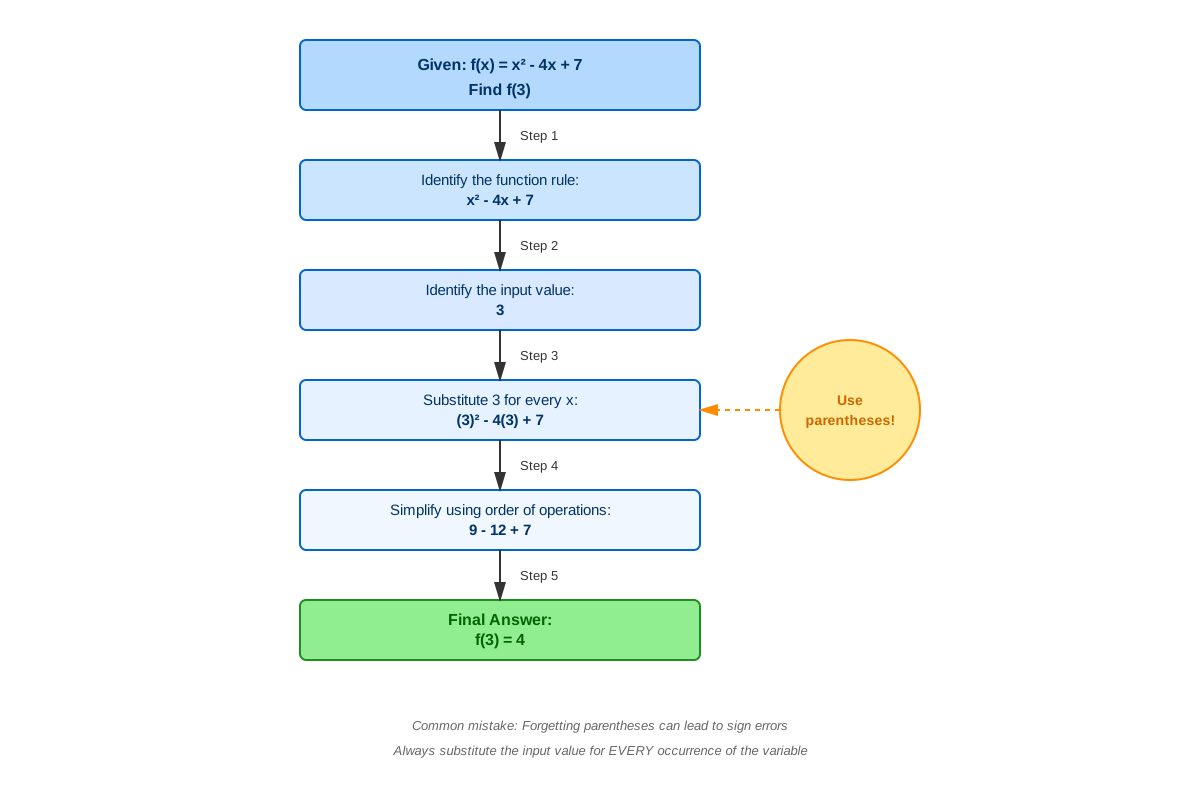
Step-by-step evaluation process:
- Identify the function rule and the input value
- Replace every instance of the input variable with the given value (use parentheses!)
- Apply order of operations to simplify
- State the final output value
Consider f(x) = x² - 4x + 7. To find f(-2):
- f(-2) = (-2)² - 4(-2) + 7
- f(-2) = 4 + 8 + 7
- f(-2) = 19
Critical detail: When substituting negative numbers or expressions, always use parentheses to avoid sign errors. This is especially important with exponents and multiplication.
Algebraic Input Evaluation
Functions can accept algebraic expressions as inputs, not just numbers. When evaluating f(x + 1) or f(2a), substitute the entire expression for the variable throughout the function rule.
For f(x) = x² + 3x, find f(x + 1):
- f(x + 1) = (x + 1)² + 3(x + 1)
- f(x + 1) = x² + 2x + 1 + 3x + 3
- f(x + 1) = x² + 5x + 4
This technique is essential for function composition and appears frequently in harder GMAT problems.
Function Composition
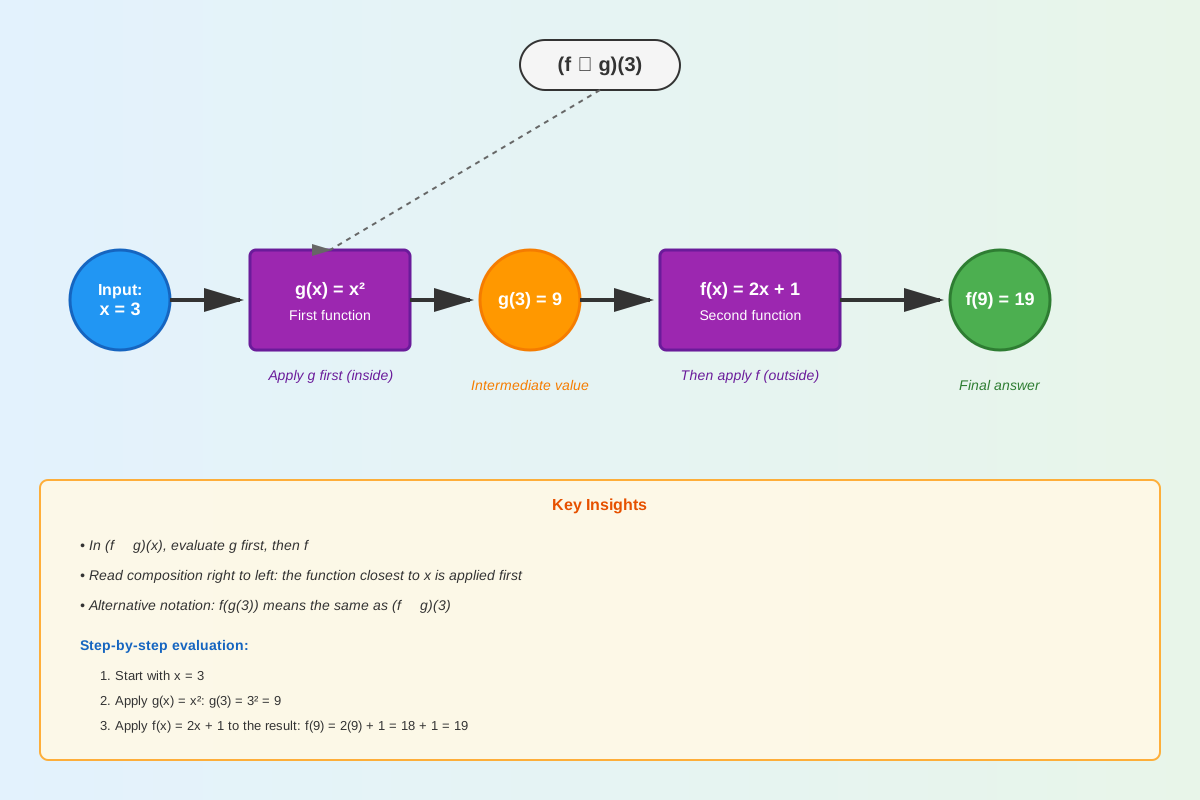
Function composition combines two functions by using the output of one function as the input to another. The notation f(g(x)) means "apply g first, then apply f to the result." This is read as "f of g of x" or "f composed with g."
To evaluate f(g(3)) when f(x) = 2x - 1 and g(x) = x² + 2:
- First evaluate the inner function: g(3) = 3² + 2 = 9 + 2 = 11
- Use this result as input to the outer function: f(11) = 2(11) - 1 = 22 - 1 = 21
- Therefore, f(g(3)) = 21
Order matters: f(g(x)) generally does not equal g(f(x)). Always work from the inside out.
Custom Operations and Symbolic Functions
The GMAT frequently defines non-standard operations using unique symbols. These are simply functions in disguise, using unfamiliar notation to test whether students can follow definitions precisely.
Example: Define a ⊗ b = a² + ab - b²
To evaluate 3 ⊗ 4:
- 3 ⊗ 4 = 3² + (3)(4) - 4²
- 3 ⊗ 4 = 9 + 12 - 16
- 3 ⊗ 4 = 5
These problems test reading comprehension and careful substitution more than advanced mathematics. The key is to identify what each symbol represents and substitute methodically.
Piecewise Functions
Piecewise functions use different rules for different input ranges. They are defined with conditions that specify which rule applies when.
Example:
f(x) = { 2x + 1,  if x < 0
       { x²,      if x ≥ 0
To evaluate f(-3): Since -3 < 0, use the first rule: f(-3) = 2(-3) + 1 = -5
To evaluate f(4): Since 4 ≥ 0, use the second rule: f(4) = 4² = 16
Always check the conditions first to determine which rule applies before calculating.
Domain and Range Concepts
The domain of a function is the set of all possible input values, while the range is the set of all possible output values. While the GMAT rarely asks for formal domain/range statements, understanding these concepts helps interpret function problems correctly.
Common domain restrictions:
- Cannot divide by zero: f(x) = 1/(x - 3) excludes x = 3
- Cannot take square roots of negative numbers (in real numbers): f(x) = √(x - 5) requires x ≥ 5
- Logarithms require positive arguments: f(x) = log(x) requires x > 0
Inverse Functions
An inverse function reverses the operation of the original function. If f(a) = b, then f⁻¹(b) = a. The notation f⁻¹(x) represents the inverse function (not 1/f(x)).
To find an inverse algebraically:
- Replace f(x) with y
- Swap x and y
- Solve for y
- Replace y with f⁻¹(x)
For f(x) = 2x - 3:
- y = 2x - 3
- x = 2y - 3
- x + 3 = 2y
- y = (x + 3)/2
- f⁻¹(x) = (x + 3)/2
Concept Relationships
Function notation concepts build upon each other in a clear hierarchy. Basic function evaluation forms the foundation, requiring only substitution and algebraic simplification. This skill directly enables algebraic input evaluation, where expressions rather than numbers are substituted. Both of these techniques combine to make function composition possible, as composition requires evaluating one function and using that result as input to another.
Custom operations represent a parallel application of the same substitution principles, simply using unfamiliar symbols instead of standard notation. Piecewise functions add a conditional logic layer to basic evaluation, requiring students to first determine which rule applies before performing substitution. Domain and range concepts provide the theoretical framework that explains why certain inputs are valid or invalid, connecting to the practical evaluation skills. Finally, inverse functions represent the most advanced concept, requiring both equation-solving skills and deep understanding of the input-output relationship.
The progression flows: Basic Evaluation → Algebraic Evaluation → Composition → Advanced Applications (Piecewise, Inverse, Custom Operations). Each level assumes mastery of the previous concepts. This topic also connects backward to prerequisite algebra skills (substitution, equation solving) and forward to sequences, coordinate geometry (where functions describe curves), and word problems involving functional relationships.
Quick check — test yourself on Function notation so far.
Try Flashcards →High-Yield Facts
- ⭐ Function notation f(x) means "the output when x is the input"; the variable in parentheses is a placeholder that can be replaced with any value or expression
- ⭐ When evaluating functions with negative numbers or expressions, always use parentheses around the substituted value to avoid sign errors
- ⭐ Function composition f(g(x)) means evaluate g first, then use that result as input to f; always work from the inside out
- ⭐ For custom operations like a ⊗ b, carefully identify what each variable represents in the definition and substitute the given values in the correct positions
- ⭐ In piecewise functions, check the conditions first to determine which rule applies before performing any calculations
- f(a + b) does not generally equal f(a) + f(b); each function must be evaluated according to its specific rule
- The notation f⁻¹(x) represents the inverse function, not the reciprocal 1/f(x)
- When a function is defined using multiple variables like f(x, y) = x² + 2y, substitute values in the order they appear in the parentheses
- If f(x) = f(y), this does not necessarily mean x = y unless the function is one-to-one (passes the horizontal line test)
- Domain restrictions often arise from division by zero, square roots of negative numbers, or logarithms of non-positive numbers
- Function composition is not commutative: f(g(x)) ≠ g(f(x)) in general
- To find f(f(x)), substitute the entire function rule for x in the original function
- When solving equations like f(x) = 5, substitute the function rule for f(x) and solve the resulting equation for x
Common Misconceptions
Misconception: f(x + 2) equals f(x) + f(2) → Correction: f(x + 2) means substitute (x + 2) for every x in the function rule. For f(x) = x², f(x + 2) = (x + 2)² = x² + 4x + 4, which is not equal to f(x) + f(2) = x² + 4.
Misconception: The notation f(3) means f times 3 → Correction: f(3) means the output value of function f when the input is 3. It represents function evaluation, not multiplication. To find f(3), substitute 3 into the function rule.
Misconception: f⁻¹(x) means 1/f(x) → Correction: The superscript -1 in function notation indicates the inverse function, not a reciprocal. The inverse function reverses the original function's operation. If f(x) = 2x, then f⁻¹(x) = x/2, not 1/(2x).
Misconception: When evaluating f(-3) for f(x) = x², the answer is -9 → Correction: f(-3) = (-3)² = 9, not -9. The negative sign is inside the parentheses and gets squared. The error comes from forgetting to use parentheses when substituting negative values.
Misconception: In function composition, f(g(x)) means multiply f and g → Correction: f(g(x)) means evaluate g(x) first, then use that result as the input to f. It represents nested function evaluation, not multiplication. If f(x) = x + 1 and g(x) = 2x, then f(g(3)) = f(6) = 7.
Misconception: All functions have inverses → Correction: Only one-to-one functions (where each output corresponds to exactly one input) have inverses. For example, f(x) = x² does not have an inverse over all real numbers because f(2) = f(-2) = 4.
Misconception: For piecewise functions, all rules apply simultaneously → Correction: In piecewise functions, only one rule applies for any given input value, determined by which condition the input satisfies. Check the conditions to identify the single applicable rule before calculating.
Worked Examples
Example 1: Multi-Step Function Evaluation with Composition
Problem: If f(x) = 2x² - 3x + 1 and g(x) = x + 4, find the value of f(g(2)) - g(f(1)).
Solution:
Step 1: Evaluate g(2)
- g(2) = 2 + 4 = 6
Step 2: Evaluate f(g(2)) = f(6)
- f(6) = 2(6)² - 3(6) + 1
- f(6) = 2(36) - 18 + 1
- f(6) = 72 - 18 + 1
- f(6) = 55
Step 3: Evaluate f(1)
- f(1) = 2(1)² - 3(1) + 1
- f(1) = 2 - 3 + 1
- f(1) = 0
Step 4: Evaluate g(f(1)) = g(0)
- g(0) = 0 + 4 = 4
Step 5: Calculate final answer
- f(g(2)) - g(f(1)) = 55 - 4 = 51
Key Insights: This problem tests function composition in both directions and requires careful organization. Always evaluate the innermost function first, then work outward. Writing each step clearly prevents errors and makes verification possible.
Example 2: Custom Operation with Algebraic Inputs
Problem: Define the operation a ⊕ b = (a + b)² - (a - b)². If x ⊕ 3 = 48, what is the value of x?
Solution:
Step 1: Substitute x and 3 into the operation definition
- x ⊕ 3 = (x + 3)² - (x - 3)²
Step 2: Expand both squared terms
- (x + 3)² = x² + 6x + 9
- (x - 3)² = x² - 6x + 9
Step 3: Subtract the second from the first
- x ⊕ 3 = (x² + 6x + 9) - (x² - 6x + 9)
- x ⊕ 3 = x² + 6x + 9 - x² + 6x - 9
- x ⊕ 3 = 12x
Step 4: Set equal to 48 and solve
- 12x = 48
- x = 4
Step 5: Verify (optional but recommended)
- 4 ⊕ 3 = (4 + 3)² - (4 - 3)² = 49 - 1 = 48 ✓
Key Insights: Custom operations are just functions with unusual notation. The key is to substitute carefully according to the definition, then simplify algebraically. Notice that the x² terms canceled, which often happens in these problems—look for such simplifications to save time.
Example 3: Piecewise Function with Multiple Evaluations
Problem: A function h is defined as:
h(x) = { x² + 1,     if x ≤ 2
       { 3x - 2,     if x > 2
What is h(h(1))?
Solution:
Step 1: Evaluate h(1)
- Since 1 ≤ 2, use the first rule: h(1) = 1² + 1 = 2
Step 2: Evaluate h(h(1)) = h(2)
- Since 2 ≤ 2, use the first rule: h(2) = 2² + 1 = 5
Answer: h(h(1)) = 5
Alternative consideration: If the problem asked for h(h(3)):
- Step 1: Since 3 > 2, use the second rule: h(3) = 3(3) - 2 = 7
- Step 2: Since 7 > 2, use the second rule: h(7) = 3(7) - 2 = 19
Key Insights: With piecewise functions, always check the condition before each evaluation. When composing a piecewise function with itself, the output of the first evaluation determines which rule to use for the second evaluation. Don't assume the same rule applies both times.
Exam Strategy
When approaching GMAT function notation questions, begin by identifying the type of function problem: basic evaluation, composition, custom operation, or piecewise. This classification determines the solution strategy and helps allocate time appropriately.
Trigger words and phrases to recognize:
- "If f(x) = ..." signals a function definition requiring substitution
- "f(g(x))" or "f of g of x" indicates composition; work inside-out
- Unusual symbols (⊗, ⊕, *, #) with definitions indicate custom operations
- "For x < a" or "when x ≥ b" signals piecewise functions; check conditions first
- "What is f(a)?" asks for direct evaluation
- "For what value of x does f(x) = k?" requires solving an equation
- "f⁻¹(x)" indicates inverse functions; reverse the operation
Systematic approach for function problems:
- Read the definition carefully: Identify all variables and their roles
- Use parentheses religiously: When substituting, always enclose the substituted value in parentheses
- Work inside-out for composition: Evaluate the innermost function first
- Check conditions for piecewise functions: Determine which rule applies before calculating
- Simplify step-by-step: Don't try to do too much mental math; write intermediate steps
- Verify with easy numbers: If time permits, check your answer by substituting a simple value
Process of elimination tips:
- If a choice doesn't match the expected form (e.g., should be quadratic but answer is linear), eliminate it
- For composition problems, eliminate answers that ignore the order of operations
- Check extreme values: if f(0) should equal 5 but a choice gives f(0) = 3, eliminate it
- For custom operations, eliminate answers that don't respect the operation's symmetry or properties
Time allocation: Basic function evaluation should take 30-60 seconds. Composition problems typically require 90-120 seconds. Complex piecewise or multi-step problems may need 2-2.5 minutes. If a problem exceeds these times, consider marking it for review and moving on.
Exam Tip: The GMAT often makes function problems look harder than they are by using unfamiliar notation or complex-looking definitions. Stay calm, follow the definition precisely, and trust your substitution skills. Most function problems test careful execution rather than advanced mathematical insight.
Memory Techniques
FUNCTION mnemonic for evaluation steps:
- Find the function rule
- Understand what's being substituted
- Nest the substitution in parentheses
- Calculate using order of operations
- Test your answer if time permits
- Identify the output value
- Organize your work clearly
- Never skip parentheses
Composition order reminder: "Inside Out" - just like putting on socks before shoes, evaluate the inner function before the outer function. For f(g(x)), g is "inside" so it goes first.
Piecewise function visualization: Think of piecewise functions as a decision tree. At each input value, you're at a fork in the road—check the conditions to see which path (rule) to follow.
Custom operation translation: When you see a ⊗ b = [expression], mentally translate it to "The function ⊗ takes two inputs, a and b, and produces [expression]." This makes it clear that you're just doing function evaluation with unusual notation.
Inverse function concept: Remember "inverse means reverse." If a function takes you from A to B, the inverse takes you from B back to A. Think of it like a reversible journey.
Summary
Function notation provides a standardized mathematical language for expressing relationships between variables, where f(x) represents the output when x is the input. Mastering function notation requires understanding that the variable in parentheses is a placeholder that can be replaced with any value or expression, and that evaluation always involves careful substitution followed by algebraic simplification. The GMAT tests this concept through various formats: basic evaluation, algebraic input evaluation, function composition (where one function's output becomes another's input), custom operations using unusual symbols, and piecewise functions with different rules for different input ranges. Success with function problems depends on methodical substitution, consistent use of parentheses to avoid sign errors, working inside-out for composition, and checking conditions before applying piecewise rules. While function notation can appear intimidating with unfamiliar symbols or complex definitions, the underlying mathematics is typically straightforward algebra—the challenge lies in careful reading and precise execution. Students who develop systematic approaches to function problems and practice recognizing common patterns will find these high-frequency GMAT questions become reliable scoring opportunities rather than obstacles.
Key Takeaways
- Function notation f(x) uses the variable in parentheses as a placeholder that can be replaced with any value or expression through substitution
- Always enclose substituted values in parentheses to prevent sign errors, especially with negative numbers and algebraic expressions
- Function composition f(g(x)) requires evaluating the inner function first, then using that result as input to the outer function—always work inside-out
- Custom operations with unusual symbols are simply functions in disguise; follow the given definition precisely and substitute carefully
- Piecewise functions require checking conditions first to determine which rule applies before performing any calculations
- The GMAT frequently uses function notation to test careful reading and systematic execution rather than advanced mathematical concepts
- Practice translating between different representations of functions (standard notation, custom symbols, word descriptions) to build flexibility and confidence
Related Topics
Sequences and Series: Function notation provides the foundation for understanding sequences, where terms can be expressed as functions of position (e.g., aₙ = f(n)). Mastering function evaluation enables efficient work with recursive and explicit sequence formulas.
Coordinate Geometry: Functions describe relationships between x and y coordinates on the coordinate plane. Understanding function notation is essential for interpreting graphs, finding intercepts, and analyzing geometric properties of curves.
Inequalities with Functions: Solving inequalities involving functions (e.g., f(x) > 5) combines function evaluation with inequality manipulation, a common GMAT problem type.
Word Problems with Functional Relationships: Many GMAT word problems describe situations where one quantity depends on another (cost as a function of quantity, distance as a function of time), requiring translation into function notation.
Advanced Algebra: Function concepts extend to exponential functions, logarithmic functions, and polynomial functions, all of which appear on harder GMAT questions and build directly on the function notation foundation.
Practice CTA
Now that you've mastered the core concepts of function notation, it's time to solidify your understanding through active practice. Attempt the practice questions associated with this topic, focusing on applying the systematic approaches outlined in this guide. Work through problems methodically, writing out each substitution step clearly. Use the flashcards to reinforce key definitions and common patterns until function evaluation becomes automatic. Remember that function notation problems reward careful execution and attention to detail—skills that improve rapidly with focused practice. Each problem you solve builds the pattern recognition and confidence needed to tackle these high-yield GMAT questions efficiently on test day. You've built a strong foundation; now strengthen it through deliberate practice!
Sign up free to keep reading
Create a free AnvayaPrep account to finish this GMAT guide on Function notation — plus flashcards and practice questions.