Overview
The quadratic formula is one of the most powerful and frequently tested algebraic tools on the GMAT Quantitative Reasoning section. This formula provides a systematic method for finding the roots (solutions) of any quadratic equation, regardless of whether the equation can be easily factored. While many students initially learn to solve quadratic equations through factoring, the quadratic formula serves as a universal solution method that works in all cases, making it an indispensable tool for test-takers facing time pressure and complex problems.
On the GMAT, quadratic equations appear in various contexts: pure algebra problems, word problems involving area and geometry, optimization questions, and data sufficiency scenarios. Understanding the GMAT quadratic formula and its applications enables students to tackle these diverse question types with confidence and efficiency. The formula not only provides solutions but also reveals important information about the nature of those solutions—whether they are real or complex, rational or irrational, and how many distinct solutions exist.
Mastery of the quadratic formula connects directly to broader algebraic concepts including polynomial functions, graphing parabolas, inequalities, and systems of equations. It builds upon foundational skills in arithmetic operations, radical simplification, and equation manipulation while serving as a gateway to more advanced problem-solving strategies. For GMAT success, students must not only memorize the formula but also develop fluency in recognizing when to apply it, executing calculations accurately under time constraints, and interpreting results within the context of specific problems.
Learning Objectives
- [ ] Identify quadratic equations that require the quadratic formula for solution
- [ ] Explain the components and derivation of the quadratic formula
- [ ] Apply the quadratic formula to solve GMAT questions efficiently and accurately
- [ ] Determine the number and nature of solutions using the discriminant
- [ ] Recognize when alternative methods (factoring, completing the square) may be more efficient
- [ ] Interpret quadratic formula results in the context of word problems and data sufficiency questions
Prerequisites
- Basic algebraic manipulation: Essential for rearranging equations into standard form (ax² + bx + c = 0) before applying the formula
- Operations with radicals: Required for simplifying square root expressions that appear in the formula's numerator
- Fraction arithmetic: Necessary for reducing final answers and working with the formula's division component
- Understanding of equation solutions: Foundational concept that solutions are values that make the equation true when substituted
- Exponent rules: Needed for recognizing and manipulating squared terms in quadratic expressions
Why This Topic Matters
The quadratic formula represents a critical intersection of theoretical mathematics and practical problem-solving that appears consistently throughout the GMAT. In real-world applications, quadratic equations model countless phenomena: projectile motion, profit optimization, area maximization, and population growth patterns. Business school candidates encounter quadratic relationships in economics (supply-demand equilibrium), finance (compound interest calculations), and operations management (inventory optimization).
On the GMAT specifically, quadratic equations appear in approximately 10-15% of Quantitative Reasoning questions, making this a high-yield topic that directly impacts scores. Questions involving the quadratic formula typically appear at medium to high difficulty levels (600-750 score range), meaning mastery of this topic is essential for students targeting competitive business school programs. The formula appears in multiple question formats: Problem Solving questions requiring explicit calculation of roots, Data Sufficiency questions testing understanding of solution conditions, and integrated reasoning scenarios involving graphical interpretations.
Common GMAT manifestations include: word problems where two unknowns can be reduced to a single quadratic equation, geometry problems involving area or the Pythagorean theorem that generate quadratic relationships, questions about the x-intercepts of parabolas, and problems requiring analysis of when expressions are positive or negative. The GMAT also frequently tests conceptual understanding through questions about the discriminant, the relationship between roots and coefficients, and the conditions under which equations have specific types of solutions.
Core Concepts
The Standard Form of a Quadratic Equation
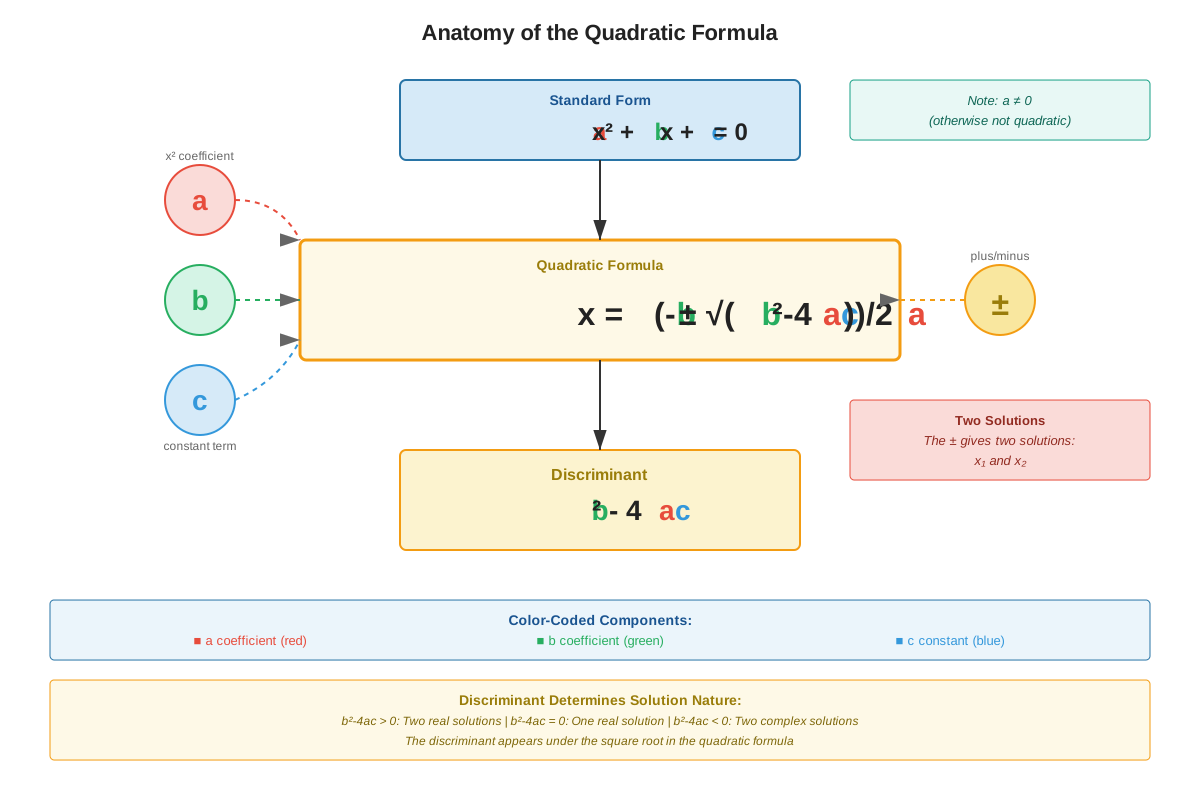
A quadratic equation must be written in standard form before applying the quadratic formula: ax² + bx + c = 0, where a, b, and c are constants and a ≠ 0. The coefficient a is the leading coefficient (attached to the squared term), b is the linear coefficient (attached to the first-degree term), and c is the constant term. Recognizing and properly identifying these three coefficients is the critical first step in applying the formula correctly.
Many GMAT problems present quadratic equations in non-standard forms such as x² = 5x - 6 or 3x² + 7 = 10x. Students must rearrange these equations by moving all terms to one side, resulting in x² - 5x + 6 = 0 and 3x² - 10x + 7 = 0 respectively. Careful attention to signs during this rearrangement prevents the most common errors in formula application.
The Quadratic Formula Itself
The quadratic formula states that for any quadratic equation ax² + bx + c = 0, the solutions are:
x = (-b ± √(b² - 4ac)) / (2a)This formula provides both solutions simultaneously through the ± symbol, which indicates that one solution uses addition while the other uses subtraction. The numerator contains two components: the opposite of the linear coefficient (-b) and the square root of a special expression called the discriminant. The denominator (2a) is always twice the leading coefficient.
Understanding the formula's structure helps prevent errors: the entire numerator, including both -b and the radical, must be divided by 2a. A common mistake is dividing only the radical portion by 2a while leaving -b separate. Proper use of parentheses when substituting values is essential, particularly when b or c are negative.
The Discriminant and Nature of Solutions
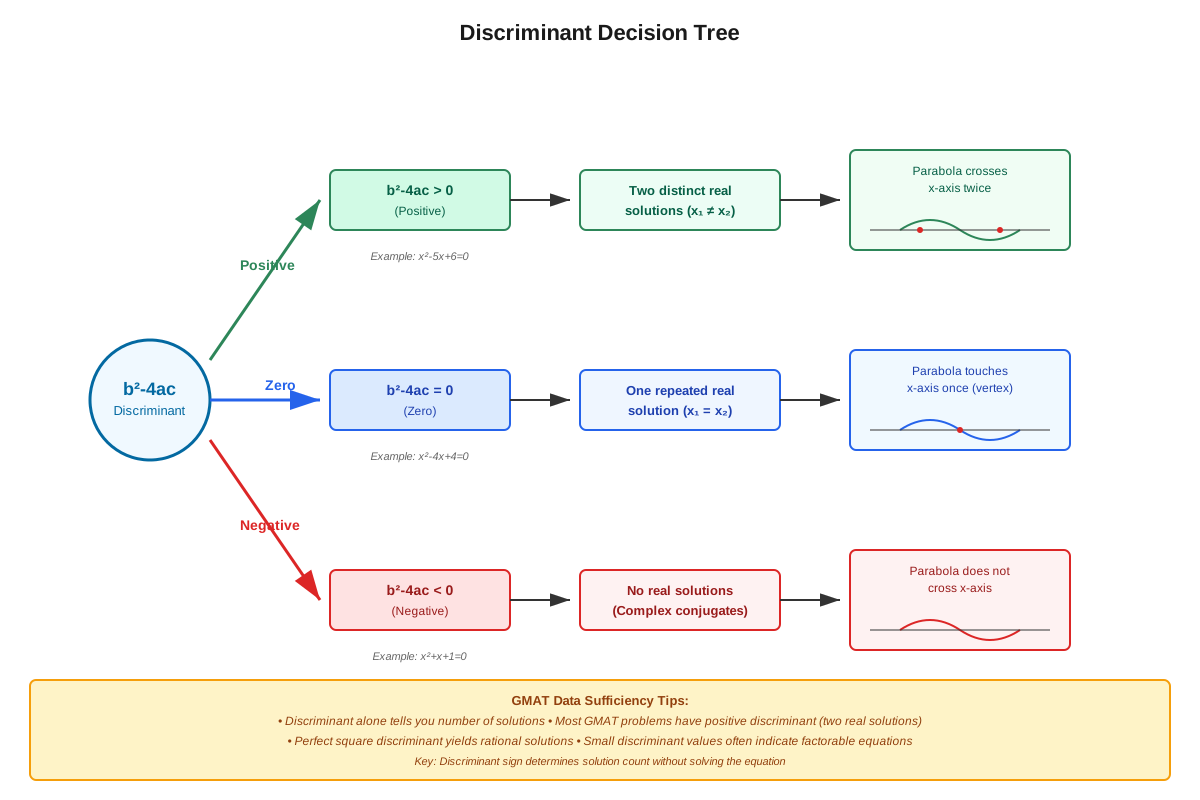
The expression under the square root, b² - 4ac, is called the discriminant and determines the number and type of solutions. This single value provides crucial information without requiring complete calculation of the roots:
| Discriminant Value | Number of Solutions | Type of Solutions | Graphical Interpretation |
|---|---|---|---|
| b² - 4ac > 0 | Two distinct solutions | Real numbers | Parabola crosses x-axis twice |
| b² - 4ac = 0 | One solution (repeated root) | Real number | Parabola touches x-axis once (vertex on x-axis) |
| b² - 4ac < 0 | No real solutions | Complex/imaginary numbers | Parabola does not intersect x-axis |
On the GMAT, questions about the discriminant frequently appear in Data Sufficiency format, where students must determine whether given information is sufficient to establish the number of solutions without actually calculating them. Understanding that a positive discriminant guarantees two real solutions while a negative discriminant means no real solutions is essential for these questions.
Step-by-Step Application Process
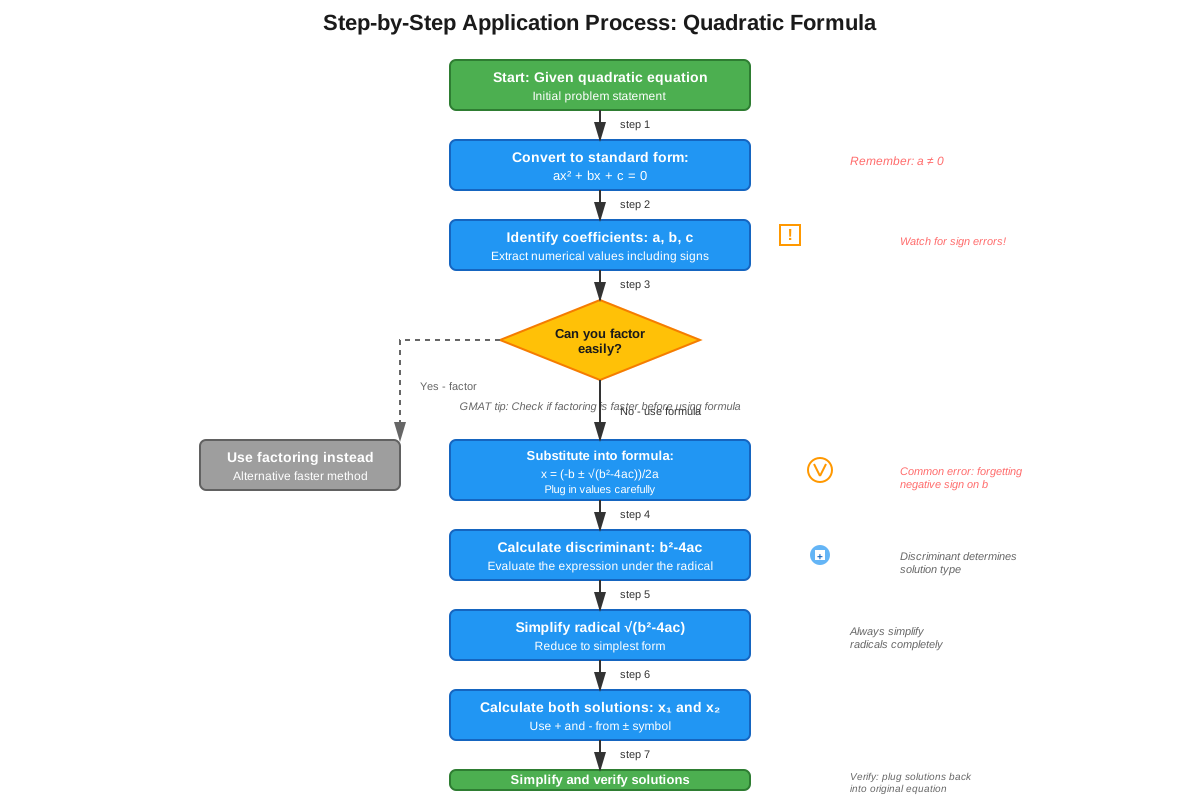
Applying the quadratic formula systematically minimizes errors:
- Rearrange to standard form: Move all terms to one side so the equation equals zero
- Identify coefficients: Clearly determine the values of a, b, and c, paying careful attention to signs
- Calculate the discriminant: Compute b² - 4ac first to check if real solutions exist
- Substitute into the formula: Replace a, b, and c with their values, using parentheses for negative numbers
- Simplify the radical: Factor out perfect squares from under the square root
- Separate the two solutions: Calculate both the addition and subtraction versions
- Reduce fractions: Simplify by factoring common terms from numerator and denominator
- Verify reasonableness: Check if solutions make sense in the problem context
Simplification Techniques
After substituting values into the quadratic formula, simplification often requires multiple steps. When the discriminant is a perfect square, the radical simplifies to a rational number, yielding rational solutions. For example, if b² - 4ac = 36, then √36 = 6, leading to rational solutions.
When the discriminant is not a perfect square, factor out the largest perfect square possible. For instance, √48 = √(16 × 3) = 4√3. This simplification is crucial because GMAT answer choices typically present solutions in simplified radical form.
The final step involves reducing the fraction by factoring common terms from the numerator. If the numerator is -6 ± 4√3 and the denominator is 4, factor 2 from the numerator: 2(-3 ± 2√3)/4 = (-3 ± 2√3)/2. This attention to simplification ensures answers match the format of GMAT answer choices.
Alternative Solution Methods
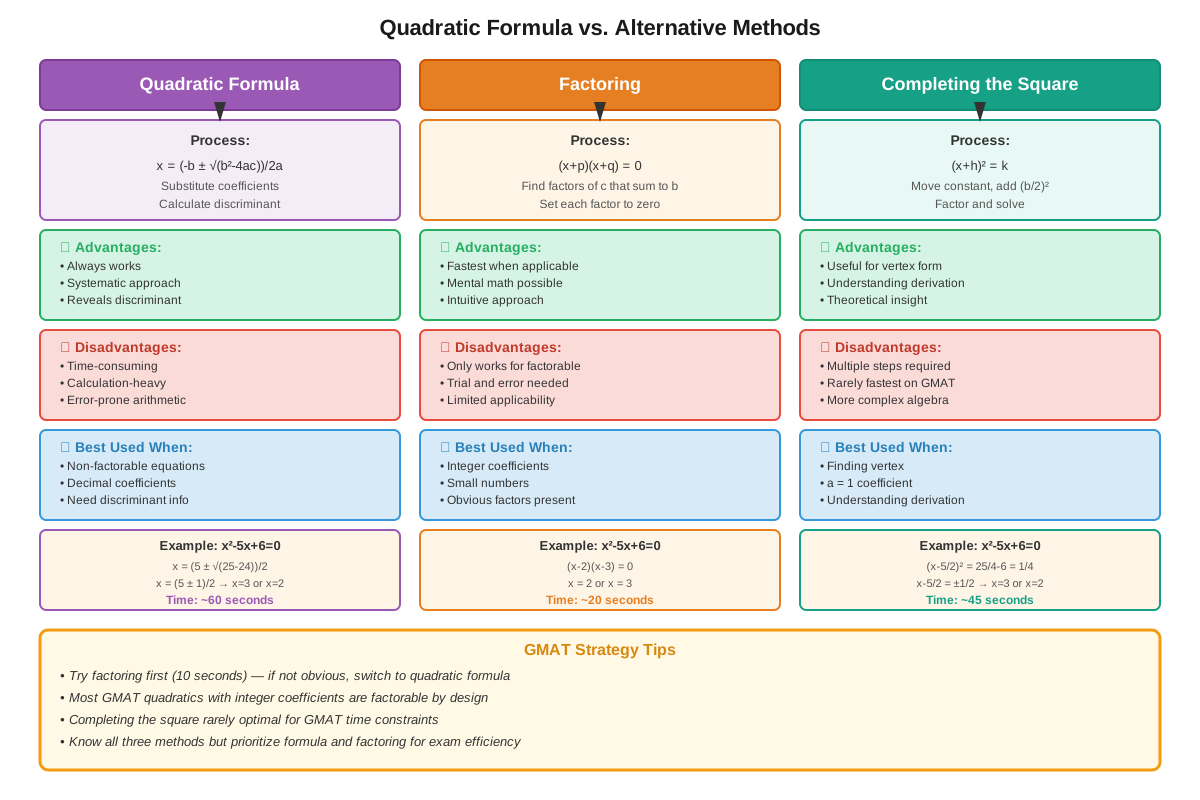
While the quadratic formula works universally, recognizing when factoring is faster saves valuable test time. If a quadratic equation has integer coefficients and factors easily, factoring is typically quicker. For example, x² - 5x + 6 = 0 factors as (x - 2)(x - 3) = 0, immediately yielding solutions x = 2 and x = 3.
Completing the square is another alternative method that, while less commonly used on the GMAT, provides insight into the formula's derivation and is occasionally the most elegant approach for certain problems. Understanding multiple solution methods allows strategic selection based on the specific problem structure.
Concept Relationships
The quadratic formula sits at the center of a web of interconnected algebraic concepts. It derives directly from the process of completing the square, which itself relies on understanding perfect square trinomials and algebraic manipulation. This derivation, while not typically required on the GMAT, illuminates why the formula takes its particular form.
The relationship flows: Standard form equation → Coefficient identification → Discriminant calculation → Formula application → Solution simplification → Answer interpretation. Each step depends on the previous one, and errors in early steps propagate through to incorrect final answers.
The discriminant connects the quadratic formula to graphing parabolas: the discriminant's sign determines how many times the parabola intersects the x-axis, which are precisely the solutions to the equation. This connection extends to inequalities: understanding where a quadratic expression is positive or negative requires knowing the locations of its roots.
The quadratic formula also relates to Vieta's formulas, which state that for a quadratic equation ax² + bx + c = 0 with roots r and s: the sum of roots r + s = -b/a, and the product of roots r × s = c/a. These relationships enable solving problems about roots without explicitly calculating them, a technique frequently tested on the GMAT.
Furthermore, the formula connects to systems of equations: many word problems that initially present two variables can be reduced to a single quadratic equation through substitution, making the quadratic formula the key to unlocking the solution.
High-Yield Facts
⭐ The quadratic formula is x = (-b ± √(b² - 4ac)) / (2a) for the equation ax² + bx + c = 0
⭐ The discriminant b² - 4ac determines the number of real solutions: positive means two, zero means one, negative means none
⭐ Both solutions must be divided by 2a, not just the radical portion
⭐ When the discriminant is a perfect square, the solutions are rational numbers
⭐ A quadratic equation must equal zero before identifying coefficients a, b, and c
- The coefficient a cannot equal zero, or the equation is not quadratic but linear
- Negative values for b or c must be substituted with parentheses: (-(-5)) = +5
- The sum of the two roots equals -b/a (Vieta's formula)
- The product of the two roots equals c/a (Vieta's formula)
- If a quadratic factors easily with integer coefficients, factoring is usually faster than the formula
- The vertex of the parabola y = ax² + bx + c occurs at x = -b/(2a), which is the midpoint between the two roots
- When a > 0, the parabola opens upward; when a < 0, it opens downward
- Completing the square and the quadratic formula always yield the same solutions
- In Data Sufficiency questions, knowing the discriminant's sign is often sufficient without calculating actual roots
Quick check — test yourself on Quadratic formula so far.
Try Flashcards →Common Misconceptions
Misconception: The quadratic formula only works for equations that cannot be factored.
Correction: The quadratic formula works for ALL quadratic equations, whether factorable or not. It is a universal method, though factoring may be faster when applicable.
Misconception: Only the radical portion (√(b² - 4ac)) needs to be divided by 2a.
Correction: The entire numerator, including both -b and ±√(b² - 4ac), must be divided by 2a. The formula is x = [(-b) ± √(b² - 4ac)] / (2a), not x = -b ± [√(b² - 4ac) / (2a)].
Misconception: A negative discriminant means there are no solutions at all.
Correction: A negative discriminant means there are no real number solutions, but complex solutions do exist. On the GMAT, which focuses on real numbers, this effectively means "no solutions" in the context of the test.
Misconception: The ± symbol means you can choose either addition or subtraction based on which gives a "nicer" answer.
Correction: The ± symbol indicates that there are TWO solutions: one using addition and one using subtraction. Both must be calculated (unless the problem context eliminates one).
Misconception: When b is negative in the original equation, you substitute -b as a negative number.
Correction: The formula already includes a negative sign before b. If b = -5 in the equation, then -b = -(-5) = +5 in the formula. Always use parentheses when substituting to avoid sign errors.
Misconception: If the discriminant equals zero, there are no solutions.
Correction: When the discriminant equals zero, there is exactly one solution (a repeated root). The parabola touches the x-axis at exactly one point, which is its vertex.
Misconception: The quadratic formula can be used when the equation is not set equal to zero.
Correction: The equation must be in standard form (ax² + bx + c = 0) before applying the formula. If the equation is x² + 3x = 10, it must first be rearranged to x² + 3x - 10 = 0.
Worked Examples
Example 1: Standard Application with Simplification
Problem: Solve for x: 2x² - 7x + 3 = 0
Solution:
Step 1: Identify the equation is already in standard form with a = 2, b = -7, and c = 3.
Step 2: Calculate the discriminant to verify real solutions exist:
- b² - 4ac = (-7)² - 4(2)(3)
- = 49 - 24
- = 25
Since the discriminant is positive (and a perfect square), we have two distinct rational solutions.
Step 3: Apply the quadratic formula:
- x = (-b ± √(b² - 4ac)) / (2a)
- x = (-(-7) ± √25) / (2(2))
- x = (7 ± 5) / 4
Step 4: Calculate both solutions:
- x = (7 + 5) / 4 = 12/4 = 3
- x = (7 - 5) / 4 = 2/4 = 1/2
Step 5: Verify by substitution into the original equation:
- For x = 3: 2(3)² - 7(3) + 3 = 2(9) - 21 + 3 = 18 - 21 + 3 = 0 ✓
- For x = 1/2: 2(1/2)² - 7(1/2) + 3 = 2(1/4) - 7/2 + 3 = 1/2 - 7/2 + 6/2 = 0 ✓
Answer: x = 3 or x = 1/2
This example demonstrates the complete process and shows how a perfect square discriminant yields rational solutions. This problem could also be solved by factoring: 2x² - 7x + 3 = (2x - 1)(x - 3) = 0, but the quadratic formula provides a systematic approach when factoring is not immediately apparent.
Example 2: Word Problem Application
Problem: A rectangular garden has a length that is 4 meters more than its width. If the area of the garden is 60 square meters, what is the width of the garden?
Solution:
Step 1: Define variables and set up the equation.
- Let w = width of the garden
- Then length = w + 4
- Area = length × width
- 60 = w(w + 4)
Step 2: Expand and rearrange to standard form:
- 60 = w² + 4w
- w² + 4w - 60 = 0
Step 3: Identify coefficients: a = 1, b = 4, c = -60
Step 4: Calculate the discriminant:
- b² - 4ac = (4)² - 4(1)(-60)
- = 16 + 240
- = 256
Step 5: Apply the quadratic formula:
- w = (-4 ± √256) / (2(1))
- w = (-4 ± 16) / 2
Step 6: Calculate both solutions:
- w = (-4 + 16) / 2 = 12/2 = 6
- w = (-4 - 16) / 2 = -20/2 = -10
Step 7: Interpret in context:
Since width cannot be negative, we reject w = -10. The width must be 6 meters.
Step 8: Verify:
- Width = 6 meters, Length = 6 + 4 = 10 meters
- Area = 6 × 10 = 60 square meters ✓
Answer: The width of the garden is 6 meters.
This example illustrates how the quadratic formula applies to real-world contexts and demonstrates the importance of rejecting solutions that don't make sense in the problem's context. This type of question is extremely common on the GMAT, where mathematical solutions must be interpreted within practical constraints.
Exam Strategy
When approaching GMAT questions involving quadratic equations, begin by assessing whether the quadratic formula is the most efficient method. Scan the equation for easy factoring opportunities: if coefficients are small integers and you can quickly identify factors, factoring saves time. However, if factoring is not immediately apparent after 10-15 seconds of consideration, proceed directly to the quadratic formula rather than wasting time.
Trigger words and phrases that signal quadratic formula application include: "solve for x," "find the roots," "x-intercepts," "where the graph crosses the x-axis," "values that satisfy the equation," and in word problems, phrases involving area, product relationships, or "more than/less than" relationships that create squared terms.
For Data Sufficiency questions, recognize that you often don't need to calculate exact solutions. Instead, determine whether the given information allows you to find the discriminant's sign or establish the number of solutions. Statement analysis should focus on whether you can determine a, b, and c uniquely, not on actually solving the equation.
Process of elimination strategies specific to quadratic formula questions:
- If answer choices contain radicals, the discriminant is likely not a perfect square
- If all answer choices are integers or simple fractions, look for factoring opportunities first
- Eliminate answers that don't come in pairs (unless the discriminant equals zero)
- Check answer choices by substitution if time permits—this can be faster than complete calculation
- For word problems, eliminate negative solutions or solutions that violate problem constraints immediately
Time allocation: Budget approximately 2-3 minutes for straightforward quadratic formula problems. If a problem requires more than 3 minutes, consider whether you've missed a simpler approach or should make an educated guess and move forward. Practice calculating discriminants quickly, as this skill enables rapid assessment of solution types without full calculation.
Common GMAT traps include: answer choices that represent common calculation errors (forgetting the negative sign in -b, dividing only the radical by 2a, or sign errors in the discriminant), problems where one solution must be rejected based on context, and Data Sufficiency statements designed to appear sufficient but actually providing insufficient information about the discriminant.
Memory Techniques
Mnemonic for the quadratic formula: "Negative Boy, Plus or Minus Square Root, Boy Squared Minus Four Alpha Charlie, Over Two Alpha"
This translates to: -b ± √(b² - 4ac) / 2a
Visual memory aid: Picture the formula as a fraction with three distinct parts:
- Top left: -b (the opposite of the middle coefficient)
- Top right: ±√(discriminant) (the plus-minus square root)
- Bottom: 2a (twice the first coefficient)
Discriminant decision tree: Create a mental flowchart:
- Calculate b² - 4ac
- Is it positive? → Two real solutions
- Is it zero? → One real solution
- Is it negative? → No real solutions
Acronym for solution steps: SICSAV
- Standardize (rearrange to standard form)
- Identify (find a, b, c)
- Calculate (find the discriminant)
- Substitute (plug into formula)
- Arithmetic (simplify)
- Verify (check reasonableness)
Finger counting technique: Use your fingers to track the order of operations in the discriminant: hold up two fingers for b², four fingers for 4ac, then remember to subtract. This physical memory aid helps prevent the common error of adding instead of subtracting.
Summary
The quadratic formula provides a universal, systematic method for solving any quadratic equation of the form ax² + bx + c = 0. By substituting the coefficients into x = (-b ± √(b² - 4ac)) / (2a), students can find both solutions to any quadratic equation, regardless of whether it factors easily. The discriminant, b² - 4ac, serves as a powerful diagnostic tool that reveals the number and nature of solutions before complete calculation: positive discriminants indicate two real solutions, zero indicates one repeated solution, and negative discriminants indicate no real solutions. On the GMAT, mastery of the quadratic formula enables efficient solution of algebra problems, word problems involving area and optimization, and Data Sufficiency questions about solution existence and uniqueness. Success requires not only memorizing the formula but also developing fluency in coefficient identification, careful attention to signs during substitution, systematic simplification of radicals and fractions, and contextual interpretation of solutions. The formula connects to broader concepts including factoring, graphing parabolas, and systems of equations, making it a cornerstone of GMAT Quantitative Reasoning.
Key Takeaways
- The quadratic formula x = (-b ± √(b² - 4ac)) / (2a) solves any equation in the form ax² + bx + c = 0
- Always rearrange equations to standard form (equal to zero) before identifying coefficients a, b, and c
- The discriminant b² - 4ac determines solution types: positive (two real), zero (one real), negative (no real)
- The entire numerator, including -b and the radical, must be divided by 2a—not just the radical portion
- Use parentheses when substituting negative values to avoid sign errors, especially with -b
- In word problems, reject solutions that violate physical constraints (negative lengths, impossible times)
- For GMAT efficiency, attempt factoring first for 10-15 seconds; if not obvious, proceed to the formula
Related Topics
Factoring Quadratic Expressions: Understanding how to factor quadratics provides an alternative solution method and deeper insight into the relationship between roots and coefficients. Mastering the quadratic formula makes factoring verification straightforward.
Graphing Parabolas: The solutions from the quadratic formula represent x-intercepts of parabolas. Understanding this connection enables visualization of quadratic relationships and solution of optimization problems.
Quadratic Inequalities: Solving inequalities like x² - 5x + 6 > 0 requires finding the roots using the quadratic formula, then analyzing sign changes between roots.
Systems of Equations: Many GMAT problems involving two equations and two unknowns reduce to a single quadratic equation through substitution, making the quadratic formula essential for complete solution.
Completing the Square: This technique not only provides an alternative solution method but also reveals the derivation of the quadratic formula itself, deepening conceptual understanding.
Vieta's Formulas: These relationships between roots and coefficients enable solving problems about roots without explicit calculation, a powerful technique for advanced GMAT questions.
Practice CTA
Now that you've mastered the theoretical foundations and strategic applications of the quadratic formula, it's time to solidify your understanding through deliberate practice. Attempt the practice questions associated with this topic, focusing on both computational accuracy and strategic efficiency. Use the flashcards to reinforce formula memorization and discriminant interpretation until recall becomes automatic. Remember that GMAT success comes not just from knowing the formula, but from developing the judgment to apply it efficiently under time pressure. Each practice problem you solve builds the pattern recognition and procedural fluency that will serve you on test day. Approach practice with the same focus and time awareness you'll need on the actual exam, and track which types of problems challenge you most so you can target your review effectively. You've got this!
Sign up free to keep reading
Create a free AnvayaPrep account to finish this GMAT guide on Quadratic formula — plus flashcards and practice questions.