Overview
Factoring is one of the most fundamental and frequently tested algebraic skills on the GMAT Quantitative Reasoning section. At its core, factoring involves breaking down algebraic expressions into products of simpler expressions, essentially reversing the process of multiplication and expansion. This technique serves as a critical tool for simplifying complex expressions, solving equations, and identifying relationships between variables that might otherwise remain hidden.
The importance of GMAT factoring cannot be overstated. Questions involving factoring appear across multiple problem types, including Problem Solving and Data Sufficiency questions. Mastery of factoring enables test-takers to quickly simplify rational expressions, solve quadratic equations, identify common factors in algebraic expressions, and recognize patterns that lead to efficient solutions. Without strong factoring skills, students often resort to time-consuming algebraic manipulation or, worse, become stuck on problems that could be solved in under a minute with the right factoring technique.
Within the broader landscape of GMAT Quantitative Reasoning, factoring serves as a bridge between basic algebraic manipulation and more advanced problem-solving strategies. It connects directly to topics such as quadratic equations, inequalities, functions, and number properties. The ability to factor efficiently also supports critical thinking about divisibility, prime factorization, and the structure of polynomial expressions—all concepts that appear regularly throughout the GMAT. Students who develop strong factoring intuition gain a significant strategic advantage, as they can often transform seemingly complex problems into straightforward calculations.
Learning Objectives
By the end of this study guide, you should be able to:
- [ ] Identify when factoring is the appropriate technique to apply in a GMAT problem
- [ ] Explain the fundamental principles and methods of factoring algebraic expressions
- [ ] Apply factoring techniques to solve GMAT questions efficiently and accurately
- [ ] Recognize and factor common algebraic patterns including difference of squares, perfect square trinomials, and sum/difference of cubes
- [ ] Factor quadratic expressions with various coefficient combinations
- [ ] Use factoring to simplify rational expressions and solve equations within time constraints
Prerequisites
Before mastering factoring, students should have solid understanding of:
- Basic algebraic operations: Factoring reverses multiplication and distribution, so understanding how to expand expressions like (x + 3)(x + 5) is essential
- The distributive property: Factoring relies on recognizing common factors and "undoing" distribution
- Integer properties and divisibility: Identifying common factors requires understanding how numbers divide into one another
- Exponent rules: Factoring expressions with variables requires manipulating powers correctly
- Polynomial terminology: Understanding terms, coefficients, and degrees helps identify factoring patterns
Why This Topic Matters
Factoring represents one of the highest-yield skills for GMAT preparation. Research on GMAT question patterns reveals that approximately 15-20% of Quantitative Reasoning questions either directly test factoring or require factoring as an intermediate step toward the solution. This frequency makes factoring one of the top five most commonly tested algebraic concepts on the exam.
In real-world applications, factoring underlies many quantitative fields including finance, engineering, and data science. Financial analysts use factoring when simplifying complex formulas for present value calculations. Engineers factor expressions when solving optimization problems. Computer scientists apply factoring principles in algorithm design and cryptography.
On the GMAT specifically, factoring appears in several distinct question formats. Problem Solving questions may ask students to simplify expressions, solve equations, or evaluate expressions at specific values—all tasks that become dramatically easier with factoring. Data Sufficiency questions frequently test whether students can recognize that factoring reveals hidden information about variables or relationships. Word problems involving area, revenue optimization, or number properties often require factoring as a critical intermediate step. Additionally, factoring skills prove invaluable when working with inequalities, as factored forms make it easier to identify critical values and test intervals.
Core Concepts
What is Factoring?
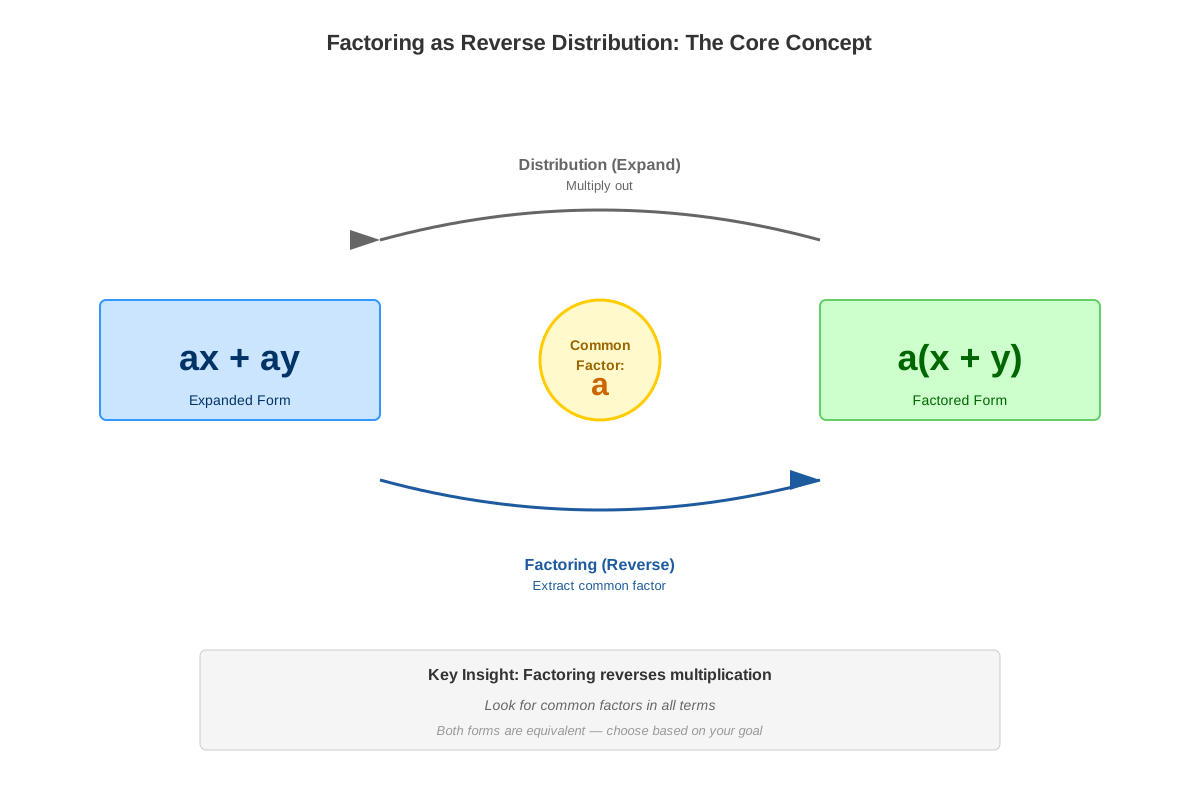
Factoring is the process of expressing an algebraic expression as a product of two or more simpler expressions called factors. When you factor an expression, you're essentially asking: "What expressions, when multiplied together, produce this result?" This process reverses expansion or distribution.
For example, the expression x² + 5x + 6 can be factored as (x + 2)(x + 3). You can verify this by expanding: (x + 2)(x + 3) = x² + 3x + 2x + 6 = x² + 5x + 6.
Greatest Common Factor (GCF)
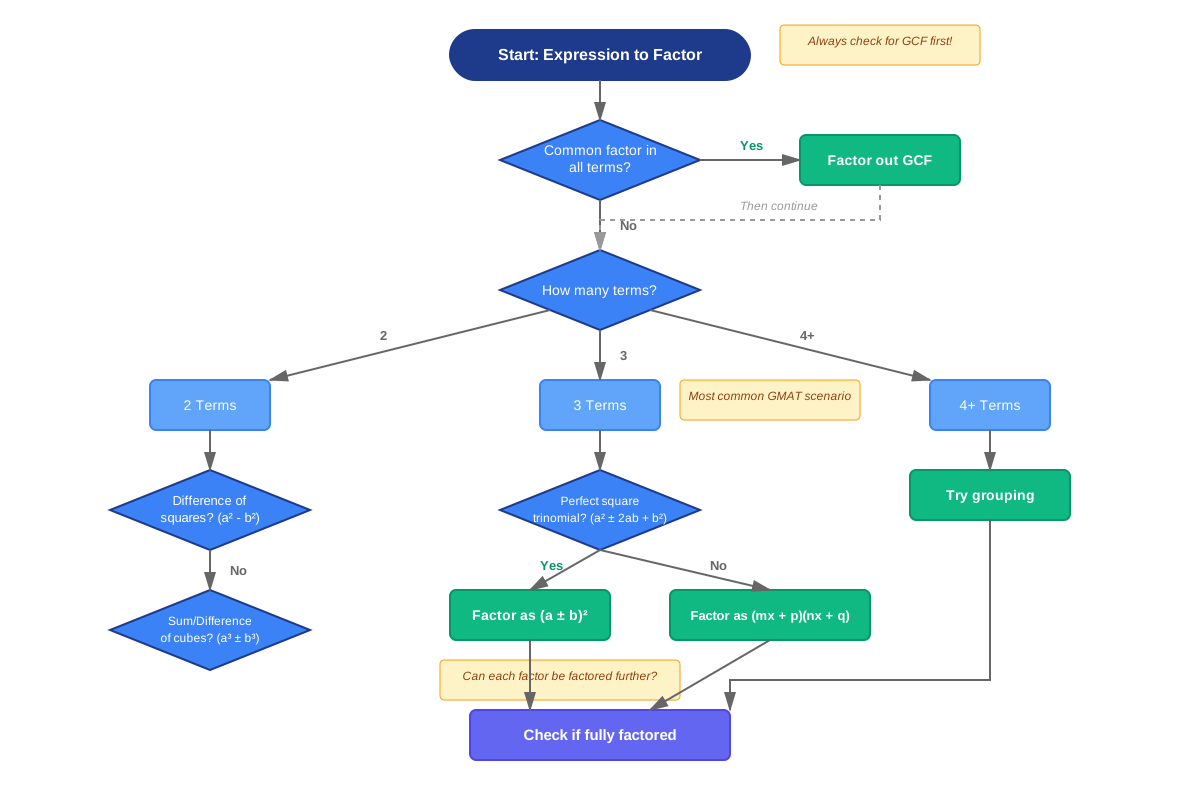
The most fundamental factoring technique involves identifying the greatest common factor—the largest expression that divides evenly into all terms. Always check for a GCF before attempting other factoring methods.
Steps for factoring out the GCF:
- Identify the largest numerical coefficient that divides all terms
- Identify the lowest power of each variable that appears in all terms
- Factor out this common expression
- Write the remaining expression in parentheses
Example: 6x³ + 9x² - 15x
- GCF of coefficients: 3
- Lowest power of x: x¹
- GCF = 3x
- Result: 3x(2x² + 3x - 5)
Factoring Quadratic Expressions
A quadratic expression has the form ax² + bx + c, where a, b, and c are constants. Factoring quadratics is among the most frequently tested factoring skills on the GMAT.
Simple Trinomials (a = 1)
When the coefficient of x² is 1, factor expressions of the form x² + bx + c into (x + m)(x + n), where:
- m + n = b (the coefficient of x)
- m × n = c (the constant term)
Example: x² + 7x + 12
- Need two numbers that add to 7 and multiply to 12
- Numbers: 3 and 4
- Factored form: (x + 3)(x + 4)
Complex Trinomials (a ≠ 1)
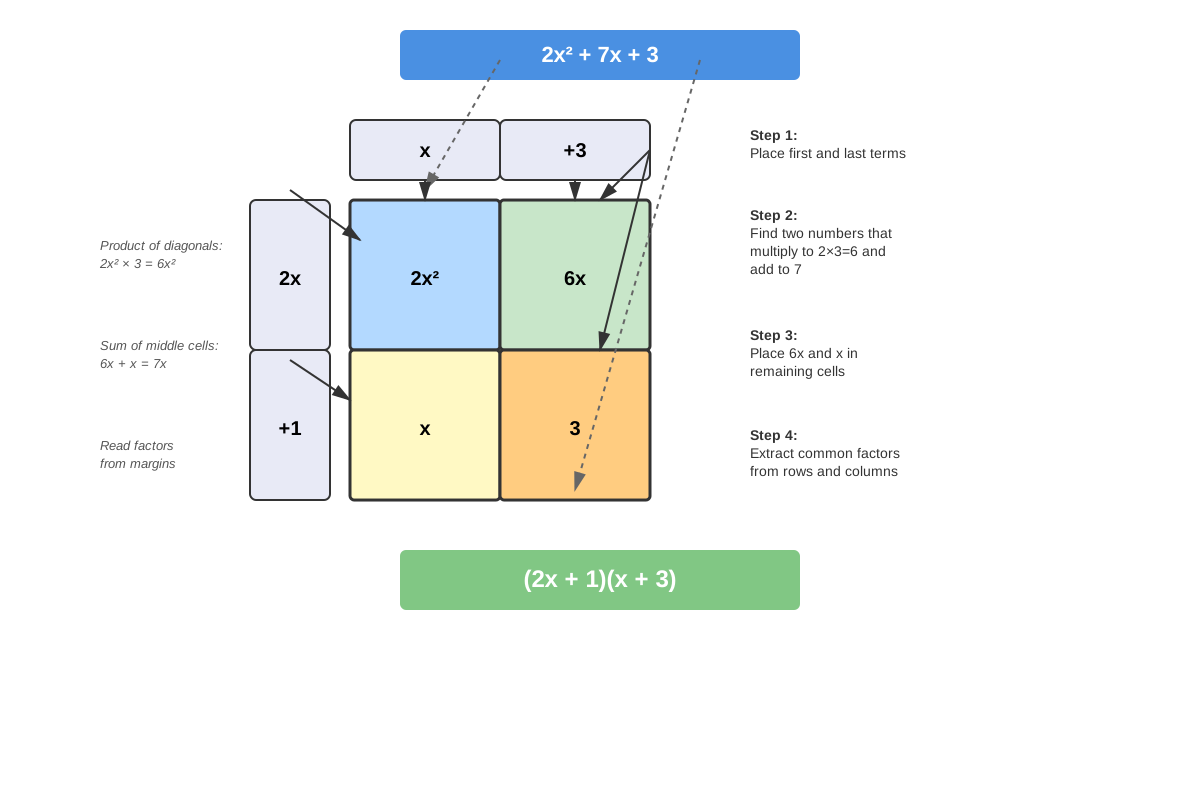
When a ≠ 1, factor expressions of the form ax² + bx + c using the AC method:
- Multiply a × c
- Find two numbers that multiply to ac and add to b
- Rewrite the middle term using these two numbers
- Factor by grouping
Example: 2x² + 7x + 3
- ac = 2 × 3 = 6
- Need numbers that multiply to 6 and add to 7: 6 and 1
- Rewrite: 2x² + 6x + 1x + 3
- Group: (2x² + 6x) + (1x + 3)
- Factor each group: 2x(x + 3) + 1(x + 3)
- Factor out common binomial: (2x + 1)(x + 3)
Special Factoring Patterns
The GMAT frequently tests recognition of special patterns. Memorizing these saves significant time.
Difference of Squares
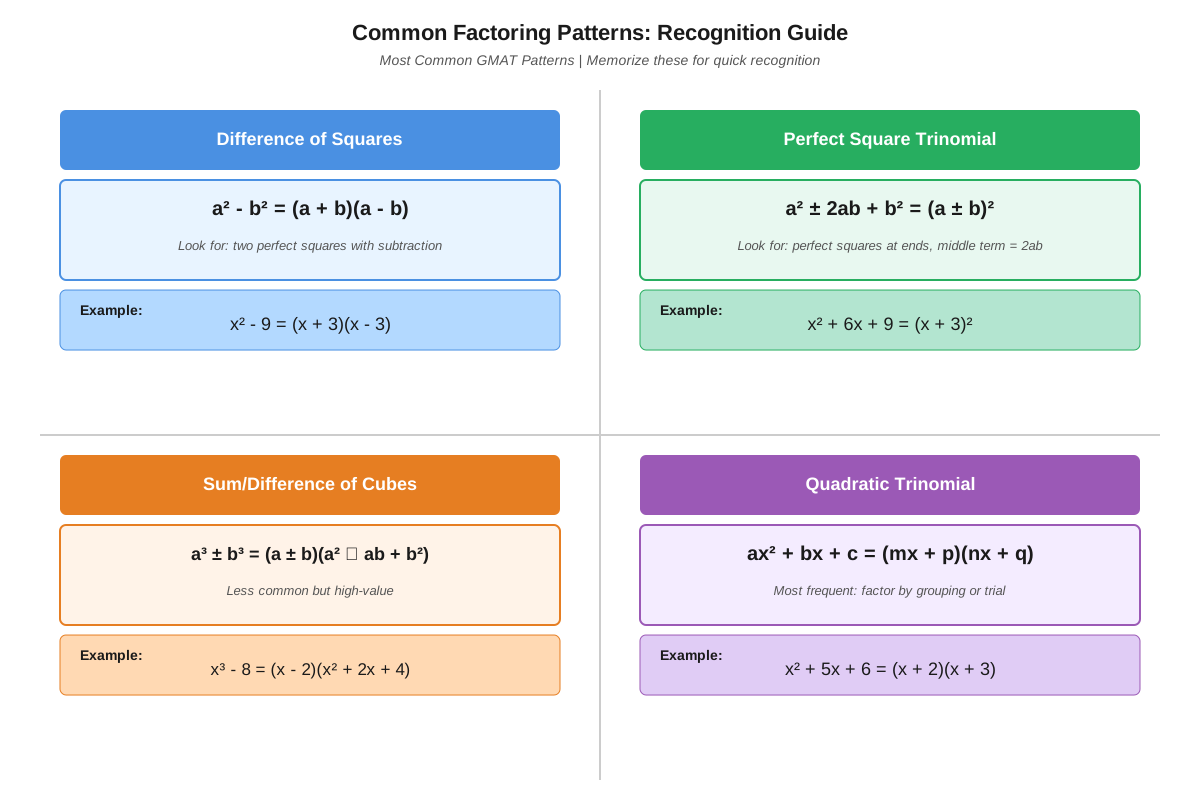
The pattern a² - b² = (a + b)(a - b) appears constantly on the GMAT.
Examples:
- x² - 25 = (x + 5)(x - 5)
- 4x² - 9 = (2x + 3)(2x - 3)
- 49 - y² = (7 + y)(7 - y)
Exam Tip: Watch for difference of squares hidden within larger expressions. The GMAT often embeds this pattern in complex problems.
Perfect Square Trinomials
These follow the patterns:
- a² + 2ab + b² = (a + b)²
- a² - 2ab + b² = (a - b)²
Recognition clues: The first and last terms are perfect squares, and the middle term equals twice the product of their square roots.
Examples:
- x² + 6x + 9 = (x + 3)²
- 4x² - 12x + 9 = (2x - 3)²
- 25y² + 20y + 4 = (5y + 2)²
Sum and Difference of Cubes
Less common but occasionally tested:
- a³ + b³ = (a + b)(a² - ab + b²)
- a³ - b³ = (a - b)(a² + ab + b²)
Example: x³ - 8 = x³ - 2³ = (x - 2)(x² + 2x + 4)
Factoring by Grouping
When expressions have four or more terms, factoring by grouping often works:
- Group terms in pairs
- Factor out the GCF from each pair
- Factor out the common binomial factor
Example: x³ + 3x² + 2x + 6
- Group: (x³ + 3x²) + (2x + 6)
- Factor each: x²(x + 3) + 2(x + 3)
- Factor out (x + 3): (x + 3)(x² + 2)
Factoring Strategy Summary
| Expression Type | Method | Example |
|---|---|---|
| Common factor in all terms | GCF | 6x² + 9x = 3x(2x + 3) |
| x² + bx + c | Find m, n where m+n=b, mn=c | x² + 5x + 6 = (x+2)(x+3) |
| ax² + bx + c | AC method or trial | 2x² + 5x + 3 = (2x+3)(x+1) |
| a² - b² | Difference of squares | x² - 16 = (x+4)(x-4) |
| a² ± 2ab + b² | Perfect square | x² + 8x + 16 = (x+4)² |
| Four or more terms | Grouping | xy + 3x + 2y + 6 = (x+2)(y+3) |
Concept Relationships
Factoring concepts build upon one another in a logical hierarchy. The greatest common factor serves as the foundation—always the first technique to check regardless of the expression's complexity. Once the GCF is factored out, the remaining expression often reveals one of the special patterns.
Quadratic factoring connects directly to solving quadratic equations. When you factor a quadratic expression and set it equal to zero, you can apply the zero product property to find solutions. This relationship makes factoring essential for solving equations: x² + 5x + 6 = 0 → (x + 2)(x + 3) = 0 → x = -2 or x = -3.
The special patterns (difference of squares, perfect square trinomials, sum/difference of cubes) represent shortcuts that bypass standard factoring procedures. Recognizing these patterns immediately connects to the broader concept of pattern recognition that pervades GMAT problem-solving.
Factoring by grouping extends the GCF concept to more complex expressions, demonstrating how fundamental techniques scale to handle sophisticated problems.
Relationship flow: GCF identification → Pattern recognition (special forms) → Standard factoring methods (quadratics) → Advanced techniques (grouping) → Application to equations and simplification
Factoring also connects forward to topics like rational expressions (where factoring enables simplification), inequalities (where factored forms reveal critical values), and functions (where factoring helps identify zeros and behavior).
High-Yield Facts
⭐ Always check for a greatest common factor first before attempting any other factoring method—this simplifies subsequent steps and prevents errors.
⭐ The difference of squares pattern a² - b² = (a + b)(a - b) is the single most frequently tested factoring pattern on the GMAT.
⭐ For x² + bx + c, find two numbers that add to b and multiply to c—this method solves the majority of quadratic factoring problems.
⭐ Perfect square trinomials have the form a² ± 2ab + b² and factor to (a ± b)²; recognize them by checking if the middle term equals twice the product of the square roots of the outer terms.
⭐ When factoring ax² + bx + c where a ≠ 1, multiply a × c first and find factors of this product that add to b.
- The sum of squares a² + b² cannot be factored using real numbers (no factoring pattern exists for this form).
- Factoring is the reverse of distribution: if (x + 3)(x + 5) expands to x² + 8x + 15, then x² + 8x + 15 factors to (x + 3)(x + 5).
- When an expression is completely factored, none of the factors can be factored further (except for factoring out -1 if needed).
- The zero product property states that if ab = 0, then a = 0 or b = 0—this makes factored forms essential for solving equations.
- Factoring reveals the zeros (roots) of a polynomial: if (x - 3)(x + 2) = 0, then x = 3 or x = -2.
- Negative signs can be factored out to make expressions easier to work with: -x² + 4 = -(x² - 4) = -(x + 2)(x - 2).
- The expression x² - y² factors, but x² + y² does not (over real numbers).
- Factoring by grouping requires four or more terms and works by creating common binomial factors.
- When factoring completely, continue factoring until all factors are prime (cannot be factored further).
- The coefficient of x² in a quadratic affects the factoring approach: when it's 1, use simple methods; when it's not 1, use the AC method or trial and error.
Quick check — test yourself on Factoring so far.
Try Flashcards →Common Misconceptions
Misconception: x² + 25 can be factored as (x + 5)².
Correction: This is incorrect. Expanding (x + 5)² gives x² + 10x + 25, not x² + 25. The expression x² + 25 is a sum of squares and cannot be factored using real numbers. Only difference of squares (x² - 25) factors to (x + 5)(x - 5).
Misconception: When factoring x² + 5x + 6, any two numbers that multiply to 6 will work.
Correction: The two numbers must both multiply to 6 AND add to 5 (the coefficient of x). While 1 and 6 multiply to 6, they add to 7, not 5. The correct numbers are 2 and 3, which multiply to 6 and add to 5, giving (x + 2)(x + 3).
Misconception: Factoring 2x² + 8x gives 2x(x + 8).
Correction: This is incorrect. When factoring out 2x from 2x², you get x, not 2x. The correct factorization is 2x(x + 4). Always verify by expanding: 2x(x + 4) = 2x² + 8x ✓.
Misconception: The expression (x + 3)² equals x² + 9.
Correction: This error stems from incorrectly squaring a binomial. The correct expansion is (x + 3)² = (x + 3)(x + 3) = x² + 3x + 3x + 9 = x² + 6x + 9. The middle term (6x) cannot be omitted. Remember: (a + b)² = a² + 2ab + b².
Misconception: After factoring out a GCF, the factoring is complete.
Correction: Factoring out the GCF is only the first step. Always examine what remains in parentheses to see if it can be factored further. For example, 2x³ - 8x = 2x(x² - 4) is not completely factored because x² - 4 is a difference of squares. The complete factorization is 2x(x + 2)(x - 2).
Misconception: When factoring 3x² + 7x + 2, you can factor the coefficient 3 separately from the rest.
Correction: Unlike expressions where all terms share a common factor, you cannot factor the leading coefficient separately in a quadratic trinomial. The coefficient 3 affects the entire factoring process. The correct approach uses the AC method: 3x² + 7x + 2 = 3x² + 6x + x + 2 = (3x + 1)(x + 2).
Misconception: Factoring always makes expressions simpler or shorter.
Correction: While factoring often simplifies problem-solving, the factored form may appear more complex than the original. For example, x² - 1 looks simpler than (x + 1)(x - 1), but the factored form is more useful for solving equations or simplifying rational expressions. Factoring reveals structure rather than necessarily reducing length.
Worked Examples
Example 1: Multi-Step Factoring Problem
Problem: Factor completely: 3x³ - 27x
Solution:
Step 1: Check for a greatest common factor.
- All terms contain a factor of 3
- All terms contain at least one factor of x
- GCF = 3x
Step 2: Factor out the GCF.
3x³ - 27x = 3x(x² - 9)
Step 3: Examine the expression in parentheses.
The expression x² - 9 is a difference of squares: x² - 3²
Step 4: Apply the difference of squares pattern.
x² - 9 = (x + 3)(x - 3)
Step 5: Write the complete factorization.
3x³ - 27x = 3x(x + 3)(x - 3)
Step 6: Verify by expanding.
3x(x + 3)(x - 3) = 3x[(x + 3)(x - 3)] = 3x[x² - 9] = 3x³ - 27x ✓
Connection to Learning Objectives: This example demonstrates identifying when factoring is appropriate (recognizing the GCF and special patterns), explaining the process (showing each factoring method), and applying techniques systematically. This multi-step approach appears frequently on GMAT problems where complete factorization is required.
Example 2: GMAT-Style Application Problem
Problem: If x² - y² = 48 and x - y = 6, what is the value of x + y?
Solution:
Step 1: Recognize the factoring opportunity.
The expression x² - y² is a difference of squares.
Step 2: Factor x² - y².
x² - y² = (x + y)(x - y)
Step 3: Substitute into the original equation.
(x + y)(x - y) = 48
Step 4: Use the given information.
We know x - y = 6, so substitute:
(x + y)(6) = 48
Step 5: Solve for x + y.
x + y = 48/6 = 8
Alternative approach without factoring (to show why factoring is superior):
- From x - y = 6, we get x = y + 6
- Substitute into x² - y² = 48: (y + 6)² - y² = 48
- Expand: y² + 12y + 36 - y² = 48
- Simplify: 12y + 36 = 48
- Solve: 12y = 12, so y = 1
- Find x: x = y + 6 = 7
- Calculate x + y: 7 + 1 = 8
Analysis: The factoring approach required three simple steps after recognizing the pattern, while the algebraic approach required six steps with more complex calculations. On the GMAT, where time is critical, recognizing that x² - y² factors immediately leads to an elegant solution. This demonstrates why pattern recognition is essential for GMAT success.
Connection to Learning Objectives: This problem shows how to identify when factoring applies (recognizing the difference of squares in context), apply factoring to solve efficiently, and demonstrates the strategic advantage factoring provides on GMAT questions.
Exam Strategy
Approaching GMAT Factoring Questions
Trigger words and phrases that signal factoring may be useful:
- "Factor completely"
- "Simplify the expression"
- "Solve for x" (when dealing with quadratic equations)
- "What are the values of..." (often requires factoring to find multiple solutions)
- Questions presenting expressions like x² - [number] or x² + bx + c
- Data Sufficiency questions asking "What is the value of x + y?" when given x² - y²
Systematic Approach
- Always check for GCF first (5-10 seconds)—this step prevents errors and simplifies everything that follows
- Count the terms to determine strategy:
- Two terms: Look for difference of squares or sum/difference of cubes
- Three terms: Check for perfect square trinomial, then use quadratic factoring
- Four+ terms: Try factoring by grouping
- Look for special patterns before attempting standard methods—pattern recognition saves 30-60 seconds per problem
- Factor completely—don't stop after one step; check if factors can be factored further
- Verify when time permits—expand your factored form to confirm it matches the original
Process of Elimination Tips
In Problem Solving questions with factored expressions as answer choices:
- Eliminate answers with incorrect signs: If the original has a negative constant term, the factors must have opposite signs
- Check the constant term: Multiply the constant terms in the factors—they must equal the original constant
- Verify the leading coefficient: The product of the leading coefficients in the factors must equal the original leading coefficient
- Use the middle term as a tiebreaker: When down to two choices, expand just the middle term to distinguish
In Data Sufficiency questions:
- Factor expressions in both statements to reveal hidden relationships
- Recognize that factored forms often make sufficiency clearer: x² - y² = 24 alone seems insufficient, but (x+y)(x-y) = 24 combined with x - y = 4 is clearly sufficient
Time Allocation
- Simple factoring (GCF or difference of squares): 15-30 seconds
- Quadratic factoring (standard trinomials): 30-45 seconds
- Complex factoring (multiple steps or difficult coefficients): 45-75 seconds
- If you don't see a pattern within 20 seconds, consider whether factoring is actually the intended approach—the GMAT sometimes includes problems where factoring seems necessary but an alternative method is faster
Critical Exam Tip: On Data Sufficiency questions, factoring often reveals that seemingly different pieces of information are actually equivalent. For example, knowing x² - 4 = 0 is equivalent to knowing (x-2)(x+2) = 0, which tells you x = 2 or x = -2.
Memory Techniques
Factoring Pattern Mnemonics
DOTS for Difference Of Two Squares:
- Difference (subtraction, not addition)
- Of
- Two
- Squares (both terms must be perfect squares)
- Formula: a² - b² = (a + b)(a - b)
SOAP for Sum and Product (quadratic factoring):
- Sum: The two numbers must add to the middle coefficient
- Of
- A (and)
- Product: The two numbers must multiply to the constant term
Visualization Strategy
Picture factoring as "breaking apart" or "unpacking" an expression:
- The original expression is a closed box
- Factoring opens the box to reveal the components inside
- Each factor is a building block that, when multiplied together, reconstructs the original
For difference of squares, visualize:
x² - 25 = (x + 5)(x - 5)
[large square] - [small square] = [sum of sides] × [difference of sides]
Perfect Square Trinomial Recognition
"First, Last, Twice" method:
- First term is a perfect square (a²)
- Last term is a perfect square (b²)
- Middle term is Twice the product of the square roots (2ab)
If all three conditions are met: a² ± 2ab + b² = (a ± b)²
Sign Pattern Memory Aid
For x² + bx + c = (x + m)(x + n):
- Both positive (+ +): m and n are both positive
- Both negative (- -): m and n are both negative
- Positive product, negative sum (- +): larger number is negative
- Negative product (opposite signs): one positive, one negative
Summary
Factoring is the process of expressing algebraic expressions as products of simpler factors, essentially reversing multiplication and distribution. This fundamental skill appears in 15-20% of GMAT Quantitative Reasoning questions and serves as a critical tool for solving equations, simplifying expressions, and revealing mathematical relationships. The core factoring techniques include identifying the greatest common factor (always the first step), factoring quadratic expressions using sum-product relationships or the AC method, recognizing special patterns (difference of squares, perfect square trinomials, sum/difference of cubes), and applying factoring by grouping for expressions with four or more terms. Success on GMAT factoring questions requires both technical proficiency with these methods and strategic pattern recognition—the ability to quickly identify which technique applies to a given expression. The difference of squares pattern (a² - b² = (a + b)(a - b)) represents the single most frequently tested factoring concept and should be instantly recognizable. Complete factorization requires continuing the process until all factors are prime, and verification through expansion helps prevent careless errors. Mastering factoring provides significant strategic advantages on the GMAT, enabling faster problem-solving and revealing elegant solutions that would otherwise remain hidden.
Key Takeaways
- Always begin by factoring out the greatest common factor—this simplifies all subsequent factoring steps and is the most commonly overlooked technique
- The difference of squares (a² - b²) factors to (a + b)(a - b)—this is the highest-yield pattern on the GMAT and should be instantly recognizable
- For quadratic expressions x² + bx + c, find two numbers that add to b and multiply to c—this method solves the majority of standard factoring problems
- Factoring reveals structure and relationships that enable efficient problem-solving, particularly in Data Sufficiency questions where factored forms often clarify sufficiency
- Pattern recognition is more valuable than mechanical calculation—investing time to memorize special factoring patterns (perfect squares, difference of squares, sum/difference of cubes) yields significant time savings
- Complete factorization requires multiple steps—after factoring once, always check whether the resulting factors can be factored further
- Verification through expansion takes only seconds and prevents costly errors on test day
Related Topics
Quadratic Equations: Factoring provides the primary method for solving quadratic equations by applying the zero product property to factored forms. Mastering factoring is prerequisite to efficiently solving equations of the form ax² + bx + c = 0.
Rational Expressions: Simplifying fractions with polynomial numerators and denominators requires factoring both parts to identify and cancel common factors. This topic directly builds on factoring skills.
Inequalities: Solving polynomial inequalities requires factoring to identify critical values and test intervals. The factored form reveals where expressions change sign.
Functions and Graphs: Factoring helps identify zeros (x-intercepts) of polynomial functions and reveals the behavior of functions near these zeros, essential for understanding function graphs.
Number Properties: Factoring integers into prime factors connects algebraic factoring to number theory concepts tested on the GMAT, including divisibility, GCD, and LCM.
Practice CTA
Now that you've mastered the core concepts of factoring, it's time to solidify your understanding through practice. Attempt the practice questions associated with this topic, focusing on recognizing patterns quickly and applying techniques efficiently. Use the flashcards to drill the special factoring patterns until they become automatic—this pattern recognition will save you valuable time on test day. Remember, factoring is a skill that improves dramatically with practice. Each problem you solve strengthens your intuition for which technique to apply and builds the speed necessary for GMAT success. Approach practice strategically: time yourself, verify your answers by expanding, and analyze any mistakes to understand where your process broke down. Your investment in mastering factoring will pay dividends across multiple question types throughout the Quantitative Reasoning section.
Sign up free to keep reading
Create a free AnvayaPrep account to finish this GMAT guide on Factoring — plus flashcards and practice questions.