Overview
Factors are fundamental building blocks in arithmetic and number theory, representing the integers that divide evenly into a given number. Understanding factors is crucial for success on the GMAT factors questions, which appear frequently throughout the Quantitative Reasoning section. A factor of a number n is any integer that divides n without leaving a remainder. For example, the factors of 12 are 1, 2, 3, 4, 6, and 12, because each of these numbers divides 12 evenly.
Mastery of factors extends far beyond simple identification. The GMAT tests this concept in sophisticated ways, embedding factor questions within problems involving divisibility, prime factorization, greatest common divisors, least common multiples, and even data sufficiency questions. Questions may ask test-takers to determine the number of factors a given integer has, identify common factors between numbers, or use factor properties to solve complex word problems involving scheduling, grouping, or optimization scenarios.
The topic of factors serves as a cornerstone for understanding broader quantitative concepts tested on the GMAT. It connects directly to prime numbers, exponents, divisibility rules, and rational number operations. Strong command of factors enables efficient problem-solving across multiple question types and provides the foundation for tackling advanced arithmetic problems that combine multiple concepts. Students who master factors gain significant advantages in speed and accuracy, particularly on problem-solving and data sufficiency questions where recognizing factor relationships can eliminate answer choices or determine sufficiency within seconds.
Learning Objectives
- [ ] Identify factors of positive integers systematically and completely
- [ ] Explain the relationship between factors, divisibility, and prime factorization
- [ ] Apply factors to GMAT questions involving number properties and word problems
- [ ] Determine the total number of factors for any positive integer using prime factorization
- [ ] Find common factors and greatest common factors between two or more integers
- [ ] Recognize factor-based patterns in data sufficiency questions to evaluate statement sufficiency
Prerequisites
- Basic multiplication and division: Essential for determining whether one number divides evenly into another, which is the fundamental definition of a factor
- Understanding of integers: Factors are defined within the set of integers, and distinguishing between positive and negative integers matters for complete factor identification
- Prime numbers: Recognizing prime numbers accelerates factor identification and enables the use of prime factorization methods
- Exponent rules: Prime factorization expresses numbers using exponents, and manipulating these expressions requires comfort with exponent operations
Why This Topic Matters
Factors appear in approximately 10-15% of GMAT Quantitative Reasoning questions, making them one of the highest-yield arithmetic topics to master. Beyond direct factor questions, the concept underlies problems involving ratios, fractions, divisibility, remainders, and number properties. Real-world applications include resource allocation (dividing items into equal groups), scheduling (finding common time intervals), construction (determining tile or panel sizes), and financial calculations (payment schedules and interest periods).
On the GMAT, factor questions appear in multiple formats: problem-solving questions that require calculating the number of factors, data sufficiency questions testing whether given information determines factor properties, and word problems where recognizing factor relationships provides the key insight. Common question types include determining how many factors a number has, finding the greatest common factor of two numbers, identifying numbers with specific factor properties (such as perfect squares having an odd number of factors), and solving optimization problems where factor relationships constrain possible solutions.
The GMAT particularly favors questions that combine factors with other concepts. Test-takers might encounter problems requiring them to use factors alongside divisibility rules, prime factorization, or least common multiples. Data sufficiency questions frequently test whether students understand what information is necessary and sufficient to determine factor-related properties. Mastering factors provides a competitive advantage because many test-takers struggle with these questions, making them excellent opportunities to gain points relative to other examinees.
Core Concepts
Definition and Basic Properties
A factor (also called a divisor) of a positive integer n is any positive integer that divides n evenly, leaving no remainder. Mathematically, if a and n are positive integers, then a is a factor of n if there exists a positive integer b such that n = a × b. Both a and b are factors of n in this relationship.
Every positive integer has at least two factors: 1 and itself. The number 1 is a factor of every integer because any number divided by 1 equals itself. Similarly, every number is a factor of itself because n ÷ n = 1. Numbers with exactly two factors (1 and themselves) are called prime numbers, while numbers with more than two factors are called composite numbers.
Key properties of factors include:
- Factors always come in pairs (except for perfect squares, where one factor pairs with itself)
- If a is a factor of n, then n/a is also a factor of n
- The smallest factor of any positive integer (other than 1) is always 1
- The largest factor of any positive integer is always the number itself
- Factors are always less than or equal to the number they divide
Systematic Factor Identification
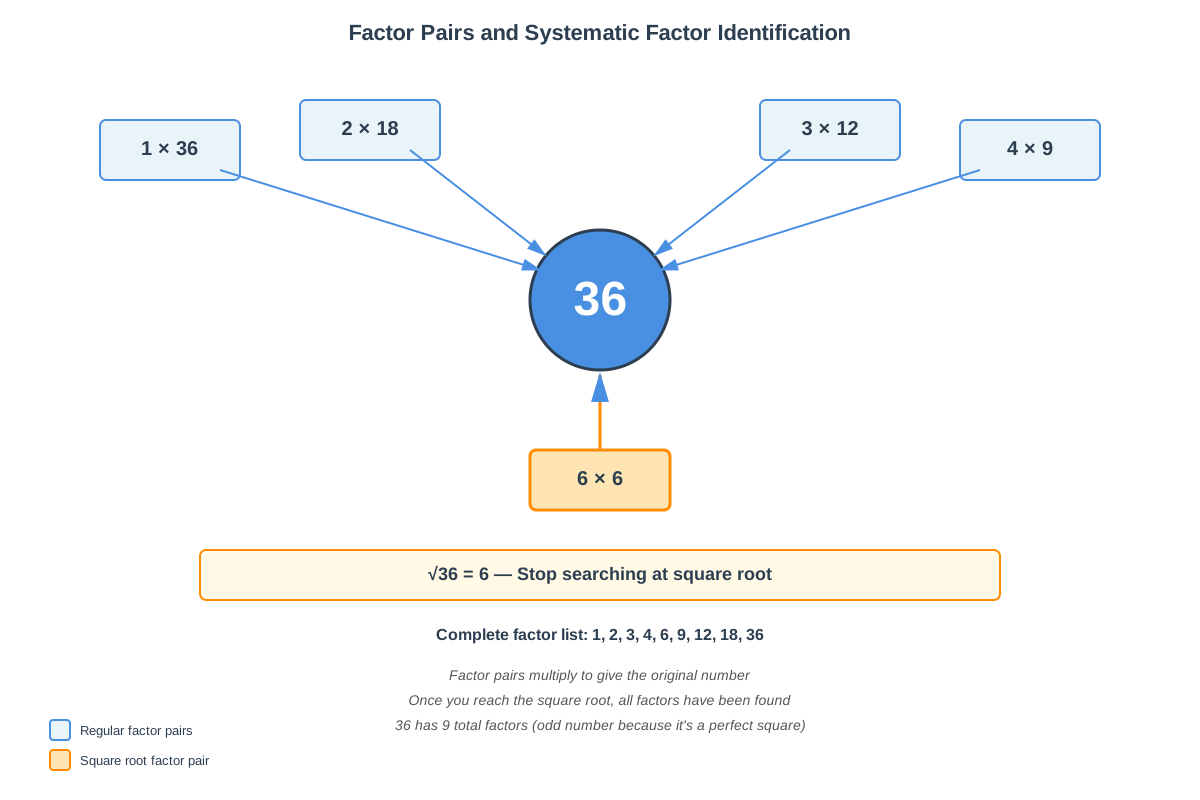
To identify all factors of a number systematically, test divisibility starting from 1 and proceeding upward, but only up to the square root of the number. This method exploits the pairing property: when you find a factor a, you automatically identify its pair n/a.
Example: Finding all factors of 36
- Start with 1: 36 ÷ 1 = 36 → factors 1 and 36
- Test 2: 36 ÷ 2 = 18 → factors 2 and 18
- Test 3: 36 ÷ 3 = 12 → factors 3 and 12
- Test 4: 36 ÷ 4 = 9 → factors 4 and 9
- Test 5: 36 ÷ 5 = 7.2 (not a whole number, so 5 is not a factor)
- Test 6: 36 ÷ 6 = 6 → factor 6 (pairs with itself)
- Stop here because √36 = 6
Complete factor list: 1, 2, 3, 4, 6, 9, 12, 18, 36
Prime Factorization Method
Prime factorization expresses any positive integer as a product of prime numbers raised to various powers. This representation is unique for each number (fundamental theorem of arithmetic) and provides a powerful tool for factor analysis.
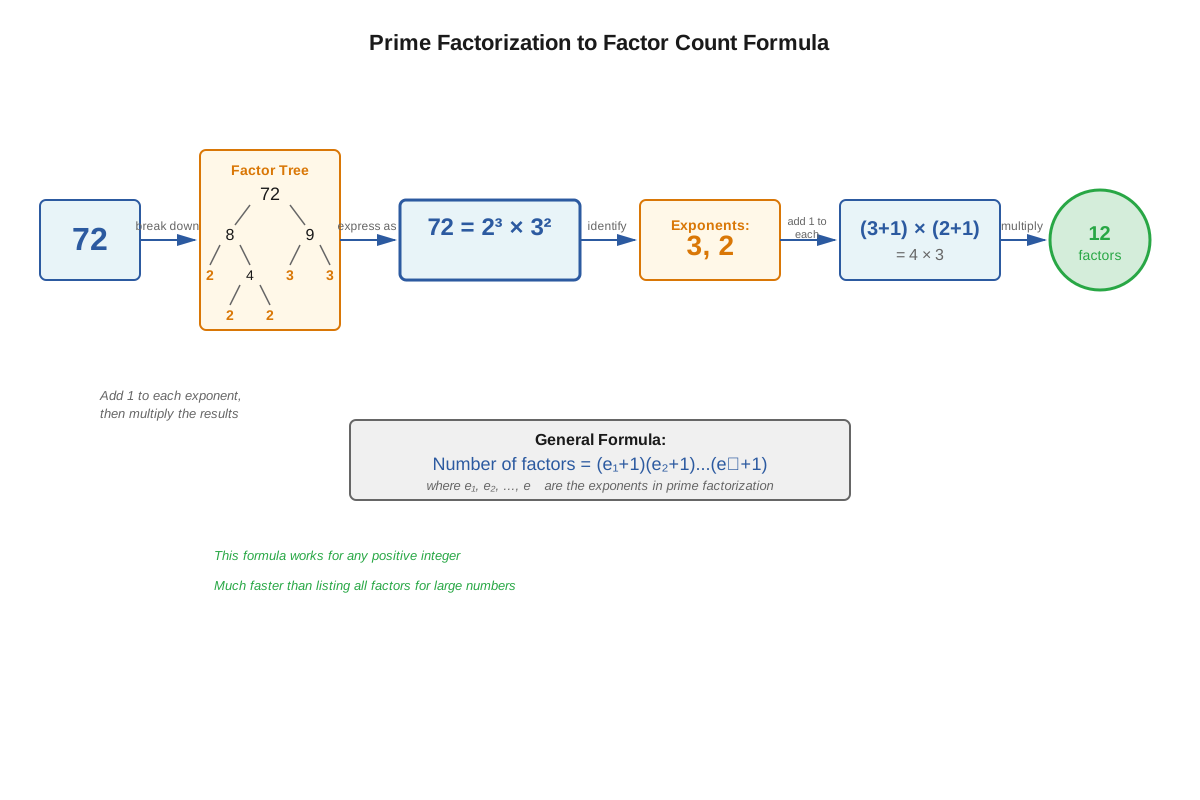
For a number expressed as n = p₁^a × p₂^b × p₃^c (where p₁, p₂, p₃ are distinct primes and a, b, c are positive integers), the total number of factors can be calculated using the formula:
Number of factors = (a + 1)(b + 1)(c + 1)
This formula works because each factor is formed by choosing an exponent from 0 to a for p₁, from 0 to b for p₂, and from 0 to c for p₃.
Example: Find the number of factors of 72
- Prime factorization: 72 = 2³ × 3²
- Number of factors = (3 + 1)(2 + 1) = 4 × 3 = 12 factors
The actual factors are: 1, 2, 3, 4, 6, 8, 9, 12, 18, 24, 36, 72
Factor Pairs and Perfect Squares
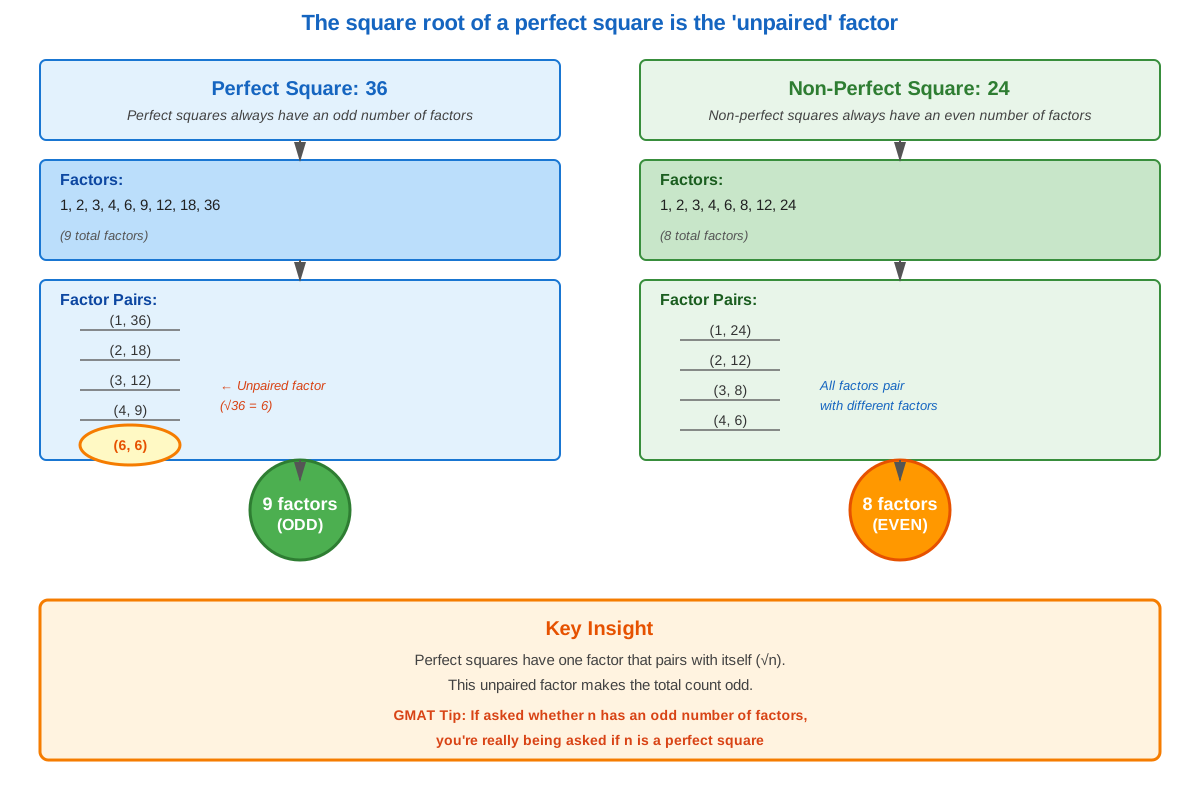
Factors naturally organize into pairs whose product equals the original number. For most numbers, all factor pairs consist of two distinct numbers. However, perfect squares have one factor that pairs with itself (the square root), resulting in an odd total number of factors.
| Number Type | Factor Count | Example |
|---|---|---|
| Non-perfect square | Even | 12 has 6 factors: (1,12), (2,6), (3,4) |
| Perfect square | Odd | 16 has 5 factors: (1,16), (2,8), (4,4) |
This property provides a quick test: if a number has an odd number of factors, it must be a perfect square.
Common Factors and Greatest Common Factor
When analyzing multiple numbers, common factors are integers that divide all the numbers evenly. The Greatest Common Factor (GCF), also called the Greatest Common Divisor (GCD), is the largest integer that divides all given numbers without remainder.
Methods for finding the GCF:
- Listing method: List all factors of each number and identify the largest common factor
- Prime factorization method: Express each number as a product of primes, then multiply the common prime factors using the lowest exponent for each
Example: Find GCF(48, 60)
- 48 = 2⁴ × 3¹
- 60 = 2² × 3¹ × 5¹
- Common prime factors: 2² × 3¹ = 4 × 3 = 12
- GCF(48, 60) = 12
Factor Applications in Problem Solving
GMAT questions use factors in various contexts:
Divisibility problems: Determining whether one number divides another, or finding remainders
Grouping problems: Dividing objects into equal groups (the group size must be a factor of the total)
Optimization problems: Finding maximum or minimum values constrained by factor relationships
Number property questions: Identifying numbers with specific factor characteristics
Understanding that factors represent possible equal divisions enables recognition of factor-based problem structures even when the word "factor" doesn't appear explicitly in the question.
Concept Relationships
The concept of factors serves as a central hub connecting multiple arithmetic and number theory topics. Factors → directly determine → divisibility, since a number is divisible by another if and only if the divisor is a factor. This relationship flows both ways: identifying factors requires testing divisibility, while divisibility rules help identify factors quickly.
Prime factorization → enables efficient → factor counting and identification. Rather than testing every potential divisor, expressing a number as a product of primes allows immediate calculation of the total number of factors and systematic generation of all factors by combining prime factors in different ways.
Factors → combine to form → Greatest Common Factor (GCF) and Least Common Multiple (LCM). The GCF represents the largest shared factor between numbers, while the LCM represents the smallest number that has all given numbers as factors. These concepts are inverse relationships: GCF(a,b) × LCM(a,b) = a × b for any two positive integers.
Perfect squares → exhibit unique → factor properties because their square root pairs with itself, resulting in an odd number of total factors. This connects factors to exponent properties and square root operations.
Factors → underlie → fraction simplification, since reducing fractions requires dividing numerator and denominator by common factors. The fraction is fully simplified when the GCF of numerator and denominator equals 1 (making them relatively prime).
Within GMAT problem-solving, factor recognition → triggers → strategic approaches for word problems involving equal grouping, scheduling with repeating cycles, or optimization under divisibility constraints. Recognizing a factor-based problem structure immediately suggests solution methods involving GCF or factor enumeration.
Quick check — test yourself on Factors so far.
Try Flashcards →High-Yield Facts
⭐ Every positive integer has at least two factors: 1 and itself
⭐ The number of factors formula: For n = p₁^a × p₂^b × p₃^c, the number of factors = (a+1)(b+1)(c+1)
⭐ Perfect squares always have an odd number of factors
⭐ 1 is a factor of every positive integer
⭐ Prime numbers have exactly two factors: 1 and themselves
- Factors always come in pairs, except when a factor equals the square root of the number
- The largest factor of any number (except the number itself) is always less than or equal to half the number
- If a is a factor of b, and b is a factor of c, then a is a factor of c (transitivity)
- The GCF of two numbers is always less than or equal to the smaller number
- Two numbers are relatively prime (coprime) if their GCF equals 1
- Composite numbers have at least three factors
- For any number n, the number of factors less than √n equals the number of factors greater than √n (except for perfect squares)
- The product of all factors of a perfect square equals that number raised to the power of (number of factors)/2
Common Misconceptions
Misconception: Negative numbers can be factors of positive integers → Correction: In GMAT contexts, factors refer exclusively to positive integers. While mathematically negative numbers can divide positive numbers evenly, the GMAT defines factors as positive divisors unless explicitly stated otherwise.
Misconception: Zero is a factor of some numbers → Correction: Zero is never a factor of any number because division by zero is undefined. However, every integer is a factor of zero (since 0 = n × 0 for any n).
Misconception: A number always has an even number of factors → Correction: Only non-perfect squares have an even number of factors. Perfect squares have an odd number of factors because the square root pairs with itself rather than with a different number.
Misconception: The fastest way to find all factors is to test every number from 1 to n → Correction: Testing only up to √n is sufficient because factors come in pairs. Once you reach the square root, you've identified all factor pairs.
Misconception: Prime factorization and listing factors are the same thing → Correction: Prime factorization expresses a number as a product of primes (e.g., 12 = 2² × 3), while listing factors identifies all divisors (1, 2, 3, 4, 6, 12). Prime factorization is a tool that helps find all factors efficiently.
Misconception: If two numbers share some factors, their GCF is the sum of those common factors → Correction: The GCF is the largest single factor that divides both numbers, not a sum. For example, 12 and 18 share factors 1, 2, 3, and 6, but their GCF is 6 (the largest), not 12 (the sum).
Misconception: Every even number has the same number of factors → Correction: The number of factors depends on the complete prime factorization, not just whether a number is even. For example, 6 has four factors while 8 has four factors, but 12 has six factors.
Worked Examples
Example 1: Determining Number of Factors Using Prime Factorization
Question: How many positive factors does 180 have?
Solution:
Step 1: Find the prime factorization of 180
- 180 = 2 × 90
- 90 = 2 × 45
- 45 = 3 × 15
- 15 = 3 × 5
- Therefore: 180 = 2² × 3² × 5¹
Step 2: Apply the factor counting formula
- For n = p₁^a × p₂^b × p₃^c, number of factors = (a+1)(b+1)(c+1)
- Number of factors = (2+1)(2+1)(1+1)
- Number of factors = 3 × 3 × 2 = 18
Answer: 180 has 18 positive factors
Connection to learning objectives: This example demonstrates both identifying factors systematically through prime factorization and applying the factor formula—key skills for GMAT efficiency. Rather than listing all 18 factors individually (time-consuming), using prime factorization provides the answer in seconds.
Example 2: Data Sufficiency with Factor Properties
Question: Is positive integer n a perfect square?
Statement (1): n has exactly 9 positive factors
Statement (2): n = 2^a × 3^b where a and b are positive integers
Solution:
Analyzing Statement (1):
- Perfect squares have an odd number of factors
- n has 9 factors (odd number)
- However, having an odd number of factors is necessary but not sufficient alone
- We need to verify that 9 factors comes from a perfect square structure
- Using the formula (a+1)(b+1)(c+1) = 9, possible factorizations: 9 = 9×1 = 3×3
- If 9 = 9×1, then n = p⁸ (like 2⁸ = 256, which is 16²) ✓ perfect square
- If 9 = 3×3, then n = p² × q² (like 2² × 3² = 36, which is 6²) ✓ perfect square
- Statement (1) is SUFFICIENT
Analyzing Statement (2):
- n = 2^a × 3^b where a, b are positive integers
- If a = 2 and b = 2, then n = 36 = 6² (perfect square)
- If a = 1 and b = 1, then n = 6 (not a perfect square)
- Statement (2) is INSUFFICIENT
Answer: Statement (1) alone is sufficient, but statement (2) alone is not sufficient. Answer choice: A
Connection to learning objectives: This example applies factor concepts to GMAT data sufficiency questions, demonstrating how understanding the relationship between factor count and perfect squares enables quick evaluation of statement sufficiency—a high-value GMAT skill.
Exam Strategy
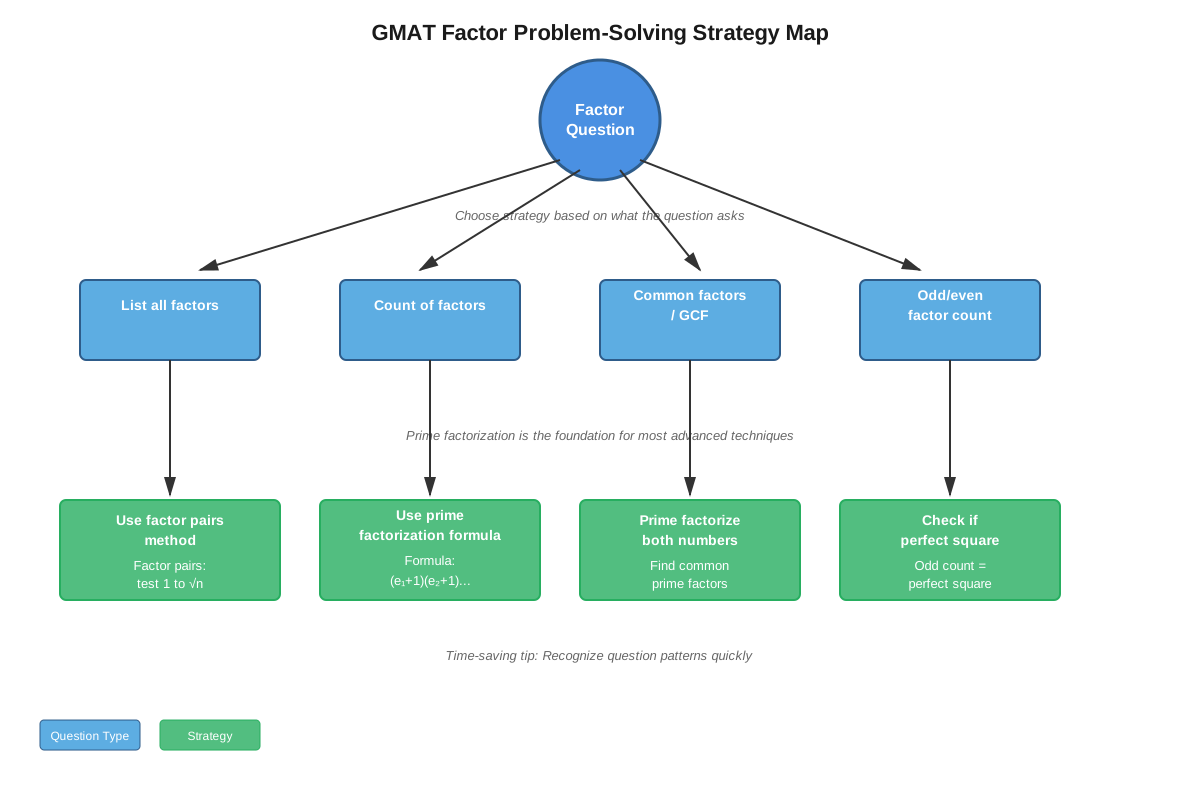
When approaching GMAT factors questions, begin by identifying whether the question asks for factor identification, factor counting, or factor relationships (like GCF). This classification determines the optimal solution method.
Trigger words and phrases that signal factor-based questions include:
- "divides evenly into"
- "divisible by"
- "how many factors"
- "greatest common factor/divisor"
- "can be divided into equal groups"
- "perfect square"
- "prime factorization"
For problem-solving questions asking for the number of factors, immediately use prime factorization rather than listing factors individually. This approach saves significant time, especially for larger numbers. Write out the prime factorization clearly, then apply the (a+1)(b+1)(c+1) formula.
For data sufficiency questions, recognize that factor properties often create sufficient conditions even when exact values aren't provided. For example, knowing a number is a perfect square immediately tells you it has an odd number of factors. Test extreme cases: try the smallest possible values and one larger value to check whether statements provide consistent information.
Process of elimination strategies:
- Eliminate answer choices that violate basic factor properties (like suggesting a prime has more than two factors)
- For "number of factors" questions, eliminate answers that give even numbers when the original number is a perfect square
- For GCF questions, eliminate any answer larger than the smaller of the two numbers being compared
Time allocation: Spend 15-20 seconds identifying the question type and choosing your method (listing vs. prime factorization). For straightforward factor-counting questions, prime factorization should take 30-45 seconds total. If you find yourself listing factors beyond 60 seconds, stop and switch to prime factorization. For data sufficiency, allocate 90-120 seconds, spending equal time carefully analyzing each statement.
Exam Tip: When a question involves factors of numbers with many digits, look for patterns or use divisibility rules before attempting full prime factorization. Sometimes the question can be answered by recognizing that a number is even, divisible by 5, or divisible by 3, without complete factorization.
Memory Techniques
Mnemonic for factor counting formula: "Plus One Product" (POP)
- Plus one to each exponent
- Product of all results
- This gives you the total number of factors
Visualization for factor pairs: Picture factors as a ladder where each rung represents a factor pair. The middle of the ladder (where the sides meet) represents the square root for perfect squares. This visual reinforces why you only need to check up to the square root.
Acronym for perfect square properties: "ODD"
- Odd number of factors
- Divisible by a perfect square
- Double-counted middle factor (the square root)
Memory aid for GCF vs. LCM:
- GCF = Greatest Common Factor = "Go Close to Floor" (smallest/greatest that fits)
- LCM = Least Common Multiple = "Look Ceiling Most" (largest/least that contains)
Rhyme for factor basics: "One and itself are always there, factors come in pairs with care, except when squares are in the air—then one stands alone without a pair."
Summary
Factors represent the positive integers that divide evenly into a given number, forming a foundational concept in GMAT Quantitative Reasoning. Mastery requires three core competencies: systematically identifying all factors of a number, using prime factorization to efficiently count factors via the (a+1)(b+1)(c+1) formula, and recognizing factor relationships in problem contexts. Every positive integer has at least two factors (1 and itself), with factors naturally pairing except in perfect squares, which have an odd total number of factors because the square root pairs with itself. The GMAT tests factors through direct calculation questions, data sufficiency problems requiring recognition of factor properties, and word problems where factor relationships provide solution pathways. Strategic use of prime factorization dramatically improves speed and accuracy compared to listing factors individually. Understanding that factors underlie divisibility, GCF/LCM relationships, and fraction operations enables test-takers to recognize factor-based problem structures even when questions don't explicitly mention factors, providing a significant competitive advantage on test day.
Key Takeaways
- Factors are positive integers that divide a number evenly; every number has at least two factors (1 and itself)
- Use prime factorization and the formula (a+1)(b+1)(c+1) to count factors efficiently rather than listing them all
- Perfect squares always have an odd number of factors because the square root pairs with itself
- Only test potential factors up to the square root of a number, since factors come in pairs
- The GCF (Greatest Common Factor) is found by taking the product of common prime factors with their lowest exponents
- Factor questions appear in 10-15% of GMAT Quantitative problems, making them high-yield for score improvement
- Recognizing factor-based problem structures (equal grouping, divisibility, optimization) triggers efficient solution strategies
Related Topics
Prime Numbers and Prime Factorization: Deepens understanding of how to break numbers into prime components, which is essential for advanced factor analysis and forms the basis for the efficient factor-counting formula covered in this guide.
Divisibility Rules: Provides shortcuts for quickly determining whether numbers are divisible by 2, 3, 4, 5, 6, 8, 9, and 11 without performing full division, accelerating factor identification on time-pressured GMAT questions.
Greatest Common Factor (GCF) and Least Common Multiple (LCM): Extends factor concepts to relationships between multiple numbers, essential for ratio problems, fraction operations, and scheduling/cycle problems on the GMAT.
Perfect Squares and Square Roots: Explores the special properties of numbers that are products of an integer with itself, building on the factor property that perfect squares have odd numbers of factors.
Exponents and Powers: Connects to prime factorization notation and enables manipulation of expressions involving factors, particularly important for questions combining multiple arithmetic concepts.
Practice CTA
Now that you've mastered the core concepts of factors, it's time to solidify your understanding through active practice. Attempt the practice questions to apply these strategies under test-like conditions, and use the flashcards to reinforce high-yield facts and formulas until they become automatic. Remember: understanding factors gives you a powerful advantage on 10-15% of GMAT Quantitative questions—that's potentially 4-6 questions that can significantly impact your score. Every practice problem you solve builds the pattern recognition and speed you'll need on test day. Start practicing now to transform this knowledge into points!
Sign up free to keep reading
Create a free AnvayaPrep account to finish this GMAT guide on Factors — plus flashcards and practice questions.