Overview
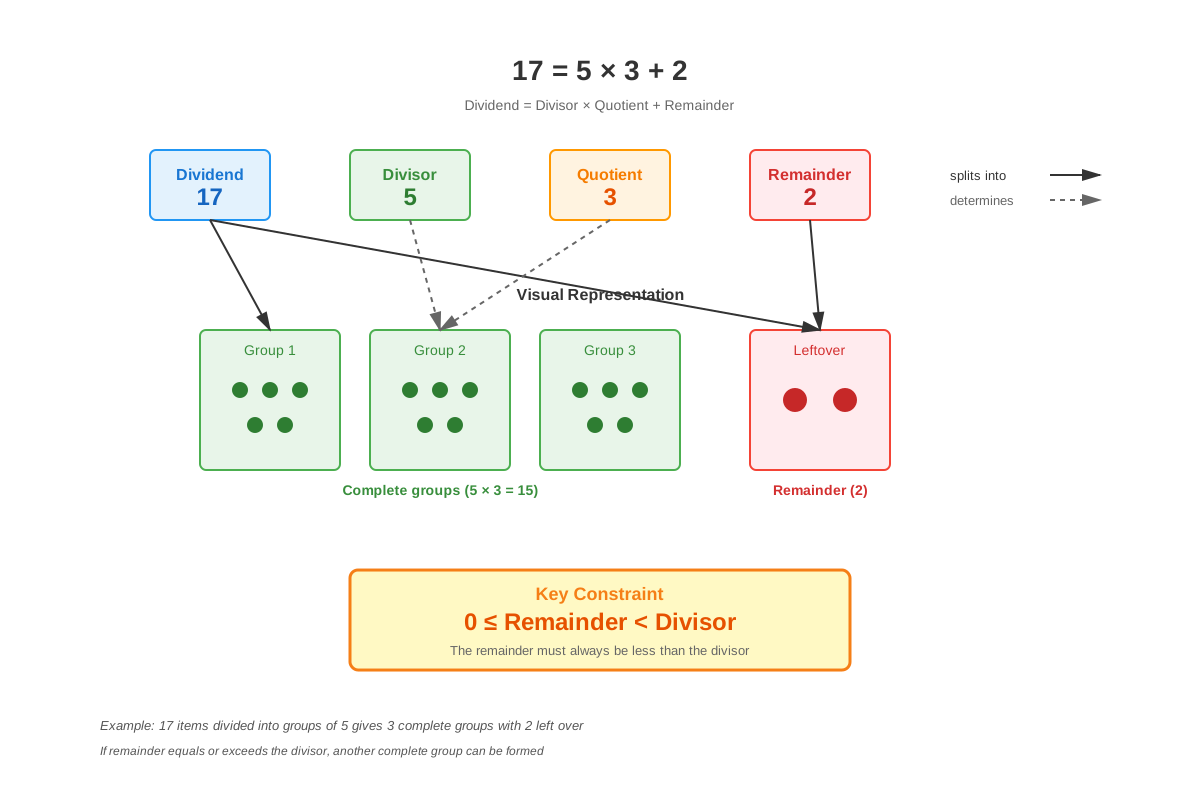
Remainders are a fundamental concept in arithmetic that appears frequently on the GMAT Quantitative Reasoning section. When one integer is divided by another and the division is not exact, the amount "left over" is called the remainder. For example, when 17 is divided by 5, the quotient is 3 and the remainder is 2, because 17 = 5 × 3 + 2. Understanding remainders is crucial not only for direct remainder problems but also for questions involving divisibility, number properties, patterns in sequences, and modular arithmetic applications.
The GMAT tests remainders in various sophisticated ways that go beyond simple division. Questions may involve finding patterns in remainder sequences, working with negative numbers, combining multiple remainder conditions, or using remainder properties to solve complex word problems. Mastery of GMAT remainders requires understanding both the mechanical process of finding remainders and the deeper mathematical properties that govern how remainders behave under different operations. This topic frequently appears in Data Sufficiency questions where students must determine whether given information is sufficient to find a unique remainder.
Remainders connect to broader Quantitative Reasoning concepts including divisibility rules, prime factorization, greatest common divisors, and least common multiples. They form the foundation for understanding cyclical patterns in number sequences and are essential for solving problems involving scheduling, grouping, and distribution scenarios. Strong remainder skills enable students to approach integer property questions with confidence and often provide elegant shortcuts for problems that might otherwise require lengthy calculations.
Learning Objectives
- [ ] Identify remainders in division problems and real-world scenarios
- [ ] Explain the relationship between dividend, divisor, quotient, and remainder
- [ ] Apply remainder concepts to solve GMAT questions efficiently
- [ ] Determine remainder patterns in sequences and cyclical problems
- [ ] Use remainder properties to solve problems involving multiple divisibility conditions
- [ ] Recognize when remainder theorems can simplify complex calculations
- [ ] Evaluate Data Sufficiency questions involving remainder constraints
Prerequisites
- Integer arithmetic: Understanding of whole numbers, positive and negative integers, and basic operations is essential since remainders only apply to integer division
- Multiplication and division: Fluency with these operations enables quick calculation and verification of remainders
- Divisibility concepts: Knowledge of factors and multiples provides context for when remainders are zero versus non-zero
- Basic algebraic manipulation: Ability to work with variables helps in solving remainder problems presented in abstract form
Why This Topic Matters
Remainder problems appear in approximately 10-15% of GMAT Quantitative Reasoning questions, making them a high-yield topic for test preparation. These questions span both Problem Solving and Data Sufficiency formats, with Data Sufficiency remainder questions being particularly common because they test logical reasoning about number properties rather than just computational ability.
In real-world applications, remainders are essential for scheduling problems (determining what day of the week a future date falls on), resource allocation (distributing items into groups), computer science (hash functions and cryptography), and quality control (sampling at regular intervals). The GMAT leverages these practical contexts to create word problems that test both mathematical understanding and analytical reasoning.
On the exam, remainder questions commonly appear disguised as problems about patterns, cycles, or distributions. A question might ask about the last digit of a large power (which is a remainder when divided by 10), the day of the week after a certain number of days (remainder when divided by 7), or whether items can be evenly distributed into groups (testing if the remainder is zero). Recognizing these patterns allows test-takers to apply remainder concepts even when the word "remainder" never appears in the question stem.
Core Concepts
The Division Algorithm
The foundation of remainder theory is the division algorithm, which states that for any integers a (dividend) and b (divisor) where b > 0, there exist unique integers q (quotient) and r (remainder) such that:
a = b × q + r, where 0 ≤ r < bThis equation is fundamental to all remainder problems. The remainder r must always be non-negative and strictly less than the divisor b. For example, when dividing 23 by 5:
- 23 = 5 × 4 + 3
- Here, a = 23, b = 5, q = 4, and r = 3
The constraint that 0 ≤ r < b is crucial. The remainder must be in the range from 0 to (divisor - 1). When dividing by 7, possible remainders are 0, 1, 2, 3, 4, 5, or 6. This limited range creates cyclical patterns that the GMAT frequently tests.
Finding Remainders
To find the remainder when a is divided by b:
- Perform the division a ÷ b
- Identify the integer quotient q (discard any decimal portion)
- Multiply the divisor by the quotient: b × q
- Subtract this product from the dividend: r = a - (b × q)
Example: Find the remainder when 47 is divided by 6
- 47 ÷ 6 = 7.833...
- Integer quotient q = 7
- 6 × 7 = 42
- Remainder r = 47 - 42 = 5
For negative dividends, the process requires care. The remainder must still satisfy 0 ≤ r < b. When dividing -17 by 5:
- -17 = 5 × (-4) + 3
- The remainder is 3, not -2, because we need r ≥ 0
Remainder Properties Under Operations
Understanding how remainders behave under arithmetic operations is essential for GMAT problem-solving:
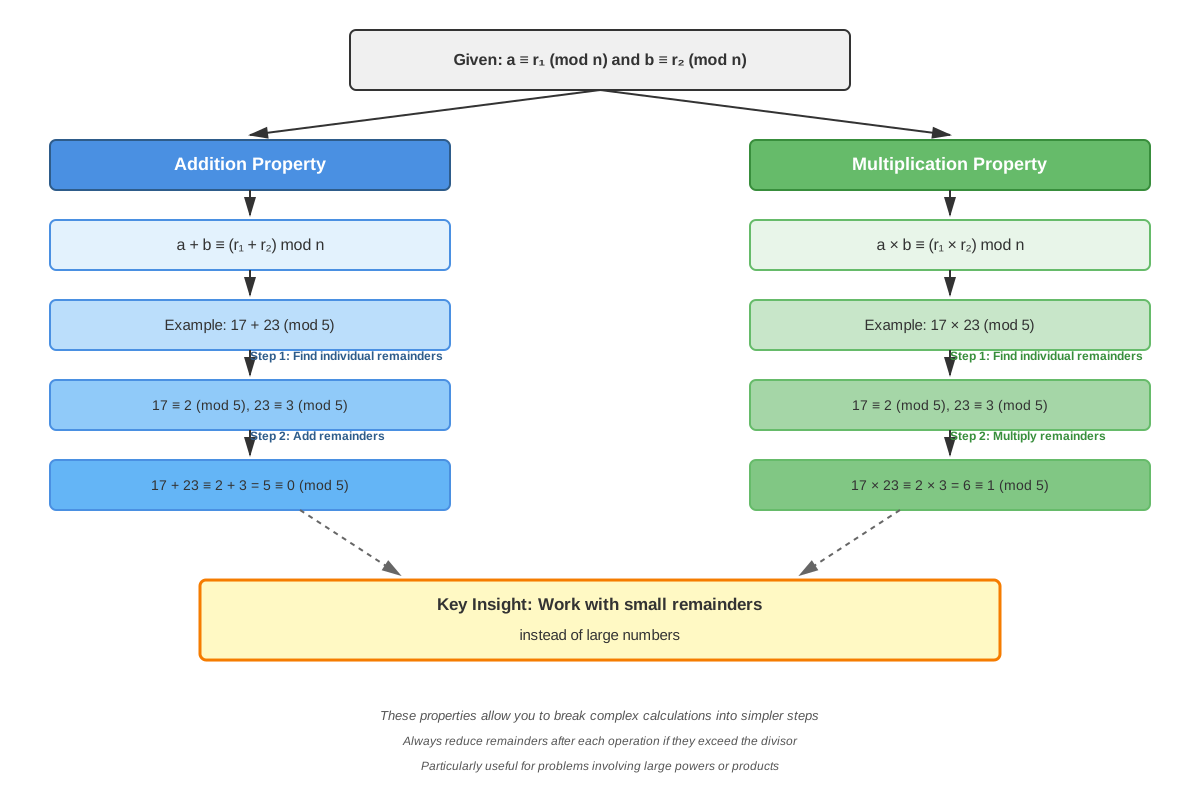
Addition Property: If a leaves remainder r₁ when divided by n, and b leaves remainder r₂ when divided by n, then (a + b) leaves remainder equal to the remainder of (r₁ + r₂) divided by n.
Example: 17 leaves remainder 2 when divided by 5, and 23 leaves remainder 3 when divided by 5. Therefore, 17 + 23 = 40 leaves the same remainder as 2 + 3 = 5, which is 0 when divided by 5.
Multiplication Property: If a leaves remainder r₁ when divided by n, and b leaves remainder r₂ when divided by n, then (a × b) leaves remainder equal to the remainder of (r₁ × r₂) divided by n.
Example: 17 leaves remainder 2 when divided by 5, and 23 leaves remainder 3 when divided by 5. Therefore, 17 × 23 = 391 leaves the same remainder as 2 × 3 = 6, which is 1 when divided by 5.
Subtraction Property: Similar to addition, (a - b) leaves the same remainder as (r₁ - r₂) when divided by n, adjusting for negative results by adding n if necessary.
Power Property: If a leaves remainder r when divided by n, then aᵏ leaves the same remainder as rᵏ when divided by n.
| Operation | Remainder Rule | Example (mod 5) |
|---|---|---|
| Addition | (r₁ + r₂) mod n | (2 + 3) mod 5 = 0 |
| Subtraction | (r₁ - r₂) mod n | (3 - 2) mod 5 = 1 |
| Multiplication | (r₁ × r₂) mod n | (2 × 3) mod 5 = 1 |
| Power | (r₁)ᵏ mod n | 2³ mod 5 = 3 |
Cyclical Patterns in Remainders
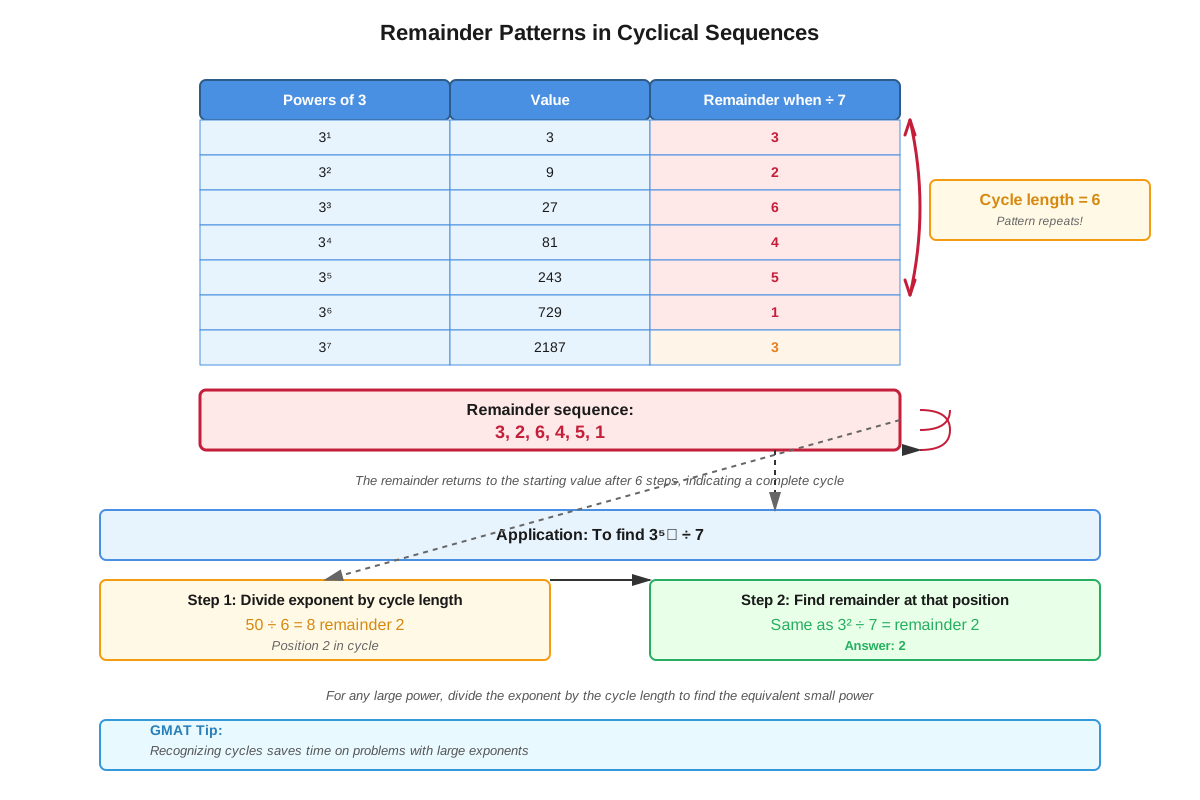
Many GMAT remainder problems exploit the cyclical nature of remainders, particularly in problems involving powers or sequences. When calculating remainders of successive powers, patterns emerge that repeat.
Example: Remainders when powers of 3 are divided by 7
- 3¹ ÷ 7 → remainder 3
- 3² = 9 ÷ 7 → remainder 2
- 3³ = 27 ÷ 7 → remainder 6
- 3⁴ = 81 ÷ 7 → remainder 4
- 3⁵ = 243 ÷ 7 → remainder 5
- 3⁶ = 729 ÷ 7 → remainder 1
- 3⁷ = 2187 ÷ 7 → remainder 3 (pattern repeats)
The cycle length is 6, so to find the remainder of 3⁵⁰ divided by 7, calculate 50 mod 6 = 2, meaning 3⁵⁰ has the same remainder as 3², which is 2.
Remainder Zero and Divisibility
When the remainder is zero, the dividend is divisible by the divisor. This connection between remainders and divisibility is frequently tested:
- "a is divisible by b" means "a divided by b leaves remainder 0"
- "a leaves remainder r when divided by b" means "a is r more than a multiple of b"
This relationship allows translation between remainder language and divisibility language, which can simplify problem-solving.
Chinese Remainder Theorem Applications
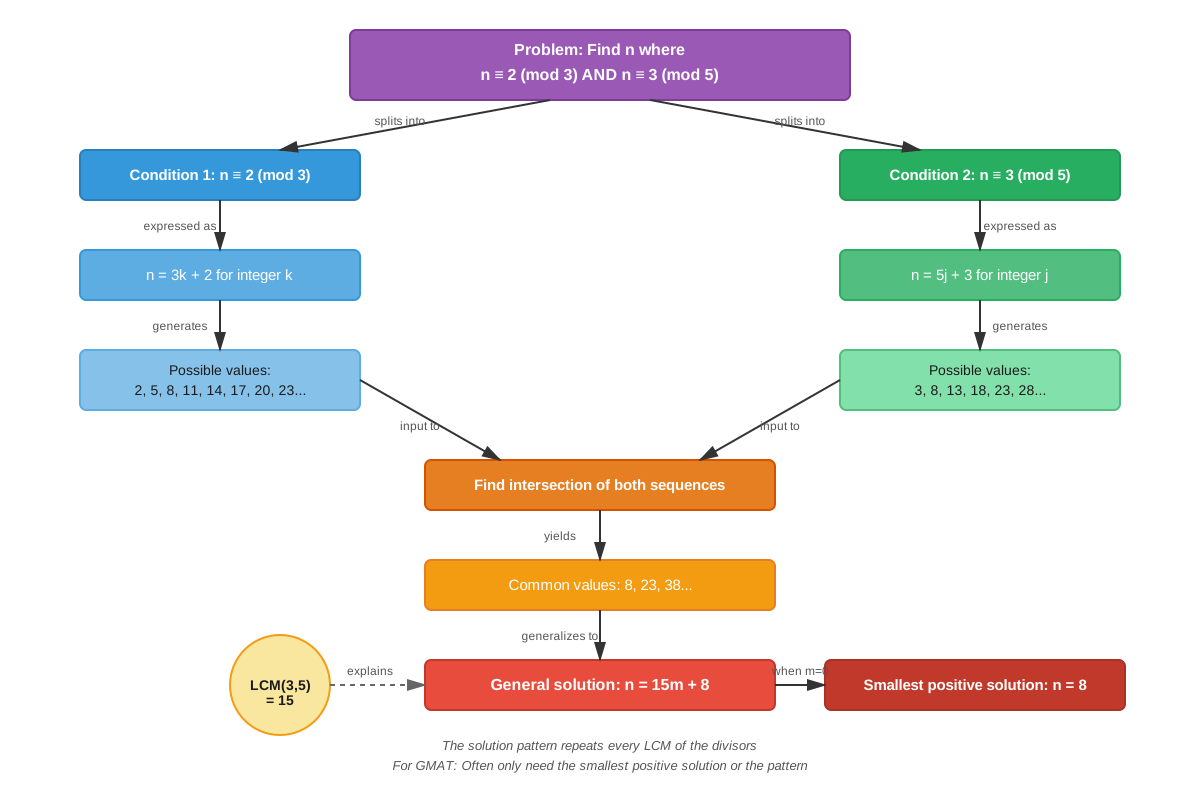
While the full Chinese Remainder Theorem is beyond GMAT scope, the test does present problems involving multiple remainder conditions. When given that a number leaves remainder r₁ when divided by n₁ and remainder r₂ when divided by n₂, students must find numbers satisfying both conditions simultaneously.
Approach:
- Express the first condition: x = n₁k + r₁ for some integer k
- Substitute into the second condition
- Solve for k, then find x
This systematic approach handles problems like "Find a number that leaves remainder 3 when divided by 5 and remainder 2 when divided by 7."
Concept Relationships
The core concepts within remainder theory form an interconnected system. The division algorithm serves as the foundation, defining what a remainder is and establishing the constraint 0 ≤ r < b. This leads directly to methods for finding remainders, which are the computational tools for applying the definition.
Understanding remainder properties under operations builds on the basic definition and enables efficient calculation without performing full division repeatedly. These properties → lead to → recognition of cyclical patterns, particularly in power problems where the multiplication property creates repeating sequences. Cyclical patterns → connect back to → the division algorithm through modular arithmetic, where the limited range of possible remainders guarantees eventual repetition.
The concept of remainder zero bridges remainder theory with divisibility, factors, and multiples—prerequisite topics that provide context. This connection flows both ways: divisibility problems can be reframed as remainder problems, and remainder problems can leverage divisibility rules for quick calculation.
Multiple remainder conditions represent the synthesis of all previous concepts, requiring students to apply the division algorithm, use operational properties, and often recognize patterns to find solutions efficiently. These problems → connect to → systems of equations and number theory, demonstrating how remainders integrate with broader mathematical concepts.
The relationship map: Division Algorithm → Finding Remainders → Operational Properties → Cyclical Patterns → Multiple Conditions, with Remainder Zero connecting throughout to divisibility concepts.
High-Yield Facts
⭐ The remainder when a is divided by b must satisfy 0 ≤ r < b, meaning remainders range from 0 to (divisor - 1)
⭐ If a leaves remainder r when divided by n, then a = nq + r for some integer quotient q
⭐ The remainder when (a + b) is divided by n equals the remainder when (r₁ + r₂) is divided by n, where r₁ and r₂ are the remainders of a and b respectively
⭐ The remainder when (a × b) is divided by n equals the remainder when (r₁ × r₂) is divided by n
⭐ When the remainder is 0, the dividend is divisible by the divisor (no amount left over)
- The remainder when dividing by 10 gives the units digit of a number
- Consecutive integers divided by n will produce all possible remainders 0 through (n-1) in sequence
- If a number leaves remainder r when divided by n, then adding or subtracting any multiple of n preserves the remainder
- Powers of a number divided by n follow cyclical patterns that repeat after at most (n-1) terms
- For negative dividends, adjust the calculation to ensure the remainder stays in the range [0, b)
- The remainder when a² is divided by 4 can only be 0 or 1 (useful for even/odd analysis)
- If two numbers leave the same remainder when divided by n, their difference is divisible by n
Quick check — test yourself on Remainders so far.
Try Flashcards →Common Misconceptions
Misconception: The remainder can be negative or greater than the divisor.
Correction: By definition, the remainder r must satisfy 0 ≤ r < b. If calculations produce a negative result or a value ≥ b, adjustment is needed. For example, if working with remainders produces -2 when dividing by 5, add 5 to get the correct remainder of 3.
Misconception: When dividing negative numbers, the remainder is simply the negative of what it would be for positive numbers.
Correction: The remainder must still be non-negative. When -17 is divided by 5, the remainder is 3, not -2, because -17 = 5(-4) + 3. The quotient adjusts to keep the remainder in the valid range.
Misconception: To find the remainder of a large power like 7⁵⁰ divided by 6, you must calculate 7⁵⁰ first.
Correction: Use cyclical patterns and remainder properties. Find the pattern of remainders for successive powers (7¹, 7², 7³...), identify the cycle length, then use the exponent modulo the cycle length to determine which remainder in the pattern applies.
Misconception: If a leaves remainder 3 when divided by 5, and b leaves remainder 4 when divided by 5, then (a + b) leaves remainder 7 when divided by 5.
Correction: The sum of remainders must itself be reduced modulo the divisor. Since 3 + 4 = 7 and 7 = 5(1) + 2, the remainder is 2, not 7. Always take the remainder of the remainder sum.
Misconception: Remainder problems always require long division or calculator computation.
Correction: Many GMAT remainder problems are designed to be solved using properties, patterns, or divisibility rules rather than direct calculation. Recognizing the underlying pattern or property is often faster and less error-prone than computing.
Misconception: If a number is 2 more than a multiple of 7, it leaves remainder 2 when divided by 7, but this doesn't help with other operations.
Correction: This representation is extremely useful. If x = 7k + 2, then 3x = 21k + 6 = 7(3k) + 6, immediately showing that 3x leaves remainder 6 when divided by 7, without knowing the specific value of x.
Worked Examples
Example 1: Finding Remainder with Large Numbers
Problem: What is the remainder when 2⁵⁰ is divided by 7?
Solution:
Rather than calculating 2⁵⁰ directly (which is impossibly large), we'll find the pattern of remainders when powers of 2 are divided by 7.
Step 1: Calculate remainders for small powers of 2 divided by 7
- 2¹ = 2 → remainder 2
- 2² = 4 → remainder 4
- 2³ = 8 → remainder 1 (since 8 = 7 × 1 + 1)
- 2⁴ = 16 → remainder 2 (since 16 = 7 × 2 + 2)
- 2⁵ = 32 → remainder 4 (since 32 = 7 × 4 + 4)
- 2⁶ = 64 → remainder 1 (since 64 = 7 × 9 + 1)
Step 2: Identify the pattern
The remainders follow the pattern: 2, 4, 1, 2, 4, 1, ...
The cycle length is 3 (the pattern repeats every 3 powers).
Step 3: Determine where 2⁵⁰ falls in the cycle
Divide the exponent by the cycle length: 50 ÷ 3 = 16 remainder 2
This means 2⁵⁰ has the same remainder as 2² in our pattern.
Step 4: Find the answer
From our pattern, 2² leaves remainder 4 when divided by 7.
Answer: The remainder is 4.
Connection to Learning Objectives: This example demonstrates applying remainder concepts to GMAT questions by using cyclical patterns rather than brute-force calculation, and explains the relationship between powers and remainders.
Example 2: Multiple Remainder Conditions (Data Sufficiency Style)
Problem: What is the value of positive integer n?
Statement (1): When n is divided by 5, the remainder is 3.
Statement (2): When n is divided by 7, the remainder is 2.
Solution:
Step 1: Analyze Statement (1)
If n leaves remainder 3 when divided by 5, then n = 5k + 3 for some non-negative integer k.
Possible values: 3, 8, 13, 18, 23, 28, 33, 38, 43, 48, ...
This gives infinitely many possibilities, so Statement (1) alone is INSUFFICIENT.
Step 2: Analyze Statement (2)
If n leaves remainder 2 when divided by 7, then n = 7m + 2 for some non-negative integer m.
Possible values: 2, 9, 16, 23, 30, 37, 44, 51, ...
This also gives infinitely many possibilities, so Statement (2) alone is INSUFFICIENT.
Step 3: Analyze both statements together
We need a number that appears in both lists. Looking at the sequences:
- From (1): 3, 8, 13, 18, 23, 28, 33, 38, 43, 48, 53, 58, 63, 68, 73, ...
- From (2): 2, 9, 16, 23, 30, 37, 44, 51, 58, 65, 72, ...
Common values: 23, 58, 93, ...
The pattern shows that numbers satisfying both conditions differ by 35 (which is 5 × 7, the product of the two divisors). Since there are infinitely many such numbers, both statements together are still INSUFFICIENT.
Answer: (E) Statements (1) and (2) together are not sufficient.
Key Insight: When dealing with multiple remainder conditions, if the divisors are relatively prime (share no common factors other than 1), solutions exist but repeat every LCM(divisor₁, divisor₂) units. Without an upper bound or additional constraint, we cannot determine a unique value.
Connection to Learning Objectives: This example demonstrates identifying and explaining remainder concepts in a Data Sufficiency context, showing how to systematically evaluate remainder conditions and recognize when information is insufficient.
Exam Strategy
When approaching GMAT remainder questions, begin by identifying whether the problem explicitly mentions remainders or disguises them in context (days of the week, last digits, distribution problems). Look for trigger phrases such as "left over," "evenly distributed," "what remains," "last digit," or "what day of the week."
For Problem Solving questions, determine whether direct calculation is feasible or whether pattern recognition is more efficient. If the numbers are small (dividing numbers under 100 by single digits), direct calculation may be fastest. For large numbers, especially powers or products, immediately look for cyclical patterns or use remainder properties to avoid impossible calculations.
Exam Tip: When you see a power with a large exponent (like 7⁵⁰), never attempt direct calculation. Always look for the remainder pattern in the first few powers.
In Data Sufficiency questions, remainder problems often test whether you understand the range of possible values. Remember that a single remainder condition typically allows infinitely many values, so look for what additional information would narrow the possibilities. Consider whether the statements provide:
- An upper or lower bound on the number
- A second remainder condition with a different divisor
- Information about other properties (even/odd, prime, etc.)
Time allocation: Straightforward remainder calculations should take 30-60 seconds. Pattern-finding problems may require 90-120 seconds. If you're spending more than 2 minutes, you're likely missing a shortcut or pattern.
Process of elimination tips:
- Eliminate answer choices that fall outside the valid remainder range [0, divisor-1]
- For "what is the remainder" questions, if you can quickly determine the remainder is even or odd, eliminate accordingly
- In word problems, eliminate answers that don't make logical sense in context (negative remainders, remainders larger than the group size)
Common question types and approaches:
| Question Type | Approach |
|---|---|
| Last digit problems | Find remainder when divided by 10 |
| Day of week problems | Find remainder when divided by 7 |
| Distribution problems | Set up division and find remainder |
| Large power problems | Find cyclical pattern in remainders |
| Multiple conditions | List possibilities or use algebraic representation |
Memory Techniques
Mnemonic for the Division Algorithm: "Dad Quickly Bought Roses" represents D = Q × B + R (Dividend = Quotient × Base + Remainder), where "Base" is another term for divisor.
Remainder Range Rule: "Remainders Run from Zero to Before the Divisor" (R ranges from 0 to D-1). Visualize a number line from 0 to just before the divisor.
Visualization for Cyclical Patterns: Picture a clock face. Just as hours cycle through 1-12 and repeat, remainders cycle through 0 to (n-1) and repeat. When finding the remainder of 3⁵⁰ ÷ 7, you're asking "where on the remainder clock does 3⁵⁰ land?"
Acronym for Remainder Properties: "Add, Subtract, Multiply, Power" = ASMP = "Always Simplify Modulo Periodically." This reminds you that for all these operations, you can work with remainders instead of original numbers, simplifying calculations.
Memory Palace Technique: Associate remainder concepts with physical locations:
- Front door (entrance) = Division Algorithm (the entry point to all remainder problems)
- Kitchen (where you divide food) = Finding Remainders through division
- Living room (where patterns repeat in furniture) = Cyclical Patterns
- Garage (where you store multiple items) = Multiple Remainder Conditions
Finger Counting for Small Remainders: When dividing by small numbers (2-10), use fingers to count up by the divisor until you reach or pass the dividend. The amount you "overshoot" by (or the gap remaining) is the remainder. This kinesthetic approach helps some learners internalize the concept.
Summary
Remainders represent the amount left over when one integer is divided by another, formally defined by the division algorithm: a = bq + r where 0 ≤ r < b. Mastering remainders for the GMAT requires understanding both the mechanical process of finding remainders and the mathematical properties that govern their behavior. Key properties include how remainders behave under addition, subtraction, multiplication, and exponentiation—allowing complex calculations to be simplified by working with remainders rather than original numbers. The cyclical nature of remainders, particularly in power problems, enables efficient solution of problems involving large numbers that would be impossible to calculate directly. GMAT remainder questions appear in various disguises including last digit problems, day-of-the-week calculations, and distribution scenarios. Success requires recognizing these patterns, applying remainder properties strategically, and understanding when direct calculation is appropriate versus when pattern recognition is necessary. For Data Sufficiency questions, understanding that a single remainder condition typically allows infinitely many solutions is crucial for evaluating sufficiency correctly.
Key Takeaways
- The remainder r when dividing a by b must satisfy 0 ≤ r < b, creating a limited range that produces cyclical patterns
- The division algorithm a = bq + r is the foundation for all remainder calculations and problem-solving
- Remainder properties allow operations on remainders directly: (a + b) mod n = (r₁ + r₂) mod n, and similarly for multiplication
- Large power problems require finding cyclical patterns in remainders rather than direct calculation
- Remainder zero indicates divisibility, connecting remainder theory to factors, multiples, and divisibility rules
- Multiple remainder conditions typically produce infinitely many solutions unless additional constraints are provided
- GMAT remainder questions often appear disguised as real-world problems about distribution, cycles, or patterns
Related Topics
Divisibility Rules: Understanding shortcuts for determining whether numbers are divisible by 2, 3, 4, 5, 6, 8, 9, and 10 builds directly on remainder concepts, as divisibility means remainder zero. Mastering remainders provides the theoretical foundation for why these rules work.
Number Properties and Integer Constraints: Remainder problems frequently combine with even/odd analysis, prime numbers, and consecutive integer properties. Strong remainder skills enable more sophisticated problem-solving in these areas.
Modular Arithmetic: While not explicitly tested by name on the GMAT, modular arithmetic is the formal mathematical framework underlying remainder operations. Advanced students may benefit from exploring this topic for deeper understanding.
Greatest Common Divisor (GCD) and Least Common Multiple (LCM): These concepts connect to remainders through problems involving multiple divisibility conditions and finding numbers that satisfy various remainder requirements simultaneously.
Sequences and Patterns: Many sequence problems involve finding terms that follow remainder-based patterns, making remainder mastery essential for this broader topic area.
Practice CTA
Now that you've mastered the core concepts of remainders, it's time to solidify your understanding through practice. Attempt the practice questions to apply these concepts in GMAT-style problems, ranging from straightforward calculations to complex multi-step reasoning. Use the flashcards to reinforce key facts and properties until they become automatic. Remember, remainder problems reward pattern recognition and strategic thinking—skills that improve dramatically with focused practice. Each problem you solve strengthens your ability to recognize remainder patterns quickly on test day, giving you a significant advantage in the Quantitative Reasoning section.
Sign up free to keep reading
Create a free AnvayaPrep account to finish this GMAT guide on Remainders — plus flashcards and practice questions.