Overview
Roots are fundamental mathematical operations that appear frequently throughout the GMAT Quantitative Reasoning section. A root represents the inverse operation of raising a number to a power—while exponents ask "what happens when we multiply a number by itself repeatedly," roots ask "what number, when multiplied by itself a certain number of times, gives us this result?" Understanding GMAT roots is essential not only for direct calculation problems but also for algebraic manipulation, equation solving, geometry problems involving area and volume, and data sufficiency questions that test conceptual understanding rather than pure computation.
The GMAT tests roots in multiple contexts: simplifying radical expressions, solving equations containing roots, comparing quantities involving roots, and recognizing when root properties can simplify complex expressions. Questions may appear straightforward—asking for the square root of 144—or may embed root concepts within word problems, geometry scenarios, or algebraic expressions. The exam particularly favors questions that test whether students understand the properties and restrictions of roots rather than simply their ability to calculate.
Mastery of roots connects directly to other critical Quantitative Reasoning topics including exponents (roots are fractional exponents), algebraic equations (many require isolating variables under root signs), inequalities (roots affect inequality direction under certain conditions), and number properties (understanding perfect squares, cubes, and the behavior of roots with negative numbers, fractions, and decimals). This topic serves as a bridge between basic arithmetic operations and more advanced algebraic manipulation, making it a high-yield area for focused study.
Learning Objectives
- [ ] Identify roots in various mathematical expressions and contexts
- [ ] Explain the properties and rules governing root operations
- [ ] Apply roots to GMAT questions across multiple question types
- [ ] Simplify radical expressions using root properties
- [ ] Solve equations containing root expressions
- [ ] Recognize the relationship between roots and fractional exponents
- [ ] Determine when root operations are valid based on the radicand and index
Prerequisites
- Basic arithmetic operations: Multiplication and division form the foundation for understanding what roots represent and how to manipulate them
- Exponent rules: Roots are intimately connected to exponents (roots are fractional exponents), so understanding exponential notation is essential
- Order of operations: Correctly evaluating expressions with roots requires knowing when to apply root operations in multi-step problems
- Perfect squares and cubes: Recognizing common perfect powers (4, 9, 16, 25, 36, 49, 64, 81, 100, etc.) enables rapid mental calculation
- Properties of real numbers: Understanding positive, negative, zero, fractions, and decimals helps predict root behavior
Why This Topic Matters
Roots appear in approximately 10-15% of GMAT Quantitative Reasoning questions, making them a high-frequency topic that directly impacts scores. Beyond standalone calculation problems, root concepts integrate into geometry (calculating side lengths from areas, diagonal distances), algebra (solving quadratic and higher-order equations), and data sufficiency questions (determining whether information about roots is sufficient to answer a question).
In real-world applications, roots are essential for finance (compound interest calculations), engineering (signal processing and wave analysis), statistics (standard deviation calculations), and physics (inverse square laws). For business school candidates, understanding roots supports quantitative analysis in operations research, financial modeling, and data analytics—all areas where MBA students must demonstrate competence.
The GMAT presents roots in several characteristic ways: simplifying radical expressions, solving equations where the variable appears under a root sign, comparing the relative size of different root expressions, determining whether statements about roots are sufficient to answer a question, and identifying equivalent forms of expressions involving both roots and exponents. Problem-solving questions typically require calculation or simplification, while data sufficiency questions test conceptual understanding of when root operations preserve or change relationships between quantities.
Core Concepts
Definition and Notation
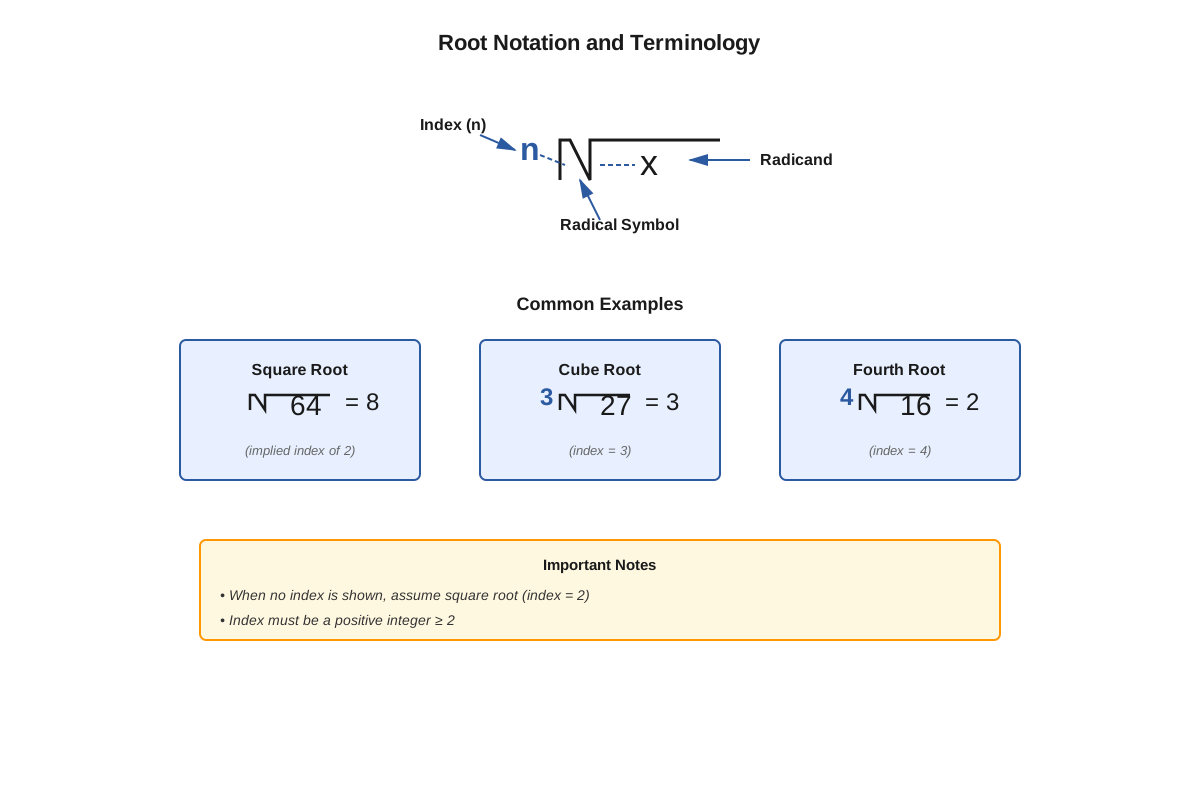
A root is a mathematical operation that determines what number, when raised to a specific power, produces a given value. The square root (√) is the most common root, asking "what number times itself equals this value?" The general form is the nth root, written as ⁿ√x or x^(1/n), which asks "what number raised to the nth power equals x?"
The anatomy of a root expression includes:
- The radical symbol (√): the notation indicating a root operation
- The radicand: the number or expression under the radical symbol
- The index: the small number indicating which root (2 for square root, 3 for cube root, etc.)—when no index appears, square root is assumed
For example, in ³√27, the index is 3, the radicand is 27, and the expression asks "what number cubed equals 27?" The answer is 3, since 3³ = 27.
Principal Root and Sign Conventions
The principal root is the non-negative root when multiple roots exist. For square roots of positive numbers, two values technically satisfy the equation (both 5 and -5 squared equal 25), but √25 specifically denotes the principal (positive) root: 5. To indicate the negative root, a negative sign must be explicitly written: -√25 = -5.
This convention creates an important distinction:
- √x always represents the non-negative root (when x ≥ 0)
- The equation x² = 25 has two solutions: x = ±5
- The expression √25 has one value: 5
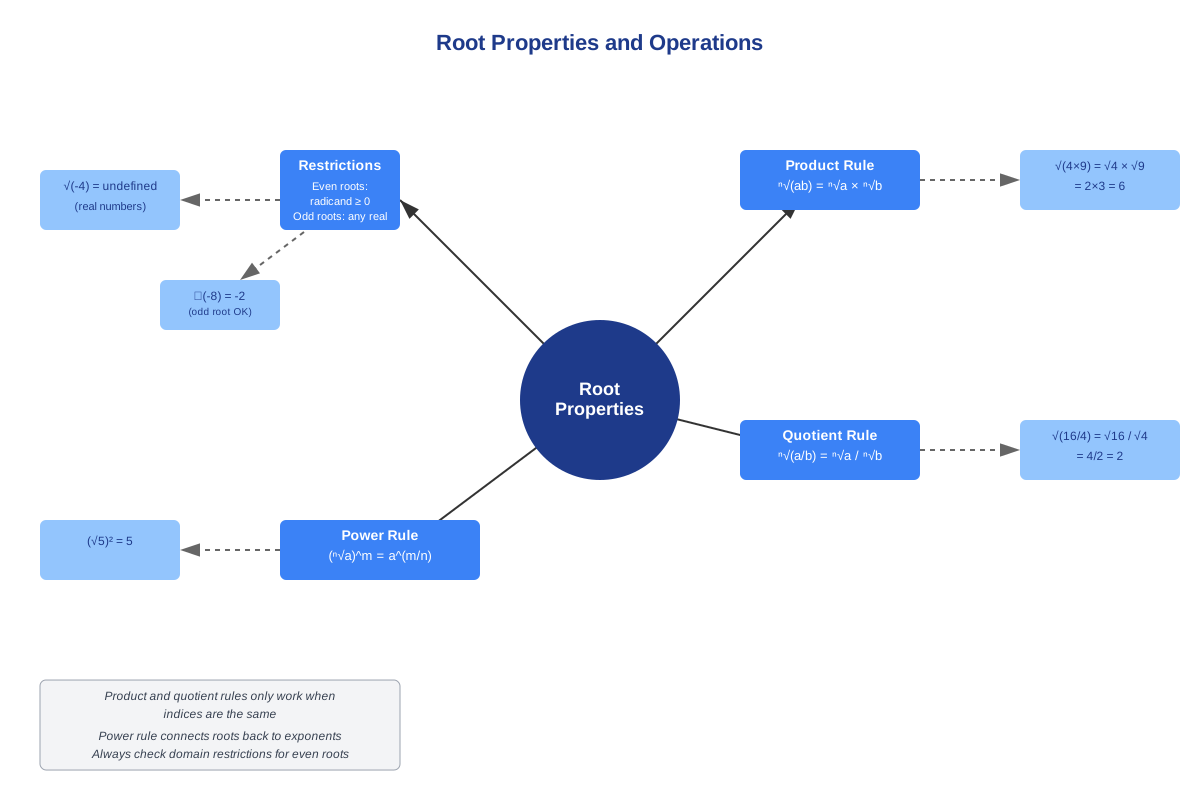
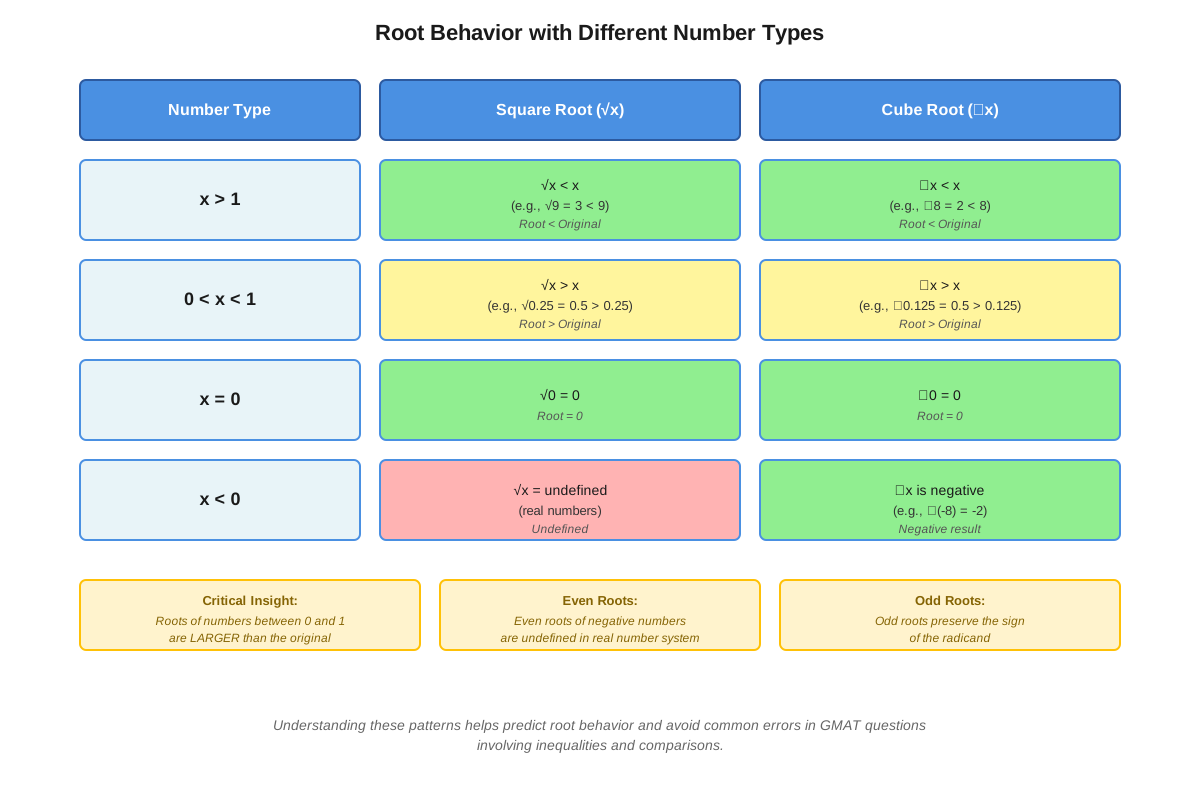
For odd-indexed roots (cube roots, fifth roots, etc.), negative radicands are permissible, and the root preserves the sign: ³√(-8) = -2 because (-2)³ = -8. For even-indexed roots (square roots, fourth roots, etc.), negative radicands produce non-real results, which the GMAT avoids by restricting domains appropriately.
Relationship Between Roots and Exponents
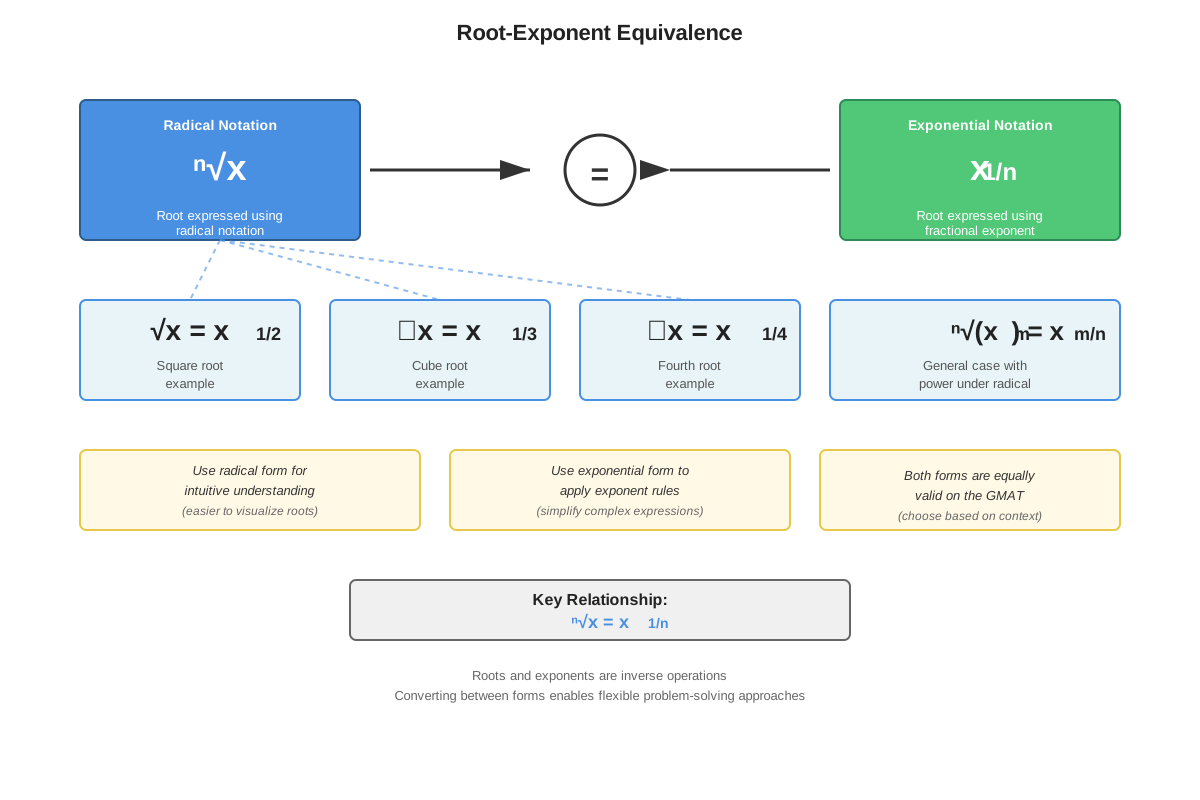
Roots and exponents are inverse operations, and any root can be expressed as a fractional exponent:
ⁿ√x = x^(1/n)
ⁿ√(x^m) = x^(m/n)
This relationship enables powerful simplification techniques:
- √x = x^(1/2)
- ³√x = x^(1/3)
- √(x³) = x^(3/2)
- ⁴√(x²) = x^(2/4) = x^(1/2) = √x
Converting between radical and exponential notation allows application of exponent rules to root problems, particularly when multiplying or dividing expressions with roots.
Properties of Root Operations
Multiplication Property: The root of a product equals the product of the roots (when all roots are defined):
√(ab) = √a · √b
ⁿ√(ab) = ⁿ√a · ⁿ√b
Example: √(36 × 4) = √36 · √4 = 6 · 2 = 12
Division Property: The root of a quotient equals the quotient of the roots:
√(a/b) = √a / √b (where b ≠ 0)Example: √(100/25) = √100 / √25 = 10/5 = 2
Power Property: A root of a power can be simplified:
√(x²) = |x| (absolute value necessary for even roots)
ⁿ√(x^n) = x (when n is odd)
ⁿ√(x^n) = |x| (when n is even)
Important Non-Property: Roots do NOT distribute over addition or subtraction:
√(a + b) ≠ √a + √b
√(a - b) ≠ √a - √b
This is a critical point where many errors occur. For example, √(9 + 16) = √25 = 5, but √9 + √16 = 3 + 4 = 7.
Simplifying Radical Expressions
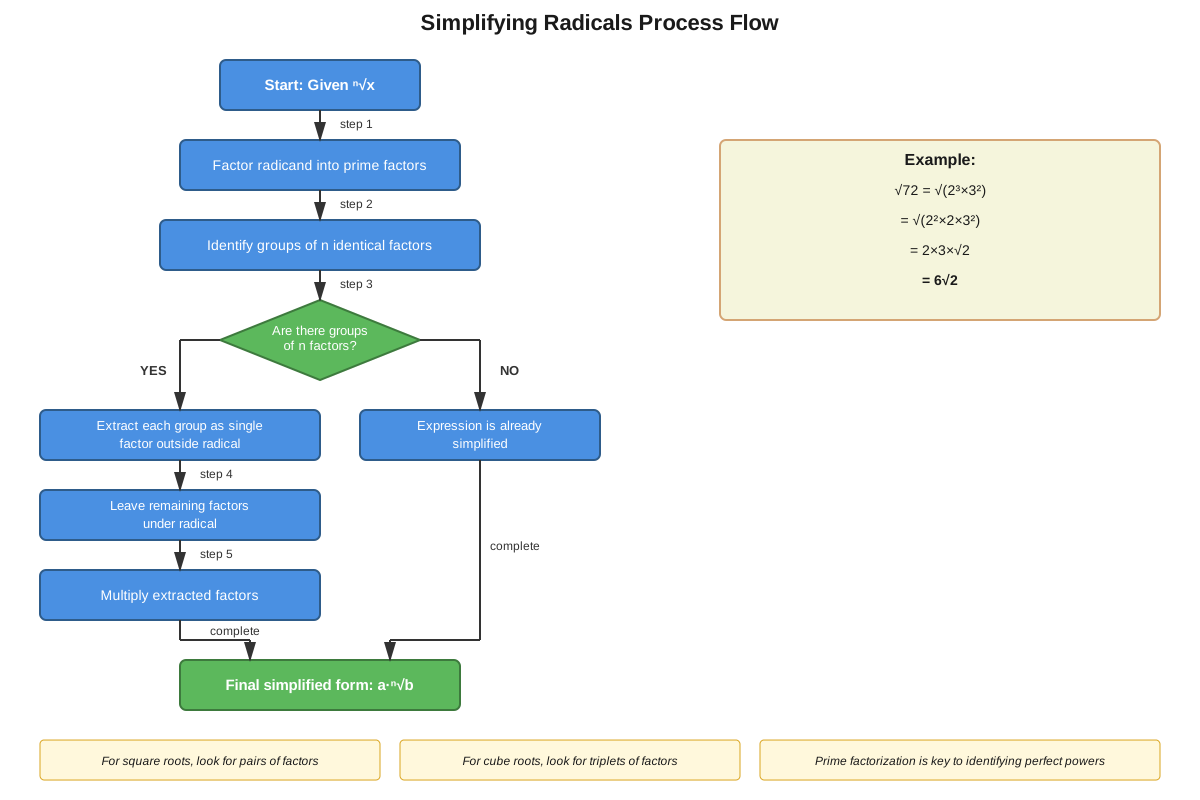
Simplification involves expressing roots in their most reduced form by factoring out perfect powers:
Process:
- Factor the radicand into prime factors or identify perfect power factors
- Apply the multiplication property to separate perfect powers
- Simplify the perfect power roots
- Express the result with the simplified root and any coefficients
Example: Simplify √72
- Factor: 72 = 36 × 2 = 6² × 2
- Separate: √72 = √(36 × 2) = √36 · √2
- Simplify: 6√2
Example: Simplify ³√(54)
- Factor: 54 = 27 × 2 = 3³ × 2
- Separate: ³√54 = ³√(27 × 2) = ³√27 · ³√2
- Simplify: 3³√2
Rationalizing Denominators
Rationalizing means eliminating roots from denominators, a standard form preferred in mathematics:
For single root denominators, multiply numerator and denominator by the root:
1/√x = 1/√x · √x/√x = √x/xExample: 5/√3 = 5√3/3
For binomial denominators containing roots (like a + √b), multiply by the conjugate (a - √b):
1/(a + √b) = 1/(a + √b) · (a - √b)/(a - √b) = (a - √b)/(a² - b)Example: 1/(2 + √3) = (2 - √3)/((2)² - (√3)²) = (2 - √3)/(4 - 3) = 2 - √3
Operations with Like and Unlike Radicals
Like radicals have the same index and radicand and can be combined like like terms:
- 3√5 + 2√5 = 5√5
- 7√2 - 4√2 = 3√2
Unlike radicals cannot be directly combined but may become like radicals after simplification:
Example: √8 + √18
- Simplify: √8 = 2√2 and √18 = 3√2
- Combine: 2√2 + 3√2 = 5√2
Solving Equations with Roots
To solve equations containing roots, isolate the root and then raise both sides to the power matching the root's index:
Example: √(x + 5) = 7
- Square both sides: (√(x + 5))² = 7²
- Simplify: x + 5 = 49
- Solve: x = 44
Critical consideration: Squaring both sides can introduce extraneous solutions (solutions that don't satisfy the original equation), so always verify solutions in the original equation.
Example: √x = -3
- Squaring gives x = 9
- But √9 = 3, not -3
- Therefore, no solution exists (√x cannot be negative)
Comparing Root Values
Understanding relative magnitudes of roots aids in inequality and comparison problems:
| Expression | Approximate Value | Key Insight |
|---|---|---|
| √2 | 1.414 | Between 1 and 2 |
| √3 | 1.732 | Between 1 and 2 |
| √5 | 2.236 | Between 2 and 3 |
| ³√2 | 1.260 | Less than √2 |
| √0.5 | 0.707 | Less than 1 |
For numbers between 0 and 1, roots are larger than the original number: √0.25 = 0.5 > 0.25
For numbers greater than 1, roots are smaller than the original number: √4 = 2 < 4
Higher-index roots produce values closer to 1: ³√8 = 2, but ⁶√8 ≈ 1.414
Concept Relationships
The core concepts of roots form an interconnected system where understanding one concept reinforces others. The definition and notation of roots establishes the foundation, which directly connects to the relationship between roots and exponents—recognizing that ⁿ√x = x^(1/n) allows all exponent rules to apply to root problems.
The properties of root operations (multiplication, division, and power properties) emerge from the exponential relationship and enable simplifying radical expressions. Simplification relies on factoring radicands into perfect powers, which requires knowledge of perfect squares and cubes from prerequisite topics.
Rationalizing denominators applies the multiplication property of roots and uses the difference of squares formula (from algebra prerequisites) when dealing with conjugates. This technique connects to operations with like and unlike radicals, as rationalization often produces like radicals that can be combined.
Solving equations with roots integrates multiple concepts: isolating the root term, applying the power property in reverse (raising both sides to eliminate the root), and understanding the principal root convention to identify valid solutions versus extraneous ones.
Comparing root values synthesizes understanding of how roots behave differently for numbers less than 1, equal to 1, and greater than 1, connecting to number properties and inequalities.
Relationship flow: Definition → Exponential form → Properties → Simplification → Operations → Equation solving → Applications
High-Yield Facts
⭐ The square root symbol √x always represents the principal (non-negative) root when x ≥ 0
⭐ Roots can be expressed as fractional exponents: ⁿ√x = x^(1/n), enabling application of all exponent rules
⭐ The multiplication property √(ab) = √a · √b is valid, but roots do NOT distribute over addition: √(a+b) ≠ √a + √b
⭐ When solving equations by squaring both sides, always check for extraneous solutions in the original equation
⭐ For 0 < x < 1, the square root is larger than the original number; for x > 1, the square root is smaller
- Even-indexed roots (square roots, fourth roots) of negative numbers are not real; odd-indexed roots (cube roots) of negative numbers are real and negative
- To rationalize a denominator with a single root, multiply by that root over itself; for binomials with roots, multiply by the conjugate
- Like radicals (same index and radicand) can be added or subtracted by combining coefficients
- The domain of √x is x ≥ 0, and the range is y ≥ 0 (all non-negative real numbers)
- Perfect squares to memorize: 1, 4, 9, 16, 25, 36, 49, 64, 81, 100, 121, 144, 169, 196, 225
- Perfect cubes to memorize: 1, 8, 27, 64, 125, 216
- √2 ≈ 1.41, √3 ≈ 1.73, √5 ≈ 2.24 are useful approximations for estimation
- Higher-index roots produce values closer to 1 than lower-index roots for the same radicand > 1
- Simplifying radicals before performing operations often makes calculations significantly easier
Quick check — test yourself on Roots so far.
Try Flashcards →Common Misconceptions
Misconception: √(a + b) = √a + √b → Correction: Roots do not distribute over addition or subtraction. √(9 + 16) = √25 = 5, but √9 + √16 = 3 + 4 = 7. These are different values. Only multiplication and division distribute through roots.
Misconception: √(x²) = x for all values of x → Correction: √(x²) = |x|, the absolute value of x. If x = -3, then √((-3)²) = √9 = 3, not -3. The square root operation always produces a non-negative result (the principal root).
Misconception: The equation x² = 16 has the same solution as √x = 4 → Correction: x² = 16 has two solutions: x = ±4. However, √x = 4 has only one solution: x = 16. The square root symbol denotes only the principal (positive) root, while solving x² = 16 requires considering both positive and negative roots.
Misconception: √(-9) = -3 → Correction: √(-9) is not a real number. Square roots (and all even-indexed roots) of negative numbers are not defined in the real number system. Only odd-indexed roots like ³√(-8) = -2 are defined for negative radicands.
Misconception: (√a)² and √(a²) are always equal → Correction: (√a)² = a when a ≥ 0, but √(a²) = |a| for all real a. If a = -5, then (√a)² is undefined (can't take the square root of -5), but √(a²) = √25 = 5.
Misconception: Squaring both sides of an equation always produces equivalent equations → Correction: Squaring can introduce extraneous solutions. If √x = -2, squaring gives x = 4, but √4 = 2 ≠ -2, so x = 4 is extraneous. Always verify solutions in the original equation.
Misconception: √(1/4) = 1/√4 = 1/2, so roots and reciprocals commute → Correction: While this example works, the reasoning is flawed. √(1/4) = 1/2 is correct because √(1/4) = √1/√4 = 1/2 (using the division property of roots). The reciprocal of √4 is 1/√4 = 1/2, which happens to equal √(1/4), but this is not a general property—it's specific to this calculation.
Misconception: Larger roots produce larger values → Correction: For numbers greater than 1, higher-index roots produce smaller values closer to 1. For example, √8 ≈ 2.83, but ³√8 = 2, and ⁴√8 ≈ 1.68. The higher the index, the closer the result is to 1.
Worked Examples
Example 1: Simplifying and Combining Radical Expressions
Problem: Simplify and combine: 2√50 + 3√32 - √18
Solution:
Step 1: Simplify each radical by factoring out perfect squares.
For 2√50:
- Factor 50 = 25 × 2 = 5² × 2
- √50 = √(25 × 2) = √25 · √2 = 5√2
- Therefore, 2√50 = 2(5√2) = 10√2
For 3√32:
- Factor 32 = 16 × 2 = 4² × 2
- √32 = √(16 × 2) = √16 · √2 = 4√2
- Therefore, 3√32 = 3(4√2) = 12√2
For √18:
- Factor 18 = 9 × 2 = 3² × 2
- √18 = √(9 × 2) = √9 · √2 = 3√2
Step 2: Substitute simplified forms into the original expression.
2√50 + 3√32 - √18 = 10√2 + 12√2 - 3√2
Step 3: Combine like radicals.
10√2 + 12√2 - 3√2 = (10 + 12 - 3)√2 = 19√2
Answer: 19√2
Connection to learning objectives: This problem demonstrates identifying roots in complex expressions, applying simplification properties, and combining like radicals—all essential skills for GMAT root problems.
Example 2: Solving an Equation with Roots
Problem: Solve for x: √(2x + 5) = x - 1
Solution:
Step 1: Verify domain restrictions. Since √(2x + 5) must be non-negative, we need 2x + 5 ≥ 0, so x ≥ -2.5. Also, since √(2x + 5) = x - 1, and square roots are non-negative, we need x - 1 ≥ 0, so x ≥ 1.
Step 2: Square both sides to eliminate the root.
(√(2x + 5))² = (x - 1)²
2x + 5 = x² - 2x + 1
Step 3: Rearrange into standard quadratic form.
0 = x² - 2x + 1 - 2x - 5
0 = x² - 4x - 4
Step 4: Solve the quadratic equation using the quadratic formula.
x = (4 ± √(16 + 16))/2 = (4 ± √32)/2 = (4 ± 4√2)/2 = 2 ± 2√2
This gives two potential solutions:
- x = 2 + 2√2 ≈ 2 + 2.83 ≈ 4.83
- x = 2 - 2√2 ≈ 2 - 2.83 ≈ -0.83
Step 5: Check both solutions in the original equation (critical step to identify extraneous solutions).
For x = 2 + 2√2:
- Left side: √(2(2 + 2√2) + 5) = √(4 + 4√2 + 5) = √(9 + 4√2)
- Right side: (2 + 2√2) - 1 = 1 + 2√2
- Check if (1 + 2√2)² = 9 + 4√2: (1 + 2√2)² = 1 + 4√2 + 8 = 9 + 4√2 ✓
For x = 2 - 2√2 ≈ -0.83:
- This violates our domain restriction x ≥ 1
- Checking: √(2(-0.83) + 5) = √3.34 ≈ 1.83, but x - 1 = -0.83 - 1 = -1.83
- These are not equal (and have opposite signs), so this is extraneous ✗
Answer: x = 2 + 2√2
Connection to learning objectives: This problem demonstrates solving equations with roots, checking for extraneous solutions, understanding domain restrictions, and applying root properties—all high-yield GMAT skills.
Exam Strategy
Approach for GMAT Root Questions:
- Identify the question type first: Is this asking for calculation, simplification, comparison, or testing sufficiency? This determines your strategy.
- Look for perfect powers: Before calculating, scan for perfect squares (1, 4, 9, 16, 25, 36, 49, 64, 81, 100, 121, 144) or perfect cubes (1, 8, 27, 64, 125) that can be simplified immediately.
- Simplify before operating: Always simplify radicals before adding, subtracting, multiplying, or dividing. This often reveals like radicals or cancellations that make the problem trivial.
- Convert to exponential form for complex operations: When multiplying or dividing expressions with different root indices, convert to fractional exponents to apply exponent rules systematically.
Trigger Words and Phrases:
- "Square root of" or "cube root of" → Direct root calculation or simplification
- "Solve for x" with roots → Isolate root, then raise to appropriate power; check for extraneous solutions
- "Simplify" → Factor out perfect powers and combine like radicals
- "Which is greater" with roots → Compare by squaring (if both positive) or estimate using known values
- "Rationalize" → Eliminate roots from denominators using multiplication or conjugates
- "In simplest radical form" → Factor completely and extract all perfect powers
Process of Elimination Tips:
- Eliminate answers with roots in denominators when the question asks for simplified or rationalized form
- Eliminate negative values for even-indexed roots of positive numbers (√25 cannot equal -5 as a principal root)
- Eliminate answers that violate domain restrictions (even roots of negative numbers)
- Check answer magnitude: If √x should be between 5 and 6, eliminate answers outside this range
- Test with simple values: If the question involves variables, substitute x = 1 or x = 4 to eliminate incorrect answers quickly
Time Allocation:
- Simple root calculations (√64, ³√27): 15-30 seconds—these should be automatic
- Simplification problems: 45-60 seconds—factor, simplify, combine
- Equation solving: 90-120 seconds—isolate, solve, verify (don't skip verification)
- Data sufficiency with roots: 60-90 seconds—test sufficiency conceptually before calculating
Exam Tip: On data sufficiency questions, remember that knowing x² = 25 is NOT sufficient to determine x (could be ±5), but knowing √x = 5 IS sufficient to determine x (must be 25). The square root symbol always denotes the principal root.
Memory Techniques
Mnemonic for Root Properties - "My Dad Pays Nothing Added"
- Multiplication: √(ab) = √a · √b ✓
- Division: √(a/b) = √a / √b ✓
- Power: √(a²) = |a| ✓
- No addition: √(a+b) ≠ √a + √b ✗
- Also no subtraction: √(a-b) ≠ √a - √b ✗
Perfect Squares Visualization - Picture a multiplication table grid:
- 1×1=1, 2×2=4, 3×3=9, 4×4=16, 5×5=25
- 6×6=36, 7×7=49, 8×8=64, 9×9=81, 10×10=100
- Continue to 12×12=144, 13×13=169, 14×14=196, 15×15=225
Perfect Cubes Pattern - "1-8-27 is the date (1/8/27), then 64-125 are powers of 2 and 5"
- 1³=1, 2³=8, 3³=27, 4³=64, 5³=125, 6³=216
Conjugate Pairs - Remember "Same terms, Opposite sign" (STOS)
- The conjugate of (a + √b) is (a - √b)
- Multiplying conjugates eliminates the radical: (a + √b)(a - √b) = a² - b
Domain Restrictions - "Even roots need positive treats"
- Even-indexed roots (√, ⁴√, ⁶√) require non-negative radicands
- Odd-indexed roots (³√, ⁵√) accept any real number
Extraneous Solutions - "Square with care, then check if it's there"
- Whenever you square both sides of an equation, you must verify solutions
- Squaring can create solutions that don't satisfy the original equation
Summary
Roots represent the inverse operation of exponentiation, asking what value raised to a specific power produces a given number. The GMAT tests roots through direct calculation, simplification, equation solving, and conceptual understanding in data sufficiency contexts. Mastery requires knowing that roots can be expressed as fractional exponents (ⁿ√x = x^(1/n)), understanding that the radical symbol denotes the principal (non-negative) root, and applying key properties: roots distribute over multiplication and division but NOT over addition or subtraction. Simplifying radicals involves factoring out perfect powers, while solving equations with roots requires isolating the radical, raising both sides to the appropriate power, and checking for extraneous solutions. Critical distinctions include recognizing that even-indexed roots require non-negative radicands while odd-indexed roots accept negative values, understanding that √(x²) = |x| rather than simply x, and knowing that for 0 < x < 1, roots are larger than the original number, while for x > 1, roots are smaller. Success on GMAT root questions depends on rapid recognition of perfect squares and cubes, systematic simplification before performing operations, and careful attention to domain restrictions and sign conventions.
Key Takeaways
- Roots are fractional exponents: ⁿ√x = x^(1/n), allowing all exponent rules to apply to root problems
- The radical symbol √ always denotes the principal (non-negative) root, distinguishing √25 = 5 from the equation x² = 25 which has solutions x = ±5
- Roots distribute over multiplication and division but never over addition or subtraction: √(ab) = √a·√b is valid, but √(a+b) ≠ √a + √b
- Simplify radicals by factoring out perfect powers before performing any operations—this often transforms complex problems into simple arithmetic
- Always verify solutions when solving equations by squaring both sides, as this process can introduce extraneous solutions that don't satisfy the original equation
- Even-indexed roots require non-negative radicands (√(-4) is undefined), while odd-indexed roots accept negative values (³√(-8) = -2)
- Memorize perfect squares through 15² = 225 and perfect cubes through 6³ = 216 for rapid mental calculation on test day
Related Topics
Exponents and Powers: Roots are the inverse of exponents, and understanding exponential rules (product rule, quotient rule, power rule) directly enables manipulation of root expressions through fractional exponent notation.
Quadratic Equations: Solving quadratics often requires taking square roots, and the quadratic formula itself contains a square root (the discriminant √(b² - 4ac)), making root properties essential for equation solving.
Inequalities with Radicals: Understanding how root operations affect inequality direction and when roots preserve or reverse ordering relationships extends root knowledge to comparison problems.
Geometry - Pythagorean Theorem: Calculating distances, diagonals, and side lengths in right triangles requires square root operations, making roots essential for GMAT geometry.
Distance Formula and Coordinate Geometry: The distance between two points involves a square root of the sum of squared differences, integrating roots with coordinate plane concepts.
Number Properties with Radicals: Determining whether expressions involving roots are rational or irrational, and understanding how roots interact with integers, fractions, and decimals, deepens number sense.
Mastering roots provides the foundation for these advanced topics and enables confident handling of the algebraic manipulation and geometric reasoning that characterize high-difficulty GMAT questions.
Practice CTA
Now that you've built a comprehensive understanding of roots and their properties, it's time to solidify your mastery through deliberate practice. Attempt the practice questions associated with this topic, focusing on applying the strategies and recognizing the patterns discussed in this guide. Use the flashcards to drill perfect squares, perfect cubes, and key properties until they become automatic—speed and accuracy on root fundamentals will free up mental resources for the more complex reasoning the GMAT demands. Remember, the GMAT rewards not just knowledge but the ability to apply that knowledge efficiently under time pressure. Each practice problem is an opportunity to refine your approach and build the confidence that translates to points on test day. You've got this!
Sign up free to keep reading
Create a free AnvayaPrep account to finish this GMAT guide on Roots — plus flashcards and practice questions.