Overview
Percents represent one of the most frequently tested topics in GMAT Quantitative Reasoning, appearing in approximately 15-20% of all quantitative questions. Understanding percents is fundamental to success on the GMAT because these concepts appear not only in straightforward arithmetic problems but also in complex word problems, data sufficiency questions, and integrated reasoning scenarios. The ability to quickly convert between fractions, decimals, and percents while solving multi-step problems under time pressure distinguishes high-scoring test-takers from average performers.
GMAT percents questions test far more than basic calculation skills. The exam evaluates conceptual understanding through problems involving percent change, successive percent changes, percent increase and decrease, reverse percent problems, and compound interest scenarios. These questions often combine multiple arithmetic concepts, requiring test-takers to navigate between different representations of the same value while maintaining accuracy. The GMAT particularly favors questions that test whether students understand what the "whole" or base value is in a given situation, as this conceptual confusion is a common source of errors.
Within the broader Quantitative Reasoning framework, percents serve as a bridge between pure arithmetic and applied problem-solving. They connect directly to ratios and proportions, form the foundation for understanding interest and growth problems, and appear regularly in data interpretation questions. Mastering percents enables students to tackle more complex topics such as profit and loss calculations, population growth models, and financial mathematics—all of which appear regularly on the GMAT. The conceptual clarity gained from studying percents also strengthens overall numerical reasoning, making it easier to estimate answers quickly and eliminate incorrect choices efficiently.
Learning Objectives
- [ ] Identify Percents in various problem contexts and formats
- [ ] Explain Percents conceptually, including the relationship between percents, fractions, and decimals
- [ ] Apply Percents to GMAT questions involving single and multiple percent changes
- [ ] Calculate percent increase and percent decrease accurately in multi-step problems
- [ ] Solve reverse percent problems where the final value is known but the original value must be determined
- [ ] Analyze successive percent changes and understand why they cannot simply be added together
- [ ] Evaluate percent problems in data sufficiency format to determine statement adequacy
Prerequisites
- Basic arithmetic operations (addition, subtraction, multiplication, division): Essential for performing percent calculations and conversions
- Understanding of fractions and decimals: Percents are alternative representations of these values, and conversion between forms is constant
- Ratio and proportion concepts: Percents express part-to-whole relationships, which are fundamentally proportional
- Algebraic manipulation skills: Many percent problems require setting up and solving equations
- Word problem comprehension: GMAT percent questions are almost always presented in context rather than as pure calculations
Why This Topic Matters
Percents pervade real-world decision-making across business, finance, science, and everyday life. Business professionals use percents to analyze profit margins, calculate discounts, evaluate investment returns, and assess growth rates. Financial analysts rely on percent changes to track stock performance, inflation rates, and economic indicators. Even in personal contexts, understanding percents enables informed decisions about loans, credit cards, tips, taxes, and sales discounts. The GMAT tests percents extensively because quantitative literacy in this area directly correlates with success in business school and professional environments.
On the GMAT specifically, percent problems appear in multiple question formats with varying difficulty levels. Approximately 4-6 questions per exam directly test percent concepts, while many additional questions incorporate percents as part of more complex scenarios. These questions appear as:
- Problem Solving questions requiring direct calculation of percent values, percent changes, or successive percents
- Data Sufficiency questions testing whether students understand what information is needed to solve percent problems
- Word problems embedding percent calculations within business scenarios (sales, profit, discounts, interest)
- Integrated Reasoning questions requiring interpretation of graphs and tables containing percent data
The GMAT particularly favors questions that test conceptual understanding over mechanical calculation. Common question types include finding the original value after a percent change, calculating the net effect of successive percent changes, determining what percent one quantity is of another, and solving problems where the base (the "whole") changes between steps. High-scoring test-takers recognize these patterns quickly and apply efficient solution strategies rather than relying on lengthy calculations.
Core Concepts
Definition and Basic Representation
A percent is a ratio that expresses a number as a fraction of 100. The word "percent" literally means "per hundred" (from Latin per centum). When expressing a value as a percent, the denominator is always 100, making percents a standardized way to compare proportions. For example, 45% means 45 out of 100, or 45/100, or 0.45 as a decimal.
The fundamental percent equation is:
Percent = (Part / Whole) × 100This equation can be rearranged to solve for any of the three variables:
Part = (Percent / 100) × Whole
Whole = Part / (Percent / 100)
Understanding these relationships is crucial because GMAT questions deliberately vary which value is unknown, testing whether students can flexibly apply the percent formula.
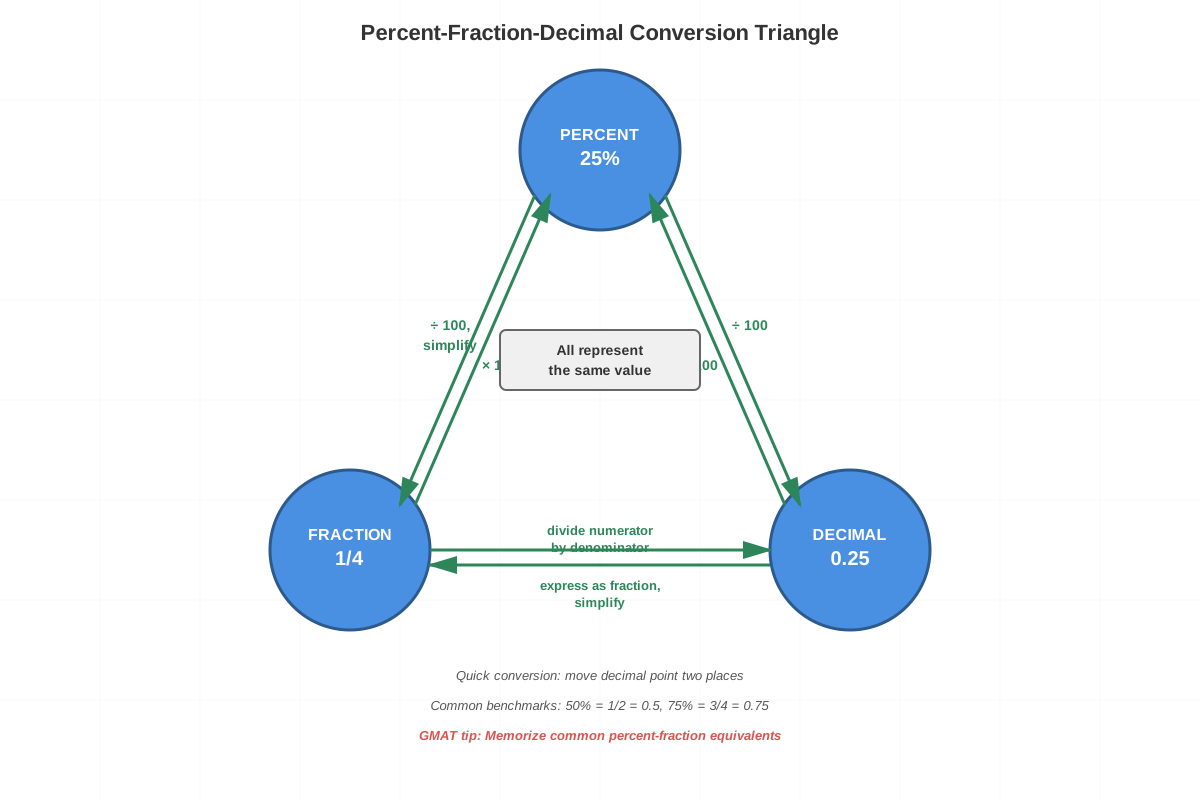
Converting Between Percents, Decimals, and Fractions
Fluency in converting between these three representations is essential for GMAT success. The conversions follow consistent patterns:
| From | To Decimal | To Percent | To Fraction |
|---|---|---|---|
| Percent | Divide by 100 (move decimal 2 left) | — | Write over 100, then simplify |
| Decimal | — | Multiply by 100 (move decimal 2 right) | Write as fraction, simplify |
| Fraction | Divide numerator by denominator | Convert to decimal, then multiply by 100 | — |
Examples:
- 75% = 0.75 = 3/4
- 0.125 = 12.5% = 1/8
- 2/5 = 0.4 = 40%
Memorizing common fraction-percent equivalents saves valuable time on the GMAT:
- 1/2 = 50%, 1/3 ≈ 33.33%, 1/4 = 25%, 1/5 = 20%
- 1/8 = 12.5%, 1/10 = 10%, 1/6 ≈ 16.67%
- 2/3 ≈ 66.67%, 3/4 = 75%, 4/5 = 80%
Percent Increase and Percent Decrease
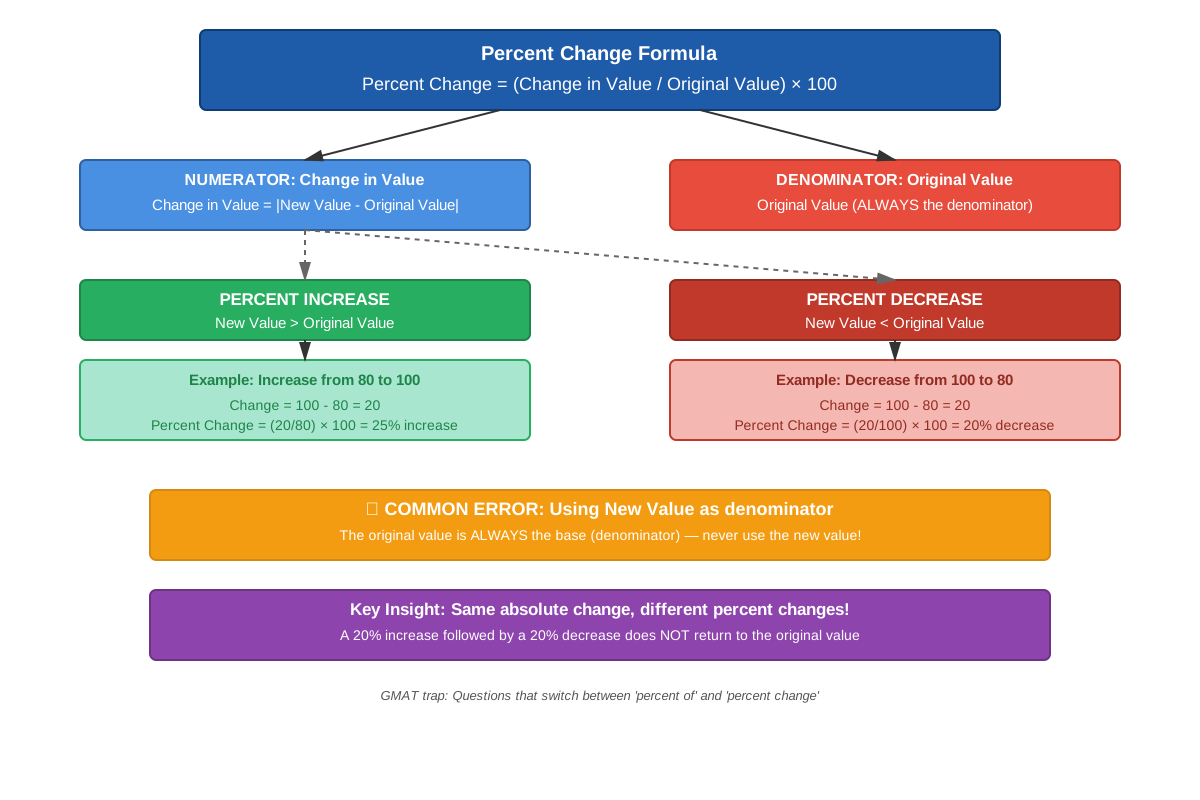
Percent change measures the relative change in a quantity compared to its original value. The formula is:
Percent Change = [(New Value - Original Value) / Original Value] × 100When the new value is greater than the original, this represents a percent increase. When the new value is smaller, it represents a percent decrease.
Critical concept: The base (denominator) for percent change is always the original value, not the new value. This is a frequent source of GMAT trap answers.
Example: If a stock price increases from $40 to $50:
Percent Increase = [(50 - 40) / 40] × 100 = (10/40) × 100 = 25%To calculate a new value after a percent change:
New Value = Original Value × (1 + Percent Change/100)For a percent increase, add the percent; for a decrease, subtract it:
- After a 20% increase: New Value = Original × 1.20
- After a 20% decrease: New Value = Original × 0.80
Successive Percent Changes
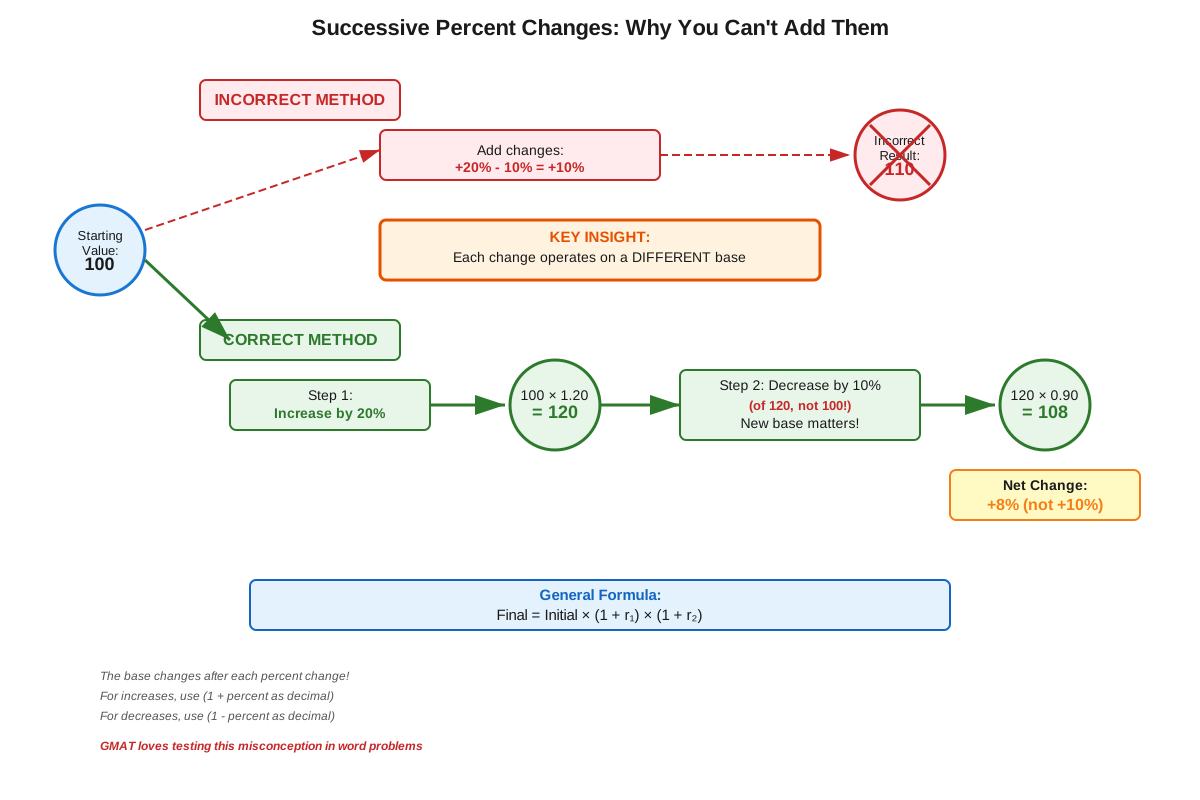
One of the most important concepts for GMAT percents is that successive percent changes cannot simply be added or subtracted. When multiple percent changes occur sequentially, each change applies to the result of the previous change, not to the original value.
Example: A price increases by 20%, then decreases by 20%.
- Starting price: $100
- After 20% increase: $100 × 1.20 = $120
- After 20% decrease: $120 × 0.80 = $96
- Net result: 4% decrease (not 0%!)
The formula for successive percent changes is:
Net Multiplier = (1 + r₁/100) × (1 + r₂/100) × ... × (1 + rₙ/100)Where increases are positive and decreases are negative.
For two successive changes of r₁% and r₂%:
Net Percent Change = r₁ + r₂ + (r₁ × r₂)/100This formula reveals why successive changes don't simply add: there's an interaction term (r₁ × r₂)/100 that represents the percent change applied to the percent change.
Reverse Percent Problems
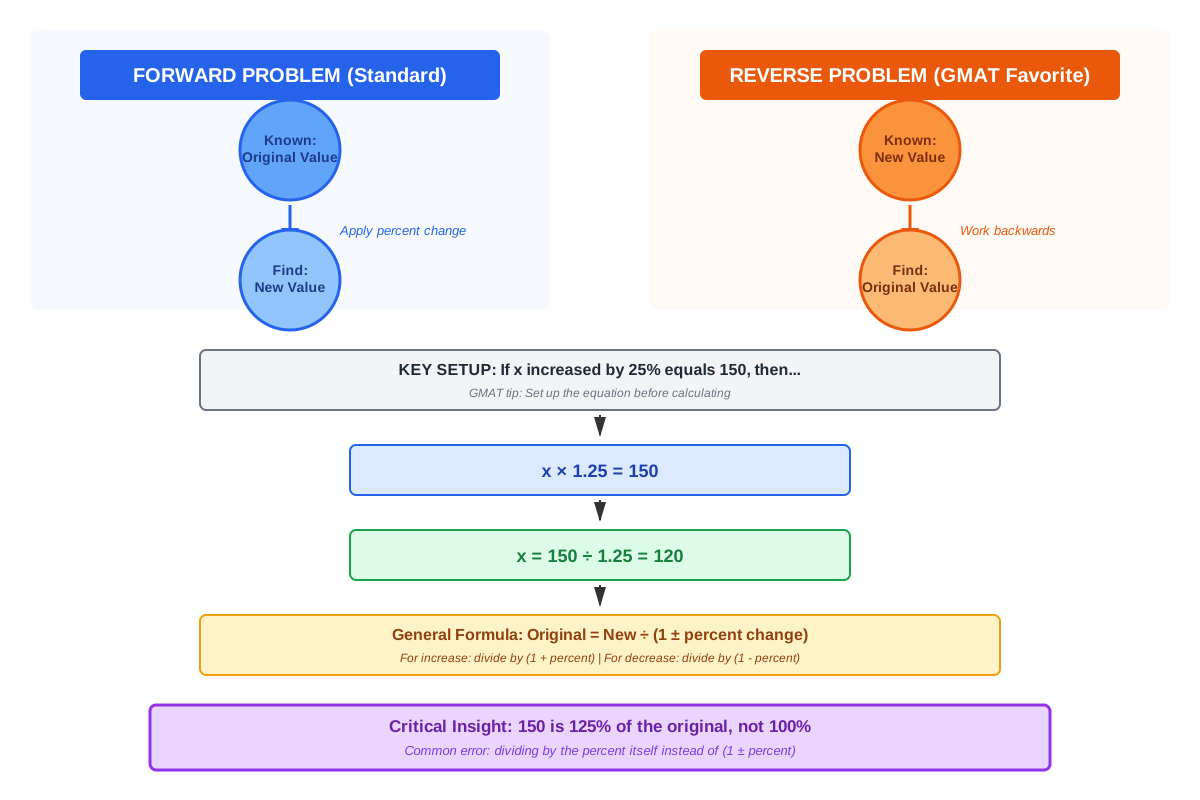
Reverse percent problems provide the final value after a percent change and ask for the original value. These problems require working backward through the percent change formula.
Setup: If a value after a percent change is known, and the original value is unknown:
Original Value = Final Value / (1 + Percent Change/100)Example: After a 25% increase, a salary is $50,000. What was the original salary?
Original = 50,000 / 1.25 = $40,000The GMAT frequently tests this concept because students often incorrectly subtract 25% from $50,000, yielding $37,500—a common trap answer.
Percent "Of" vs. Percent "More Than" or "Less Than"
Understanding the linguistic distinction between these phrases is crucial:
- "X is Y% of Z" means: X = (Y/100) × Z
- "X is Y% more than Z" means: X = Z + (Y/100) × Z = Z(1 + Y/100)
- "X is Y% less than Z" means: X = Z - (Y/100) × Z = Z(1 - Y/100)
Example distinguishing these concepts:
- "30 is 60% of 50" → 30 = 0.60 × 50 ✓
- "30 is 60% more than X" → 30 = X(1.60), so X = 18.75
- "30 is 60% less than Y" → 30 = Y(0.40), so Y = 75
Percents Greater Than 100%
Percents can exceed 100%, representing values greater than the whole. This occurs in two common scenarios:
- When comparing a larger quantity to a smaller base: "200 is what percent of 50?" → 400%
- When describing increases greater than the original value: "A population tripled" → 200% increase (not 300%)
A 100% increase means doubling (the new value equals the original plus 100% of the original). A 200% increase means tripling (the new value equals the original plus 200% of the original).
Finding What Percent One Number Is of Another
This fundamental operation appears constantly on the GMAT:
"A is what percent of B?" → (A/B) × 100Example: "18 is what percent of 24?"
(18/24) × 100 = 0.75 × 100 = 75%The key is identifying which value is the part (numerator) and which is the whole (denominator). The value after "of" is always the whole/base.
Concept Relationships
The concepts within percents form an interconnected hierarchy. At the foundation lies the basic percent definition (part/whole × 100), which enables all other operations. This definition directly leads to conversion between percents, decimals, and fractions, as these are merely different representations of the same proportional relationship.
From the basic definition, two major branches emerge:
Branch 1: Forward Percent Calculations
Basic percent definition → Finding percents of numbers → Percent increase/decrease → Successive percent changes
Each step builds on the previous: once students can find a percent of a number, they can calculate percent changes by finding the percent that the change represents of the original. Successive percent changes then apply this operation multiple times sequentially.
Branch 2: Reverse Percent Calculations
Basic percent definition → Finding what percent one number is of another → Reverse percent problems
This branch emphasizes working backward from results to find original values or determine the percent relationship between quantities.
These branches converge in complex GMAT problems that require both forward and reverse operations, often involving successive changes where the original value must be determined from a final result.
Connections to prerequisite topics:
- Fractions and decimals provide alternative representations that often simplify percent calculations
- Ratios and proportions underlie percent relationships, as percents are standardized ratios with denominator 100
- Algebraic equations enable solving for unknown values in percent problems
Connections to advanced topics:
- Interest calculations (simple and compound) apply percent concepts to financial growth
- Profit and loss problems use percent markup, discount, and margin calculations
- Mixture problems often involve percent concentrations
- Rate problems may incorporate percent changes in speed or efficiency
High-Yield Facts
⭐ The base (whole) in a percent calculation is the value that comes after "of" in the problem statement
⭐ Percent change always uses the original value as the denominator, not the new value
⭐ Successive percent changes cannot be added; they must be multiplied as (1 + r₁/100) × (1 + r₂/100)
⭐ A 100% increase means doubling; a 200% increase means tripling
⭐ To reverse a percent increase of x%, divide by (1 + x/100); to reverse a decrease, divide by (1 - x/100)
- Converting a percent to a decimal requires dividing by 100 (moving the decimal point two places left)
- A percent increase followed by an equal percent decrease does not return to the original value
- When a value increases by x% then decreases by x%, the net change is always a decrease of (x²/100)%
- The phrase "percent more than" means addition: X is Y% more than Z → X = Z(1 + Y/100)
- Percents can be greater than 100%, representing values larger than the base
- To find what percent A is of B, calculate (A/B) × 100
- A 50% decrease requires a 100% increase to return to the original value
- Percent problems often have trap answers that result from using the wrong base value
- When comparing percent changes, the base matters: 20% of 100 ≠ 20% of 200
- In data sufficiency, knowing the percent change and either the original or final value is sufficient to find the other
Quick check — test yourself on Percents so far.
Try Flashcards →Common Misconceptions
Misconception: Successive percent changes can be added together (e.g., a 10% increase followed by a 20% increase equals a 30% increase).
Correction: Successive percent changes multiply, not add. The second change applies to the already-changed value, not the original. A 10% increase followed by a 20% increase results in a 32% total increase: 1.10 × 1.20 = 1.32.
Misconception: A percent increase followed by an equal percent decrease returns to the original value.
Correction: These changes do not cancel out because they apply to different base values. After a 25% increase, a 25% decrease leaves you below the original value. If you start with 100, increase by 25% to 125, then decrease by 25%, you get 125 × 0.75 = 93.75.
Misconception: To reverse a 20% increase, subtract 20% from the new value.
Correction: To reverse a 20% increase, divide by 1.20, not multiply by 0.80. If a value increased 20% to reach 120, the original was 120/1.20 = 100, not 120 × 0.80 = 96.
Misconception: "200% more" means the same as "200% of."
Correction: "200% more than X" means X + 200% of X = 3X (tripling), while "200% of X" means 2X (doubling). The word "more" indicates addition to the original value.
Misconception: The base (whole) in a percent problem is always the larger number.
Correction: The base is determined by context, not size. In "150 is what percent of 100?", the base is 100 (the smaller number), and the answer is 150%. The base is the reference value—what comes after "of."
Misconception: Percent change is calculated as (change/new value) × 100.
Correction: Percent change always uses the original value as the denominator: (change/original value) × 100. Using the new value is a common trap that leads to incorrect answers.
Misconception: A 100% increase means the value becomes 100.
Correction: A 100% increase means the value doubles (increases by 100% of itself). If something costs $50 and increases by 100%, it becomes $100, not $100 total.
Worked Examples
Example 1: Successive Percent Changes with Reverse Calculation
Problem: A store marks up the wholesale price of an item by 60%, then offers a 25% discount off the marked price during a sale. If the sale price is $120, what was the wholesale price?
Solution:
Step 1: Identify the successive changes and work backward.
- First change: 60% markup (multiply by 1.60)
- Second change: 25% discount (multiply by 0.75)
- Combined multiplier: 1.60 × 0.75 = 1.20
Step 2: Set up the equation.
Let W = wholesale price
After both changes: W × 1.20 = $120
Step 3: Solve for the wholesale price.
W = 120 / 1.20 = 100Step 4: Verify the answer.
- Wholesale price: $100
- After 60% markup: $100 × 1.60 = $160
- After 25% discount: $160 × 0.75 = $120 ✓
Key insight: This problem combines successive percent changes with reverse calculation. The trap answer would be to work backward by dividing by 0.75 then by 1.60 separately, or to incorrectly add the percent changes (60% - 25% = 35%) and divide by 1.35. The correct approach recognizes that the net multiplier is 1.20, so dividing the final price by 1.20 yields the original.
Connection to learning objectives: This example applies percents to a GMAT-style question, demonstrates successive percent changes, and requires reverse percent problem-solving.
Example 2: Percent Comparison with Changing Base
Problem: In 2020, Company A had 200 employees and Company B had 250 employees. In 2021, Company A's workforce increased by 30% while Company B's decreased by 20%. By what percent is Company A's 2021 workforce greater or less than Company B's 2021 workforce?
Solution:
Step 1: Calculate each company's 2021 workforce.
- Company A in 2021: 200 × 1.30 = 260 employees
- Company B in 2021: 250 × 0.80 = 200 employees
Step 2: Identify what the question asks.
"By what percent is A greater than B?" means: What percent more is 260 than 200?
The base (whole) is Company B's workforce: 200
Step 3: Calculate the percent difference.
Percent difference = [(260 - 200) / 200] × 100
                   = (60 / 200) × 100
                   = 0.30 × 100
= 30%Answer: Company A's 2021 workforce is 30% greater than Company B's 2021 workforce.
Step 4: Verify understanding of the base.
If the question asked "By what percent is B less than A?", the base would be A's workforce (260):
[(260 - 200) / 260] × 100 = (60/260) × 100 ≈ 23.08%Key insight: The critical skill here is identifying the correct base. "A is what percent greater than B" uses B as the base. The trap answer of 23.08% results from using the wrong base. This problem also reinforces that percent changes don't preserve relationships—even though A started with fewer employees, after the changes A has more.
Connection to learning objectives: This example requires identifying and explaining the correct base in percent comparisons, applying percent increase/decrease calculations, and demonstrating the conceptual understanding necessary for GMAT questions.
Exam Strategy
Approaching GMAT Percent Questions
Step 1: Identify the question type
- Is this a forward calculation (finding a percent of a number)?
- Is this a percent change problem (increase/decrease)?
- Is this a reverse problem (finding the original value)?
- Does it involve successive changes?
Step 2: Determine the base (whole)
Look for the word "of" in the problem—what follows is typically the base. In percent change problems, the original value is the base. Misidentifying the base is the most common error.
Step 3: Translate words into mathematical operations
- "percent of" → multiply
- "percent more than" → multiply by (1 + percent/100)
- "percent less than" → multiply by (1 - percent/100)
- "what percent" → set up a division and multiply by 100
Step 4: Consider whether estimation can eliminate answers
GMAT answer choices are often spread far enough apart that estimation is faster than exact calculation. For example, if calculating 23% of 187, recognize this is slightly less than 25% (one-quarter), which would be about 47. This eliminates answers far from 43.
Trigger Words and Phrases
Watch for these high-yield phrases that indicate specific operations:
- "What percent of X is Y?" → (Y/X) × 100
- "Y is what percent of X?" → (Y/X) × 100 (same as above)
- "X is Y% of what number?" → X / (Y/100)
- "What is Y% of X?" → (Y/100) × X
- "By what percent did X increase?" → [(new - old)/old] × 100
- "X increased by Y%" → new value = X × (1 + Y/100)
- "X is Y% more/greater than Z" → X = Z × (1 + Y/100)
- "X is Y% less/fewer than Z" → X = Z × (1 - Y/100)
Process of Elimination Tips
Eliminate answers that:
- Result from using the wrong base (often the new value instead of original)
- Come from adding successive percent changes instead of multiplying
- Represent the change amount rather than the percent change
- Assume "percent more than" means "percent of"
- Use 100 as the base when it shouldn't be
In Data Sufficiency:
- Knowing the percent change and either the original or final value is sufficient to find the other
- Knowing only the percent change without any actual value is usually insufficient
- Be careful with statements that give different bases—they may not be combinable
Time Allocation
For a typical GMAT percent problem:
- 30-45 seconds: Read and identify the question type
- 45-90 seconds: Set up and solve the problem
- 15-30 seconds: Verify the answer makes sense
If a problem requires more than 2 minutes, consider:
- Whether estimation can narrow down answers
- Whether you've misidentified the base or question type
- Whether to make an educated guess and move on
Priority strategy: Percent problems are high-yield and should not be skipped. However, complex successive percent change problems with multiple steps may be candidates for educated guessing if time is short, as they're time-intensive relative to their point value.
Memory Techniques
Mnemonic for Percent Change Formula
"NOON" - New minus Old, Over Not-new (original)
This reminds you that percent change = (New - Old) / Old × 100, with the original (not-new) value in the denominator.
Visualization for Successive Changes
Picture a staircase where each step represents a percent change. You can't skip steps—you must land on each one. A 20% increase followed by a 10% decrease means:
- Start at step 100
- Climb to step 120 (20% up)
- Descend to step 108 (10% down from 120, not from 100)
Common Fraction-Percent Equivalents (Memorize These)
Create a mental number line from 0% to 100%:
0%    10%   12.5%  16.7%   20%   25%   33.3%   50%   66.7%   75%   80%   100%
|      |      |      |      |      |      |      |      |      |      |      |
0     1/10   1/8    1/6    1/5    1/4    1/3    1/2    2/3    3/4    4/5     1
Acronym for Reverse Percent Problems
"DIVIDE" - Don't Increase/Decrease Values Incorrectly, Divide Everything
To reverse a percent change, divide by the multiplier (1 ± percent/100), don't multiply by the opposite change.
The "More Than" vs. "Of" Distinction
"More Than" = Addition (the word "more" signals adding to the original)
"Of" = Multiplication Only (just multiply, don't add)
Visualize: "50% of 100" = 50 (half the pie)
"50% more than 100" = 150 (the whole pie plus half more)
Summary
Percents represent standardized ratios with denominator 100, providing a universal language for comparing proportions and changes. Mastery of GMAT percents requires fluency in three core areas: converting between percents, decimals, and fractions; calculating percent changes (both forward and reverse); and handling successive percent changes. The fundamental percent equation—Part = (Percent/100) × Whole—can be rearranged to solve for any unknown variable, but success depends on correctly identifying which value represents the "whole" or base in each context.
The most critical conceptual understanding for GMAT success is that percent changes use the original value as the base, and successive percent changes multiply rather than add because each change applies to the result of the previous change. This creates an interaction effect that students must account for. Reverse percent problems, where the final value is known but the original must be found, require dividing by the change multiplier rather than applying the opposite percent change—a common source of trap answers.
GMAT percent questions test not just calculation ability but conceptual understanding through word problems that vary which value is unknown, use changing bases, and combine multiple operations. High-scoring test-takers recognize question patterns quickly, identify the base correctly, translate verbal descriptions into mathematical operations accurately, and verify that their answers make logical sense. With these skills, students can confidently tackle the 15-20% of GMAT quantitative questions that directly or indirectly test percent concepts.
Key Takeaways
- Percents are ratios with denominator 100, making them standardized comparisons that can be converted to fractions and decimals
- The base (whole) is always the reference value—typically what follows "of" in the problem statement—and using the wrong base is the most common error
- Percent change = (New - Old) / Old × 100, with the original value always in the denominator
- Successive percent changes multiply, never add: (1 + r₁/100) × (1 + r₂/100) gives the net multiplier
- To reverse a percent change, divide by the multiplier: reverse a 25% increase by dividing by 1.25, not by multiplying by 0.75
- "Percent more than" means addition to the original, while "percent of" means multiplication only
- Memorize common fraction-percent equivalents (1/4 = 25%, 1/3 ≈ 33.3%, 1/2 = 50%, etc.) to save time and enable quick estimation
Related Topics
Ratios and Proportions: Percents are specialized ratios where the second term is always 100. Mastering percents strengthens ratio problem-solving and vice versa, as both involve part-to-whole relationships and proportional reasoning.
Interest Calculations (Simple and Compound): These financial applications directly extend percent concepts, with simple interest applying a percent once and compound interest applying successive percent changes over multiple periods.
Profit, Loss, and Discount Problems: Business scenarios involving markup, markdown, profit margin, and discount calculations all rely on percent operations, often combining multiple percent changes in sequence.
Mixture and Concentration Problems: These problems frequently involve percent concentrations (e.g., 20% salt solution) and require understanding how percents change when quantities are combined or separated.
Data Interpretation: Graphs, tables, and charts on the GMAT often present data in percent form or require calculating percent changes between data points, making percent fluency essential for Integrated Reasoning.
Growth and Decay Models: Population growth, radioactive decay, and compound interest all involve repeated percent changes over time, extending the successive percent change concept to multiple periods.
Practice CTA
Now that you've built a comprehensive understanding of percents, it's time to solidify your mastery through practice. Attempt the practice questions associated with this topic, focusing on identifying question types quickly and applying the appropriate strategy for each. Use the flashcards to reinforce common fraction-percent equivalents and key formulas until they become automatic. Remember: percent problems are high-yield on the GMAT, appearing in roughly one out of every five quantitative questions. The time you invest in mastering this topic will pay dividends throughout your GMAT preparation and on test day. Approach each practice problem as an opportunity to refine your pattern recognition and deepen your conceptual understanding—this is where good test-takers become great ones.
Sign up free to keep reading
Create a free AnvayaPrep account to finish this GMAT guide on Percents — plus flashcards and practice questions.