Overview
Circles represent one of the most frequently tested geometric shapes on the GMAT Quantitative Reasoning section. Understanding circles is essential not only for standalone geometry problems but also for coordinate geometry questions, optimization problems, and data sufficiency challenges. The GMAT tests circles through various lenses: calculating areas and circumferences, working with inscribed and circumscribed figures, analyzing sectors and arcs, and applying the distance formula in coordinate geometry contexts.
Mastery of GMAT circles requires both conceptual understanding and computational fluency. Test-makers design questions that combine circle properties with other geometric concepts such as triangles, squares, and polygons. Students must recognize when a problem involves circles—sometimes explicitly stated, sometimes hidden within a word problem or diagram—and apply the appropriate formulas and relationships efficiently. The ability to visualize circle problems, identify relevant information, and eliminate trap answers distinguishes high scorers from average performers.
Within the broader Quantitative Reasoning framework, circles connect directly to algebra (through equations of circles), coordinate geometry (through the distance formula and graphing), and other plane geometry topics. Questions often require students to integrate multiple concepts simultaneously, such as finding the area of a shaded region by subtracting a circle's area from a square's area, or determining whether a point lies inside or outside a circle using the distance formula. This interconnectedness makes circles a high-yield topic worthy of thorough preparation.
Learning Objectives
- [ ] Identify circles in various problem contexts, including word problems, diagrams, and coordinate geometry scenarios
- [ ] Explain the fundamental properties of circles, including radius, diameter, circumference, and area
- [ ] Apply circle formulas and properties to solve GMAT questions efficiently and accurately
- [ ] Calculate arc lengths, sector areas, and central angles using proportional relationships
- [ ] Determine relationships between circles and inscribed or circumscribed polygons
- [ ] Solve coordinate geometry problems involving circles and the distance formula
- [ ] Analyze data sufficiency questions related to circle properties
Prerequisites
- Basic algebra: Necessary for manipulating circle equations and solving for unknown variables in formulas
- Understanding of π (pi): Required for all circumference and area calculations; recognizing when to leave answers in terms of π
- Coordinate geometry fundamentals: Essential for problems involving circles on the xy-plane and distance calculations
- Triangle properties: Needed for problems involving inscribed or circumscribed figures and right triangles within circles
- Ratio and proportion: Critical for solving problems involving sectors, arcs, and scaling relationships
Why This Topic Matters
Circles appear in approximately 10-15% of GMAT Quantitative Reasoning questions, making them one of the most frequently tested geometry topics. The GMAT presents circle problems in multiple formats: problem-solving questions requiring direct calculation, data sufficiency questions testing conceptual understanding, and integrated reasoning scenarios combining circles with other geometric shapes.
In real-world applications, circle concepts underpin engineering design, architecture, urban planning, and business analytics. Calculating optimal coverage areas, determining material requirements for circular components, and analyzing radial distributions all rely on circle mathematics. Business school candidates encounter these concepts in operations management, supply chain optimization, and market analysis contexts.
On the GMAT, circles commonly appear in questions involving: shaded region calculations (finding areas between circles and polygons), inscribed and circumscribed figures (circles within squares or triangles containing circles), coordinate geometry (equations of circles and distance from points), optimization problems (maximizing or minimizing circular areas), and combined figure problems (multiple circles tangent to each other or to lines). Data sufficiency questions frequently test whether students understand what information is necessary and sufficient to determine a circle's properties—for example, whether knowing the area is sufficient to find the circumference.
Core Concepts
Fundamental Circle Definitions
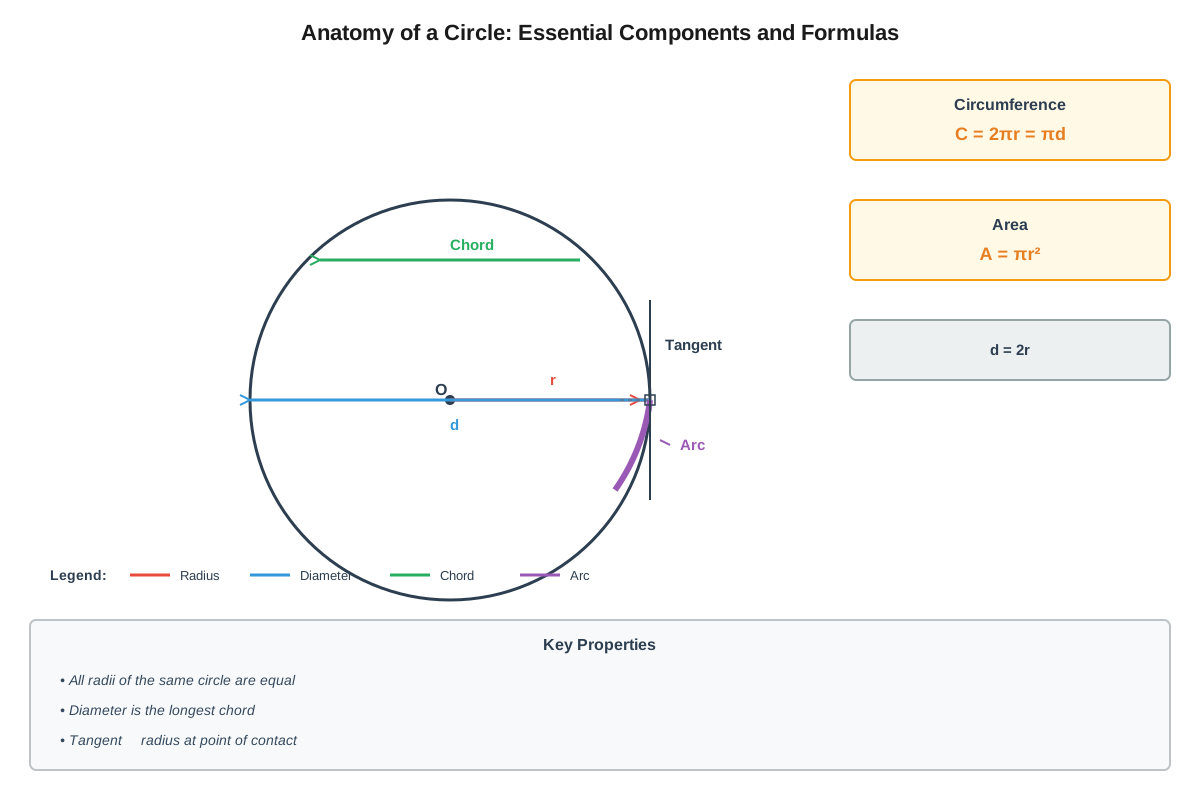
A circle is the set of all points in a plane that are equidistant from a fixed point called the center. This distance from the center to any point on the circle is the radius (r). The diameter (d) is the distance across the circle through its center, equal to twice the radius: d = 2r.
Every circle has several measurable properties:
- Circumference: The distance around the circle
- Area: The space enclosed within the circle
- Chord: A line segment connecting any two points on the circle
- Tangent: A line that touches the circle at exactly one point
- Secant: A line that intersects the circle at two points
Essential Circle Formulas
The two most critical formulas for GMAT circles are:
Circumference = 2πr = πd
Area = πr²
These formulas must be memorized and applied fluently. Note that both formulas involve π (pi), approximately 3.14159, though GMAT questions often ask for answers in terms of π rather than decimal approximations.
Key relationship: If you know any one measurement (radius, diameter, circumference, or area), you can calculate all others. This principle is frequently tested in data sufficiency questions.
| Given | Can Calculate |
|---|---|
| Radius (r) | Diameter (2r), Circumference (2πr), Area (πr²) |
| Diameter (d) | Radius (d/2), Circumference (πd), Area (π(d/2)²) |
| Circumference (C) | Radius (C/2π), Diameter (C/π), Area (π(C/2π)²) |
| Area (A) | Radius (√(A/π)), Diameter (2√(A/π)), Circumference (2π√(A/π)) |
Arcs and Sectors
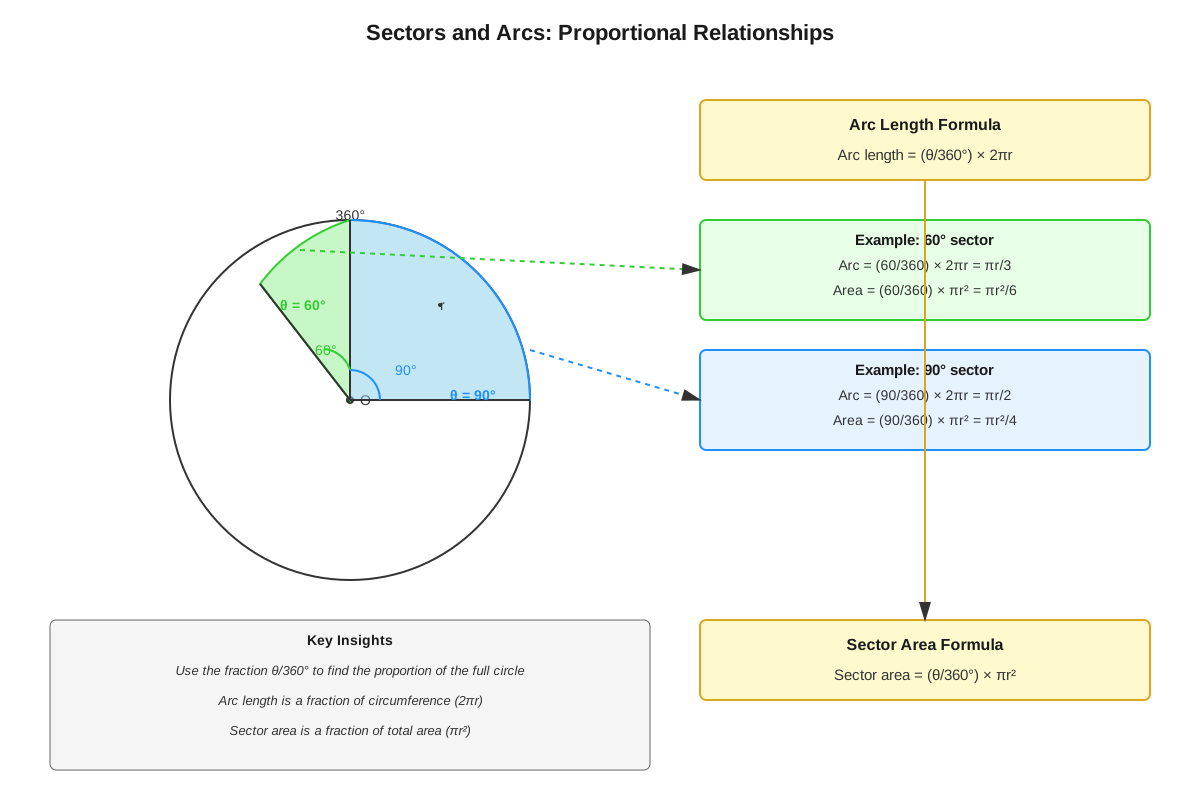
An arc is a portion of a circle's circumference, while a sector is a pie-shaped region bounded by two radii and an arc. The central angle is the angle formed by the two radii at the circle's center.
The fundamental principle for arcs and sectors is proportionality:
Arc length / Circumference = Sector area / Total area = Central angle / 360°For a central angle θ (in degrees):
Arc length = (θ/360°) × 2πr
Sector area = (θ/360°) × πr²Example: In a circle with radius 6, a sector with a 60° central angle has:
- Arc length = (60/360) × 2π(6) = (1/6) × 12π = 2π
- Sector area = (60/360) × π(6²) = (1/6) × 36π = 6π
Inscribed and Circumscribed Figures
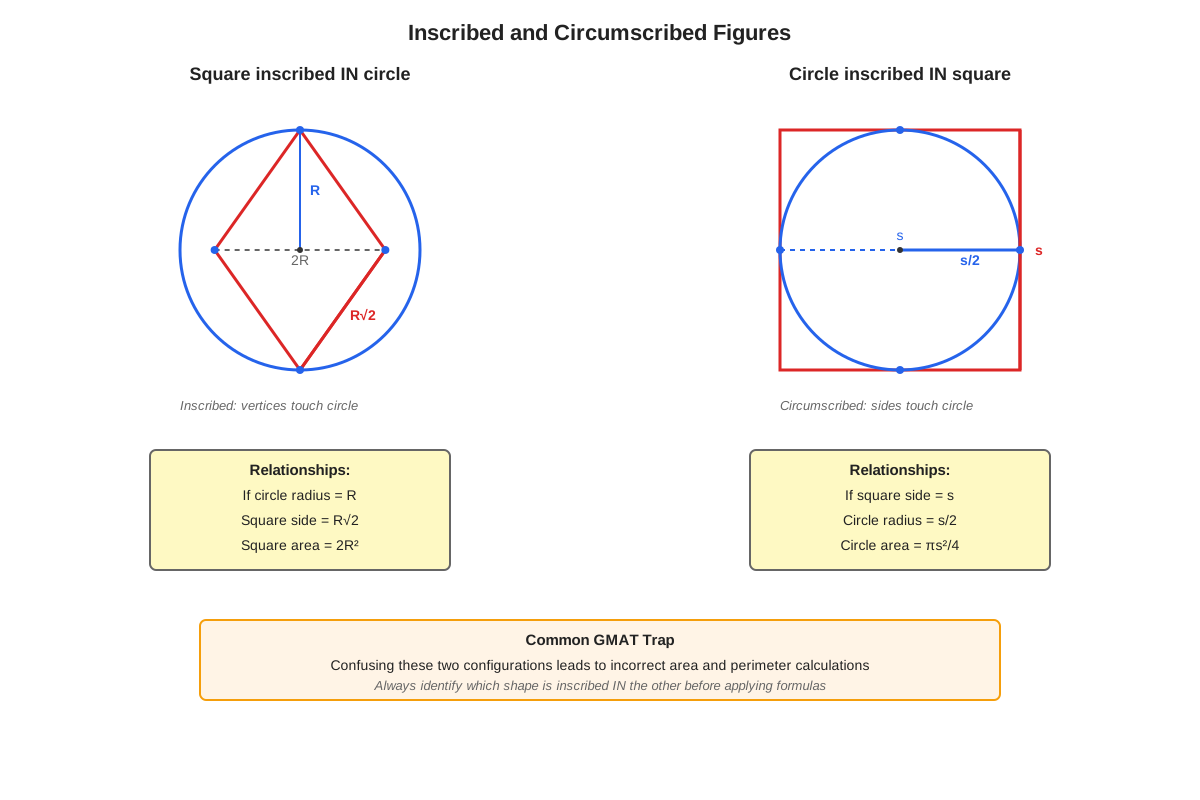
Inscribed figures are shapes drawn inside a circle such that all vertices touch the circle. Circumscribed figures are shapes drawn around a circle such that all sides are tangent to the circle.
Critical relationships:
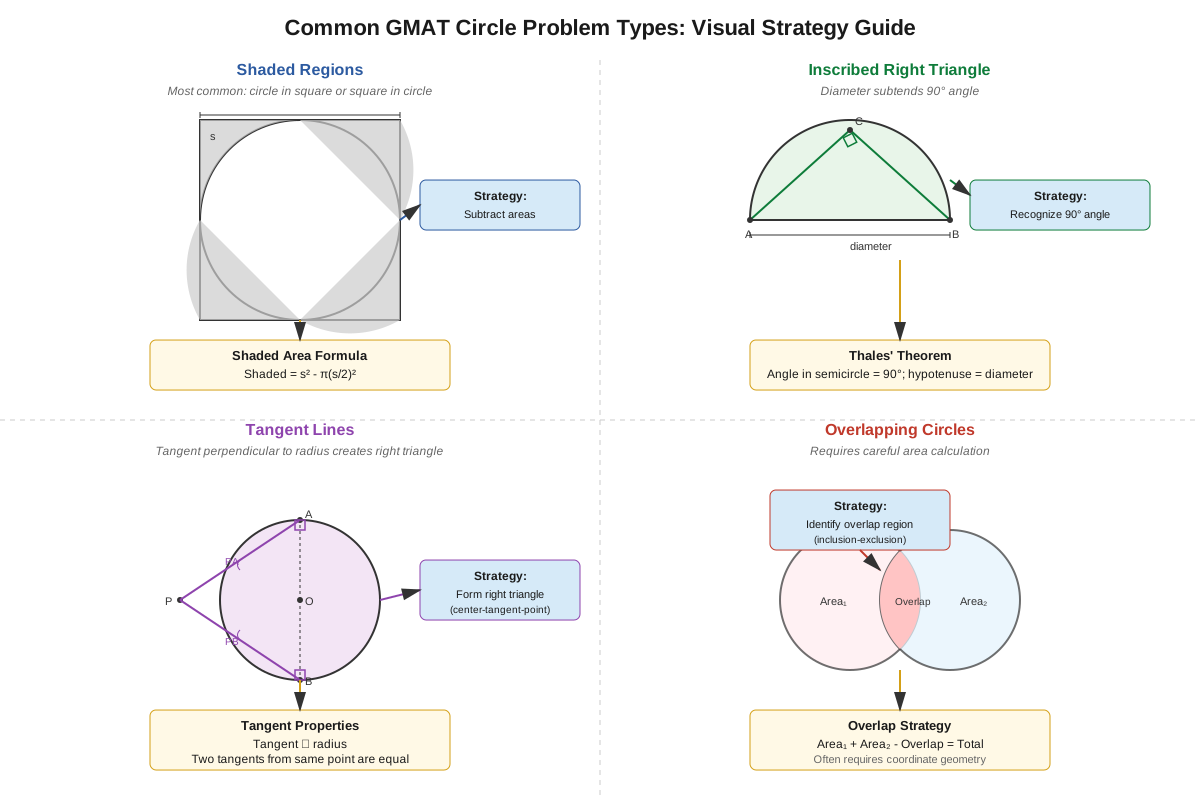
- Circle inscribed in a square: If the square has side length s, the circle's diameter equals s, so radius = s/2
- Circle circumscribed around a square: If the square has side length s, the circle's diameter equals the square's diagonal = s√2, so radius = s√2/2
- Circle inscribed in an equilateral triangle: If the triangle has side length s, the radius = s/(2√3)
- Circle circumscribed around an equilateral triangle: If the triangle has side length s, the radius = s/√3
Tangent Lines and Properties
A tangent line touches a circle at exactly one point. The radius drawn to the point of tangency is always perpendicular to the tangent line, forming a 90° angle. This property creates right triangles that are frequently tested on the GMAT.
When two tangent lines are drawn from an external point to a circle, they have equal length. This symmetry property helps solve many GMAT problems involving tangent segments.
Circles in Coordinate Geometry
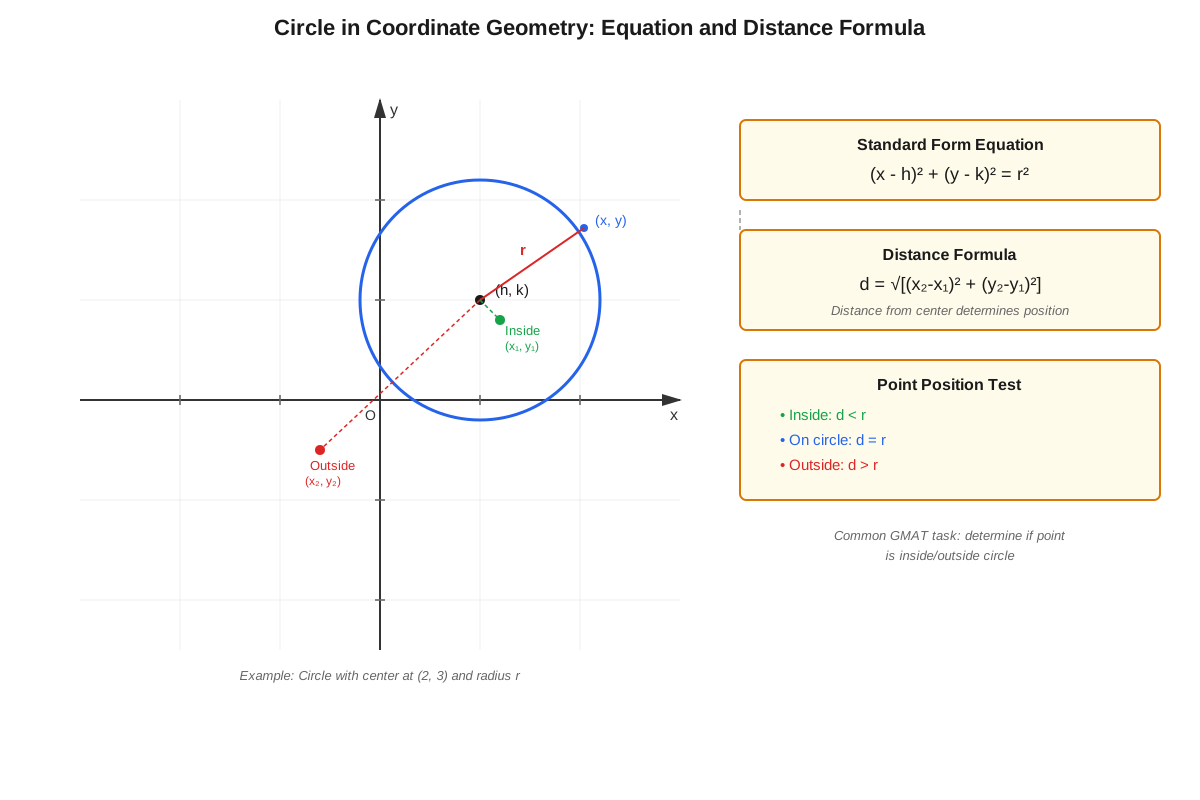
The standard equation of a circle with center (h, k) and radius r is:
(x - h)² + (y - k)² = r²For a circle centered at the origin (0, 0):
x² + y² = r²To determine whether a point (x₁, y₁) lies inside, on, or outside a circle:
- Calculate the distance from the point to the center: d = √[(x₁ - h)² + (y₁ - k)²]
- If d < r: point is inside the circle
- If d = r: point is on the circle
- If d > r: point is outside the circle
Chords and Their Properties
A chord is any line segment connecting two points on a circle. The diameter is the longest possible chord. Important chord properties include:
- A perpendicular from the center to a chord bisects the chord
- Equal chords are equidistant from the center
- The perpendicular bisector of any chord passes through the center
These properties often create right triangles where the radius is the hypotenuse, enabling use of the Pythagorean theorem.
Concept Relationships
The core circle concepts form an interconnected web of relationships. Radius serves as the fundamental measurement from which all other properties derive. Knowing the radius immediately determines the diameter (doubling), circumference (multiplying by 2π), and area (squaring and multiplying by π).
Arcs and sectors extend basic circle properties through proportional reasoning. The relationship "part/whole = part/whole" connects arc length to circumference and sector area to total area, with the central angle serving as the common ratio. This proportional thinking → applies to → solving complex problems involving partial circles.
Inscribed and circumscribed figures bridge circles with other geometric shapes, particularly squares and triangles. These relationships → require → understanding of both circle properties and polygon properties, creating synthesis questions that test multiple concepts simultaneously. The perpendicularity of tangent lines to radii → creates → right triangles, which → connects → circle problems to the Pythagorean theorem and trigonometry.
Coordinate geometry applications → transform → abstract circle properties into algebraic equations. The distance formula → becomes → the foundation for the circle equation, and understanding this connection → enables → solving problems about points, lines, and circles on the coordinate plane.
All these concepts → ultimately support → the learning objectives of identifying, explaining, and applying circle properties to GMAT questions. Mastery requires seeing both individual formulas and the relationships between them.
Quick check — test yourself on Circles so far.
Try Flashcards →High-Yield Facts
⭐ The circumference formula is C = 2πr or C = πd; the area formula is A = πr²
⭐ The diameter is always twice the radius: d = 2r
⭐ A radius drawn to a point of tangency is perpendicular to the tangent line (forms a 90° angle)
⭐ Arc length and sector area are proportional to the central angle: (angle/360°) × total measurement
⭐ For a circle inscribed in a square with side s, the circle's diameter equals s
- For a circle circumscribed around a square with side s, the circle's diameter equals s√2
- The longest chord in any circle is the diameter
- A perpendicular from the center to a chord bisects that chord
- Two tangent segments drawn from an external point to a circle have equal length
- The standard equation of a circle with center (h, k) and radius r is (x - h)² + (y - k)² = r²
- If you know any one measurement (radius, diameter, circumference, or area), you can calculate all others
- A central angle and its corresponding inscribed angle (vertex on the circle) have the relationship: central angle = 2 × inscribed angle
- The area of a circle is π times the square of the radius, not π times the radius squared then doubled
- When a circle is inscribed in a right triangle, the radius can be found using r = (a + b - c)/2, where c is the hypotenuse
Common Misconceptions
Misconception: The area formula is A = 2πr or A = πr
Correction: The area formula is A = πr². The radius must be squared, not simply multiplied by π. The formula 2πr gives the circumference, not the area.
Misconception: Doubling the radius doubles the area
Correction: Doubling the radius quadruples the area because area depends on r². If radius increases from r to 2r, area increases from πr² to π(2r)² = 4πr², which is four times the original area.
Misconception: The diameter is the same as the radius
Correction: The diameter is twice the radius (d = 2r). The diameter extends all the way across the circle through the center, while the radius extends only from the center to the edge.
Misconception: Arc length and sector area use the same formula
Correction: While both use proportional reasoning with the central angle, arc length = (θ/360°) × 2πr (proportion of circumference), while sector area = (θ/360°) × πr² (proportion of total area). They have different formulas because one measures length and the other measures area.
Misconception: A tangent line passes through the center of the circle
Correction: A tangent line touches the circle at exactly one point and never passes through the center. A line through the center that extends to the circle's edge is a radius; if it continues through to the other side, it's a diameter.
Misconception: In coordinate geometry, the equation x² + y² = 25 represents a circle with radius 25
Correction: The equation x² + y² = 25 represents a circle with radius 5 (not 25) because r² = 25, so r = 5. The number on the right side of the equation is r², not r.
Misconception: All chords have the same length
Correction: Chords can have different lengths depending on their distance from the center. The diameter is the longest chord, and chords get shorter as they move farther from the center.
Worked Examples
Example 1: Shaded Region Problem
Problem: A circle with radius 5 is inscribed in a square. What is the area of the shaded region between the square and the circle?
Solution:
Step 1: Identify what "inscribed in a square" means.
When a circle is inscribed in a square, the circle touches all four sides of the square. The diameter of the circle equals the side length of the square.
Step 2: Calculate the square's dimensions.
- Circle radius = 5
- Circle diameter = 2(5) = 10
- Square side length = 10 (equals the diameter)
Step 3: Calculate the square's area.
Area of square = s² = 10² = 100
Step 4: Calculate the circle's area.
Area of circle = πr² = π(5)² = 25π
Step 5: Find the shaded region.
Shaded area = Square area - Circle area = 100 - 25π
Answer: 100 - 25π (or approximately 100 - 78.54 = 21.46 if numerical answer required)
Connection to learning objectives: This problem requires identifying the circle within a geometric context, explaining the inscribed relationship, and applying the area formula to solve a GMAT-style question.
Example 2: Data Sufficiency with Sectors
Problem: What is the area of sector AOB in circle O?
Statement (1): The radius of circle O is 6.
Statement (2): The central angle AOB measures 60°.
Solution:
Step 1: Recall the sector area formula.
Sector area = (θ/360°) × πr²
This formula requires two pieces of information: the radius (r) and the central angle (θ).
Step 2: Evaluate Statement (1) alone.
Statement (1) gives us r = 6, but we don't know the central angle θ.
We cannot calculate the sector area with only the radius.
Statement (1) alone is INSUFFICIENT.
Step 3: Evaluate Statement (2) alone.
Statement (2) gives us θ = 60°, but we don't know the radius r.
We cannot calculate the sector area with only the central angle.
Statement (2) alone is INSUFFICIENT.
Step 4: Evaluate both statements together.
With both statements, we have r = 6 and θ = 60°.
Sector area = (60/360) × π(6²) = (1/6) × 36π = 6π
Both statements together are SUFFICIENT.
Answer: C (Both statements together are sufficient, but neither alone is sufficient)
Connection to learning objectives: This data sufficiency problem tests the ability to identify what information is necessary to solve circle problems, explain the relationship between sector properties, and apply proportional reasoning to GMAT questions.
Exam Strategy
When approaching GMAT circle questions, follow this systematic process:
Step 1: Identify the circle context
Look for trigger words: "circle," "radius," "diameter," "circumference," "inscribed," "circumscribed," "tangent," "arc," "sector." Sometimes circles appear in coordinate geometry as equations like x² + y² = r².
Step 2: Draw or enhance the diagram
If no diagram is provided, sketch one. If a diagram exists, add known measurements and mark right angles (especially at tangent points). Label the center, radius, and any relevant points.
Step 3: Determine what's given and what's needed
List known values (radius, diameter, angle, etc.) and identify the target (area, circumference, arc length, etc.). Recognize that knowing any one measurement allows calculation of others.
Step 4: Select the appropriate formula
- For whole circles: C = 2πr or A = πr²
- For parts of circles: use proportional relationships with central angles
- For coordinate geometry: use (x - h)² + (y - k)² = r² or the distance formula
Step 5: Watch for trap answers
Common traps include:
- Confusing radius with diameter (or vice versa)
- Using circumference formula when area is needed
- Forgetting to square the radius in area calculations
- Miscalculating proportions for sectors and arcs
- Forgetting that π should remain in the answer (not converting to decimal)
Time allocation: Allocate 2 minutes for straightforward circle problems, 2.5-3 minutes for problems involving multiple steps or combined figures. Data sufficiency questions about circles typically require 1.5-2 minutes.
Process of elimination tips:
- Eliminate answers with wrong units (length vs. area)
- Eliminate answers that don't include π when the question asks for an exact answer
- For data sufficiency, remember that both radius and central angle are needed for sector problems
- Check if answer choices differ by factors of 2, 4, or π—this often indicates common calculation errors
Memory Techniques
Mnemonic for circle formulas: "Circumference is Cute and simple: 2πr. Area Adds a square: πr²"
Visualization strategy: Picture a pizza to remember sectors and arcs. The crust represents the arc (part of circumference), and the slice represents the sector (part of area). The angle at the center determines what fraction of the whole pizza you get.
Acronym for tangent properties: PERT - Perpendicular, Equal lengths, Radius involved, Touches once
- Perpendicular: radius ⊥ tangent at point of contact
- Equal: two tangents from external point have equal length
- Radius: always draw the radius to the tangent point
- Touches: tangent touches circle at exactly one point
Memory aid for inscribed vs. circumscribed:
- INscribed = INside (figure inside the circle)
- CIRCUMscribed = CIRCUMference around (circle around the figure)
Relationship reminder: "Dad is Twice as old" - Diameter is Twice the radius (d = 2r)
Coordinate geometry: The circle equation looks like the distance formula squared: (x - h)² + (y - k)² = r². Remember that r² appears on the right, so take the square root to find the actual radius.
Summary
Circles represent a high-yield GMAT topic requiring mastery of fundamental formulas, proportional reasoning, and geometric relationships. The two essential formulas—circumference (C = 2πr) and area (A = πr²)—serve as the foundation for all circle calculations. Understanding that radius, diameter, circumference, and area are interconnected allows efficient problem-solving and success on data sufficiency questions. Arc lengths and sector areas extend these concepts through proportional relationships with central angles, using the principle that part/whole ratios remain constant. Inscribed and circumscribed figures connect circles to other geometric shapes, particularly squares and triangles, requiring synthesis of multiple concepts. Tangent line properties, especially the perpendicularity of tangents to radii, create right triangles that enable application of the Pythagorean theorem. In coordinate geometry, the circle equation (x - h)² + (y - k)² = r² derives from the distance formula and enables analysis of points relative to circles. Success on GMAT circle questions requires recognizing these patterns, drawing clear diagrams, selecting appropriate formulas, and avoiding common traps like confusing radius with diameter or forgetting to square the radius in area calculations.
Key Takeaways
- Master the two fundamental formulas: C = 2πr for circumference and A = πr² for area; all other circle calculations derive from these
- Recognize that knowing any one measurement (radius, diameter, circumference, or area) allows calculation of all others—critical for data sufficiency questions
- Apply proportional reasoning for arcs and sectors: (central angle/360°) equals (arc/circumference) equals (sector area/total area)
- Remember that a radius drawn to a tangent point is always perpendicular to the tangent line, creating right triangles
- Understand inscribed and circumscribed relationships: circle inscribed in square has diameter = side length; circle circumscribed around square has diameter = side√2
- Avoid common errors: don't confuse radius with diameter, don't forget to square the radius in area formulas, and don't confuse circumference with area formulas
- Draw diagrams for every problem, label all known values, and mark right angles at tangent points to visualize relationships clearly
Related Topics
Coordinate Geometry: Mastering circles enables progression to more complex coordinate geometry topics, including finding intersections between circles and lines, determining tangent lines to circles algebraically, and analyzing systems involving multiple circles.
Three-Dimensional Geometry: Understanding circles provides the foundation for cylinders (circles extended through space), spheres (three-dimensional circles), and cones (involving circular bases), all of which appear on the GMAT.
Triangles and Polygons: Circle problems frequently combine with triangle properties, particularly right triangles formed by radii and tangents, and regular polygons inscribed in or circumscribed around circles.
Optimization Problems: Many GMAT optimization questions involve maximizing or minimizing areas and perimeters of figures involving circles, requiring both circle knowledge and algebraic reasoning.
Advanced Geometry: Topics like circle theorems (inscribed angle theorem, power of a point) and more complex configurations build directly on fundamental circle concepts.
Practice CTA
Now that you've mastered the core concepts of circles, it's time to solidify your understanding through active practice. Attempt the practice questions to apply these formulas and strategies to GMAT-style problems. Use the flashcards to reinforce key formulas, properties, and relationships until they become automatic. Remember: understanding the concepts is the first step, but achieving GMAT excellence requires repeated application under timed conditions. Each practice problem you solve strengthens your pattern recognition and builds the confidence needed for test day success. Start practicing now to transform this knowledge into points on your GMAT score!
Sign up free to keep reading
Create a free AnvayaPrep account to finish this GMAT guide on Circles — plus flashcards and practice questions.