Overview
Triangles are among the most frequently tested geometric shapes on the GMAT, appearing in approximately 15-20% of all Quantitative Reasoning questions. Mastery of triangle properties, relationships, and problem-solving techniques is essential for achieving a competitive score. The GMAT tests triangles not merely as isolated shapes but as components of complex geometric scenarios, word problems, and data sufficiency questions that require both conceptual understanding and strategic application.
Understanding GMAT triangles extends beyond memorizing formulas—it requires recognizing patterns, applying theorems efficiently, and making logical deductions under time pressure. Triangle questions often integrate multiple geometric concepts simultaneously, such as coordinate geometry, area calculations, similarity, and the Pythagorean theorem. These questions reward students who can quickly identify triangle types, recall relevant properties, and select the most efficient solution path.
Within the broader Quantitative Reasoning framework, triangles serve as foundational building blocks that connect to polygons, circles, coordinate geometry, and three-dimensional figures. Many complex GMAT geometry problems can be simplified by decomposing irregular shapes into triangles or by recognizing hidden triangular relationships. The ability to work fluently with triangles therefore amplifies problem-solving capacity across the entire Geometry unit and enhances performance on integrated reasoning tasks.
Learning Objectives
- [ ] Identify triangles and classify them by sides (equilateral, isosceles, scalene) and angles (acute, right, obtuse)
- [ ] Explain fundamental triangle properties including angle sum, exterior angles, and inequality theorems
- [ ] Apply triangle concepts to solve GMAT questions involving area, perimeter, similarity, and special right triangles
- [ ] Determine when triangles are congruent or similar using standard criteria (SSS, SAS, ASA, AAS)
- [ ] Solve problems involving the Pythagorean theorem and its applications in coordinate geometry
- [ ] Recognize and efficiently use properties of special triangles (30-60-90 and 45-45-90) to accelerate calculations
Prerequisites
- Basic algebraic manipulation: Essential for setting up and solving equations involving triangle side lengths and angles
- Understanding of angles: Required to work with angle relationships, complementary and supplementary angles within triangles
- Area and perimeter concepts: Foundation for calculating triangle measurements and comparing geometric figures
- Square roots and exponents: Necessary for applying the Pythagorean theorem and working with irrational side lengths
- Coordinate plane fundamentals: Enables solving triangle problems positioned on x-y axes and calculating distances
Why This Topic Matters
Triangles represent one of the highest-yield topics in GMAT Quantitative Reasoning, appearing in both Problem Solving and Data Sufficiency formats. Questions range from straightforward applications of the Pythagorean theorem to complex multi-step problems requiring synthesis of multiple geometric principles. The GMAT frequently embeds triangle concepts within real-world contexts such as architecture, navigation, surveying, and design optimization, testing both mathematical proficiency and practical reasoning.
Statistically, students who master triangle properties improve their overall Quantitative score by an average of 30-40 points, as this knowledge transfers to related geometry topics and enhances spatial reasoning abilities. Triangle questions appear across all difficulty levels, with medium-difficulty questions typically testing 2-3 concepts simultaneously and high-difficulty questions requiring recognition of non-obvious relationships or creative problem decomposition.
Common GMAT question formats include: determining whether sufficient information exists to calculate a specific measurement (Data Sufficiency), finding missing side lengths or angles, calculating areas of composite figures, identifying similar triangles in complex diagrams, and applying triangle inequality principles to constrain possible values. The exam particularly favors questions that test conceptual understanding over rote calculation, rewarding students who recognize shortcuts through special triangle properties rather than relying on lengthy algebraic solutions.
Core Concepts
Triangle Definition and Classification
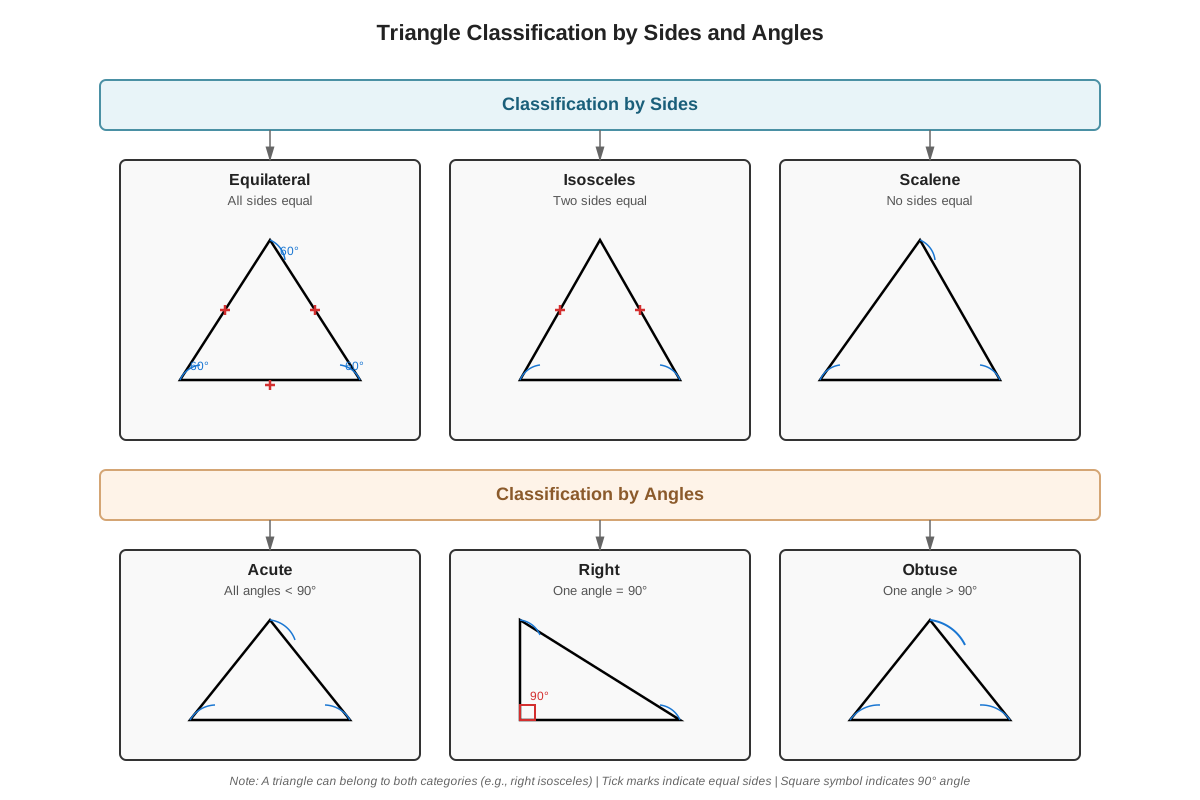
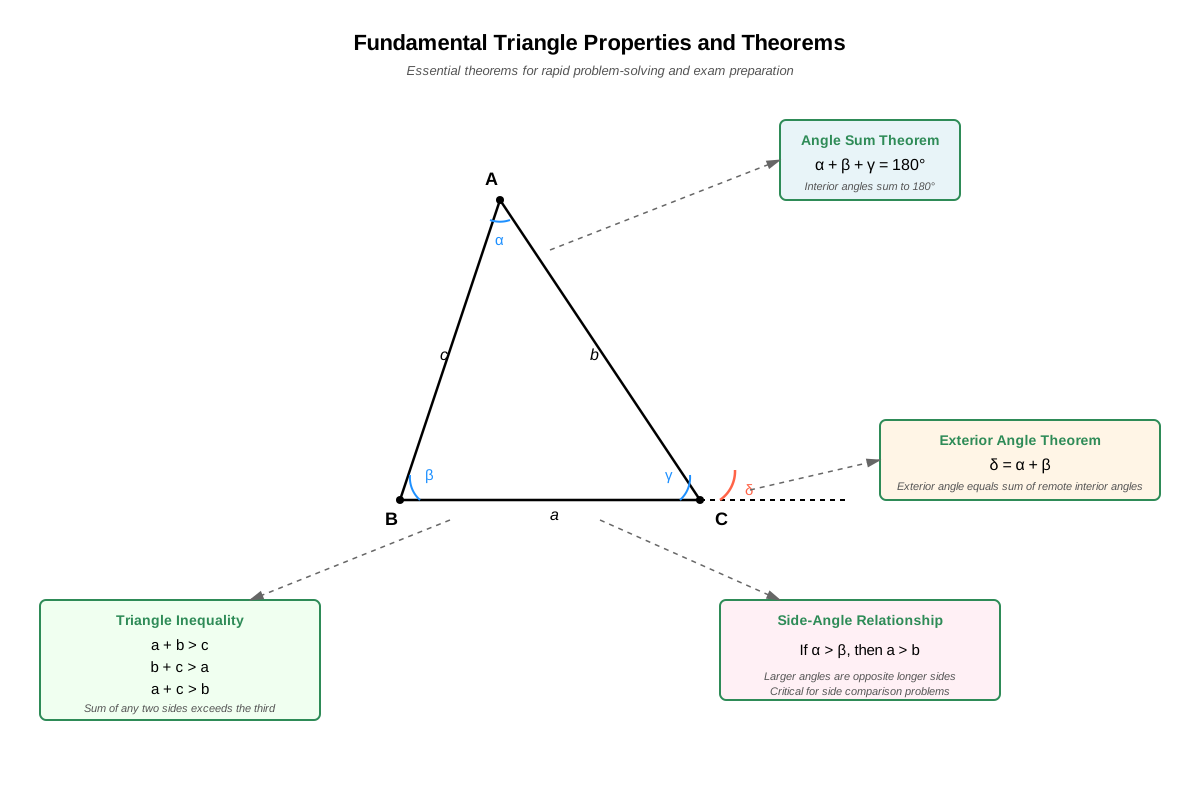
A triangle is a closed two-dimensional polygon with exactly three sides, three vertices, and three interior angles. The fundamental property that defines all triangles is that the sum of interior angles always equals 180 degrees, regardless of the triangle's shape or size. This angle sum property serves as the foundation for countless GMAT problems and enables deduction of unknown angles when two angles are known.
Triangles are classified by their sides into three categories:
- Equilateral triangles: All three sides equal in length; all three angles measure 60°
- Isosceles triangles: Exactly two sides equal in length; the angles opposite the equal sides (base angles) are also equal
- Scalene triangles: All three sides have different lengths; all three angles have different measures
Triangles are also classified by their largest angle:
- Acute triangles: All three angles measure less than 90°
- Right triangles: Exactly one angle measures 90°
- Obtuse triangles: Exactly one angle measures greater than 90°
Triangle Inequality Theorem
The Triangle Inequality Theorem states that the sum of the lengths of any two sides of a triangle must be greater than the length of the third side. This principle applies to all three possible combinations of sides. For a triangle with sides a, b, and c:
- a + b > c
- a + c > b
- b + c > a
This theorem is crucial for Data Sufficiency questions where the GMAT asks whether given information is sufficient to determine if a valid triangle can be formed. A related principle states that the difference between any two sides must be less than the third side, which helps establish ranges for unknown side lengths.
Pythagorean Theorem and Right Triangles
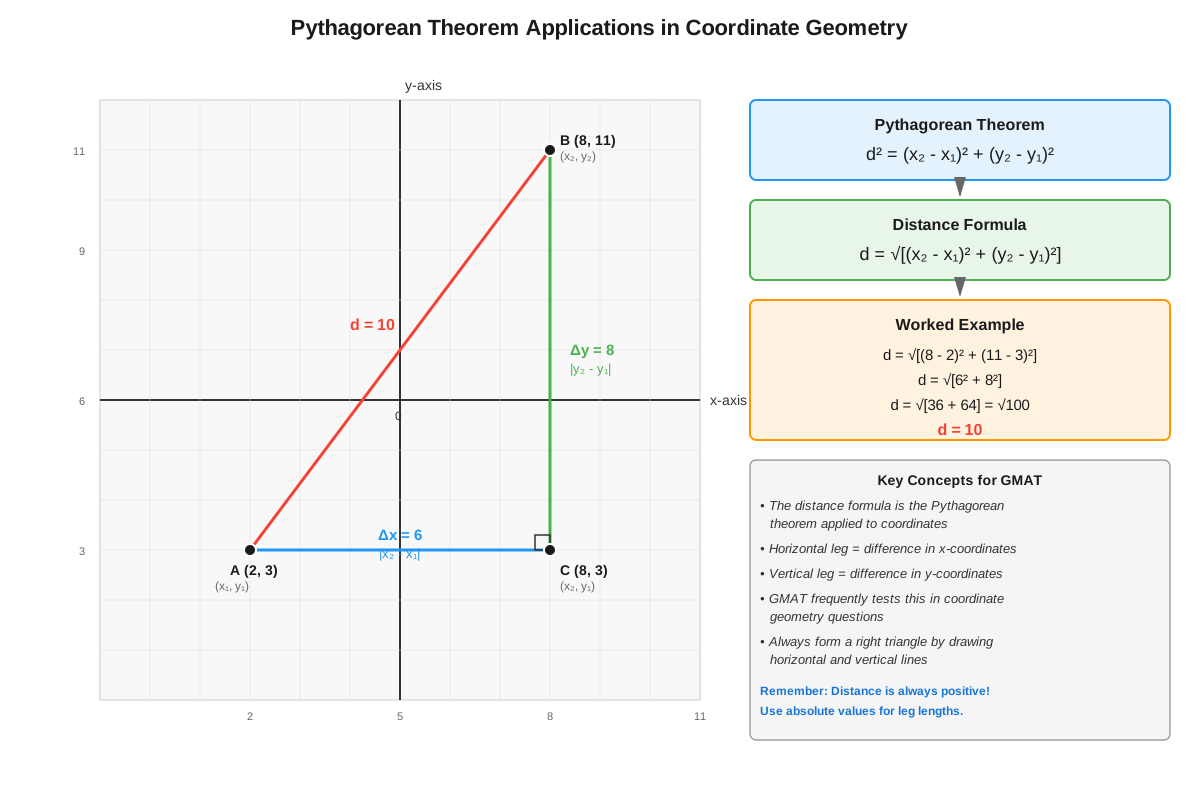
The Pythagorean theorem applies exclusively to right triangles and states that the square of the hypotenuse (the side opposite the right angle) equals the sum of the squares of the other two sides (legs). For a right triangle with legs a and b and hypotenuse c:
a² + b² = c²This theorem enables calculation of any side length when the other two are known. The GMAT frequently tests Pythagorean theorem applications in coordinate geometry, where the distance between two points forms the hypotenuse of a right triangle with legs parallel to the axes.
Pythagorean triples are sets of three positive integers that satisfy the Pythagorean theorem. The most common triples tested on the GMAT include:
| Basic Triple | Common Multiples |
|---|---|
| 3-4-5 | 6-8-10, 9-12-15, 12-16-20 |
| 5-12-13 | 10-24-26, 15-36-39 |
| 8-15-17 | 16-30-34 |
| 7-24-25 | 14-48-50 |
Recognizing these patterns eliminates the need for calculation and saves valuable time during the exam.
Special Right Triangles
Two special right triangles appear with exceptional frequency on the GMAT due to their predictable side ratios:
45-45-90 Triangle (Isosceles Right Triangle):
- Angles: 45°, 45°, 90°
- Side ratio: 1 : 1 : √2
- If legs have length x, the hypotenuse has length x√2
- Commonly appears in squares divided by diagonals
30-60-90 Triangle:
- Angles: 30°, 60°, 90°
- Side ratio: 1 : √3 : 2
- Side opposite 30° : Side opposite 60° : Hypotenuse
- If the shortest side has length x, the other leg has length x√3, and the hypotenuse has length 2x
- Commonly appears in equilateral triangles divided by altitude
These special triangles enable rapid calculation without applying the Pythagorean theorem. The GMAT rewards recognition of these patterns, particularly in problems involving equilateral triangles, squares, and hexagons.
Triangle Area Formulas
The standard area formula for any triangle is:
Area = (1/2) × base × heightThe height must be perpendicular to the base. For right triangles, the two legs serve as base and height, simplifying the calculation. The GMAT also tests alternative area formulas:
Heron's Formula (when all three sides are known):
Area = √[s(s-a)(s-b)(s-c)]where s = (a+b+c)/2 is the semi-perimeter
Area using two sides and included angle:
Area = (1/2) × a × b × sin(C)where C is the angle between sides a and b
While Heron's formula and the sine formula appear less frequently, recognizing when they apply can provide elegant solutions to otherwise complex problems.
Similar Triangles
Similar triangles have the same shape but not necessarily the same size—their corresponding angles are equal, and their corresponding sides are proportional. The GMAT tests similarity through several criteria:
- AA (Angle-Angle): If two angles of one triangle equal two angles of another, the triangles are similar
- SSS (Side-Side-Side): If corresponding sides are proportional, the triangles are similar
- SAS (Side-Angle-Side): If two sides are proportional and the included angles are equal, the triangles are similar
When triangles are similar with a ratio of similarity k, their areas are related by k². This relationship frequently appears in GMAT problems involving scaling or proportional reasoning.
Congruent Triangles
Congruent triangles are identical in both shape and size—all corresponding sides and angles are equal. Congruence criteria include:
- SSS: Three sides of one triangle equal three sides of another
- SAS: Two sides and the included angle equal
- ASA: Two angles and the included side equal
- AAS: Two angles and a non-included side equal
- HL: For right triangles only—hypotenuse and one leg equal
The GMAT rarely asks directly about congruence but uses these principles in Data Sufficiency questions to determine whether given information uniquely defines a triangle.
Exterior Angles
An exterior angle of a triangle is formed when one side is extended beyond a vertex. The exterior angle theorem states that an exterior angle equals the sum of the two non-adjacent interior angles. This property provides an efficient alternative to using the 180° angle sum when solving for unknown angles.
Median, Altitude, and Angle Bisector
- Median: A line segment from a vertex to the midpoint of the opposite side; divides the triangle into two equal areas
- Altitude: A perpendicular line segment from a vertex to the opposite side (or its extension); used to calculate area
- Angle bisector: A line segment that divides an angle into two equal parts
In special triangles (equilateral and isosceles), these three segments may coincide. The centroid (where medians intersect) divides each median in a 2:1 ratio from vertex to midpoint.
Concept Relationships
The triangle concepts form an interconnected web where understanding one principle enhances comprehension of others. The angle sum property (180°) serves as the foundation, enabling derivation of the exterior angle theorem and constraining possible angle combinations. This connects directly to triangle classification, as the presence of a 90° or obtuse angle determines whether the Pythagorean theorem applies.
The Pythagorean theorem → leads to → special right triangles (45-45-90 and 30-60-90), which are specific cases with predictable ratios. These special triangles → connect to → equilateral triangles and squares, as dividing these shapes creates special right triangles. Understanding area formulas requires knowledge of altitudes, which in turn relates to the Pythagorean theorem when calculating heights in non-right triangles.
Triangle inequality → constrains → possible side lengths, which connects to congruence criteria by determining when sufficient information exists to define a unique triangle. Similar triangles build upon proportional reasoning and connect to area relationships through the k² scaling principle. All these concepts integrate in coordinate geometry problems, where distance formula (derived from Pythagorean theorem) combines with triangle area calculations.
The prerequisite knowledge of angles, algebra, and coordinate planes enables manipulation of triangle equations, while mastery of triangles prepares students for polygons (which decompose into triangles), circles (where inscribed/circumscribed triangles appear), and three-dimensional geometry (where triangular faces define polyhedra).
Quick check — test yourself on Triangles so far.
Try Flashcards →High-Yield Facts
⭐ The sum of interior angles in any triangle always equals 180 degrees
⭐ In a right triangle with legs a and b and hypotenuse c: a² + b² = c²
⭐ The 45-45-90 triangle has side ratio 1 : 1 : √2
⭐ The 30-60-90 triangle has side ratio 1 : √3 : 2 (opposite the 30°, 60°, and 90° angles respectively)
⭐ The sum of any two sides of a triangle must be greater than the third side (Triangle Inequality)
- An exterior angle of a triangle equals the sum of the two non-adjacent interior angles
- In an isosceles triangle, the angles opposite the equal sides are equal
- The area of any triangle equals (1/2) × base × height, where height is perpendicular to the base
- Similar triangles have equal corresponding angles and proportional corresponding sides
- If two triangles are similar with ratio k, their areas are related by k²
- The three medians of a triangle intersect at the centroid, which divides each median in a 2:1 ratio
- In an equilateral triangle, all sides are equal and all angles measure 60°
- Common Pythagorean triples include 3-4-5, 5-12-13, 8-15-17, and 7-24-25 (and their multiples)
- The altitude to the hypotenuse of a right triangle creates two smaller triangles similar to the original and to each other
- In a right triangle, the side opposite the largest angle (the hypotenuse) is the longest side
Common Misconceptions
Misconception: The Pythagorean theorem applies to all triangles.
→ Correction: The Pythagorean theorem applies exclusively to right triangles. For non-right triangles, use the Law of Cosines or other methods.
Misconception: If two sides of a triangle are known, the third side can be any positive value.
→ Correction: The Triangle Inequality Theorem constrains the third side—it must be less than the sum of the other two sides and greater than their difference.
Misconception: In a 30-60-90 triangle, if the hypotenuse is 2, the side opposite the 60° angle is 2.
→ Correction: If the hypotenuse is 2, the side opposite 30° is 1, and the side opposite 60° is √3 (not 2). The ratio is 1 : √3 : 2.
Misconception: Similar triangles have the same area.
→ Correction: Similar triangles have the same shape but not necessarily the same size. If the ratio of corresponding sides is k, the ratio of areas is k².
Misconception: The altitude of a triangle is always inside the triangle.
→ Correction: In obtuse triangles, the altitude from a vertex to the opposite side may fall outside the triangle, requiring extension of the base.
Misconception: An isosceles triangle must have two equal angles at the base.
→ Correction: While the base angles are equal, an isosceles triangle can be oriented any way. The equal angles are those opposite the equal sides, regardless of which side is considered the "base."
Misconception: The longest side of a triangle is always opposite the right angle.
→ Correction: The longest side is opposite the largest angle. In a right triangle, the 90° angle is the largest, so the hypotenuse is longest. In non-right triangles, the longest side is opposite the largest angle (which is less than 90° in acute triangles or greater than 90° in obtuse triangles).
Misconception: All triangles with the same perimeter have the same area.
→ Correction: Triangles with identical perimeters can have vastly different areas. For a fixed perimeter, the equilateral triangle has the maximum area.
Worked Examples
Example 1: Special Right Triangle Application
Problem: In the coordinate plane, point A is at the origin (0, 0), point B is at (6, 0), and point C is at (3, h), where h > 0. If triangle ABC is equilateral, what is the value of h?
Solution:
Step 1: Recognize that an equilateral triangle has all sides equal. Calculate the length of side AB:
- AB = 6 - 0 = 6
Step 2: Since the triangle is equilateral, all sides equal 6. Point C at (3, h) is directly above the midpoint of AB, creating symmetry.
Step 3: The altitude of an equilateral triangle divides it into two 30-60-90 triangles. The altitude from C to AB creates a right triangle with:
- Base (from midpoint to B) = 3
- Height = h
- Hypotenuse (side of equilateral triangle) = 6
Step 4: In a 30-60-90 triangle with hypotenuse 6, the sides are in ratio 1 : √3 : 2. Therefore:
- Short side = 6 × (1/2) = 3
- Long side = 6 × (√3/2) = 3√3
Step 5: The height h corresponds to the long side (opposite the 60° angle):
- h = 3√3
Answer: h = 3√3
This problem demonstrates the learning objective of applying special triangle properties to coordinate geometry, a high-frequency GMAT question type.
Example 2: Triangle Inequality and Data Sufficiency
Problem: Triangle PQR has sides of length p, q, and r. Is p < 10?
Statement (1): q = 7 and r = 4
Statement (2): The perimeter of triangle PQR is 20
Solution:
Analyze Statement (1):
- Given q = 7 and r = 4
- Apply Triangle Inequality: The sum of any two sides must exceed the third
- Therefore: p + 4 > 7, which gives p > 3
- Also: p + 7 > 4 (automatically satisfied for positive p)
- Also: 7 + 4 > p, which gives p < 11
- Combined: 3 < p < 11
- This does NOT definitively answer whether p < 10 (p could be 10.5)
- Statement (1) is INSUFFICIENT
Analyze Statement (2):
- Perimeter = p + q + r = 20
- This alone provides no information about individual side lengths
- p could be 2 (with q = 9, r = 9) or p could be 15 (with q = 2.6, r = 2.6, though we'd need to verify Triangle Inequality)
- Statement (2) is INSUFFICIENT
Analyze Both Statements Together:
- From (1): 3 < p < 11
- From (2): p + 7 + 4 = 20, so p = 9
- Since 9 < 10, we can definitively answer YES
- Both statements together are SUFFICIENT
Answer: C (Both statements together are sufficient, but neither alone is sufficient)
This example illustrates the learning objectives of identifying triangle constraints and applying the Triangle Inequality Theorem to GMAT Data Sufficiency questions.
Exam Strategy
When approaching GMAT triangle questions, begin by identifying the triangle type (right, isosceles, equilateral, or special right triangle), as this immediately activates relevant properties and formulas. Look for trigger words such as "perpendicular" (suggests right triangle), "equal sides" (isosceles or equilateral), "diagonal of a square" (45-45-90), or "altitude of an equilateral triangle" (30-60-90).
For Data Sufficiency questions, determine whether the given information uniquely defines the triangle. Remember that three pieces of information are typically needed (SSS, SAS, ASA, AAS, or HL for right triangles), but sometimes fewer suffice due to special properties. Always check the Triangle Inequality when side lengths are involved.
Time-saving techniques include:
- Recognizing Pythagorean triples instead of calculating (saves 30-45 seconds per question)
- Using special right triangle ratios rather than applying the Pythagorean theorem
- Sketching diagrams for word problems to visualize relationships
- Checking answer choices before calculating—sometimes estimation or process of elimination is faster
Process of elimination strategies:
- Eliminate answers that violate Triangle Inequality
- Eliminate answers where the hypotenuse is shorter than a leg
- For area questions, eliminate answers that exceed (1/2) × product of two sides (the maximum possible area)
- Check units and ensure answers are dimensionally consistent
Time allocation: Allocate 2 minutes for straightforward triangle problems, 2.5 minutes for multi-step problems involving multiple concepts, and up to 3 minutes for complex Data Sufficiency questions requiring case analysis. If a problem requires more than 3 minutes, mark it for review and move forward.
Memory Techniques
Mnemonic for Triangle Inequality: "Two Sides Must Exceed the Third" (TS-MET)
Mnemonic for Special Right Triangles:
- 45-45-90: "One-One-Root Two" (emphasizing the 1:1:√2 ratio)
- 30-60-90: "One-Root Three-Two" (emphasizing the 1:√3:2 ratio, in order of increasing angle)
Visualization for Pythagorean Triples: Picture a 3-4-5 triangle as a "construction triangle" (commonly used in carpentry). Multiples are simply scaled versions: 6-8-10 is "double construction," 9-12-15 is "triple construction."
Acronym for Congruence Criteria: "Some Students Study All Summer And Ace School" (SSS, SAS, ASA, AAS)
Memory aid for Area Formulas: Visualize a triangle as "half a rectangle"—the formula (1/2) × base × height comes from dividing a rectangle diagonally.
Angle Sum Visualization: Picture a triangle's three angles being "torn off" and placed adjacent to each other—they form a straight line (180°).
Summary
Triangles constitute a cornerstone of GMAT Quantitative Reasoning, requiring mastery of classification systems, fundamental theorems, and strategic problem-solving approaches. The angle sum property (180°), Pythagorean theorem, and Triangle Inequality Theorem form the theoretical foundation, while special right triangles (45-45-90 and 30-60-90) provide computational shortcuts that save critical exam time. Understanding similarity and congruence enables analysis of complex geometric relationships, and fluency with multiple area formulas ensures flexibility across diverse question formats. Success on GMAT triangle questions demands not merely formula memorization but pattern recognition—identifying when a problem involves special triangles, Pythagorean triples, or hidden right triangles within complex figures. The integration of triangle concepts with coordinate geometry, word problems, and Data Sufficiency scenarios reflects the GMAT's emphasis on applied reasoning rather than isolated calculation. Students who internalize these principles and practice strategic question analysis will find triangles to be a reliable source of correct answers and score improvement.
Key Takeaways
- The sum of interior angles in any triangle equals 180°, enabling calculation of unknown angles when two are known
- The Pythagorean theorem (a² + b² = c²) applies exclusively to right triangles and is foundational for coordinate geometry
- Special right triangles (45-45-90 with ratio 1:1:√2 and 30-60-90 with ratio 1:√3:2) enable rapid calculation without the Pythagorean theorem
- The Triangle Inequality Theorem constrains possible side lengths: the sum of any two sides must exceed the third
- Recognizing Pythagorean triples (3-4-5, 5-12-13, 8-15-17, 7-24-25) eliminates calculation and saves valuable time
- Similar triangles have proportional sides and equal angles; their areas are related by the square of the similarity ratio
- Triangle classification by sides (equilateral, isosceles, scalene) and angles (acute, right, obtuse) activates relevant properties and solution strategies
Related Topics
Polygons and Quadrilaterals: Mastery of triangles enables decomposition of complex polygons into triangular components, facilitating area calculations and angle analysis. Many quadrilateral properties derive from dividing them into triangles.
Coordinate Geometry: Triangle concepts integrate extensively with the coordinate plane, where the distance formula (derived from the Pythagorean theorem) and area calculations using coordinates build upon triangular foundations.
Circles: Inscribed and circumscribed triangles appear frequently in circle problems. Understanding triangle properties enables solving problems involving tangent lines, chords, and arc relationships.
Three-Dimensional Geometry: Pyramids, prisms, and other solids have triangular faces. Calculating surface areas and understanding spatial relationships requires fluency with two-dimensional triangle concepts.
Trigonometry: While tested minimally on the GMAT, basic trigonometric ratios (sine, cosine, tangent) derive from right triangle relationships and occasionally appear in advanced problems.
Practice CTA
Now that you've mastered the core concepts of triangles, it's time to solidify your understanding through active practice. Attempt the practice questions to apply these principles under exam-like conditions, focusing on pattern recognition and efficient solution strategies. Use the flashcards to reinforce high-yield facts and special triangle ratios until they become automatic. Remember: GMAT success comes not from passive reading but from deliberate practice and strategic review. Each problem you solve strengthens your geometric intuition and builds the confidence needed to tackle triangles quickly and accurately on test day. You've built the foundation—now construct your mastery through consistent application!
Sign up free to keep reading
Create a free AnvayaPrep account to finish this GMAT guide on Triangles — plus flashcards and practice questions.