Overview
The distance formula is a fundamental mathematical tool that calculates the straight-line distance between two points in a coordinate plane. Derived directly from the Pythagorean theorem, this formula is essential for solving a wide range of GMAT Quantitative Reasoning problems involving coordinate geometry, spatial relationships, and analytical reasoning. The GMAT distance formula appears frequently in problem-solving and data sufficiency questions, making it a high-yield topic that demands thorough understanding and rapid application skills.
On the GMAT, the distance formula serves as a bridge between algebraic manipulation and geometric visualization. Test-takers encounter this concept not only in pure geometry questions but also in word problems involving optimization, circles, and coordinate-based scenarios. The ability to quickly recognize when to apply the distance formula—and execute the calculation accurately under time pressure—distinguishes high-scoring candidates from average performers. Questions may present the formula directly, embed it within multi-step problems, or require students to derive distance relationships from given information.
Understanding the distance formula connects to broader Quantitative Reasoning concepts including the Pythagorean theorem, coordinate geometry, circles (where distance from center defines the radius), and even algebraic problem-solving. Mastery of this topic enables efficient navigation through complex geometry problems and provides a foundation for understanding more advanced spatial relationships tested on the GMAT. The formula's versatility makes it one of the most frequently applied tools in the geometry section, appearing in approximately 10-15% of quantitative questions either directly or as a component of larger problems.
Learning Objectives
- [ ] Identify the distance formula and recognize when it applies to GMAT problems
- [ ] Explain the mathematical derivation and conceptual basis of the distance formula
- [ ] Apply the distance formula accurately to calculate distances between coordinate points
- [ ] Solve multi-step GMAT problems that incorporate distance calculations with other geometric concepts
- [ ] Recognize distance formula applications in non-standard formats (word problems, data sufficiency)
- [ ] Evaluate answer choices efficiently by estimating distances before calculating exact values
Prerequisites
- Pythagorean Theorem: The distance formula is a direct application of a² + b² = c² in the coordinate plane, making this foundational knowledge essential
- Coordinate Geometry Basics: Understanding ordered pairs (x, y), plotting points, and navigating the Cartesian plane enables visualization of distance problems
- Algebraic Manipulation: Simplifying radicals, squaring binomials, and working with square roots are necessary for executing distance calculations
- Basic Geometry Concepts: Familiarity with right triangles, horizontal and vertical distances, and the concept of hypotenuse supports conceptual understanding
Why This Topic Matters
The distance formula represents one of the most practical applications of coordinate geometry in both academic and real-world contexts. Engineers use distance calculations for structural design, computer scientists apply them in graphics programming and machine learning algorithms, and urban planners utilize distance metrics for infrastructure optimization. The formula's ubiquity across STEM fields makes it a fundamental skill that extends far beyond standardized testing.
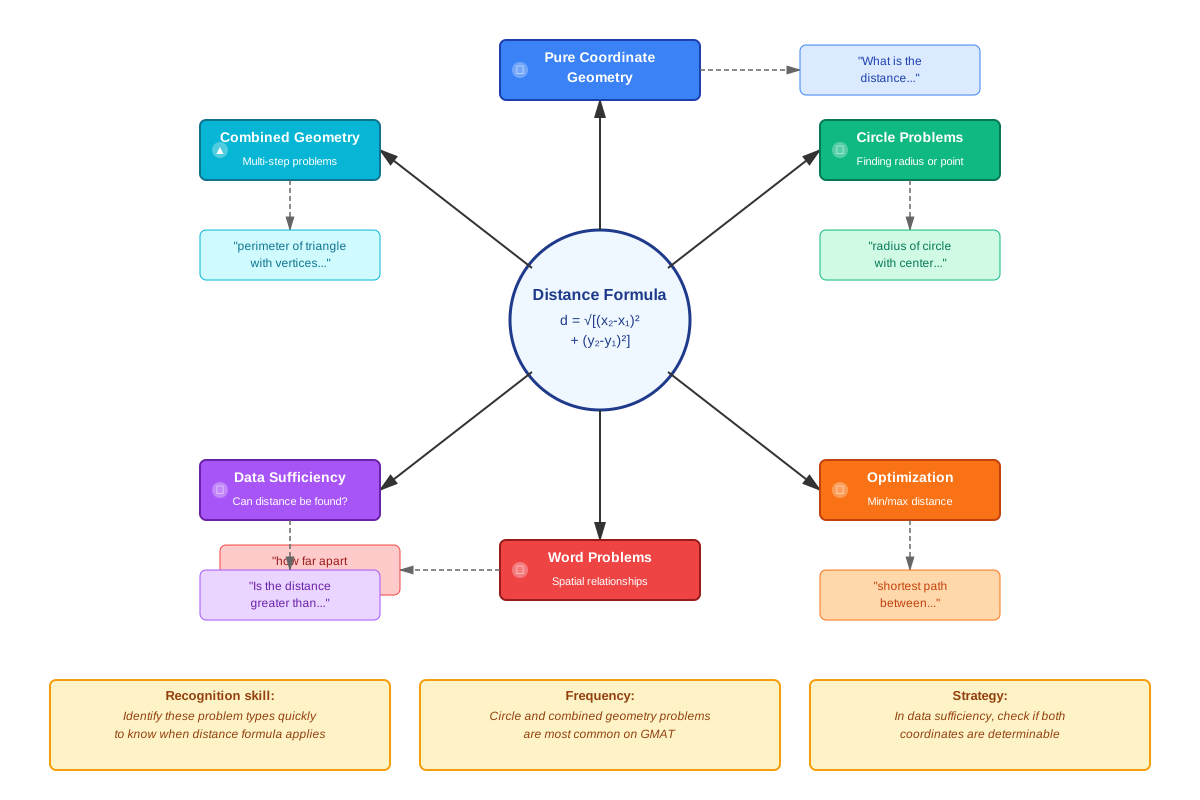
On the GMAT specifically, distance formula questions appear with notable frequency—approximately 2-3 questions per exam directly test this concept, while another 3-5 questions incorporate it as part of multi-step problem solving. The GMAT presents distance formula problems in several formats: pure coordinate geometry questions asking for the distance between two points, circle problems requiring radius calculations, optimization scenarios involving minimum or maximum distances, and data sufficiency questions testing whether given information allows distance determination. The versatility of this topic means it can appear in both problem-solving and data sufficiency formats across difficulty levels.
Common GMAT question patterns include: finding the distance between two coordinate points; determining whether a point lies on, inside, or outside a circle; calculating the shortest distance from a point to a line; identifying coordinates that satisfy specific distance conditions; and solving word problems where spatial relationships translate into coordinate geometry. The exam frequently combines distance formula applications with other concepts like midpoint formula, slope calculations, or algebraic equations, testing the ability to integrate multiple mathematical tools efficiently.
Core Concepts
The Distance Formula Definition
The distance formula calculates the straight-line (Euclidean) distance between two points in a coordinate plane. For points P₁(x₁, y₁) and P₂(x₂, y₂), the distance d is given by:
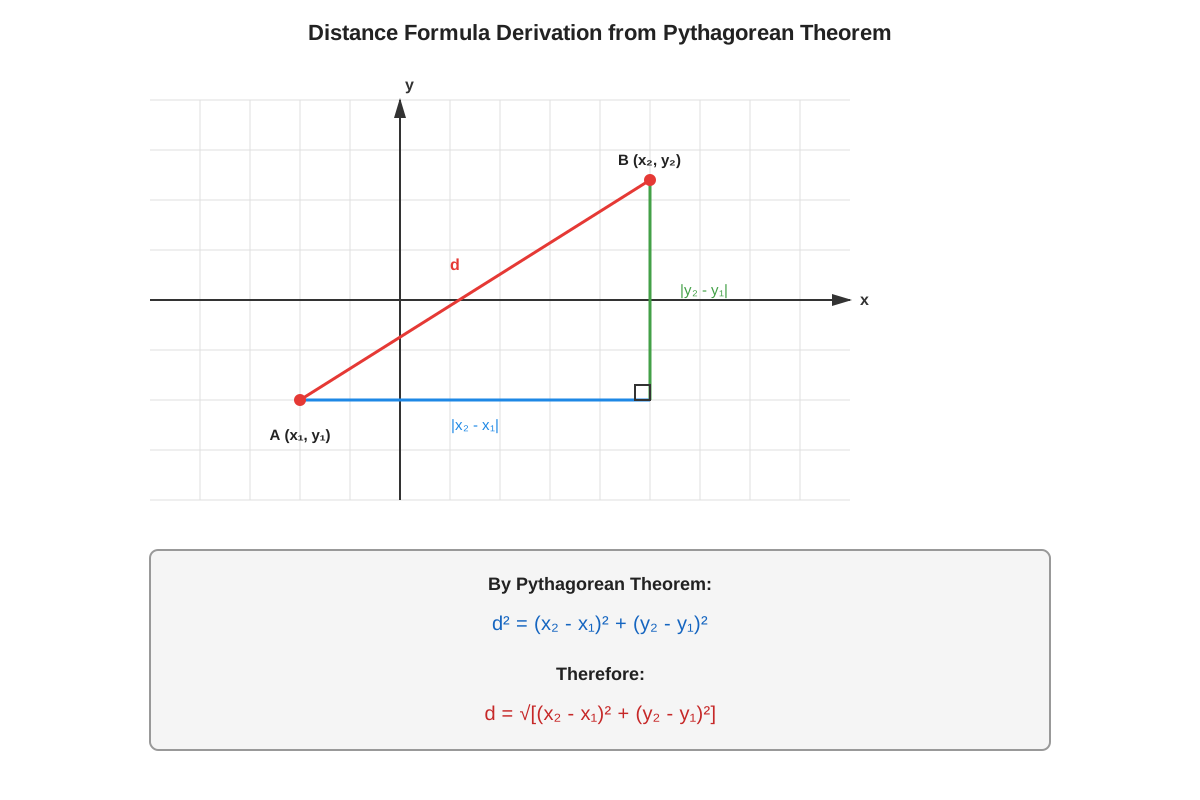
d = √[(x₂ - x₁)² + (y₂ - y₁)²]This formula represents the length of the hypotenuse of a right triangle formed by the horizontal and vertical distances between the two points. The horizontal leg has length |x₂ - x₁| and the vertical leg has length |y₂ - y₁|. Since we square these differences, the absolute value signs become unnecessary—squaring always produces a non-negative result.
Derivation from the Pythagorean Theorem
Understanding the derivation reinforces conceptual mastery and aids in remembering the formula. Consider two points A(x₁, y₁) and B(x₂, y₂) in the coordinate plane. To find the distance between them:
- Create a right triangle by drawing a horizontal line from point A and a vertical line from point B (or vice versa)
- The horizontal leg length equals the absolute difference in x-coordinates: |x₂ - x₁|
- The vertical leg length equals the absolute difference in y-coordinates: |y₂ - y₁|
- The distance between A and B is the hypotenuse of this right triangle
- Apply the Pythagorean theorem: d² = (x₂ - x₁)² + (y₂ - y₁)²
- Take the square root of both sides: d = √[(x₂ - x₁)² + (y₂ - y₁)²]
This derivation demonstrates that the distance formula is not an arbitrary equation but a logical consequence of fundamental geometric principles.
Order of Coordinates
A crucial property of the distance formula is its symmetry: the order in which points are labeled does not affect the result. Whether calculating from P₁ to P₂ or P₂ to P₁, the distance remains identical because:
- (x₂ - x₁)² = (x₁ - x₂)²
- (y₂ - y₁)² = (y₁ - y₂)²
This property simplifies calculations—students can subtract coordinates in whichever order feels most natural without worrying about sign errors affecting the final answer.
Special Cases and Simplifications
Several special cases allow for simplified distance calculations:
Horizontal Distance: When two points share the same y-coordinate (y₁ = y₂), they lie on a horizontal line. The distance simplifies to:
d = |x₂ - x₁|Vertical Distance: When two points share the same x-coordinate (x₁ = x₂), they lie on a vertical line. The distance simplifies to:
d = |y₂ - y₁|Distance from Origin: When one point is the origin (0, 0), the formula simplifies to:
d = √(x² + y²)This special case appears frequently in circle problems where the center is at the origin.
Three-Dimensional Extension
While the GMAT primarily focuses on two-dimensional coordinate geometry, understanding the three-dimensional extension demonstrates the formula's generalizability. For points in 3D space P₁(x₁, y₁, z₁) and P₂(x₂, y₂, z₂):
d = √[(x₂ - x₁)² + (y₂ - y₁)² + (z₂ - z₁)²]Though rarely tested directly, this extension occasionally appears in advanced GMAT problems or helps conceptualize the formula's underlying logic.
Computational Strategy
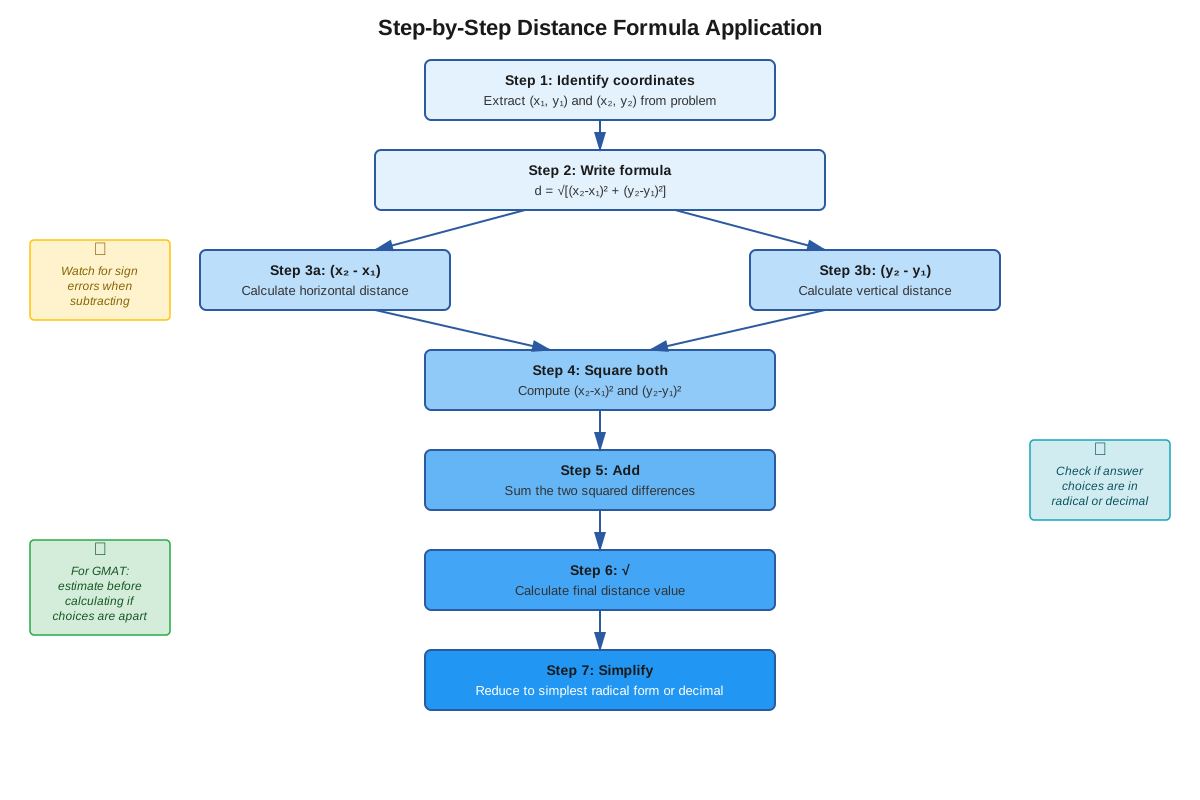
Efficient calculation requires systematic execution:
- Identify coordinates: Clearly label x₁, y₁, x₂, y₂ from the given points
- Calculate differences: Find (x₂ - x₁) and (y₂ - y₁) separately
- Square each difference: Compute (x₂ - x₁)² and (y₂ - y₁)²
- Sum the squares: Add the two squared values
- Take the square root: Find √(sum) for the final distance
For GMAT purposes, recognizing when to leave answers in radical form versus converting to decimals is important—the exam typically accepts exact radical expressions.
Concept Relationships
The distance formula sits at the intersection of multiple mathematical domains, serving as a practical application of abstract concepts. The Pythagorean theorem serves as the foundational parent concept—the distance formula is essentially the Pythagorean theorem applied to coordinate geometry. This relationship means that any problem solvable with the distance formula could theoretically be solved by constructing a right triangle and applying a² + b² = c², though the distance formula provides a more efficient approach.
Coordinate geometry provides the framework within which the distance formula operates. Understanding how to plot points, interpret ordered pairs, and visualize the coordinate plane enables proper application of the formula. The distance formula transforms abstract coordinate pairs into concrete geometric measurements, bridging algebraic representation and spatial understanding.
The midpoint formula shares structural similarities with the distance formula—both operate on coordinate pairs and involve arithmetic operations on x and y coordinates separately. While the midpoint formula averages coordinates to find a central point, the distance formula measures separation. These formulas frequently appear together in GMAT problems requiring both location and distance information.
Circle equations depend fundamentally on the distance formula. The standard form equation (x - h)² + (y - k)² = r² represents all points at distance r from center (h, k). This equation is simply the distance formula squared, with the distance set equal to the radius. Many GMAT circle problems require recognizing this connection and applying distance calculations to determine whether points lie on, inside, or outside circles.
Optimization problems often incorporate distance calculations when finding minimum or maximum spatial separations. These problems may require combining the distance formula with algebraic techniques like completing the square or using calculus concepts (though calculus itself is not tested on the GMAT).
The relationship flow can be visualized as: Pythagorean Theorem → Distance Formula → Circle Equations and Optimization Problems, with Coordinate Geometry providing the underlying framework for all applications.
High-Yield Facts
⭐ The distance formula is d = √[(x₂ - x₁)² + (y₂ - y₁)²] for points (x₁, y₁) and (x₂, y₂)
⭐ The formula is derived directly from the Pythagorean theorem applied to coordinate geometry
⭐ The order of points does not matter—distance from A to B equals distance from B to A
⭐ When points share the same y-coordinate, distance simplifies to |x₂ - x₁| (horizontal distance)
⭐ When points share the same x-coordinate, distance simplifies to |y₂ - y₁| (vertical distance)
- Distance from any point (x, y) to the origin (0, 0) is √(x² + y²)
- The distance formula always produces a non-negative result (distance cannot be negative)
- Squaring the differences eliminates the need for absolute value signs in the formula
- The distance formula can be used to verify if three points form a right triangle (check if a² + b² = c²)
- In circle problems, the distance from center to any point on the circle equals the radius
- The shortest distance between two points is always a straight line (what the formula calculates)
- Common GMAT trap answers involve forgetting to take the square root or incorrectly squaring differences
- Distance calculations often involve simplifying radicals—recognize perfect squares to simplify efficiently
Quick check — test yourself on Distance formula so far.
Try Flashcards →Common Misconceptions
Misconception: The order of subtraction matters in the distance formula, and reversing it will produce a negative distance.
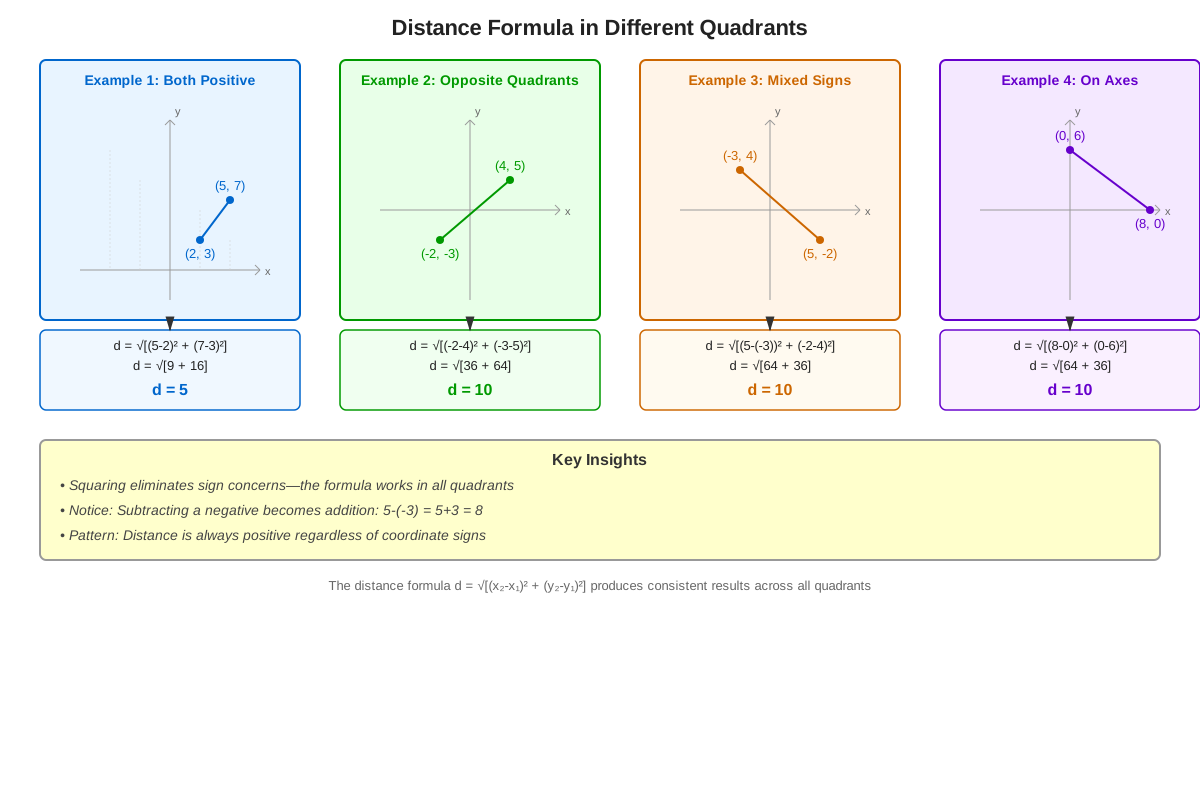
Correction: Because both differences are squared, the order of subtraction is irrelevant. (x₂ - x₁)² always equals (x₁ - x₂)², and distance is always non-negative. The squaring operation eliminates any sign concerns.
Misconception: The distance formula only applies to points in the first quadrant (positive coordinates).
Correction: The distance formula works for any two points in the coordinate plane, regardless of which quadrant they occupy. Negative coordinates are handled correctly through the subtraction and squaring operations.
Misconception: When calculating distance, simply add the absolute differences: d = |x₂ - x₁| + |y₂ - y₁|.
Correction: This calculates the "Manhattan distance" or "taxicab distance," not the straight-line Euclidean distance. The correct formula requires squaring the differences, summing them, and taking the square root—following the Pythagorean theorem structure.
Misconception: If two points have the same x-coordinate or y-coordinate, the distance formula cannot be used.
Correction: The distance formula works perfectly for horizontal and vertical distances; it simply simplifies because one of the terms becomes zero. For example, if y₁ = y₂, then (y₂ - y₁)² = 0, and d = √[(x₂ - x₁)² + 0] = |x₂ - x₁|.
Misconception: The distance formula gives the distance traveled along a path between two points.
Correction: The distance formula calculates the straight-line distance "as the crow flies," not the distance along a particular path. Path distance depends on the specific route taken and is typically longer than the straight-line distance.
Misconception: When the distance formula produces a result like √50, this must be converted to decimal form (approximately 7.07).
Correction: On the GMAT, radical expressions are often the preferred answer format. √50 can be simplified to 5√2, which is typically more accurate and acceptable than decimal approximations. Only convert to decimals when answer choices are in decimal form or when estimation is strategically useful.
Misconception: The distance between points (2, 3) and (5, 7) can be found by calculating √(5² + 7²).
Correction: This error involves using the coordinates directly rather than their differences. The correct calculation is √[(5-2)² + (7-3)²] = √(3² + 4²) = √25 = 5. Always subtract corresponding coordinates before squaring.
Worked Examples
Example 1: Basic Distance Calculation
Problem: Find the distance between points A(-2, 3) and B(4, -1).
Solution:
Step 1: Identify the coordinates clearly.
- Point A: x₁ = -2, y₁ = 3
- Point B: x₂ = 4, y₂ = -1
Step 2: Apply the distance formula.
d = √[(x₂ - x₁)² + (y₂ - y₁)²]Step 3: Calculate the x-difference.
x₂ - x₁ = 4 - (-2) = 4 + 2 = 6Step 4: Calculate the y-difference.
y₂ - y₁ = -1 - 3 = -4Step 5: Square each difference.
(x₂ - x₁)² = 6² = 36
(y₂ - y₁)² = (-4)² = 16
Step 6: Sum the squares and take the square root.
d = √(36 + 16) = √52Step 7: Simplify the radical.
√52 = √(4 × 13) = 2√13Answer: The distance between points A and B is 2√13 units (approximately 7.21 units).
Connection to Learning Objectives: This example demonstrates the direct application of the distance formula, showing systematic execution of each calculation step. It reinforces the importance of careful arithmetic with negative numbers and radical simplification.
Example 2: Circle Application (Data Sufficiency Style)
Problem: Point P has coordinates (3, 4). Is point Q inside, on, or outside the circle with center at the origin and radius 6?
Given Information:
- Statement 1: Point Q has coordinates (5, 2)
- Statement 2: The distance from Q to the origin is less than the distance from P to the origin
Solution:
First, establish the criterion: A point is inside a circle if its distance from the center is less than the radius, on the circle if the distance equals the radius, and outside if the distance exceeds the radius.
Analyzing Statement 1:
Step 1: Calculate the distance from Q(5, 2) to the origin (0, 0).
d = √[(5 - 0)² + (2 - 0)²]
d = √(25 + 4)
d = √29
Step 2: Compare this distance to the radius.
√29 ≈ 5.39 < 6Since the distance from Q to the origin (√29) is less than the radius (6), point Q is inside the circle.
Statement 1 alone is SUFFICIENT.
Analyzing Statement 2:
Step 1: Calculate the distance from P(3, 4) to the origin.
d = √[(3 - 0)² + (4 - 0)²]
d = √(9 + 16)
d = √25 = 5
Step 2: Interpret Statement 2.
Statement 2 tells us that the distance from Q to the origin is less than 5.
Step 3: Compare to the radius.
Since the distance from Q to the origin is less than 5, and 5 < 6 (the radius), point Q must be inside the circle.
Statement 2 alone is SUFFICIENT.
Answer: EACH statement ALONE is sufficient (Answer choice D in GMAT data sufficiency format).
Connection to Learning Objectives: This example demonstrates how the distance formula integrates with circle concepts and appears in data sufficiency format. It shows that recognizing when to apply the formula is as important as executing the calculation, and that sometimes comparison without exact calculation is sufficient.
Exam Strategy
When approaching GMAT questions involving the distance formula, begin by identifying whether the problem explicitly provides coordinates or requires extracting them from a word problem or diagram. Trigger phrases include "distance between two points," "how far apart," "length of the line segment," "radius of the circle," and "shortest distance." These phrases signal that coordinate-based distance calculation may be necessary.
For problem-solving questions, follow this systematic approach:
- Extract or identify coordinates: Write down x₁, y₁, x₂, y₂ clearly to avoid confusion
- Check for simplifications: Before applying the full formula, verify whether points share an x or y coordinate (allowing for simpler horizontal or vertical distance calculation)
- Calculate methodically: Work through differences, squares, sum, and square root in distinct steps to minimize arithmetic errors
- Simplify radicals: Factor out perfect squares from under the radical sign—GMAT answer choices often present simplified radical forms
- Verify reasonableness: Estimate the distance visually or using the coordinate differences to catch calculation errors
For data sufficiency questions, the strategy differs significantly:
- Determine what's needed: Identify whether you need exact coordinates, just the distance, or relative position information
- Avoid unnecessary calculation: Often, recognizing that sufficient information exists is enough—you don't need to calculate the actual distance
- Consider geometric properties: Sometimes distance relationships can be determined without the formula (e.g., using symmetry or special triangles)
- Test boundary cases: For circle problems, check whether a point could be inside, on, or outside based on given constraints
Process-of-elimination tips specific to distance formula questions:
- Eliminate answers that are negative (distance is always non-negative)
- Eliminate answers that exceed the sum of absolute differences in coordinates (the straight-line distance is always less than or equal to the Manhattan distance)
- For radical answers, eliminate options that aren't properly simplified
- In data sufficiency, eliminate choices that require calculation when conceptual understanding suffices
Time allocation: Basic distance formula questions should take 1.5-2 minutes. If a problem requires more than 2.5 minutes, consider whether there's a simpler approach or whether strategic guessing might be more efficient. Complex multi-step problems involving distance may warrant 3 minutes, but recognize when diminishing returns set in.
Exam Tip: When answer choices are in decimal form, use estimation before calculating. If points are (1, 2) and (4, 6), the x-difference is 3 and y-difference is 4—this forms a 3-4-5 right triangle, so the distance is exactly 5. Recognizing common Pythagorean triples (3-4-5, 5-12-13, 8-15-17) can save significant calculation time.
Memory Techniques
Primary Mnemonic for the Formula Structure: "Differences Squared Summed Square-rooted" (DSSS)
- Differences: Subtract corresponding coordinates
- Squared: Square each difference
- Summed: Add the squared values
- Square-rooted: Take the square root of the sum
Visual Memory Aid: Picture a right triangle connecting two points. The horizontal leg is the "x-journey," the vertical leg is the "y-journey," and the hypotenuse is the "direct distance." This visualization reinforces that the distance formula is just the Pythagorean theorem in coordinate form.
Acronym for Special Cases: "HOV" lane for quick distance
- Horizontal: Same y-coordinate → distance = |x₂ - x₁|
- Origin: One point at (0,0) → distance = √(x² + y²)
- Vertical: Same x-coordinate → distance = |y₂ - y₁|
Rhyme for Order Independence: "First to second, second to first, the distance stays the same—no curse!" This reminds students that coordinate order doesn't affect the result.
Finger Counting Method: Use fingers to track the four-step process:
- Thumb: x-difference
- Index: y-difference
- Middle: Square and sum
- Ring: Square root
This physical memory aid helps ensure no steps are skipped during high-pressure testing.
Summary
The distance formula, d = √[(x₂ - x₁)² + (y₂ - y₁)²], is an essential GMAT tool that calculates the straight-line distance between two coordinate points. Derived from the Pythagorean theorem, this formula transforms abstract coordinate pairs into measurable geometric quantities. Mastery requires understanding both the conceptual foundation—visualizing the right triangle formed by horizontal and vertical distances—and the computational execution—systematically calculating differences, squaring, summing, and taking the square root. The formula's symmetry means coordinate order is irrelevant, and special cases (horizontal, vertical, or origin-based distances) allow for simplified calculations. On the GMAT, distance formula questions appear in multiple contexts: pure coordinate geometry, circle problems, optimization scenarios, and data sufficiency questions. Success demands recognizing when to apply the formula, executing calculations accurately under time pressure, and integrating distance concepts with other geometric principles. The ability to simplify radicals, estimate distances for answer verification, and avoid common misconceptions distinguishes high-performing test-takers.
Key Takeaways
- The distance formula d = √[(x₂ - x₁)² + (y₂ - y₁)²] is the Pythagorean theorem applied to coordinate geometry
- Coordinate order doesn't matter—distance from A to B equals distance from B to A due to squaring
- Special cases simplify calculation: horizontal distances when y-coordinates match, vertical distances when x-coordinates match
- The formula connects directly to circle equations, where distance from center equals radius
- Always simplify radicals in final answers—factor out perfect squares for the form expected in GMAT answer choices
- Recognize common Pythagorean triples (3-4-5, 5-12-13) to accelerate calculations and verify answers
- In data sufficiency questions, determine whether you need the actual distance or just whether sufficient information exists to calculate it
Related Topics
Midpoint Formula: Calculates the coordinates of the point exactly halfway between two given points, using the average of x-coordinates and y-coordinates separately. Mastering the distance formula provides the foundation for understanding how midpoint and distance relate—the midpoint divides the distance into two equal segments.
Circle Equations: The standard form (x - h)² + (y - k)² = r² represents all points at distance r from center (h, k). Understanding the distance formula is prerequisite to comprehending why circle equations take this form and solving problems involving points on or near circles.
Pythagorean Theorem Applications: Beyond the distance formula, the Pythagorean theorem appears in numerous GMAT geometry problems involving right triangles, rectangles, and three-dimensional figures. The distance formula serves as a gateway to recognizing these broader applications.
Coordinate Geometry Advanced Topics: Including slope calculations, parallel and perpendicular lines, and line equations. The distance formula often combines with these concepts in multi-step problems requiring integrated geometric reasoning.
Practice CTA
Now that you've mastered the theoretical foundation and strategic approach to the distance formula, it's time to solidify your understanding through active practice. Attempt the practice questions associated with this topic, focusing on both computational accuracy and strategic decision-making. Work through the flashcards to reinforce key formulas and special cases until recall becomes automatic. Remember that GMAT success comes not just from knowing the formula, but from recognizing when and how to apply it efficiently under time pressure. Each practice problem you solve builds the pattern recognition and confidence needed to excel on test day. Challenge yourself with increasingly complex scenarios, and review any mistakes thoroughly to understand where your reasoning diverged from the correct approach. Your investment in deliberate practice now will pay dividends in both speed and accuracy when you encounter these high-yield questions on the actual exam.
Sign up free to keep reading
Create a free AnvayaPrep account to finish this GMAT guide on Distance formula — plus flashcards and practice questions.