Overview
The midpoint is a fundamental concept in coordinate geometry that appears frequently on the GMAT Quantitative Reasoning section. At its core, the midpoint represents the exact center point between two given points on a line segment or in a coordinate plane. Understanding how to calculate and apply the midpoint formula is essential for solving a variety of geometry problems, from basic coordinate questions to complex multi-step problems involving distance, symmetry, and geometric properties.
On the GMAT, midpoint questions test not only computational ability but also conceptual understanding of spatial relationships and algebraic manipulation. These questions often appear in problem-solving formats and occasionally in data sufficiency questions, where determining whether you have enough information to find a midpoint becomes the challenge. The GMAT midpoint questions typically integrate multiple concepts, requiring students to combine coordinate geometry knowledge with algebraic reasoning, making this a high-yield topic that deserves focused attention.
Mastering the midpoint concept provides a foundation for understanding more advanced geometric principles, including the properties of polygons, circles, and transformations in the coordinate plane. The midpoint formula serves as a bridge between pure algebra and geometric visualization, helping students develop the spatial reasoning skills that are crucial for tackling the most challenging GMAT geometry problems. This topic frequently appears alongside distance formula questions, slope calculations, and problems involving geometric figures plotted on coordinate axes.
Learning Objectives
- [ ] Identify the midpoint of a line segment given two endpoints in coordinate form
- [ ] Explain the midpoint formula and its derivation from averaging coordinates
- [ ] Apply the midpoint formula to solve GMAT problem-solving questions
- [ ] Use midpoint concepts in data sufficiency questions to determine statement adequacy
- [ ] Calculate unknown endpoint coordinates when given one endpoint and the midpoint
- [ ] Integrate midpoint calculations with other geometric concepts such as distance and slope
- [ ] Recognize when midpoint properties can simplify complex geometry problems
Prerequisites
- Basic coordinate geometry: Understanding the Cartesian coordinate system with x and y axes is essential for locating points and applying the midpoint formula
- Algebraic manipulation: Solving equations and working with variables is necessary when finding unknown coordinates or working backward from a midpoint
- Arithmetic operations with fractions and decimals: The midpoint formula involves averaging, which requires comfort with division and simplification
- Understanding of line segments: Recognizing that a line segment has two endpoints and finite length provides the geometric foundation for the midpoint concept
Why This Topic Matters
In real-world applications, the midpoint concept appears in numerous practical contexts including navigation systems that calculate intermediate waypoints, computer graphics that determine center points for rendering, architecture and engineering for finding structural balance points, and urban planning for optimal facility placement. The mathematical principle of finding a center point between two locations has direct applications in logistics, surveying, and any field requiring spatial analysis.
On the GMAT, midpoint questions appear with moderate to high frequency, typically showing up in 2-4 questions per exam across both problem-solving and data sufficiency formats. According to GMAT question analysis, approximately 15-20% of coordinate geometry questions involve midpoint calculations either directly or as part of a multi-step solution. These questions often carry medium to high difficulty ratings, making them valuable opportunities to demonstrate quantitative proficiency and earn points that distinguish top scorers.
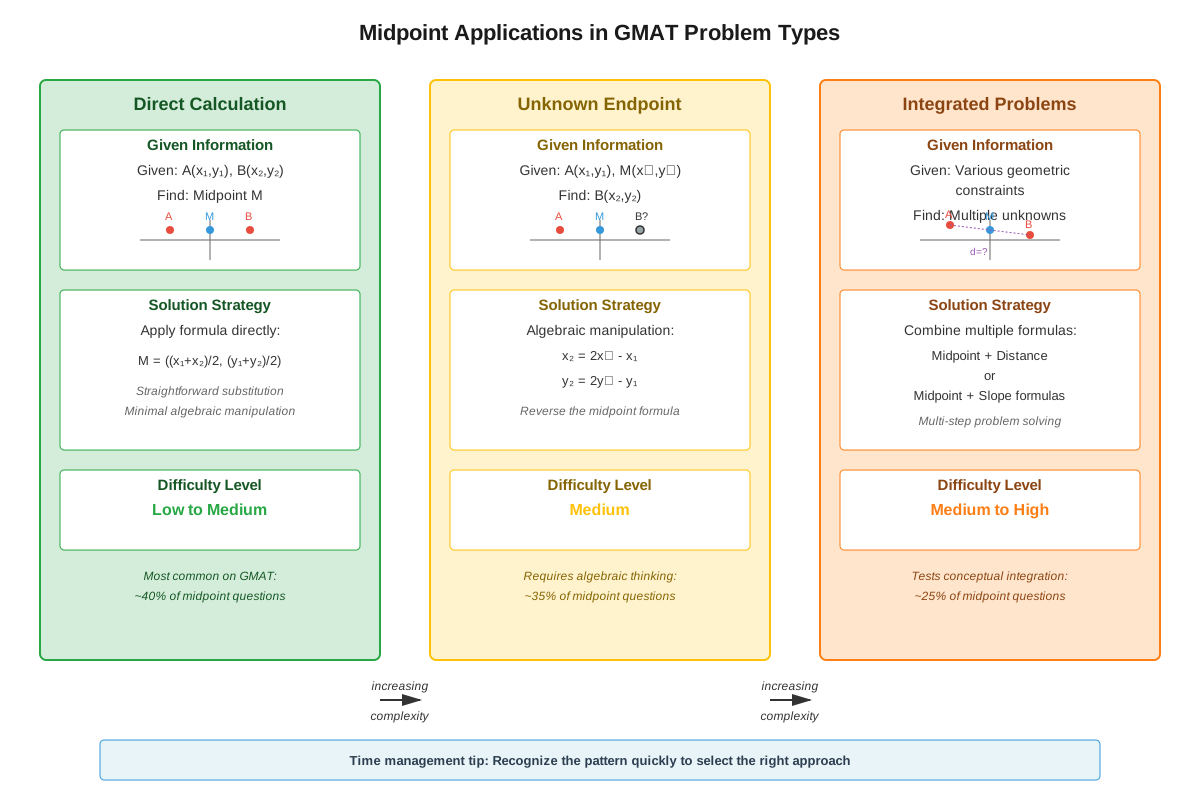
The GMAT presents midpoint concepts in several common formats: direct calculation problems asking for the midpoint coordinates given two endpoints; reverse problems where the midpoint and one endpoint are known and the other endpoint must be found; integrated problems where midpoint calculations combine with distance, slope, or area calculations; and data sufficiency questions testing whether given information is adequate to determine a midpoint. Additionally, midpoint concepts frequently appear in problems involving geometric figures like rectangles, triangles, and circles plotted on coordinate planes, where finding the center or a vertex requires midpoint calculations.
Core Concepts
The Midpoint Formula
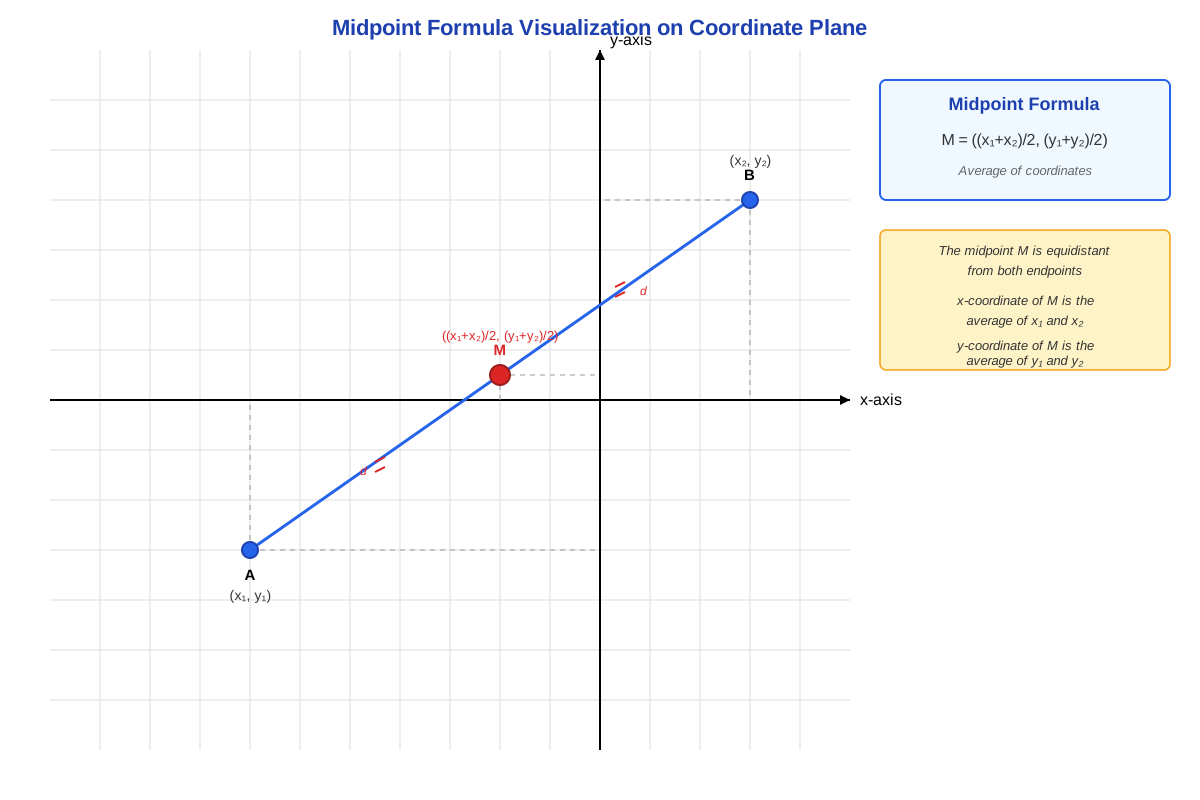
The midpoint of a line segment is the point that lies exactly halfway between the two endpoints, dividing the segment into two equal parts. For a line segment with endpoints at coordinates (x₁, y₁) and (x₂, y₂), the midpoint M has coordinates given by the midpoint formula:
M = ((x₁ + x₂)/2, (y₁ + y₂)/2)This formula works by averaging the x-coordinates of the two endpoints to find the x-coordinate of the midpoint, and averaging the y-coordinates to find the y-coordinate of the midpoint. The averaging process ensures that the midpoint is equidistant from both endpoints.
The logic behind this formula becomes clear when considering a simple example on a number line. If you want to find the midpoint between 2 and 8, you add them (2 + 8 = 10) and divide by 2 (10/2 = 5), giving you 5, which is indeed exactly halfway between 2 and 8. The two-dimensional midpoint formula simply applies this same averaging principle to both the x and y coordinates independently.
Calculating Midpoints: Step-by-Step Process
To find the midpoint between two points, follow this systematic approach:
- Identify the coordinates: Clearly label the coordinates of both endpoints as (x₁, y₁) and (x₂, y₂)
- Calculate the x-coordinate of the midpoint: Add x₁ and x₂, then divide the sum by 2
- Calculate the y-coordinate of the midpoint: Add y₁ and y₂, then divide the sum by 2
- Write the midpoint coordinates: Express the result as an ordered pair (x_mid, y_mid)
- Verify if needed: Check that the midpoint makes geometric sense relative to the original points
For example, to find the midpoint between A(3, 7) and B(11, -1):
- x-coordinate: (3 + 11)/2 = 14/2 = 7
- y-coordinate: (7 + (-1))/2 = 6/2 = 3
- Midpoint M = (7, 3)
Finding Unknown Endpoints
A powerful application of the midpoint concept involves working backward: when you know the midpoint and one endpoint, you can find the other endpoint. This reverse application requires algebraic manipulation of the midpoint formula.
If M(x_m, y_m) is the midpoint between A(x₁, y₁) and unknown point B(x₂, y₂), then:
x_m = (x₁ + x₂)/2  →  x₂ = 2x_m - x₁
y_m = (y₁ + y₂)/2  →  y₂ = 2y_m - y₁
The pattern is straightforward: multiply the midpoint coordinate by 2, then subtract the known endpoint coordinate. This gives you the unknown endpoint coordinate.
For instance, if the midpoint is M(5, 4) and one endpoint is A(2, 7), find endpoint B:
- x₂ = 2(5) - 2 = 10 - 2 = 8
- y₂ = 2(4) - 7 = 8 - 7 = 1
- Therefore, B = (8, 1)
Midpoint Properties and Characteristics
The midpoint possesses several important geometric properties that frequently appear in GMAT questions:
- Equidistance: The midpoint is equidistant from both endpoints, meaning the distance from the midpoint to either endpoint is exactly half the total length of the segment
- Collinearity: The midpoint always lies on the line segment connecting the two endpoints (all three points are collinear)
- Uniqueness: Every line segment has exactly one midpoint
- Symmetry: The midpoint serves as a point of symmetry for the line segment
- Bisection: The midpoint divides the segment into two congruent (equal-length) segments
Midpoint in Three-Dimensional Space
While GMAT questions primarily focus on two-dimensional coordinate geometry, understanding the extension to three dimensions reinforces conceptual mastery. For points (x₁, y₁, z₁) and (x₂, y₂, z₂), the midpoint is:
M = ((x₁ + x₂)/2, (y₁ + y₂)/2, (z₁ + z₂)/2)The principle remains identical: average each coordinate independently.
Integration with Other Geometric Concepts
| Concept | Relationship to Midpoint | GMAT Application |
|---|---|---|
| Distance Formula | Distance from midpoint to either endpoint equals half the segment length | Verifying midpoint calculations; finding segment lengths |
| Slope | Slope from either endpoint to midpoint equals the slope of the entire segment | Confirming collinearity; working with parallel/perpendicular lines |
| Diagonals | Diagonals of parallelograms bisect each other at their midpoint | Rectangle and square problems; quadrilateral properties |
| Circles | Midpoint of a diameter is the circle's center | Circle equation problems; finding radius |
| Triangles | Midpoint of sides connects to form the midsegment | Triangle properties; parallel line problems |
Special Cases and Edge Conditions
Several special scenarios deserve attention:
Horizontal segments: When y₁ = y₂, the midpoint has the same y-coordinate as both endpoints, and only the x-coordinate needs averaging.
Vertical segments: When x₁ = x₂, the midpoint has the same x-coordinate as both endpoints, and only the y-coordinate needs averaging.
Segments through the origin: When one endpoint is at the origin (0, 0), the midpoint coordinates are simply half the coordinates of the other endpoint.
Negative coordinates: The midpoint formula works identically with negative numbers; careful attention to signs during addition is essential.
Concept Relationships
The midpoint concept serves as a central hub connecting multiple geometric and algebraic ideas. The foundational relationship begins with coordinate geometry → which enables → point location → which leads to → midpoint calculation → which connects to → distance and length calculations.
The midpoint formula itself derives from the more general concept of weighted averages, where the midpoint represents the special case of equal weighting (50-50 split). This connects midpoint to broader algebraic thinking about averages and means. When students understand that the midpoint is simply the arithmetic mean of coordinates, they can extend this thinking to find points that divide segments in other ratios.
The relationship between midpoint and distance is particularly important: the distance from the midpoint to either endpoint equals exactly half the total segment length. This relationship allows students to verify their midpoint calculations and solve problems that integrate both concepts. Similarly, slope calculations connect to midpoint through collinearity—the slope from one endpoint to the midpoint must equal the slope from the midpoint to the other endpoint.
In polygon geometry, midpoint concepts extend to quadrilateral properties, particularly the fact that the diagonals of parallelograms, rectangles, and squares bisect each other. This means their intersection point is the midpoint of both diagonals. For circles, the midpoint of any diameter is the center, creating a direct link between midpoint calculations and circle equations.
The midpoint also connects forward to more advanced topics like geometric transformations, where midpoints help identify centers of rotation and reflection, and optimization problems, where midpoints often represent optimal locations or balance points.
High-Yield Facts
⭐ The midpoint formula is M = ((x₁ + x₂)/2, (y₁ + y₂)/2), which averages the x-coordinates and y-coordinates independently.
⭐ To find an unknown endpoint when given the midpoint and one endpoint, use: x₂ = 2x_m - x₁ and y₂ = 2y_m - y₁.
⭐ The midpoint is always equidistant from both endpoints, with each distance equal to half the total segment length.
⭐ The diagonals of a parallelogram, rectangle, or square bisect each other, meaning they intersect at their mutual midpoint.
⭐ The midpoint of a circle's diameter is the center of the circle.
- The midpoint always lies on the line segment connecting the two endpoints (collinearity property).
- Every line segment has exactly one unique midpoint.
- The slope from either endpoint to the midpoint equals the slope of the entire segment.
- When one endpoint is the origin (0, 0), the midpoint coordinates are simply half the other endpoint's coordinates.
- Midpoint calculations work identically with negative coordinates; careful sign management is essential.
- The midpoint divides a segment into two congruent (equal-length) parts.
- In data sufficiency questions, you need both coordinates of both endpoints (four values total) to determine a unique midpoint.
- The midsegment of a triangle (connecting midpoints of two sides) is parallel to the third side and half its length.
- Midpoint problems often combine with distance formula questions, requiring both formulas in sequence.
- The x-coordinate and y-coordinate of a midpoint can be calculated independently of each other.
Quick check — test yourself on Midpoint so far.
Try Flashcards →Common Misconceptions
Misconception: The midpoint formula requires subtracting coordinates before dividing by 2.
Correction: The midpoint formula requires adding (not subtracting) the corresponding coordinates, then dividing by 2. Subtraction is used in the distance formula, not the midpoint formula. The midpoint averages positions, while distance measures separation.
Misconception: When finding an unknown endpoint, you divide the midpoint coordinates by 2.
Correction: To find an unknown endpoint, you multiply the midpoint coordinate by 2, then subtract the known endpoint coordinate. The formula is x₂ = 2x_m - x₁, not x₂ = x_m/2. This reverses the averaging process.
Misconception: The midpoint must have integer coordinates if both endpoints have integer coordinates.
Correction: The midpoint can have fractional coordinates even when both endpoints are integers. For example, the midpoint of (1, 3) and (4, 6) is (2.5, 4.5). The sum of two odd numbers or two numbers with different parities produces a non-integer when divided by 2.
Misconception: The order of the endpoints matters when calculating the midpoint.
Correction: The midpoint formula is commutative—it produces the same result regardless of which point you label as (x₁, y₁) and which as (x₂, y₂). Addition is commutative, so (x₁ + x₂)/2 = (x₂ + x₁)/2.
Misconception: The midpoint is always closer to the origin than both endpoints.
Correction: The midpoint's distance from the origin depends on the positions of the endpoints. If both endpoints are far from the origin in the same direction, the midpoint will also be far from the origin. The midpoint is only guaranteed to be between the two endpoints, not necessarily closer to the origin.
Misconception: You can find a midpoint with only one endpoint and the segment length.
Correction: Knowing one endpoint and the segment length is insufficient to determine a unique midpoint because infinitely many segments of that length can extend from the given endpoint in different directions. You need either both endpoints or one endpoint plus the midpoint itself.
Misconception: The midpoint formula only works for segments in the first quadrant.
Correction: The midpoint formula works for points in any quadrant and with any combination of positive and negative coordinates. The averaging principle applies universally across the entire coordinate plane.
Worked Examples
Example 1: Direct Midpoint Calculation with Application
Problem: Point A is located at coordinates (-3, 8) and point B is located at coordinates (5, -2). Point M is the midpoint of segment AB. What is the distance from point M to the origin?
Solution:
Step 1: Find the midpoint M using the midpoint formula.
- x-coordinate of M: (x₁ + x₂)/2 = (-3 + 5)/2 = 2/2 = 1
- y-coordinate of M: (y₁ + y₂)/2 = (8 + (-2))/2 = 6/2 = 3
- Therefore, M = (1, 3)
Step 2: Calculate the distance from M(1, 3) to the origin O(0, 0) using the distance formula.
- Distance = √[(x₂ - x₁)² + (y₂ - y₁)²]
- Distance = √[(1 - 0)² + (3 - 0)²]
- Distance = √[1² + 3²]
- Distance = √[1 + 9]
- Distance = √10
Answer: The distance from the midpoint to the origin is √10 (approximately 3.16 units).
Connection to Learning Objectives: This problem demonstrates the application of the midpoint formula (Objective 3) and integrates midpoint calculations with the distance formula (Objective 6), showing how midpoint problems often require multiple geometric concepts.
Example 2: Finding an Unknown Endpoint
Problem: The midpoint of segment PQ is M(4, -1). If point P has coordinates (7, 5), what are the coordinates of point Q?
Solution:
Step 1: Identify what we know and what we need to find.
- Known: M(4, -1) is the midpoint, P(7, 5) is one endpoint
- Unknown: Q(x₂, y₂) is the other endpoint
Step 2: Use the reverse midpoint formula to find the x-coordinate of Q.
- The midpoint formula states: x_m = (x₁ + x₂)/2
- Rearranging: x₂ = 2x_m - x₁
- Substituting: x₂ = 2(4) - 7 = 8 - 7 = 1
Step 3: Use the reverse midpoint formula to find the y-coordinate of Q.
- The midpoint formula states: y_m = (y₁ + y₂)/2
- Rearranging: y₂ = 2y_m - y₁
- Substituting: y₂ = 2(-1) - 5 = -2 - 5 = -7
Step 4: Write the coordinates of point Q.
- Q = (1, -7)
Step 5: Verify the answer by checking that M is indeed the midpoint of P and Q.
- x-coordinate check: (7 + 1)/2 = 8/2 = 4 ✓
- y-coordinate check: (5 + (-7))/2 = -2/2 = -1 ✓
Answer: Point Q has coordinates (1, -7).
Connection to Learning Objectives: This problem addresses Objective 5 (calculating unknown endpoints) and demonstrates the algebraic manipulation required to work backward from the midpoint formula, a common GMAT question type that tests deeper understanding beyond simple formula application.
Example 3: Data Sufficiency with Midpoint
Problem: What is the x-coordinate of the midpoint of segment RS?
Statement (1): Point R has coordinates (2, 6) and point S has coordinates (x, 10).
Statement (2): The y-coordinate of the midpoint of RS is 8.
Solution:
Analyze Statement (1):
- We know R = (2, 6) and S = (x, 10)
- The x-coordinate of the midpoint would be (2 + x)/2
- However, we don't know the value of x, so we cannot determine a specific numerical value for the x-coordinate of the midpoint
- Statement (1) alone is INSUFFICIENT
Analyze Statement (2):
- The y-coordinate of the midpoint is 8
- This tells us that (y₁ + y₂)/2 = 8, so y₁ + y₂ = 16
- However, this gives us no information about the x-coordinates of either endpoint
- Statement (2) alone is INSUFFICIENT
Analyze Both Statements Together:
- From Statement (1): R = (2, 6) and S = (x, 10)
- From Statement (2): The y-coordinate of the midpoint is 8
- Check: (6 + 10)/2 = 16/2 = 8 ✓ (This confirms consistency but doesn't help find x)
- We still don't know the value of x, so we cannot determine the x-coordinate of the midpoint
- Both statements together are INSUFFICIENT
Answer: E (Statements (1) and (2) together are not sufficient)
Connection to Learning Objectives: This example demonstrates Objective 4 (using midpoint concepts in data sufficiency questions) and shows how the GMAT tests conceptual understanding by requiring students to recognize what information is necessary to determine a midpoint coordinate.
Exam Strategy
When approaching GMAT midpoint questions, begin by quickly identifying what information is given and what is being asked. Draw a quick sketch if the problem involves multiple points or geometric figures—visualization often reveals relationships that aren't immediately obvious from coordinates alone. This is especially valuable for problems involving rectangles, triangles, or other polygons where midpoints of sides or diagonals play a role.
Trigger words and phrases to watch for include: "midpoint," "halfway between," "center of the segment," "bisects," "divides equally," "equidistant from both endpoints," and "the point that divides the segment into two equal parts." In data sufficiency questions, phrases like "the diagonals intersect" or "the center of the rectangle" implicitly reference midpoint concepts.
For problem-solving questions, follow this systematic approach:
- Write down the midpoint formula at the top of your scratch paper if you're not completely confident
- Clearly label all given coordinates
- Identify whether you're finding a midpoint (forward application) or an endpoint (reverse application)
- Perform calculations carefully, paying special attention to negative signs
- If time permits, verify your answer by checking that the midpoint is equidistant from both endpoints
For data sufficiency questions, remember that to find a unique midpoint, you need complete information about both endpoints (four coordinate values total). Consider whether the given statements provide this information directly or allow you to derive it. Be alert for problems where geometric properties (like diagonals bisecting each other) provide implicit midpoint information.
Process-of-elimination tips: If answer choices include coordinates, eliminate any that don't fall between the given endpoints in both x and y directions (unless the problem involves finding an endpoint rather than a midpoint). For numerical answers involving midpoint calculations, eliminate choices that aren't the average of the given coordinates. If you're finding an unknown endpoint and the answer choices are far from twice the midpoint minus the known endpoint, those can be eliminated.
Time allocation: Standard midpoint problems should take 1.5-2 minutes. If a problem combines midpoint with other concepts (distance, slope, area), allocate 2-2.5 minutes. Don't spend more than 2.5 minutes on any single midpoint question—if you're stuck, make an educated guess and move on. The midpoint formula itself is quick to apply; most time should go to careful arithmetic and verification.
Memory Techniques
Mnemonic for the Midpoint Formula: "Midpoint Means Middle—Add and Average" reminds you that the midpoint is found by adding coordinates and averaging (dividing by 2). The three M's emphasize that midpoint, means (average), and middle are all connected concepts.
Visualization Strategy: Picture a seesaw or balance beam with the two endpoints as the ends and the midpoint as the fulcrum in the exact center. This physical image reinforces that the midpoint is equidistant from both ends and represents perfect balance. When you need to find an unknown endpoint, imagine the seesaw tipping—if you know where the center (midpoint) is and where one end is, you can figure out where the other end must be to maintain balance.
Acronym for Reverse Midpoint: "TME" stands for "Twice the Midpoint minus the Endpoint" to remember the formula for finding an unknown endpoint: x₂ = 2x_m - x₁. Think "TIME" without the I to recall this reverse process.
Coordinate Separation Technique: Remember that x and y coordinates are completely independent in midpoint calculations—you can solve for the x-coordinate of the midpoint without even looking at the y-coordinates, and vice versa. Visualize two separate number lines (one horizontal for x, one vertical for y) to reinforce this independence.
The "Half-Sum" Shortcut: Instead of thinking "add then divide by 2," you can think "half of the sum," which is mathematically identical but sometimes easier to compute mentally. For example, the midpoint x-coordinate between 3 and 11 is "half of 14" rather than "3 plus 11 divided by 2"—both give 7, but one might be faster depending on the numbers involved.
Summary
The midpoint concept is a high-yield GMAT topic that combines coordinate geometry with algebraic reasoning. The fundamental midpoint formula, M = ((x₁ + x₂)/2, (y₁ + y₂)/2), finds the point exactly halfway between two endpoints by averaging their x-coordinates and y-coordinates independently. This formula can be applied forward to find midpoints or reversed to find unknown endpoints using x₂ = 2x_m - x₁. The midpoint possesses key properties including equidistance from both endpoints, collinearity with the segment, and uniqueness. On the GMAT, midpoint questions appear in both problem-solving and data sufficiency formats, often integrated with other geometric concepts like distance, slope, and polygon properties. Success requires not just memorizing the formula but understanding when and how to apply it, recognizing implicit midpoint relationships in geometric figures, and carefully managing arithmetic with both positive and negative coordinates. Mastery of midpoint concepts provides essential foundation for advanced coordinate geometry problems and demonstrates the quantitative reasoning skills that distinguish top GMAT performers.
Key Takeaways
- The midpoint formula M = ((x₁ + x₂)/2, (y₁ + y₂)/2) averages coordinates independently to find the exact center point between two endpoints
- To find an unknown endpoint when given the midpoint and one endpoint, use the reverse formula: x₂ = 2x_m - x₁ and y₂ = 2y_m - y₁
- The midpoint is always equidistant from both endpoints, with each distance equal to half the total segment length
- Midpoint calculations work identically with negative coordinates; careful attention to signs during addition is critical
- In geometric figures, diagonals of parallelograms bisect each other at their midpoint, and the midpoint of a circle's diameter is its center
- GMAT midpoint questions frequently integrate with distance, slope, and area calculations, requiring multi-step problem-solving
- For data sufficiency questions, determining a unique midpoint requires complete information about both endpoints (four coordinate values)
Related Topics
Distance Formula: Building on midpoint concepts, the distance formula calculates the length of a segment between two points. Mastering midpoint enables you to verify that the distance from the midpoint to each endpoint is half the total length, and many GMAT problems require both formulas in sequence.
Slope and Linear Equations: The slope of a line segment remains constant throughout its length, including at the midpoint. Understanding midpoint helps solve problems involving parallel and perpendicular lines, as well as verifying collinearity of points.
Circles in the Coordinate Plane: The center of a circle is the midpoint of any diameter, making midpoint calculations essential for deriving circle equations and solving problems involving tangent lines, chords, and arc lengths.
Polygon Properties: Midpoints of polygon sides create important relationships, such as the midsegment of a triangle being parallel to the third side and half its length. Advanced polygon problems often require finding multiple midpoints to establish these relationships.
Geometric Transformations: Reflections, rotations, and translations often involve midpoint calculations to identify centers of symmetry and verify that transformations preserve distance relationships.
Practice CTA
Now that you've mastered the core concepts of midpoint calculations, it's time to solidify your understanding through practice. Attempt the practice questions to test your ability to apply the midpoint formula in various contexts, work backward to find unknown endpoints, and integrate midpoint concepts with other geometric principles. Use the flashcards to reinforce the key formulas and properties until they become second nature. Remember, the difference between understanding a concept and mastering it for the GMAT lies in repeated, focused practice. Each problem you solve builds the pattern recognition and computational confidence you need to tackle midpoint questions quickly and accurately on test day. You've got this—start practicing now!
Sign up free to keep reading
Create a free AnvayaPrep account to finish this GMAT guide on Midpoint — plus flashcards and practice questions.