Overview
Geometry problem solving represents one of the most critical and frequently tested areas within the GMAT Quantitative Reasoning section. Unlike pure computational geometry questions that test formula recall, GMAT geometry problem solving requires students to synthesize multiple geometric principles, apply spatial reasoning, and often combine algebraic techniques with geometric insights to arrive at solutions. These problems typically present complex scenarios involving multiple shapes, require multi-step reasoning, and test the ability to identify which geometric properties and relationships are relevant to finding the solution.
The GMAT tests geometry problem solving through questions that demand more than memorization—they require analytical thinking, pattern recognition, and the ability to break down complex figures into manageable components. Students must navigate problems involving coordinate geometry, properties of polygons, circles, three-dimensional figures, and the relationships between angles, areas, perimeters, and volumes. Success in this area directly correlates with overall Quantitative Reasoning performance, as approximately 15-20% of GMAT quant questions involve geometric concepts, with the majority requiring problem-solving rather than straightforward calculation.
Within the broader Quantitative Reasoning framework, geometry problem solving serves as a bridge between pure mathematical computation and logical reasoning. It connects algebraic manipulation with spatial visualization, requiring students to translate visual information into equations and vice versa. Mastery of this topic enhances performance not only on explicit geometry questions but also on data sufficiency problems, word problems with geometric contexts, and integrated reasoning questions that combine multiple quantitative skills.
Learning Objectives
- [ ] Identify geometry problem solving scenarios and recognize which geometric principles apply
- [ ] Explain the logical steps and reasoning process required to solve complex geometry problems
- [ ] Apply geometry problem solving strategies to GMAT questions efficiently and accurately
- [ ] Synthesize multiple geometric concepts within a single problem to determine solutions
- [ ] Evaluate data sufficiency in geometric contexts by determining what information is necessary and sufficient
- [ ] Construct auxiliary lines, labels, and diagrams to clarify problem structure and reveal solution paths
Prerequisites
- Basic geometric formulas: Understanding area, perimeter, circumference, and volume formulas is essential as these form the computational foundation for problem solving
- Properties of triangles, quadrilaterals, and circles: Knowledge of angle relationships, special triangles (30-60-90, 45-45-90), and circle theorems enables recognition of problem patterns
- Coordinate geometry fundamentals: Familiarity with the coordinate plane, distance formula, and slope concepts allows translation between algebraic and geometric representations
- Algebraic manipulation: Ability to set up and solve equations is necessary since geometry problems often require algebraic solutions
- Ratio and proportion: Many geometric relationships involve proportional reasoning, particularly in similar figures and scale problems
Why This Topic Matters
Geometry problem solving extends far beyond the GMAT exam room into real-world applications across architecture, engineering, computer graphics, navigation, and spatial planning. The analytical skills developed through geometric reasoning—breaking complex problems into components, visualizing relationships, and applying systematic approaches—transfer directly to business analytics, strategic planning, and logical decision-making in management contexts.
On the GMAT specifically, geometry questions appear in approximately 4-6 questions per exam (out of 31 Quantitative Reasoning questions), representing roughly 15-20% of the quant section. These questions span both problem-solving and data sufficiency formats, with data sufficiency geometry questions often proving particularly challenging due to the need to determine what information is necessary without actually solving completely. Geometry problems frequently appear at medium to high difficulty levels, making them critical for students targeting scores above the 70th percentile.
Common manifestations of geometry problem solving on the GMAT include: coordinate geometry problems requiring distance or slope calculations; area and perimeter problems involving composite figures; circle problems combining radius, diameter, arc length, and sector area; three-dimensional problems involving surface area and volume; problems requiring recognition of similar triangles or proportional relationships; angle problems in complex polygon configurations; and optimization problems asking for maximum or minimum values of geometric quantities. The GMAT particularly favors problems that require insight rather than lengthy calculation, rewarding students who can identify elegant solution paths through geometric properties and relationships.
Core Concepts
Problem-Solving Framework
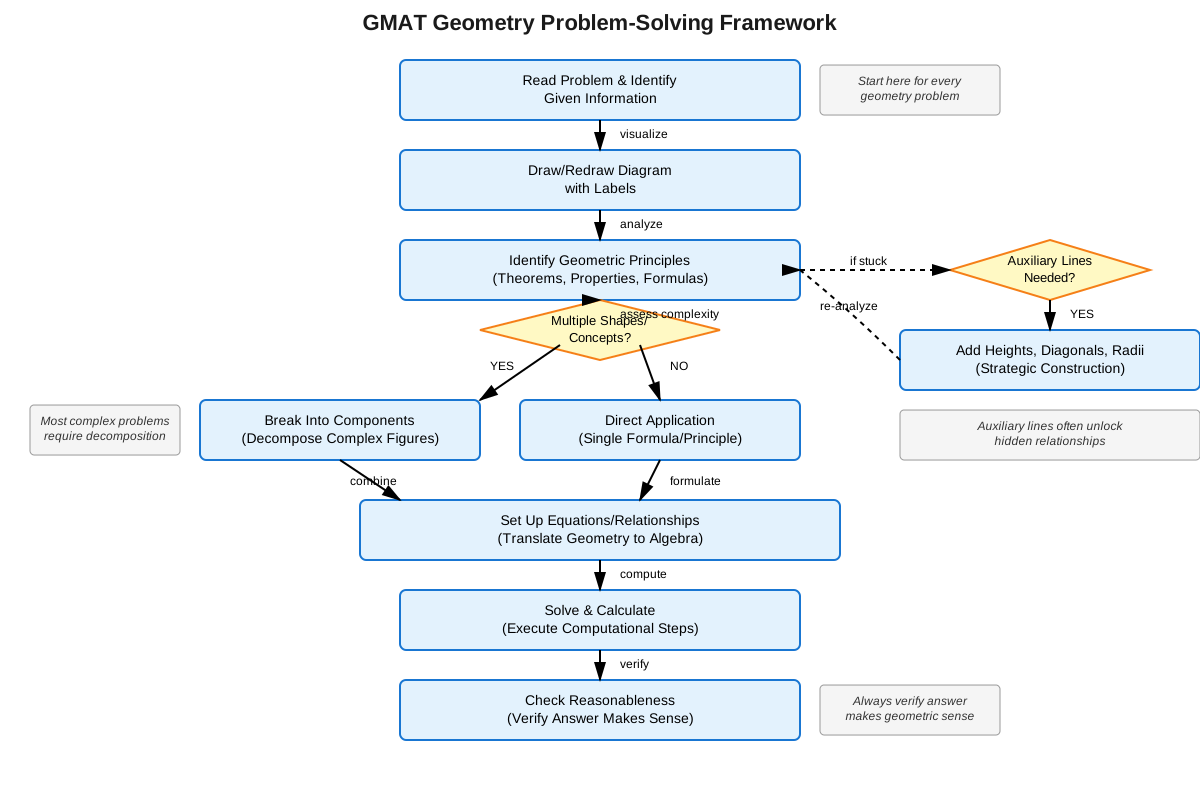
The foundation of successful geometry problem solving lies in adopting a systematic approach rather than attempting to immediately calculate. The GMAT rewards strategic thinking, and geometry problems particularly benefit from a structured methodology:
- Visualize and diagram: Draw or redraw the figure, adding all given information clearly
- Identify what's given and what's needed: List known values and the target quantity
- Recognize relevant properties: Determine which geometric principles apply
- Plan the solution path: Identify intermediate steps needed to reach the answer
- Execute with precision: Perform calculations carefully, checking reasonableness
- Verify the answer: Ensure the solution makes geometric sense
This framework prevents the common pitfall of rushing into calculations without understanding the problem structure, which often leads to wasted time and incorrect answers.
Composite Figures and Area Decomposition
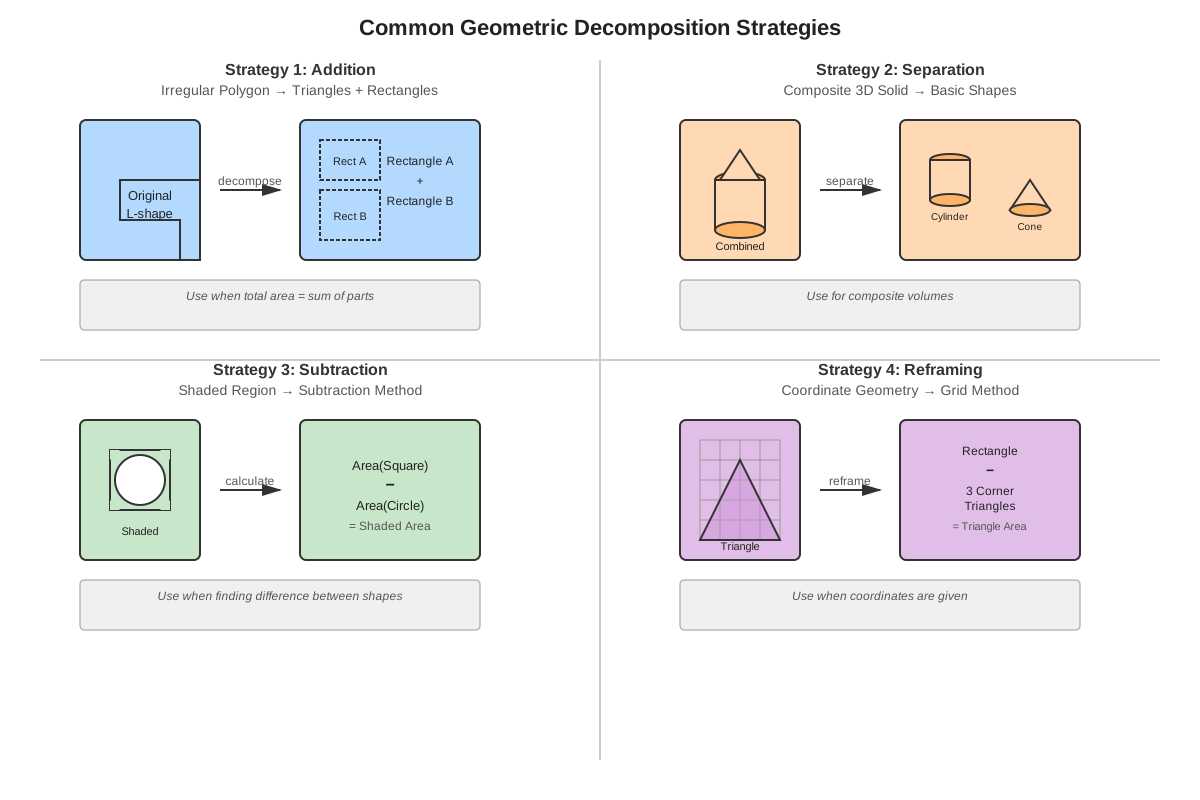
Many GMAT geometry problems involve composite figures—shapes formed by combining or subtracting basic geometric shapes. The key strategy involves decomposing complex figures into familiar components:
Addition approach: Break the figure into non-overlapping basic shapes (rectangles, triangles, circles), calculate each area separately, then sum the results.
Subtraction approach: Identify a larger containing shape, then subtract the areas of regions not included in the target figure.
For example, finding the area of a figure formed by a rectangle with a semicircular section removed requires calculating the rectangle's area and subtracting the semicircle's area. The choice between addition and subtraction often depends on which approach minimizes calculation steps.
Coordinate Geometry Integration
Coordinate geometry problems require translating between algebraic equations and geometric representations. Key concepts include:
- Distance formula: The distance between points (x₁, y₁) and (x₂, y₂) equals √[(x₂-x₁)² + (y₂-y₁)²]
- Midpoint formula: The midpoint of a segment has coordinates ((x₁+x₂)/2, (y₁+y₂)/2)
- Slope relationships: Parallel lines have equal slopes; perpendicular lines have slopes that are negative reciprocals
- Area using coordinates: For triangles with vertices at known coordinates, use the formula or decomposition methods
GMAT problems often embed geometric relationships within coordinate systems, requiring students to recognize when distance, slope, or midpoint calculations reveal the solution path.
Similar Figures and Proportional Reasoning
Similar figures maintain the same shape but differ in size, with all corresponding angles equal and all corresponding sides proportional. This concept appears frequently in GMAT problems involving:
- Triangles with parallel lines creating similar sub-triangles
- Scale factors relating dimensions of similar figures
- Area and volume relationships in similar figures (areas scale with the square of the linear scale factor; volumes scale with the cube)
When two triangles are similar with a scale factor of k, their corresponding sides have ratio k:1, their areas have ratio k²:1, and if they were three-dimensional, their volumes would have ratio k³:1.
Circle Properties and Relationships
Circle problems on the GMAT test understanding of multiple related concepts:
| Circle Element | Formula | Relationship |
|---|---|---|
| Radius | r | Fundamental measure |
| Diameter | d = 2r | Twice the radius |
| Circumference | C = 2πr = πd | Perimeter of circle |
| Area | A = πr² | Interior region |
| Arc length | L = (θ/360°) × 2πr | Portion of circumference |
| Sector area | A = (θ/360°) × πr² | Portion of total area |
Problems often require recognizing that inscribed angles, central angles, and arc measures relate systematically, or that tangent lines form right angles with radii at the point of tangency.
Triangle Problem-Solving Techniques
Triangles appear in more GMAT geometry problems than any other shape. Essential problem-solving techniques include:
Special right triangles: Recognizing 30-60-90 triangles (sides in ratio 1:√3:2) and 45-45-90 triangles (sides in ratio 1:1:√2) allows immediate determination of unknown sides without using the Pythagorean theorem.
Pythagorean theorem applications: For right triangles, a² + b² = c² connects the three sides, enabling calculation of any side given the other two.
Area calculations: Multiple formulas exist (½ × base × height, Heron's formula for three sides, ½ab sin C for two sides and included angle), and choosing the most efficient method saves time.
Angle relationships: The sum of interior angles equals 180°, exterior angles equal the sum of remote interior angles, and in isosceles triangles, equal sides opposite equal angles.
Three-Dimensional Geometry
Three-dimensional problems test spatial visualization and understanding of surface area and volume relationships:
Rectangular solids: Volume = length × width × height; Surface area = 2(lw + lh + wh)
Cylinders: Volume = πr²h; Surface area = 2πr² + 2πrh (two circular bases plus lateral surface)
Cubes: Special case of rectangular solid where all edges equal s; Volume = s³; Surface area = 6s²
GMAT problems often involve finding dimensions given volume or surface area, or determining how changes in dimensions affect these quantities. Understanding that volume scales with the cube of linear dimensions while surface area scales with the square is crucial.
Angle Relationships in Complex Figures
Problems involving multiple intersecting lines, parallel lines cut by transversals, or polygons require systematic application of angle relationships:
- Vertical angles are equal
- Supplementary angles sum to 180°
- Complementary angles sum to 90°
- Alternate interior angles are equal when parallel lines are cut by a transversal
- Corresponding angles are equal when parallel lines are cut by a transversal
- Interior angles of an n-sided polygon sum to (n-2) × 180°
Recognizing these relationships allows determination of unknown angles through chains of logical deductions.
Optimization and Constraint Problems
Some GMAT geometry problems ask for maximum or minimum values subject to constraints. These require understanding how geometric quantities relate:
- For a fixed perimeter, the circle encloses maximum area
- For a fixed area, the circle has minimum perimeter
- Among rectangles with fixed perimeter, the square has maximum area
- Among rectangles with fixed area, the square has minimum perimeter
These problems test conceptual understanding rather than computation, rewarding students who recognize the underlying principles.
Concept Relationships
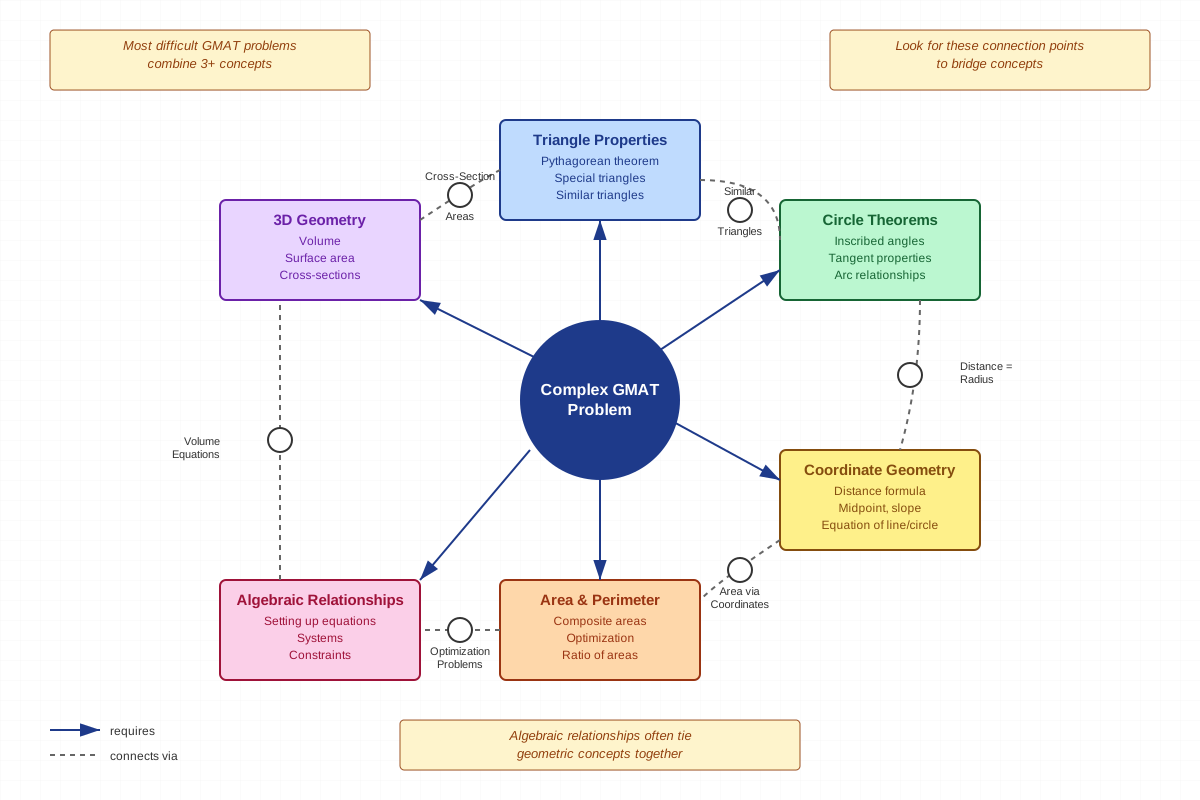
The concepts within geometry problem solving form an interconnected web where mastery of one area enhances understanding of others. The problem-solving framework serves as the overarching methodology that guides application of all other concepts—it's the strategic lens through which students approach every geometry question.
Composite figures connect directly to area decomposition strategies, which in turn require solid knowledge of basic shape formulas (prerequisite knowledge). When composite figures appear in coordinate geometry contexts, students must integrate distance and area calculation methods. The relationship flows: Basic formulas → Composite figure recognition → Strategic decomposition → Coordinate integration.
Similar figures and proportional reasoning underpin many advanced geometry problems, connecting to triangle problem-solving (similar triangles), circle properties (proportional arc lengths and areas), and three-dimensional geometry (scale factors affecting volume and surface area). This concept acts as a multiplier, appearing across multiple geometric contexts.
Circle properties often combine with angle relationships (inscribed angles, central angles) and coordinate geometry (equations of circles, tangent lines). Understanding one circle property frequently unlocks others through logical chains: radius → diameter → circumference → area → sector calculations.
Triangle techniques serve as building blocks for more complex problems, as many polygons can be decomposed into triangles, and three-dimensional figures often involve triangular faces or cross-sections. The relationship map shows: Triangle properties → Polygon decomposition → 3D figure analysis.
Optimization problems synthesize multiple concepts, requiring understanding of how perimeter relates to area, how dimensions affect volume and surface area, and how constraints limit possible solutions. These represent the highest level of geometric reasoning, integrating nearly all other concepts.
Quick check — test yourself on Geometry problem solving so far.
Try Flashcards →High-Yield Facts
⭐ The area of a triangle can be calculated as ½ × base × height, where the height must be perpendicular to the chosen base
⭐ In a 30-60-90 triangle, the sides are in the ratio 1:√3:2 (opposite the 30°, 60°, and 90° angles respectively)
⭐ The area of a circle is πr², and the circumference is 2πr or πd, where r is radius and d is diameter
⭐ When two parallel lines are cut by a transversal, alternate interior angles are equal and corresponding angles are equal
⭐ The sum of interior angles in any polygon equals (n-2) × 180°, where n is the number of sides
- In a 45-45-90 triangle, the sides are in the ratio 1:1:√2 (the two legs are equal, and the hypotenuse is √2 times each leg)
- The distance between two points (x₁, y₁) and (x₂, y₂) in the coordinate plane is √[(x₂-x₁)² + (y₂-y₁)²]
- When figures are similar with scale factor k, their areas are related by k² and their volumes by k³
- A tangent line to a circle is perpendicular to the radius at the point of tangency
- The diagonal of a rectangle with sides a and b has length √(a² + b²)
- The area of a sector with central angle θ (in degrees) is (θ/360°) × πr²
- The volume of a rectangular solid is length × width × height, and its surface area is 2(lw + lh + wh)
- An inscribed angle in a circle is half the measure of the central angle subtending the same arc
- The perimeter of a rectangle is 2(length + width), and for a square with side s, it's 4s
- Vertical angles formed by two intersecting lines are always equal
Common Misconceptions
Misconception: The height of a triangle is always one of its sides → Correction: The height must be perpendicular to the base and may fall outside the triangle (in obtuse triangles) or be a side only in right triangles where it's perpendicular to the base.
Misconception: Doubling the radius of a circle doubles its area → Correction: Since area equals πr², doubling the radius multiplies the area by 4 (2² = 4). Linear dimensions and area scale differently—area scales with the square of linear changes.
Misconception: In coordinate geometry, the distance between points can be found by simply subtracting coordinates → Correction: Distance requires the distance formula √[(x₂-x₁)² + (y₂-y₁)²], accounting for both horizontal and vertical separation. Simply subtracting gives only one-dimensional distance.
Misconception: All angles in a diagram are drawn to scale and can be estimated visually → Correction: GMAT explicitly states "figures not drawn to scale" on many problems. Never assume angle measures or relative lengths from appearance—use only given information and geometric properties.
Misconception: The diagonal of a square with side s has length 2s → Correction: The diagonal of a square with side s has length s√2, derived from the Pythagorean theorem (s² + s² = d², so d = s√2). This is a 45-45-90 triangle relationship.
Misconception: Perimeter and area change proportionally → Correction: Perimeter is a linear measure while area is two-dimensional. A shape can have the same perimeter as another but different area (e.g., a long thin rectangle vs. a square with the same perimeter).
Misconception: In similar triangles, if the scale factor is k, all measurements scale by k → Correction: Linear measurements (sides, heights, perimeters) scale by k, but areas scale by k², and volumes (if extended to 3D) scale by k³. Different types of measurements scale differently.
Misconception: The longest side of a triangle is always opposite the largest angle, so any side can be the hypotenuse → Correction: While the longest side is opposite the largest angle, the term "hypotenuse" specifically refers to the side opposite the right angle in a right triangle. Not all triangles have a hypotenuse.
Worked Examples
Example 1: Composite Figure with Coordinate Geometry
Problem: In the coordinate plane, a figure is formed by a rectangle with vertices at (0,0), (6,0), (6,4), and (0,4), with a semicircle removed from the top side. The semicircle has its diameter along the top side of the rectangle from (1,4) to (5,4). What is the area of the resulting figure?
Solution:
Step 1 - Identify the approach: This is a composite figure requiring subtraction—we'll find the rectangle's area and subtract the semicircle's area.
Step 2 - Calculate rectangle area:
- Length = 6, Width = 4
- Area of rectangle = 6 × 4 = 24 square units
Step 3 - Determine semicircle dimensions:
- Diameter extends from (1,4) to (5,4)
- Diameter length = 5 - 1 = 4 units
- Radius = 4/2 = 2 units
Step 4 - Calculate semicircle area:
- Full circle area = πr² = π(2)² = 4π
- Semicircle area = 4π/2 = 2π square units
Step 5 - Find final area:
- Area of figure = Rectangle area - Semicircle area
- Area = 24 - 2π square units
Connection to learning objectives: This problem requires identifying the problem type (composite figure), explaining the solution strategy (subtraction method), and applying coordinate geometry to determine dimensions.
Example 2: Similar Triangles with Proportional Reasoning
Problem: Triangle ABC has sides AB = 12, BC = 16, and AC = 20. A line parallel to BC intersects AB at point D and AC at point E, with AD = 3. What is the length of DE?
Solution:
Step 1 - Recognize the setup: A line parallel to one side of a triangle creates a similar triangle. Triangle ADE is similar to triangle ABC.
Step 2 - Verify this is a right triangle:
- Check if 12² + 16² = 20²
- 144 + 256 = 400 ✓
- This is a right triangle (useful context, though not required for this problem)
Step 3 - Determine the scale factor:
- AD/AB = 3/12 = 1/4
- Since the triangles are similar, all corresponding sides have the same ratio
Step 4 - Calculate DE:
- DE corresponds to BC in the larger triangle
- DE/BC = 1/4
- DE/16 = 1/4
- DE = 16/4 = 4
Step 5 - Verify reasonableness:
- The smaller triangle has sides 1/4 the length of the larger triangle
- AD = 3 (which is 1/4 of 12) ✓
- DE = 4 (which is 1/4 of 16) ✓
- AE should be 5 (which is 1/4 of 20) ✓
Answer: DE = 4
Connection to learning objectives: This demonstrates identifying similar triangles, explaining the proportional relationships, and applying the scale factor concept systematically. It also shows how recognizing special triangles (3-4-5 scaled by 4) can provide verification, though the solution doesn't depend on this recognition.
Exam Strategy
Primary Strategy: Always begin by drawing or redrawing the figure with all given information clearly labeled. The GMAT often provides figures that are intentionally not to scale or omits figures entirely to test whether students can accurately visualize the problem.
Trigger words and phrases to recognize:
- "Not drawn to scale" → Do not trust visual appearance; rely only on given information
- "Inscribed" → Look for right angles (inscribed in semicircle) or angle-arc relationships
- "Tangent" → Expect perpendicular relationships with radii
- "Similar" or "parallel" → Anticipate proportional reasoning
- "Maximum" or "minimum" → Consider optimization principles or extreme cases
- "Perimeter is" → May need to work backwards from perimeter to find dimensions
Process of elimination techniques:
- Eliminate based on units: If the question asks for area, eliminate answers with linear units; if asking for length, eliminate squared units
- Use estimation: Even when figures aren't to scale, rough magnitude estimates can eliminate unreasonable answers
- Test extreme cases: If a variable can be very small or very large, test what happens to the answer in these cases
- Check answer reasonableness: A triangle's area cannot exceed half the product of its two longest sides; a circle's area cannot be less than the square of its radius
Time allocation guidance:
- Simple geometry problems (single shape, one calculation): Target 1-1.5 minutes
- Medium complexity (composite figures, two-step solutions): Allocate 2 minutes
- Complex problems (multiple concepts, data sufficiency with geometric reasoning): Allow 2-2.5 minutes
- If a problem requires more than 3 minutes, consider whether you're missing an insight that would simplify the solution—look for special triangles, similar figures, or elegant geometric properties
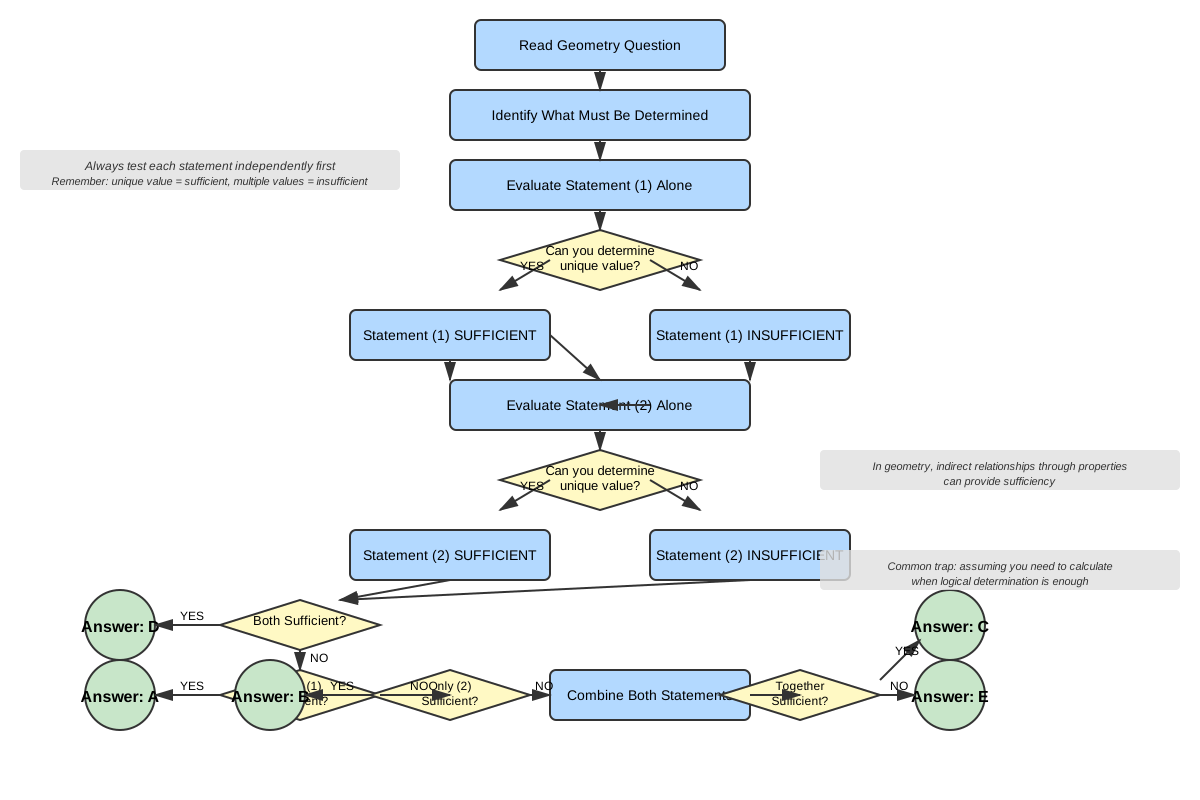
Data sufficiency specific strategies:
For geometry data sufficiency, remember that you often don't need to calculate the exact answer—only determine whether sufficient information exists:
- One side of a triangle is never sufficient to determine area (need height or another side with angle)
- Two sides of a triangle with the included angle are sufficient for area
- Radius or diameter alone is sufficient for any circle calculation
- For rectangles, perimeter alone is insufficient for area (need both dimensions or a relationship between them)
Memory Techniques
CAST mnemonic for angle relationships with parallel lines:
- Corresponding angles are equal
- Alternate interior angles are equal
- Same-side interior angles are supplementary
- Transversal creates these relationships
"Please Call For The Area" for circle formulas:
- Pi r squared for area (πr²)
- Circumference = 2πr
- Formula for sector: (θ/360) × πr²
- Tangent perpendicular to radius
"3-4-5, 5-12-13, 8-15-17" Pythagorean triple chant: Memorize these common right triangle side ratios and their multiples (6-8-10, 9-12-15, etc.) to quickly recognize right triangles and avoid unnecessary Pythagorean theorem calculations.
Visualization for special right triangles:
- 30-60-90: Picture an equilateral triangle cut in half—the short side is half the original side (1), the hypotenuse is the original side (2), and the height is √3
- 45-45-90: Picture a square cut diagonally—the legs are the square's sides (1 each), and the diagonal is √2
"Square the scale for area, cube for volume": When dealing with similar figures, remember that if linear dimensions scale by factor k, areas scale by k² and volumes by k³. Visualize: doubling all dimensions of a square makes 4 small squares fit inside (2² = 4).
Coordinate geometry "rise over run": For slope and distance, visualize a right triangle formed by the two points—the horizontal leg is the "run" (x₂ - x₁), the vertical leg is the "rise" (y₂ - y₁), and the hypotenuse is the distance.
Summary
Geometry problem solving on the GMAT requires synthesizing multiple geometric principles, applying systematic problem-solving frameworks, and recognizing patterns that lead to efficient solutions. Success depends not on memorizing hundreds of formulas but on deeply understanding core relationships: how angles relate in various configurations, how areas and perimeters connect to dimensions, how similar figures maintain proportional relationships, and how coordinate geometry translates between algebraic and visual representations. The most effective approach involves drawing clear diagrams, identifying which geometric properties apply, planning solution paths before calculating, and verifying answers for reasonableness. GMAT geometry problems reward insight over computation—recognizing special triangles, similar figures, or elegant geometric properties often reveals solutions that would otherwise require lengthy calculations. Students must practice translating between different representations (visual diagrams, coordinate systems, algebraic equations) and develop the spatial reasoning to decompose complex figures into manageable components. Mastery comes from understanding why geometric relationships work, not just memorizing that they do.
Key Takeaways
- Systematic approach beats rushed calculation: Always draw/redraw figures, identify given information, recognize relevant properties, plan your path, then execute
- Special triangles (30-60-90 and 45-45-90) appear frequently: Memorize their side ratios to avoid Pythagorean theorem calculations and save time
- Composite figures require strategic decomposition: Choose between addition (sum of parts) and subtraction (larger shape minus removed portions) based on which minimizes steps
- Similar figures scale predictably: Linear dimensions scale by k, areas by k², volumes by k³—understanding this relationship is crucial for proportion problems
- Coordinate geometry integrates algebra and geometry: Master the distance formula, midpoint formula, and slope relationships to handle these hybrid problems
- Circle problems connect multiple concepts: Radius determines all other measurements (diameter, circumference, area, sector area, arc length)
- Data sufficiency requires determining what's needed, not calculating the answer: Know which combinations of information suffice for various geometric quantities
Related Topics
Advanced Coordinate Geometry: Building on basic coordinate concepts, this topic explores equations of circles, parabolas, and other curves, as well as transformations and symmetry in the coordinate plane. Mastering geometry problem solving provides the foundation for understanding how algebraic equations represent geometric objects.
Solid Geometry and 3D Visualization: Extends two-dimensional geometry concepts into three dimensions, covering prisms, pyramids, cylinders, cones, and spheres. The problem-solving strategies learned here apply directly to more complex three-dimensional scenarios.
Geometric Probability: Combines geometry with probability concepts, asking questions about the likelihood of events occurring within geometric regions. Strong geometry problem-solving skills enable quick calculation of areas and regions needed for probability ratios.
Optimization in Geometry: Advanced problems involving maximizing or minimizing geometric quantities subject to constraints, often requiring calculus-level thinking presented in GMAT-appropriate formats. The optimization concepts introduced here form the foundation for these more complex problems.
Data Sufficiency with Geometric Reasoning: Specialized question type requiring determination of whether given information suffices to answer geometric questions. Mastery of geometry problem solving enables quick assessment of what information is necessary versus superfluous.
Practice CTA
Now that you've built a comprehensive understanding of geometry problem solving strategies and concepts, it's time to cement your knowledge through active practice. Attempt the practice questions associated with this topic, focusing on applying the systematic framework: draw clear diagrams, identify relevant properties, plan before calculating, and verify your answers. Use the flashcards to reinforce high-yield facts and formulas until they become automatic. Remember, geometry problem solving is a skill that improves dramatically with deliberate practice—each problem you work through strengthens your pattern recognition and strategic thinking. You've equipped yourself with the tools; now apply them to achieve mastery and confidence on test day!
Sign up free to keep reading
Create a free AnvayaPrep account to finish this GMAT guide on Geometry problem solving — plus flashcards and practice questions.