Overview
Perimeter is one of the foundational concepts in GMAT Quantitative Reasoning, appearing regularly across Problem Solving and Data Sufficiency questions. The perimeter represents the total distance around the boundary of a two-dimensional geometric figure, and mastering this concept is essential for success on geometry questions that constitute approximately 10-15% of the Quantitative section. While the concept itself may seem straightforward, the GMAT tests perimeter in sophisticated ways—combining it with area calculations, coordinate geometry, optimization problems, and algebraic reasoning to create multi-step challenges that separate high scorers from average performers.
Understanding perimeter goes beyond memorizing formulas for common shapes. The GMAT frequently presents irregular figures, composite shapes, and scenarios where students must deduce missing information through logical reasoning. Questions may require calculating the perimeter when only partial information is given, determining relationships between perimeter and other geometric properties, or applying perimeter concepts to real-world optimization scenarios. The ability to visualize shapes, break complex figures into manageable components, and recognize when perimeter calculations are necessary distinguishes test-takers who achieve scores in the 700+ range.
The GMAT perimeter questions integrate seamlessly with other Quantitative Reasoning topics including area, coordinate geometry, algebraic equations, ratios, and word problems. This interconnectedness means that perimeter rarely appears in isolation; instead, it serves as a building block for more complex problem-solving scenarios. Students who develop fluency with perimeter calculations gain a significant advantage in tackling multi-concept questions that test mathematical reasoning under time pressure.
Learning Objectives
- [ ] Identify perimeter in various geometric figures and problem contexts
- [ ] Explain perimeter conceptually and distinguish it from related measures like area
- [ ] Apply perimeter formulas to GMAT questions involving standard and irregular shapes
- [ ] Calculate perimeter when given indirect information requiring algebraic manipulation
- [ ] Solve optimization problems involving perimeter constraints
- [ ] Analyze Data Sufficiency questions to determine what information is necessary to find perimeter
- [ ] Decompose composite figures into standard shapes to calculate total perimeter
Prerequisites
- Basic arithmetic operations: Essential for performing calculations involving addition, multiplication, and working with fractions in perimeter formulas
- Algebraic manipulation: Required for solving equations when perimeter is given but dimensions are unknown, or when variables represent side lengths
- Properties of common geometric shapes: Understanding characteristics of triangles, rectangles, squares, and circles enables quick formula application
- Unit conversion: Necessary when problems present measurements in different units that must be standardized before calculation
- Coordinate geometry basics: Helpful for calculating distances between points when perimeter must be determined from coordinate information
Why This Topic Matters
Perimeter concepts appear in real-world applications ranging from construction and landscaping (fencing requirements, border materials) to urban planning (walking paths, property boundaries) and manufacturing (edge finishing, trim materials). Professionals in architecture, engineering, and design regularly calculate perimeters to estimate materials, costs, and spatial requirements. This practical relevance makes perimeter an ideal testing ground for the GMAT's emphasis on quantitative reasoning applied to business and real-world scenarios.
On the GMAT specifically, perimeter questions appear in approximately 8-12% of Quantitative Reasoning sections, making them high-yield content for focused study. These questions typically appear at medium difficulty levels (500-650 score range) but can scale to high difficulty (700+) when combined with optimization, coordinate geometry, or complex Data Sufficiency scenarios. Problem Solving questions may ask for direct calculation, comparison of perimeters, or determination of maximum/minimum perimeter given constraints. Data Sufficiency questions frequently test whether students understand what information is truly necessary to calculate perimeter—a skill that requires deep conceptual understanding rather than formula memorization.
Common question formats include: calculating the perimeter of composite figures formed by combining or removing shapes; determining side lengths when perimeter and relationships between sides are given; comparing perimeters of figures with equal areas; finding perimeter from coordinate geometry; and optimization problems asking for maximum area given fixed perimeter or minimum perimeter enclosing fixed area. Recognition of these patterns enables strategic approach selection and efficient problem-solving.
Core Concepts
Definition and Fundamental Understanding
The perimeter of a two-dimensional figure is the total length of its boundary—the distance one would travel walking completely around the outside edge of the shape. For polygons (closed figures with straight sides), perimeter equals the sum of all side lengths. For curved figures like circles, perimeter refers to the circumference. This measurement is always expressed in linear units (inches, feet, meters, centimeters) and represents a one-dimensional quantity despite measuring a two-dimensional object's boundary.
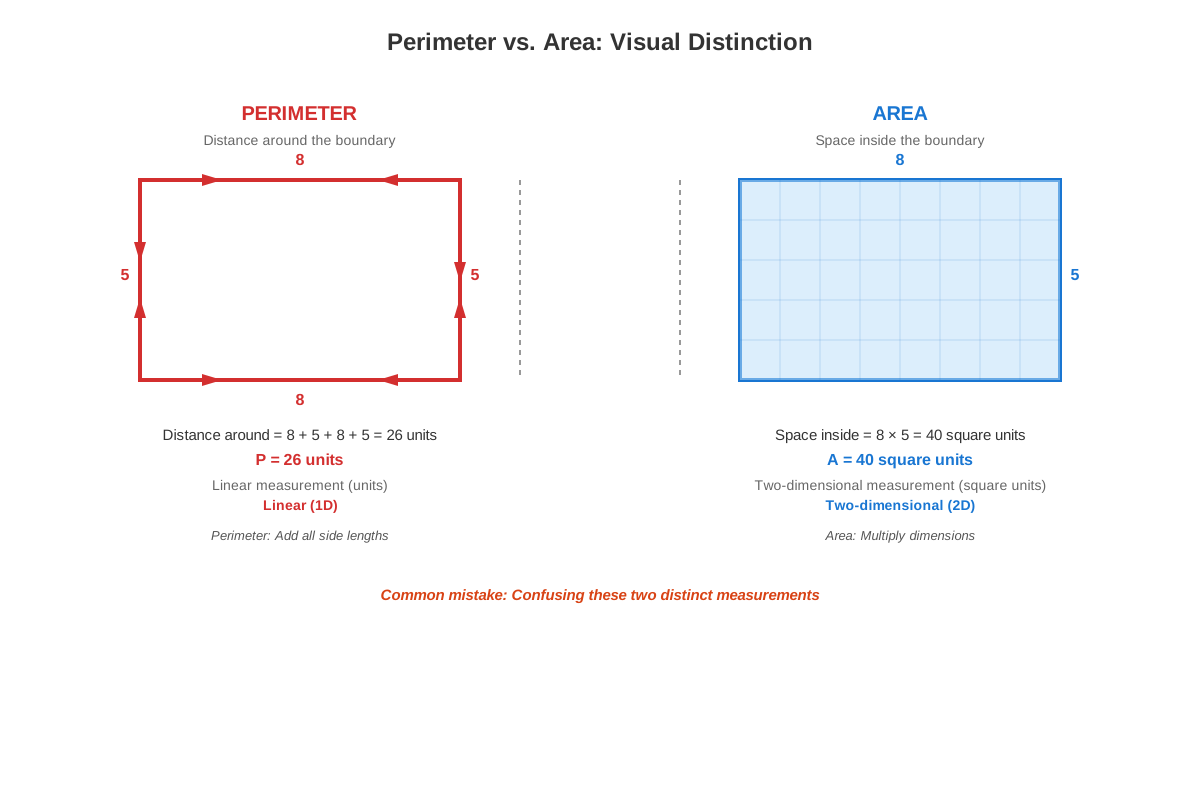
The conceptual distinction between perimeter and area is crucial: perimeter measures distance around a figure (linear measurement), while area measures the space enclosed within the figure (square measurement). Two figures can have identical perimeters but vastly different areas, and vice versa. This relationship frequently appears in GMAT questions that test whether students truly understand these distinct concepts.
Perimeter Formulas for Standard Shapes
Understanding and memorizing perimeter formulas for common geometric figures is essential for GMAT success. The following table summarizes the key formulas:
| Shape | Formula | Variables |
|---|---|---|
| Rectangle | P = 2l + 2w or P = 2(l + w) | l = length, w = width |
| Square | P = 4s | s = side length |
| Triangle | P = a + b + c | a, b, c = side lengths |
| Equilateral Triangle | P = 3s | s = side length |
| Regular Polygon | P = n × s | n = number of sides, s = side length |
| Circle (Circumference) | C = 2πr or C = πd | r = radius, d = diameter |
For rectangles, recognizing that opposite sides are equal allows the formula P = 2l + 2w. Squares, being special rectangles with all sides equal, simplify to P = 4s. Regular polygons (all sides and angles equal) follow the pattern of multiplying the number of sides by the side length. The circle's perimeter, called circumference, involves the constant π (approximately 3.14 or 22/7).
Calculating Perimeter of Irregular and Composite Figures
GMAT questions frequently present irregular polygons or composite figures formed by combining multiple shapes. For irregular polygons, the approach remains straightforward: add all side lengths, ensuring no side is omitted or counted twice. The challenge lies in identifying all sides, including those that may not be explicitly labeled.
For composite figures, the key strategy involves:
- Identify component shapes: Recognize how standard shapes combine to form the composite figure
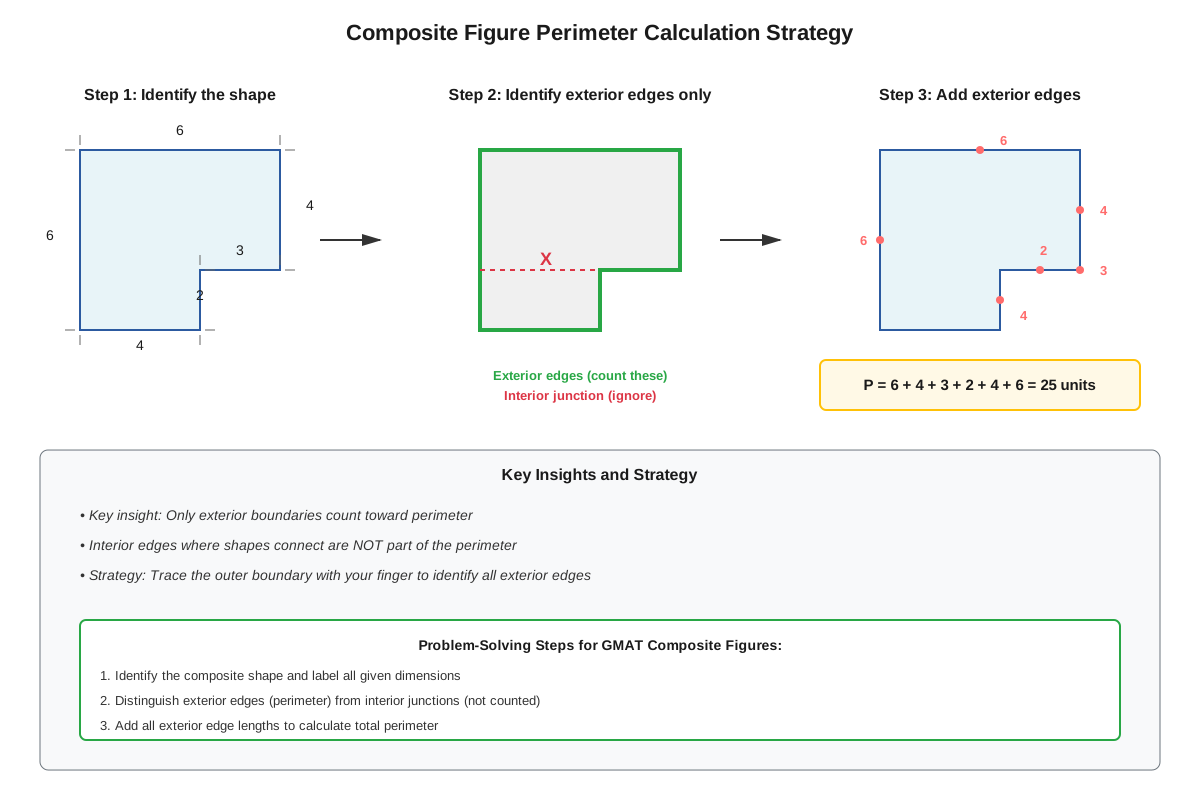
- Determine which boundaries count: Only exterior edges contribute to perimeter; internal boundaries where shapes join do not
- Calculate missing dimensions: Use properties of component shapes to find unlabeled side lengths
- Sum exterior edges: Add only the lengths forming the outer boundary
For example, an L-shaped figure formed by two rectangles requires identifying six exterior sides (not the internal junction) and using the given dimensions plus geometric relationships to find all necessary lengths.
Perimeter in Coordinate Geometry
When geometric figures are presented on a coordinate plane, calculating perimeter requires finding distances between vertices using the distance formula:
d = √[(x₂ - x₁)² + (y₂ - y₁)²]For figures with sides parallel to axes (horizontal or vertical), distance calculation simplifies to the absolute difference in the relevant coordinate. For diagonal sides, the full distance formula applies. This approach is particularly common in GMAT questions testing integration of algebra and geometry.
Relationship Between Perimeter and Other Properties
The GMAT frequently tests understanding of how perimeter relates to other geometric properties:
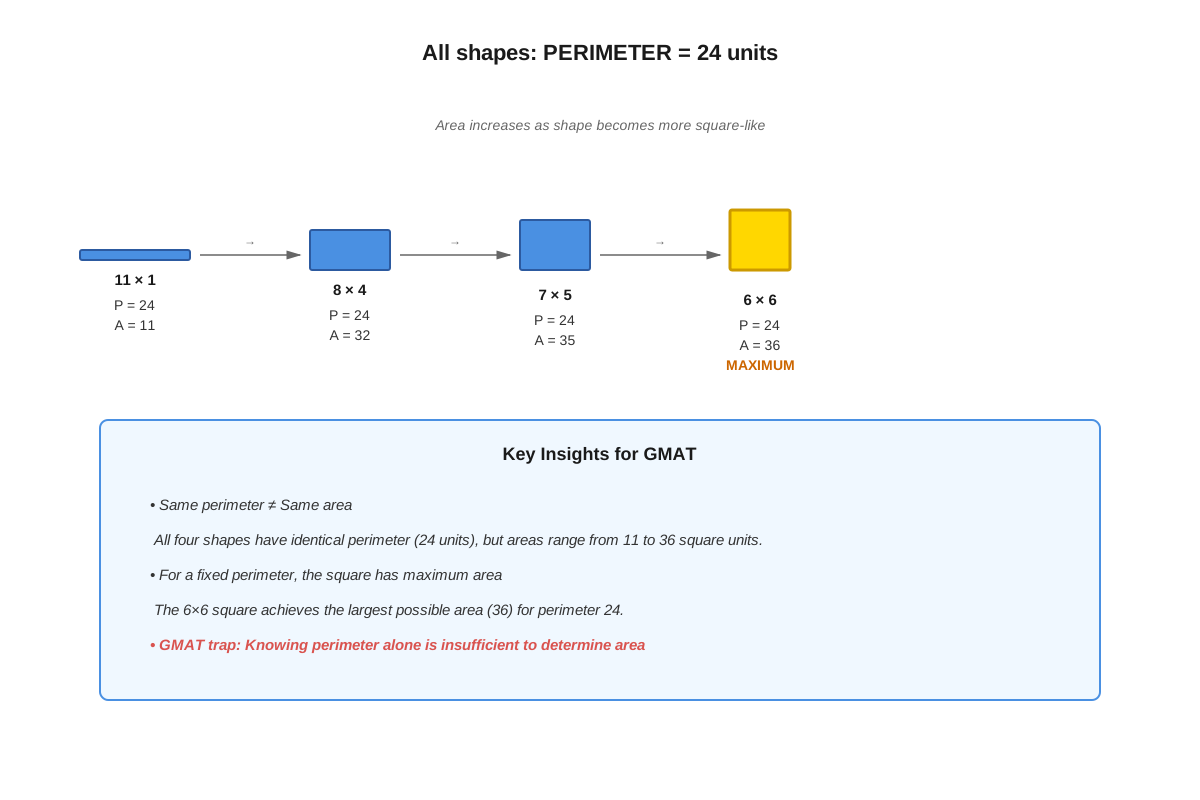
Perimeter and Area: For a fixed perimeter, the circle encloses maximum area, while among rectangles, the square encloses maximum area. Conversely, for a fixed area, the circle has minimum perimeter, and among rectangles, the square has minimum perimeter. These optimization principles appear in word problems and comparison questions.
Perimeter and Scale: When a figure's dimensions are scaled by factor k, the perimeter scales by the same factor k (linear relationship), while area scales by k². This distinction is crucial for similarity and scaling questions.
Perimeter and Constraints: Many GMAT problems provide perimeter as a constraint and ask for maximum/minimum area, or provide area and ask about perimeter possibilities. Recognizing these optimization scenarios enables strategic problem-solving.
Special Considerations and Edge Cases
Several special scenarios require careful attention:
- Semicircles and partial circles: Perimeter includes both the curved arc and the straight diameter
- Figures with curved and straight sides: Combine appropriate formulas for each portion
- Three-dimensional figure cross-sections: When a 3D figure is cut, the perimeter of the resulting 2D cross-section may be requested
- Overlapping figures: Carefully identify which boundaries form the exterior perimeter of the combined shape
Concept Relationships
The perimeter concept serves as a foundational element connecting multiple geometric and algebraic topics. Basic perimeter calculation → leads to → area-perimeter relationships, where students must distinguish between these distinct measurements and understand their interactions. This relationship extends to optimization problems, where constraints on one property (perimeter) determine possibilities for another (area).
Perimeter of standard shapes → builds toward → composite figure analysis, requiring decomposition strategies and spatial reasoning. This progression continues to coordinate geometry applications, where distance formula mastery enables perimeter calculation from vertex coordinates.
The algebraic dimension emerges when given perimeter values → require → solving for unknown dimensions, connecting perimeter to equation-solving skills. This relationship extends to ratio and proportion problems, where perimeter relationships between similar figures follow predictable patterns.
Perimeter concepts → integrate with → word problems and real-world applications, particularly in optimization contexts (fencing, borders, materials estimation). These applications frequently combine perimeter with cost calculations and constraint satisfaction, testing multi-step reasoning.
Understanding these relationships enables recognition of question types and strategic approach selection, particularly valuable in Data Sufficiency where determining necessary information requires seeing these connections clearly.
Quick check — test yourself on Perimeter so far.
Try Flashcards →High-Yield Facts
⭐ The perimeter of a rectangle equals 2(length + width), and knowing perimeter alone is insufficient to determine unique dimensions
⭐ Among all rectangles with the same perimeter, the square has the maximum area
⭐ When a figure's dimensions are scaled by factor k, perimeter scales by k, but area scales by k²
⭐ The perimeter of a composite figure includes only exterior boundaries, not internal junctions where shapes meet
⭐ For a circle, circumference = 2πr = πd, and knowing either radius or diameter is sufficient to calculate perimeter
- The perimeter of an equilateral triangle with side s is 3s, and its area is (s²√3)/4
- A semicircle's perimeter includes both the curved arc (πr) and the straight diameter (2r), totaling πr + 2r
- In coordinate geometry, horizontal and vertical distances can be calculated by simple subtraction; diagonal distances require the distance formula
- Regular polygons with n sides and side length s have perimeter P = ns
- Two figures can have identical perimeters but completely different areas, and vice versa
- The perimeter of a triangle must satisfy the triangle inequality: the sum of any two sides exceeds the third side
- For optimization problems, circular shapes provide maximum area for given perimeter and minimum perimeter for given area
- When calculating perimeter of irregular polygons, systematically account for each side to avoid omissions or double-counting
Common Misconceptions
Misconception: Perimeter and area are interchangeable or directly proportional concepts.
Correction: Perimeter measures linear distance around a figure (in units like meters), while area measures enclosed space (in square units like m²). Figures with equal perimeters can have vastly different areas, and vice versa. These are independent properties requiring different formulas and conceptual understanding.
Misconception: Doubling all dimensions of a figure doubles both perimeter and area.
Correction: Doubling all dimensions doubles the perimeter (linear scaling) but quadruples the area (scaling by the square of the factor). If dimensions scale by factor k, perimeter scales by k and area by k². This distinction is critical for similarity and scaling problems.
Misconception: The perimeter of a composite figure equals the sum of the perimeters of its component shapes.
Correction: Only exterior boundaries contribute to a composite figure's perimeter. Internal boundaries where shapes join are not part of the perimeter. For example, when two squares share a common side, that shared side does not count toward the composite figure's perimeter.
Misconception: In Data Sufficiency, knowing the perimeter of a rectangle is sufficient to determine its area.
Correction: Perimeter alone does not uniquely determine a rectangle's dimensions. A rectangle with perimeter 20 could be 1×9 (area 9), 2×8 (area 16), 3×7 (area 21), 4×6 (area 24), or 5×5 (area 25). Additional information about the relationship between length and width is necessary.
Misconception: The perimeter of a semicircle is half the circumference of the full circle.
Correction: A semicircle's perimeter includes both the curved arc (which is half the full circumference, or πr) and the straight diameter (2r). Therefore, the semicircle's perimeter is πr + 2r, not simply πr.
Misconception: All shapes with the same perimeter have the same area.
Correction: Perimeter and area are independent properties. For example, a 1×9 rectangle and a 5×5 square both have perimeter 20, but their areas are 9 and 25 respectively. Among shapes with equal perimeter, the circle has maximum area.
Worked Examples
Example 1: Composite Figure Perimeter
Problem: A figure is formed by removing a small square of side length 2 from one corner of a larger square of side length 8. What is the perimeter of the resulting figure?
Solution:
Step 1: Visualize the figure. We start with an 8×8 square and remove a 2×2 square from one corner, creating an L-shaped figure.
Step 2: Identify all exterior sides. The removal creates a "notch" in the corner, adding interior edges that become part of the new perimeter.
Step 3: Count the sides systematically:
- Bottom edge: 8 (unchanged)
- Right edge: 8 (unchanged)
- Top edge: 8 - 2 = 6 (shortened by the removed square)
- Small vertical edge going down into the notch: 2 (new edge created)
- Small horizontal edge going left across the notch: 2 (new edge created)
- Left edge going down: 8 - 2 = 6 (shortened by the removed square)
Step 4: Sum all exterior edges:
P = 8 + 8 + 6 + 2 + 2 + 6 = 32
Key Insight: Notice that removing the square added edges (the notch boundaries) rather than simply reducing perimeter. The perimeter of the original square was 32, and the perimeter remains 32 after the removal. This occurs because the removed square's contribution (two sides of length 2 each, totaling 4) is exactly replaced by the new interior edges created (also totaling 4).
Connection to Learning Objectives: This problem applies perimeter calculation to a composite figure, requiring identification of all boundary segments and systematic summation—a common GMAT scenario testing spatial reasoning.
Example 2: Perimeter and Optimization
Problem: A rectangular garden has a perimeter of 60 meters. If the length is twice the width, what is the area of the garden?
Solution:
Step 1: Define variables. Let w = width and l = length.
Step 2: Translate given information into equations:
- Perimeter: 2l + 2w = 60
- Length-width relationship: l = 2w
Step 3: Substitute the relationship into the perimeter equation:
2(2w) + 2w = 60
4w + 2w = 60
6w = 60
w = 10 meters
Step 4: Find the length:
l = 2w = 2(10) = 20 meters
Step 5: Calculate area:
A = l × w = 20 × 10 = 200 square meters
Verification: Check perimeter: 2(20) + 2(10) = 40 + 20 = 60 ✓
Key Insight: This problem demonstrates how perimeter serves as a constraint in optimization and dimension-finding problems. The GMAT frequently provides perimeter along with a relationship between dimensions, requiring algebraic manipulation to find specific measurements. Notice that perimeter alone would be insufficient (Data Sufficiency consideration), but the additional relationship makes the problem solvable.
Connection to Learning Objectives: This example applies perimeter concepts to solve for unknown dimensions using algebraic reasoning, integrating multiple mathematical skills in a single problem—characteristic of medium-to-high difficulty GMAT questions.
Exam Strategy
When approaching GMAT perimeter questions, begin by identifying the question type: direct calculation, dimension-finding with constraints, composite figures, or Data Sufficiency. This classification determines the optimal solution strategy.
Trigger words and phrases to recognize include: "distance around," "fencing required," "border," "total length of sides," "circumference" (for circles), "enclose," and "boundary." These signal perimeter calculations. Distinguish these from area triggers like "space enclosed," "region," "surface," or "cover."
For Problem Solving questions:
- Draw or redraw the figure if not provided or if the given diagram is not to scale
- Label all known dimensions directly on your diagram
- Identify what information is given and what must be calculated
- For composite figures, mark which boundaries form the exterior perimeter
- Use geometric properties to find missing dimensions before calculating perimeter
- Double-check that all exterior sides are included exactly once
For Data Sufficiency questions:
- Determine what information would be sufficient to calculate perimeter
- Remember that perimeter alone rarely determines other properties uniquely
- Consider whether each statement provides enough information to find all necessary side lengths
- Watch for trap answers where information seems sufficient but actually isn't (e.g., perimeter alone for a rectangle)
- Recognize when geometric properties provide implicit information (e.g., square means all sides equal)
Process-of-elimination tips: Eliminate answer choices that violate basic principles such as perimeter being less than the sum of given sides, or perimeter having incorrect units. For comparison questions, eliminate choices inconsistent with scaling relationships (doubling dimensions doubles perimeter, not area).
Time allocation: Standard perimeter problems should take 1.5-2 minutes. If a problem requires more than 2.5 minutes, consider whether a simpler approach exists or whether strategic guessing is appropriate. Complex composite figures or optimization problems may justify 2.5-3 minutes.
Exam Tip: When a problem provides both perimeter and area, or asks you to compare them, immediately recognize this as testing the distinction between these concepts. Never assume they're proportional or directly related.
Memory Techniques
Mnemonic for Rectangle Perimeter: "Two Lengths, Two Widths" → 2L + 2W reminds you that rectangles have two pairs of equal sides.
Visualization Strategy for Composite Figures: Imagine walking around the outside of the figure with a marker, tracing only the exterior boundary. Any edge you trace counts toward perimeter; any edge you don't trace (interior boundaries) doesn't count.
Circle Formula Memory: "Circumference uses Circle constant π" → C = 2πr. Remember that diameter is twice radius, so C = πd is equivalent.
Acronym for Perimeter Problem Steps: DLIS
- Draw the figure
- Label known dimensions
- Identify missing information
- Sum all exterior sides
Scaling Relationship Memory: "Linear for Length (perimeter), Square for Space (area)" → When dimensions scale by k, perimeter scales by k¹ and area by k².
Semicircle Perimeter Memory: Think "Curve Plus Diameter" → The curved part (πr) plus the straight diameter (2r) gives the full perimeter.
Summary
Perimeter represents the total distance around a two-dimensional figure's boundary and is a fundamental concept in GMAT Quantitative Reasoning, appearing in 8-12% of questions across various difficulty levels. Mastery requires understanding formulas for standard shapes (rectangles, squares, triangles, circles), the ability to calculate perimeter for irregular and composite figures by identifying exterior boundaries, and skill in applying perimeter concepts to optimization and constraint problems. The GMAT tests perimeter not in isolation but integrated with algebraic reasoning, coordinate geometry, and area relationships. Success requires distinguishing perimeter (linear measurement) from area (square measurement), recognizing that figures with equal perimeters can have different areas, understanding scaling relationships (perimeter scales linearly while area scales quadratically), and applying systematic problem-solving approaches. Data Sufficiency questions particularly test conceptual understanding of what information is necessary to determine perimeter. Strategic approaches include careful diagram analysis, systematic accounting of all sides, recognition of geometric properties that provide implicit information, and awareness of common traps involving perimeter-area confusion.
Key Takeaways
- Perimeter measures the total distance around a figure's boundary and is always expressed in linear units, fundamentally distinct from area
- Standard formulas must be memorized: rectangle P = 2(l + w), square P = 4s, circle C = 2πr, triangle P = sum of all sides
- For composite figures, only exterior boundaries count toward perimeter; internal junctions where shapes meet do not contribute
- Perimeter and area are independent properties—equal perimeters don't imply equal areas, and knowing perimeter alone rarely determines area uniquely
- When dimensions scale by factor k, perimeter scales by k (linear) while area scales by k² (quadratic)
- Among rectangles with equal perimeter, the square has maximum area; among shapes with equal perimeter, the circle has maximum area
- Systematic approaches (drawing figures, labeling dimensions, identifying missing information) prevent errors and save time on test day
Related Topics
Area of Polygons and Circles: Building on perimeter understanding, area calculations measure the space enclosed within boundaries. Mastering perimeter provides the foundation for understanding area-perimeter relationships and optimization problems that appear frequently on the GMAT.
Coordinate Geometry: Calculating perimeter from coordinate points requires distance formula application. This topic extends perimeter concepts into the algebraic realm, enabling solution of problems where figures are defined by vertex coordinates.
Similar Figures and Scaling: Understanding how perimeter scales when figures are enlarged or reduced connects to ratio concepts and proportional reasoning, essential for advanced geometry questions.
Three-Dimensional Geometry: While perimeter applies to 2D figures, the analogous concept of surface area for 3D objects builds on similar calculation principles, extending spatial reasoning skills.
Optimization Problems: Many GMAT word problems involve maximizing or minimizing one quantity (area) given constraints on another (perimeter), requiring integration of perimeter concepts with algebraic reasoning and critical thinking.
Practice CTA
Now that you've mastered the core concepts of perimeter, it's time to solidify your understanding through active practice. Attempt the practice questions to apply these principles to GMAT-style problems, and use the flashcards to reinforce key formulas and relationships. Remember, the difference between understanding a concept and achieving a top score lies in repeated application under test-like conditions. Each practice problem you solve builds the pattern recognition and problem-solving speed essential for GMAT success. You've built a strong foundation—now transform that knowledge into points on test day!
Sign up free to keep reading
Create a free AnvayaPrep account to finish this GMAT guide on Perimeter — plus flashcards and practice questions.