Overview
Area is one of the most fundamental and frequently tested concepts in GMAT Quantitative Reasoning. Understanding how to calculate, manipulate, and apply area formulas across various geometric shapes forms the backbone of success on geometry questions, which constitute approximately 15-20% of all GMAT Quant problems. The concept of area refers to the amount of two-dimensional space enclosed within a boundary, measured in square units. Mastery of this topic extends beyond simple formula memorization—it requires the ability to recognize complex shapes, decompose them into manageable components, and apply multiple geometric principles simultaneously.
The importance of GMAT area questions cannot be overstated. These problems frequently appear in both Problem Solving and Data Sufficiency formats, often combining area calculations with other geometric concepts such as perimeter, volume, coordinate geometry, and similar triangles. The GMAT tests not just computational ability but also spatial reasoning, pattern recognition, and the capacity to work efficiently under time pressure. Area problems may present themselves straightforwardly or may be embedded within word problems involving real-world scenarios like landscaping, construction, or resource allocation.
Within the broader Quantitative Reasoning framework, area serves as a bridge concept connecting pure geometry to algebra, ratios, and even probability. Many optimization problems require understanding how changes in dimensions affect area (quadratic relationships), while coordinate geometry questions often demand area calculations using algebraic methods. The ability to visualize geometric relationships and translate them into mathematical expressions distinguishes high-scoring test-takers from average performers, making this topic essential for anyone targeting a competitive GMAT score.
Learning Objectives
- [ ] Identify area in various geometric contexts and problem types
- [ ] Explain area concepts, formulas, and their derivations for standard shapes
- [ ] Apply area formulas to GMAT questions involving single and composite shapes
- [ ] Synthesize area concepts with other geometric principles to solve complex problems
- [ ] Evaluate Data Sufficiency questions involving area by determining necessary and sufficient information
- [ ] Analyze optimization problems involving area maximization or minimization
- [ ] Decompose irregular shapes into standard geometric components for area calculation
Prerequisites
- Basic algebraic manipulation: Essential for rearranging area formulas to solve for unknown dimensions and working with variables in geometric contexts
- Understanding of exponents and square roots: Required since area is measured in square units and many problems involve reversing area calculations to find dimensions
- Familiarity with coordinate systems: Necessary for calculating areas using coordinate geometry methods and understanding position-based problems
- Knowledge of basic geometric shapes: Foundational for recognizing which formulas apply to different figures and visualizing problem scenarios
- Ratio and proportion concepts: Critical for understanding how dimensional changes affect area (scale factor relationships)
Why This Topic Matters
Area calculations appear in countless real-world applications, from determining the amount of paint needed for a wall to calculating land values in real estate, optimizing agricultural yields, or designing efficient floor plans. These practical applications make area problems particularly suitable for GMAT word problems that test business and analytical reasoning. Understanding area also develops spatial intelligence, a cognitive skill valuable in fields ranging from architecture and engineering to data visualization and strategic planning.
On the GMAT specifically, area questions appear in approximately 3-5 questions per exam, representing a significant portion of the geometry subset. These questions typically fall into several categories: direct calculation problems (20%), composite shape problems (30%), optimization problems (20%), coordinate geometry area problems (15%), and Data Sufficiency problems requiring area information (15%). The medium difficulty level means these questions are accessible to most test-takers but contain enough complexity to differentiate between score bands.
Area concepts commonly appear disguised within other problem types. A question might present as an algebra problem but require area calculation as an intermediate step. Data Sufficiency questions frequently test whether students understand what information is necessary and sufficient to determine area—for instance, knowing that a rectangle's diagonal and one side are sufficient to find its area, but knowing only the perimeter is not. Word problems might describe scenarios involving carpeting, fencing, or tiling that fundamentally test area understanding while assessing reading comprehension and problem translation skills.
Core Concepts
Fundamental Definition of Area
Area represents the measure of the two-dimensional space enclosed within a boundary, expressed in square units (square inches, square meters, etc.). The concept originates from the basic unit square: a square with side length 1 has an area of 1 square unit. All other area calculations derive from determining how many such unit squares would fit within a given shape. This foundational understanding helps students grasp why area formulas take their specific forms and why area scales with the square of linear dimensions.
Rectangle and Square Areas
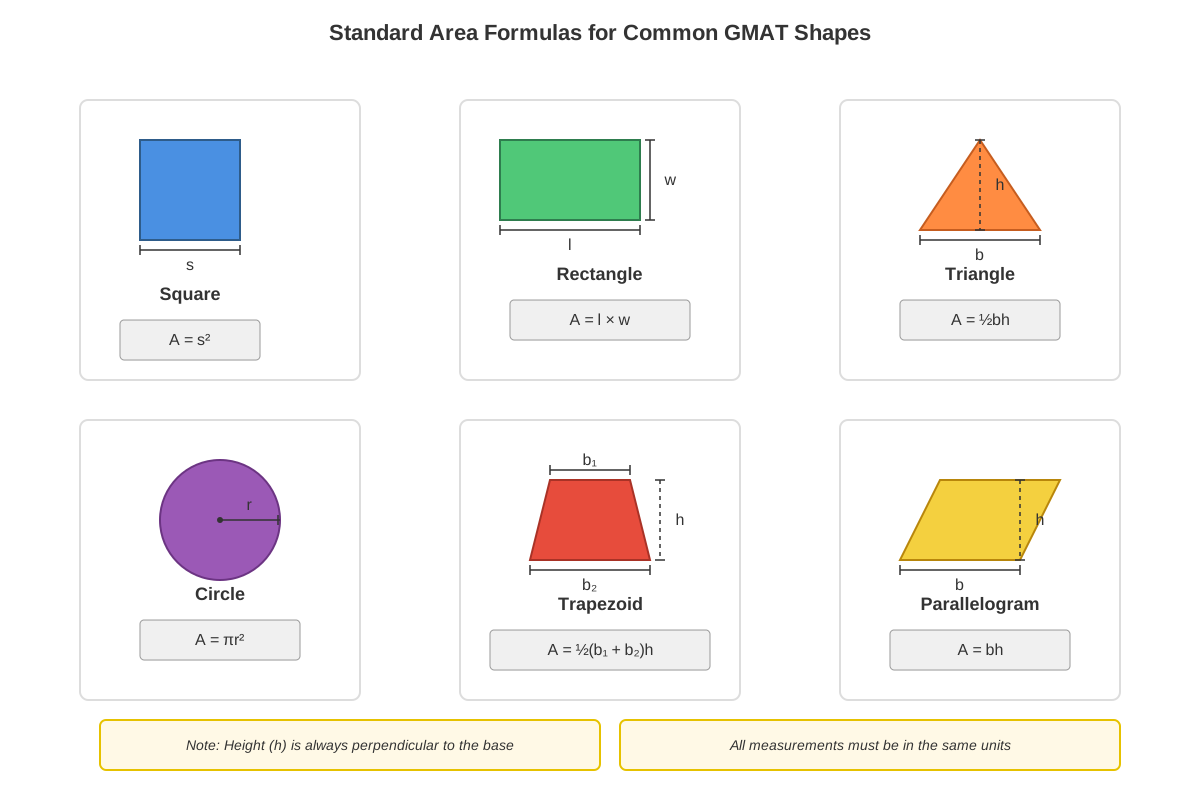
The rectangle serves as the most fundamental area calculation, with the formula:
Area = length × widthThis formula directly reflects the unit square definition: a rectangle with length 5 and width 3 contains exactly 15 unit squares arranged in a 5×3 grid. The square, a special rectangle with equal sides, uses the formula:
Area = side²These formulas form the basis for understanding all other area calculations. Key properties include:
- Doubling one dimension doubles the area
- Doubling both dimensions quadruples the area
- Area remains constant for rectangles with the same length-width product (different shapes, same area)
Triangle Areas
The triangle area formula is:
Area = (1/2) × base × heightThe height must be perpendicular to the base—a critical detail often tested on the GMAT. This formula works for all triangles: right, acute, and obtuse. The factor of 1/2 exists because any triangle represents exactly half of a parallelogram with the same base and height.
Special triangle considerations:
- Right triangles: Either leg can serve as base or height, simplifying calculations
- Equilateral triangles: For side length s, area = (s²√3)/4
- Isosceles triangles: Height bisects the base, enabling Pythagorean theorem applications
- Heron's formula: For sides a, b, c and semi-perimeter s = (a+b+c)/2, area = √[s(s-a)(s-b)(s-c)]
Circle Areas
The circle area formula is:
Area = πr²where r represents the radius. Understanding this formula requires recognizing that area scales with the square of the radius—doubling the radius quadruples the area. Related concepts include:
- Diameter relationship: Since d = 2r, area = πd²/4
- Circumference connection: C = 2πr, establishing the relationship between boundary and enclosed space
- Sector areas: For a sector with central angle θ (in degrees), area = (θ/360) × πr²
- Segment areas: Area between chord and arc, calculated as sector area minus triangle area
Parallelogram and Trapezoid Areas
The parallelogram area formula mirrors the rectangle:
Area = base × heightThe height must be perpendicular to the base, not the slant side length. This distinction frequently appears in GMAT problems designed to test careful reading.
The trapezoid (quadrilateral with one pair of parallel sides) uses:
Area = (1/2) × (base₁ + base₂) × heightThis formula represents the average of the two parallel bases multiplied by the perpendicular distance between them. Trapezoids can often be decomposed into triangles and rectangles for alternative calculation methods.
Composite Shapes
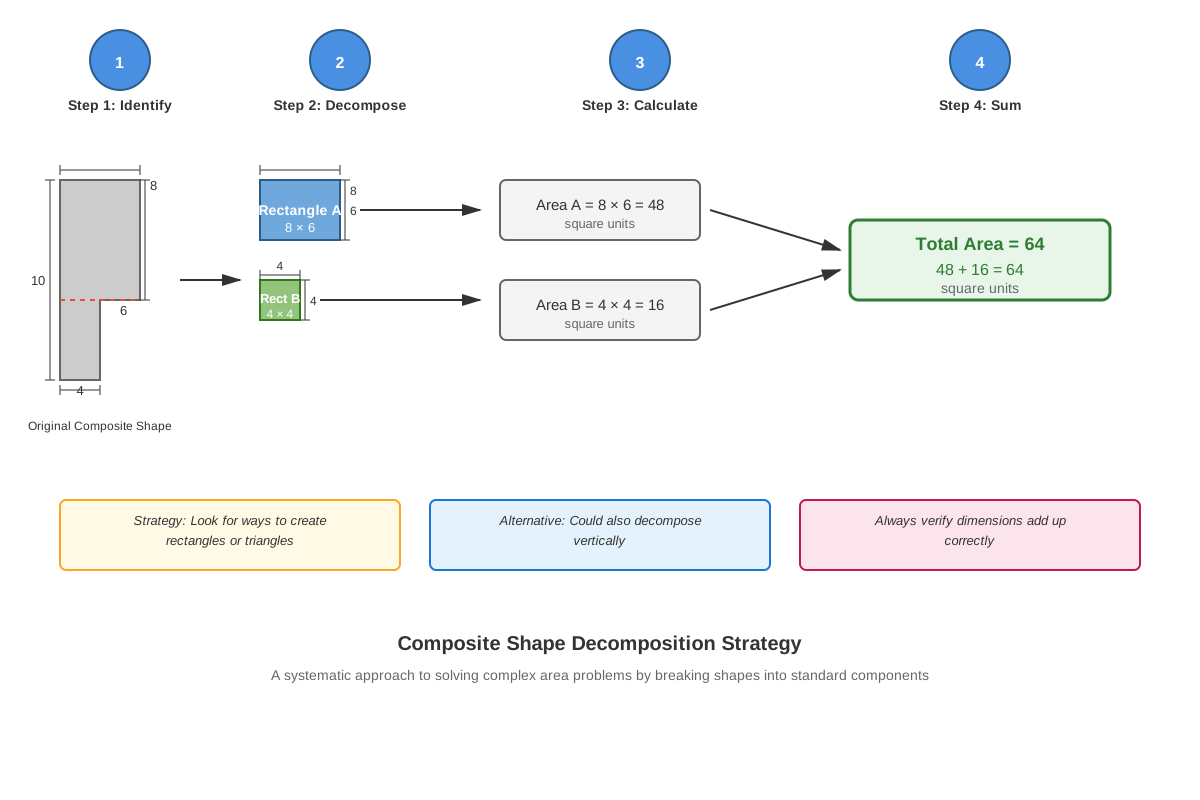
Composite shapes combine multiple standard geometric figures. The GMAT frequently tests the ability to:
- Identify component shapes within complex figures
- Determine whether to add or subtract areas
- Recognize shared dimensions between components
- Avoid double-counting overlapping regions
Common strategies include:
- Addition method: Calculate each component separately and sum
- Subtraction method: Calculate a larger encompassing shape and subtract removed portions
- Rearrangement: Mentally reorganize pieces into simpler configurations
Coordinate Geometry Area Methods
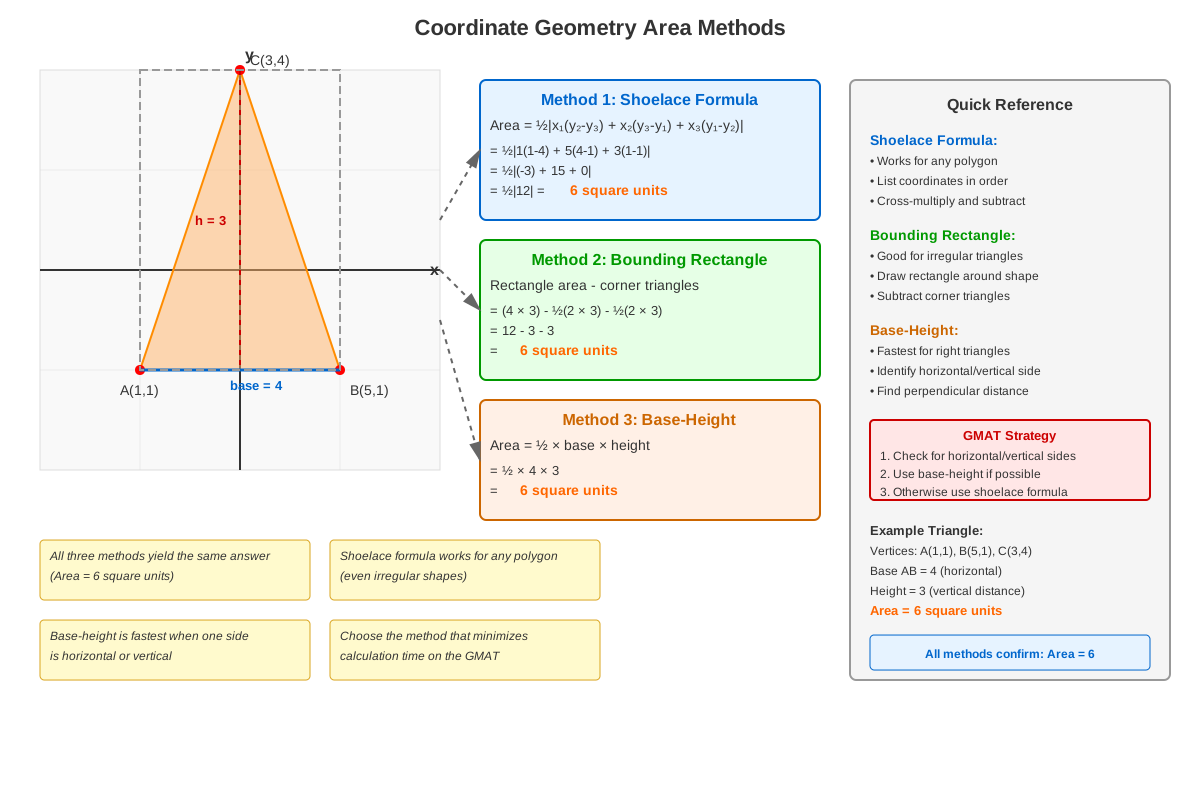
When shapes are defined by coordinate points, several specialized methods apply:
Shoelace formula for polygons with vertices (x₁,y₁), (x₂,y₂), ..., (xₙ,yₙ):
Area = (1/2)|x₁(y₂-yₙ) + x₂(y₃-y₁) + ... + xₙ(y₁-yₙ₋₁)|Rectangle in coordinate plane: Area = |x₂-x₁| × |y₂-y₁| for opposite corners (x₁,y₁) and (x₂,y₂)
Triangle with vertices: Area = (1/2)|x₁(y₂-y₃) + x₂(y₃-y₁) + x₃(y₁-y₂)|
Scale Factor Relationships
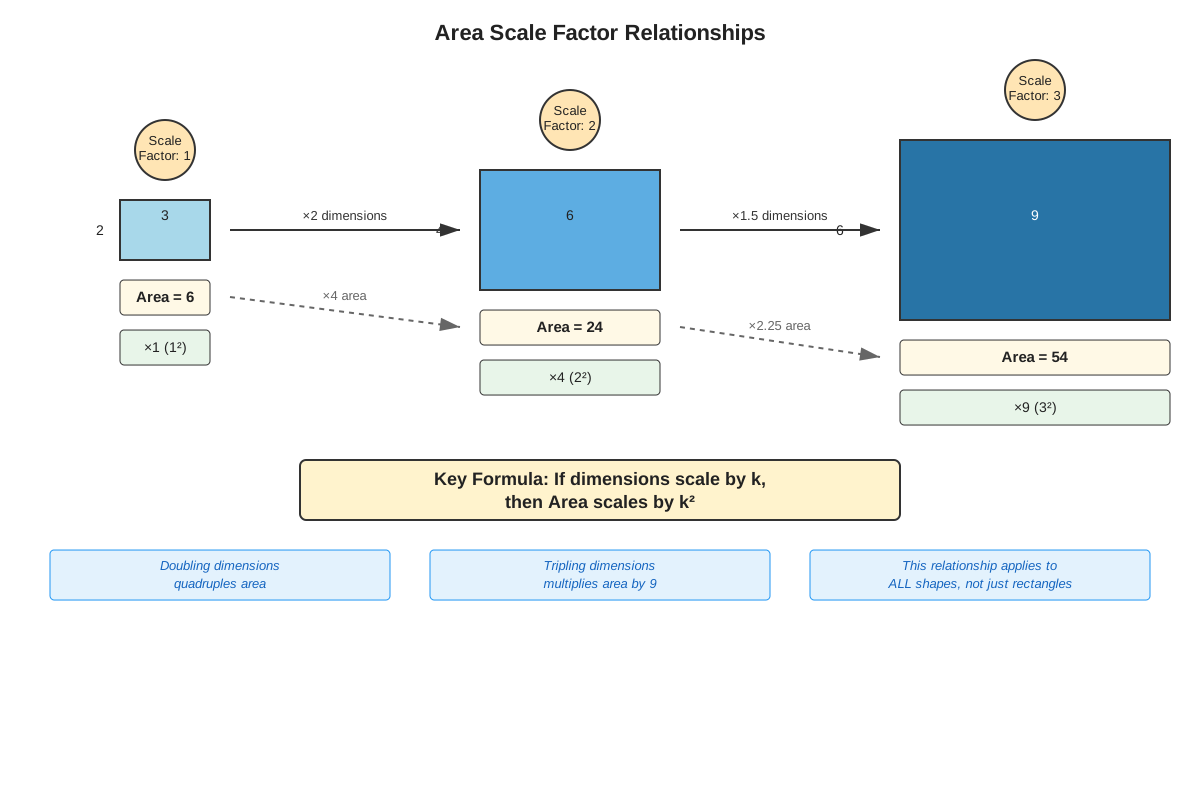
Understanding how area changes with dimension scaling is crucial for GMAT problems:
| Linear Scale Factor | Area Scale Factor | Example |
|---|---|---|
| 2× | 4× | Doubling all dimensions quadruples area |
| 3× | 9× | Tripling all dimensions multiplies area by 9 |
| k× | k²× | General relationship for any scale factor |
| 1/2× | 1/4× | Halving dimensions reduces area to one-quarter |
This quadratic relationship explains why similar figures have areas proportional to the square of corresponding linear measurements—a concept frequently tested in ratio problems.
Concept Relationships
The area concepts form an interconnected web of relationships. Rectangle area serves as the foundational concept → which extends to → parallelogram area (through the principle that parallel shifts don't change area) → which connects to → triangle area (as half a parallelogram). Meanwhile, triangle area → enables calculation of → trapezoid area (decomposable into triangles) and → polygon areas (triangulation method).
Circle area stands somewhat independently but connects to sector and segment areas through proportional reasoning. The relationship between radius and area (quadratic) parallels the scale factor relationships that apply across all shapes, linking area to similarity and ratio concepts.
Composite shapes represent the synthesis of all individual shape formulas, requiring strategic thinking about addition versus subtraction. These connect to coordinate geometry methods when shapes are defined algebraically rather than geometrically, bridging pure geometry with algebraic reasoning.
The prerequisite knowledge of algebra enables manipulation of area formulas to solve for unknown dimensions, while ratio understanding facilitates scale factor problems. Together, these relationships mean that mastering area requires both memorizing individual formulas and understanding the logical connections between them—the latter being what the GMAT truly tests at higher difficulty levels.
Quick check — test yourself on Area so far.
Try Flashcards →High-Yield Facts
⭐ The area of a triangle equals (1/2) × base × height, where height must be perpendicular to the base
⭐ Doubling all linear dimensions of any shape quadruples its area (scale factor k → area multiplies by k²)
⭐ A circle's area equals πr², and doubling the radius quadruples the area
⭐ Rectangle area equals length × width; knowing only the perimeter is insufficient to determine area
⭐ For Data Sufficiency, two independent measurements are typically needed to determine area (except for squares and equilateral triangles)
- The area of an equilateral triangle with side s equals (s²√3)/4
- A sector with central angle θ degrees has area (θ/360) × πr²
- Parallelogram area equals base × perpendicular height, not base × slant side
- The area of a trapezoid equals (1/2) × (sum of parallel bases) × height
- Composite shapes require identifying whether to add or subtract component areas
- In coordinate geometry, the area of a triangle with vertices at (x₁,y₁), (x₂,y₂), (x₃,y₃) can be found using: (1/2)|x₁(y₂-y₃) + x₂(y₃-y₁) + x₃(y₁-y₂)|
- The diagonal of a rectangle with sides a and b equals √(a²+b²), enabling area calculation when diagonal and one side are known
- Shaded region problems typically require subtracting the area of the unshaded portion from a larger encompassing shape
- Similar figures have areas in the ratio of the square of their corresponding linear dimensions
- A right triangle with legs a and b has area (1/2)ab, making it the simplest triangle area calculation
Common Misconceptions
Misconception: The height of a triangle is always one of its sides.
Correction: Height must be perpendicular to the base. In obtuse triangles, the height often falls outside the triangle itself, and in non-right triangles, the height is typically different from any side length.
Misconception: Knowing a rectangle's perimeter is sufficient to determine its area.
Correction: Infinite rectangles share the same perimeter but have different areas. For example, rectangles with dimensions 5×5, 6×4, 7×3, 8×2, and 9×1 all have perimeter 20 but areas of 25, 24, 21, 16, and 9 respectively. Both length and width (or perimeter plus one dimension) are needed.
Misconception: Doubling the dimensions of a shape doubles its area.
Correction: Doubling all linear dimensions quadruples the area because area scales with the square of linear dimensions. If a square has side 3 (area 9), doubling to side 6 gives area 36, which is 4× the original, not 2×.
Misconception: The slant height of a parallelogram can be used as the height in the area formula.
Correction: Only the perpendicular distance between parallel sides counts as height. Using the slant side length will overestimate the area. The formula is base × perpendicular height, not base × slant side.
Misconception: All quadrilaterals with equal sides have equal areas.
Correction: A square with side 4 has area 16, but a rhombus with side 4 can have various areas depending on its angles. Shape matters as much as side lengths. Only squares maximize area for a given perimeter among quadrilaterals.
Misconception: In composite shapes, you always add the areas of components.
Correction: Sometimes you must subtract areas (e.g., finding a shaded region by subtracting an inner circle from an outer square). Carefully determine whether regions are being added to or removed from the total.
Misconception: The area of a circle with diameter d is πd².
Correction: The formula πr² uses radius, not diameter. Since r = d/2, the correct formula using diameter is π(d/2)² = πd²/4. Using πd² would overestimate by a factor of 4.
Worked Examples
Example 1: Composite Shape with Circle and Rectangle
Problem: A rectangular garden measures 20 meters by 12 meters. A circular fountain with radius 3 meters is built in the center of the garden. What is the area of the garden excluding the fountain? (Use π ≈ 3.14)
Solution:
Step 1: Identify the approach
This is a subtraction problem: total garden area minus fountain area.
Step 2: Calculate rectangle area
Area of garden = length × width = 20 × 12 = 240 square meters
Step 3: Calculate circle area
Area of fountain = πr² = 3.14 × 3² = 3.14 × 9 = 28.26 square meters
Step 4: Subtract to find remaining area
Remaining garden area = 240 - 28.26 = 211.74 square meters
Connection to learning objectives: This problem requires identifying area in a composite context (Objective 1), applying both rectangle and circle formulas (Objective 3), and synthesizing multiple concepts through subtraction (Objective 4).
GMAT insight: The problem tests whether students recognize this as a subtraction scenario and can work with both rectangular and circular areas in one problem—a common GMAT pattern.
Example 2: Data Sufficiency with Triangle Area
Problem: What is the area of triangle ABC?
(1) The base of the triangle is 8 and one of the other sides is 10.
(2) The triangle is a right triangle with the right angle at vertex B.
Solution:
Analyzing Statement (1) alone:
Knowing the base (8) and one other side (10) is insufficient. We need the perpendicular height to the base, which we cannot determine from just two side lengths. The triangle could have various configurations with different heights.
Statement (1) is INSUFFICIENT.
Analyzing Statement (2) alone:
Knowing the triangle is right-angled at B tells us the two sides meeting at B are perpendicular, but without any measurements, we cannot calculate area.
Statement (2) is INSUFFICIENT.
Analyzing both statements together:
If the triangle is right-angled at B, and we know two sides, we need to determine which sides they are. If the base (8) and the other given side (10) are the two legs meeting at the right angle, then area = (1/2) × 8 × 10 = 40. However, if 10 is the hypotenuse, we'd need to use the Pythagorean theorem to find the other leg: other leg = √(10² - 8²) = √(100 - 64) = √36 = 6, giving area = (1/2) × 8 × 6 = 24.
The ambiguity about which side is which means we still cannot definitively determine the area.
Both statements together are INSUFFICIENT.
Answer: E (Statements (1) and (2) together are not sufficient)
Connection to learning objectives: This problem tests the ability to evaluate what information is necessary and sufficient to determine area (Objective 5), requiring deep understanding of triangle area requirements rather than just formula application.
GMAT insight: Data Sufficiency problems often test conceptual understanding of what information is needed. Many students incorrectly choose C, assuming that having a right triangle with two side lengths is always sufficient, but the ambiguity about which sides are which makes this insufficient.
Exam Strategy
When approaching GMAT area questions, begin by identifying the shape type and determining which formula applies. Draw a diagram if none is provided—visualization prevents errors and often reveals solution pathways not immediately apparent from the text alone. For composite shapes, mark known dimensions directly on your diagram and look for shared measurements between components.
Trigger words and phrases to watch for include:
- "Shaded region" → typically requires subtraction
- "Inscribed" or "circumscribed" → involves relationships between shapes
- "Dimensions are doubled/tripled" → scale factor problem (area multiplies by square of factor)
- "Perimeter is" → check whether this alone is sufficient for area (usually not)
- "Right triangle" → legs can serve as base and height
- "Semicircle" → half the area of a full circle
For Data Sufficiency questions, remember that area typically requires two independent measurements. A single measurement suffices only for special shapes (square needs one side, equilateral triangle needs one side, circle needs radius). Be wary of statements that seem to provide enough information but actually leave ambiguity—like knowing two sides of a triangle without knowing the included angle or whether it's a right triangle.
Process of elimination strategies:
- Eliminate choices that use incorrect formulas (e.g., πd² instead of πr² for circles)
- Eliminate answers that don't account for all components in composite shapes
- In Data Sufficiency, eliminate C if either statement alone is sufficient
- Watch for answer choices that represent intermediate calculations rather than final answers
Time allocation: Straightforward area problems should take 1.5-2 minutes. Allocate 2-2.5 minutes for composite shapes or problems requiring multiple steps. Data Sufficiency questions involving area often require 2-3 minutes due to the need to analyze multiple scenarios. If a problem requires more than 3 minutes, consider making an educated guess and moving on—the GMAT rewards efficient time management.
Memory Techniques
Mnemonic for common area formulas - "Really Tall People Can't Sit":
- Rectangle: length × width
- Triangle: (1/2) × base × height
- Parallelogram: base × height
- Circle: πr²
- Square: side²
Visualization strategy for scale factors: Picture a 2×2 square (area 4) becoming a 4×4 square (area 16). Visually, you can see that four of the original squares fit inside the enlarged one, reinforcing that doubling dimensions quadruples area.
Acronym for composite shape strategy - "DADS":
- Draw the figure clearly
- Analyze components (identify each shape)
- Determine operation (add or subtract?)
- Solve systematically (one component at a time)
Memory aid for perpendicular height: "Height takes flight" - imagine the height as an airplane taking off perpendicular to the runway (base). This reinforces that height must be perpendicular, not slanted.
Circle area vs. circumference: Remember "Area is squared, circumference is not" - πr² vs. 2πr. The squared term appears in area because it's two-dimensional.
Summary
Area represents the two-dimensional space enclosed within a boundary and constitutes a high-yield topic for GMAT Quantitative Reasoning. Mastery requires knowing standard formulas for rectangles (length × width), triangles ((1/2) × base × height), circles (πr²), parallelograms (base × height), and trapezoids ((1/2) × (base₁ + base₂) × height), while understanding that height must always be perpendicular to the base. The GMAT tests not just formula application but also the ability to work with composite shapes, recognize scale factor relationships (area scales with the square of linear dimensions), and determine sufficiency of information in Data Sufficiency contexts. Success requires careful diagram drawing, strategic decomposition of complex shapes, and awareness of common traps like confusing slant height with perpendicular height or assuming perimeter alone determines area. The interconnections between area and other geometric concepts—particularly similarity, coordinate geometry, and optimization—make this topic central to achieving a competitive Quantitative score.
Key Takeaways
- Area formulas must be memorized for all standard shapes, with particular attention to perpendicular height requirements in triangles and parallelograms
- Scale factor relationships are quadratic: multiplying linear dimensions by k multiplies area by k²
- Composite shapes require strategic thinking about whether to add or subtract component areas
- Two independent measurements are typically needed to determine area (except for squares, equilateral triangles, and circles)
- Drawing accurate diagrams and labeling known dimensions prevents errors and reveals solution pathways
- Data Sufficiency questions test conceptual understanding of what information is necessary and sufficient, not just computational ability
- The GMAT frequently disguises area problems within word problems or combines them with other geometric concepts
Related Topics
Perimeter and Circumference: Understanding the relationship between boundary measurements and enclosed area enables solving optimization problems and working with constraints. Mastering area provides the foundation for exploring how shapes with equal perimeters can have different areas.
Volume and Surface Area: Three-dimensional extensions of area concepts, where understanding two-dimensional area calculations is prerequisite to computing volumes and surface areas of solids like cylinders, cones, and spheres.
Coordinate Geometry: Area calculations in the coordinate plane use algebraic methods and connect geometric visualization with algebraic manipulation, building on the foundational area concepts covered here.
Similar Triangles and Polygons: The scale factor relationships learned in area study directly apply to similarity problems, where corresponding areas relate by the square of the similarity ratio.
Optimization Problems: Many GMAT problems ask for maximum or minimum areas given constraints, requiring both area formula mastery and algebraic reasoning about how dimensional changes affect area.
Practice CTA
Now that you've mastered the core concepts, formulas, and strategies for area problems, it's time to solidify your understanding through practice. Attempt the practice questions to apply these concepts in realistic GMAT scenarios, and use the flashcards to reinforce formula memorization and key relationships. Remember, the GMAT rewards not just knowledge but also efficient application under time pressure—practice is where you develop the pattern recognition and strategic thinking that distinguish top scorers. Each problem you solve strengthens your geometric intuition and builds the confidence needed for test day success. Start practicing now to transform this knowledge into points on your GMAT score!
Sign up free to keep reading
Create a free AnvayaPrep account to finish this GMAT guide on Area — plus flashcards and practice questions.