Overview
Surface area is a fundamental geometric concept that measures the total area of all external faces of a three-dimensional solid. On the GMAT, surface area problems test spatial reasoning, formula application, and the ability to visualize three-dimensional objects from two-dimensional representations. Understanding GMAT surface area questions requires not only memorizing formulas but also developing the ability to decompose complex shapes, identify which faces contribute to the total surface area, and apply algebraic reasoning to solve for unknown dimensions.
Surface area questions appear regularly in the GMAT Quantitative Reasoning section, typically as Problem Solving questions that require direct calculation or Data Sufficiency questions that test whether given information is adequate to determine surface area. These problems often combine multiple geometric concepts, requiring students to integrate knowledge of area formulas for two-dimensional shapes (rectangles, triangles, circles) with three-dimensional visualization skills. The GMAT frequently presents surface area problems in practical contexts such as packaging, painting, or construction scenarios, making this topic both mathematically rigorous and practically relevant.
Mastering surface area connects directly to broader Quantitative Reasoning competencies including spatial visualization, formula manipulation, and problem decomposition. Surface area problems often appear alongside volume calculations, requiring students to distinguish between these related but distinct measurements. Additionally, surface area questions frequently incorporate algebraic reasoning, as students must set up equations involving unknown dimensions, work with ratios and proportions, and apply optimization principles. This topic serves as an excellent assessment of a test-taker's ability to integrate multiple mathematical skills under time pressure, making it a high-yield area for focused preparation.
Learning Objectives
- [ ] Identify surface area in various three-dimensional geometric solids
- [ ] Explain surface area concepts and formulas for common GMAT shapes
- [ ] Apply surface area formulas to GMAT questions involving rectangular solids, cubes, cylinders, and spheres
- [ ] Decompose complex three-dimensional shapes into component surfaces to calculate total surface area
- [ ] Distinguish between surface area and volume in problem contexts
- [ ] Solve Data Sufficiency questions by determining what information is necessary to calculate surface area
- [ ] Apply surface area concepts to optimization and real-world application problems
Prerequisites
- Area formulas for two-dimensional shapes (rectangles, squares, triangles, circles): Surface area calculations require computing the area of individual faces, which are two-dimensional shapes
- Basic algebraic manipulation: Many surface area problems involve setting up and solving equations with unknown dimensions
- Understanding of three-dimensional geometric solids: Recognition of cubes, rectangular prisms, cylinders, and spheres is essential for applying appropriate formulas
- Exponent rules and square roots: Surface area formulas often involve squared terms and may require extracting dimensions from area measurements
- Unit conversion and dimensional analysis: Problems may require converting between different units or recognizing when dimensions are consistent
Why This Topic Matters
Surface area concepts have extensive real-world applications in manufacturing, packaging design, construction, and materials science. Engineers calculate surface area to determine paint requirements for structures, manufacturers optimize packaging to minimize material costs while maximizing volume, and architects consider surface area when estimating heating and cooling costs for buildings. These practical applications make surface area a natural fit for GMAT word problems that assess quantitative reasoning in business contexts.
On the GMAT, surface area questions appear in approximately 5-8% of Quantitative Reasoning sections, making them moderately frequent but highly predictable. These questions typically appear at medium to medium-high difficulty levels, serving as effective discriminators between average and high-scoring test-takers. Surface area problems most commonly involve rectangular solids (including cubes), cylinders, and occasionally spheres, with the GMAT rarely testing more exotic shapes like cones or pyramids.
The exam presents surface area in several characteristic formats: direct calculation problems asking for total surface area given dimensions; reverse problems providing surface area and asking for dimensions or volume; optimization problems seeking minimum surface area for a given volume; and Data Sufficiency questions testing whether provided information adequately determines surface area. Additionally, the GMAT frequently combines surface area with other concepts such as ratios (comparing surface areas of similar solids), percentages (calculating paint coverage or material requirements), and algebra (solving for unknown dimensions).
Core Concepts
Definition of Surface Area
Surface area represents the sum of the areas of all external faces of a three-dimensional solid. Unlike volume, which measures the space contained within a solid, surface area measures the total "skin" or boundary of the object. For any three-dimensional shape, surface area is expressed in square units (square inches, square centimeters, square meters, etc.), reflecting that it is fundamentally a two-dimensional measurement applied to the exterior of a three-dimensional object.
The key to calculating surface area lies in identifying all distinct faces of the solid, calculating the area of each face using appropriate two-dimensional area formulas, and summing these individual areas. For regular solids with identical faces, this process simplifies through multiplication rather than repeated addition.
Rectangular Solid (Rectangular Prism)
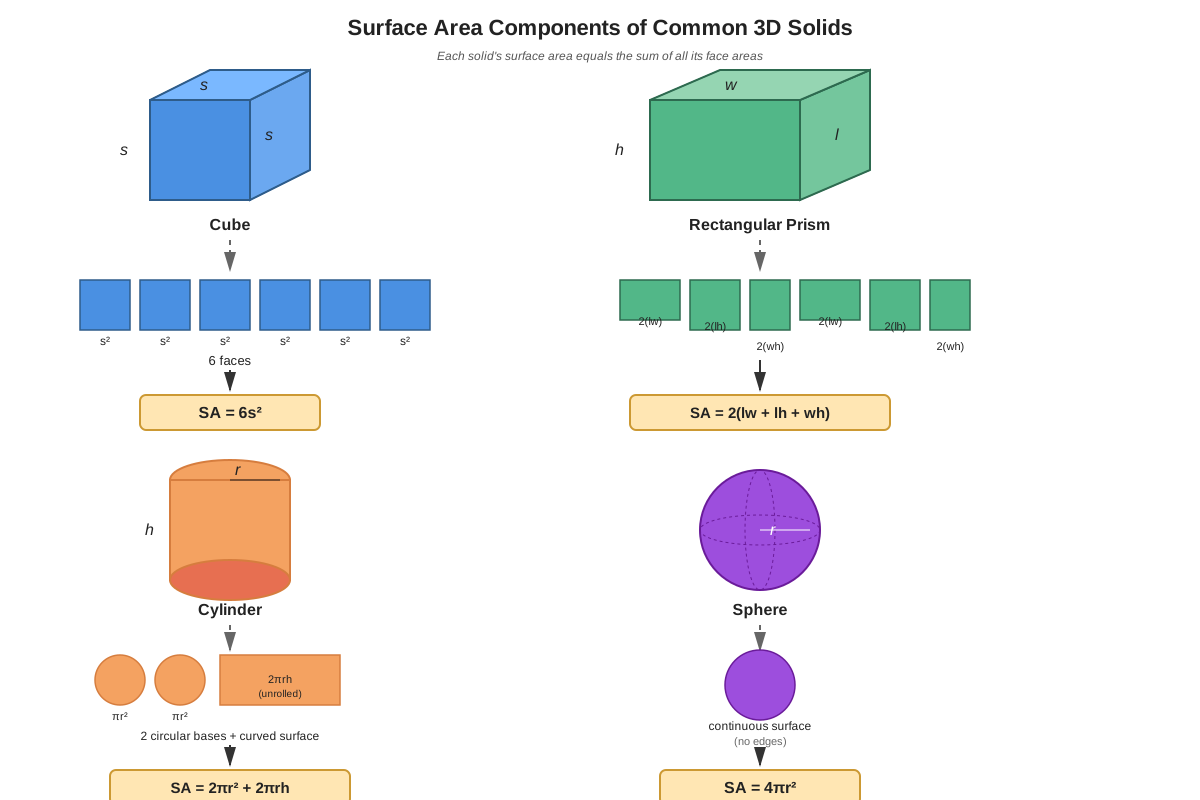
A rectangular solid has six rectangular faces arranged in three pairs of congruent (identical) opposite faces. If the dimensions are length (l), width (w), and height (h), the surface area formula is:
Surface Area = 2lw + 2lh + 2wh = 2(lw + lh + wh)This formula accounts for:
- Two faces with area lw (top and bottom)
- Two faces with area lh (front and back)
- Two faces with area wh (left and right sides)
The factor of 2 appears because opposite faces are congruent. Understanding this decomposition helps when dealing with problems where certain faces are excluded (such as an open box) or when dimensions must be determined from given surface area.
Cube
A cube is a special case of a rectangular solid where all edges have equal length (s). Since all six faces are congruent squares, the surface area formula simplifies dramatically:
Surface Area = 6s²This elegant formula makes cube problems particularly amenable to algebraic manipulation. When the GMAT provides surface area and asks for edge length, students can solve: s² = (Surface Area)/6, then take the square root. Conversely, doubling the edge length of a cube multiplies the surface area by 4 (since area scales with the square of linear dimensions), a relationship frequently tested in ratio problems.
Cylinder
A cylinder consists of two circular bases and one rectangular lateral surface that wraps around the circumference. If the radius is r and the height is h, the surface area formula is:
Surface Area = 2πr² + 2πrh = 2πr(r + h)Breaking this down:
- 2πr² accounts for the two circular bases (top and bottom), each with area πr²
- 2πrh represents the lateral (curved) surface area, which "unrolls" into a rectangle with width equal to the circumference (2πr) and height h
The GMAT sometimes tests cylinders with one or both bases removed (such as a pipe or tube), requiring students to adjust the formula accordingly. Understanding the component parts enables flexible application rather than rote memorization.
Sphere
A sphere has a single continuous curved surface with no edges or vertices. For a sphere with radius r, the surface area formula is:
Surface Area = 4πr²This formula is exactly four times the area of a great circle (a cross-sectional circle through the sphere's center). While sphere problems appear less frequently than rectangular solid or cylinder problems on the GMAT, they do occur, particularly in Data Sufficiency questions or problems involving ratios of surface area to volume.
Composite Solids
Many GMAT problems involve composite solids—shapes formed by combining or modifying basic geometric solids. Common examples include:
- Open boxes: Rectangular solids missing the top face (surface area = 2lw + 2lh + 2wh - lw = lw + 2lh + 2wh)
- L-shaped prisms: Can be decomposed into multiple rectangular solids
- Cylinders with hemispheres: Such as a capsule shape
The strategy for composite solids involves:
- Decomposing the shape into recognizable components
- Calculating surface area for each component
- Adjusting for internal faces that don't contribute to external surface area
- Summing the contributing surfaces
Surface Area vs. Volume Relationships
A critical conceptual distinction involves understanding how surface area and volume scale differently with dimension changes. When all linear dimensions of a solid are multiplied by a factor k:
- Surface area multiplies by k²
- Volume multiplies by k³
This relationship explains why larger objects have proportionally less surface area relative to volume—a principle with applications in biology, physics, and engineering. The GMAT tests this through problems asking about the effect of dimension changes on surface area or comparing ratios of surface area to volume.
| Dimension Change | Surface Area Change | Volume Change |
|---|---|---|
| Double all dimensions (×2) | Multiply by 4 (×2²) | Multiply by 8 (×2³) |
| Triple all dimensions (×3) | Multiply by 9 (×3²) | Multiply by 27 (×3³) |
| Halve all dimensions (×0.5) | Multiply by 0.25 (×0.5²) | Multiply by 0.125 (×0.5³) |
Concept Relationships
Surface area concepts form an interconnected network within geometry. At the foundation, two-dimensional area formulas (rectangles, circles, triangles) serve as building blocks for calculating individual face areas. These combine through addition and multiplication to yield total surface area for three-dimensional solids.
The relationship flows: Basic 2D shapes → Individual face calculations → Surface area of regular solids → Surface area of composite solids. Simultaneously, surface area connects laterally to volume calculations, as both measure properties of the same three-dimensional objects but capture different attributes (boundary vs. interior).
Surface area also connects to algebraic reasoning when problems provide surface area and require solving for unknown dimensions, creating the pathway: Given surface area → Set up equation → Algebraic manipulation → Solve for dimension. This often involves quadratic equations when dealing with squared terms in surface area formulas.
Additionally, surface area relates to ratio and proportion concepts when comparing similar solids or analyzing how dimension changes affect surface area. The scaling relationship (surface area scales with the square of linear dimensions) connects to exponent rules and proportional reasoning.
Finally, surface area problems frequently incorporate optimization concepts, particularly in Data Sufficiency questions that ask whether given information suffices to determine a unique surface area value, connecting to logical reasoning and sufficiency analysis.
Quick check — test yourself on Surface area so far.
Try Flashcards →High-Yield Facts
⭐ The surface area of a rectangular solid with dimensions l, w, and h is 2(lw + lh + wh)
⭐ The surface area of a cube with edge length s is 6s²
⭐ The surface area of a cylinder with radius r and height h is 2πr² + 2πrh
⭐ When all dimensions of a solid are multiplied by k, surface area multiplies by k²
⭐ Surface area is measured in square units, while volume is measured in cubic units
- The surface area of a sphere with radius r is 4πr²
- An open box (rectangular solid missing the top) has surface area lw + 2lh + 2wh
- The lateral surface area of a cylinder (excluding the circular bases) is 2πrh
- For a cube, the ratio of surface area to volume is 6/s, which decreases as the cube gets larger
- Doubling all dimensions of any solid quadruples its surface area but multiplies volume by 8
- The minimum surface area for a given volume occurs when the shape is as "spherical" as possible; among rectangular solids, a cube minimizes surface area for a given volume
Common Misconceptions
Misconception: Surface area and volume are the same thing or can be used interchangeably.
Correction: Surface area measures the total area of external faces (in square units), while volume measures the space contained within the solid (in cubic units). They are fundamentally different measurements with different formulas and applications.
Misconception: The surface area formula for a rectangular solid is lwh.
Correction: The formula lwh calculates volume, not surface area. Surface area for a rectangular solid is 2(lw + lh + wh), accounting for all six faces.
Misconception: When dimensions double, surface area also doubles.
Correction: When all linear dimensions are multiplied by a factor k, surface area multiplies by k². Doubling dimensions quadruples surface area, tripling dimensions multiplies surface area by 9, etc.
Misconception: A cylinder's lateral surface area is πrh.
Correction: The lateral surface area (the curved surface, excluding the circular bases) is 2πrh, not πrh. The factor of 2 comes from the full circumference 2πr.
Misconception: For composite solids, simply add the surface areas of individual components.
Correction: When shapes are joined, internal faces (where components connect) do not contribute to external surface area and must be subtracted. Only exposed external surfaces count toward total surface area.
Misconception: All six faces of a rectangular solid must be included in surface area calculations.
Correction: Some problems involve open boxes, containers without lids, or other configurations where certain faces are absent. Carefully read the problem to determine which faces are actually present.
Misconception: The surface area of a sphere is πr².
Correction: The formula πr² gives the area of a circle (a two-dimensional shape). The surface area of a sphere is 4πr², exactly four times the area of a great circle.
Worked Examples
Example 1: Rectangular Solid Surface Area Calculation
Problem: A rectangular box has length 8 inches, width 5 inches, and height 3 inches. What is the total surface area of the box?
Solution:
Step 1: Identify the shape and appropriate formula.
This is a rectangular solid with all six faces present, so we use: Surface Area = 2(lw + lh + wh)
Step 2: Identify the given dimensions.
- Length (l) = 8 inches
- Width (w) = 5 inches
- Height (h) = 3 inches
Step 3: Calculate the area of each pair of faces.
- Top and bottom faces: lw = 8 × 5 = 40 square inches
- Front and back faces: lh = 8 × 3 = 24 square inches
- Left and right faces: wh = 5 × 3 = 15 square inches
Step 4: Apply the formula.
Surface Area = 2(lw + lh + wh)
Surface Area = 2(40 + 24 + 15)
Surface Area = 2(79)
Surface Area = 158 square inches
Answer: 158 square inches
Connection to Learning Objectives: This example demonstrates the application of surface area formulas to a standard GMAT shape (rectangular solid) and shows the systematic approach of identifying faces, calculating individual areas, and summing appropriately.
Example 2: Cylinder with Optimization Context
Problem: A cylindrical can must hold exactly 250π cubic centimeters of liquid. If the can is designed to minimize the amount of material used (surface area), and the radius equals the height, what is the surface area of the can?
Solution:
Step 1: Set up the volume constraint.
Volume of cylinder = πr²h = 250π
Since r = h (given constraint), we have: πr²(r) = 250π
This simplifies to: πr³ = 250π
Step 2: Solve for the radius.
r³ = 250
r = ∛250 = ∛(125 × 2) = 5∛2 cm
Step 3: Determine the height.
Since h = r, we have h = 5∛2 cm
Step 4: Calculate surface area using the cylinder formula.
Surface Area = 2πr² + 2πrh = 2πr(r + h)
Since r = h: Surface Area = 2πr(r + r) = 2πr(2r) = 4πr²
Step 5: Substitute the value of r.
Surface Area = 4π(5∛2)²
Surface Area = 4π(25 × ∛4)
Surface Area = 100π∛4 cm²
Alternatively, calculating numerically:
r ≈ 6.3 cm
Surface Area = 4π(6.3)² ≈ 4π(39.69) ≈ 498.8 cm²
Answer: 100π∛4 cm² (or approximately 499 cm²)
Connection to Learning Objectives: This problem integrates surface area with volume constraints, demonstrates algebraic manipulation to find unknown dimensions, and shows how optimization contexts appear in GMAT problems. It also illustrates the importance of working with both exact and approximate values.
Exam Strategy
When approaching GMAT surface area questions, begin by carefully reading the problem to identify the specific three-dimensional shape involved. Look for trigger words such as "rectangular box," "cube," "cylindrical container," "spherical," "tank," "can," or "packaging." These immediately signal which formula to apply.
For Problem Solving questions, follow this systematic approach:
- Sketch the shape if not provided, labeling all given dimensions
- Identify which formula applies (rectangular solid, cube, cylinder, sphere)
- Determine if all faces are present or if modifications are needed (open box, tube without ends)
- Substitute known values into the formula
- Perform calculations carefully, watching for arithmetic errors with squared terms
- Verify that your answer has appropriate square units
For Data Sufficiency questions, focus on what information is necessary to calculate surface area:
- For a rectangular solid: need all three dimensions (l, w, h) or equivalent information
- For a cube: need only the edge length (one dimension determines everything)
- For a cylinder: need both radius and height
- For a sphere: need only the radius
Watch for sufficient but indirect information, such as volume plus one dimension (allowing calculation of other dimensions), or relationships between dimensions (such as "height equals twice the radius").
Time management: Surface area problems typically require 1.5-2.5 minutes. If a problem involves complex composite shapes or requires solving a system of equations, consider whether the time investment is worthwhile or if you should make an educated guess and move forward.
Process of elimination tips:
- Eliminate answers with incorrect units (cubic instead of square)
- Eliminate answers that seem unreasonably large or small relative to given dimensions
- For scaling problems, eliminate answers that don't reflect the k² relationship
- Check whether answer choices suggest a particular approach (exact vs. approximate values)
Memory Techniques
Mnemonic for Rectangular Solid: "Two Long Walls, Two Long Halls, Two Wide Halls" reminds you of the three pairs of faces: 2lw, 2lh, 2wh.
Visualization Strategy for Cylinders: Picture "unrolling" the curved surface into a rectangle. The width of this rectangle equals the circumference (2πr), and the height remains h, giving lateral area = 2πrh. Then add the two circular "caps" (2πr²).
Acronym for Surface Area Components: FACE = Find All Component Exteriors. This reminds you to identify every external surface before calculating.
Scaling Memory Device: "Square for Surface, Cube for Content" reminds you that surface area scales with the square (k²) of dimension changes, while volume (content) scales with the cube (k³).
Sphere Formula Memory: The surface area of a sphere (4πr²) is exactly four times the area of its "shadow" (the great circle with area πr²). Visualize four circles covering the sphere's surface.
Cube Quick Check: For a cube, remember "Six Squares" (6s²). The number 6 for six faces, and s² because each face is a square.
Summary
Surface area represents the total area of all external faces of a three-dimensional solid, measured in square units. Mastering GMAT surface area questions requires knowing the formulas for common shapes—rectangular solids (2(lw + lh + wh)), cubes (6s²), cylinders (2πr² + 2πrh), and spheres (4πr²)—and understanding how to apply them in various contexts. Critical concepts include recognizing that surface area scales with the square of linear dimensions (not linearly), distinguishing surface area from volume, and adapting formulas for modified shapes like open boxes or composite solids. Success on GMAT surface area problems depends on systematic problem decomposition: identifying the shape, determining which faces contribute to external surface area, applying appropriate two-dimensional area formulas to each face, and summing correctly. For Data Sufficiency questions, understanding what information is necessary and sufficient to determine surface area is essential. The most common errors involve confusing surface area with volume, forgetting to account for all faces, and incorrectly applying scaling relationships when dimensions change.
Key Takeaways
- Surface area measures the total external boundary of a three-dimensional solid in square units, distinct from volume which measures interior space in cubic units
- The four most important formulas are: rectangular solid 2(lw + lh + wh), cube 6s², cylinder 2πr² + 2πrh, and sphere 4πr²
- When all dimensions of a solid are multiplied by factor k, surface area multiplies by k² (not k)
- For composite or modified shapes, identify all external surfaces and exclude any internal faces where components join
- Data Sufficiency questions require determining whether given information provides enough constraints to calculate a unique surface area value
- Systematic problem-solving involves sketching the shape, identifying the appropriate formula, checking for modifications, and verifying units
- Surface area problems frequently combine with algebra (solving for unknown dimensions), ratios (comparing similar solids), and optimization (minimizing material for given volume)
Related Topics
Volume of Three-Dimensional Solids: Understanding volume formulas and calculations complements surface area knowledge, as many GMAT problems require both measurements or test the relationship between them. Mastering surface area provides the geometric foundation for volume problems.
Similar Solids and Scaling: Advanced problems involving proportional reasoning with three-dimensional shapes build directly on surface area concepts, particularly the k² scaling relationship for areas and k³ for volumes.
Coordinate Geometry in Three Dimensions: Some higher-difficulty problems place geometric solids in coordinate systems, requiring integration of surface area concepts with coordinate geometry skills.
Optimization Problems: Business-context problems involving minimizing packaging costs or maximizing efficiency often require surface area calculations combined with constraint analysis.
Practice CTA
Now that you've mastered the core concepts of surface area, it's time to solidify your understanding through active practice. Attempt the practice questions to apply these formulas and strategies to realistic GMAT problems, and use the flashcards to reinforce quick recall of key formulas and relationships. Remember, surface area questions reward systematic thinking and careful attention to which faces contribute to the total—skills that improve dramatically with deliberate practice. Each problem you solve strengthens your spatial reasoning and builds the confidence needed to tackle these high-yield questions efficiently on test day!
Sign up free to keep reading
Create a free AnvayaPrep account to finish this GMAT guide on Surface area — plus flashcards and practice questions.