Overview
Volume is a fundamental geometric concept that measures the three-dimensional space occupied by a solid object. On the GMAT, volume problems test a student's ability to visualize three-dimensional shapes, apply formulas accurately, and solve complex multi-step problems involving spatial reasoning. Understanding gmat volume questions is critical because they frequently appear in the Quantitative Reasoning section, often combined with other geometric concepts such as surface area, ratios, and coordinate geometry.
Volume problems on the GMAT range from straightforward formula application to complex word problems involving real-world scenarios like filling containers, comparing capacities, or optimizing dimensions. These questions assess not only computational skills but also conceptual understanding of how changing one dimension affects the overall volume. Mastery of volume calculations enables students to tackle approximately 10-15% of geometry questions on the exam, making it a high-yield topic that directly impacts overall Quantitative scores.
The concept of volume connects deeply with other Quantitative Reasoning topics including area calculations, algebraic manipulation, ratios and proportions, and problem-solving strategies. Volume questions often require students to work backwards from given information, set up equations involving multiple variables, or recognize relationships between similar solids. A strong foundation in volume calculations provides the spatial reasoning skills necessary for advanced geometry problems and data sufficiency questions that test conceptual understanding rather than mere computation.
Learning Objectives
- [ ] Identify volume as the three-dimensional space occupied by a solid object
- [ ] Explain volume formulas for common geometric solids tested on the GMAT
- [ ] Apply volume concepts to solve GMAT questions efficiently and accurately
- [ ] Calculate volumes of composite solids by breaking them into simpler shapes
- [ ] Determine how changes in dimensions affect volume through scaling relationships
- [ ] Solve data sufficiency questions involving volume by identifying necessary information
- [ ] Convert between different units of volume measurement
Prerequisites
- Basic algebra: Ability to manipulate equations and solve for unknown variables is essential for working with volume formulas where dimensions must be calculated
- Exponent rules: Understanding how to work with squared and cubed terms is necessary since volume involves three-dimensional measurements
- Area calculations: Knowledge of two-dimensional area formulas provides the foundation for understanding volume as area extended through a third dimension
- Basic geometry: Familiarity with properties of common shapes (rectangles, circles, triangles) is required to recognize and work with three-dimensional solids
- Unit conversions: Ability to convert between measurement units helps solve problems involving different scales or mixed units
Why This Topic Matters
Volume calculations have extensive real-world applications in engineering, architecture, manufacturing, logistics, and everyday decision-making. From determining the capacity of storage containers to calculating medication dosages, understanding volume is essential for practical problem-solving. In business contexts, volume calculations help optimize packaging, estimate shipping costs, and manage inventory space—skills directly relevant to MBA candidates.
On the GMAT, volume questions appear in approximately 3-5 questions per exam, representing a significant portion of the geometry subsection. These questions typically manifest in three formats: problem-solving questions requiring direct calculation, word problems embedding volume in real-world scenarios, and data sufficiency questions testing conceptual understanding of what information is necessary to determine volume. The GMAT particularly favors questions involving rectangular solids, cylinders, and composite shapes, with occasional problems featuring spheres or cones.
Volume questions frequently serve as medium-to-difficult problems that separate high scorers from average performers. They often combine multiple concepts—requiring students to first calculate a missing dimension using area or perimeter, then apply that result to find volume. The GMAT also tests volume through ratio problems (comparing volumes of similar solids), optimization questions (maximizing volume given constraints), and rate problems (filling or emptying containers). Mastering volume concepts provides a competitive advantage in achieving scores above the 70th percentile.
Core Concepts
Definition of Volume
Volume represents the amount of three-dimensional space enclosed within a solid object, measured in cubic units. Unlike area, which measures two-dimensional space, volume requires three dimensions: length, width, and height (or their equivalents). The fundamental principle underlying all volume calculations is that volume equals the area of a base multiplied by the height perpendicular to that base. This principle applies universally, whether calculating the volume of a simple rectangular box or a complex composite solid.
Volume is always expressed in cubic units—cubic inches (in³), cubic feet (ft³), cubic centimeters (cm³), or cubic meters (m³). Understanding unit conversions is crucial: if linear dimensions are given in feet, the volume will be in cubic feet. Converting between units requires cubing the conversion factor: if 1 foot = 12 inches, then 1 cubic foot = 12³ = 1,728 cubic inches.
Rectangular Solid (Box)
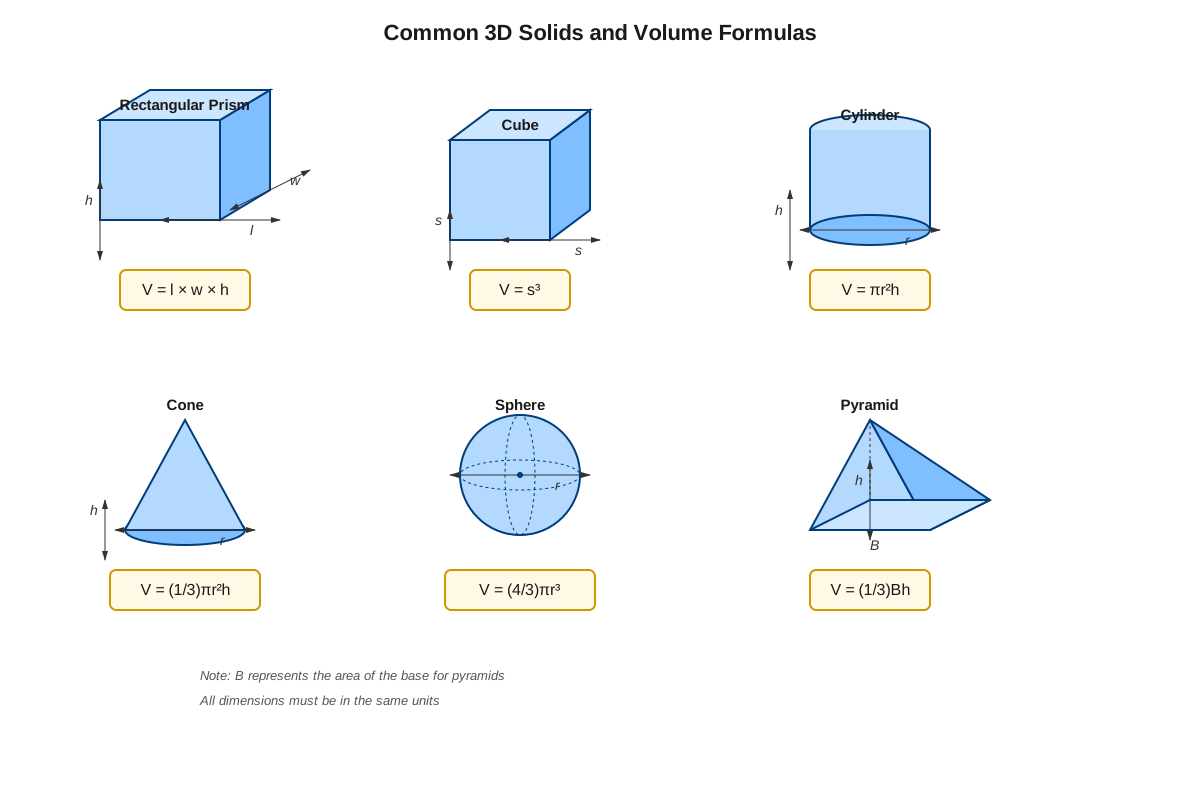
The rectangular solid, also called a rectangular prism or box, is the most frequently tested three-dimensional shape on the GMAT. Its volume formula is:
Volume = length × width × height
V = l × w × h
All faces of a rectangular solid are rectangles, and opposite faces are congruent. A special case is the cube, where all edges are equal (l = w = h), giving the simplified formula V = s³, where s represents the side length.
Key properties of rectangular solids:
- Contains 6 rectangular faces, 12 edges, and 8 vertices
- Opposite faces are parallel and congruent
- All angles are right angles (90°)
- The diagonal through the interior can be calculated using: d = √(l² + w² + h²)
GMAT questions often provide volume and two dimensions, requiring calculation of the third dimension, or they may describe constraints that require setting up algebraic equations.
Cylinder
A cylinder consists of two parallel circular bases connected by a curved surface. The volume formula is:
Volume = π × radius² × height
V = πr²h
This formula derives from the principle that volume equals base area times height. Since the base is a circle with area πr², multiplying by height h gives the total volume.
Important cylinder concepts:
- The radius is the distance from the center to the edge of the circular base
- Height is the perpendicular distance between the two circular bases
- If given diameter instead of radius, remember r = d/2
- The curved surface area (lateral area) is 2πrh, while total surface area is 2πrh + 2πr²
GMAT cylinder problems often involve containers being filled with liquid, comparing volumes of cylinders with different dimensions, or calculating how many smaller cylinders fit into a larger one.
Cone
A cone has a circular base and tapers to a single point (apex) at a height perpendicular to the base. The volume formula is:
Volume = (1/3) × π × radius² × height
V = (1/3)πr²h
The factor of 1/3 appears because a cone occupies exactly one-third the volume of a cylinder with the same base radius and height. This relationship is frequently tested on the GMAT.
Key cone properties:
- The slant height (l) is the distance from the apex to any point on the circular base edge
- The relationship between slant height, radius, and height follows the Pythagorean theorem: l² = r² + h²
- Volume depends only on the perpendicular height, not the slant height
Sphere
A sphere is a perfectly round three-dimensional object where every point on the surface is equidistant from the center. The volume formula is:
Volume = (4/3) × π × radius³
V = (4/3)πr³
Sphere concepts for the GMAT:
- Only one measurement (radius or diameter) is needed to determine volume
- If given diameter, use r = d/2 before applying the formula
- Surface area of a sphere is 4πr², which sometimes appears in related questions
- Spheres have the maximum volume for a given surface area among all shapes
While less common than rectangular solids or cylinders, sphere problems appear occasionally, often in comparison questions or word problems involving balls, tanks, or planets.
Composite Solids
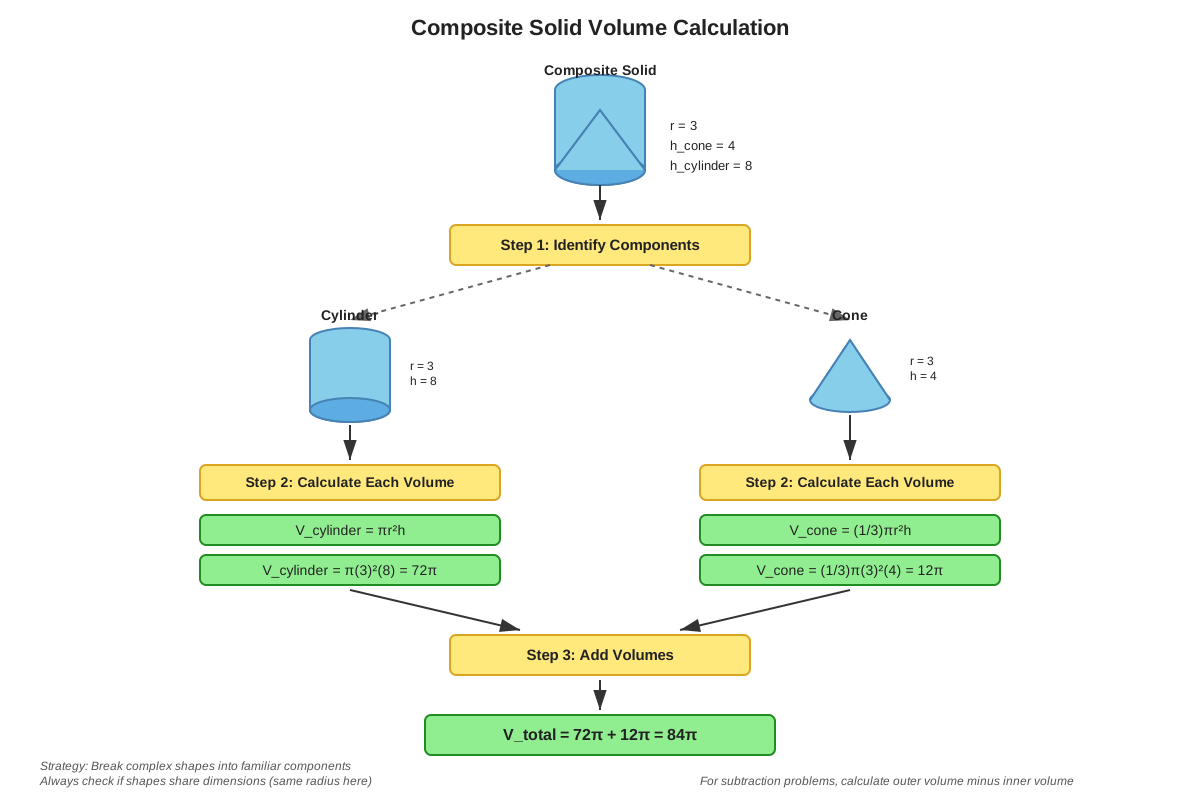
Composite solids are three-dimensional figures formed by combining or subtracting simpler shapes. The GMAT frequently tests the ability to break complex shapes into manageable components.
Strategies for composite solids:
- Identify the individual simple shapes that comprise the composite solid
- Calculate the volume of each component separately
- Add volumes if shapes are combined; subtract if one is removed from another
- Watch for shared dimensions between components
Common examples include:
- A cylinder with a hemisphere on top (add cylinder volume + half-sphere volume)
- A rectangular solid with a cylindrical hole drilled through it (subtract cylinder from box)
- An L-shaped solid (break into two or three rectangular solids)
Volume Scaling and Similar Solids
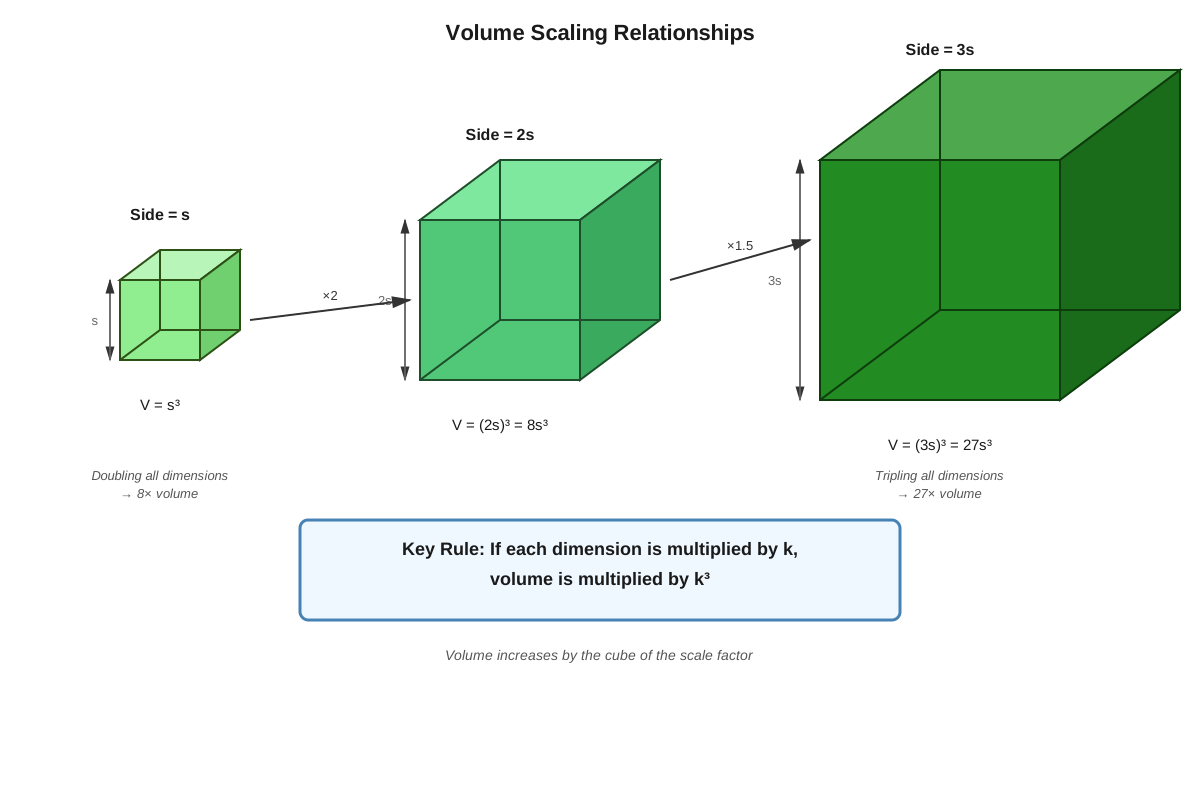
When all linear dimensions of a solid are multiplied by a scale factor k, the volume is multiplied by k³. This scaling relationship is a high-yield concept for the GMAT:
- If dimensions are doubled (k = 2), volume increases by 2³ = 8 times
- If dimensions are tripled (k = 3), volume increases by 3³ = 27 times
- If dimensions are halved (k = 1/2), volume becomes (1/2)³ = 1/8 of the original
For similar solids (same shape, different size), if the ratio of corresponding linear dimensions is a:b, then the ratio of volumes is a³:b³. This principle applies to all three-dimensional shapes and is frequently tested in ratio problems.
Volume Comparison Table
| Shape | Volume Formula | Key Variables | Special Notes |
|---|---|---|---|
| Rectangular Solid | V = lwh | l, w, h = dimensions | Cube: V = s³ |
| Cylinder | V = πr²h | r = radius, h = height | Base area × height |
| Cone | V = (1/3)πr²h | r = radius, h = height | 1/3 of cylinder volume |
| Sphere | V = (4/3)πr³ | r = radius | Only needs one measurement |
| Pyramid | V = (1/3)Bh | B = base area, h = height | 1/3 of prism volume |
Concept Relationships
Volume concepts form an interconnected web of geometric and algebraic relationships. At the foundation, area calculations provide the base for volume formulas, since volume fundamentally equals base area multiplied by height. This connection means that mastering two-dimensional geometry directly supports three-dimensional problem-solving.
The relationship flow: Basic shapes (2D) → Area formulas → Volume formulas (3D) → Composite solids → Optimization problems
Within volume concepts, the cylinder-cone-sphere relationship is particularly important. A cone with the same base and height as a cylinder has exactly 1/3 the volume, while a sphere with radius equal to the cylinder's radius and height equal to the diameter has volume (4/3)πr³. Understanding these proportional relationships enables quick comparisons without full calculations.
Scaling relationships connect volume to ratio and proportion concepts. When linear dimensions change by a factor, area changes by the square of that factor, and volume by the cube. This principle links to exponent rules and algebraic manipulation, as students must work with squared and cubed terms.
Volume problems frequently require working backwards from given information, connecting to equation-solving skills. For example, if given volume and two dimensions, students must rearrange formulas to isolate the unknown dimension. This connects volume to algebraic problem-solving and data sufficiency reasoning.
The progression to composite solids represents synthesis of multiple concepts: spatial visualization, addition/subtraction of volumes, and recognition of component shapes. This connects to problem decomposition strategies used throughout GMAT Quantitative Reasoning.
Finally, volume connects to unit conversion and dimensional analysis, as problems may require converting between cubic inches and cubic feet, or liters and cubic centimeters. This relationship emphasizes the importance of tracking units throughout calculations.
High-Yield Facts
⭐ Volume is always measured in cubic units (in³, ft³, cm³, m³), and converting linear units requires cubing the conversion factor.
⭐ The volume of a rectangular solid is V = length × width × height, and a cube is a special case where V = s³.
⭐ A cylinder's volume is V = πr²h, which equals the circular base area multiplied by height.
⭐ A cone has exactly 1/3 the volume of a cylinder with the same base radius and height: V = (1/3)πr²h.
⭐ When all dimensions of a solid are scaled by factor k, the volume is multiplied by k³, not k.
- A sphere's volume is V = (4/3)πr³, requiring only the radius for complete determination.
- For composite solids, calculate each component's volume separately, then add or subtract as appropriate.
- The diagonal through a rectangular solid is d = √(l² + w² + h²), extending the Pythagorean theorem to three dimensions.
- Similar solids with linear dimension ratio a:b have volume ratio a³:b³.
- A pyramid has volume V = (1/3)Bh, where B is the base area and h is the perpendicular height.
- Doubling all dimensions of any solid increases its volume by a factor of 8 (2³ = 8).
- The volume of a cylinder remains constant if you increase radius by factor k and decrease height by factor k², maintaining πr²h.
- When a problem gives volume in one unit and dimensions in another, convert before calculating.
- For data sufficiency questions, you need exactly three independent pieces of information to determine the volume of a rectangular solid.
- The volume of water displaced by a submerged object equals the volume of that object (Archimedes' principle, occasionally tested).
Quick check — test yourself on Volume so far.
Try Flashcards →Common Misconceptions
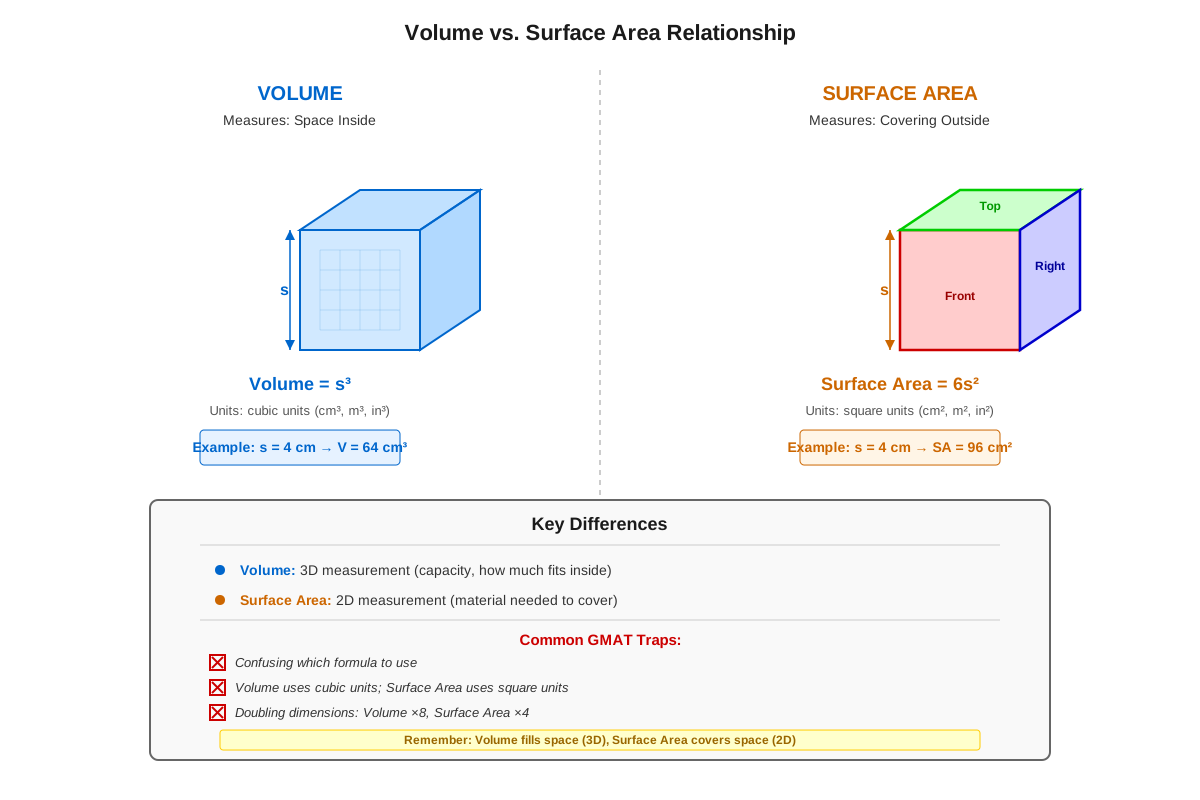
Misconception: Volume and surface area are the same thing or can be calculated using the same formula.
Correction: Volume measures three-dimensional space (cubic units) while surface area measures the total area of all outer surfaces (square units). They require completely different formulas and represent distinct concepts. A rectangular solid with dimensions 2×3×4 has volume 24 cubic units but surface area 2(2×3 + 2×4 + 3×4) = 52 square units.
Misconception: When you double the dimensions of a solid, you double its volume.
Correction: Doubling all linear dimensions multiplies volume by 2³ = 8, not 2. This is because volume depends on three dimensions multiplied together. If a cube has side length 2 (volume = 8), doubling to side length 4 gives volume = 64, which is 8 times larger.
Misconception: The slant height of a cone can be used directly in the volume formula.
Correction: The volume formula V = (1/3)πr²h requires the perpendicular height from base to apex, not the slant height. If given slant height l and radius r, you must first calculate h = √(l² - r²) using the Pythagorean theorem before finding volume.
Misconception: A cylinder and cone with the same radius and height have similar volumes.
Correction: A cone has exactly 1/3 the volume of a cylinder with identical dimensions. This is a fixed mathematical relationship, not an approximation. If a cylinder has volume 90 cm³, a cone with the same base and height has volume 30 cm³.
Misconception: You can find the volume of a rectangular solid if you know only the surface area.
Correction: Surface area alone is insufficient to determine volume uniquely. Multiple different rectangular solids can have the same surface area but different volumes. For example, a 1×1×7 box and a 1×2×4 box have different volumes (7 vs. 8) but could have similar surface areas. You need three independent dimensions or equivalent information.
Misconception: π can be approximated as 3 for quick calculations on the GMAT.
Correction: While π ≈ 3.14159, the GMAT typically leaves π in the answer choices rather than requiring decimal approximation. Using 3 instead of π introduces significant error (about 4.5%) and may lead to selecting an incorrect answer. Keep π as a symbol throughout calculations and match your answer to the choice containing π.
Misconception: The volume of a composite solid is always the sum of its component volumes.
Correction: When one shape is removed from another (like a cylindrical hole drilled through a rectangular solid), you must subtract volumes. Always carefully read whether shapes are combined (add) or one is removed from another (subtract). Visualization and sketching help determine the correct operation.
Worked Examples
Example 1: Rectangular Solid with Constraint
Problem: A rectangular water tank has a square base and a height of 6 feet. If the volume of the tank is 150 cubic feet, what is the length of one side of the base?
Solution:
Step 1: Identify the given information and what we need to find.
- The base is square, so length = width (let's call this dimension s)
- Height h = 6 feet
- Volume V = 150 cubic feet
- Find: side length s of the square base
Step 2: Write the volume formula for a rectangular solid.
V = length × width × height
Step 3: Substitute known values, recognizing that length = width = s.
150 = s × s × 6
150 = s² × 6
Step 4: Solve for s².
s² = 150/6
s² = 25
Step 5: Solve for s.
s = √25 = 5 feet
Step 6: Verify the answer.
V = 5 × 5 × 6 = 150 ✓
Answer: The side length of the square base is 5 feet.
Connection to Learning Objectives: This problem demonstrates applying volume formulas to GMAT questions by working backwards from volume to find a dimension, and it reinforces the concept that rectangular solids require three dimensions (even when two are equal).
Example 2: Cylinder and Scaling Relationship
Problem: A cylindrical container has a radius of 4 inches and a height of 9 inches. If a similar cylindrical container has a radius of 8 inches, what is the ratio of the volume of the smaller container to the volume of the larger container?
Solution:
Step 1: Recognize this is a scaling problem with similar solids.
- Small cylinder: r₁ = 4 inches, h₁ = 9 inches
- Large cylinder: r₂ = 8 inches, h₂ = ?
Step 2: Determine the scale factor.
The radius doubled from 4 to 8, so k = 2.
For similar solids, all dimensions scale by the same factor.
Therefore, h₂ = 9 × 2 = 18 inches.
Step 3: Apply the volume scaling principle.
When linear dimensions are multiplied by k, volume is multiplied by k³.
Since k = 2, the volume ratio is 1 : 2³ = 1 : 8.
Alternative approach (calculating actual volumes):
Step 4: Calculate volume of smaller cylinder.
V₁ = πr₁²h₁ = π(4²)(9) = π(16)(9) = 144π cubic inches
Step 5: Calculate volume of larger cylinder.
V₂ = πr₂²h₂ = π(8²)(18) = π(64)(18) = 1,152π cubic inches
Step 6: Find the ratio.
V₁ : V₂ = 144π : 1,152π = 144 : 1,152 = 1 : 8
Answer: The ratio of the smaller volume to the larger volume is 1:8.
Connection to Learning Objectives: This problem illustrates how changes in dimensions affect volume through scaling relationships, a critical concept for efficiently solving GMAT comparison questions without lengthy calculations.
Example 3: Composite Solid
Problem: A decorative piece consists of a cylinder with a hemisphere (half-sphere) attached to the top. The cylinder has a radius of 3 cm and a height of 10 cm. The hemisphere has the same radius as the cylinder. What is the total volume of the decorative piece?
Solution:
Step 1: Identify the component shapes.
- Cylinder: r = 3 cm, h = 10 cm
- Hemisphere: r = 3 cm (same as cylinder)
Step 2: Calculate the volume of the cylinder.
V_cylinder = πr²h = π(3²)(10) = π(9)(10) = 90π cm³
Step 3: Calculate the volume of the hemisphere.
A full sphere has volume V = (4/3)πr³
A hemisphere is half of that: V_hemisphere = (1/2) × (4/3)πr³ = (2/3)πr³
V_hemisphere = (2/3)π(3³) = (2/3)π(27) = 18π cm³
Step 4: Add the volumes (since shapes are combined).
V_total = V_cylinder + V_hemisphere = 90π + 18π = 108π cm³
Answer: The total volume is 108π cubic centimeters.
Connection to Learning Objectives: This problem demonstrates calculating volumes of composite solids by breaking them into simpler shapes, a common GMAT strategy for complex three-dimensional problems.
Exam Strategy
When approaching gmat volume questions, begin by carefully reading the problem to identify which three-dimensional shape(s) are involved. Sketch the solid if possible, labeling all given dimensions and marking what needs to be found. This visualization step prevents confusion between similar-sounding measurements like radius versus diameter, or height versus slant height.
Trigger words and phrases to watch for:
- "Rectangular container," "box," or "tank" → rectangular solid (V = lwh)
- "Cylindrical," "circular base," or "pipe" → cylinder (V = πr²h)
- "Cone-shaped" or "tapers to a point" → cone (V = (1/3)πr²h)
- "Spherical" or "ball" → sphere (V = (4/3)πr³)
- "Cube" → special rectangular solid (V = s³)
- "Capacity" or "holds" → volume problem
- "Dimensions are doubled/tripled" → scaling relationship (multiply volume by k³)
For data sufficiency questions on volume, remember that you need exactly three independent pieces of information to determine the volume of a rectangular solid. For a cylinder, you need radius and height (two pieces). For a sphere, you need only radius (one piece). Evaluate whether the given statements provide sufficient independent information, watching for disguised information (e.g., "the base is square" tells you length = width, reducing unknowns).
Process-of-elimination strategies:
- Eliminate answers with incorrect units (square units instead of cubic units)
- Check if the answer is reasonable in magnitude—volume should be larger than any single dimension
- For scaling problems, eliminate answers that don't reflect the k³ relationship
- If π appears in the problem, it should typically appear in the answer
- For composite solids, eliminate answers that only account for one component
Time allocation: Straightforward volume calculations should take 1-1.5 minutes. Complex word problems or composite solids may require 2-2.5 minutes. If a problem seems to require extensive calculation, look for a shortcut using ratios, scaling relationships, or conceptual understanding rather than brute-force computation.
Common shortcuts:
- For similar solids, use the k³ scaling rule instead of calculating both volumes
- When comparing volumes, look for common factors that cancel
- If answer choices are far apart, estimate using simplified values (e.g., π ≈ 3)
- For composite solids, check if symmetry allows you to calculate one part and multiply
Always verify your answer makes sense: a volume cannot be negative, should have cubic units, and should be reasonable given the dimensions. If a box has dimensions around 5 units each, the volume should be around 125 cubic units, not 25 or 625.
Memory Techniques
Mnemonic for common volume formulas - "L-W-H, Pi-R-Squared-H, One-Third for Points":
- L-W-H: Rectangular solid = Length × Width × Height
- Pi-R-Squared-H: Cylinder = π × Radius² × Height (same as circle area × height)
- One-Third for Points: Cone and pyramid both use 1/3 in their formulas (shapes that taper to a point)
Visualization strategy for scaling: Picture a Rubik's cube. A 2×2×2 cube has 8 small cubes. A 3×3×3 cube has 27 small cubes. This physical model reinforces that tripling dimensions multiplies volume by 27 (3³), not 3.
Acronym for cylinder components - "RAH" (like cheering):
- R: Radius (from center to edge of circular base)
- A: Area of base (πr²)
- H: Height (perpendicular distance between bases)
Volume = A × H = πr²h
Memory hook for cone vs. cylinder: A cone is an ice cream cone—it holds less than a full cylinder (exactly 1/3). Imagine three ice cream cones filling one cylindrical container.
Sphere formula memory: "Four-thirds-pi-r-cubed" has a natural rhythm. Practice saying it aloud: "FOUR-thirds-PI-r-CUBED" with emphasis on the capitalized syllables. The rhythm helps recall during the exam.
Unit conversion reminder: "Cube the conversion" - When converting volume units, always cube the linear conversion factor. Write "³" next to your conversion to remind yourself: 1 ft = 12 in, so 1 ft³ = 12³ in³.
Summary
Volume measures the three-dimensional space occupied by a solid object and is expressed in cubic units. The GMAT tests volume through five primary shapes: rectangular solids (V = lwh), cylinders (V = πr²h), cones (V = (1/3)πr²h), spheres (V = (4/3)πr³), and composite solids formed by combining or subtracting these basic shapes. Mastery requires not only memorizing formulas but understanding the underlying principle that volume equals base area multiplied by perpendicular height. Critical concepts include the scaling relationship (when dimensions are multiplied by k, volume is multiplied by k³), the 1:3 ratio between cones and cylinders with identical dimensions, and strategies for decomposing composite solids into manageable components. Success on GMAT volume questions demands careful attention to units, ability to work backwards from volume to find dimensions, recognition of trigger words indicating specific shapes, and efficient use of shortcuts like scaling relationships instead of lengthy calculations. Students must distinguish between volume (cubic units) and surface area (square units), correctly apply perpendicular height rather than slant height in formulas, and recognize when data sufficiency questions provide adequate information to determine volume uniquely.
Key Takeaways
- Volume formulas for GMAT: Rectangular solid V = lwh, Cylinder V = πr²h, Cone V = (1/3)πr²h, Sphere V = (4/3)πr³
- When all dimensions scale by factor k, volume scales by k³—doubling dimensions multiplies volume by 8, not 2
- A cone has exactly 1/3 the volume of a cylinder with the same base radius and height
- Composite solids require calculating each component separately, then adding or subtracting volumes appropriately
- Volume is always measured in cubic units; converting linear units requires cubing the conversion factor
- For data sufficiency, a rectangular solid needs three independent pieces of information to determine volume uniquely
- Use perpendicular height in volume formulas, not slant height or diagonal measurements
Related Topics
Surface Area of Solids: Understanding how to calculate the total area of all faces of three-dimensional objects complements volume knowledge and frequently appears in combined problems where both volume and surface area must be determined or compared.
Coordinate Geometry in 3D: Extends two-dimensional coordinate concepts to three dimensions, using volume calculations to find distances and regions in three-dimensional space, building on the volume foundation established here.
Ratios and Proportions: Volume problems frequently involve comparing volumes of similar solids or determining how scaling affects volume, requiring strong ratio skills that connect directly to the k³ scaling relationship.
Optimization Problems: Advanced applications of volume include maximizing or minimizing volume subject to constraints, combining volume formulas with calculus concepts or algebraic inequality reasoning.
Rate Problems with Volume: Problems involving filling or emptying containers at specified rates combine volume calculations with time-rate-distance concepts, representing a synthesis of multiple quantitative reasoning skills.
Mastering volume provides the spatial reasoning foundation necessary for these advanced topics and represents a critical stepping stone toward comprehensive geometry proficiency on the GMAT.
Practice CTA
Now that you've mastered the core concepts of volume, it's time to reinforce your learning through active practice. Attempt the practice questions associated with this topic to test your ability to identify shapes, apply formulas accurately, and solve complex multi-step problems under timed conditions. Use the flashcards to drill the essential formulas and relationships until they become automatic. Remember, the difference between knowing a formula and applying it successfully under exam pressure comes from deliberate practice. Each problem you solve strengthens your pattern recognition and builds the confidence needed to tackle any volume question the GMAT presents. Your investment in practice now will pay dividends in points on test day!
Sign up free to keep reading
Create a free AnvayaPrep account to finish this GMAT guide on Volume — plus flashcards and practice questions.