Overview
Polygons are fundamental geometric figures that appear frequently throughout the GMAT Quantitative Reasoning section. A polygon is a closed, two-dimensional figure formed by three or more straight line segments that meet only at their endpoints. Understanding polygons is essential not only for direct geometry questions but also for word problems, data sufficiency questions, and integrated reasoning scenarios where spatial relationships must be analyzed. The GMAT tests polygon concepts in various contexts, from calculating perimeters and areas to determining angle measures and identifying special properties of regular and irregular figures.
Mastery of GMAT polygons provides the foundation for tackling more complex geometric problems involving coordinate geometry, three-dimensional figures, and optimization questions. Polygon questions on the GMAT often combine multiple concepts—such as properties of triangles, quadrilaterals, and other multi-sided figures—with algebraic reasoning and problem-solving strategies. The exam frequently presents polygon problems that require students to recognize patterns, apply formulas efficiently, and make logical deductions based on given constraints.
Within the broader Quantitative Reasoning framework, polygons serve as a bridge between basic geometric principles and advanced spatial reasoning. They connect directly to concepts such as angles, lines, triangles, circles, and coordinate geometry. A solid understanding of polygon properties enables test-takers to approach complex multi-step problems with confidence, recognize when to apply specific formulas, and eliminate incorrect answer choices systematically. Given that geometry comprises approximately 10-15% of GMAT Quantitative questions, and polygons represent a significant portion of these geometry problems, this topic deserves focused attention and thorough preparation.
Learning Objectives
- [ ] Identify polygons and distinguish them from non-polygonal figures
- [ ] Explain the properties and characteristics of various polygon types
- [ ] Apply polygon formulas and concepts to GMAT questions
- [ ] Calculate interior and exterior angles of regular and irregular polygons
- [ ] Determine perimeters and areas of common polygons using appropriate formulas
- [ ] Analyze relationships between different polygon types and their special properties
- [ ] Solve data sufficiency questions involving polygon characteristics
Prerequisites
- Basic angle relationships: Understanding complementary, supplementary, and vertical angles is essential for calculating polygon interior and exterior angles
- Triangle properties: Triangles are the simplest polygons and serve as building blocks for understanding more complex figures
- Algebraic manipulation: Solving equations and working with variables is necessary for polygon problems involving unknown side lengths or angle measures
- Area and perimeter concepts: Fundamental understanding of these measurements provides the foundation for polygon calculations
- Coordinate plane basics: Some polygon problems require plotting points and calculating distances in the xy-plane
Why This Topic Matters
Polygon questions appear in approximately 3-5 questions per GMAT exam, making them a high-yield topic for test preparation. These questions test not only geometric knowledge but also logical reasoning, pattern recognition, and the ability to synthesize multiple concepts simultaneously. The GMAT favors polygon problems because they efficiently assess mathematical maturity and problem-solving skills within time constraints.
In real-world applications, polygon concepts underpin architecture, engineering, computer graphics, urban planning, and design. Understanding how polygons tessellate, how their properties change with the number of sides, and how to optimize their dimensions for specific purposes has practical significance across numerous fields. For business school candidates, spatial reasoning skills developed through polygon study translate to data visualization, strategic planning, and analytical thinking.
On the GMAT, polygon questions commonly appear as:
- Problem Solving questions requiring direct calculation of angles, perimeters, or areas
- Data Sufficiency questions testing whether given information uniquely determines polygon properties
- Word problems embedding polygon concepts within real-world scenarios
- Integrated Reasoning questions combining polygon analysis with data interpretation
- Multi-step problems requiring decomposition of complex figures into simpler polygons
Core Concepts
Definition and Classification of Polygons
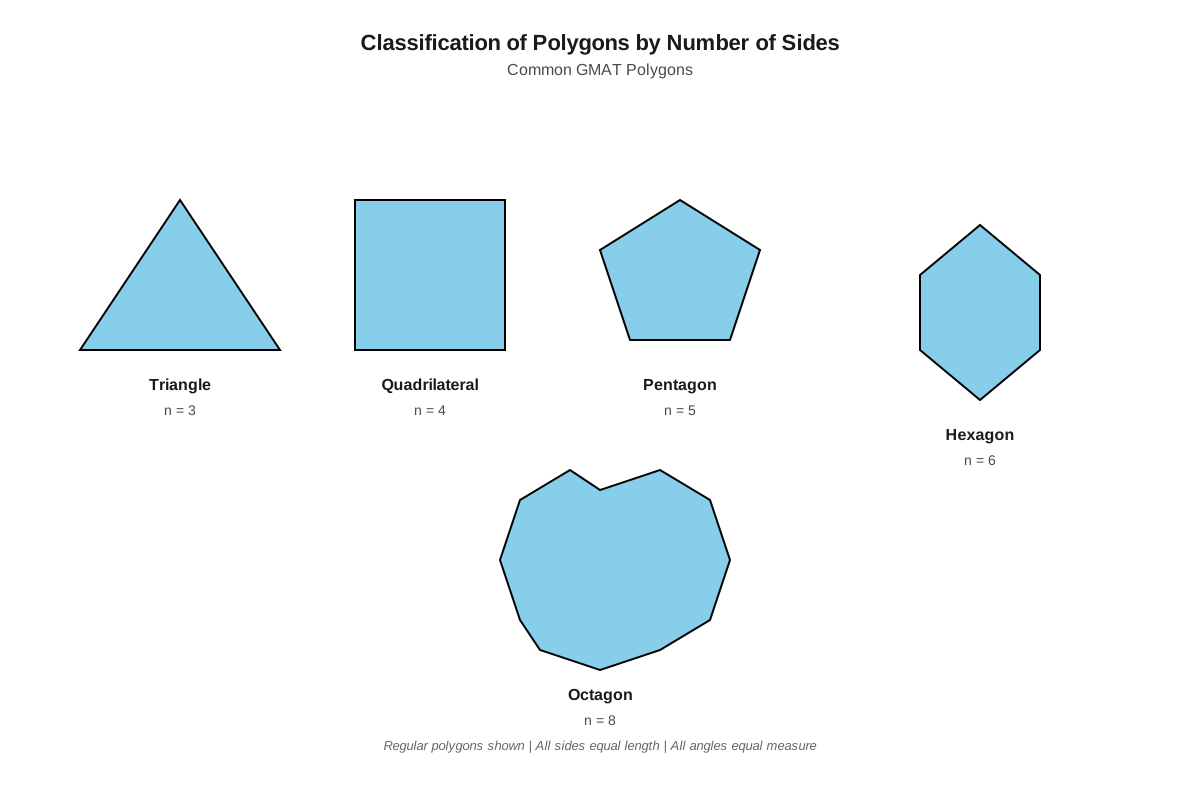
A polygon is a closed plane figure bounded by three or more straight line segments called sides, where each side intersects exactly two other sides at points called vertices. The term derives from Greek: "poly" (many) and "gon" (angle). Polygons are classified by the number of sides they possess, and this classification is fundamental to understanding their properties.
| Number of Sides | Polygon Name | Sum of Interior Angles |
|---|---|---|
| 3 | Triangle | 180° |
| 4 | Quadrilateral | 360° |
| 5 | Pentagon | 540° |
| 6 | Hexagon | 720° |
| 7 | Heptagon | 900° |
| 8 | Octagon | 1080° |
| 9 | Nonagon | 1260° |
| 10 | Decagon | 1440° |
| n | n-gon | (n-2) × 180° |
Polygons are further categorized as regular or irregular. A regular polygon has all sides of equal length and all interior angles of equal measure. Examples include equilateral triangles, squares, and regular hexagons. Irregular polygons have sides and/or angles of varying measures. Additionally, polygons can be convex (all interior angles less than 180°) or concave (at least one interior angle greater than 180°). The GMAT primarily focuses on convex polygons.
Interior Angles of Polygons
The sum of interior angles in any polygon follows a predictable pattern based on the number of sides. For a polygon with n sides, the sum of interior angles equals:
Sum of Interior Angles = (n - 2) × 180°This formula derives from the fact that any polygon can be divided into (n - 2) triangles by drawing diagonals from a single vertex, and each triangle contributes 180° to the total. For a regular polygon with n sides, each individual interior angle measures:
Each Interior Angle = [(n - 2) × 180°] / nFor example, in a regular hexagon (n = 6):
- Sum of interior angles = (6 - 2) × 180° = 720°
- Each interior angle = 720° / 6 = 120°
Understanding this relationship is crucial for GMAT questions that provide partial information about a polygon and require deduction of other properties.
Exterior Angles of Polygons
An exterior angle of a polygon is formed by extending one side of the polygon beyond a vertex. A fundamental property states that the sum of exterior angles of any convex polygon, taking one exterior angle at each vertex, always equals 360°, regardless of the number of sides. This remarkable property holds for triangles, quadrilaterals, and all other polygons.
For a regular polygon with n sides, each exterior angle measures:
Each Exterior Angle = 360° / nSince an interior angle and its adjacent exterior angle are supplementary (sum to 180°), this relationship provides an alternative method for calculating interior angles:
Each Interior Angle = 180° - (360° / n)This exterior angle property is particularly useful for GMAT questions involving regular polygons or problems requiring quick angle calculations.
Diagonals in Polygons
A diagonal is a line segment connecting two non-adjacent vertices of a polygon. The number of diagonals in a polygon with n sides is given by:
Number of Diagonals = n(n - 3) / 2This formula accounts for the fact that from each vertex, you can draw (n - 3) diagonals (to all vertices except itself and its two adjacent vertices), giving n(n - 3) total, but this counts each diagonal twice, so we divide by 2.
For example:
- Triangle (n = 3): 3(0) / 2 = 0 diagonals
- Quadrilateral (n = 4): 4(1) / 2 = 2 diagonals
- Pentagon (n = 5): 5(2) / 2 = 5 diagonals
- Hexagon (n = 6): 6(3) / 2 = 9 diagonals
GMAT questions may ask about the number of diagonals directly or use diagonal properties to create complex geometric relationships.
Common Quadrilaterals
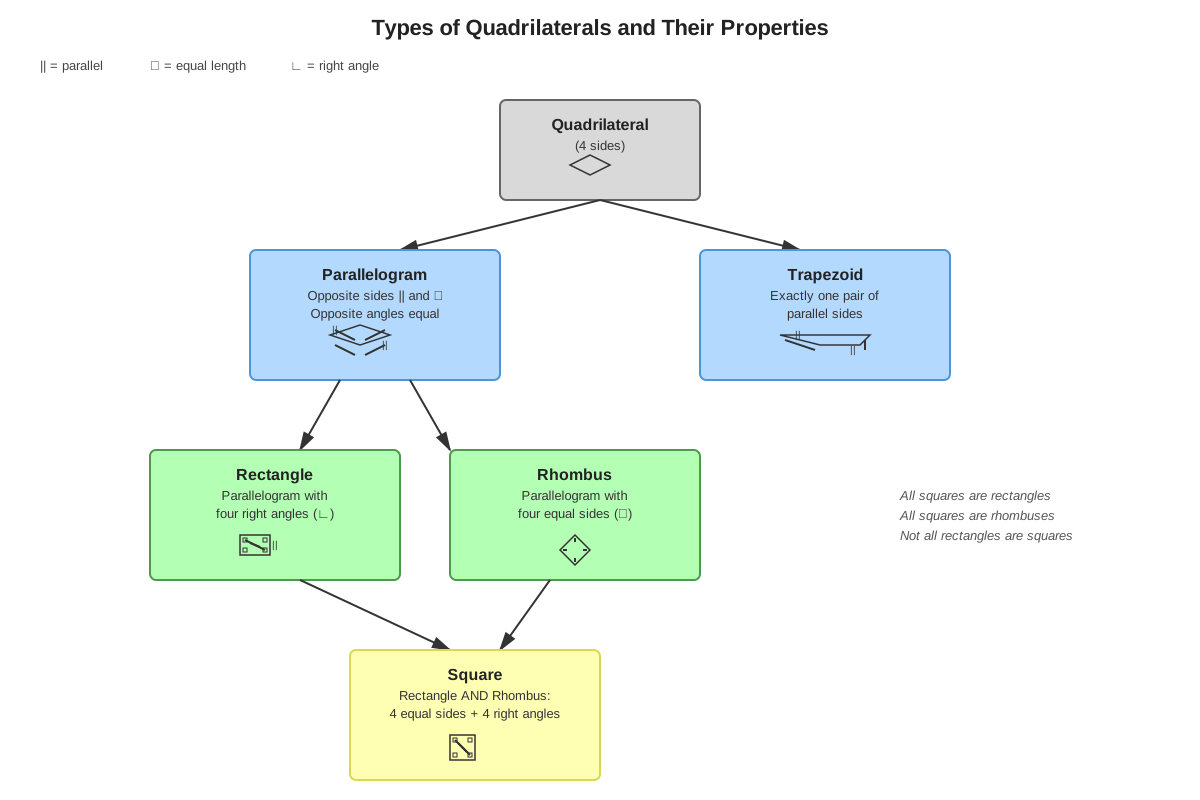
Quadrilaterals are four-sided polygons with particularly important properties for the GMAT. Key types include:
Parallelogram: Opposite sides are parallel and equal in length; opposite angles are equal; consecutive angles are supplementary; diagonals bisect each other.
Rectangle: A parallelogram with four right angles; diagonals are equal in length and bisect each other.
Square: A rectangle with all sides equal; diagonals are equal, perpendicular, and bisect each other at 45° angles.
Rhombus: A parallelogram with all sides equal; diagonals are perpendicular and bisect each other; opposite angles are equal.
Trapezoid: Exactly one pair of parallel sides (called bases); the non-parallel sides are called legs.
Understanding the hierarchical relationships among quadrilaterals is essential: all squares are rectangles and rhombuses; all rectangles and rhombuses are parallelograms; all parallelograms are quadrilaterals.
Perimeter and Area Formulas
Perimeter is the total distance around a polygon, calculated by summing all side lengths. For a regular polygon with n sides of length s:
Perimeter = n × sArea formulas vary by polygon type:
- Triangle: Area = (1/2) × base × height
- Rectangle: Area = length × width
- Square: Area = side²
- Parallelogram: Area = base × height
- Trapezoid: Area = (1/2) × (base₁ + base₂) × height
- Regular polygon: Area = (1/2) × perimeter × apothem (where apothem is the perpendicular distance from center to any side)
For irregular polygons, the GMAT typically requires decomposition into triangles or rectangles, calculating individual areas, and summing the results.
Regular Polygons and Symmetry
Regular polygons possess special properties that the GMAT exploits in problem design. A regular polygon with n sides has:
- n lines of symmetry (each passing through a vertex and the midpoint of the opposite side, or through midpoints of opposite sides)
- Rotational symmetry of order n (looks identical after rotation by 360°/n)
- A center point equidistant from all vertices
- An inscribed circle (incircle) touching all sides
- A circumscribed circle (circumcircle) passing through all vertices
The relationship between the radius of the circumscribed circle (R), the side length (s), and the number of sides (n) involves trigonometry, but the GMAT typically provides sufficient information to solve problems without requiring advanced trigonometric formulas.
Concept Relationships
The study of polygons builds hierarchically from simpler to more complex concepts. Basic angle relationships (supplementary, complementary) → Triangle properties (simplest polygon) → General polygon angle formulas → Specific polygon types (quadrilaterals, pentagons, etc.) → Regular vs. irregular polygons → Complex problem-solving applications.
Within polygon study, interior angles and exterior angles are complementary concepts, with the exterior angle sum property (360°) providing an elegant alternative to interior angle calculations. The number of sides determines both the sum of interior angles and the number of diagonals, creating interconnected relationships that GMAT questions frequently exploit.
Polygons connect to other geometry topics through multiple pathways: Triangles serve as building blocks for understanding all polygons through triangulation; Circles relate to regular polygons through inscribed and circumscribed relationships; Coordinate geometry allows polygon problems to be solved using distance and slope formulas; Three-dimensional geometry extends polygon concepts to polyhedra (three-dimensional figures with polygonal faces).
The relationship map: Polygon identification → Angle calculations → Side length relationships → Perimeter and area computations → Problem-solving synthesis. Each step builds upon previous knowledge, and GMAT questions often require integration across multiple levels of this hierarchy.
Quick check — test yourself on Polygons so far.
Try Flashcards →High-Yield Facts
⭐ The sum of interior angles of any polygon with n sides equals (n - 2) × 180°
⭐ The sum of exterior angles of any convex polygon always equals 360°, regardless of the number of sides
⭐ Each interior angle of a regular n-sided polygon measures [(n - 2) × 180°] / n
⭐ The number of diagonals in an n-sided polygon equals n(n - 3) / 2
⭐ In a regular polygon, each exterior angle measures 360° / n
- A polygon must have at least three sides; there is no upper limit to the number of sides
- All sides of a polygon are straight line segments; curved sides disqualify a figure from being a polygon
- The vertices of a polygon are the points where exactly two sides meet
- A regular polygon has all sides equal in length AND all angles equal in measure (both conditions must be satisfied)
- In any quadrilateral, the sum of interior angles equals 360°
- A square is both a rectangle and a rhombus, possessing all properties of both
- The apothem of a regular polygon is the perpendicular distance from the center to any side
- Convex polygons have all interior angles less than 180°; concave polygons have at least one interior angle greater than 180°
- The perimeter of any polygon equals the sum of all its side lengths
- For regular polygons, symmetry properties often provide shortcuts to solving complex problems
Common Misconceptions
Misconception: All quadrilaterals with four equal sides are squares.
Correction: A rhombus has four equal sides but does not necessarily have right angles. A square is a special case of a rhombus that also has four right angles.
Misconception: The formula (n - 2) × 180° gives the measure of each interior angle of a polygon.
Correction: This formula gives the SUM of all interior angles. To find each individual angle in a regular polygon, divide this sum by n: [(n - 2) × 180°] / n.
Misconception: A regular polygon is any polygon with all sides equal.
Correction: A regular polygon must have both all sides equal AND all angles equal. A rhombus has all sides equal but is not regular because its angles are not all equal.
Misconception: The exterior angle sum depends on the number of sides of the polygon.
Correction: The sum of exterior angles (one at each vertex) is always 360° for any convex polygon, regardless of whether it has 3, 4, 10, or 100 sides.
Misconception: Diagonals of all quadrilaterals bisect each other.
Correction: Only parallelograms (including rectangles, squares, and rhombuses) have diagonals that bisect each other. Trapezoids and general quadrilaterals do not have this property.
Misconception: A trapezoid must have exactly two right angles.
Correction: A trapezoid only requires one pair of parallel sides. It may have zero, one, or two right angles. A trapezoid with two right angles is called a right trapezoid.
Misconception: The area of a polygon can always be found by multiplying two of its dimensions.
Correction: This works only for rectangles and squares. Other polygons require specific formulas (triangles need base × height / 2, trapezoids need the average of bases × height, etc.) or decomposition into simpler shapes.
Worked Examples
Example 1: Regular Polygon Angle Calculation
Problem: In a regular polygon, each interior angle measures 156°. How many sides does the polygon have?
Solution:
Step 1: Recall that for a regular polygon with n sides, each interior angle equals [(n - 2) × 180°] / n.
Step 2: Set up the equation:
[(n - 2) × 180°] / n = 156°Step 3: Multiply both sides by n:
(n - 2) × 180° = 156nStep 4: Distribute:
180n - 360 = 156nStep 5: Solve for n:
180n - 156n = 360
24n = 360
n = 15
Step 6: Verify using the exterior angle approach. If each interior angle is 156°, each exterior angle is 180° - 156° = 24°. Since the sum of exterior angles is 360°, the number of sides is 360° / 24° = 15.
Answer: The polygon has 15 sides (a regular pentadecagon).
Connection to Learning Objectives: This problem demonstrates the application of polygon angle formulas to GMAT questions and shows how to work backward from an angle measure to determine the number of sides.
Example 2: Quadrilateral Properties and Area
Problem: ABCD is a parallelogram with base AB = 10 and height = 6. If the parallelogram is divided by diagonal AC into two triangles, what is the area of triangle ABC?
Solution:
Step 1: Recall that the area of a parallelogram equals base × height.
Area of parallelogram ABCD = 10 × 6 = 60Step 2: Recognize that a diagonal of a parallelogram divides it into two congruent triangles. This is because opposite sides of a parallelogram are equal, and the diagonal creates two triangles that share the diagonal as a common side, with the other two sides being pairs of opposite sides of the parallelogram.
Step 3: Since the two triangles are congruent, each has half the area of the parallelogram:
Area of triangle ABC = 60 / 2 = 30Alternative approach: Calculate directly using the triangle area formula. Triangle ABC has base AB = 10 and the same height as the parallelogram (6), so:
Area = (1/2) × 10 × 6 = 30Answer: The area of triangle ABC is 30 square units.
Connection to Learning Objectives: This problem illustrates the relationship between different polygon types (parallelograms and triangles) and demonstrates how understanding polygon properties enables efficient problem-solving without unnecessary calculations.
Exam Strategy
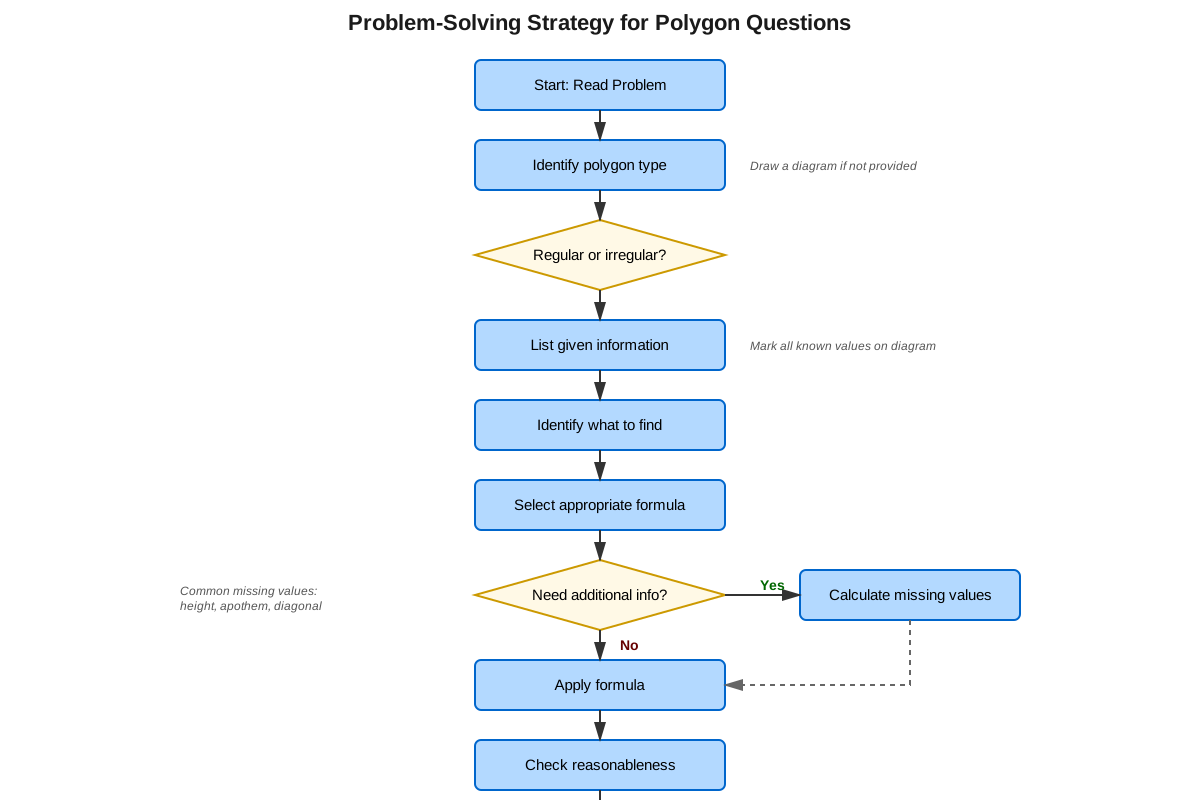
When approaching polygon questions on the GMAT, begin by identifying the type of polygon and noting any special properties mentioned (regular, specific quadrilateral type, etc.). This immediate classification activates the relevant formulas and properties needed for the problem.
Trigger words and phrases to watch for:
- "Regular polygon" → all sides and angles are equal
- "Convex" or "concave" → determines whether all interior angles are less than 180°
- "Diagonal" → may require the diagonal formula or properties of specific quadrilaterals
- "Perimeter" → sum all side lengths
- "Each angle" vs. "sum of angles" → determines whether to divide by n
- "Inscribed" or "circumscribed" → relates polygon to a circle
For Data Sufficiency questions involving polygons, recognize that:
- Knowing the number of sides and that a polygon is regular is sufficient to determine all angle measures
- For quadrilaterals, knowing the type (rectangle, rhombus, etc.) provides multiple properties
- Area problems typically require both a base/side measurement and a height measurement
- The number of diagonals uniquely determines the number of sides
Process-of-elimination strategies:
- Eliminate answer choices that violate fundamental properties (e.g., interior angle sum not equal to (n - 2) × 180°)
- For regular polygons, eliminate choices where the angle measure doesn't divide evenly into the total
- Check whether answer choices satisfy both necessary conditions (e.g., for a square, both equal sides AND right angles)
- Use estimation for area and perimeter problems to eliminate unreasonable values
Time allocation: Spend 15-20 seconds identifying the polygon type and relevant properties, 60-90 seconds on calculations, and 15-20 seconds verifying your answer. For complex problems requiring decomposition, budget up to 2.5 minutes total. If a problem requires extensive calculation, consider whether there's a property or shortcut you've overlooked.
Memory Techniques
Angle Sum Mnemonic: "Need Two Triangles" → (N - 2) × 180° for the sum of interior angles in an n-sided polygon.
Exterior Angle Memory: Visualize walking around any polygon, turning at each vertex. You make one complete rotation (360°) regardless of the polygon's shape—this is why exterior angles always sum to 360°.
Diagonal Formula Visualization: From each vertex, you can't draw diagonals to itself or its two neighbors (3 vertices excluded), leaving (n - 3) possible diagonals. Multiply by n vertices, then divide by 2 because each diagonal connects two vertices and gets counted twice: n(n - 3) / 2.
Quadrilateral Hierarchy Acronym: "Please Remember Squares" for Parallelogram → Rectangle → Square (each inherits all properties of the previous and adds more restrictions).
Regular Polygon Symmetry: The number of sides equals the number of lines of symmetry equals the order of rotational symmetry. If you know one, you know all three.
Area Formula Pattern: Notice that most polygon area formulas involve multiplication by 1/2: triangles (1/2 × base × height), trapezoids (1/2 × sum of bases × height), regular polygons (1/2 × perimeter × apothem). This pattern helps recall formulas under pressure.
Summary
Polygons are closed plane figures formed by three or more straight sides meeting at vertices, and they constitute a high-yield topic for GMAT Quantitative Reasoning. Mastery requires understanding the classification system (by number of sides and regularity), angle relationships (interior angle sum of (n - 2) × 180° and exterior angle sum of 360°), and properties of specific polygon types, particularly quadrilaterals. Regular polygons possess special symmetry properties and equal angles calculated by dividing the total angle sum by the number of sides. The number of diagonals follows the formula n(n - 3) / 2, and this property often appears in GMAT problems. Successful problem-solving depends on recognizing polygon types quickly, applying appropriate formulas efficiently, and understanding hierarchical relationships among different polygon categories. Quadrilaterals deserve special attention, as their varied properties (parallelograms, rectangles, squares, rhombuses, trapezoids) frequently appear in both problem-solving and data sufficiency questions. The ability to decompose complex figures into simpler polygons, calculate perimeters and areas accurately, and make logical deductions from partial information distinguishes high-scoring test-takers.
Key Takeaways
- The sum of interior angles in any n-sided polygon equals (n - 2) × 180°, while exterior angles always sum to 360°
- Regular polygons have all sides equal AND all angles equal; knowing the number of sides determines all other properties
- Each interior angle of a regular n-sided polygon measures [(n - 2) × 180°] / n, and each exterior angle measures 360° / n
- The number of diagonals in an n-sided polygon is n(n - 3) / 2
- Quadrilaterals form a hierarchy: all squares are rectangles and rhombuses; all rectangles and rhombuses are parallelograms
- Polygon problems often require decomposition into triangles or other simpler shapes for area calculations
- Understanding the relationship between interior and exterior angles (they're supplementary) provides alternative solution paths
Related Topics
Triangles: As the simplest polygons, triangles provide foundational concepts for understanding all polygons. Mastering triangle properties, including the Pythagorean theorem, special right triangles, and triangle inequality, directly supports polygon problem-solving.
Circles and Regular Polygons: Regular polygons can be inscribed in or circumscribed about circles, creating relationships between polygon properties and circle measurements. This connection appears in advanced GMAT geometry problems.
Coordinate Geometry: Polygons plotted on the coordinate plane require integration of polygon properties with distance formulas, slope calculations, and area determination using coordinates. This synthesis represents higher-level GMAT problem-solving.
Three-Dimensional Geometry: Understanding polygons enables progression to polyhedra (three-dimensional figures with polygonal faces), including prisms, pyramids, and other solids that appear on the GMAT.
Optimization Problems: Many GMAT word problems involve maximizing or minimizing polygon dimensions subject to constraints, requiring both geometric understanding and algebraic problem-solving skills.
Practice CTA
Now that you've mastered the core concepts of polygons, it's time to solidify your understanding through active practice. Attempt the practice questions to apply these formulas and strategies to GMAT-style problems, and use the flashcards to reinforce high-yield facts and formulas. Remember, polygon questions reward pattern recognition and efficient formula application—skills that improve dramatically with focused practice. Each problem you solve strengthens your geometric intuition and builds the confidence needed to tackle any polygon question on test day. Start practicing now to transform this knowledge into points on your GMAT score!
Sign up free to keep reading
Create a free AnvayaPrep account to finish this GMAT guide on Polygons — plus flashcards and practice questions.