Overview
Independent events represent one of the foundational concepts in probability theory and appear frequently on the GMAT Quantitative Reasoning section. Understanding independent events is crucial because they form the basis for calculating compound probabilities—situations where multiple events occur in sequence or simultaneously. On the GMAT, questions involving gmat independent events often test whether students can correctly identify when events do not influence each other and apply the multiplication rule to find combined probabilities.
The concept of independence is deceptively simple yet frequently misunderstood. Two or more events are independent when the occurrence of one event has absolutely no effect on the probability of the other event(s) occurring. This principle allows test-takers to multiply individual probabilities together to find the probability of multiple events happening. Without mastering this concept, students struggle with a wide range of probability questions, from basic coin flips to complex scenarios involving multiple selections, dice rolls, or real-world business situations.
Within the broader context of GMAT Quantitative Reasoning, independent events serve as a bridge between basic probability concepts and more advanced topics like conditional probability and combinatorics. The ability to recognize independence versus dependence determines which calculation method to apply, making this topic essential for achieving accuracy under time pressure. Questions on this topic frequently appear in both Problem Solving and Data Sufficiency formats, often embedded within word problems that require careful analysis to determine whether events influence each other.
Learning Objectives
- [ ] Identify independent events in probability scenarios
- [ ] Explain independent events and distinguish them from dependent events
- [ ] Apply independent events to GMAT questions using the multiplication rule
- [ ] Calculate compound probabilities for multiple independent events
- [ ] Determine whether given events are independent using probability definitions
- [ ] Solve Data Sufficiency questions involving independence assumptions
- [ ] Recognize common GMAT scenarios where independence applies (coin flips, dice rolls, replacement scenarios)
Prerequisites
- Basic probability concepts: Understanding that probability represents the ratio of favorable outcomes to total possible outcomes is essential for calculating individual event probabilities before combining them.
- Fractions and decimal operations: Independent event calculations require multiplying fractions or decimals, making computational fluency necessary for efficiency.
- Set theory fundamentals: Recognizing outcomes, sample spaces, and events as sets helps visualize when events overlap or remain separate.
- Multiplication and division: The multiplication rule for independent events relies on accurate arithmetic with fractions and percentages.
Why This Topic Matters
Independent events appear in approximately 15-20% of GMAT probability questions, making them a high-yield topic for test preparation. The concept extends beyond pure mathematics into real-world business scenarios that the GMAT frequently tests: quality control processes, market research sampling, investment portfolio analysis, and operational risk assessment. Understanding independence allows business professionals to make accurate predictions when multiple factors operate simultaneously without influencing each other.
On the GMAT, independent events questions typically appear in three formats: (1) straightforward probability calculations involving multiple trials, (2) word problems requiring students to first identify whether events are independent before calculating, and (3) Data Sufficiency questions where determining independence is key to assessing whether sufficient information exists. The topic frequently combines with other concepts like complementary probability, "at least one" scenarios, and expected value calculations.
Common question stems include scenarios involving: drawing cards with replacement, rolling multiple dice, flipping coins multiple times, selecting items from different groups, independent quality control checks, and probability of success across multiple independent attempts. The GMAT particularly favors questions where students must recognize that replacement makes events independent, while selection without replacement creates dependence.
Core Concepts
Definition of Independent Events
Two events A and B are independent events if and only if the occurrence of one event does not change the probability of the other event occurring. Mathematically, events A and B are independent when:
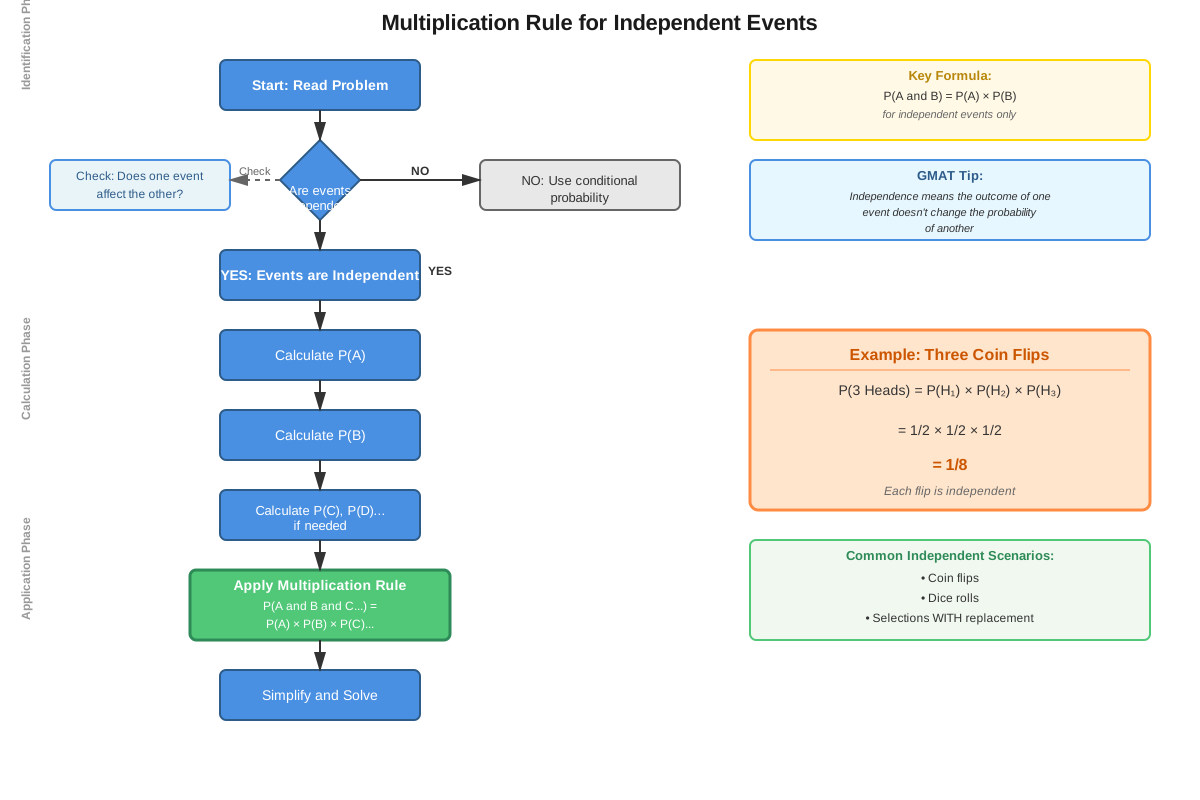
P(A and B) = P(A) × P(B)Alternatively, independence can be defined using conditional probability: events A and B are independent if P(A|B) = P(A), meaning the probability of A given that B has occurred equals the probability of A without any condition. This definition emphasizes that knowing B occurred provides no information about whether A will occur.
The multiplication rule for independent events extends to any number of events. For three independent events A, B, and C:
P(A and B and C) = P(A) × P(B) × P(C)This principle scales to any finite number of independent events, making it powerful for complex scenarios.
Identifying Independence in GMAT Scenarios
Several classic scenarios on the GMAT involve independent events:
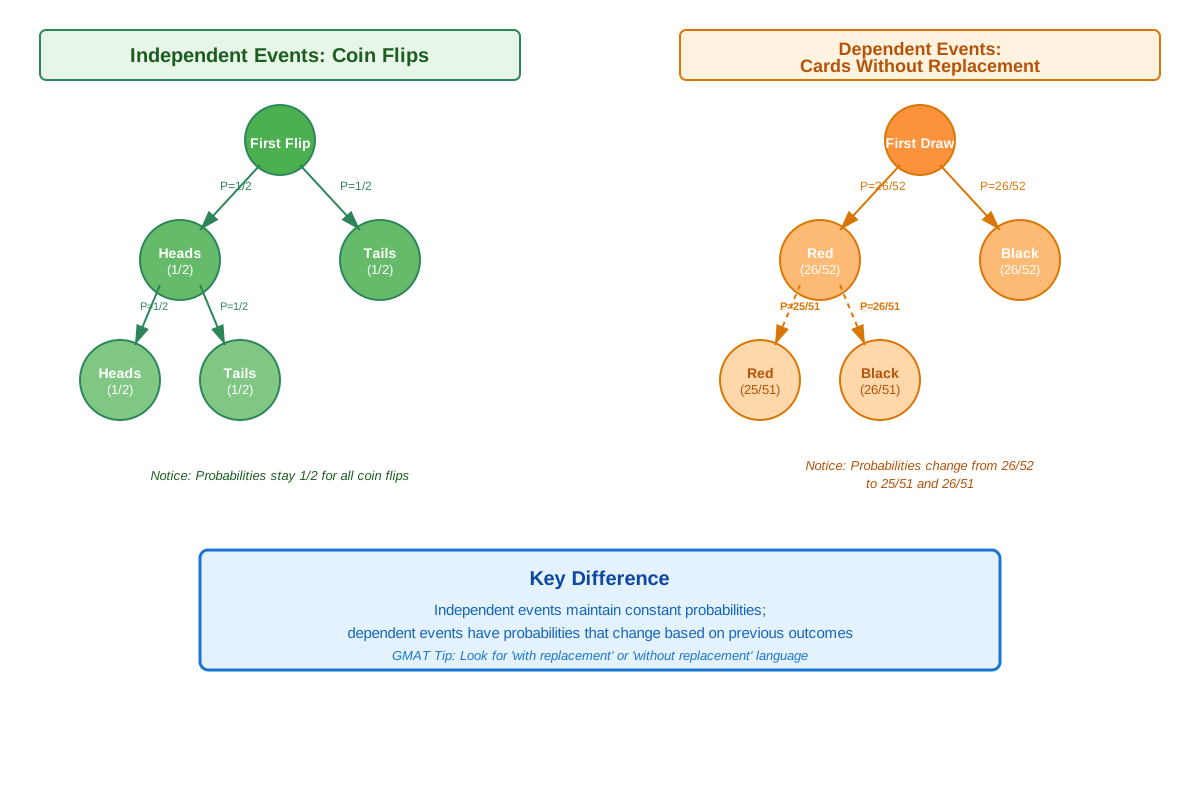
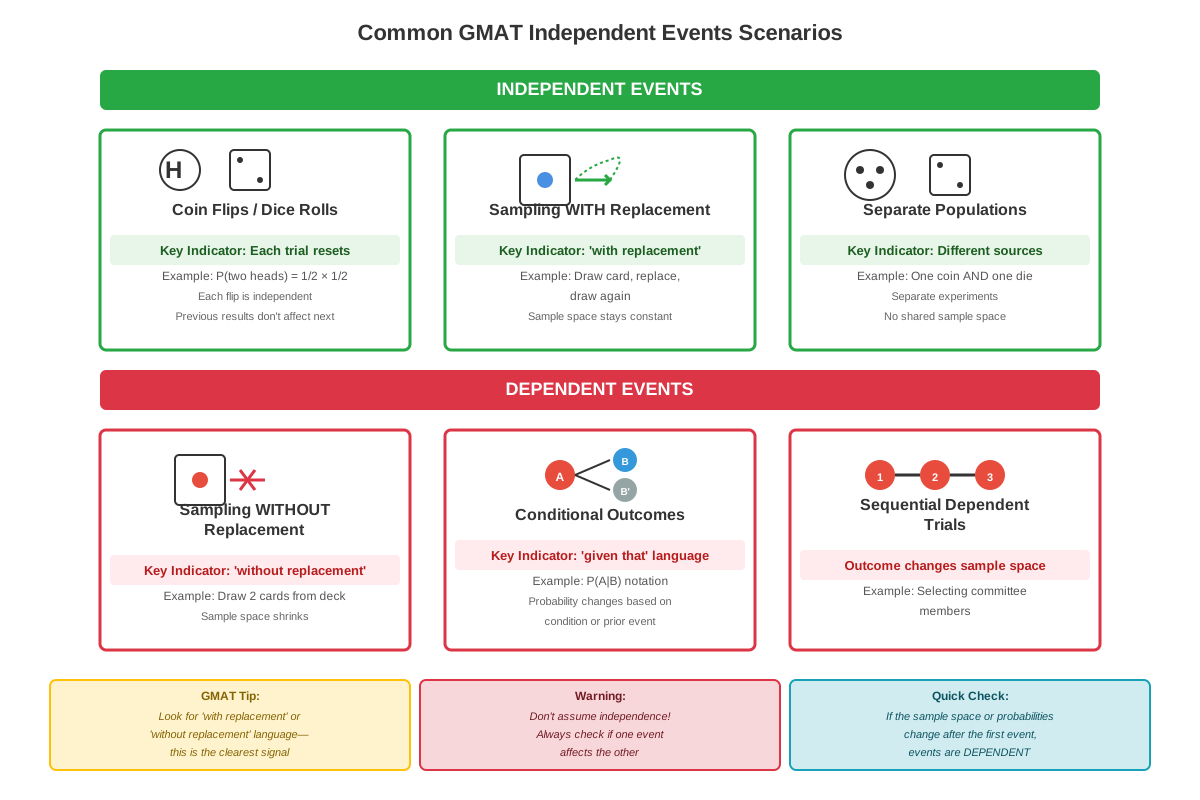
Replacement scenarios: When an item is selected from a group, observed, and then returned before the next selection, each selection is independent. For example, drawing a card from a deck, recording it, replacing it, shuffling, and drawing again creates independent events because the deck composition remains unchanged.
Separate physical processes: Events involving different objects or mechanisms are typically independent. Rolling two different dice, flipping multiple coins, or spinning separate spinners all involve independence because one physical object cannot affect another.
Repeated trials with reset conditions: When a process is repeated under identical conditions with no memory of previous outcomes, trials are independent. Manufacturing defect rates across different production runs, assuming consistent processes, represent independent events.
Simultaneous events: Events occurring at the same time in different locations or contexts are generally independent unless explicitly connected. The probability of rain in two different cities on the same day (absent weather system connections) represents independent events.
The Multiplication Rule Application
The multiplication rule provides the computational foundation for independent events problems. When calculating the probability that multiple independent events all occur, multiply their individual probabilities:
Example structure: If Event A has probability 1/3 and Event B has probability 1/4, and they are independent, then:
P(A and B) = 1/3 × 1/4 = 1/12This rule applies regardless of whether events occur sequentially or simultaneously. The key requirement is independence, not timing.
For "at least one" scenarios involving independent events, the complement rule often provides the most efficient solution:
P(at least one success) = 1 - P(all failures)Since failures are independent if successes are independent, calculate the probability of all events failing (multiply failure probabilities), then subtract from 1.
Independence vs. Dependence
Understanding the distinction between independent and dependent events is crucial for selecting the correct calculation method:
| Characteristic | Independent Events | Dependent Events | ||
|---|---|---|---|---|
| Definition | One event does not affect the other | One event changes the probability of the other | ||
| Calculation | P(A and B) = P(A) × P(B) | P(A and B) = P(A) × P(B\ | A) | |
| Common scenarios | With replacement, separate objects | Without replacement, conditional situations | ||
| Probability relationship | P(A\ | B) = P(A) | P(A\ | B) ≠ P(A) |
| Sample space | Remains constant between events | Changes after first event |
Dependent events require conditional probability calculations because the sample space or favorable outcomes change after the first event. For example, drawing two cards without replacement creates dependence because the second draw occurs from a reduced deck.
Testing for Independence
The GMAT occasionally requires determining whether events are independent given probability information. Use the mathematical definition:
If P(A and B) = P(A) × P(B), the events are independent.
If P(A and B) ≠ P(A) × P(B), the events are dependent.
Alternatively, check whether P(A|B) = P(A). If knowing B occurred changes the probability of A, the events are dependent.
Common Independent Event Calculations
Multiple coin flips: Each flip is independent with P(heads) = 1/2. The probability of getting heads on three consecutive flips:
P(HHH) = 1/2 × 1/2 × 1/2 = 1/8Multiple dice rolls: Each roll is independent. The probability of rolling a 6 on a first die AND a 3 on a second die:
P(6 and 3) = 1/6 × 1/6 = 1/36Selection with replacement: Drawing a red marble from a bag containing 3 red and 7 blue marbles, replacing it, then drawing red again:
P(red, then red) = 3/10 × 3/10 = 9/100Concept Relationships
The concept of independent events builds directly on fundamental probability principles, particularly the definition of probability as favorable outcomes divided by total outcomes. Understanding independence requires first mastering single-event probability calculations, as these individual probabilities become the building blocks for compound probability calculations.
Relationship flow: Basic probability → Independent events → Compound probability → Conditional probability
Independent events connect to complementary probability through "at least one" problems. When calculating the probability that at least one of several independent events occurs, the complement approach (1 minus the probability that none occur) leverages both independence and complementary probability principles.
The distinction between independence and dependence leads directly to conditional probability. While independent events satisfy P(A|B) = P(A), dependent events require the full conditional probability formula P(A|B) = P(A and B) / P(B). Recognizing which situation applies determines the calculation path.
Independent events also connect to combinatorics when questions involve counting outcomes. For example, determining the probability of specific sequences (like getting exactly 2 heads in 3 coin flips) requires both the multiplication rule for independent events and combinatorial counting to determine how many sequences satisfy the condition.
Within Data Sufficiency questions, independence often relates to sufficiency analysis. A statement might provide information about individual event probabilities, which is sufficient to calculate compound probabilities only if events are independent. Recognizing this conditional sufficiency is crucial for correct answers.
High-Yield Facts
⭐ Two events A and B are independent if and only if P(A and B) = P(A) × P(B)
⭐ For independent events, P(A|B) = P(A), meaning knowing B occurred doesn't change the probability of A
⭐ Selection WITH replacement creates independent events; selection WITHOUT replacement creates dependent events
⭐ The probability of at least one success in independent trials = 1 - P(all failures)
⭐ Events involving separate physical objects (different dice, different coins) are typically independent
- The multiplication rule for independent events extends to any number of events: multiply all individual probabilities
- Independence is symmetric: if A is independent of B, then B is independent of A
- If events are independent, their complements are also independent
- Mutually exclusive events (events that cannot both occur) are NOT independent unless one has probability zero
- Repeated trials under identical conditions with no memory of previous outcomes are independent
- The probability of a specific sequence of independent events equals the product of individual probabilities regardless of order
- Zero probability events are independent of all events
- Independence is different from mutual exclusivity: independent events CAN occur together
- For three or more events, pairwise independence doesn't guarantee mutual independence (though this is rare on the GMAT)
- Time separation alone doesn't guarantee independence; events must have no causal or informational connection
Quick check — test yourself on Independent events so far.
Try Flashcards →Common Misconceptions
Misconception: If two events cannot occur simultaneously (mutually exclusive), they are independent.
Correction: Mutually exclusive events are actually dependent, not independent. If A and B are mutually exclusive, then P(A|B) = 0, which differs from P(A) unless P(A) = 0. Independence means one event doesn't affect the other's probability; mutual exclusivity means one event completely prevents the other.
Misconception: Events that occur at different times are automatically independent.
Correction: Temporal separation doesn't guarantee independence. Drawing two cards sequentially without replacement involves events at different times, but they're dependent because the first draw changes the deck composition. Independence requires no informational or causal connection, not just time separation.
Misconception: The multiplication rule P(A and B) = P(A) × P(B) applies to all probability problems involving two events.
Correction: This rule applies ONLY to independent events. For dependent events, you must use P(A and B) = P(A) × P(B|A), incorporating conditional probability. Always verify independence before applying the simple multiplication rule.
Misconception: If P(A) = P(B), the events are independent.
Correction: Equal probabilities don't imply independence. Independence is about whether one event affects the other's probability, not about the probabilities being equal. Two events can have the same probability yet be highly dependent on each other.
Misconception: In "at least one" problems, you should add the individual probabilities.
Correction: For independent events, use the complement approach: P(at least one) = 1 - P(none). Adding individual probabilities overcounts scenarios where multiple events occur and only works for mutually exclusive events, which are not independent.
Misconception: Real-world events are usually independent.
Correction: Many real-world events are actually dependent due to common causes, sequential relationships, or shared resources. The GMAT tests your ability to recognize when independence is a reasonable assumption (like separate coin flips) versus when events are clearly dependent (like drawing without replacement).
Misconception: If three events A, B, and C are pairwise independent (A independent of B, A independent of C, B independent of C), they are mutually independent.
Correction: Pairwise independence doesn't guarantee mutual independence. Mutual independence requires P(A and B and C) = P(A) × P(B) × P(C), which is a stronger condition. However, this distinction rarely appears on the GMAT.
Worked Examples
Example 1: Multiple Independent Trials
Problem: A quality control inspector tests three independently manufactured computer chips. Each chip has a 0.95 probability of passing inspection. What is the probability that all three chips pass inspection?
Solution:
Step 1: Identify that the events are independent. The problem states the chips are "independently manufactured," and each test is separate.
Step 2: Identify the individual probabilities. Each chip has P(pass) = 0.95.
Step 3: Apply the multiplication rule for independent events. Since we want all three to pass:
P(all three pass) = P(chip 1 passes) × P(chip 2 passes) × P(chip 3 passes)
P(all three pass) = 0.95 × 0.95 × 0.95
P(all three pass) = 0.857375 ≈ 0.857 or 85.7%
Connection to learning objectives: This example demonstrates identifying independent events (separate manufacturing processes), explaining why they're independent (no influence between chips), and applying the multiplication rule to calculate compound probability.
Example 2: At Least One Success with Independent Events
Problem: A basketball player has a 60% free throw success rate. If she takes three free throws, what is the probability she makes at least one shot? Assume each shot is independent.
Solution:
Step 1: Recognize this is an "at least one" problem, which is most efficiently solved using the complement approach.
Step 2: Identify the complement event. The complement of "at least one success" is "zero successes" or "all failures."
Step 3: Calculate the probability of failure on each shot:
P(miss) = 1 - 0.60 = 0.40Step 4: Calculate the probability of all failures using the multiplication rule for independent events:
P(all three miss) = 0.40 × 0.40 × 0.40 = 0.064Step 5: Apply the complement rule:
P(at least one makes) = 1 - P(all three miss)
P(at least one makes) = 1 - 0.064 = 0.936 or 93.6%
Alternative approach (less efficient): Calculate P(exactly 1 makes) + P(exactly 2 make) + P(all 3 make), which requires combinatorial counting and more calculations.
Connection to learning objectives: This example shows applying independent events to a realistic GMAT scenario, using the complement rule efficiently, and recognizing that independence allows us to multiply failure probabilities.
Example 3: Data Sufficiency with Independence
Problem: A bag contains red and blue marbles. What is the probability of drawing two red marbles?
Statement (1): The probability of drawing a red marble on the first draw is 2/5.
Statement (2): After drawing one marble and replacing it, the probability of drawing a red marble on the second draw is 2/5.
Solution:
Step 1: Analyze what's needed. To find P(two red marbles), we need to know whether draws are independent and the individual probabilities.
Step 2: Evaluate Statement (1) alone. This gives P(red on first draw) = 2/5, but provides no information about the second draw or whether replacement occurs. INSUFFICIENT.
Step 3: Evaluate Statement (2) alone. This tells us replacement occurs (making draws independent) and P(red on second draw) = 2/5, but doesn't give the first draw probability. However, with replacement, the first draw probability must also be 2/5. SUFFICIENT.
P(two red) = 2/5 × 2/5 = 4/25Step 4: Evaluate both statements together. Both statements together confirm replacement and give consistent probabilities. SUFFICIENT.
Answer: Statement (2) alone is sufficient, but Statement (1) alone is not sufficient. Answer choice B.
Connection to learning objectives: This example demonstrates identifying when events are independent (replacement mentioned in Statement 2), explaining why this matters (allows multiplication rule), and applying this understanding to Data Sufficiency format.
Exam Strategy
When approaching gmat independent events questions, follow this systematic process:
Step 1: Identify whether events are independent. Look for trigger phrases: "with replacement," "independently," "separate," "different [objects]," or scenarios involving distinct physical processes. If the problem involves selection without replacement or conditional language, events are likely dependent.
Step 2: Extract individual probabilities. Before combining probabilities, clearly identify P(A), P(B), etc. Write these down to avoid calculation errors.
Step 3: Choose the appropriate calculation method. For "all events occur," multiply probabilities directly. For "at least one event occurs," use the complement approach: 1 - P(none occur). For "exactly k events occur," you'll need combinatorics combined with the multiplication rule.
Step 4: Verify your answer makes sense. The probability of multiple independent events all occurring should be less than the probability of any single event (since you're multiplying fractions less than 1). If your answer violates this, recheck your work.
Exam Tip: When you see "at least one" in a probability question involving independent events, immediately think complement rule. Calculate the probability that none of the events occur, then subtract from 1. This approach is almost always faster than calculating multiple scenarios and adding them.
Trigger words for independence:
- "with replacement"
- "independently"
- "separate" (dice, coins, processes)
- "each time" (suggesting reset conditions)
- "different" (objects, locations)
Trigger words suggesting dependence (NOT independent):
- "without replacement"
- "given that"
- "after" (when describing changed conditions)
- "conditional on"
- "depends on"
Time allocation: Straightforward independent events problems should take 1.5-2 minutes. If you're spending more time, you may be overcomplicating the problem. Check whether you're correctly identifying independence and using the multiplication rule efficiently.
Process of elimination tips: In multiple choice questions, eliminate answers that are greater than any individual probability when the question asks for all events occurring. Also eliminate answers that equal the sum of individual probabilities unless events are mutually exclusive (which means they're not independent).
Memory Techniques
Mnemonic for independence: "INDEPENDENT = IN Different Environments, Probabilities ENd up DENTical" - If knowing one event occurred doesn't change (keeps identical) the probability of another, they're independent.
Multiplication Rule Memory: "AND means MULTIPLY" - When you want event A AND event B to occur with independent events, MULTIPLY their probabilities. This distinguishes from "OR" situations where you typically add (for mutually exclusive events).
Replacement Rule: "REPLACE = REPEAT" - With replacement, you REPEAT the same probability because the situation resets. Without replacement, probabilities change (dependence).
Complement Visualization: For "at least one" problems, visualize a Venn diagram where you're shading everything except the small region where nothing happens. This reinforces that 1 - P(none) captures all scenarios with at least one success.
Independence Test Acronym - SAME:
- Separate physical processes
- After replacement
- Multiple independent trials
- Equal probability regardless of other events
Formula Memory: Write the independence definition both ways and memorize both:
- P(A and B) = P(A) × P(B)
- P(A|B) = P(A)
Knowing both forms helps you recognize independence in different question formats.
Summary
Independent events form a cornerstone of GMAT probability questions, appearing in approximately 15-20% of probability problems across both Problem Solving and Data Sufficiency formats. The fundamental principle is that two events are independent when the occurrence of one event does not affect the probability of the other occurring, mathematically expressed as P(A and B) = P(A) × P(B). Recognizing independence versus dependence determines which calculation method to apply, making this distinction critical for accuracy. Common independent scenarios include selection with replacement, separate physical processes (different dice or coins), and repeated trials under identical conditions. The multiplication rule provides the computational foundation: multiply individual probabilities to find the probability of all events occurring. For "at least one" scenarios, the complement approach (1 minus the probability of all failures) offers the most efficient solution path. Success on GMAT independent events questions requires three skills: correctly identifying whether events are independent based on problem context, applying the multiplication rule accurately, and recognizing when the complement approach simplifies calculations. Understanding that independence is fundamentally about informational separation—one event provides no information about another—helps students avoid common misconceptions like confusing independence with mutual exclusivity or assuming temporal separation guarantees independence.
Key Takeaways
- Independent events satisfy P(A and B) = P(A) × P(B), meaning multiply individual probabilities to find compound probability
- Selection WITH replacement creates independence; selection WITHOUT replacement creates dependence
- For "at least one" problems with independent events, use the complement: P(at least one) = 1 - P(none)
- Independence means P(A|B) = P(A): knowing B occurred doesn't change the probability of A
- Common independent scenarios: separate physical objects, replacement situations, repeated trials with reset conditions
- Mutually exclusive events are NOT independent (unless one has zero probability)
- Always verify independence before applying the simple multiplication rule; dependent events require conditional probability
Related Topics
Conditional Probability: Building on independent events, conditional probability addresses dependent events where P(A|B) ≠ P(A). Mastering independence provides the foundation for understanding when conditional probability formulas are necessary versus when the simpler multiplication rule suffices.
Combinatorics and Counting: Many GMAT problems combine independent events with counting principles, such as determining the probability of exactly k successes in n independent trials. This requires both the multiplication rule and combinatorial formulas.
Complementary Probability: The complement rule (P(A) = 1 - P(not A)) combines powerfully with independent events for "at least one" scenarios, making this a natural next topic for study.
Expected Value: Understanding independent events enables calculation of expected values for multiple independent trials, a common GMAT application in business contexts.
Probability Distributions: Advanced applications of independent events include binomial distributions (repeated independent trials with two outcomes), though this appears less frequently on the GMAT.
Practice CTA
Now that you've mastered the core concepts of independent events, it's time to solidify your understanding through practice. Attempt the practice questions to test your ability to identify independence, apply the multiplication rule, and solve "at least one" problems efficiently. Use the flashcards to reinforce key definitions and formulas until they become automatic. Remember, the GMAT rewards not just knowledge but also speed and accuracy—practice will build all three. Each problem you solve strengthens your pattern recognition for test day. You've built a strong foundation; now apply it with confidence!
Sign up free to keep reading
Create a free AnvayaPrep account to finish this GMAT guide on Independent events — plus flashcards and practice questions.