Overview
The median is one of the three fundamental measures of central tendency in statistics, alongside the mean and mode. On the GMAT, understanding the median is crucial because it appears frequently in both Problem Solving and Data Sufficiency questions, often testing not just calculation ability but also conceptual understanding of how the median behaves under different conditions. The GMAT median questions are designed to assess whether test-takers can identify the middle value in a dataset, understand how adding or removing data points affects the median, and recognize when the median provides more meaningful information than other measures of central tendency.
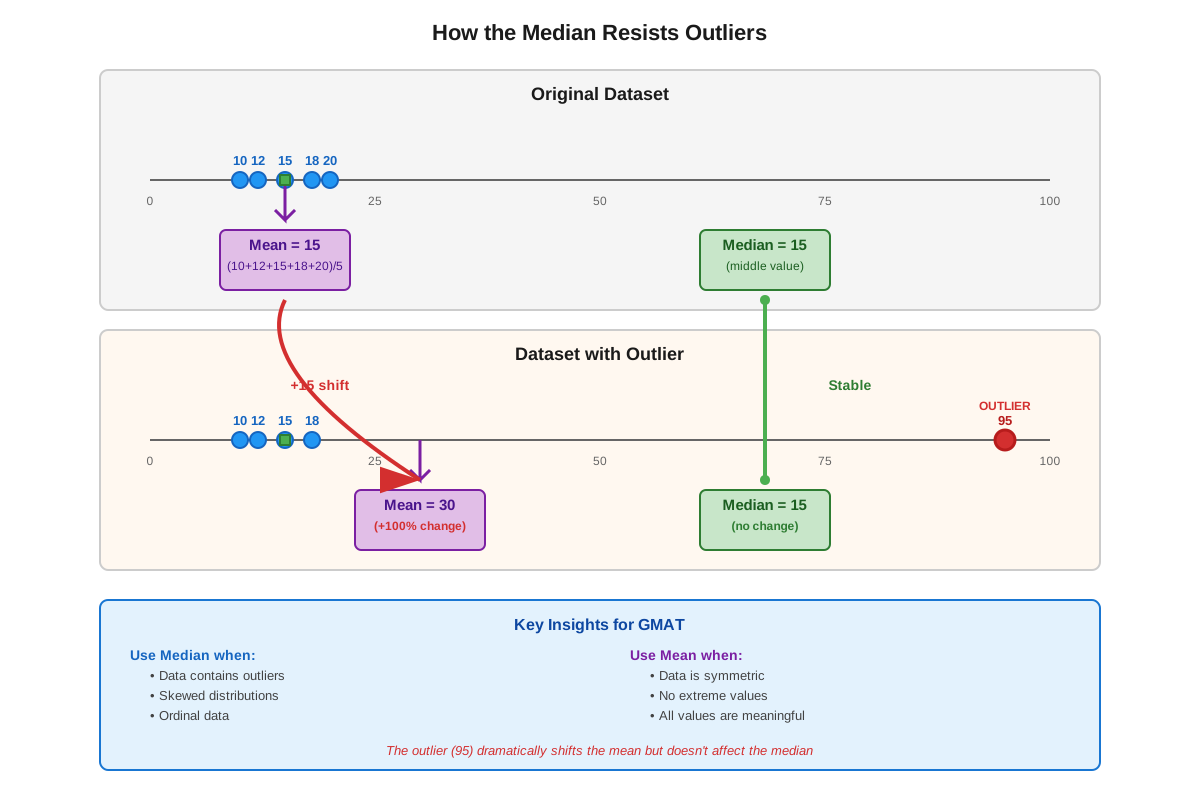
The median represents the middle value in an ordered dataset, effectively dividing the distribution into two equal halves. Unlike the mean, which can be heavily influenced by extreme values (outliers), the median remains stable and provides a more accurate representation of the "typical" value in skewed distributions. This resistance to outliers makes the median particularly valuable in real-world applications involving income data, housing prices, and other datasets where extreme values might distort the picture provided by the mean.
Within the broader context of GMAT Quantitative Reasoning, the median connects directly to concepts in Statistics and Probability, data interpretation, and number properties. Questions involving the median often integrate multiple mathematical concepts, requiring students to work with inequalities, understand even and odd number properties, manipulate algebraic expressions, and interpret data presented in various formats including tables, charts, and word problems. Mastering the median is essential not only for direct median questions but also for comparative statistics problems where test-takers must determine which measure of central tendency best represents a given dataset.
Learning Objectives
- [ ] Identify the median in both odd-length and even-length datasets
- [ ] Explain how the median differs from other measures of central tendency and when it is most appropriate to use
- [ ] Apply median concepts to solve GMAT Problem Solving and Data Sufficiency questions
- [ ] Calculate the median when given incomplete information about a dataset
- [ ] Determine how changes to a dataset (adding, removing, or modifying values) affect the median
- [ ] Recognize when sufficient information exists to determine a unique median value
- [ ] Solve for unknown variables when the median is given as a constraint
Prerequisites
- Basic arithmetic operations: Essential for calculating the average of two middle values and ordering numbers
- Understanding of inequalities: Required for determining relative positions of values and solving for unknowns when the median is specified
- Number properties (odd/even): Necessary for understanding whether the median will be a single value or the average of two values
- Basic algebra: Needed for solving equations when the median is given and variables must be determined
- Ordering and sequencing: Fundamental for arranging datasets from least to greatest, which is the first step in finding any median
Why This Topic Matters
The median appears in approximately 10-15% of GMAT Quantitative Reasoning questions, making it a high-yield topic that deserves focused attention. Beyond its direct testing frequency, median concepts often appear embedded within more complex statistics problems, data interpretation questions, and integrated reasoning scenarios. Understanding the median is particularly important because GMAT questions frequently test conceptual understanding rather than mere calculation—for instance, asking whether sufficient information exists to determine a median rather than simply asking students to calculate it.
In real-world applications, the median serves as a critical tool for understanding distributions in economics, business analytics, and social sciences. When analyzing salary data, for example, the median income provides a more accurate picture of typical earnings than the mean, which can be skewed by extremely high earners. Real estate professionals rely on median home prices to understand market trends, and healthcare researchers use median survival times to communicate treatment effectiveness. Business analysts use the median to understand customer behavior patterns, inventory turnover rates, and other key performance indicators where outliers might distort the analysis.
On the GMAT, median questions typically appear in several distinct formats: straightforward calculation problems where students must find the median of a given set; Data Sufficiency questions asking whether enough information exists to determine the median; comparative questions requiring students to determine relationships between the median and other statistics; and complex word problems where the median must be used to solve for unknown values or make business decisions. The exam particularly favors questions that test whether students understand that the median depends only on the middle value(s) and not on the specific values of extreme data points.
Core Concepts
Definition and Basic Calculation
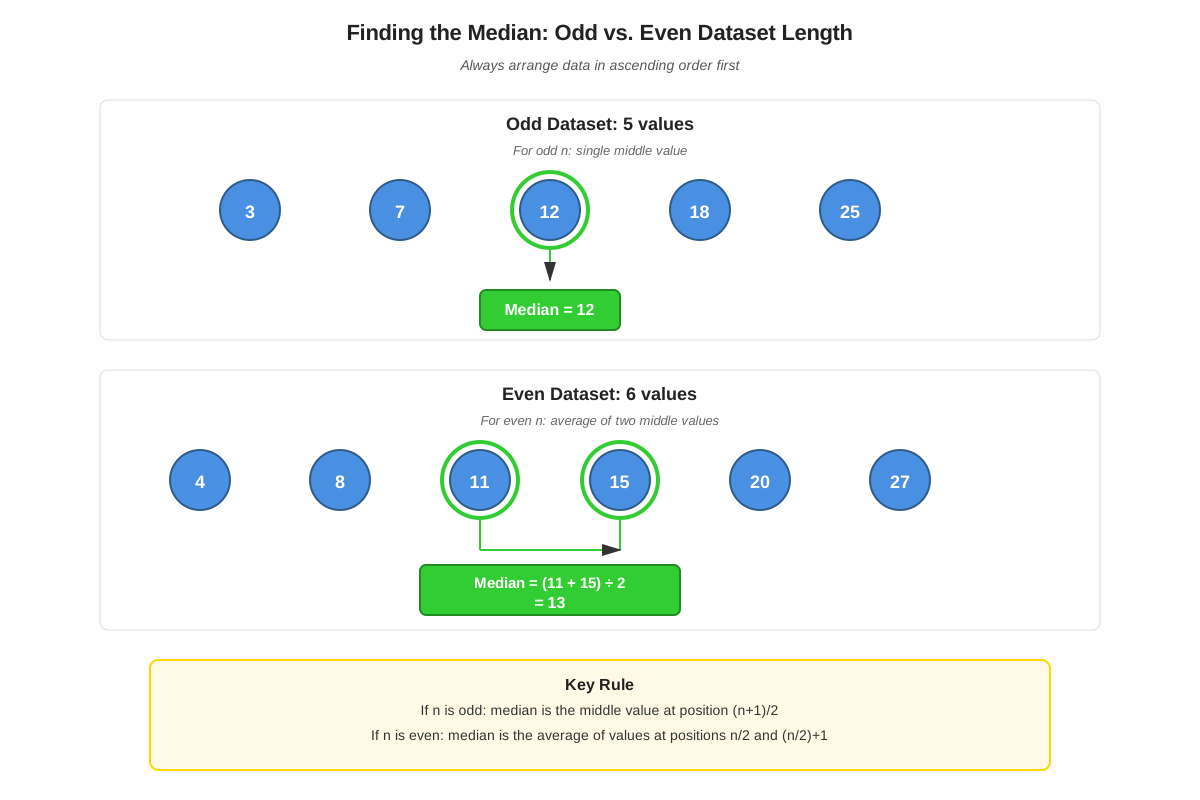
The median is defined as the middle value in an ordered dataset. To find the median, the data must first be arranged in ascending (or descending) order. The calculation method depends on whether the dataset contains an odd or even number of values.
For a dataset with an odd number of values (n values where n is odd), the median is the single middle value located at position (n+1)/2 when the data is ordered. For example, in the dataset {3, 7, 9, 15, 21}, which contains 5 values, the median is the value at position (5+1)/2 = 3, which is 9.
For a dataset with an even number of values (n values where n is even), the median is the arithmetic mean (average) of the two middle values located at positions n/2 and (n/2)+1. For example, in the dataset {2, 5, 8, 12, 15, 20}, which contains 6 values, the two middle values are at positions 3 and 4 (values 8 and 12), so the median is (8+12)/2 = 10.
Ordering Requirement
A critical aspect of finding the median is that the dataset must be ordered before identifying the middle value(s). This is a common source of errors on the GMAT, where datasets are often presented in random order. Consider the set {15, 3, 22, 8, 11}. The median is NOT 22 (the middle value as presented). Instead, the set must first be reordered as {3, 8, 11, 15, 22}, revealing that the median is 11.
Median with Repeated Values
When a dataset contains repeated values, these repetitions must be included in the ordering and counting process. For the dataset {4, 7, 7, 7, 9, 12}, the median is the average of the 3rd and 4th values (both 7), yielding a median of 7. The fact that 7 appears multiple times does not change the calculation method—each occurrence counts as a separate data point.
Median vs. Mean Comparison
Understanding when the median differs from the mean is crucial for GMAT questions. The following table illustrates key differences:
| Characteristic | Median | Mean |
|---|---|---|
| Definition | Middle value when ordered | Sum divided by count |
| Sensitivity to outliers | Resistant (not affected) | Sensitive (heavily affected) |
| Calculation complexity | Requires ordering | Requires only addition and division |
| Best used when | Data is skewed or has outliers | Data is symmetrically distributed |
| Always equals a data value? | Only if n is odd | No, can be any value |
In a symmetric distribution, the median and mean are equal. In a right-skewed distribution (with high outliers), the mean exceeds the median. In a left-skewed distribution (with low outliers), the median exceeds the mean.
Effect of Adding or Removing Values
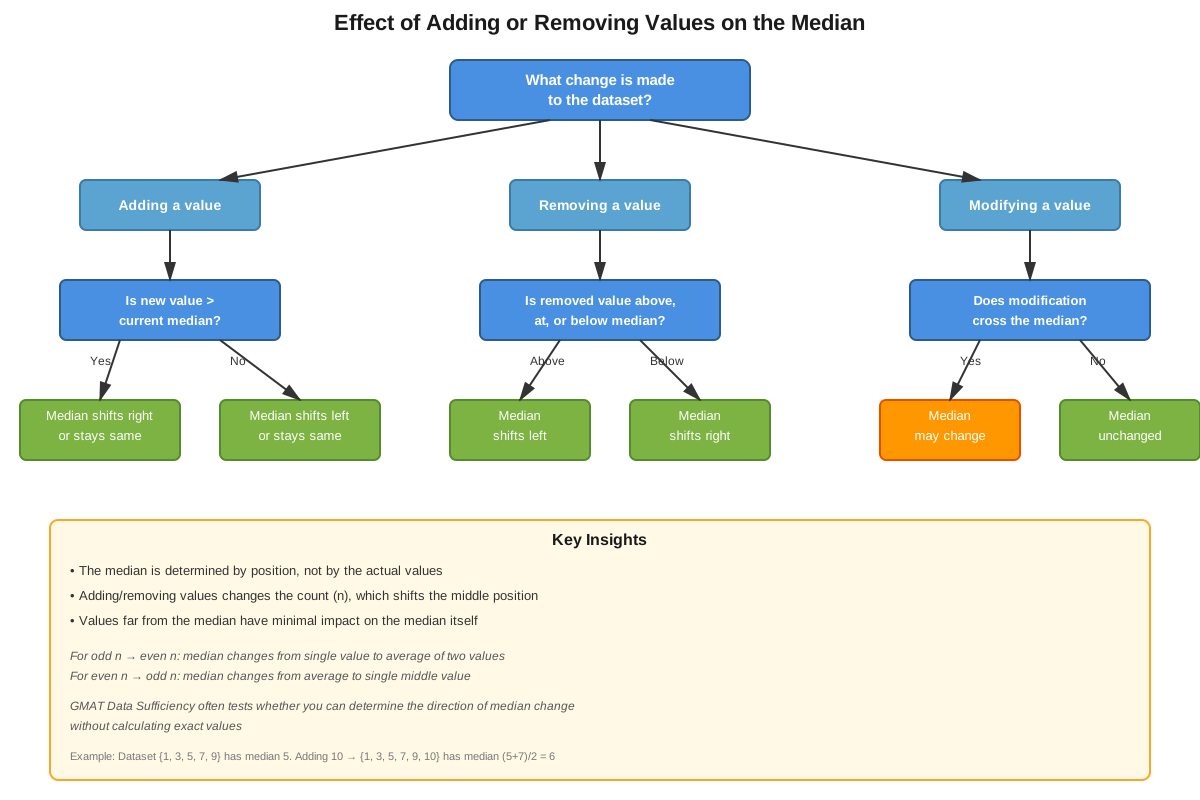
Understanding how the median changes when data points are added or removed is a high-yield GMAT concept. The median is determined solely by the middle position(s), so:
- Adding a value above the current median may or may not change the median, depending on whether it shifts the middle position
- Adding a value below the current median may or may not change the median for the same reason
- The specific value of an extreme data point does not affect the median, only its position relative to the middle
For example, if the dataset {2, 5, 8, 11, 14} has a median of 8, adding the value 100 creates {2, 5, 8, 11, 14, 100}, which has a median of (8+11)/2 = 9.5. The median changed not because 100 is large, but because adding any sixth value changes the calculation from a single middle value to the average of two middle values.
Median in Data Sufficiency Questions
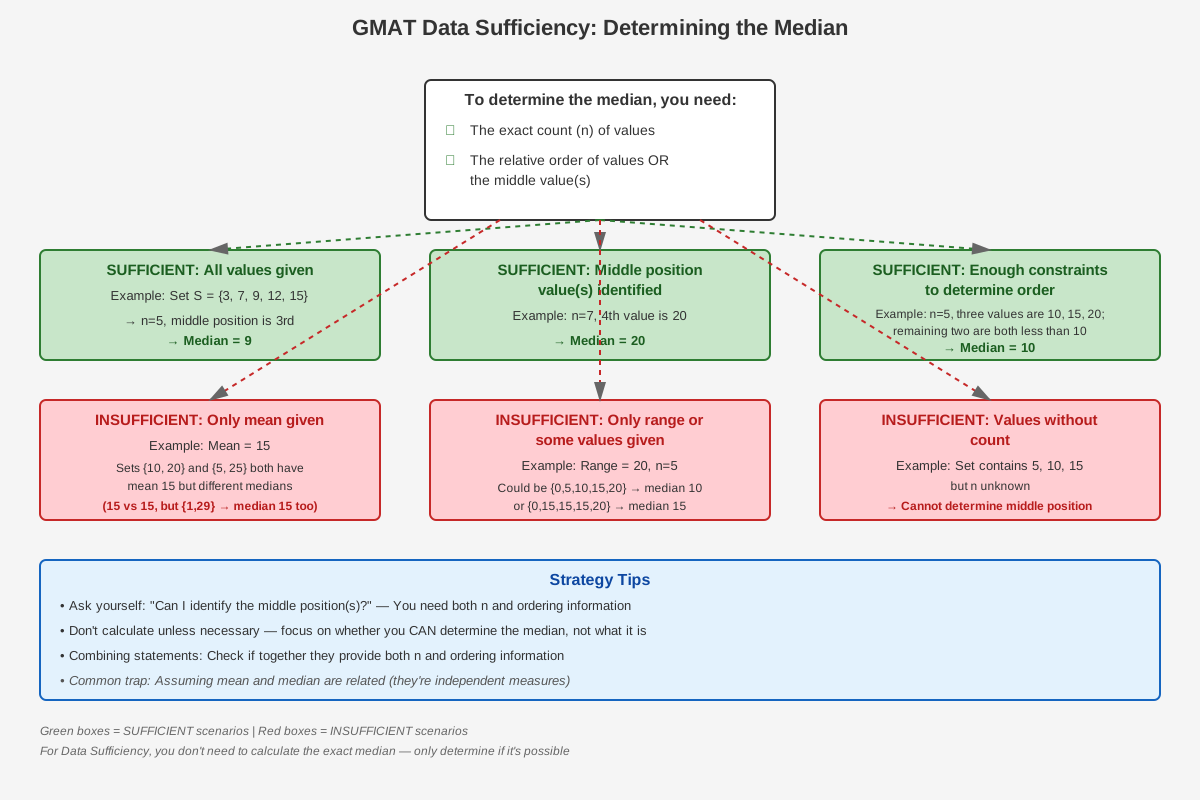
GMAT Data Sufficiency questions frequently test whether given information is sufficient to determine a unique median. Key principles include:
- To determine the median of n values, you need to know the values at positions ⌈n/2⌉ and ⌊n/2⌋ + 1 (the middle position(s))
- You do NOT need to know all values in the dataset
- Information about extreme values (maximum, minimum) often does not help determine the median
- Information about the number of values above or below a certain threshold can be sufficient
Median with Variables
GMAT questions often present datasets containing variables and ask students to solve for those variables given that the median equals a specific value. The approach involves:
- Arranging the dataset in order (which may require considering different cases based on the variable's possible values)
- Identifying the middle position(s)
- Setting up an equation where the median expression equals the given value
- Solving for the variable
For example, if {3, x, 7, 9, 12} has a median of 8, we must determine where x fits in the ordering. If x is the middle value (3rd position), then x = 8. We can verify: {3, 7, 8, 9, 12} indeed has a median of 8.
Concept Relationships
The median concept connects to multiple areas within GMAT Quantitative Reasoning through a network of relationships. At the foundational level, ordering and sequencing → enables → median identification, since the median cannot be determined without first arranging data in order. This ordering process relies on inequality understanding → which supports → determining relative positions of values.
The median relates directly to other measures of central tendency through comparison relationships: median ← compared with → mean to understand distribution shape, and median ← compared with → mode to understand data concentration. These comparisons lead to distribution analysis → which informs → appropriate statistical measure selection.
Within Data Sufficiency questions, median concepts → combine with → logical reasoning to determine sufficiency. Specifically, understanding that extreme values don't affect median → enables → efficient sufficiency evaluation without complete information. Additionally, number properties (odd/even) → determines → median calculation method (single value vs. average of two values).
The median also connects forward to more advanced topics: median understanding → provides foundation for → quartiles and percentiles, and median in datasets → extends to → median in probability distributions. Furthermore, median manipulation → integrates with → algebraic problem-solving when variables are present in datasets.
High-Yield Facts
⭐ The median is the middle value of an ordered dataset; the data MUST be ordered before finding the median
⭐ For odd-length datasets (n values), the median is the single value at position (n+1)/2
⭐ For even-length datasets (n values), the median is the average of the values at positions n/2 and (n/2)+1
⭐ The median is resistant to outliers; extreme values do not affect the median as long as they remain extreme
⭐ In a symmetric distribution, the median equals the mean; in right-skewed distributions, mean > median; in left-skewed distributions, median > mean
- Adding or removing a single value from a dataset can change the median by changing which position(s) represent the middle
- To determine a unique median, you only need to know the value(s) at the middle position(s), not all values in the dataset
- When a dataset contains variables, the median may depend on where those variables fall in the ordered sequence
- The median of a dataset with repeated values treats each repetition as a separate data point
- In Data Sufficiency questions, information about the number of values above or below a threshold can be sufficient to determine the median
Quick check — test yourself on Median so far.
Try Flashcards →Common Misconceptions
Misconception: The median is always one of the values in the dataset.
Correction: The median is only guaranteed to be a dataset value when the number of values is odd. For even-length datasets, the median is the average of the two middle values and may not appear in the original dataset. For example, the median of {2, 5, 8, 11} is 6.5, which is not in the dataset.
Misconception: You can find the median without ordering the data by just picking the middle value as presented.
Correction: The dataset must always be arranged in ascending or descending order before identifying the middle value(s). The median of {15, 3, 22, 8, 11} is NOT 22; it is 11 after ordering to {3, 8, 11, 15, 22}.
Misconception: Changing an extreme value in a dataset always changes the median.
Correction: The median depends only on the middle value(s), so changing extreme values (as long as they remain extreme) does not affect the median. In {2, 5, 8, 11, 14}, the median is 8. Changing 14 to 1000 still yields a median of 8.
Misconception: To find the median in a Data Sufficiency question, you need to know all the values in the dataset.
Correction: You only need sufficient information to determine the value(s) at the middle position(s). Knowing that a dataset of 7 values has three values equal to 5, two values less than 5, and two values greater than 5 is sufficient to determine that the median is 5, even without knowing the specific other values.
Misconception: The median and mean are always close to each other in value.
Correction: In skewed distributions, the median and mean can differ substantially. For example, in {1, 2, 3, 4, 100}, the median is 3 but the mean is 22. The presence of outliers causes this divergence.
Misconception: When adding a value to a dataset, if the new value is above the current median, the median must increase.
Correction: Adding a value above the current median may increase, decrease, or leave the median unchanged, depending on whether the dataset length changes from odd to even (or vice versa) and where the new middle position(s) fall. Adding 20 to {1, 3, 5, 7, 9} (median 5) creates {1, 3, 5, 7, 9, 20} with median (5+7)/2 = 6, but adding 20 to {1, 3, 5} (median 3) creates {1, 3, 5, 20} with median (3+5)/2 = 4.
Worked Examples
Example 1: Finding Median with Variables
Problem: The set {4, 7, x, 12, 15} has a median of 9. What is the value of x?
Solution:
Step 1: Understand that for a 5-element set, the median is the 3rd value when ordered (position (5+1)/2 = 3).
Step 2: Determine where x must fall in the ordering. Since the median is 9, the 3rd value when ordered must be 9.
Step 3: Consider the given values: 4, 7, 12, 15. We need to determine where x = 9 fits.
Step 4: Order the known values: 4, 7, __, 12, 15. For the 3rd position to be 9, we need 9 to fall between 7 and 12.
Step 5: If x = 9, the ordered set is {4, 7, 9, 12, 15}, and the 3rd value is indeed 9.
Step 6: Verify that x = 9 is the only solution. If x were any value other than 9, the 3rd position would contain a different value. For instance, if x = 6, the ordered set would be {4, 6, 7, 12, 15} with median 7. If x = 11, the ordered set would be {4, 7, 11, 12, 15} with median 11.
Answer: x = 9
Connection to Learning Objectives: This example demonstrates the ability to apply median concepts to solve for unknown variables, requiring students to understand both the definition of median (middle value of ordered set) and how to work backwards from a given median to determine dataset values.
Example 2: Data Sufficiency - Determining if Median Can Be Found
Problem: What is the median of the set {a, b, c, d, e}, where a ≤ b ≤ c ≤ d ≤ e?
Statement (1): a = 3 and e = 15
Statement (2): c = 8
Solution:
Step 1: Recognize that this is a 5-element set, so the median is the 3rd value (c) when ordered.
Step 2: Evaluate Statement (1): Knowing a = 3 and e = 15 tells us the minimum and maximum values, but provides no information about c, the middle value. For example, the set could be {3, 4, 5, 10, 15} with median 5, or {3, 7, 10, 12, 15} with median 10. Statement (1) is INSUFFICIENT.
Step 3: Evaluate Statement (2): Knowing c = 8 directly tells us the value at the 3rd position. Since the median of a 5-element ordered set is the 3rd value, and c = 8, the median is 8. We don't need to know the values of a, b, d, or e. Statement (2) is SUFFICIENT.
Step 4: Determine the answer. Statement (1) alone is insufficient, Statement (2) alone is sufficient.
Answer: B (Statement 2 alone is sufficient)
Connection to Learning Objectives: This example illustrates a critical GMAT concept—that determining the median requires only knowledge of the middle value(s), not all values in the dataset. It demonstrates the ability to identify what information is necessary and sufficient to determine a median, a key skill for Data Sufficiency questions.
Exam Strategy
When approaching GMAT median questions, begin by immediately identifying whether the question involves an odd or even number of data points, as this determines whether you'll find a single middle value or average two middle values. Look for the phrase "middle value" or "median" as trigger words, but also watch for questions that describe the median concept without using the term explicitly, such as "the value that divides the dataset into two equal halves."
For Problem Solving questions, always write out the dataset in order before attempting to identify the median—this simple step prevents the most common error of selecting the middle value from an unordered list. If the dataset contains variables, consider whether you need to determine the variable's value or whether you can determine the median without knowing the exact value (for instance, if the variable is clearly extreme and won't affect the middle position).
In Data Sufficiency questions, apply the principle that you only need information about the middle position(s). Immediately eliminate statements that provide information only about extreme values (maximum, minimum, or values far from the middle) unless the dataset is very small. Look for statements that tell you about the middle value directly, or that provide enough information to determine how many values fall above and below certain thresholds, allowing you to pinpoint the middle.
Exam Tip: If a Data Sufficiency question asks about the median of n values, and a statement tells you the value at position (n+1)/2 (for odd n) or gives you both values at positions n/2 and (n/2)+1 (for even n), that statement is automatically sufficient, regardless of what else you know about the dataset.
Watch for questions that test conceptual understanding rather than calculation. The GMAT frequently asks "Could the median be X?" or "Must the median be greater than Y?" rather than simply "What is the median?" For these questions, consider extreme cases and test boundary conditions rather than trying to calculate a specific value.
Time management is crucial: straightforward median calculations should take 30-45 seconds, while complex Data Sufficiency questions involving median concepts may require 90-120 seconds. If you find yourself spending more than two minutes on a median question, you may be overcomplicating the problem—step back and reconsider whether you're using the most efficient approach.
Process of elimination works particularly well on median questions. If answer choices are given, you can often eliminate options by considering whether they're even possible given the constraints. For instance, if you know the dataset contains only positive integers and one answer choice is negative or non-integer, eliminate it immediately.
Memory Techniques
ODD-EVEN Mnemonic: "One Direct Determination" for odd-length datasets (one middle value, directly determined), versus "Exactly Values Expressed Numerically" for even-length datasets (exactly two values expressed as their numerical average).
Ordering Reminder: Visualize the word MEDIAN with the letters rearranged: "Always Arrange Data In Moving Either North" (ascending order). The awkward phrasing makes it memorable, and the emphasis on "arrange" reminds you to order the data first.
Resistance to Outliers: Picture the median as a "Middle Executive Disregarding Irrational Abnormal Numbers"—a businessperson who focuses on the middle ground and isn't swayed by extreme positions. This helps remember that outliers don't affect the median.
Position Formula Memory: For odd n, use (n+1)/2 → think "add one before dividing" (the "+1" is memorable because it's the extra step). For even n, use n/2 and (n/2)+1 → think "split evenly, then take neighbors" (even splits evenly, and you need the two neighboring positions).
Median vs. Mean: Remember "Median Maintains Middle" (resistant to outliers) while "Mean Moves with Magnitude" (affected by extreme values). The alliteration makes this distinction stick.
Summary
The median is a fundamental measure of central tendency representing the middle value in an ordered dataset, calculated as either the single middle value (for odd-length datasets) or the average of the two middle values (for even-length datasets). Understanding the median is essential for GMAT success because it appears frequently in both Problem Solving and Data Sufficiency questions, often testing conceptual understanding rather than mere calculation ability. The median's key characteristic—resistance to outliers—distinguishes it from the mean and makes it the preferred measure for skewed distributions. To find the median, data must always be ordered first, and the calculation method depends on whether the dataset contains an odd or even number of values. On the GMAT, median questions frequently test whether students understand that only the middle value(s) matter, not the specific values of extreme data points, making it possible to determine the median with incomplete information about the dataset. Mastery requires understanding how the median changes when values are added or removed, how to solve for variables when the median is given, and how to efficiently evaluate sufficiency in Data Sufficiency contexts. The median connects to broader statistical concepts including distribution shape, comparison with other measures of central tendency, and data interpretation skills essential for business and analytical reasoning.
Key Takeaways
- The median is the middle value of an ordered dataset; always order the data before identifying the median
- For odd n values, median = value at position (n+1)/2; for even n values, median = average of values at positions n/2 and (n/2)+1
- The median is resistant to outliers—extreme values don't affect it as long as they remain extreme and don't shift the middle position
- In Data Sufficiency questions, you only need information about the middle position(s), not all values in the dataset
- The relationship between median and mean reveals distribution shape: median = mean (symmetric), mean > median (right-skewed), median > mean (left-skewed)
- Adding or removing values changes the median by potentially shifting which position(s) represent the middle, not necessarily by the magnitude of the added/removed value
- When datasets contain variables, consider all possible orderings based on where the variable might fall in the sequence
Related Topics
Mean (Arithmetic Average): Understanding the mean complements median knowledge and enables comparison between these measures of central tendency. Mastering both allows students to determine which measure best represents a dataset and to solve problems requiring multiple statistical calculations.
Mode: The third measure of central tendency, representing the most frequently occurring value. Combined with median and mean, the mode completes the toolkit for describing data distributions and appears in comparative statistics questions.
Range and Standard Deviation: These measures of dispersion work alongside the median to provide a complete picture of data distribution. Understanding how spread relates to central tendency is crucial for advanced statistics questions.
Quartiles and Percentiles: The median is actually the 50th percentile or second quartile. Mastering the median provides the foundation for understanding how datasets are divided into quarters or hundredths, a concept tested in data interpretation questions.
Box Plots and Data Visualization: Box plots display the median prominently along with quartiles. Understanding the median enables interpretation of these visual representations of data distribution commonly found in Integrated Reasoning questions.
Practice CTA
Now that you've mastered the core concepts of median, it's time to solidify your understanding through active practice. Attempt the practice questions to test your ability to identify, explain, and apply median concepts in various GMAT question formats. Use the flashcards to reinforce key definitions and formulas until they become automatic. Remember, the GMAT tests not just calculation ability but conceptual understanding—practice questions that challenge you to think about sufficiency, variable relationships, and the effects of data manipulation will prepare you for the full range of median questions you'll encounter on test day. Your investment in deliberate practice now will pay dividends in both speed and accuracy when you face these high-yield questions under timed conditions.
Sign up free to keep reading
Create a free AnvayaPrep account to finish this GMAT guide on Median — plus flashcards and practice questions.