Overview
The mean, commonly known as the average, is one of the most fundamental concepts in statistics and a cornerstone of GMAT Quantitative Reasoning. Understanding the mean goes far beyond simply adding numbers and dividing—it requires mastery of algebraic manipulation, weighted averages, and the ability to work backward from given information to find missing values. The GMAT tests the mean in diverse contexts, from straightforward calculation problems to complex multi-step word problems involving sets of data, combined groups, and changing values.
The mean appears frequently on the GMAT, both as a standalone concept and integrated with other statistical measures like median, mode, and range. Test-makers favor questions that require students to manipulate the mean formula algebraically, understand how adding or removing data points affects the average, and work with weighted averages across multiple groups. These questions often appear in Problem Solving format but also emerge in Data Sufficiency questions where determining whether sufficient information exists to calculate a mean becomes the central challenge.
Within the broader landscape of Quantitative Reasoning, the mean serves as a bridge between basic arithmetic operations and more sophisticated statistical analysis. It connects directly to concepts of ratios, proportions, and algebraic equations, while also providing the foundation for understanding standard deviation, probability distributions, and data interpretation. Mastering the mean is essential not only for statistics questions but also for word problems involving rates, mixtures, and group comparisons that pervade the GMAT.
Learning Objectives
- [ ] Identify Mean in various problem contexts and data presentations
- [ ] Explain Mean conceptually and distinguish it from other measures of central tendency
- [ ] Apply Mean to GMAT questions involving single sets, combined sets, and weighted averages
- [ ] Calculate missing values when given the mean and partial data
- [ ] Determine how changes to a data set (adding, removing, or modifying values) affect the mean
- [ ] Solve Data Sufficiency problems by identifying what information is necessary to calculate or compare means
- [ ] Apply weighted average concepts to complex multi-group scenarios
Prerequisites
- Basic arithmetic operations: Addition, subtraction, multiplication, and division form the computational foundation for calculating means
- Algebraic manipulation: Solving for unknown variables is essential when working backward from a given mean to find missing data points
- Fractions and decimals: Many mean calculations involve non-integer values requiring comfort with fractional arithmetic
- Basic equation solving: Setting up and solving equations is necessary for problems involving relationships between means and data values
Why This Topic Matters
The mean appears in countless real-world applications, from calculating grade point averages and batting averages to determining average salaries, temperatures, speeds, and financial returns. Businesses use means to analyze sales performance, customer satisfaction scores, and operational metrics. Scientists rely on means to summarize experimental data and identify trends. This ubiquity makes the mean an essential tool for quantitative literacy in professional and academic contexts.
On the GMAT specifically, mean-related questions appear in approximately 10-15% of Quantitative Reasoning sections, making it a high-yield topic for focused study. These questions typically fall into several categories: direct calculation problems (20% of mean questions), weighted average scenarios (30%), problems involving changes to data sets (25%), combined group problems (15%), and Data Sufficiency questions testing conceptual understanding (10%). The GMAT particularly favors questions that require algebraic thinking rather than straightforward computation.
Mean questions commonly appear disguised within word problems about test scores, work rates, prices, distances, and time. The exam frequently presents scenarios where students must recognize that finding an average is the key to solving the problem, even when the word "mean" or "average" doesn't explicitly appear. Questions might ask about "typical" values, "per unit" amounts, or situations requiring distribution of a total across multiple items—all contexts where mean calculation is essential.
Core Concepts
Definition and Basic Formula
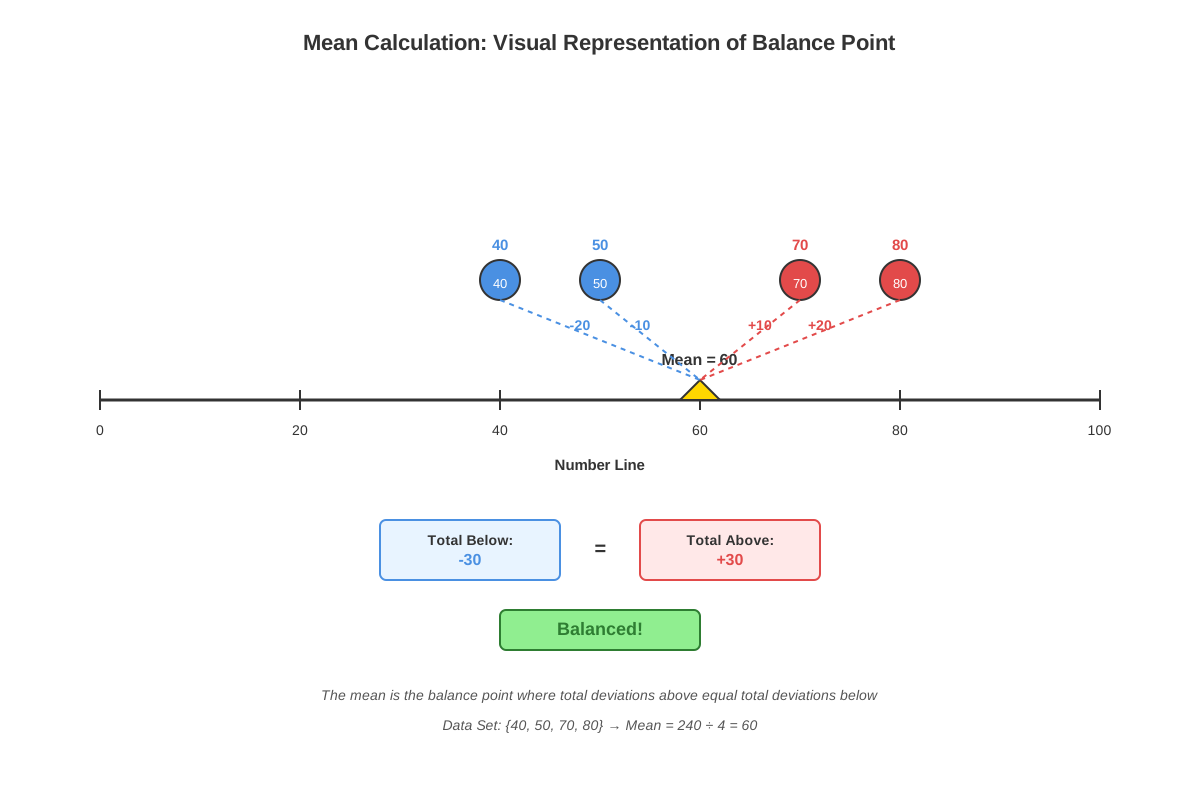
The mean (or arithmetic mean) of a set of numbers is the sum of all values divided by the count of values. This measure of central tendency represents the "balance point" of a data set—the value that would result if all quantities were distributed equally. The GMAT mean formula is expressed as:
Mean = (Sum of all values) / (Number of values)Algebraically, for a set of n values (x₁, x₂, x₃, ..., xₙ):
Mean = (x₁ + x₂ + x₃ + ... + xₙ) / nThis formula can be rearranged to solve for different unknowns:
- Sum = Mean × Number of values
- Number of values = Sum / Mean
Understanding these algebraic rearrangements is crucial for GMAT success, as many questions provide the mean and ask for the sum, or vice versa.
Working Backward from the Mean
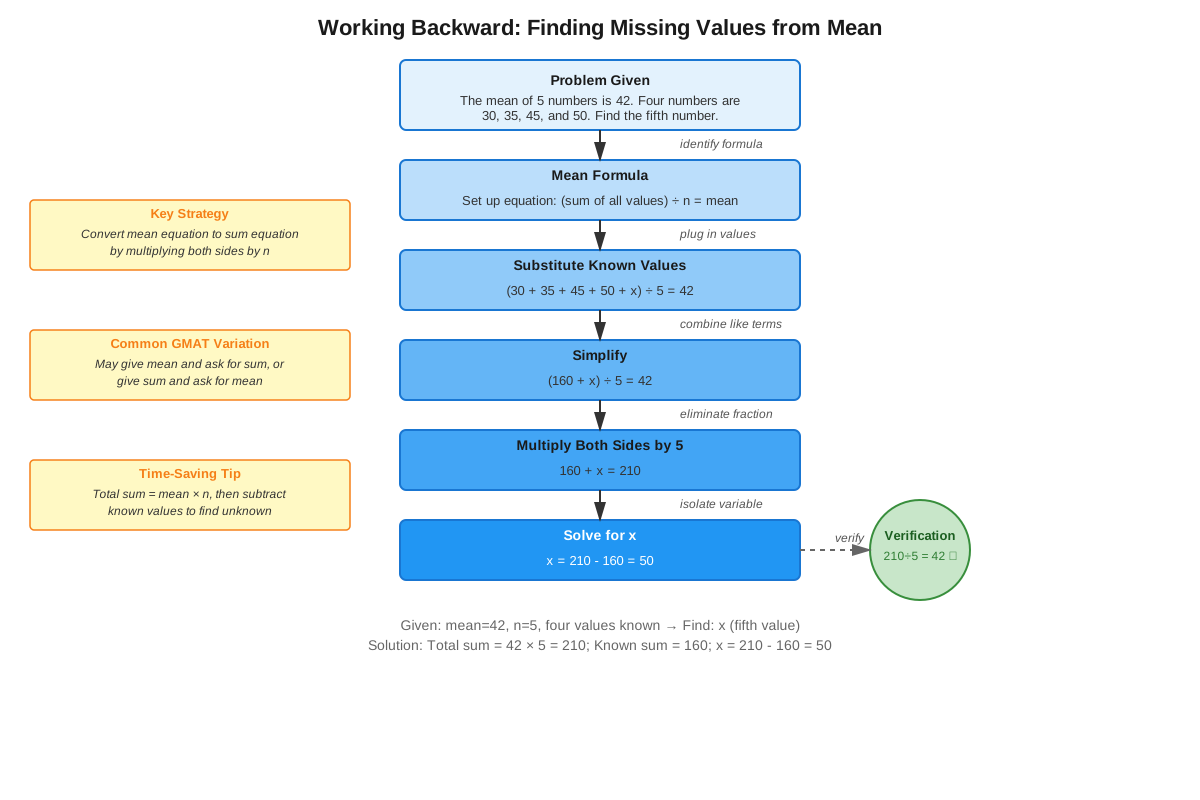
Many GMAT questions provide the mean and some data values, requiring students to find missing values. This involves setting up an equation using the mean formula and solving algebraically.
Example approach: If five test scores have a mean of 84, and four scores are 78, 82, 88, and 90, find the fifth score.
- Set up the equation: (78 + 82 + 88 + 90 + x) / 5 = 84
- Multiply both sides by 5: 338 + x = 420
- Solve for x: x = 82
This technique extends to more complex scenarios involving multiple unknowns or constraints.
Effect of Adding or Removing Values
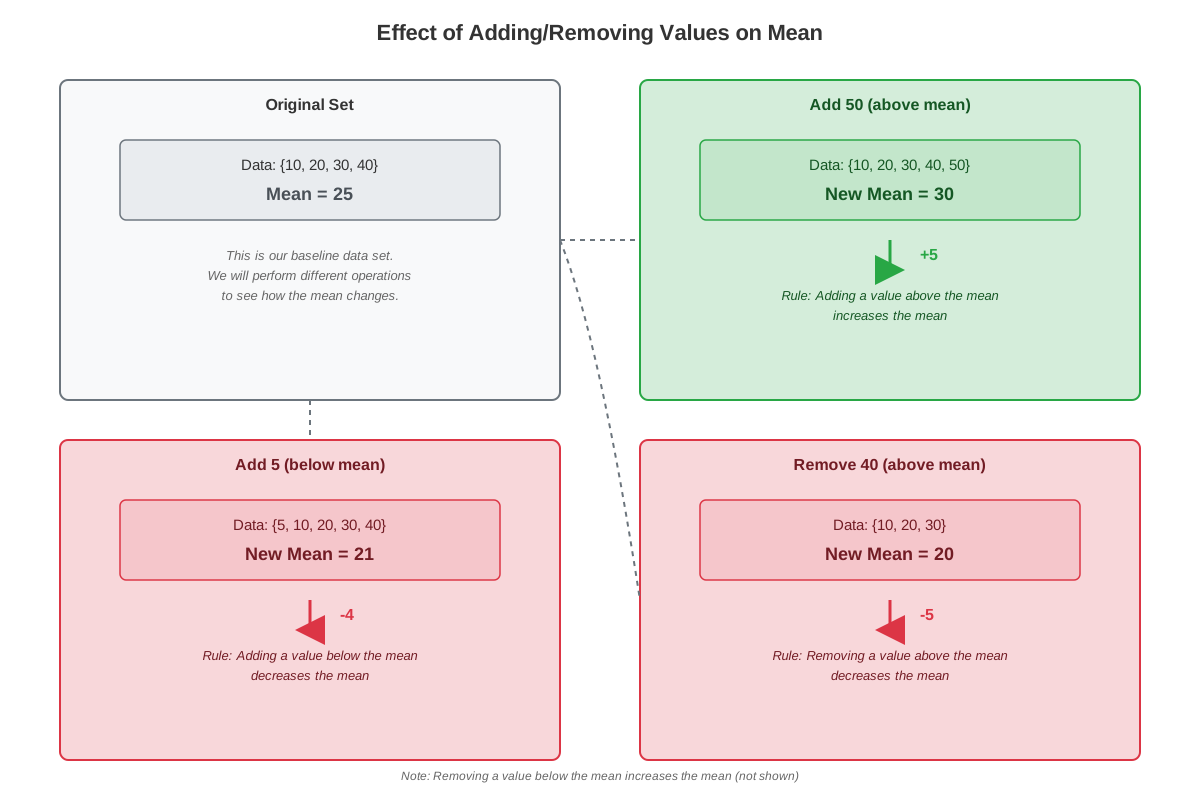
Understanding how the mean changes when data points are added or removed is a high-yield GMAT concept. Key principles include:
- Adding a value equal to the current mean: The mean remains unchanged
- Adding a value greater than the current mean: The mean increases
- Adding a value less than the current mean: The mean decreases
- Removing a value equal to the mean: The mean remains unchanged
- Removing a value greater than the mean: The mean decreases
- Removing a value less than the mean: The mean increases
The magnitude of change depends on both the difference between the new value and the current mean, and the size of the data set. Larger data sets experience smaller changes when individual values are added or removed.
Weighted Averages
A weighted average occurs when different values contribute unequally to the overall mean. Each value is multiplied by its weight (frequency or importance), then these products are summed and divided by the total weight.
Weighted Mean = (w₁x₁ + w₂x₂ + ... + wₙxₙ) / (w₁ + w₂ + ... + wₙ)Common GMAT scenarios include:
- Test scores with different point values
- Prices of items purchased in different quantities
- Average speeds over different distances
- Combined groups with different sizes
Combined Group Averages
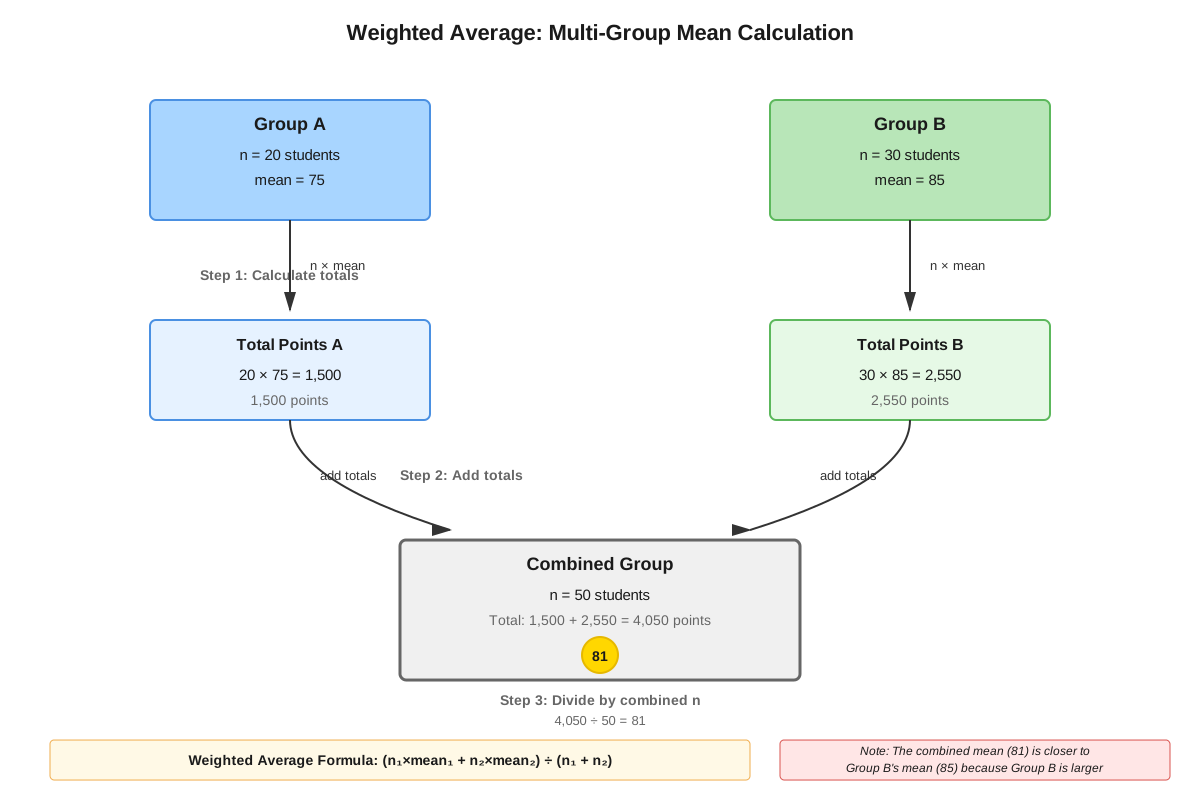
When combining two or more groups, each with its own mean, the overall mean is NOT simply the average of the individual means (unless the groups are equal in size). Instead, calculate:
Combined Mean = (Sum₁ + Sum₂) / (n₁ + n₂)Or equivalently:
Combined Mean = (Mean₁ × n₁ + Mean₂ × n₂) / (n₁ + n₂)This is essentially a weighted average where the weights are the group sizes.
| Scenario | Formula | Key Insight |
|---|---|---|
| Single group | Sum / n | Basic definition |
| Finding sum | Mean × n | Algebraic rearrangement |
| Weighted average | Σ(weight × value) / Σ(weights) | Accounts for unequal contribution |
| Combined groups | (Sum₁ + Sum₂) / (n₁ + n₂) | Weight by group size |
| Change in mean | Compare new sum/count to original | Depends on value relative to current mean |
Mean vs. Other Measures
While the mean is the most commonly used measure of central tendency, understanding its relationship to median and mode helps with GMAT questions that test conceptual knowledge:
- Mean: Sensitive to extreme values (outliers); uses all data points
- Median: Resistant to outliers; represents the middle value
- Mode: Identifies the most frequent value; can have multiple modes or none
The GMAT may present scenarios where the mean is misleading due to outliers, testing whether students recognize when alternative measures are more appropriate.
Distance from the Mean
The concept of how far individual values deviate from the mean underlies many advanced statistics topics. For GMAT purposes, understanding that:
- The sum of positive deviations equals the sum of negative deviations
- Values can be expressed as "mean ± deviation"
- Balancing deviations helps solve for unknown values
This principle appears in questions about evenly spaced sets, symmetric distributions, and problems requiring students to determine possible values given constraints about the mean.
Concept Relationships
The mean serves as a central hub connecting multiple quantitative concepts. At its foundation, the mean relies on basic arithmetic operations (addition and division), which students must execute accurately under time pressure. Moving upward in complexity, the mean formula transforms into algebraic equations when unknowns are introduced, requiring manipulation skills to isolate variables.
The relationship flow progresses as follows: Basic arithmetic → Mean calculation → Algebraic manipulation → Weighted averages → Combined group problems → Statistical analysis. Each level builds upon the previous, with weighted averages representing a sophisticated application of the basic mean concept, and combined group problems requiring both weighted average understanding and algebraic problem-solving.
Horizontally, the mean connects to ratios and proportions through weighted average problems, where the ratio of group sizes determines the overall average. It also relates to rate problems, as average speed, average cost per unit, and average rate of work all employ mean calculations. The concept extends to mixture problems, where finding the average concentration or average price requires weighted average techniques.
Within statistics, the mean forms the foundation for standard deviation (measuring spread around the mean), normal distributions (centered on the mean), and probability calculations involving expected values. For Data Sufficiency questions, understanding the mean connects to sufficiency analysis—determining what minimum information is needed to calculate or compare means.
High-Yield Facts
⭐ The mean of a set equals the sum of all values divided by the number of values: This fundamental formula can be algebraically rearranged to solve for sum or count.
⭐ Sum = Mean × Number of values: This rearrangement is essential for working backward from a given mean to find totals.
⭐ When combining groups, the overall mean is a weighted average based on group sizes: Never simply average the individual means unless groups are equal in size.
⭐ Adding a value above the current mean increases the mean; adding a value below the current mean decreases it: The magnitude of change depends on the distance from the mean and the data set size.
⭐ In a weighted average, the overall mean lies between the individual means, closer to the mean of the larger group: This principle helps eliminate incorrect answer choices quickly.
- The mean is the only measure of central tendency that uses every value in the data set, making it sensitive to outliers.
- For evenly spaced sets (arithmetic sequences), the mean equals the median and is the average of the first and last terms.
- Multiplying every value in a set by a constant k multiplies the mean by k; adding a constant c to every value adds c to the mean.
- The sum of deviations from the mean always equals zero: Σ(xᵢ - mean) = 0.
- In Data Sufficiency questions, knowing the mean and count is sufficient to determine the sum, and vice versa.
- When values are removed from a set, the new mean can be calculated using: New Mean = (Old Sum - Removed Value) / (Old Count - 1).
- The mean of means equals the overall mean only when all subgroups have equal size.
Quick check — test yourself on Mean so far.
Try Flashcards →Common Misconceptions
Misconception: The average of two averages is the overall average.
Correction: This is only true when both groups have the same size. When groups differ in size, the overall average is a weighted average where larger groups have more influence. For example, if 10 students average 80 and 20 students average 90, the overall average is not 85 but rather (10×80 + 20×90)/(10+20) = 86.67.
Misconception: Adding any value to a data set always changes the mean.
Correction: Adding a value exactly equal to the current mean leaves the mean unchanged. The mean only changes when the added value differs from the current mean, increasing if the new value is higher and decreasing if it's lower.
Misconception: The mean is always one of the values in the data set.
Correction: The mean can be any value within or even outside the range of the data set. For example, the mean of {1, 2, 6} is 3, which doesn't appear in the set. The mean represents a calculated balance point, not necessarily an actual data value.
Misconception: Removing the highest value always decreases the mean by a predictable amount.
Correction: While removing a value above the mean does decrease the mean, the amount of decrease depends on both how far above the mean the value is and how many values remain. The calculation requires finding the new sum and dividing by the new count.
Misconception: In Data Sufficiency questions, knowing some values and the mean is always sufficient to find all values.
Correction: Knowing the mean and some values allows you to find the sum of the remaining values, but not necessarily individual values unless you have enough constraints. For example, knowing the mean of five numbers and three of the values tells you the sum of the other two, but not their individual values.
Misconception: The mean, median, and mode are always close to each other.
Correction: In symmetric distributions they coincide, but in skewed distributions they can differ substantially. The mean is pulled toward outliers, while the median is resistant to them. The GMAT tests understanding of when these measures diverge.
Misconception: Doubling all values in a set doubles the mean, and doubling the number of values (by repeating the set) also doubles the mean.
Correction: Doubling all values does double the mean, but doubling the count by repeating values leaves the mean unchanged. If a set {2, 4, 6} has mean 4, the set {4, 8, 12} has mean 8, but {2, 4, 6, 2, 4, 6} still has mean 4.
Worked Examples
Example 1: Finding Missing Values with Constraints
Problem: The mean of five positive integers is 12. Four of the integers are 8, 10, 14, and 16. What is the fifth integer?
Solution:
Step 1: Identify what we know and what we need to find.
- Mean = 12
- Number of values = 5
- Four known values: 8, 10, 14, 16
- Unknown: fifth integer (call it x)
Step 2: Use the relationship Sum = Mean × Number of values.
- Total sum = 12 × 5 = 60
Step 3: Find the sum of known values.
- Sum of known values = 8 + 10 + 14 + 16 = 48
Step 4: Solve for the unknown value.
- 48 + x = 60
- x = 12
Step 5: Verify the answer.
- Mean = (8 + 10 + 14 + 16 + 12) / 5 = 60 / 5 = 12 ✓
Connection to learning objectives: This problem demonstrates applying the mean formula algebraically to find missing values, a core GMAT skill. Notice that the fifth value equals the mean, which makes sense conceptually—adding a value equal to the mean doesn't change the mean.
Example 2: Combined Group Weighted Average
Problem: In a company, the 20 employees in Department A have an average salary of $60,000, while the 30 employees in Department B have an average salary of $75,000. What is the average salary across both departments?
Solution:
Step 1: Recognize this as a weighted average problem where group sizes differ.
- Department A: 20 employees, mean = $60,000
- Department B: 30 employees, mean = $75,000
Step 2: Calculate the total salary for each department using Sum = Mean × Count.
- Total salary in Department A = $60,000 × 20 = $1,200,000
- Total salary in Department B = $75,000 × 30 = $2,250,000
Step 3: Find the combined total and combined count.
- Combined total salary = $1,200,000 + $2,250,000 = $3,450,000
- Combined employee count = 20 + 30 = 50
Step 4: Calculate the overall mean.
- Overall mean = $3,450,000 / 50 = $69,000
Step 5: Verify the answer makes sense.
- The overall mean ($69,000) falls between the two individual means ($60,000 and $75,000) ✓
- It's closer to $75,000 because Department B is larger (30 vs. 20 employees) ✓
- Note: Simply averaging $60,000 and $75,000 would give $67,500, which is incorrect
Alternative approach using weighted average formula:
Combined Mean = (20 × $60,000 + 30 × $75,000) / (20 + 30)
             = ($1,200,000 + $2,250,000) / 50
             = $69,000
Connection to learning objectives: This problem illustrates the critical concept that combining groups requires weighting by group size, not simply averaging the means. This is one of the most commonly tested mean concepts on the GMAT and appears frequently in word problems involving combined classes, departments, or groups.
Exam Strategy
When approaching GMAT mean questions, begin by identifying the question type: Are you calculating a mean directly, finding missing values, combining groups, or determining sufficiency of information? This classification determines your solution strategy.
Trigger words and phrases that signal mean problems include: "average," "mean," "per unit," "typical," "evenly distributed," and phrases like "on average" or "average out to." In Data Sufficiency, watch for questions asking whether you can "determine the average" or "compare the means"—these test whether you understand what information is necessary and sufficient.
For Problem Solving questions, immediately write down the mean formula and identify which variable you're solving for. If the problem involves multiple groups or weighted values, create a simple table with columns for group/category, count/weight, mean, and total. This organization prevents calculation errors and makes the solution path clear.
For Data Sufficiency questions, remember these sufficiency principles:
- Mean + Count → Sum (sufficient)
- Sum + Count → Mean (sufficient)
- Mean + Some values + Count → Sum of remaining values (sufficient for the sum, but not necessarily individual values)
- Two group means without group sizes → Cannot determine combined mean (insufficient)
Process of elimination strategies:
- When combining groups of different sizes, eliminate answer choices that equal the simple average of the means
- If adding a value above the current mean, eliminate choices showing the mean decreased
- For weighted averages, eliminate choices outside the range of the individual means
- Use estimation: If one group is much larger, the combined mean should be very close to that group's mean
Time allocation: Straightforward mean calculation problems should take 60-90 seconds. Weighted average and combined group problems typically require 2-2.5 minutes. If you find yourself spending more than 3 minutes, you may be overcomplicating the problem—look for a more direct approach or consider strategic guessing.
Common trap answers include:
- The simple average of means when groups differ in size
- The median of the given values instead of the mean
- Calculation errors from incorrect order of operations
- In Data Sufficiency, marking "sufficient" when you can find the sum but not individual values
Exam Tip: Before calculating, estimate the answer. For combined groups, the overall mean must fall between the individual means, weighted toward the larger group. This estimation helps you catch calculation errors and quickly eliminate unreasonable answer choices.
Memory Techniques
MEAN Mnemonic:
- Multiply mean by number to get sum
- Equal values don't change the mean
- Add all values, then divide
- Number of values matters for weighting
Weighted Average Visualization: Picture a seesaw or balance scale. The fulcrum (balance point) represents the mean. Larger groups are heavier weights, pulling the mean toward their value. This mental image helps remember that combined means are weighted by group size.
The "Sum Bridge" Technique: When working with means, always think of the sum as a bridge between the mean and the count. Draw a triangle with "Mean" at the top, "Sum" in the middle, and "Count" at the bottom. Arrows show: Mean × Count → Sum, and Sum ÷ Count → Mean. This visual reinforces the algebraic relationships.
Change Direction Acronym - AAA:
- Above the mean → mean goes Ascending (up)
- At the mean → mean stays the sAme
- Below the mean → mean goes Descending (down) [breaks the pattern, making it memorable]
Group Combination Reminder: "Never average averages unless groups are twins" (equal size). This rhyme helps remember that simple averaging only works when groups are identical in size.
Summary
The mean is a fundamental measure of central tendency calculated by dividing the sum of all values by the count of values. GMAT questions test not just basic calculation but algebraic manipulation, weighted averages, combined groups, and the effects of adding or removing values. Success requires understanding that Sum = Mean × Count, recognizing that combined group means must be weighted by group size, and knowing how values above or below the current mean affect the overall average. The mean appears in approximately 10-15% of GMAT Quantitative questions, often disguised within word problems about test scores, salaries, speeds, or prices. Mastery involves both computational accuracy and conceptual understanding—knowing when information is sufficient to calculate a mean, how the mean relates to other statistical measures, and how to work backward from a given mean to find missing values. The key to GMAT success with mean problems is recognizing the question type quickly, setting up the appropriate equation or weighted average calculation, and using logical reasoning to verify that answers fall within expected ranges.
Key Takeaways
- The mean formula (Sum ÷ Count) can be algebraically rearranged to solve for any of its three components: mean, sum, or count
- When combining groups with different sizes, the overall mean is a weighted average—never simply average the individual means unless groups are equal
- Adding a value above the current mean increases it; adding a value below decreases it; adding a value equal to the mean leaves it unchanged
- Weighted averages account for unequal contribution of values, with the formula: Σ(weight × value) / Σ(weights)
- In Data Sufficiency questions, knowing any two of {mean, sum, count} allows you to determine the third
- The mean is sensitive to outliers and uses all data points, distinguishing it from median and mode
- Estimation and logical bounds checking (combined means must fall between individual means) help eliminate wrong answers and catch calculation errors
Related Topics
Median and Mode: These alternative measures of central tendency complement the mean. Understanding when each is most appropriate and how they relate in symmetric versus skewed distributions deepens statistical reasoning. Mastering the mean provides the foundation for comparing these measures.
Standard Deviation and Variance: These measures of spread quantify how far data points deviate from the mean. The mean serves as the reference point for all deviation calculations, making it prerequisite knowledge for understanding data dispersion.
Weighted Averages in Mixture Problems: Mixture problems involving solutions, alloys, or combined investments apply weighted average principles. The mean concepts learned here extend directly to these more complex scenarios.
Rate and Work Problems: Average speed, average rate of work, and average cost per unit all employ mean calculations. The algebraic manipulation skills developed with mean problems transfer directly to these application areas.
Data Sufficiency Strategy: Mean problems appear frequently in Data Sufficiency format, testing whether students can identify necessary and sufficient information. Mastering mean calculations builds the foundation for more complex sufficiency analysis.
Practice CTA
Now that you've mastered the core concepts of mean, it's time to solidify your understanding through practice. Attempt the practice questions to apply these concepts under exam-like conditions, focusing on both accuracy and speed. Use the flashcards to reinforce key formulas, relationships, and strategies until they become automatic. Remember, GMAT success comes not just from understanding concepts but from recognizing question patterns instantly and executing solutions efficiently. Each practice problem you solve builds the pattern recognition and confidence needed to excel on test day. Start practicing now—your target score is within reach!
Sign up free to keep reading
Create a free AnvayaPrep account to finish this GMAT guide on Mean — plus flashcards and practice questions.