Overview
The mode is one of the three fundamental measures of central tendency in statistics, alongside the mean and median. In the context of the GMAT, understanding the mode is essential for solving data analysis problems, interpreting data sets, and answering questions about frequency distributions. The mode represents the value that appears most frequently in a data set, making it a straightforward yet powerful tool for identifying patterns in numerical information. While it may seem simpler than other statistical measures, the mode plays a critical role in GMAT Quantitative Reasoning questions, particularly those involving data interpretation, statistics, and problem-solving scenarios.
The GMAT mode concept frequently appears in Data Sufficiency and Problem Solving questions, where test-takers must analyze sets of numbers, identify patterns, or determine missing values based on statistical properties. Unlike the mean, which can be influenced by extreme values, or the median, which focuses on positional ordering, the mode emphasizes frequency and repetition. This distinction makes the mode particularly useful when dealing with categorical data or when the most common occurrence matters more than the average or middle value. GMAT questions often test whether students can distinguish between these measures and apply the appropriate one to specific scenarios.
Understanding the mode connects directly to broader Quantitative Reasoning concepts including data analysis, set theory, and probability. The mode serves as a foundation for more advanced statistical concepts and frequently appears in multi-step problems that require students to calculate or compare multiple measures of central tendency. Mastering the mode enables test-takers to approach complex data interpretation questions with confidence and provides essential tools for analyzing real-world business scenarios that the GMAT frequently models.
Learning Objectives
- [ ] Identify the mode in various data sets, including those with single modes, multiple modes, or no mode
- [ ] Explain the definition, properties, and significance of the mode as a measure of central tendency
- [ ] Apply mode concepts to solve GMAT Problem Solving and Data Sufficiency questions
- [ ] Distinguish between situations where mode is the most appropriate measure versus mean or median
- [ ] Calculate the mode in data sets presented in various formats (lists, frequency tables, charts)
- [ ] Analyze how changes to a data set affect the mode and other statistical measures
- [ ] Solve multi-step problems that require integrating mode with other statistical concepts
Prerequisites
- Basic arithmetic operations: Essential for counting frequencies and comparing values within data sets
- Understanding of data sets and lists: Necessary for organizing and analyzing collections of numbers
- Familiarity with mean and median: Provides context for comparing different measures of central tendency
- Number sense and ordering: Required for identifying patterns and frequencies in numerical data
Why This Topic Matters
The mode has significant real-world applications across business, economics, and data analysis—all domains that the GMAT emphasizes. In business contexts, the mode helps identify the most popular product size, the most common customer complaint category, or the most frequent transaction amount. Retailers use mode to determine which inventory items to stock, while manufacturers use it to optimize production for the most demanded specifications. Unlike the mean, which can be skewed by outliers, the mode provides insight into what actually occurs most frequently in practice.
On the GMAT, mode-related questions appear with moderate to high frequency, particularly in the Quantitative Reasoning section. Approximately 5-8% of GMAT quantitative questions involve measures of central tendency, with mode appearing either as the primary focus or as part of multi-concept problems. These questions typically appear as:
- Data Sufficiency questions asking whether given information is sufficient to determine the mode
- Problem Solving questions requiring calculation of the mode from a data set
- Integrated Reasoning questions involving interpretation of charts or tables where mode identification is necessary
- Multi-step problems where the mode must be compared with mean or median
- Word problems describing real-world scenarios where frequency matters most
The GMAT frequently tests mode in combination with other statistical concepts, requiring students to demonstrate comprehensive understanding of when and how to apply each measure appropriately. Questions may present data in various formats—raw lists, frequency distributions, or graphical representations—testing both computational skills and conceptual understanding.
Core Concepts
Definition of Mode
The mode is defined as the value or values that appear most frequently in a data set. Unlike the mean (average) or median (middle value), the mode focuses exclusively on frequency of occurrence. To identify the mode, count how many times each distinct value appears in the data set; the value(s) with the highest count represent the mode. For example, in the data set {2, 3, 3, 5, 7, 7, 7, 9}, the number 7 appears three times—more than any other value—making 7 the mode.
The mode is the only measure of central tendency that can be used with categorical (non-numerical) data. While you cannot calculate a meaningful mean or median for categories like "red, blue, blue, green, blue," you can identify that "blue" is the mode because it appears most frequently. This versatility makes the mode particularly valuable in diverse analytical contexts.
Types of Modal Distributions
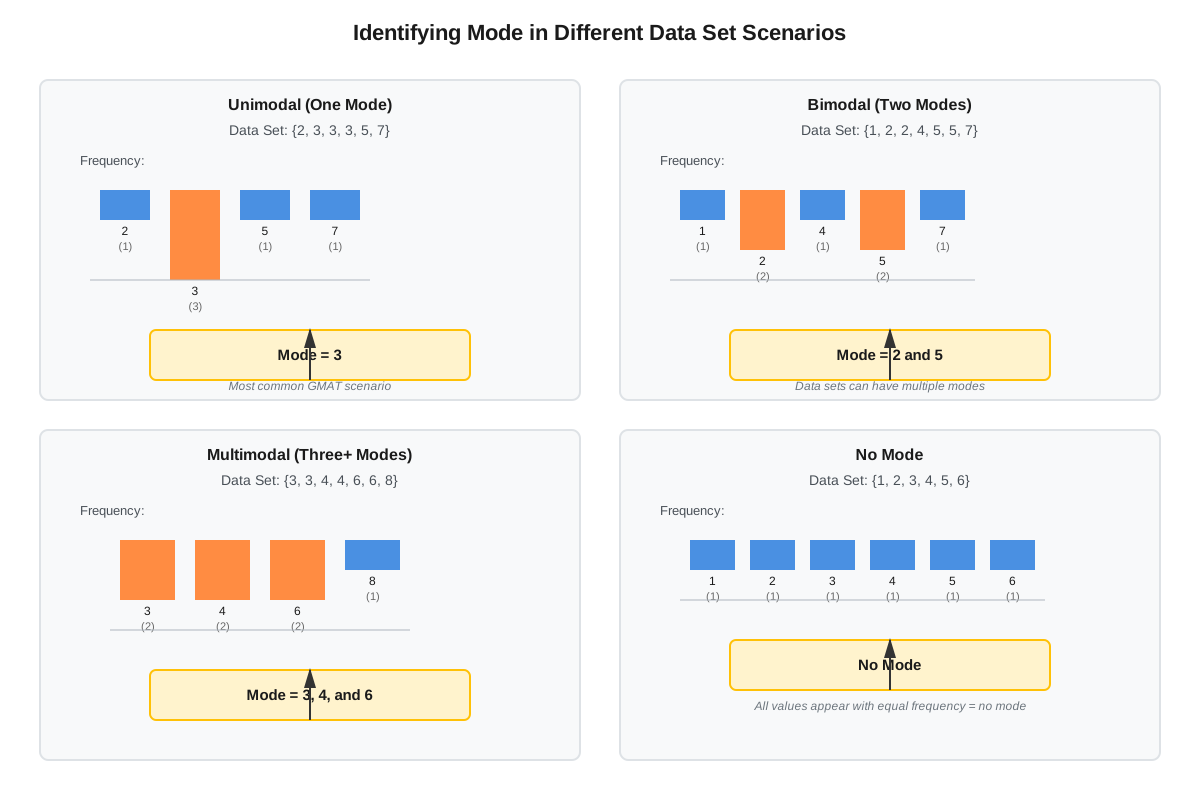
Data sets can be classified based on their modal characteristics:
Unimodal: A data set with exactly one mode. Example: {1, 2, 2, 2, 3, 4, 5} has a mode of 2.
Bimodal: A data set with exactly two modes (two values tied for highest frequency). Example: {1, 1, 1, 2, 3, 4, 4, 4} has modes of 1 and 4, both appearing three times.
Multimodal: A data set with more than two modes. Example: {2, 2, 3, 3, 5, 5, 7} has modes of 2, 3, and 5, each appearing twice.
No mode (amodal): A data set where all values appear with equal frequency, or where each value appears exactly once. Example: {1, 2, 3, 4, 5} has no mode because each value appears once.
| Distribution Type | Number of Modes | Example Data Set | Mode(s) |
|---|---|---|---|
| Unimodal | 1 | {3, 5, 5, 5, 7, 9} | 5 |
| Bimodal | 2 | {2, 2, 4, 6, 6, 8} | 2 and 6 |
| Multimodal | 3+ | {1, 1, 3, 3, 5, 5} | 1, 3, and 5 |
| No mode | 0 | {10, 20, 30, 40} | None |
Calculating Mode from Different Data Formats
From a simple list: Organize the data (mentally or on paper), count frequencies, and identify the highest frequency value(s).
From a frequency table: Look for the value associated with the highest frequency count.
Example frequency table:
Value    | Frequency
---------|----------
10       | 3
15       | 7
20       | 4
25       | 2
The mode is 15 (frequency of 7).
From grouped data or histograms: Identify the interval or category with the highest frequency. Note that for grouped data, you identify the modal class (the interval with the highest frequency) rather than a specific value.
Properties and Characteristics of Mode
The mode possesses several important properties that distinguish it from other measures of central tendency:
- Not affected by extreme values: Unlike the mean, the mode remains unchanged by outliers or extreme values in the data set
- Can be used with any type of data: Applicable to numerical, ordinal, and categorical data
- May not exist: Some data sets have no mode
- May not be unique: Data sets can have multiple modes
- Not necessarily central: The mode may not be near the center of the data distribution
- Simple to identify: Requires only counting, not complex calculations
- Represents actual data values: The mode is always a value that actually appears in the data set
Mode vs. Mean vs. Median
Understanding when to use each measure of central tendency is crucial for GMAT success:
| Measure | Best Used When | Advantages | Limitations |
|---|---|---|---|
| Mode | Identifying most common value; categorical data | Not affected by outliers; works with non-numerical data | May not exist or may not be unique |
| Mean | Data is symmetrical; all values matter | Uses all data points; algebraically useful | Heavily influenced by outliers |
| Median | Data has outliers; need middle value | Resistant to outliers; always exists | Ignores actual values of extremes |
Mode in Context of Data Distribution
The relationship between mode, mean, and median reveals information about data distribution shape:
- Symmetrical distribution: Mode ≈ Mean ≈ Median (all three are approximately equal)
- Right-skewed distribution: Mode < Median < Mean (mode is smallest)
- Left-skewed distribution: Mean < Median < Mode (mode is largest)
This relationship helps in answering GMAT questions that ask about distribution characteristics or require estimating one measure when others are known.
Concept Relationships
The mode connects to other statistical concepts in a hierarchical and complementary manner. At the foundational level, understanding data sets and frequency is essential before identifying mode, as mode is fundamentally about counting occurrences. The mode exists as one of three primary measures of central tendency (mode, mean, median), each providing different insights into the same data set.
The relationship flows as follows: Data Collection → Frequency Analysis → Mode Identification → Comparison with Mean/Median → Distribution Analysis → Statistical Inference
Mode connects directly to probability concepts, as the mode represents the outcome with the highest probability of occurrence in a discrete distribution. When analyzing frequency distributions, the mode corresponds to the peak of the distribution curve. In data sufficiency problems, determining whether information is sufficient to identify the mode requires understanding how mode relates to the complete data set structure.
The mode also relates to range and standard deviation in that these measures together provide a comprehensive picture of data characteristics. While mode tells us about frequency, range tells us about spread, and standard deviation tells us about variability. GMAT questions frequently require synthesizing these concepts to fully analyze a data set.
Understanding mode enables progression to more advanced topics including weighted averages, probability distributions, and statistical inference. The conceptual framework of identifying patterns through frequency analysis extends to more complex GMAT topics involving data interpretation and quantitative reasoning.
High-Yield Facts
⭐ The mode is the value that appears most frequently in a data set
⭐ A data set can have one mode, multiple modes, or no mode at all
⭐ Mode is the only measure of central tendency that can be used with categorical data
⭐ The mode is not affected by extreme values or outliers in the data set
⭐ In a perfectly symmetrical distribution, the mode, mean, and median are all equal
- When all values in a data set appear with equal frequency, the data set has no mode
- A bimodal distribution has exactly two values tied for highest frequency
- The mode must be an actual value from the data set, not a calculated average
- Adding or removing non-modal values does not change the mode unless it affects frequency counts
- The mode can be at the extreme end of a data set rather than near the center
- In grouped data, the modal class is the interval with the highest frequency
- Multiple modes indicate multiple peaks in the frequency distribution
- The mode is particularly useful for discrete data with repeated values
- For continuous data with no repeated values, mode may not be a useful measure
- GMAT questions often test whether you can distinguish when mode is more appropriate than mean or median
Quick check — test yourself on Mode so far.
Try Flashcards →Common Misconceptions
Misconception: The mode is always the middle value of a data set.
Correction: The mode is the most frequent value, not the middle value. The median is the middle value when data is ordered. The mode can appear anywhere in the distribution and may even be at an extreme end.
Misconception: Every data set must have a mode.
Correction: Data sets where all values appear with equal frequency have no mode. For example, {1, 2, 3, 4, 5} has no mode because each value appears exactly once.
Misconception: The mode must be unique (only one value).
Correction: Data sets can have multiple modes. When two values tie for highest frequency, the distribution is bimodal. When three or more values tie, it is multimodal. All tied values are considered modes.
Misconception: The mode is always close to the mean and median.
Correction: While mode, mean, and median are equal in perfectly symmetrical distributions, they can differ significantly in skewed distributions. The mode represents frequency, which may not align with average or middle values.
Misconception: You cannot calculate mode from a frequency table.
Correction: Frequency tables make finding the mode easier, not harder. Simply identify the value associated with the highest frequency count. This is often the most efficient way to determine mode.
Misconception: The mode is less important than mean or median for the GMAT.
Correction: The GMAT tests all three measures of central tendency with similar frequency. Understanding when to use mode versus mean or median is a key skill tested on the exam. Mode questions appear regularly in both Problem Solving and Data Sufficiency formats.
Misconception: If a data set has a mode, it must be the best measure of central tendency to use.
Correction: The existence of a mode does not automatically make it the most appropriate measure. The choice depends on the context and what aspect of the data is most relevant to the question being asked.
Misconception: The mode of a data set changes if you add the mean to the data set.
Correction: Adding any single value (including the mean) to a data set only changes the mode if that value either becomes the new most frequent value or ties with the existing mode. Simply adding one instance of a value rarely changes the mode.
Worked Examples
Example 1: Identifying Mode in a Data Set
Problem: A company tracks the number of customer service calls received per day over a two-week period: {23, 27, 23, 31, 23, 29, 27, 31, 23, 29, 31, 27, 23, 29}. What is the mode of this data set?
Solution:
Step 1: Organize the data to count frequencies more easily. Arrange in ascending order:
{23, 23, 23, 23, 23, 27, 27, 27, 29, 29, 29, 31, 31, 31}
Step 2: Count the frequency of each distinct value:
- 23 appears 5 times
- 27 appears 3 times
- 29 appears 3 times
- 31 appears 3 times
Step 3: Identify the value with the highest frequency.
The value 23 appears 5 times, which is more than any other value.
Answer: The mode is 23.
Connection to Learning Objectives: This example demonstrates the fundamental skill of identifying the mode by counting frequencies and selecting the most common value. It reinforces that the mode represents actual occurrences in real-world data.
Example 2: Data Sufficiency with Mode
Problem: What is the mode of the set {3, 7, 9, 12, x}?
Statement (1): x = 7
Statement (2): The mean of the set is 8
Solution:
Analyze Statement (1):
If x = 7, the data set becomes {3, 7, 9, 12, 7}.
Rearranging: {3, 7, 7, 9, 12}
Counting frequencies:
- 3 appears 1 time
- 7 appears 2 times
- 9 appears 1 time
- 12 appears 1 time
The value 7 appears most frequently (2 times), so the mode is 7.
Statement (1) is SUFFICIENT.
Analyze Statement (2):
If the mean is 8, then: (3 + 7 + 9 + 12 + x) / 5 = 8
Therefore: 31 + x = 40
So: x = 9
The data set becomes {3, 7, 9, 12, 9}.
Rearranging: {3, 7, 9, 9, 12}
Counting frequencies:
- 3 appears 1 time
- 7 appears 1 time
- 9 appears 2 times
- 12 appears 1 time
The value 9 appears most frequently (2 times), so the mode is 9.
Statement (2) is SUFFICIENT.
Answer: D (Each statement alone is sufficient)
Connection to Learning Objectives: This example demonstrates applying mode concepts to GMAT Data Sufficiency questions, showing how to determine whether given information is adequate to identify the mode. It also illustrates the relationship between mode and other statistical measures like the mean.
Example 3: Multiple Modes
Problem: A teacher records test scores for a small class: {78, 82, 78, 90, 85, 82, 88, 78, 82}. The teacher claims the class performance shows a single clear trend. Is this claim supported by the mode?
Solution:
Step 1: Organize the data in ascending order:
{78, 78, 78, 82, 82, 82, 85, 88, 90}
Step 2: Count frequencies:
- 78 appears 3 times
- 82 appears 3 times
- 85 appears 1 time
- 88 appears 1 time
- 90 appears 1 time
Step 3: Identify the mode(s).
Both 78 and 82 appear 3 times, which is more frequent than any other value.
Answer: The data set is bimodal with modes of 78 and 82. The teacher's claim of a "single clear trend" is not supported by the mode, as the bimodal distribution suggests two distinct performance levels rather than one clear trend.
Connection to Learning Objectives: This example shows how to identify multiple modes and interpret what they reveal about data distribution. It demonstrates the practical application of mode analysis in real-world decision-making contexts.
Exam Strategy
When approaching GMAT questions involving mode, follow this systematic approach:
Step 1: Identify the question type. Determine whether the question asks you to calculate the mode, use the mode to find other values, or assess whether given information is sufficient to determine the mode.
Step 2: Organize the data. If given a list of numbers, quickly arrange them in order (mentally or on scratch paper) to make frequency counting easier. For frequency tables, identify the column showing counts.
Step 3: Count systematically. Don't rush through frequency counting. A single counting error will lead to the wrong answer. Use tick marks or grouping if helpful.
Step 4: Watch for multiple modes. Before selecting your answer, verify that no other value has the same frequency as your identified mode. GMAT questions often include trap answers that assume a single mode when multiple exist.
Exam Tip: When a Data Sufficiency question asks about the mode, remember that knowing the mode exists is different from knowing what it is. A statement might tell you the data set has a mode without specifying which value it is.
Trigger words and phrases to watch for:
- "Most common" or "most frequent" → directly indicates mode
- "Appears more often than" → comparing frequencies
- "Typical value" → may refer to mode, mean, or median depending on context
- "Each value appears exactly once" → signals no mode exists
- "Two values tie for highest frequency" → indicates bimodal distribution
Process-of-elimination tips:
- Eliminate answer choices that aren't actual values in the data set (mode must be a real data point)
- Eliminate choices that appear less frequently than other values
- In Data Sufficiency, eliminate statements that provide information about mean or median without connecting to frequency
- Watch for answer choices that confuse mode with median (middle value) or mean (average)
Time allocation advice:
Mode questions typically require 1.5-2 minutes. Spend 30-45 seconds organizing and counting, 30-45 seconds identifying the mode, and 30-45 seconds verifying your answer and checking for multiple modes. If a question requires calculating mode along with mean and median, allocate 2.5-3 minutes total.
For Data Sufficiency questions about mode, spend extra time analyzing whether each statement truly provides enough information about frequencies, not just about values in the set.
Memory Techniques
Mnemonic for Mode: "Mode = Most" — The mode is the value that appears MOST frequently. The double "M" creates a strong memory link.
Visualization strategy: Picture a histogram or bar chart where the mode is the tallest bar. When you see a data set, mentally visualize bars of different heights representing how often each value appears. The tallest bar is the mode.
Acronym for measures of central tendency: "M-M-M" (Mode, Median, Mean)
- Mode = Most frequent
- Median = Middle value
- Mean = Mathematical average
Frequency counting technique: Use the "tally and circle" method. As you count each value's frequency, make tally marks, then circle the value with the most tallies. This visual approach reduces counting errors.
Distribution shape memory aid: "S-M-M" for Symmetrical distributions
- Symmetrical → Mode = Median = Mean (all equal)
- For skewed distributions, remember: the tail pulls the mean furthest, median is in the middle, mode stays at the peak
Multiple modes reminder: Think "BI-cycle has TWO wheels" → BImodal has TWO modes. This helps remember that bimodal means exactly two modes, not just "more than one."
Summary
The mode is a fundamental measure of central tendency that identifies the most frequently occurring value in a data set. Unlike the mean and median, the mode focuses exclusively on frequency rather than numerical value or position, making it the only measure applicable to categorical data. A data set may have one mode (unimodal), multiple modes (bimodal or multimodal), or no mode at all when all values appear with equal frequency. The mode is not affected by extreme values or outliers, distinguishing it from the mean, and it always represents an actual value from the data set rather than a calculated figure. On the GMAT, mode appears in approximately 5-8% of quantitative questions, typically in Problem Solving and Data Sufficiency formats that test both computational skills and conceptual understanding. Success with mode questions requires systematic organization of data, careful frequency counting, awareness of multiple modes, and understanding when mode is the most appropriate measure of central tendency. The mode connects to broader statistical concepts including data distribution, probability, and comparative analysis of central tendency measures, making it an essential component of GMAT Quantitative Reasoning mastery.
Key Takeaways
- The mode is the value that appears most frequently in a data set and is the only measure of central tendency applicable to categorical data
- A data set can have one mode, multiple modes (bimodal or multimodal), or no mode when all values appear equally
- Mode is not affected by outliers or extreme values, unlike the mean, making it useful for skewed distributions
- To find the mode, organize data systematically and count frequencies carefully, watching for ties that create multiple modes
- GMAT questions test mode through direct calculation, Data Sufficiency scenarios, and comparison with mean and median
- The mode must always be an actual value from the data set, not a calculated average or interpolated value
- Understanding when to use mode versus mean or median is crucial for selecting the appropriate measure for specific analytical contexts
Related Topics
Mean (Arithmetic Average): The sum of all values divided by the number of values. Mastering mode provides foundation for comparing measures of central tendency and understanding when each is most appropriate. Mean is more sensitive to outliers than mode.
Median: The middle value when data is arranged in order. Understanding mode alongside median enables comprehensive data analysis and helps identify distribution characteristics. Together, these measures provide complementary insights into data sets.
Range and Standard Deviation: Measures of data spread and variability. After mastering mode (a measure of central tendency), these dispersion measures complete the statistical toolkit for comprehensive data analysis on the GMAT.
Frequency Distributions and Histograms: Visual representations of data frequency. Mode concepts directly apply to interpreting these graphical formats, which frequently appear in GMAT Integrated Reasoning questions.
Probability and Expected Value: The mode relates to probability as the outcome with highest likelihood. Understanding mode provides foundation for more advanced probability concepts tested on the GMAT.
Data Sufficiency Strategies: Mode questions frequently appear in Data Sufficiency format. Mastering mode enables tackling more complex Data Sufficiency problems involving multiple statistical concepts.
Practice CTA
Now that you've mastered the core concepts of mode, it's time to reinforce your learning through active practice. Attempt the practice questions to test your ability to identify modes in various data formats, solve Data Sufficiency problems, and apply mode concepts to realistic GMAT scenarios. Use the flashcards to drill key definitions and properties until they become automatic. Remember, statistical concepts like mode become intuitive through repeated application—each practice problem strengthens your pattern recognition and problem-solving speed. You're building essential skills that will serve you throughout the Quantitative Reasoning section. Stay focused, practice systematically, and watch your confidence grow!
Sign up free to keep reading
Create a free AnvayaPrep account to finish this GMAT guide on Mode — plus flashcards and practice questions.