Overview
The range is one of the fundamental measures of dispersion in statistics, representing the spread between the highest and lowest values in a data set. On the GMAT, understanding range is critical for success in the Quantitative Reasoning section, particularly within Statistics and Probability questions. The GMAT range concept appears frequently in Data Sufficiency and Problem Solving questions, often testing a student's ability to quickly identify the spread of data, understand how outliers affect measures of dispersion, and apply this knowledge to real-world business scenarios involving data analysis.
Range serves as the simplest measure of variability, providing immediate insight into how spread out a data set is. While more sophisticated measures like standard deviation and variance exist, range remains highly testable on the GMAT because it can be calculated quickly and appears in combination with other statistical concepts such as mean, median, and mode. The GMAT frequently tests whether students can identify when range is sufficient to answer a question versus when additional information about data distribution is needed.
Understanding range connects directly to broader Quantitative Reasoning skills including number properties, inequalities, and logical reasoning. Questions involving range often require students to work backward from given constraints, determine possible values that satisfy certain conditions, or recognize how adding or removing data points affects the overall spread. Mastery of this topic builds the foundation for more complex statistical analysis and demonstrates the quantitative literacy that business schools value in prospective MBA candidates.
Learning Objectives
- [ ] Identify Range in a given data set
- [ ] Explain Range and its significance as a measure of dispersion
- [ ] Apply Range to GMAT questions in both Problem Solving and Data Sufficiency formats
- [ ] Calculate how changes to a data set (adding, removing, or modifying values) affect the range
- [ ] Determine what information is sufficient to establish the range of a data set
- [ ] Distinguish between range and other measures of dispersion in context
- [ ] Solve multi-step problems that combine range with other statistical measures
Prerequisites
- Basic arithmetic operations: Addition, subtraction, and comparison of numbers are essential for calculating the difference between maximum and minimum values
- Understanding of data sets: Familiarity with how collections of numbers are organized and represented enables quick identification of relevant values
- Number line concepts: Visualizing numbers on a line helps conceptualize the spread between values
- Inequality notation: Reading and interpreting expressions like x ≤ 10 or y > 5 is necessary for Data Sufficiency questions involving range constraints
Why This Topic Matters
Range appears in real-world business contexts constantly: analyzing salary ranges within departments, understanding price variation across markets, measuring quality control tolerances in manufacturing, and evaluating performance metrics across teams. Business leaders must quickly assess data spread to make informed decisions about resource allocation, risk management, and strategic planning. The ability to calculate and interpret range demonstrates fundamental data literacy that MBA programs expect from incoming students.
On the GMAT, range-related questions appear in approximately 8-12% of Quantitative Reasoning sections, making it a high-yield topic for focused study. These questions typically appear as medium-difficulty problems, though they can reach higher difficulty levels when combined with other concepts. Range questions most commonly appear in three formats: direct calculation problems asking for the range of a given set, Data Sufficiency questions testing whether provided information is adequate to determine range, and complex word problems where range must be calculated as part of a multi-step solution.
The GMAT particularly favors questions where students must determine how manipulating a data set affects its range, such as "If the smallest value is increased by 3, how does the range change?" or "What is the minimum possible range given these constraints?" These questions test both computational skills and conceptual understanding, rewarding students who grasp that range depends exclusively on the two extreme values rather than the entire distribution.
Core Concepts
Definition of Range
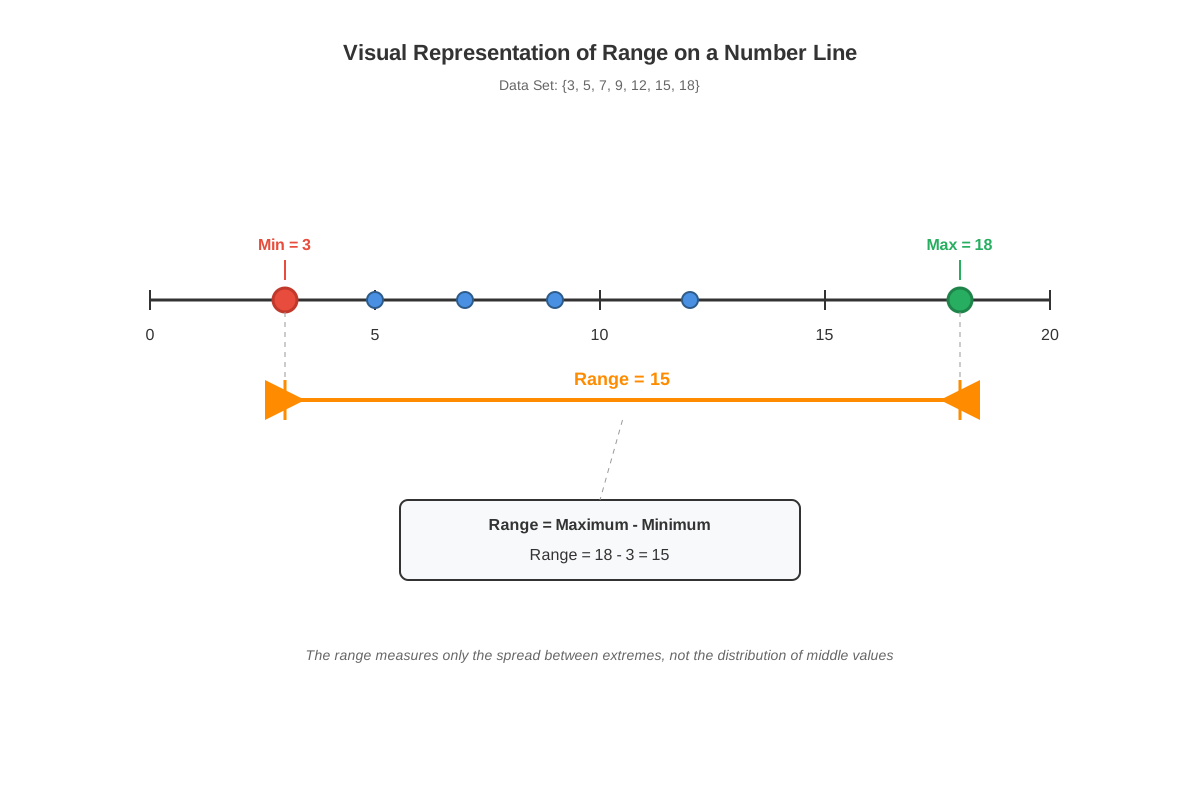
The range of a data set is defined as the difference between the maximum (largest) value and the minimum (smallest) value in that set. Mathematically, this is expressed as:
Range = Maximum Value - Minimum ValueFor example, in the data set {3, 7, 12, 15, 20}, the maximum value is 20 and the minimum value is 3, so the range equals 20 - 3 = 17. This single number (17) tells us that the data spans 17 units from the smallest to largest observation.
Importantly, range is always a non-negative value. Even if a data set contains negative numbers, the range itself represents a distance or spread and therefore cannot be negative. For the set {-8, -3, 0, 5, 12}, the range is 12 - (-8) = 12 + 8 = 20.
Properties of Range
Range possesses several key properties that the GMAT frequently tests:
- Sensitivity to outliers: Range is determined entirely by the two extreme values, making it highly sensitive to outliers. A single unusually large or small value dramatically affects the range while not necessarily representing the typical spread of the data.
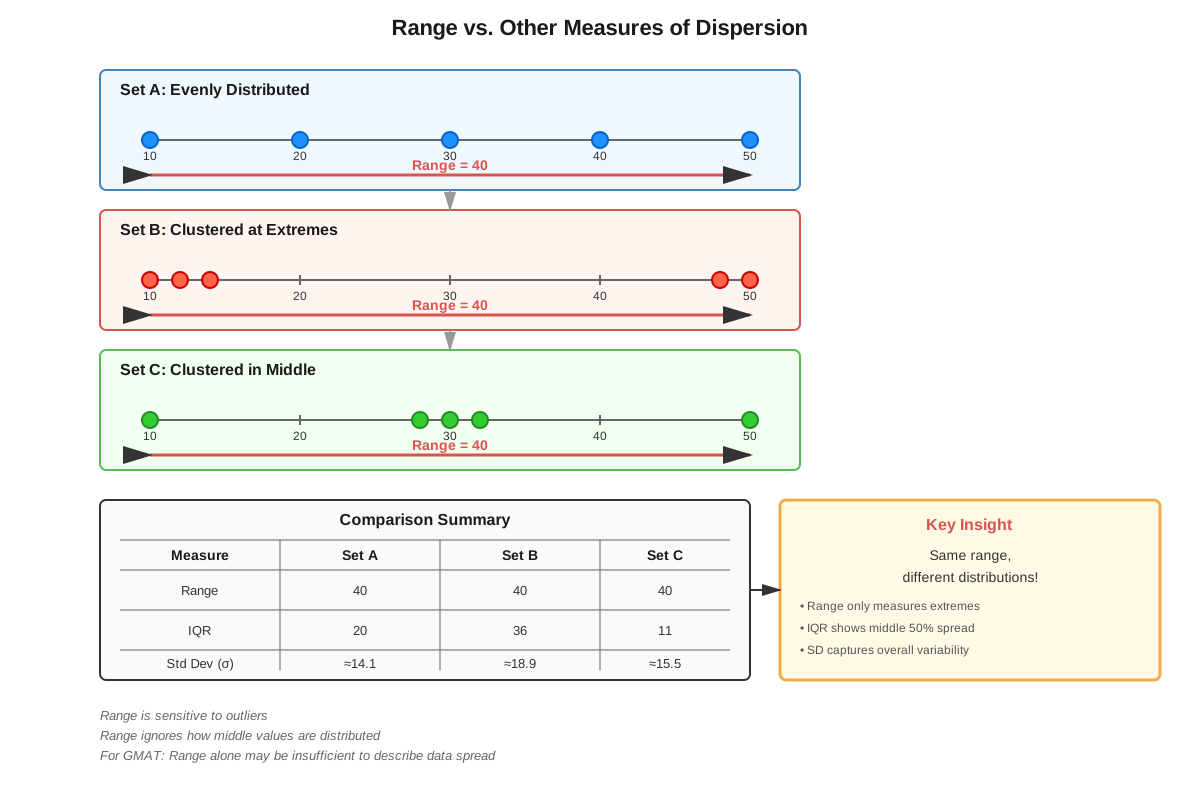
- Independence from middle values: All values between the minimum and maximum have no effect on range. The sets {1, 2, 3, 4, 5} and {1, 1, 1, 5, 5} both have a range of 4, despite having completely different distributions.
- Non-negative property: Range ≥ 0 for all data sets, with range = 0 only when all values in the set are identical.
- Unit preservation: Range maintains the same units as the original data. If measuring salaries in thousands of dollars, the range is also expressed in thousands of dollars.
Calculating Range with Different Data Types
Discrete data sets: When working with a finite list of numbers, simply identify the largest and smallest values and subtract. For {45, 23, 67, 89, 34, 12}, the range is 89 - 12 = 77.
Data with constraints: GMAT questions often provide constraints rather than explicit values. For example, "All values are integers between 10 and 25, inclusive" means the maximum possible range is 25 - 10 = 15, achieved when the set includes both endpoints.
Continuous ranges: When data can take any value within an interval, such as "all real numbers x where 3 < x ≤ 8," the range approaches but may not equal the difference between boundaries. Here, since x cannot equal 3 but can equal 8, the range approaches 5 but technically depends on whether endpoints are included.
How Range Changes with Data Manipulation
Understanding how operations affect range is crucial for GMAT success:
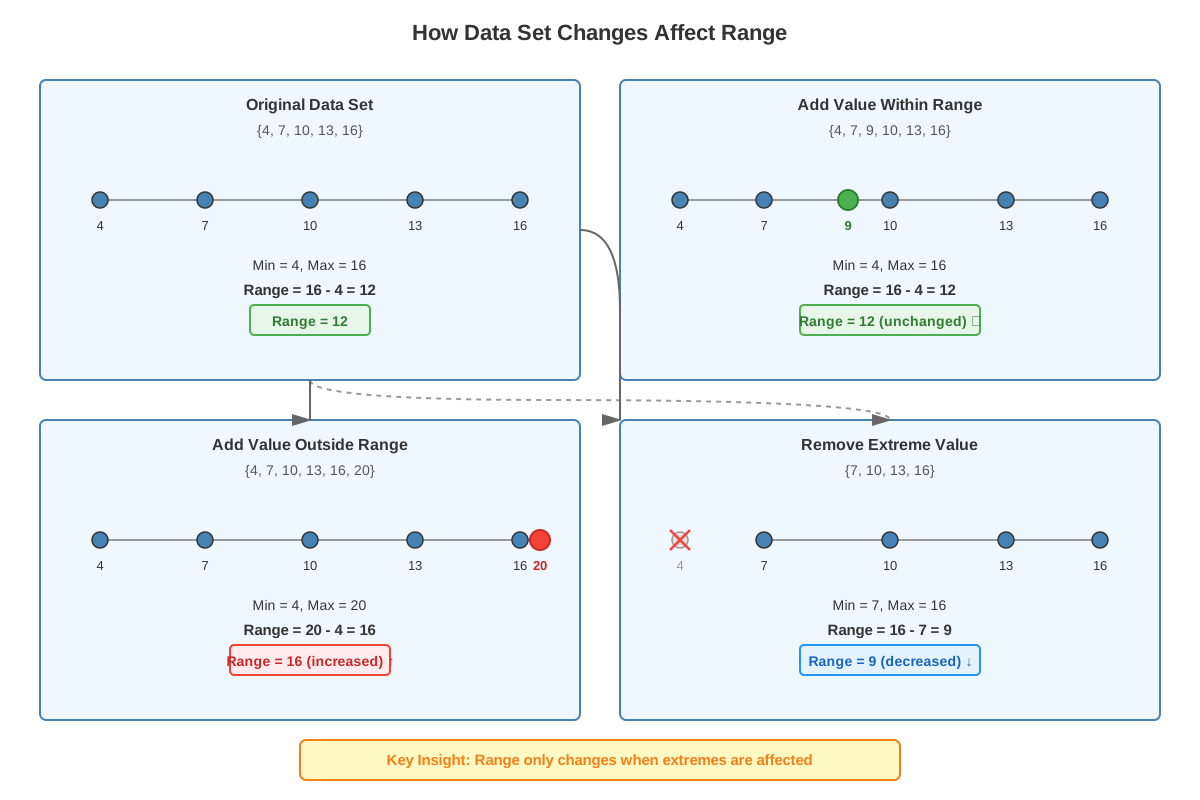
| Operation | Effect on Range | Example |
|---|---|---|
| Add constant to all values | No change | {2, 5, 9} → {7, 10, 14}: range stays 7 |
| Multiply all values by positive constant | Range multiplied by that constant | {2, 5, 9} → {4, 10, 18}: range doubles from 7 to 14 |
| Multiply all values by negative constant | Range multiplied by absolute value of constant | {2, 5, 9} → {-18, -10, -4}: range stays 14 |
| Add new value within existing range | No change | {2, 5, 9} → {2, 4, 5, 9}: range stays 7 |
| Add new value outside existing range | Range increases | {2, 5, 9} → {2, 5, 9, 12}: range becomes 10 |
| Remove maximum or minimum | Range decreases or stays same | {2, 5, 9} → {2, 5}: range becomes 3 |
Range in Data Sufficiency Questions
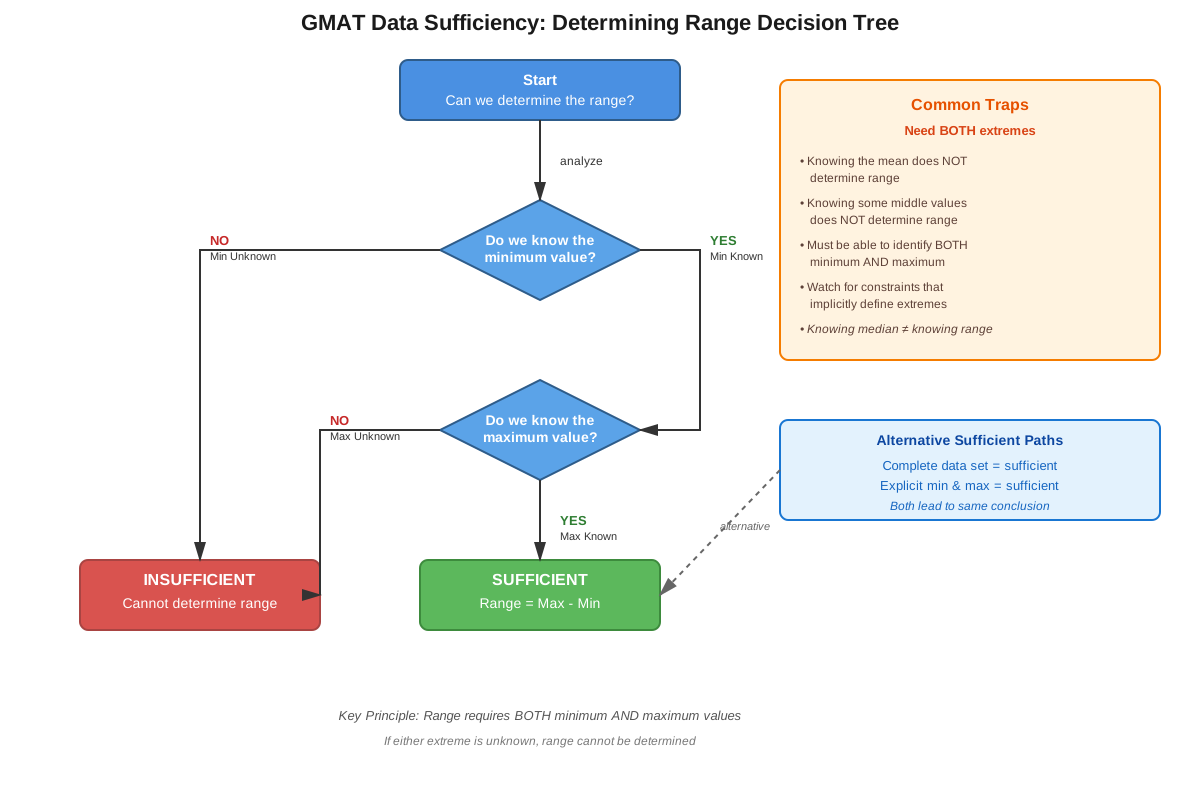
Data Sufficiency questions involving range typically ask whether given information is sufficient to determine the range of a set. Key principles include:
- Knowing both extremes is sufficient: If you can determine both the maximum and minimum values, you can calculate range.
- Knowing one extreme plus constraints may be sufficient: If you know the minimum is 5 and all values are less than or equal to 12, you can determine the maximum possible range.
- Knowing the number of elements is typically insufficient: Simply knowing a set has 8 elements tells you nothing about their spread.
- Knowing the mean or median alone is insufficient: These measures of central tendency don't determine the extremes.
Range Versus Other Measures of Dispersion
While range measures spread, it differs fundamentally from other dispersion measures:
- Standard deviation considers all data points and measures typical deviation from the mean, making it more robust than range but more complex to calculate.
- Interquartile range (IQR) measures the spread of the middle 50% of data, making it less sensitive to outliers than range.
- Variance is the squared standard deviation, emphasizing larger deviations more heavily.
Range remains the simplest and quickest measure to calculate, making it ideal for GMAT time constraints, but its sensitivity to outliers means it may not always represent typical data spread.
Concept Relationships
The concept of range connects to multiple statistical and mathematical ideas in a hierarchical structure. At the foundation, number properties and ordering enable identification of maximum and minimum values, which directly leads to range calculation. This relationship can be expressed as: Number Ordering → Extreme Value Identification → Range Determination.
Range serves as the gateway to understanding measures of dispersion more broadly. Once students grasp range, they can better appreciate why more sophisticated measures like standard deviation exist—to address range's limitations regarding outlier sensitivity and middle-value ignorance. The progression follows: Range (simplest) → Interquartile Range (more robust) → Standard Deviation (most comprehensive).
Within GMAT problem-solving, range frequently appears alongside mean, median, and mode in questions testing comprehensive statistical understanding. These measures complement each other: central tendency measures (mean, median, mode) describe the "center" of data, while range describes its "spread." Together, they provide a complete picture of data distribution.
Range also connects to inequality reasoning and optimization problems. Questions asking for "minimum possible range" or "maximum possible range" given constraints require students to apply inequality logic to determine extreme scenarios. This relationship manifests as: Constraints (inequalities) → Extreme Value Optimization → Range Boundaries.
Quick check — test yourself on Range so far.
Try Flashcards →High-Yield Facts
⭐ Range equals maximum value minus minimum value: This is the fundamental definition and calculation method.
⭐ Range depends only on the two extreme values: All middle values are irrelevant to range calculation.
⭐ Adding a constant to all values does not change the range: The spread remains identical when all values shift equally.
⭐ Multiplying all values by a positive constant multiplies the range by that constant: If range is 10 and all values double, range becomes 20.
⭐ Range is always non-negative: Range ≥ 0, with equality only when all values are identical.
- Adding a value within the existing range does not change the range: The extremes remain the same.
- Removing the maximum or minimum value typically decreases the range: Unless multiple values equal the extreme.
- Range is measured in the same units as the original data: If data is in meters, range is in meters.
- A single outlier can dramatically affect range: Range is the most outlier-sensitive dispersion measure.
- Knowing the range alone does not determine the data distribution: Sets with identical ranges can have completely different distributions.
- In Data Sufficiency, you need both extremes (or sufficient information to determine them) to calculate range: Partial information is typically insufficient.
- Range of a single-element set is zero: {5} has range 0 because max and min are both 5.
Common Misconceptions
Misconception: Range is calculated by adding the maximum and minimum values.
Correction: Range is the difference (subtraction) between maximum and minimum, not their sum. For {2, 8}, range = 8 - 2 = 6, not 8 + 2 = 10.
Misconception: Range can be negative if the data set contains negative numbers.
Correction: Range represents a distance or spread and is always non-negative. For {-10, -3, 5}, range = 5 - (-10) = 15, which is positive.
Misconception: Adding any new value to a data set always changes the range.
Correction: Adding a value within the existing range leaves the range unchanged. Adding 6 to {2, 5, 9} maintains range = 7 because 6 falls between the existing extremes.
Misconception: Range considers all values in the data set equally.
Correction: Range depends exclusively on the two extreme values. The sets {1, 5, 9} and {1, 2, 3, 4, 5, 6, 7, 8, 9} both have range = 8 despite having different numbers of elements and distributions.
Misconception: If you know the mean and the number of elements, you can determine the range.
Correction: Mean and count provide no information about the spread of values. A set with mean 10 could have range 0 (all values = 10) or range 100 (values like 0 and 20) or any other range.
Misconception: Multiplying all values by -2 changes the range to a negative number.
Correction: When multiplying by a negative constant, the maximum and minimum swap positions, but range remains positive. For {2, 8} with range 6, multiplying by -2 gives {-16, -4} with range = -4 - (-16) = 12 (doubled, still positive).
Misconception: Range and standard deviation always increase or decrease together.
Correction: While often correlated, these measures can change independently. Adding a value at the mean increases range if it's a new extreme but doesn't affect standard deviation significantly.
Worked Examples
Example 1: Basic Range Calculation with Data Manipulation
Problem: A data set consists of five test scores: {72, 85, 91, 78, 88}. If the lowest score is increased by 10 points and the highest score is decreased by 5 points, what is the new range?
Solution:
Step 1: Identify the original minimum and maximum values.
- Minimum = 72
- Maximum = 91
- Original range = 91 - 72 = 19
Step 2: Apply the transformations.
- New minimum = 72 + 10 = 82
- New maximum = 91 - 5 = 86
Step 3: Calculate the new range.
- New range = 86 - 82 = 4
Step 4: Verify the logic.
The lowest score increased (moving the minimum up) and the highest score decreased (moving the maximum down), so both changes work to reduce the range. The range decreased from 19 to 4.
Answer: The new range is 4.
Connection to Learning Objectives: This problem demonstrates the ability to identify range in an original data set and apply understanding of how specific changes to extreme values affect the range, addressing the "Apply Range to GMAT questions" objective.
Example 2: Data Sufficiency with Range Constraints
Problem: What is the range of the set S containing 6 positive integers?
Statement (1): The smallest integer in S is 8.
Statement (2): The largest integer in S is less than 25.
Solution:
Analyze Statement (1) alone:
- We know the minimum value is 8
- We have no information about the maximum value
- The maximum could be 9 (giving range = 1) or 1000 (giving range = 992)
- Statement (1) alone is INSUFFICIENT
Analyze Statement (2) alone:
- We know the maximum is less than 25, so at most 24 (since integers)
- We have no information about the minimum value
- The minimum could be 1 (giving range up to 23) or 23 (giving range = 1)
- Statement (2) alone is INSUFFICIENT
Analyze both statements together:
- Minimum = 8
- Maximum < 25, so maximum ≤ 24
- We know the minimum exactly but only have an upper bound for the maximum
- The maximum could be 24 (range = 16), 20 (range = 12), or any integer from 8 to 24
- Even together, we cannot determine a unique range value
- Both statements together are INSUFFICIENT
Answer: E (Statements (1) and (2) together are not sufficient)
Key Insight: To determine range definitively, you need exact values (or sufficient constraints to determine exact values) for both the minimum and maximum. An inequality constraint on one extreme without pinning down the exact value leaves multiple possible ranges.
Connection to Learning Objectives: This example addresses "Determine what information is sufficient to establish the range of a data set" and demonstrates the application of range concepts to GMAT Data Sufficiency questions.
Exam Strategy
When approaching GMAT questions involving range, follow this systematic process:
Step 1: Identify what the question asks
- Is it asking for the range directly?
- Is it asking how a change affects the range?
- Is it a Data Sufficiency question about whether you can determine the range?
Step 2: Locate or determine the extreme values
- Scan the data set for the largest and smallest values
- If constraints are given instead of explicit values, determine the possible extremes
- Watch for inclusive versus exclusive inequalities (≤ vs <)
Step 3: Apply the range formula
- Range = Maximum - Minimum
- Double-check that you're subtracting in the correct order
- Verify your answer is non-negative
Exam Tip: If you calculate a negative range, you've made an error—immediately recheck your maximum and minimum identification.
Trigger words and phrases to watch for:
- "Spread," "difference between highest and lowest," "from minimum to maximum" → all indicate range
- "If the smallest value increases" or "if the largest value decreases" → range will decrease or stay the same
- "Adding a value" → determine if it's within or outside the current range
- "Multiplying all values" → remember the range multiplies by the absolute value of the constant
Process-of-elimination strategies:
- Eliminate answer choices that show range increasing when both extremes move toward the center
- Eliminate negative values for range
- Eliminate answers that change range when a constant is added to all values
- In Data Sufficiency, eliminate "sufficient" options if you can construct two different ranges from the given information
Time allocation:
- Simple range calculations: 30-45 seconds
- Range with data manipulation: 60-90 seconds
- Data Sufficiency range questions: 90-120 seconds
- If you're spending more than 2 minutes, make an educated guess and move on
Memory Techniques
Mnemonic for Range Formula: "Max Minus Min" → "M-M-M" (like the candy)
Visualization Strategy: Picture a number line with the data points marked. The range is the physical distance from the leftmost point (minimum) to the rightmost point (maximum). This visual helps remember that:
- Middle points don't matter (they're not at the ends)
- Adding a constant shifts all points equally (distance stays the same)
- Multiplying stretches or compresses the entire line proportionally
Acronym for Range Properties: "SINU"
- Sensitive to outliers
- Independent of middle values
- Non-negative always
- Unit-preserving
Memory Hook for Data Manipulation: "Add shifts, multiply stretches"
- Adding a constant shifts all values equally → range unchanged
- Multiplying by a constant stretches the entire distribution → range changes proportionally
Rhyme for Data Sufficiency: "To find the range without a hitch, you need both ends, not just one switch"
- Reminds you that knowing only one extreme is typically insufficient
Summary
Range is the simplest and most fundamental measure of data dispersion, calculated as the difference between the maximum and minimum values in a data set. On the GMAT, range appears frequently in both Problem Solving and Data Sufficiency questions, testing students' ability to identify extreme values, understand how data manipulation affects spread, and determine what information is sufficient to calculate range. The key principle to remember is that range depends exclusively on the two extreme values—all middle values are irrelevant. Adding a constant to all values leaves range unchanged, while multiplying by a constant scales the range proportionally. Range is always non-negative and maintains the same units as the original data. Success with GMAT range questions requires quick identification of maximum and minimum values, understanding of how operations affect these extremes, and recognition that both extremes must be determinable to calculate a definitive range. While range is sensitive to outliers and doesn't capture the full distribution of data, its simplicity makes it ideal for rapid calculation under exam time constraints.
Key Takeaways
- Range = Maximum Value - Minimum Value: This fundamental formula is the foundation of all range calculations
- Only the two extreme values matter: All values between the minimum and maximum have zero effect on range
- Adding a constant to all values does not change range: The spread remains identical when all values shift equally
- Multiplying all values by a constant multiplies the range by the absolute value of that constant: This property is frequently tested in data manipulation questions
- Range is always non-negative: A negative range indicates a calculation error
- To determine range in Data Sufficiency, you must be able to identify both the maximum and minimum values: Knowing only one extreme or having partial information is typically insufficient
- Range is highly sensitive to outliers: A single extreme value can dramatically affect the range while not representing typical data spread
Related Topics
Standard Deviation: After mastering range, students should explore standard deviation as a more sophisticated measure of dispersion that considers all data points rather than just extremes. Understanding range provides the conceptual foundation for appreciating why standard deviation offers a more complete picture of data variability.
Interquartile Range (IQR): This measure focuses on the spread of the middle 50% of data, making it more robust to outliers than range. Mastering range first makes IQR easier to understand as a "range of the middle portion."
Mean, Median, and Mode: These measures of central tendency complement range by describing where data clusters rather than how it spreads. Combined understanding of central tendency and dispersion enables comprehensive data analysis.
Box Plots and Data Visualization: Range appears as a key component of box plots, which visually represent data distribution. Understanding range is essential for interpreting these graphical representations.
Probability Distributions: In more advanced statistics, range concepts extend to understanding the support (possible values) of probability distributions, building on the foundational understanding developed here.
Practice CTA
Now that you've mastered the core concepts of range, it's time to solidify your understanding through active practice. Attempt the practice questions to test your ability to calculate range under various conditions, manipulate data sets while tracking range changes, and tackle Data Sufficiency questions that require strategic thinking about what information is truly necessary. The flashcards will help you internalize the key properties and formulas for rapid recall during the exam. Remember, range questions are high-yield on the GMAT—investing 20-30 minutes in focused practice now will pay dividends on test day. You've built the foundation; now strengthen it through application!
Sign up free to keep reading
Create a free AnvayaPrep account to finish this GMAT guide on Range — plus flashcards and practice questions.