Overview
Conclusion prediction is a critical reasoning skill that requires test-takers to identify the logical endpoint of an argument based on the premises provided. In GMAT conclusion prediction questions, students encounter incomplete arguments where they must determine what conclusion would most logically follow from the given evidence. This question type tests the ability to recognize logical flow, understand argumentative structure, and distinguish between valid inferences and unsupported leaps in reasoning.
Mastering conclusion prediction is essential for GMAT success because these questions appear regularly in the Critical Reasoning section and directly assess core analytical skills that business schools value. Unlike other question types that ask you to strengthen, weaken, or evaluate arguments, conclusion prediction questions require you to complete the logical chain of reasoning yourself. This demands a deep understanding of how premises connect to conclusions and what makes an inference valid versus speculative.
Within the broader landscape of Verbal Reasoning, conclusion prediction serves as a foundational skill that enhances performance across multiple question types. The ability to predict conclusions strengthens your capacity to evaluate argument structure, identify assumptions, and recognize logical flaws. This topic bridges the gap between understanding what an argument says and recognizing what it logically implies, making it indispensable for achieving a competitive GMAT score.
Learning Objectives
- [ ] Identify Conclusion prediction questions on the GMAT
- [ ] Explain the logical principles underlying valid conclusion prediction
- [ ] Apply conclusion prediction strategies to GMAT questions
- [ ] Distinguish between valid conclusions and unsupported inferences
- [ ] Recognize common conclusion patterns in GMAT arguments
- [ ] Evaluate answer choices based on logical necessity and sufficiency
- [ ] Integrate premise analysis with conclusion selection under time pressure
Prerequisites
- Basic argument structure: Understanding the difference between premises (evidence) and conclusions (claims supported by evidence) is fundamental to predicting what conclusion logically follows.
- Logical reasoning fundamentals: Familiarity with cause-and-effect relationships, conditional statements, and basic inference patterns enables accurate prediction of conclusions.
- Critical Reasoning question types: General knowledge of how GMAT Critical Reasoning questions are structured helps contextualize conclusion prediction within the broader exam framework.
Why This Topic Matters
Conclusion prediction questions appear in approximately 10-15% of Critical Reasoning questions on the GMAT, making them a high-frequency question type that directly impacts your Verbal score. Business schools prioritize candidates who can analyze incomplete information and draw logical conclusions—skills that translate directly to case analysis, strategic planning, and data-driven decision-making in MBA programs and professional settings.
In real-world business contexts, professionals constantly encounter situations where they must predict outcomes based on available data, anticipate logical consequences of decisions, and complete analytical frameworks with missing components. The ability to predict conclusions from premises mirrors the analytical thinking required in consulting, finance, marketing strategy, and operations management.
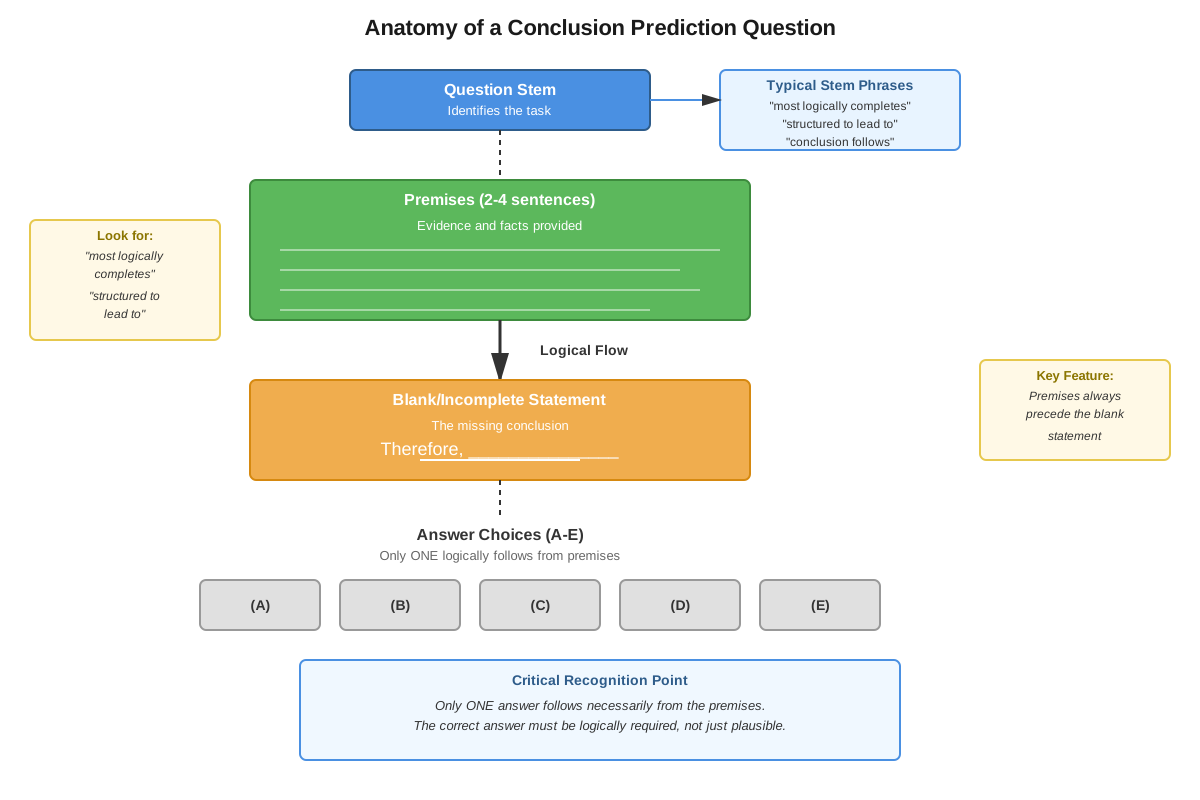
On the GMAT, conclusion prediction questions typically appear with stem phrases like "Which of the following most logically completes the argument?" or "The argument above is structured to lead to which of the following conclusions?" These questions present 2-4 sentences of premises followed by a blank or incomplete final statement. The correct answer must follow logically and necessarily from the given information without introducing new assumptions or making unsupported leaps. Understanding this question type's unique demands allows for efficient, accurate responses that maximize your score potential.
Core Concepts
Understanding Conclusion Prediction Structure
Conclusion prediction questions present an argument with premises but without a complete conclusion, requiring test-takers to identify which statement would most logically complete the reasoning chain. The fundamental principle is that the correct conclusion must be directly supported by the premises without requiring additional assumptions or external information.
The structure typically follows this pattern:
- Context statement: Establishes the general situation or background
- Evidence/Premises: Provides specific facts, data, or observations
- Incomplete conclusion: Presents a partial statement or asks what follows logically
The correct answer will be the statement that is most strongly supported by the premises and requires the fewest additional assumptions. It should feel like the natural, inevitable endpoint of the argument's logical progression.
Types of Logical Relationships in Conclusion Prediction
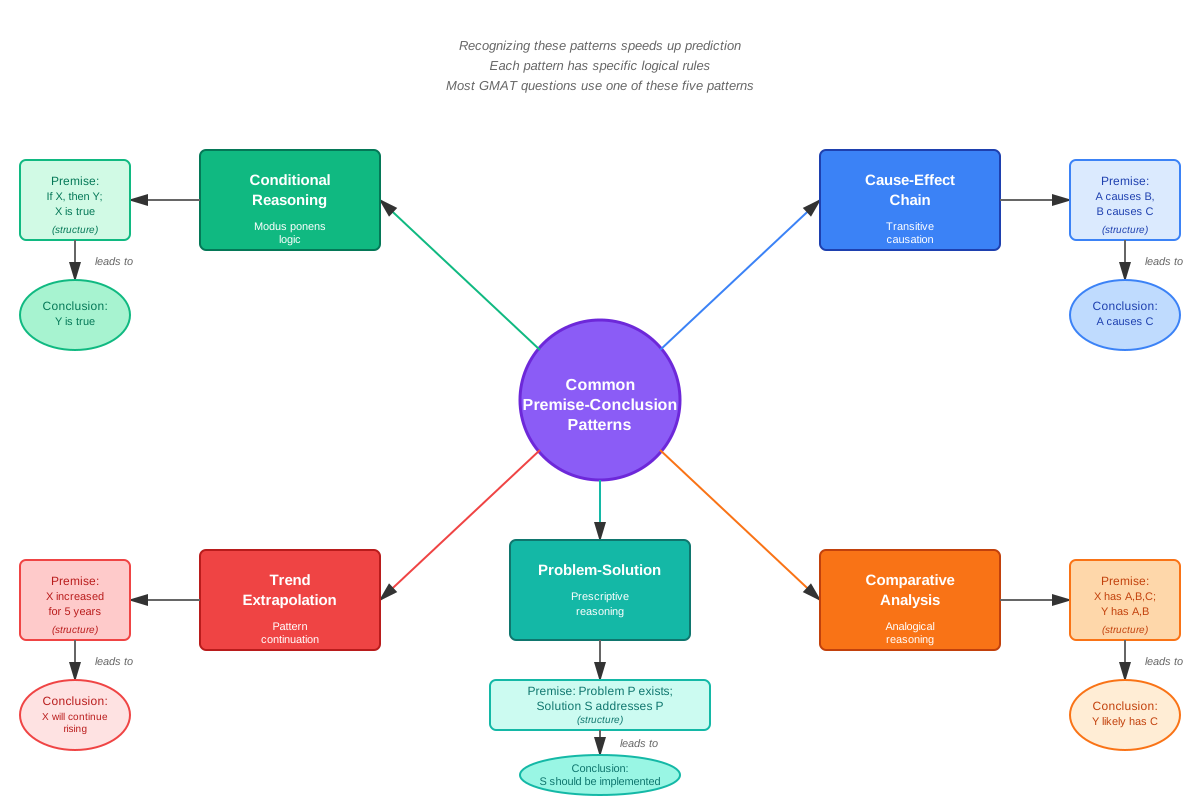
GMAT conclusion prediction questions rely on several common logical relationships between premises and conclusions:
| Relationship Type | Description | Example Pattern |
|---|---|---|
| Causal | Premises establish cause-effect relationships | If X causes Y, and X occurred, then Y will occur |
| Comparative | Premises compare two or more entities | If A has more of quality X than B, then A will outperform B in X-related outcomes |
| Conditional | Premises establish if-then relationships | If condition X is met, then outcome Y follows |
| Temporal | Premises establish time-based sequences | Event X preceded event Y, suggesting X influenced Y |
| Categorical | Premises classify entities into groups | All members of category X share property Y |
Understanding these relationship types helps predict what kind of conclusion the argument is building toward. For instance, if premises establish a causal chain, the conclusion will likely assert the final effect in that chain.
The Principle of Logical Necessity
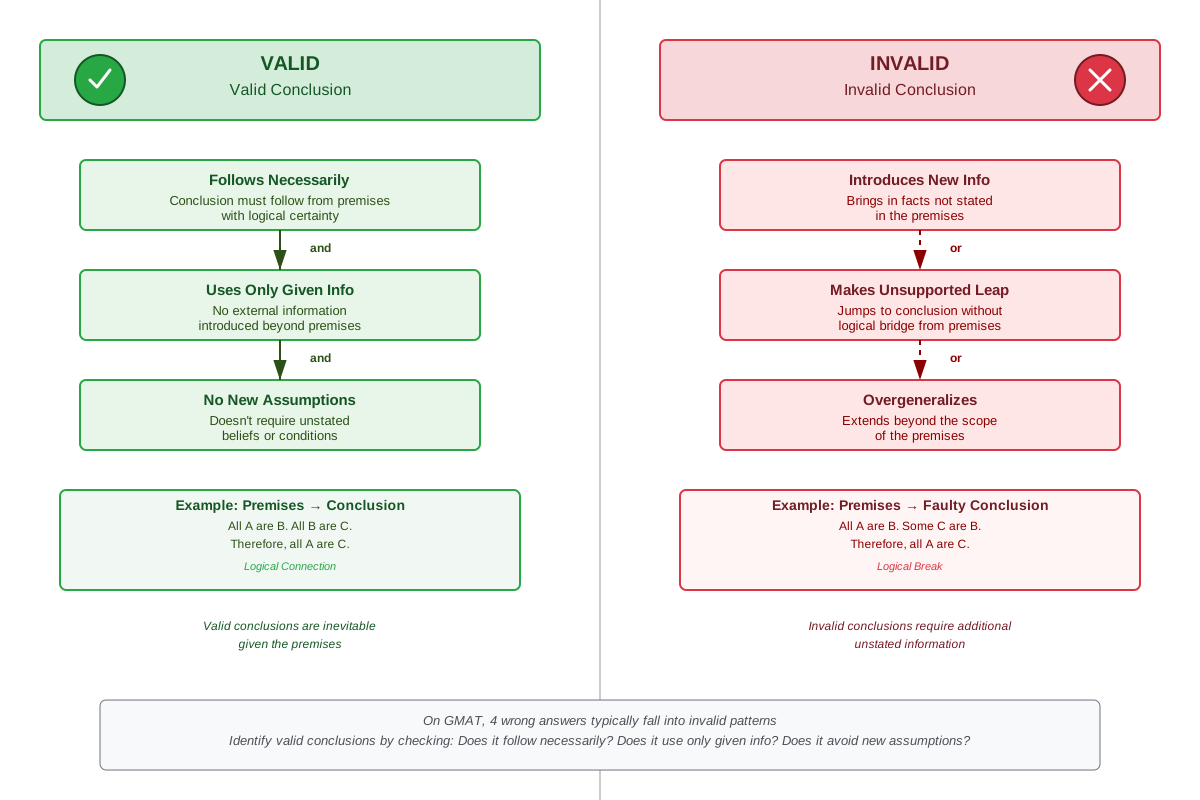
A valid conclusion in GMAT questions must be logically necessary or strongly supported by the premises. This means:
- Necessary conclusions: Must be true if the premises are true (deductive reasoning)
- Strongly supported conclusions: Are highly probable given the premises (inductive reasoning)
The GMAT typically tests strongly supported conclusions rather than absolutely necessary ones, since business reasoning often involves probability and likelihood rather than absolute certainty. However, the correct answer will always be the most strongly supported option among the choices.
Scope Matching
One of the most critical concepts in conclusion prediction is scope matching—ensuring that the conclusion's scope aligns with the premises' scope. Common scope dimensions include:
- Breadth: Does the conclusion apply to the same population/category as the premises?
- Time frame: Does the conclusion reference the same time period as the premises?
- Certainty level: Does the conclusion use appropriate qualifiers (may, will, must, likely)?
- Subject matter: Does the conclusion stay within the topic boundaries established by premises?
A conclusion that is too broad, too narrow, or shifts to a different subject will be incorrect even if it seems plausible. For example, if premises discuss "some employees," a conclusion about "all employees" exceeds the scope.
Premise Integration
Effective conclusion prediction requires premise integration—synthesizing multiple pieces of evidence into a coherent logical endpoint. The correct conclusion typically:
- Acknowledges all relevant premises (doesn't ignore key information)
- Combines premises in a logical way (doesn't treat them as isolated facts)
- Represents the natural culmination of the argument's direction
- Avoids introducing entirely new concepts not grounded in the premises
When premises seem to point in different directions, the correct conclusion often reconciles or balances these elements rather than selecting just one premise to follow.
Common Conclusion Patterns
GMAT conclusion prediction questions frequently employ these patterns:
Pattern 1: Problem-Solution
- Premises identify a problem and describe a proposed solution
- Conclusion predicts the solution's effectiveness or outcome
Pattern 2: Evidence-Explanation
- Premises present surprising or notable evidence
- Conclusion offers the most logical explanation for that evidence
Pattern 3: Trend-Projection
- Premises establish a trend or pattern
- Conclusion projects that trend into the future or to a new context
Pattern 4: Comparison-Judgment
- Premises compare options or alternatives
- Conclusion makes a judgment about which is superior or more appropriate
Recognizing these patterns quickly helps narrow down answer choices and predict the general form the conclusion should take.
Concept Relationships
The concepts within conclusion prediction form an interconnected framework where each element supports the others. Logical necessity serves as the foundation, determining whether a conclusion validly follows from premises. This principle directly connects to scope matching, since conclusions that exceed or fall short of premise scope cannot be logically necessary. Both concepts feed into premise integration, which requires understanding how multiple pieces of evidence combine to support a single conclusion.
Logical relationship types (causal, comparative, conditional, etc.) function as the mechanisms through which premises connect to conclusions. Identifying the relationship type helps predict the conclusion pattern (problem-solution, evidence-explanation, etc.) that the argument will follow. These patterns, in turn, guide the application of scope matching and premise integration principles.
The relationship map flows as follows:
Argument Structure Recognition → Logical Relationship Identification → Premise Integration → Scope Matching → Conclusion Pattern Recognition → Answer Selection
This topic builds on prerequisite knowledge of basic argument structure by adding the predictive element—moving from understanding what an argument says to anticipating what it will conclude. It connects to other Critical Reasoning question types by developing the analytical skills needed to evaluate assumptions, strengthen/weaken arguments, and identify logical flaws.
High-Yield Facts
⭐ Conclusion prediction questions ask you to complete an argument, not to evaluate or critique it—the correct answer must follow logically from the given premises.
⭐ The correct conclusion will match the scope of the premises in breadth, time frame, certainty level, and subject matter—scope violations are the most common reason answers are incorrect.
⭐ Conclusion prediction answers should not introduce entirely new concepts—they should synthesize information already present in the premises.
⭐ Look for stem phrases like "most logically completes," "structured to lead to," or "conclusion follows most logically"—these signal conclusion prediction questions.
⭐ The correct answer requires the fewest additional assumptions—if you need to assume multiple unstated facts for an answer to work, it's likely wrong.
- Conclusion prediction questions typically appear 2-3 times per GMAT exam in the Critical Reasoning section.
- Causal relationships in premises often lead to conclusions predicting effects or outcomes.
- Comparative premises typically lead to conclusions making judgments or predictions based on the comparison.
- Temporal sequences in premises suggest conclusions about causation or future trends.
- Extreme language in answer choices (always, never, all, none) is often incorrect unless premises use equally strong language.
- The correct conclusion should feel like the natural next sentence in the argument's flow.
- Premise integration means the conclusion should account for all relevant information provided, not just one premise.
- Wrong answers often commit scope errors: too broad, too narrow, or shifting subject matter.
- Conditional premises (if-then statements) require conclusions that respect the logical conditions established.
- The GMAT tests strongly supported conclusions more often than absolutely necessary ones, reflecting real-world business reasoning.
Quick check — test yourself on Conclusion prediction so far.
Try Flashcards →Common Misconceptions
Misconception: The correct conclusion must be absolutely true or proven beyond doubt. → Correction: GMAT conclusions need to be strongly supported or most logical given the premises, not necessarily proven with absolute certainty. Business reasoning involves probability and likelihood.
Misconception: Any plausible-sounding statement can be the conclusion if it relates to the topic. → Correction: The conclusion must be directly supported by the specific premises given, not just generally related to the topic. Outside knowledge or general plausibility doesn't make an answer correct.
Misconception: Longer, more detailed answer choices are more likely to be correct. → Correction: Answer length has no correlation with correctness. The GMAT deliberately includes detailed but incorrect answers to test whether you're evaluating logical support rather than surface features.
Misconception: The conclusion should introduce new solutions or perspectives to make the argument more interesting. → Correction: Introducing entirely new concepts not grounded in the premises violates the principle of logical necessity. The conclusion should synthesize existing information, not add new elements.
Misconception: If premises mention multiple factors, the conclusion should address all of them equally. → Correction: The conclusion should integrate relevant premises, but some premises may serve as background context while others drive the main conclusion. Not every detail must appear in the conclusion.
Misconception: Conclusion prediction questions are just asking for your opinion about what should happen. → Correction: These questions test logical reasoning, not personal opinion. The correct answer is determined by logical relationships between premises and conclusion, not by what seems like good advice or policy.
Misconception: Extreme or definitive language in the conclusion makes it stronger and more convincing. → Correction: The conclusion's certainty level must match the premises. If premises use qualified language (some, may, often), conclusions with extreme language (all, must, always) exceed the scope.
Worked Examples
Example 1: Causal Relationship Pattern
Argument:
"Company X implemented a new employee wellness program that included gym memberships and healthy cafeteria options. Over the following year, employee sick days decreased by 30%, and productivity metrics improved by 15%. Additionally, employee satisfaction surveys showed a 25% increase in positive responses about workplace benefits. Therefore, ___________."
Analysis Process:
- Identify the premises:
- Wellness program implemented (gym memberships, healthy food)
- Sick days decreased 30%
- Productivity increased 15%
- Satisfaction with benefits increased 25%
- Identify the logical relationship: Causal pattern—program implementation followed by positive outcomes
- Determine scope boundaries:
- Subject: Company X's wellness program and its effects
- Time frame: One year following implementation
- Certainty: Strong correlation shown, but not absolute proof
- Breadth: Limited to the specific outcomes measured
- Predict conclusion characteristics:
- Should connect the wellness program to the positive outcomes
- Should maintain appropriate certainty level (correlation, not absolute causation)
- Should stay within the scope of Company X and measured outcomes
- Should not introduce new factors not mentioned in premises
Correct Conclusion: "the wellness program likely contributed to improved employee health and performance outcomes"
Why this works: This conclusion appropriately synthesizes the premises, maintains scope (Company X, the specific outcomes mentioned), uses appropriate certainty language ("likely contributed"), and follows the causal pattern established.
Wrong Answer Example: "all companies should implement identical wellness programs to maximize profits"
Why it's wrong: Exceeds scope (moves from Company X to all companies), introduces new concept (profits weren't mentioned), uses extreme language (all, identical), and makes an unsupported leap from correlation to prescription.
Example 2: Comparative Pattern
Argument:
"Two manufacturing processes, Process A and Process B, were compared for efficiency. Process A requires specialized equipment costing $500,000 but produces 1,000 units per day with a 2% defect rate. Process B uses standard equipment costing $200,000 and produces 800 units per day with a 5% defect rate. The company's primary concern is minimizing defective products reaching customers, as defects have resulted in significant warranty costs and reputation damage. Given these considerations, ___________."
Analysis Process:
- Identify the premises:
- Process A: Higher cost ($500K), higher output (1,000 units/day), lower defects (2%)
- Process B: Lower cost ($200K), lower output (800 units/day), higher defects (5%)
- Company priority: Minimizing defects (due to warranty costs and reputation)
- Identify the logical relationship: Comparative pattern with stated priority
- Determine scope boundaries:
- Subject: Choice between two specific processes
- Constraint: Company's stated priority (minimizing defects)
- Context: Defects cause warranty costs and reputation damage
- Predict conclusion characteristics:
- Should make a judgment between the two processes
- Should prioritize defect rate given the stated concern
- Should acknowledge the trade-offs mentioned
- Should not introduce factors not mentioned (e.g., environmental impact, employee preference)
Correct Conclusion: "Process A would better serve the company's goal of reducing defect-related costs despite its higher initial investment"
Why this works: This conclusion directly addresses the comparison, prioritizes the factor the premises identify as most important (defect rate), acknowledges the cost trade-off, and stays within the scope of the information provided.
Wrong Answer Example: "the company should research additional manufacturing processes before making a decision"
Why it's wrong: Introduces a new option (researching other processes) not grounded in the premises, fails to draw a conclusion from the comparison provided, and doesn't follow the logical structure that sets up a choice between two specific options.
Exam Strategy
Identifying Conclusion Prediction Questions
Watch for these trigger phrases in question stems:
- "Which of the following most logically completes the argument?"
- "The argument is structured to lead to which of the following conclusions?"
- "Which of the following best completes the passage below?"
- "The statements above, if true, best support which of the following conclusions?"
When you see these phrases, immediately shift to conclusion prediction mode: your task is to find the logical endpoint, not to evaluate or critique the argument.
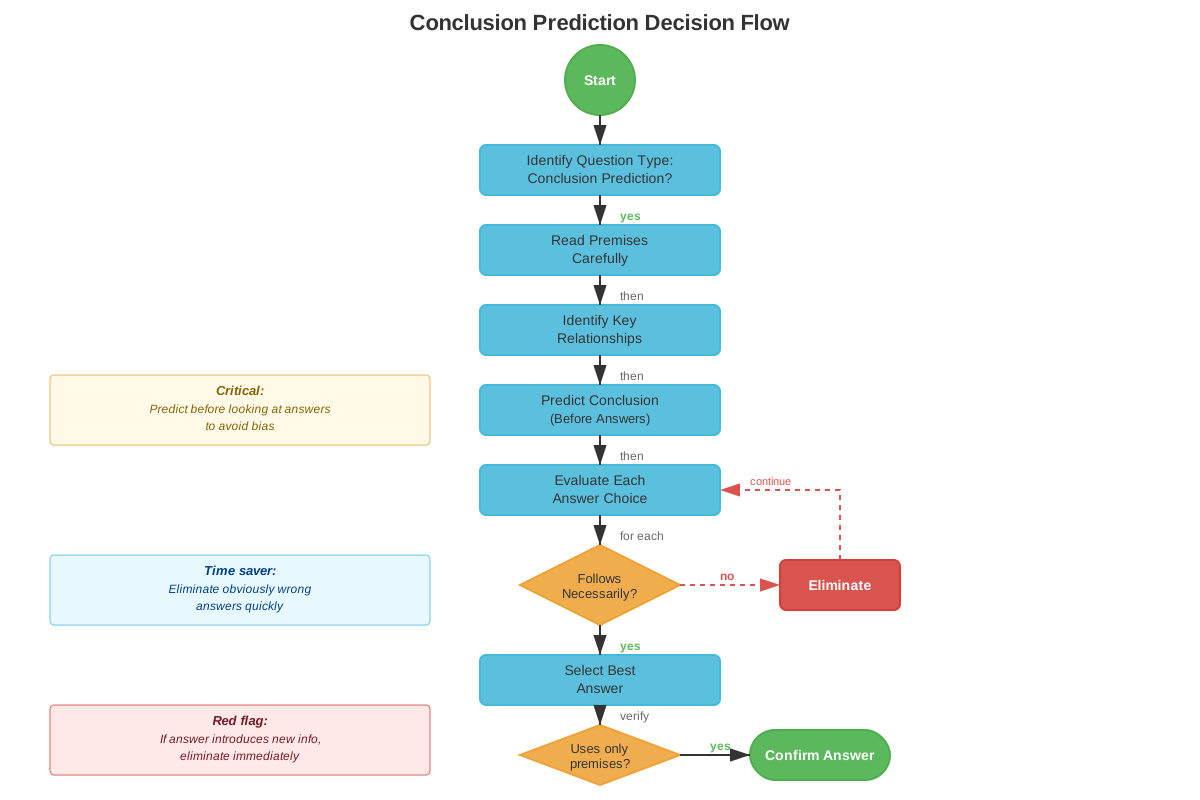
Step-by-Step Approach
Step 1: Read the argument carefully and identify all premises (30 seconds)
- Underline or mentally note each distinct piece of evidence
- Pay attention to the logical relationship between premises (causal, comparative, etc.)
Step 2: Predict the conclusion before looking at answer choices (15 seconds)
- Ask yourself: "What would logically follow from these premises?"
- Consider the scope, certainty level, and subject matter
- Form a general prediction (doesn't need to be exact wording)
Step 3: Evaluate answer choices against your prediction (45 seconds)
- Eliminate choices that violate scope (too broad, too narrow, different subject)
- Eliminate choices that introduce unsupported new concepts
- Eliminate choices that require multiple additional assumptions
- Select the choice that most closely matches your prediction
Step 4: Verify the selected answer (15 seconds)
- Reread the argument with your selected conclusion
- Confirm it flows naturally and logically
- Check that it doesn't exceed or fall short of what the premises support
Exam Tip: If you're stuck between two answers, check which one requires fewer additional assumptions. The GMAT rewards answers that follow most directly from the given information.
Time Management
Allocate approximately 1 minute 45 seconds per conclusion prediction question:
- 30 seconds: Reading and understanding premises
- 15 seconds: Predicting the conclusion
- 45 seconds: Evaluating answer choices
- 15 seconds: Verification
If you're exceeding this time, you may be overthinking. Trust the logical flow and your initial analysis.
Process of Elimination Strategies
Eliminate first: Answers with scope violations
- Too broad: "All companies everywhere..."
- Too narrow: Focuses on minor detail while ignoring main point
- Subject shift: Introduces topics not mentioned in premises
Eliminate second: Answers requiring multiple new assumptions
- If you find yourself thinking "Well, if X were true, and Y were also true, then this could work," the answer requires too many assumptions
Eliminate third: Answers with inappropriate certainty levels
- Premises use qualified language (some, may, often) but answer uses extreme language (all, must, never)
- Or vice versa: premises are definitive but answer is overly hedged
Keep: The answer that feels like the natural next sentence, requires minimal assumptions, and matches the scope and certainty of the premises.
Memory Techniques
The SCOPE Acronym
Use SCOPE to remember key elements to check in conclusion prediction:
- Subject matter: Does the conclusion address the same topic as the premises?
- Certainty level: Does the conclusion use appropriate qualifiers matching the premises?
- Outcome type: Does the conclusion follow the logical pattern (causal, comparative, etc.)?
- Premise integration: Does the conclusion synthesize all relevant premises?
- Excess assumptions: Does the conclusion require additional unstated facts?
The "Natural Next Sentence" Test
Visualize the argument as a conversation. The correct conclusion should sound like the natural next sentence the speaker would say. If you have to mentally insert "but wait, also..." or "assuming that..." before the conclusion makes sense, it's likely wrong.
The Three-Question Filter
Before selecting an answer, ask:
- Does it follow? (Logical necessity)
- Does it fit? (Scope matching)
- Does it flow? (Natural progression)
If the answer to all three is "yes," you've found the correct conclusion.
Visualization Strategy
Picture the premises as puzzle pieces. The correct conclusion is the piece that completes the picture without leaving gaps (requiring assumptions) or extending beyond the frame (exceeding scope). Wrong answers either don't fit the existing pieces or try to start a new puzzle.
Summary
Conclusion prediction is a high-yield GMAT Critical Reasoning question type that tests the ability to identify the logical endpoint of an argument based on given premises. Success requires understanding that the correct conclusion must be strongly supported by the premises without introducing unsupported new concepts or requiring multiple additional assumptions. The key principles are logical necessity (the conclusion must follow from the premises), scope matching (the conclusion must align with premises in breadth, certainty, time frame, and subject matter), and premise integration (synthesizing all relevant evidence). Common logical relationships include causal, comparative, conditional, temporal, and categorical patterns, each suggesting different conclusion types. The most effective approach involves identifying premises, predicting the conclusion before viewing answer choices, and systematically eliminating options that violate scope, introduce new concepts, or require excessive assumptions. Mastering conclusion prediction strengthens overall Critical Reasoning performance and develops analytical skills essential for business school success.
Key Takeaways
- Conclusion prediction questions ask you to complete arguments by identifying the most logical endpoint based on given premises—your task is synthesis, not evaluation.
- Scope matching is critical: the correct conclusion must align with premises in subject matter, breadth, certainty level, and time frame—scope violations are the most common error.
- The correct answer requires the fewest additional assumptions and should feel like the natural next sentence in the argument's logical flow.
- Identify the logical relationship type (causal, comparative, conditional, etc.) to predict what form the conclusion should take.
- Predict the conclusion before viewing answer choices to avoid being swayed by plausible-sounding but logically unsupported options.
- Premise integration means synthesizing all relevant evidence—the conclusion should account for the full picture, not just one isolated premise.
- Use systematic elimination: remove scope violations first, then answers requiring multiple assumptions, then those with inappropriate certainty levels.
Related Topics
Assumption Questions: Mastering conclusion prediction provides a foundation for identifying unstated assumptions, since assumptions are the missing links between premises and conclusions. Understanding what makes a conclusion valid helps identify what must be assumed for that conclusion to hold.
Strengthen/Weaken Questions: The ability to predict conclusions enhances performance on strengthen and weaken questions, as you must understand the logical connection between premises and conclusion to identify what would support or undermine that connection.
Inference Questions: Conclusion prediction develops inference skills by training you to recognize what logically follows from given information—a core skill for identifying valid inferences versus unsupported claims.
Argument Structure Analysis: Understanding how premises build toward conclusions deepens your ability to analyze overall argument structure, identify main points, and recognize supporting evidence across all Critical Reasoning question types.
Practice CTA
Now that you've mastered the core concepts of conclusion prediction, it's time to apply these strategies to real GMAT-style questions. The practice questions and flashcards will reinforce your understanding of logical relationships, scope matching, and premise integration. Each practice attempt strengthens your pattern recognition and builds the confidence needed to tackle these questions efficiently under exam conditions. Remember: conclusion prediction is a learnable skill that improves with deliberate practice. Your investment in mastering this high-yield question type will pay dividends across the entire Critical Reasoning section and contribute significantly to achieving your target GMAT score.
Sign up free to keep reading
Create a free AnvayaPrep account to finish this GMAT guide on Conclusion prediction — plus flashcards and practice questions.