Overview
Method of reasoning questions represent one of the most intellectually demanding question types in GMAT Critical Reasoning. These questions ask test-takers to analyze the structure and logical framework of an argument rather than evaluate its content or validity. Unlike assumption or strengthen/weaken questions that focus on what makes an argument work or fail, method of reasoning questions require identifying how an author constructs their case—the argumentative techniques, logical moves, and rhetorical strategies employed to reach a conclusion.
Understanding GMAT method of reasoning questions is essential because they test meta-cognitive skills that distinguish top scorers from average performers. These questions assess whether candidates can step back from the persuasive content of an argument and objectively describe its logical architecture. This skill proves invaluable not only for the GMAT but also for business school case analysis, where recognizing argumentative patterns helps evaluate proposals, marketing strategies, and strategic recommendations.
Within the broader Verbal Reasoning section, method of reasoning questions connect intimately with other Critical Reasoning question types. Mastering this topic strengthens performance on assumption questions (by understanding how premises support conclusions), parallel reasoning questions (by recognizing structural patterns), and evaluation questions (by identifying what matters in an argument's construction). Method of reasoning serves as a foundational skill that illuminates the underlying logic of all arguments encountered on the GMAT.
Learning Objectives
- [ ] Identify method of reasoning questions from their question stems
- [ ] Explain the logical structure and argumentative techniques used in GMAT passages
- [ ] Apply method of reasoning analysis to GMAT questions systematically
- [ ] Distinguish between content-based and structure-based answer choices
- [ ] Recognize common argumentative patterns and rhetorical techniques
- [ ] Translate concrete arguments into abstract structural descriptions
- [ ] Eliminate answer choices that describe content rather than method
Prerequisites
- Basic argument structure: Understanding premises, conclusions, and evidence is essential because method of reasoning questions require identifying how these components relate to each other structurally.
- Logical reasoning fundamentals: Familiarity with deductive and inductive reasoning helps recognize different argumentative approaches authors employ.
- Critical Reasoning question types: Exposure to other CR question types provides context for understanding how method of reasoning questions differ in their analytical demands.
- Abstract thinking skills: The ability to move from specific content to general patterns enables translation of concrete arguments into structural descriptions.
Why This Topic Matters
Method of reasoning questions appear regularly on the GMAT, typically comprising 10-15% of Critical Reasoning questions in the Verbal section. For test-takers aiming for scores above 700, mastering these questions becomes crucial because they often appear in higher-difficulty adaptive sections. Business schools value the analytical skills these questions assess because MBA programs require constant evaluation of how arguments are constructed in case studies, negotiations, and strategic planning.
In professional contexts, recognizing argumentative methods helps business leaders identify persuasive techniques in presentations, evaluate the logical structure of proposals, and construct more compelling arguments themselves. A marketing executive who can identify that a competitor's campaign uses analogy rather than direct evidence can craft more effective counter-strategies. A consultant who recognizes circular reasoning in a client's justification can redirect discussions productively.
On the GMAT specifically, method of reasoning questions typically present arguments that employ distinctive techniques: analogies, counterexamples, appeals to authority, causal reasoning, elimination of alternatives, or reductio ad absurdum. The question stems explicitly ask about the argument's method, technique, or procedure. Common phrasings include "proceeds by," "employs which technique," "uses which method," or "the argument does which of the following." Recognizing these stems immediately signals the need for structural rather than content-based analysis.
Core Concepts
Understanding Method of Reasoning Questions
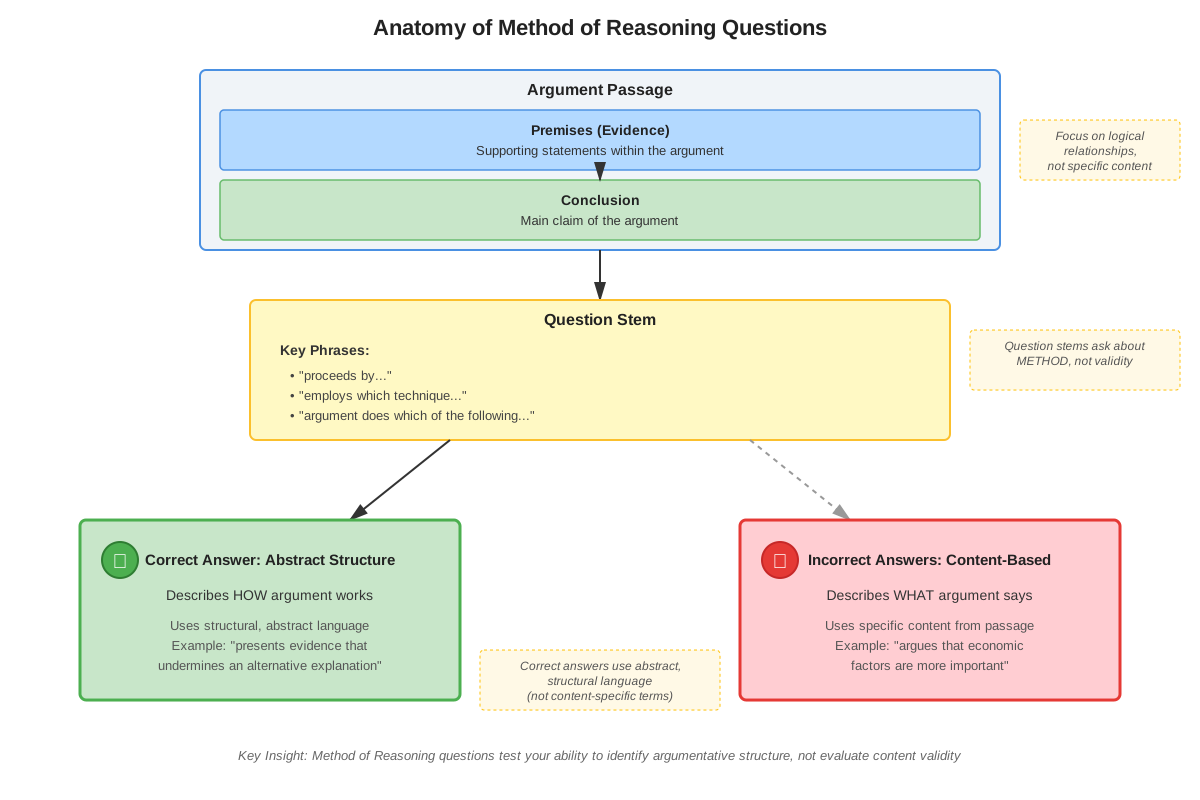
Method of reasoning questions require test-takers to describe the logical technique or argumentative strategy an author uses to advance their position. Unlike questions that ask whether an argument succeeds or what would strengthen it, these questions focus purely on how the argument operates mechanically. The correct answer provides an accurate structural description that could apply to arguments with completely different content but identical logical architecture.
The fundamental challenge lies in abstracting from specific content to general structure. When an argument states "Just as exercise strengthens muscles, reading strengthens the mind," the method involves reasoning by analogy. The correct answer won't mention exercise or reading specifically but will describe the technique: "draws a parallel between two phenomena to support a conclusion about one of them."
Common Argumentative Techniques
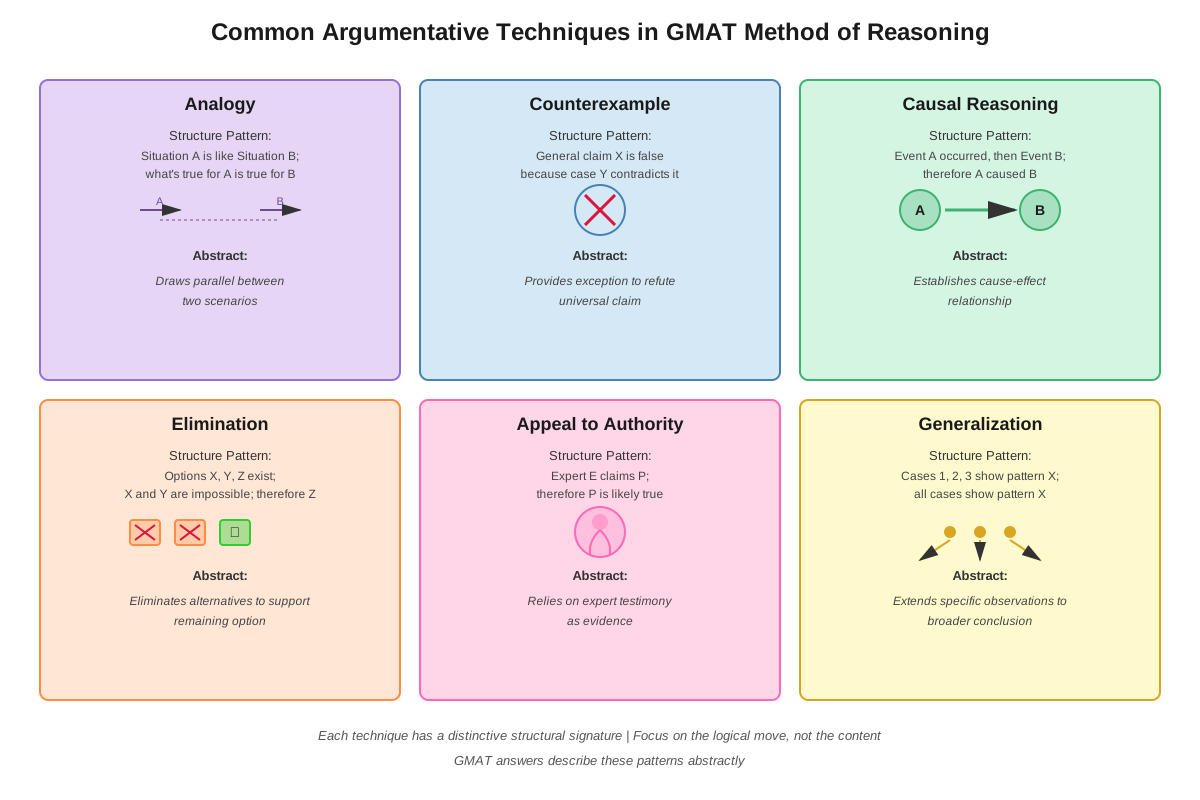
Several argumentative methods appear frequently in GMAT method of reasoning questions:
Reasoning by Analogy: The author compares two situations, objects, or phenomena and argues that what holds true for one likely holds true for the other. The strength depends on relevant similarities between the compared items.
Counterexample: The author refutes a general claim by providing a specific instance that contradicts it. This technique shows that a universal statement cannot be true if even one exception exists.
Elimination of Alternatives: The author lists possible explanations or options, systematically rules out all but one, and concludes the remaining option must be correct. This method assumes the list of alternatives is exhaustive.
Causal Reasoning: The author identifies a cause-and-effect relationship, often arguing that because one event preceded or correlates with another, it caused the second event. This may involve distinguishing correlation from causation.
Appeal to Authority or Evidence: The author supports a claim by citing expert opinion, research findings, or empirical data. The method relies on the credibility and relevance of the cited source.
Reductio ad Absurdum: The author assumes the opposite of what they want to prove, shows this assumption leads to an absurd or contradictory conclusion, and therefore concludes the original position must be true.
Generalization from Examples: The author presents specific instances or cases and draws a broader conclusion that extends beyond those particular examples.
Structural Components to Identify
When analyzing an argument's method, systematically identify these structural elements:
- The main conclusion: What is the author ultimately trying to establish?
- The premises: What evidence or reasons does the author provide?
- The logical connection: How do the premises relate to the conclusion?
- The technique employed: Which argumentative method bridges premises to conclusion?
- Any intermediate steps: Does the argument proceed through multiple stages?
Abstract vs. Concrete Description
The critical skill in method of reasoning questions involves translating concrete content into abstract structural descriptions. Consider this argument:
"Company X increased advertising spending by 40% and saw sales rise by 25%. Therefore, the advertising caused the sales increase."
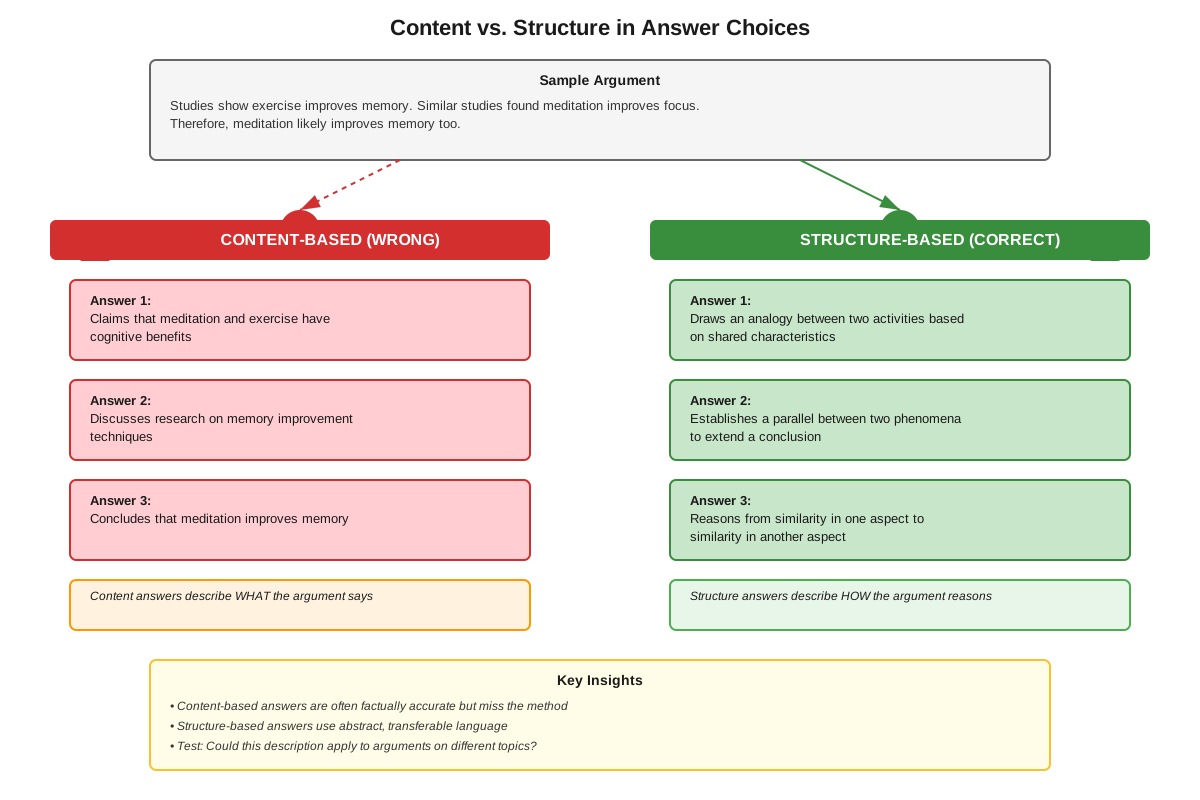
A concrete description might say: "argues that advertising spending increases cause sales increases." However, the abstract structural description states: "infers a causal relationship from a temporal correlation between two events." The latter correctly describes the method without being tied to the specific content.
| Concrete Description | Abstract Description |
|---|---|
| Mentions specific content (advertising, sales) | Describes logical structure (causal inference, correlation) |
| Cannot apply to different arguments | Applies to any argument using the same technique |
| Focuses on what the argument is about | Focuses on how the argument proceeds |
| Incorrect for method questions | Correct for method questions |
Recognizing Question Stems
Method of reasoning questions use distinctive language that signals the need for structural analysis:
- "The argument proceeds by..."
- "Which of the following describes the technique used..."
- "The author's method of argumentation is to..."
- "The argument employs which of the following strategies..."
- "The reasoning above does which of the following..."
- "The argument uses which procedure..."
These stems explicitly request description of the argumentative method rather than evaluation of the argument's validity or identification of assumptions.
Two-Part Arguments and Complex Methods
Some GMAT arguments employ multiple techniques or proceed in stages. For example, an argument might first use elimination of alternatives to narrow possibilities, then employ analogy to support the remaining option. The correct answer must capture this complexity: "eliminates several explanations before drawing an analogy to support the remaining explanation."
Recognizing these multi-step methods requires careful tracking of how the argument unfolds. Mark transitions like "furthermore," "however," "therefore," and "by contrast" that signal shifts in argumentative strategy.
Concept Relationships
Method of reasoning questions connect to other Critical Reasoning concepts through a hierarchical relationship. At the foundation lies argument structure (premises and conclusions), which method of reasoning builds upon by asking how these components relate. This understanding then supports parallel reasoning questions, which require recognizing when two arguments share identical methods despite different content.
The relationship flows: Argument Structure → Method of Reasoning → Parallel Reasoning → Evaluation Questions. Understanding method also enhances performance on assumption questions because recognizing an argument's technique helps identify what must be true for that technique to work. For instance, if an argument uses analogy, it assumes the compared items are relevantly similar.
Method of reasoning also connects laterally to flaw questions. Many flawed arguments employ legitimate techniques incorrectly—using a weak analogy, generalizing from insufficient examples, or confusing correlation with causation. Recognizing the method helps identify where it breaks down.
The progression for mastery follows: First, identify argument components → Second, recognize the technique connecting them → Third, abstract from content to structure → Fourth, match structural description to answer choices → Fifth, apply this skill to parallel reasoning and evaluation questions.
High-Yield Facts
⭐ Method of reasoning questions ask HOW an argument proceeds, not WHETHER it succeeds or what it assumes.
⭐ Correct answers describe argumentative structure in abstract terms that could apply to different content.
⭐ Common methods include analogy, counterexample, elimination of alternatives, causal reasoning, and appeal to authority.
⭐ Question stems contain trigger phrases like "proceeds by," "employs which technique," or "uses which method."
⭐ Wrong answers often describe the argument's content rather than its logical structure.
- Reasoning by analogy compares two phenomena and argues what applies to one applies to the other.
- Counterexamples refute universal claims by providing a single contradictory instance.
- Elimination of alternatives systematically rules out options until one remains.
- Causal reasoning infers that one event causes another, often from correlation or temporal sequence.
- Reductio ad absurdum assumes the opposite of the desired conclusion and shows it leads to absurdity.
- Abstract descriptions use terms like "phenomenon," "claim," "evidence," rather than specific content words.
- Multi-step arguments may employ several techniques in sequence, requiring compound descriptions.
- The method remains constant even if the argument's content or conclusion changes completely.
Quick check — test yourself on Method of reasoning so far.
Try Flashcards →Common Misconceptions
Misconception: Method of reasoning questions ask whether the argument is valid or sound.
Correction: These questions only ask for a description of the argumentative technique used, regardless of whether that technique succeeds. An argument can use analogy poorly, but if it uses analogy, that's the correct method description.
Misconception: The correct answer should mention the specific topics discussed in the argument.
Correction: Correct answers provide abstract structural descriptions that avoid specific content. If an argument discusses corporate profits and employee satisfaction, the answer won't mention these topics but will describe the logical relationship in general terms.
Misconception: Longer, more detailed answer choices are more likely to be correct.
Correction: Correct answers are precisely accurate, not necessarily lengthy. Verbose answers often add irrelevant details or describe content rather than method. Concise structural descriptions frequently prove correct.
Misconception: If an argument mentions an expert or study, it must be using "appeal to authority."
Correction: Simply citing evidence doesn't constitute appeal to authority as a method. The method depends on how that evidence functions in the argument's structure. The argument might use the evidence as a premise in causal reasoning or as support for an analogy.
Misconception: Method of reasoning questions are just asking for the argument's conclusion.
Correction: These questions ask how the author reaches the conclusion, not what the conclusion is. The method describes the logical pathway from premises to conclusion, not the destination itself.
Misconception: All arguments using examples are "generalizing from examples."
Correction: Examples can serve different functions. An argument might use a single example as a counterexample to refute a claim, or use multiple examples to establish a pattern. The method depends on how the examples function structurally, not merely their presence.
Worked Examples
Example 1: Identifying Analogy
Argument: "Just as a chain is only as strong as its weakest link, a company is only as effective as its least competent employee. Therefore, businesses should focus resources on improving their weakest performers rather than further developing their strongest employees."
Question: The argument proceeds by:
(A) presenting statistical evidence to support a business recommendation
(B) drawing a parallel between two systems to support a conclusion about one of them
(C) identifying a causal relationship between employee competence and company effectiveness
(D) eliminating alternative strategies before recommending a specific approach
(E) appealing to expert opinion about human resource management
Analysis:
Step 1: Identify the conclusion: "Businesses should focus resources on improving their weakest performers."
Step 2: Identify the premises: The comparison between a chain's strength (determined by its weakest link) and a company's effectiveness (determined by its least competent employee).
Step 3: Recognize the technique: The argument explicitly draws a parallel ("just as... so too") between chains and companies. This is reasoning by analogy.
Step 4: Evaluate answer choices:
- (A) describes content (statistical evidence) not present in the argument
- (B) accurately describes the analogical method in abstract terms
- (C) describes a causal claim but misses the analogical method used to support it
- (D) describes elimination of alternatives, which doesn't occur here
- (E) describes appeal to authority, which isn't present
Correct Answer: (B)
The argument uses analogy as its primary method. The correct answer abstracts from the specific content (chains, companies) to describe the structural technique (drawing a parallel between two systems). Notice how (C) might tempt test-takers who focus on content rather than method—while the argument does make a claim about company effectiveness, the method it uses is analogy, not direct causal reasoning.
Example 2: Recognizing Counterexample
Argument: "Some economists claim that increased government spending always leads to inflation. However, during the 2008 financial crisis, the government dramatically increased spending while inflation remained low. This shows that the economists' claim cannot be universally true."
Question: The argument employs which of the following techniques?
(A) uses statistical analysis to identify a causal relationship
(B) appeals to expert consensus to establish a general principle
(C) provides a specific instance that contradicts a universal claim
(D) draws an analogy between different economic periods
(E) eliminates alternative explanations for an economic phenomenon
Analysis:
Step 1: Identify the conclusion: "The economists' claim cannot be universally true."
Step 2: Identify the premises: The 2008 crisis example where increased spending didn't produce inflation.
Step 3: Recognize the technique: The argument refutes a universal claim ("always leads to inflation") by presenting a single contradictory case. This is the counterexample method.
Step 4: Evaluate answer choices:
- (A) misidentifies the method as statistical analysis and causal reasoning
- (B) incorrectly suggests the argument appeals to experts (it actually refutes them)
- (C) accurately describes the counterexample technique in abstract terms
- (D) suggests analogy, but no comparison between similar things occurs
- (E) suggests elimination of alternatives, which isn't the method used
Correct Answer: (C)
This argument uses a counterexample to refute a universal claim. The correct answer describes this method abstractly ("specific instance that contradicts a universal claim") without mentioning government spending, inflation, or 2008 specifically. Test-takers must recognize that providing one exception to an "always" claim constitutes the counterexample method, regardless of the argument's subject matter.
Exam Strategy
Systematic Approach to Method Questions
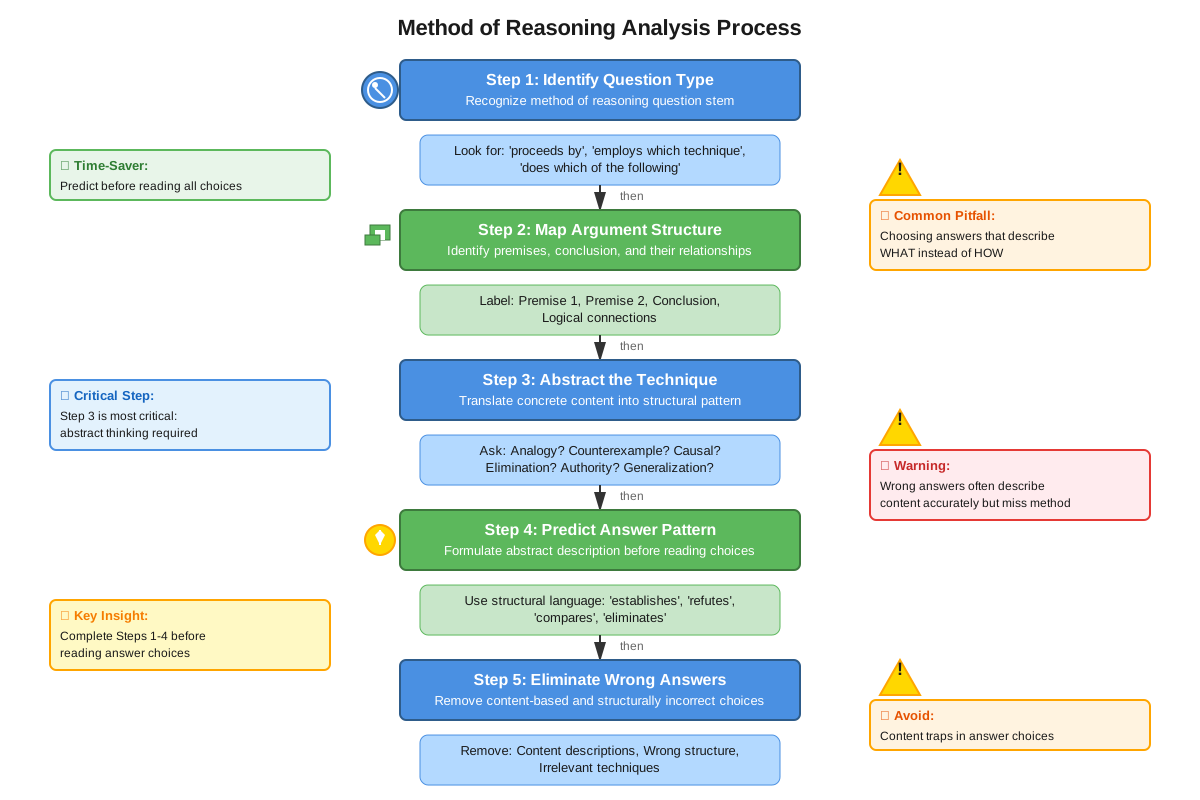
When encountering a method of reasoning question, follow this process:
- Recognize the question type from stems containing "proceeds by," "technique," or "method"
- Read the argument carefully, noting structural markers and transitions
- Identify the conclusion explicitly—what is the author ultimately arguing?
- Map the premises and how they connect to the conclusion
- Name the technique in your own words before looking at choices
- Predict the answer using abstract structural language
- Eliminate wrong answers that describe content or misidentify the method
- Select the choice that matches your structural prediction
Trigger Words and Phrases
Watch for these indicators of specific methods within arguments:
Analogy: "just as," "similarly," "like," "in the same way," "parallel to"
Counterexample: "however," "but," "one case where," "for instance," followed by contradiction
Elimination: "it cannot be X because," "Y is ruled out by," "the only remaining explanation"
Causal reasoning: "therefore," "thus," "as a result," "caused by," "led to"
Appeal to authority: "experts agree," "research shows," "according to," "studies indicate"
Process of Elimination Tips
Eliminate answer choices that:
- Mention specific content from the argument (company names, products, specific numbers) rather than abstract structure
- Describe what the argument concludes rather than how it reaches that conclusion
- Identify assumptions or implications rather than the argumentative method
- Use method terms incorrectly (e.g., calling a counterexample an "analogy")
- Describe techniques not present in the argument at all
Favor answer choices that:
- Use abstract language like "phenomenon," "claim," "evidence," "principle"
- Accurately capture the logical structure you identified in your pre-reading
- Could apply to different content using the same argumentative technique
- Match the scope of the argument (don't describe more or fewer steps than actually occur)
Time Allocation
Allocate approximately 2 minutes per method of reasoning question:
- 30 seconds: Read and understand the argument
- 20 seconds: Identify the method and predict the answer structure
- 60 seconds: Evaluate all five answer choices
- 10 seconds: Confirm your selection and move forward
If stuck between two choices, ask: "Which answer describes structure rather than content?" and "Which answer could apply to a completely different argument using the same technique?"
Memory Techniques
PACE Acronym for Common Methods
Parallel (Analogy): Drawing comparisons between similar situations
Alternatives (Elimination): Ruling out options until one remains
Counterexample: Providing an exception to refute a universal claim
Evidence (Causal/Authority): Using data or expertise to establish relationships
Visualization Strategy
Picture arguments as bridges connecting premises (one side) to conclusions (other side). The method of reasoning describes the bridge's architecture:
- Analogy: A bridge that mirrors another bridge's design
- Counterexample: A wrecking ball demolishing a bridge (refuting a claim)
- Elimination: Multiple bridge options with all but one collapsing
- Causal reasoning: A bridge showing one side pushing/pulling the other
- Appeal to authority: A bridge certified by engineers (experts)
Abstract Translation Practice
Create a mental habit: whenever you read an argument, immediately translate one sentence into abstract terms. For example:
Concrete: "Sales increased after the new marketing campaign."
Abstract: "One phenomenon followed another phenomenon."
This practice trains the abstraction skill essential for method questions.
Question Stem Recognition Mnemonic
METHOD reminds you what these questions ask:
Method of argumentation
Employs which technique
Technique used
How the argument proceeds
Operates by which strategy
Describes the reasoning
Summary
Method of reasoning questions assess the ability to analyze argumentative structure rather than content, requiring test-takers to identify and describe the logical techniques authors employ to advance their positions. Success depends on recognizing common methods—analogy, counterexample, elimination of alternatives, causal reasoning, and appeal to authority—and translating concrete arguments into abstract structural descriptions. The fundamental skill involves stepping back from persuasive content to objectively describe how premises connect to conclusions through specific logical moves. Correct answers use abstract language that could apply to different arguments with identical structure, while wrong answers typically describe content, conclusions, or assumptions rather than method. Mastering this question type strengthens overall Critical Reasoning performance by developing meta-cognitive awareness of argumentative patterns, which proves valuable for parallel reasoning questions, flaw identification, and assumption analysis. The systematic approach involves identifying the conclusion, mapping premises, naming the technique, predicting an abstract answer, and eliminating choices that describe content rather than structure.
Key Takeaways
- Method of reasoning questions ask HOW an argument proceeds structurally, not whether it succeeds or what it assumes
- Correct answers provide abstract descriptions using terms like "phenomenon" and "claim" rather than specific content
- The five most common methods are analogy, counterexample, elimination of alternatives, causal reasoning, and appeal to authority
- Question stems contain trigger phrases like "proceeds by," "employs which technique," or "uses which method"
- Wrong answers typically describe the argument's content, conclusion, or assumptions rather than its logical structure
- Successful analysis requires identifying the conclusion, mapping premises, recognizing the connecting technique, and abstracting to structural description
- This skill transfers to parallel reasoning questions and enhances overall Critical Reasoning performance
Related Topics
Parallel Reasoning: After mastering method of reasoning, parallel reasoning questions become more accessible because they require identifying arguments with identical methods despite different content. The abstraction skills developed here apply directly.
Assumption Questions: Understanding argumentative methods helps identify what must be true for those methods to work—for instance, analogies assume relevant similarity between compared items.
Flaw Questions: Many flawed arguments employ legitimate methods incorrectly. Recognizing the method helps pinpoint where the reasoning breaks down, such as weak analogies or hasty generalizations.
Argument Structure: This foundational topic underlies method of reasoning. Deeper study of complex argument structures with multiple premises and sub-conclusions enhances method identification skills.
Formal Logic: Advanced study of deductive reasoning patterns, syllogisms, and logical operators provides additional framework for understanding argumentative methods.
Practice CTA
Now that you understand method of reasoning questions, apply these concepts to practice problems. Work through the accompanying practice questions, focusing on identifying the argumentative technique before looking at answer choices. Create your own abstract descriptions and compare them to the correct answers. Use the flashcards to reinforce recognition of common methods and question stems. Remember: mastering this question type requires moving beyond content to see the logical architecture beneath every argument. With systematic practice, you'll develop the meta-cognitive skills that distinguish top GMAT performers. Each practice question strengthens your ability to abstract from specific content to general structure—an invaluable skill not just for the GMAT, but for business school and beyond.
Sign up free to keep reading
Create a free AnvayaPrep account to finish this GMAT guide on Method of reasoning — plus flashcards and practice questions.