Overview
Flaw questions represent one of the most critical question types within GMAT Critical Reasoning, testing a student's ability to identify logical weaknesses in arguments. These questions require examinees to analyze an argument's structure and pinpoint exactly where the reasoning breaks down or fails to adequately support its conclusion. Unlike other Critical Reasoning question types that ask students to strengthen, weaken, or find assumptions, flaw questions demand direct recognition of what is already wrong with the argument as presented.
Mastering GMAT flaw questions is essential because they appear with high frequency on the exam and directly assess analytical thinking skills that business schools value. These questions test whether students can critically evaluate reasoning patterns, distinguish between sound and unsound logic, and identify common argumentative errors that appear in business contexts, academic research, and everyday decision-making. The ability to spot flaws in reasoning is foundational to making sound judgments in management, strategy, and analytical roles.
Within the broader Verbal Reasoning section, flaw questions connect intimately with other Critical Reasoning question types. Understanding flaws helps students recognize what assumptions an argument makes (Assumption questions), what evidence would weaken it (Weaken questions), and what logical structures underpin it (Method of Reasoning questions). Flaw questions essentially ask students to diagnose the "disease" in an argument's logic, making them central to developing the critical thinking skills that permeate all GMAT Verbal content.
Learning Objectives
- [ ] Identify Flaw questions by recognizing their distinctive question stems and phrasing
- [ ] Explain the nature of logical flaws and how they undermine argument validity
- [ ] Apply systematic analysis techniques to GMAT flaw questions under timed conditions
- [ ] Categorize flaws into common types (causal, sampling, scope shifts, etc.)
- [ ] Distinguish between actual logical flaws and mere disagreements with premises
- [ ] Evaluate answer choices to select the option that most precisely describes the argument's weakness
Prerequisites
- Basic argument structure: Understanding premises, conclusions, and how evidence supports claims is essential because flaw questions require identifying where this support breaks down
- Common logical fallacies: Familiarity with basic reasoning errors (correlation vs. causation, hasty generalization, etc.) provides the foundation for recognizing flaws in GMAT arguments
- Critical Reasoning fundamentals: Ability to deconstruct arguments and identify their components enables students to isolate where reasoning goes wrong
- Assumption identification: Recognizing unstated assumptions helps identify gaps in logic that constitute flaws
Why This Topic Matters
In real-world business contexts, the ability to identify flawed reasoning prevents costly strategic errors, helps evaluate vendor claims, and strengthens decision-making processes. Executives who can spot logical weaknesses in proposals, market analyses, or operational plans make better-informed choices and avoid pitfalls that result from accepting faulty reasoning. This skill translates directly to case analyses in business school and consulting work where identifying weak points in arguments is crucial.
On the GMAT specifically, flaw questions typically constitute 10-15% of Critical Reasoning questions, making them one of the most frequently tested question types. Given that Critical Reasoning comprises approximately one-third of Verbal Reasoning questions, students can expect to encounter 2-4 flaw questions on a typical GMAT exam. These questions often appear at medium to high difficulty levels, making them significant score differentiators.
Flaw questions appear in several recognizable formats on the exam. The most common presentation involves a short argument (3-5 sentences) followed by a question asking students to identify the reasoning error. These arguments typically draw from business scenarios, scientific studies, policy debates, or everyday situations. The flaws themselves range from statistical reasoning errors to scope problems to unwarranted causal claims, requiring students to maintain flexibility in their analytical approach.
Core Concepts
Defining Logical Flaws
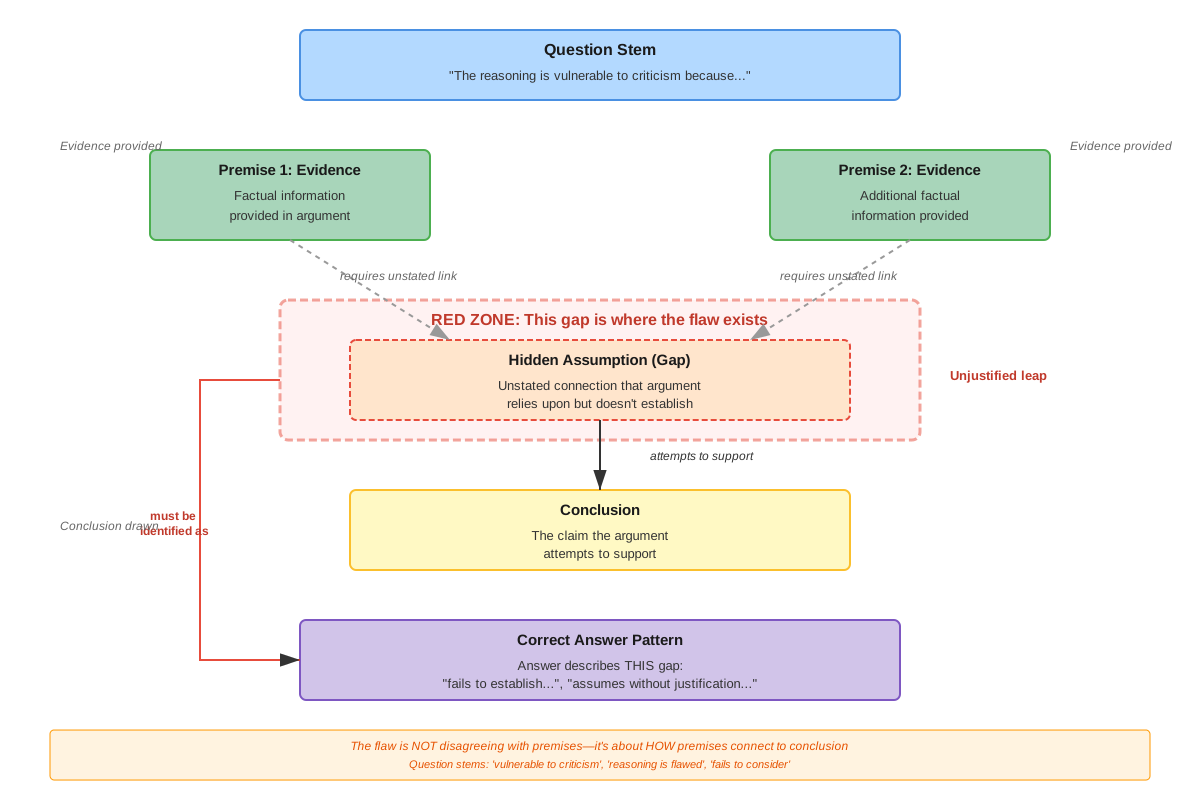
A logical flaw is a defect in reasoning that causes an argument's conclusion to be inadequately supported by its premises, even if all the premises are true. This distinction is crucial: flaw questions do not ask whether premises are factually accurate but rather whether the reasoning process from premises to conclusion is valid. A flawed argument may have true premises and even a true conclusion, but the connection between them remains logically unsound.
Flaws differ from mere weaknesses or missing information. An argument might be incomplete without being flawed—it simply needs additional support. A flaw, however, represents an active error in reasoning: a logical misstep, an unwarranted assumption, or a structural defect that undermines the argument's validity regardless of what additional information might be provided.
Recognizing Flaw Question Stems
Flaw questions use distinctive language that signals the task at hand. Common question stems include:
- "The reasoning in the argument is flawed because it..."
- "Which of the following indicates a vulnerability in the argument?"
- "The argument is most susceptible to criticism on the grounds that it..."
- "A flaw in the reasoning of the argument is that it..."
- "The argument is questionable because it..."
These stems share a common feature: they acknowledge that something is wrong with the argument and ask students to identify what that something is. Recognizing these stems immediately tells students to shift into "flaw-finding mode" rather than looking for assumptions, strengtheners, or other elements.
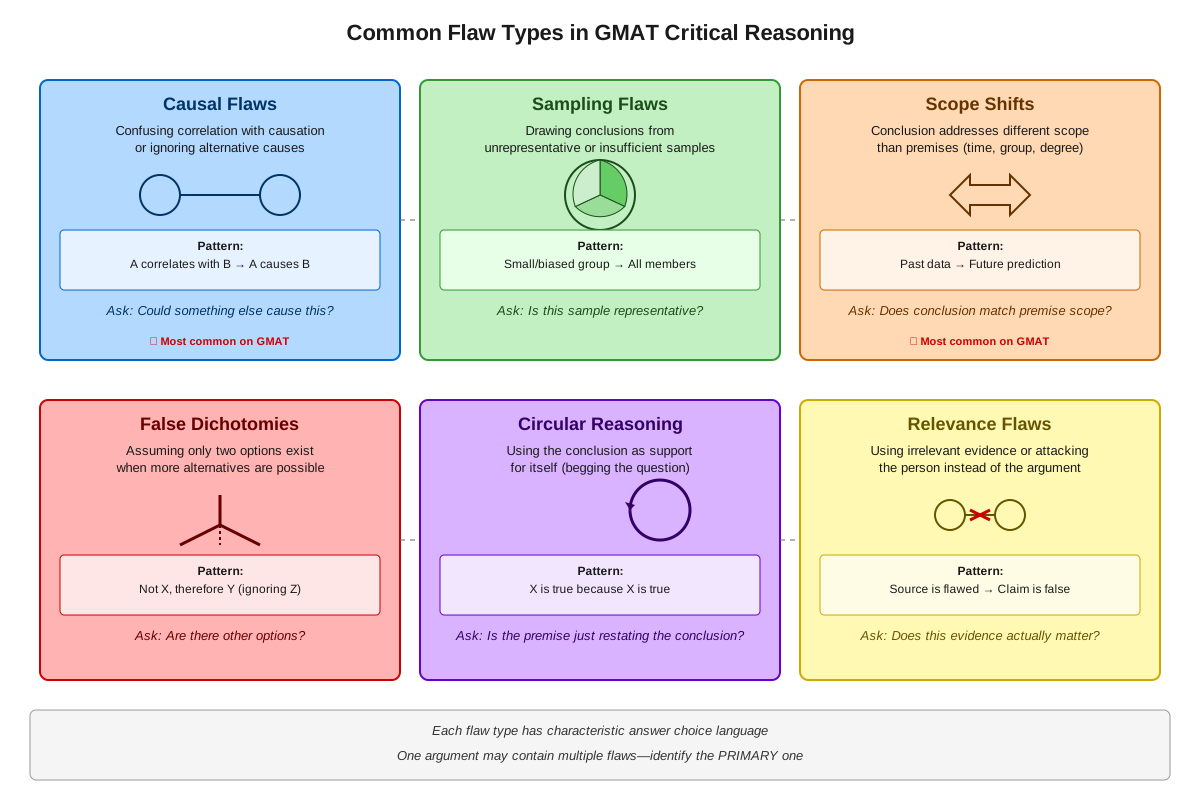
Common Flaw Categories
Causal Reasoning Flaws
Causal flaws occur when arguments incorrectly establish cause-and-effect relationships. The most common variant confuses correlation with causation: observing that two phenomena occur together and concluding that one causes the other without ruling out alternative explanations. For example, an argument might note that ice cream sales and drowning deaths both increase in summer and conclude that ice cream causes drowning, ignoring the common cause (warm weather) that explains both.
Other causal flaws include:
- Reversed causation: Assuming A causes B when B actually causes A
- Overlooking alternative causes: Failing to consider other factors that might produce the observed effect
- Confusing necessary and sufficient conditions: Treating a necessary condition as if it were sufficient, or vice versa
Sampling and Statistical Flaws
Sampling flaws involve drawing conclusions about a population based on unrepresentative or inadequate samples. An argument might survey only customers who complained and conclude that most customers are dissatisfied, ignoring the silent majority who never complained. Key sampling errors include:
- Biased samples: Using a sample that systematically differs from the population
- Sample size problems: Drawing broad conclusions from too few observations
- Self-selection bias: Relying on volunteers or respondents who choose to participate
Scope Shifts
Scope shifts occur when an argument's conclusion addresses a different group, time period, or concept than its premises support. For instance, premises about Company X's performance in 2020 cannot support a conclusion about Company Y's performance in 2025 without additional justification. Common scope shifts include:
- Temporal shifts: Moving from past/present evidence to future conclusions
- Group shifts: Shifting from one population to another
- Concept shifts: Subtly changing the meaning of key terms between premises and conclusion
False Dichotomies
A false dichotomy (or false dilemma) presents only two options when additional alternatives exist. An argument might claim "Either we expand internationally or we'll lose market share," ignoring possibilities like improving domestic operations, developing new products, or targeting different customer segments.
Circular Reasoning
Circular reasoning occurs when an argument's conclusion essentially restates its premise without providing independent support. For example: "This policy is beneficial because it produces good outcomes, and we know the outcomes are good because the policy is beneficial." The argument goes in a circle without establishing anything.
Ad Hominem and Source-Based Flaws
These flaws attack or praise the source of a claim rather than addressing the claim's merit. An argument might dismiss a proposal because its advocate has made mistakes in the past, without evaluating whether the current proposal has merit on its own terms.
Analyzing Flaw Answer Choices
Correct answers to flaw questions precisely describe the logical error in the argument. They typically:
- Accurately characterize what the argument does
- Explain why this constitutes a logical problem
- Match the specific flaw in the passage (not just any flaw)
Incorrect answers often:
- Describe flaws the argument doesn't commit
- Criticize the argument for not doing something it wasn't trying to do
- Mischaracterize the argument's structure or claims
- Point out missing information that would strengthen the argument but don't identify an actual logical error
Concept Relationships
The concepts within flaw questions form an interconnected system. Recognizing question stems enables students to activate the appropriate analytical framework, which then guides them to identify the argument's structure (premises and conclusion). Understanding common flaw categories provides a mental checklist to systematically evaluate where the reasoning breaks down. This evaluation process leads to analyzing answer choices to find the option that most precisely describes the identified flaw.
Flaw questions connect directly to Assumption questions because every flaw represents a gap that an unstated assumption attempts to bridge. When an argument commits a causal flaw, it assumes no alternative causes exist. When it shifts scope, it assumes the different groups or time periods are relevantly similar. Understanding flaws thus illuminates what assumptions arguments make.
Similarly, flaw questions relate to Weaken questions because anything that weakens an argument typically exploits an existing flaw. If an argument has a sampling flaw, evidence showing the sample is unrepresentative will weaken it. The relationship flows: Flaw identification → Understanding vulnerability → Recognizing what evidence would exploit that vulnerability.
The progression can be mapped as: Question stem recognition → Argument deconstruction → Flaw category identification → Answer choice evaluation → Precise flaw description selection
High-Yield Facts
⭐ Flaw questions ask what is wrong with the argument as written, not what additional information would help or what assumptions it makes
⭐ The correct answer must describe a flaw the argument actually commits, not just any logical error
⭐ Correlation-causation confusion is the single most common flaw type on GMAT flaw questions
⭐ Scope shifts between premises and conclusion represent another extremely frequent flaw category
⭐ The premises in flaw questions should be treated as true; the flaw lies in how the conclusion follows from them
- Flaw questions typically appear with medium to high difficulty ratings and significantly impact scores
- Answer choices often include flaws that sound plausible but don't match what the argument actually does
- Circular reasoning flaws are less common on the GMAT than causal or sampling flaws
- Recognizing the conclusion first helps identify where the argument's reasoning needs to go and where it might go wrong
- Time-efficient flaw analysis involves quickly categorizing the flaw type rather than generating a complete description from scratch
- Arguments with statistical or numerical evidence frequently contain sampling or representativeness flaws
- When an argument makes a recommendation or prediction, check for temporal scope shifts
- False dichotomies often appear in arguments about policy choices or business decisions
- The word "because" in an argument signals causal reasoning that should be scrutinized for causal flaws
- Arguments comparing two groups or situations should be examined for relevant difference flaws
Quick check — test yourself on Flaw questions so far.
Try Flashcards →Common Misconceptions
Misconception: Flaw questions ask what information would weaken the argument or what assumptions it makes.
Correction: Flaw questions specifically ask what logical error the argument commits. While related to assumptions and weakeners, flaw questions require identifying the defect in reasoning that already exists, not what could be added or changed.
Misconception: If the argument's conclusion seems wrong or implausible, that's the flaw.
Correction: The flaw lies in the reasoning process, not the conclusion's truth value. An argument can reach a true conclusion through flawed reasoning, and flaw questions focus on the logical path, not the destination.
Misconception: Any missing information or unstated assumption constitutes a flaw.
Correction: Arguments naturally rely on assumptions and don't include every possible piece of supporting evidence. A flaw is an active reasoning error, not merely incomplete support. The argument must make a logical misstep, not just fail to be exhaustive.
Misconception: The correct answer will use the same terminology as the argument.
Correction: Correct answers describe the flaw in abstract logical terms. An argument about marketing might commit a sampling flaw, and the correct answer will describe the sampling error in general terms rather than using "marketing" language.
Misconception: Longer, more complex answer choices are more likely to be correct.
Correction: Correct answers precisely describe the flaw, which may require few words. Complexity often signals incorrect answers that introduce irrelevant considerations or mischaracterize the argument.
Misconception: If the argument fails to consider something, that's automatically a flaw.
Correction: Arguments aren't required to consider every possibility. A flaw occurs when the argument's reasoning makes an unjustified logical leap. Failing to consider alternatives is only a flaw when the argument's reasoning depends on those alternatives not existing.
Worked Examples
Example 1: Causal Flaw
Argument:
"A recent study found that employees who take regular breaks throughout the workday report higher job satisfaction than those who work continuously. Additionally, the study found that departments with higher job satisfaction have better productivity metrics. Therefore, requiring employees to take regular breaks will improve departmental productivity."
Question: The reasoning in the argument is flawed because it:
Analysis:
Step 1: Identify the conclusion
The conclusion is the recommendation: "requiring employees to take regular breaks will improve departmental productivity."
Step 2: Identify the premises
- Premise 1: Employees taking regular breaks report higher job satisfaction
- Premise 2: Departments with higher job satisfaction have better productivity
Step 3: Identify the logical gap
The argument establishes correlations (breaks correlate with satisfaction; satisfaction correlates with productivity) and concludes that implementing breaks will cause improved productivity. This commits a causal reasoning flaw.
Step 4: Specify the exact flaw
The argument fails to establish that breaks cause satisfaction or that satisfaction causes productivity. Perhaps more productive departments can afford to give employees more breaks, or perhaps satisfied employees choose to take breaks (reversed causation). Maybe a third factor (good management) causes both satisfaction and productivity.
Correct Answer: "Treats a correlation between two phenomena as evidence that one causes the other without ruling out alternative explanations."
Why other answers are wrong:
- "Assumes that what is true of individuals is true of groups" - The argument doesn't commit this composition fallacy
- "Relies on a sample that is too small to support the conclusion" - Sample size isn't discussed or relevant to the flaw
- "Fails to consider that breaks might reduce total working hours" - This would weaken the argument but isn't the logical flaw in the reasoning presented
Example 2: Scope Shift Flaw
Argument:
"TechCorp's new software product received excellent reviews from technology journalists, with 90% rating it as 'innovative' or 'groundbreaking.' Based on these reviews, TechCorp's management projects that the software will achieve strong sales among small business customers in the next quarter."
Question: The argument is most vulnerable to criticism on the grounds that it:
Analysis:
Step 1: Identify the conclusion
The conclusion is the projection: "the software will achieve strong sales among small business customers."
Step 2: Identify the premises
Technology journalists gave the software excellent reviews (90% positive ratings).
Step 3: Identify the logical gap
The premises concern technology journalists' opinions, while the conclusion concerns small business customers' purchasing behavior. These are different groups with potentially different priorities, needs, and decision-making criteria.
Step 4: Specify the exact flaw
The argument shifts scope from one population (technology journalists) to another (small business customers) without justification. What impresses journalists might not drive purchasing decisions among small businesses, who may prioritize factors like cost, ease of implementation, or compatibility with existing systems over innovation.
Correct Answer: "Presumes without justification that the preferences of technology journalists reflect the purchasing priorities of small business customers."
Why other answers are wrong:
- "Relies on a biased sample of journalists" - The argument doesn't indicate bias in the journalist sample
- "Confuses a necessary condition with a sufficient condition" - This logical error isn't present in the argument
- "Assumes that past performance predicts future results" - The argument doesn't reference past performance; it shifts between different groups
Exam Strategy
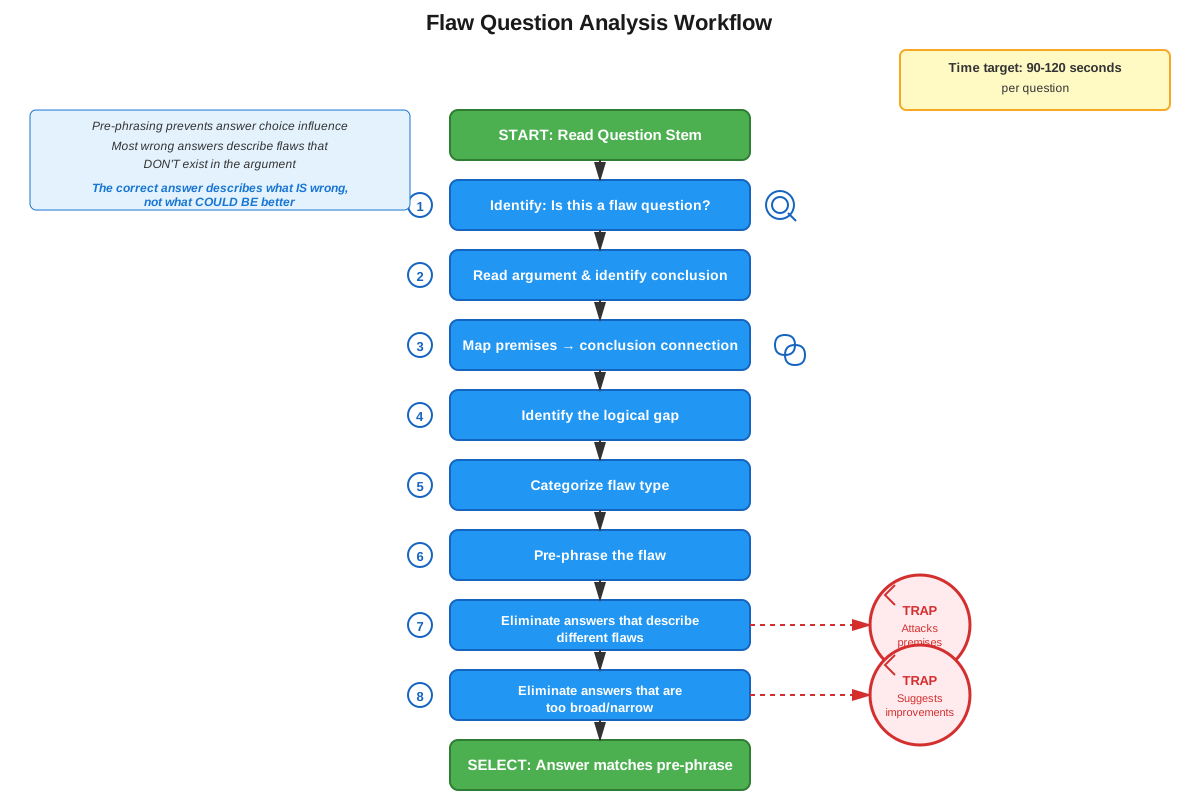
When approaching GMAT flaw questions, implement this systematic process:
Step 1: Recognize the question type (5-10 seconds)
Identify flaw question stems immediately. Words like "flawed," "vulnerable," "questionable," or "susceptible to criticism" signal flaw questions. This recognition activates the appropriate analytical framework.
Step 2: Find and bracket the conclusion (10-15 seconds)
Locate the argument's main claim. Conclusion indicators include "therefore," "thus," "consequently," and "suggests that." Understanding what the argument tries to prove is essential for identifying where the reasoning fails.
Step 3: Identify the premises (10-15 seconds)
Determine what evidence supports the conclusion. Premise indicators include "because," "since," "given that," and "studies show."
Step 4: Spot the logical gap (15-20 seconds)
Ask: "How does the conclusion follow from these premises? What's the logical leap?" Common gaps include:
- Correlation treated as causation
- Evidence about Group A supporting conclusion about Group B
- Past/present evidence supporting future conclusion
- Limited sample supporting broad generalization
Step 5: Predict the flaw category (5-10 seconds)
Before reading answer choices, mentally categorize the flaw: causal error, scope shift, sampling problem, false dichotomy, etc. This prediction prevents answer choices from misleading you.
Step 6: Evaluate answer choices (20-30 seconds)
- Eliminate answers describing flaws the argument doesn't commit
- Eliminate answers that would weaken the argument but don't describe the logical error
- Select the answer that most precisely describes the reasoning defect you identified
Exam Tip: If stuck between two answers, ask "Does the argument actually do what this answer describes?" The correct answer must accurately characterize the argument's reasoning, not just identify a potential problem.
Trigger words and phrases to watch for:
- "Studies show," "research indicates": Often signals potential sampling or statistical flaws
- "Because," "leads to," "causes": Flags causal reasoning that should be scrutinized
- "Will," "should," "must": Strong conclusions that may not be fully supported
- Comparisons between groups: Check for relevant difference flaws
- "Only," "all," "never": Extreme language that may indicate overgeneralization
Time allocation: Spend approximately 90-120 seconds per flaw question. If you've spent 90 seconds and haven't identified the flaw, make your best guess and move on. Flaw questions reward systematic analysis but can become time traps if you overthink them.
Process of elimination tips:
- Eliminate answers using terminology not present in the argument (unless describing the logical structure)
- Eliminate answers describing what the argument "fails to consider" unless that failure represents an active logical error
- Eliminate answers that are true statements about the topic but don't describe the argument's reasoning flaw
- Keep answers that precisely describe a gap between premises and conclusion
Memory Techniques
CASC-FD Mnemonic for common flaw types:
- Causal reasoning errors
- Assumption gaps (unstated premises)
- Sampling/statistical problems
- Comparison flaws (scope shifts)
- False dichotomies
- Definitional shifts (equivocation)
Visualization strategy: Picture the argument as a bridge from premises (one side) to conclusion (other side). The flaw is the missing plank or structural weakness that makes the bridge unsound. This mental image helps identify where the logical connection breaks down.
The "So What?" Test: After reading the premises, ask "So what? How does this prove the conclusion?" If the answer isn't obvious, you've likely found the flaw location.
Correlation-Causation Reminder: Remember "CANE" - Correlation Ain't Necessarily Evidence of causation. When you see two things occurring together, immediately question whether causation is warranted.
Scope Shift Detector: Use the acronym TGPC to check for scope shifts:
- Time (past/present vs. future)
- Group (different populations)
- Place (different locations)
- Concept (term meanings shift)
Summary
Flaw questions constitute a high-frequency, high-impact question type on GMAT Critical Reasoning, requiring students to identify logical errors in arguments' reasoning processes. These questions test the ability to recognize that an argument's conclusion is inadequately supported by its premises, even when those premises are assumed true. The most common flaw types include causal reasoning errors (especially correlation-causation confusion), scope shifts between premises and conclusions, sampling and statistical problems, false dichotomies, and circular reasoning. Success on flaw questions demands systematic analysis: identifying the conclusion, understanding the premises, spotting the logical gap, categorizing the flaw type, and selecting the answer choice that most precisely describes the reasoning defect. Unlike assumption or weaken questions, flaw questions ask students to diagnose what is already wrong with the argument rather than what could be added or changed. Mastering flaw questions requires understanding both common flaw categories and the ability to precisely match answer choices to the specific logical error committed in each argument.
Key Takeaways
- Flaw questions ask what logical error the argument commits, not what would strengthen/weaken it or what it assumes
- The correct answer must describe a flaw the argument actually commits, using precise logical terminology
- Correlation-causation confusion and scope shifts are the most frequently tested flaw types on the GMAT
- Treat premises as true; the flaw lies in how the conclusion follows from them, not in the premises' accuracy
- Systematic analysis (identify conclusion → identify premises → spot gap → categorize flaw → evaluate answers) maximizes accuracy and efficiency
- Predicting the flaw category before reading answer choices prevents being misled by attractive wrong answers
- Time management is crucial: spend 90-120 seconds per question and move on if stuck
Related Topics
Assumption Questions: Understanding flaws directly illuminates what assumptions arguments make, as every flaw represents a gap that an unstated assumption attempts to bridge. Mastering flaw identification makes assumption questions significantly easier.
Weaken Questions: Recognizing flaws reveals an argument's vulnerabilities, showing exactly what evidence would undermine it. The skills developed in flaw questions transfer directly to identifying effective weakeners.
Strengthen Questions: Understanding what's wrong with an argument clarifies what would fix it. Flaw identification helps recognize what additional evidence would shore up weak reasoning.
Evaluate Questions: These questions ask what information would help determine an argument's validity. Knowing an argument's flaw reveals what information would be most relevant to assess it.
Method of Reasoning Questions: These questions ask how an argument proceeds or what role specific statements play. Understanding flaws deepens comprehension of argumentative structure and reasoning patterns.
Practice CTA
Now that you've mastered the core concepts of flaw questions, it's time to apply this knowledge to actual GMAT-style problems. The practice questions and flashcards will reinforce your ability to quickly recognize question types, systematically analyze arguments, categorize flaws, and select precise answer choices under timed conditions. Each practice question you complete strengthens your pattern recognition and builds the confidence needed to excel on test day. Remember: flaw questions reward systematic thinking and careful analysis—skills that improve dramatically with focused practice. Start your practice session now to transform this knowledge into test-day performance!
Sign up free to keep reading
Create a free AnvayaPrep account to finish this GMAT guide on Flaw questions — plus flashcards and practice questions.