Overview
Strengthen questions represent one of the most frequently tested question types in GMAT Critical Reasoning, appearing in approximately 20-25% of all Critical Reasoning questions. These questions assess a test-taker's ability to identify information that would make an argument more convincing, more likely to be true, or better supported by evidence. Mastering strengthen questions is essential for achieving a competitive GMAT score, as they directly test logical reasoning skills that business schools value highly.
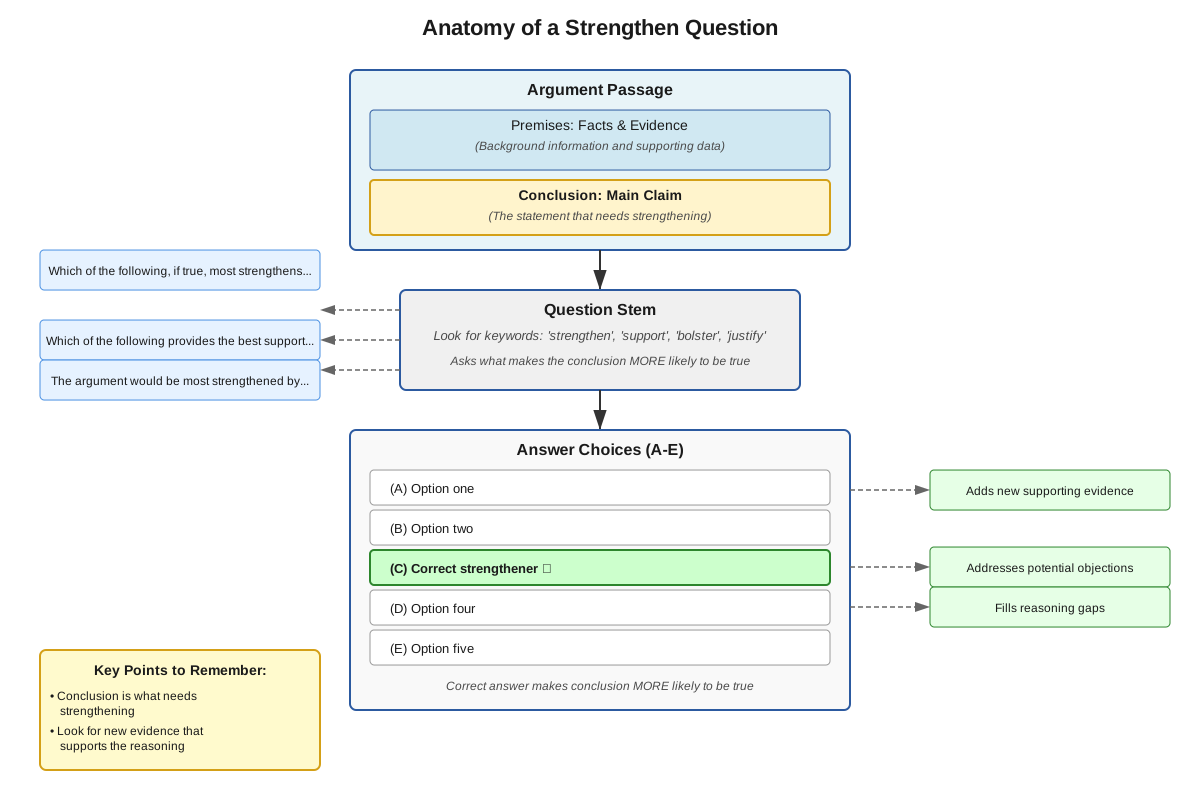
In a GMAT strengthen question, test-takers are presented with an argument containing a conclusion supported by premises, and they must select the answer choice that provides additional evidence or reasoning to make that conclusion more likely to be valid. Unlike assumption questions that identify necessary conditions for an argument to work, strengthen questions add new information that bolsters the argument's persuasiveness. The correct answer doesn't need to prove the conclusion definitively—it simply needs to increase the probability that the conclusion is correct or reduce potential objections to the argument's reasoning.
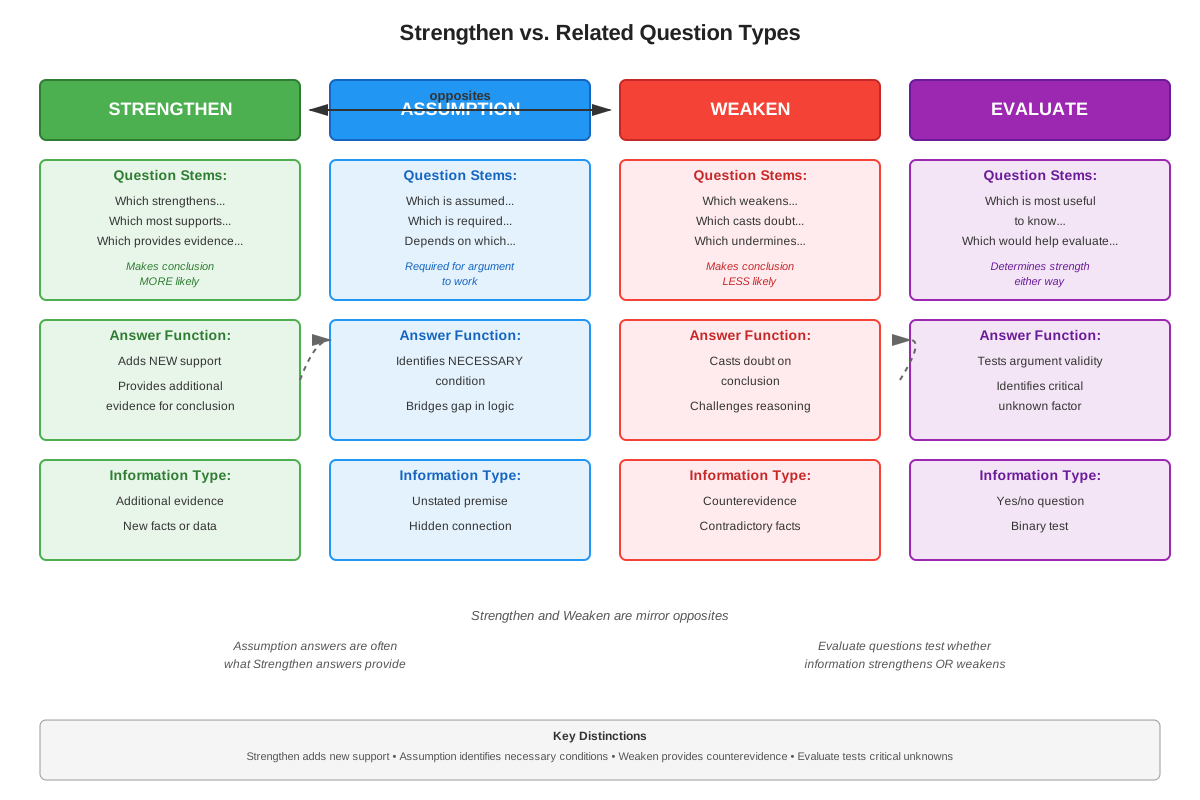
Understanding strengthen questions is fundamental to mastering Critical Reasoning as a whole. These questions connect directly to assumption questions (which identify gaps that strengthen answers often fill), weaken questions (which require the opposite analytical approach), and evaluate questions (which test whether information strengthens or weakens an argument). The analytical framework developed for strengthen questions—identifying conclusions, recognizing reasoning gaps, and evaluating evidence quality—transfers directly to other question types and forms the foundation of critical thinking skills tested throughout the Verbal Reasoning section.
Learning Objectives
- [ ] Identify Strengthen questions by recognizing characteristic question stems and language patterns
- [ ] Explain Strengthen question mechanics, including how correct answers support conclusions and address argument gaps
- [ ] Apply Strengthen strategies to GMAT questions by systematically analyzing arguments and evaluating answer choices
- [ ] Distinguish between strengthen questions and related question types (assumption, weaken, evaluate)
- [ ] Recognize common strengthen answer patterns and eliminate incorrect answer choices efficiently
- [ ] Analyze argument structure to predict what type of information would strengthen a given conclusion
Prerequisites
- Basic argument structure: Understanding premises, conclusions, and how evidence supports claims is essential because strengthen questions require identifying what part of an argument needs additional support
- Logical reasoning fundamentals: Familiarity with cause-and-effect relationships, correlation versus causation, and basic inference patterns enables recognition of argument gaps that strengthen answers address
- GMAT question format: General knowledge of how GMAT Critical Reasoning questions are structured helps with efficient reading and time management when approaching strengthen questions
Why This Topic Matters
Strengthen questions test real-world business reasoning skills that MBA programs and employers value highly. In business contexts, professionals constantly evaluate proposals, marketing strategies, and operational decisions by considering what additional evidence would make a recommendation more convincing. The ability to identify information that bolsters a position is crucial for strategic planning, risk assessment, and persuasive communication—all core competencies in management roles.
On the GMAT, strengthen questions appear with high frequency, typically comprising 4-6 questions in a standard Verbal section. These questions appear in various formats, including business scenarios (marketing strategies, operational decisions), scientific studies (research findings, experimental designs), social policy arguments (government programs, educational initiatives), and causal reasoning (explaining phenomena, predicting outcomes). The GMAT tests strengthen questions at all difficulty levels, with harder questions featuring more subtle answer choices, complex argument structures, or multiple potential gaps in reasoning.
Strengthen questions commonly appear with these characteristics: arguments with causal claims that need additional support for the proposed cause-effect relationship; arguments based on analogies or comparisons that require evidence the comparison is valid; arguments relying on surveys or studies that need support for the methodology or sample representativeness; and arguments making predictions that require evidence the predicted outcome is likely. Recognizing these patterns enables test-takers to anticipate what type of strengthening information the correct answer will provide.
Core Concepts
Understanding Strengthen Questions
A strengthen question asks test-takers to identify information that makes an argument's conclusion more likely to be true or more convincing. The correct answer provides additional evidence, eliminates potential objections, or fills logical gaps in the reasoning. Strengthen questions differ from assumption questions in that they add new, explicit information rather than identifying unstated premises necessary for the argument to work.
Strengthen question stems typically include phrases such as:
- "Which of the following, if true, most strengthens the argument?"
- "Which of the following, if true, provides the strongest support for the conclusion?"
- "Which of the following, if true, would most help to justify the recommendation?"
- "Which of the following, if true, most strongly supports the prediction?"
The key phrase "if true" signals that test-takers should accept all answer choices as factual and evaluate which one best supports the argument, regardless of whether the information seems realistic or likely in the real world.
Argument Structure in Strengthen Questions
Every strengthen question contains an argument with identifiable components:
Premises: The evidence or facts presented to support the conclusion. These are statements the argument treats as given or established.
Conclusion: The main claim the argument is trying to establish. This is what needs to be strengthened.
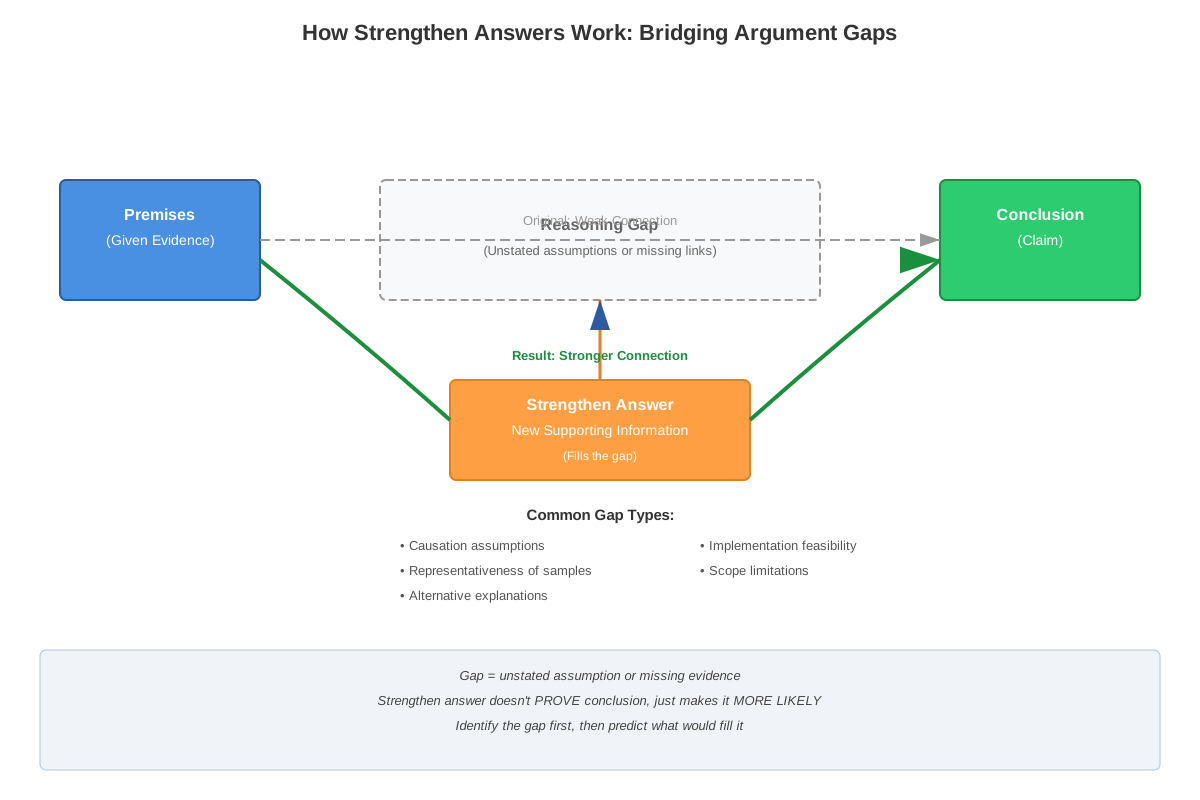
Reasoning Gap: The logical space between premises and conclusion where additional support could make the argument more convincing. Identifying this gap is crucial for predicting correct answers.
Consider this example structure:
- Premise: Company X's sales increased 20% after launching a new advertising campaign
- Conclusion: The advertising campaign caused the sales increase
- Gap: Other factors might have caused the increase; the campaign might not be responsible
A strengthen answer would provide evidence that the advertising campaign, rather than other factors, was indeed responsible for the sales increase.
Types of Strengthen Answers
Strengthen answers follow several common patterns:
1. Eliminating Alternative Explanations: When an argument claims X caused Y, a strengthen answer might show that other potential causes were not present or did not contribute to the outcome.
2. Providing Supporting Evidence: The answer adds new facts or data that directly support the conclusion's validity.
3. Establishing Representativeness: For arguments based on samples or studies, the answer shows the sample accurately represents the broader population or situation.
4. Confirming Assumptions: The answer explicitly states something the argument assumes, making the reasoning more solid (though this differs from assumption questions where the answer is necessary rather than merely helpful).
5. Showing Mechanism Validity: For causal arguments, the answer demonstrates how or why the proposed cause would produce the stated effect.
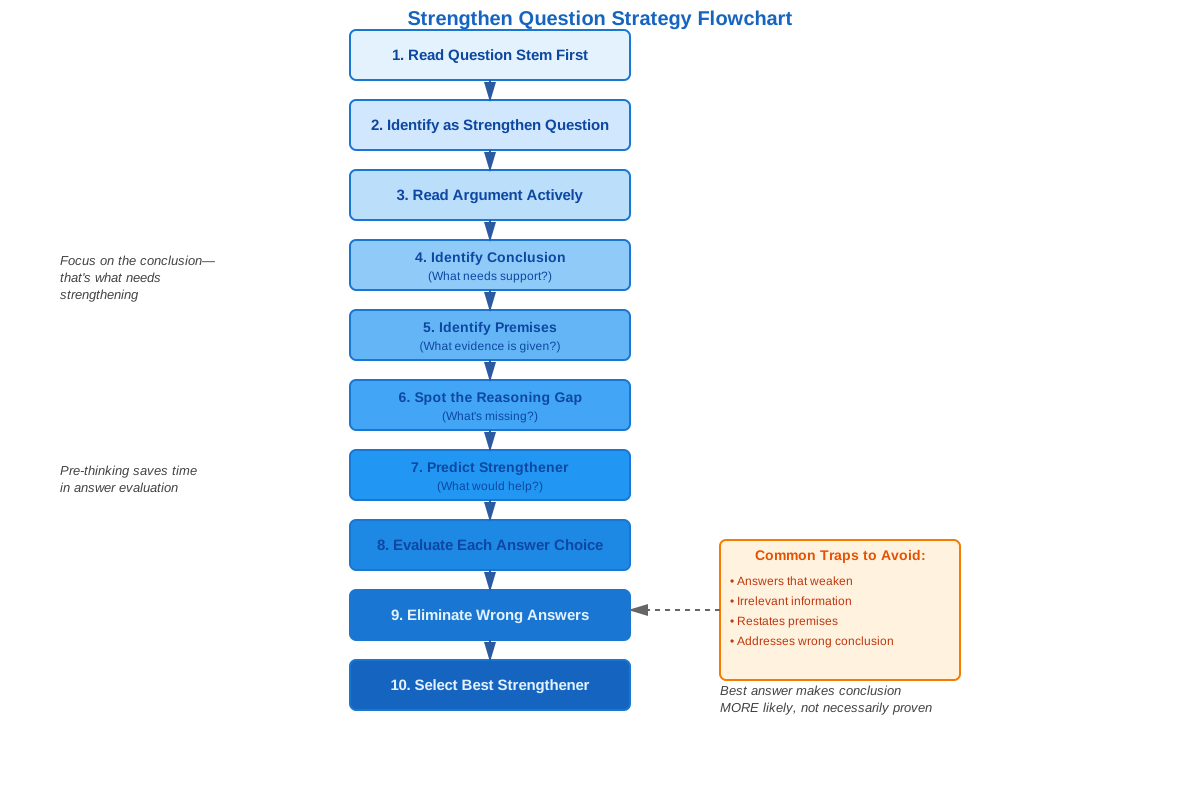
The Strengthen Question Process
| Step | Action | Purpose |
|---|---|---|
| 1 | Identify the question type | Confirms strengthen approach is needed |
| 2 | Find the conclusion | Establishes what needs to be supported |
| 3 | Identify the premises | Understands existing evidence |
| 4 | Locate the reasoning gap | Predicts what type of information would help |
| 5 | Evaluate each answer choice | Determines which best fills the gap |
| 6 | Select the strongest support | Chooses the answer that most increases conclusion likelihood |
Degree of Strengthening
Not all strengthen answers provide equal support. The GMAT often includes answer choices that strengthen the argument slightly while the correct answer strengthens it significantly. Test-takers must evaluate the degree of support each answer provides:
Strong Strengthening: Directly addresses the main reasoning gap, eliminates the most significant alternative explanation, or provides compelling evidence for the conclusion's validity.
Weak Strengthening: Provides tangential support, addresses a minor concern, or offers evidence that only slightly increases the conclusion's likelihood.
No Effect: Provides information that is irrelevant to the argument's reasoning, even if related to the topic.
The correct answer is typically the one that provides the strongest support, not merely any support. This distinction is crucial when multiple answers seem to help the argument.
Common Argument Types in Strengthen Questions
Causal Arguments: These claim that X causes Y. Strengthen answers typically eliminate alternative causes, show the cause preceded the effect, demonstrate a mechanism linking cause and effect, or provide additional instances of the cause-effect relationship.
Prediction Arguments: These forecast future outcomes based on current trends or evidence. Strengthen answers show the trend is likely to continue, eliminate factors that might disrupt the prediction, or provide evidence that similar predictions proved accurate.
Comparison/Analogy Arguments: These draw conclusions based on similarities between two situations. Strengthen answers demonstrate the situations are relevantly similar, show the comparison is valid in key respects, or eliminate important differences.
Statistical/Survey Arguments: These draw conclusions from data or samples. Strengthen answers establish sample representativeness, show methodology was sound, eliminate sampling bias, or provide corroborating data.
Concept Relationships
Strengthen questions form the positive counterpart to weaken questions—both require identifying the argument's reasoning gap, but strengthen questions seek information that fills the gap while weaken questions exploit it. The analytical process for both question types is nearly identical through the first four steps; only the final evaluation differs.
Strengthen questions connect intimately with assumption questions because assumptions represent necessary conditions for arguments to work, while strengthen answers provide sufficient (though not necessary) additional support. Often, an assumption question's correct answer would also strengthen the argument if explicitly stated, though strengthen answers typically go beyond merely stating assumptions to provide additional evidence.
The relationship flow operates as follows: Argument Structure Analysis → identifies → Reasoning Gaps → which can be addressed by → Assumptions (necessary conditions) or Strengthen Answers (additional support) → while Weaken Answers exploit the same gaps. Understanding this interconnected framework enables efficient analysis across all Critical Reasoning question types.
Strengthen questions also relate to inference questions in that both require careful logical reasoning, but inference questions ask what must be true based on the passage, while strengthen questions ask what would make the conclusion more likely if added to the passage. This distinction—working from the passage versus adding to it—is fundamental.
High-Yield Facts
⭐ Strengthen questions ask for information that makes the conclusion more likely to be true, not information that proves it definitively
⭐ The phrase "if true" in the question stem means accept all answer choices as factual and evaluate their impact on the argument
⭐ The correct answer typically addresses the main reasoning gap between premises and conclusion
⭐ Eliminating alternative explanations is one of the most common and powerful ways to strengthen causal arguments
⭐ Strengthen answers add new information to the argument; they don't merely restate premises or the conclusion
- Strengthen questions comprise approximately 20-25% of GMAT Critical Reasoning questions
- The correct answer doesn't need to be the only possible strengthener, just the strongest among the choices given
- Wrong answers in strengthen questions often include information that is irrelevant, weakens the argument, or addresses the wrong conclusion
- Causal arguments are particularly common in strengthen questions because they inherently contain reasoning gaps about alternative causes
- Strengthen answers for survey-based arguments often address sample representativeness or methodology soundness
- The degree of strengthening matters—multiple answers may help, but the correct one helps most
- Strengthen questions test the same analytical skills as weaken questions but require opposite evaluation of answer choices
- Pre-thinking what type of information would strengthen the argument before reading answer choices improves accuracy and speed
Quick check — test yourself on Strengthen so far.
Try Flashcards →Common Misconceptions
Misconception: The correct answer must prove the conclusion is true → Correction: Strengthen answers only need to make the conclusion more likely or more convincing, not prove it with certainty. The GMAT tests probabilistic reasoning, not absolute proof.
Misconception: Any answer that relates to the topic strengthens the argument → Correction: Relevance to the topic doesn't guarantee strengthening effect. The answer must specifically support the logical connection between premises and conclusion, not just discuss related ideas.
Misconception: Strengthen answers should restate or emphasize information already in the argument → Correction: Correct strengthen answers add new information that wasn't present in the original argument. Merely restating existing premises doesn't provide additional support.
Misconception: If an answer eliminates one alternative explanation, it fully strengthens the argument → Correction: While eliminating alternatives does strengthen arguments, test-takers must evaluate whether other alternatives remain and whether the answer choice addresses the most significant gap in reasoning.
Misconception: Strengthen and assumption questions are the same thing → Correction: Assumption questions identify necessary conditions (without which the argument fails), while strengthen questions provide additional support (which makes the argument more convincing but isn't strictly necessary). An assumption, if stated, would strengthen an argument, but strengthen answers often go beyond merely stating assumptions.
Misconception: The longest or most detailed answer choice is most likely correct → Correction: Answer length doesn't correlate with correctness in strengthen questions. The correct answer is determined by logical impact on the argument, not by word count or complexity.
Misconception: Strengthen answers should address every possible objection to the argument → Correction: The correct answer only needs to provide the strongest support among the given choices. It doesn't need to make the argument perfect or address every conceivable weakness.
Worked Examples
Example 1: Causal Argument
Passage:
"City officials attribute the 15% decrease in traffic accidents over the past year to the installation of 50 new traffic cameras at major intersections. The cameras were installed at the beginning of last year, and accident rates have declined steadily since then."
Question:
Which of the following, if true, most strengthens the city officials' conclusion?
Answer Choices:
(A) Traffic cameras in other cities have also been associated with reduced accident rates
(B) The intersections where cameras were installed previously had the highest accident rates in the city
(C) During the same period, neighboring cities without new traffic cameras saw no significant change in accident rates
(D) The traffic cameras are monitored 24 hours a day by trained personnel
(E) Public awareness campaigns about traffic safety were discontinued two years ago
Analysis:
Step 1: Identify the conclusion: The traffic cameras caused the 15% decrease in accidents.
Step 2: Identify the premises: Cameras were installed at the beginning of last year; accidents decreased 15% since then.
Step 3: Identify the reasoning gap: The argument assumes the cameras, rather than other factors, caused the decrease. Alternative explanations might include improved weather, better road conditions, fewer drivers, or other safety initiatives.
Step 4: Evaluate answer choices:
(A) This provides general support that cameras can reduce accidents, but doesn't address whether cameras caused THIS city's decrease. Other factors might still be responsible. Weak strengthening.
(B) This tells us where cameras were placed but doesn't address whether they caused the decrease. High-accident locations might have improved for other reasons. No strengthening effect on causation.
(C) This eliminates alternative explanations by showing that cities without cameras (but presumably subject to the same regional factors like weather, economic conditions, etc.) didn't see decreases. This strongly suggests the cameras, rather than external factors, caused the decrease. Strong strengthening.
(D) This describes camera operation but doesn't address whether cameras caused the accident reduction. Irrelevant to causation.
(E) This mentions a discontinued program but doesn't connect it to the accident decrease. If anything, discontinued safety campaigns might weaken the argument by suggesting another factor changed. No strengthening effect.
Correct Answer: (C)
This answer strengthens the argument by eliminating alternative explanations. If neighboring cities without cameras saw no change while this city with cameras saw a decrease, it's more likely the cameras caused the difference. This is a classic strengthen pattern: showing that when the proposed cause is absent, the effect doesn't occur.
Example 2: Prediction Argument
Passage:
"TechCorp's new smartphone model will likely capture significant market share from competitors. The phone features a revolutionary battery that lasts three times longer than current models, and consumer surveys consistently show that battery life is the most important factor in smartphone purchasing decisions."
Question:
Which of the following, if true, would most strengthen the prediction that TechCorp's phone will capture significant market share?
Answer Choices:
(A) TechCorp has successfully launched innovative products in the past
(B) The revolutionary battery technology will be available to competitors within six months
(C) Consumer surveys were conducted among TechCorp's existing customer base
(D) The new phone's price point is comparable to current leading smartphones
(E) Battery life has been the most important factor for the past five years
Analysis:
Step 1: Identify the conclusion: TechCorp's phone will capture significant market share.
Step 2: Identify the premises: The phone has a battery lasting 3x longer; surveys show battery life is most important to consumers.
Step 3: Identify the reasoning gap: The argument assumes that having the most desired feature will translate to market share gains. Potential objections include: the phone might be too expensive, other factors might prevent purchase, competitors might quickly match the technology, or the advantage might not be sustainable.
Step 4: Evaluate answer choices:
(A) Past success suggests competence but doesn't address whether THIS product will succeed based on its battery advantage. Weak strengthening.
(B) This actually weakens the argument by suggesting the competitive advantage will be short-lived. Weakens rather than strengthens.
(C) This weakens the argument by suggesting the survey might not represent the broader market—only existing customers were surveyed. Weakens rather than strengthens.
(D) This eliminates a major potential objection: that the phone might be too expensive despite its superior battery. If price is comparable, consumers can choose based on battery life without cost concerns, making market share capture more likely. Strong strengthening.
(E) This confirms battery life has been consistently important but doesn't address whether TechCorp's advantage will translate to sales. Weak strengthening.
Correct Answer: (D)
This answer strengthens by eliminating a significant alternative explanation for why the phone might not capture market share. Even with superior battery life, consumers might not switch if the phone were prohibitively expensive. By establishing comparable pricing, the answer removes this obstacle and makes the prediction more likely. This demonstrates another strengthen pattern: eliminating potential barriers to the predicted outcome.
Exam Strategy
Approach strengthen questions systematically: Always identify the conclusion first, then the premises, then the gap in reasoning. This three-step process takes 15-20 seconds but dramatically improves accuracy by clarifying what needs to be strengthened before evaluating answer choices.
Trigger words and phrases to watch for: Question stems containing "strengthen," "support," "justify," "help to explain," or "provide evidence for" indicate strengthen questions. The phrase "if true" is nearly universal in strengthen questions and signals that all answer choices should be accepted as factual.
Pre-think before reading answer choices: After identifying the reasoning gap, spend 5-10 seconds considering what type of information would strengthen the argument. This pre-thinking creates a mental target that helps recognize the correct answer and avoid attractive wrong answers.
Eliminate answer choices that:
- Weaken the argument (common trap answers)
- Are irrelevant to the conclusion-premise connection
- Merely restate information already in the passage
- Address a different conclusion than the one stated
- Provide only tangential or minimal support
Process of elimination strategy: On difficult strengthen questions, eliminating clearly wrong answers first is more efficient than trying to identify the correct answer immediately. Remove weakeners and irrelevant choices, then compare remaining options for degree of strengthening.
Exam Tip: If two answer choices both seem to strengthen the argument, ask yourself which one addresses the main reasoning gap versus a secondary concern. The correct answer typically addresses the central logical connection between premises and conclusion.
Time allocation: Spend approximately 1:45-2:00 minutes per strengthen question. Allocate 20-30 seconds for reading and analyzing the argument, 10 seconds for pre-thinking, and 60-80 seconds for evaluating answer choices. If stuck between two choices after 2 minutes, make your best guess and move forward.
For causal arguments specifically: The correct answer often eliminates alternative causes, shows the cause preceded the effect, or demonstrates a mechanism linking cause and effect. Predict which of these patterns would most strengthen the specific argument before reading choices.
Watch for scope shifts: Wrong answers frequently introduce information that's related to the topic but outside the scope of the specific conclusion. The correct answer must strengthen the exact conclusion stated, not a related or broader claim.
Memory Techniques
STRENGTHEN mnemonic:
- Support the conclusion directly
- Test each answer as if true
- Reasoning gap must be addressed
- Eliminate alternative explanations
- New information is required
- Greatest degree of support wins
- Topic relevance isn't enough
- Helps make conclusion more likely
- Evaluate impact on argument
- Necessary vs. sufficient distinction
The "Bridge Builder" visualization: Picture the argument as two islands (premises and conclusion) with a gap between them. The strengthen answer builds a bridge across the gap. Weak answers provide small stepping stones; strong answers provide solid bridges. This mental image helps evaluate the degree of strengthening each answer provides.
The "Alternative Assassin" technique: For causal arguments, visualize the conclusion as a target and alternative explanations as threats. The strengthen answer "assassinates" the most dangerous alternative threat, making the conclusion more secure. This helps remember that eliminating alternatives is a powerful strengthen pattern.
The "If-True Test" reminder: Create a mental habit of saying "if this is true" before evaluating each answer choice. This prevents the common error of rejecting answers because they seem unlikely or unrealistic—in strengthen questions, all choices are assumed true.
Summary
Strengthen questions test the ability to identify information that makes an argument's conclusion more likely to be true or more convincing. These questions appear frequently on the GMAT (20-25% of Critical Reasoning) and require systematic analysis: identifying the conclusion, recognizing the premises, locating the reasoning gap between them, and selecting the answer choice that best fills that gap. The correct answer adds new information that supports the conclusion, often by eliminating alternative explanations, providing corroborating evidence, or establishing the validity of key assumptions. Strengthen questions differ from assumption questions in that they provide sufficient additional support rather than identifying necessary conditions, and they differ from weaken questions only in the direction of impact on the argument. Success requires understanding common argument types (causal, prediction, comparison, statistical), recognizing strengthen patterns (eliminating alternatives, confirming mechanisms, establishing representativeness), and evaluating the degree of support each answer provides. The key insight is that strengthen answers make conclusions more probable, not certain, and the correct answer provides the strongest support among the given choices, not necessarily perfect support.
Key Takeaways
- Strengthen questions ask for information that makes the conclusion more likely, not information that proves it definitively—probabilistic reasoning is key
- Always identify the conclusion, premises, and reasoning gap before evaluating answer choices; this systematic approach dramatically improves accuracy
- The phrase "if true" means accept all answer choices as factual and evaluate their logical impact on the argument
- Eliminating alternative explanations is one of the most powerful and common ways to strengthen causal arguments
- The correct answer provides the strongest support among the choices given, even if multiple answers provide some support
- Strengthen answers must add new information to the argument, not merely restate existing premises or emphasize points already made
- Pre-thinking what type of information would strengthen the argument before reading choices improves speed and helps avoid trap answers that seem relevant but don't address the reasoning gap
Related Topics
Weaken Questions: These questions require identifying information that makes an argument's conclusion less likely to be true. Mastering strengthen questions provides the analytical framework for weaken questions, as both require identifying reasoning gaps—strengthen questions fill them while weaken questions exploit them.
Assumption Questions: These questions identify unstated premises necessary for an argument to work. Understanding strengthen questions helps with assumptions because stated assumptions would strengthen arguments, though strengthen answers typically provide additional support beyond merely stating necessary conditions.
Evaluate Questions: These questions ask what information would be most useful in assessing an argument's strength. Mastering strengthen questions enables success on evaluate questions because the relevant information is often that which would either strengthen or weaken the argument depending on the answer.
Causal Reasoning: This broader topic encompasses understanding cause-and-effect relationships, correlation versus causation, and alternative explanations. Strengthen questions frequently test causal reasoning, making deeper study of causation valuable for improving performance.
Practice CTA
Now that you've mastered the core concepts of strengthen questions, it's time to apply this knowledge to actual GMAT-style problems. Attempt the practice questions to reinforce your understanding of argument structure, reasoning gaps, and strengthen patterns. Use the flashcards to memorize key concepts like common strengthen patterns and trigger words. Remember that strengthen questions reward systematic analysis—identify the conclusion, find the gap, predict what would help, then evaluate choices. With practice, this process becomes automatic, enabling you to tackle even the most challenging strengthen questions with confidence. Your ability to analyze arguments and identify supporting evidence will serve you not only on test day but throughout your business school career and professional life.
Sign up free to keep reading
Create a free AnvayaPrep account to finish this GMAT guide on Strengthen — plus flashcards and practice questions.