Overview
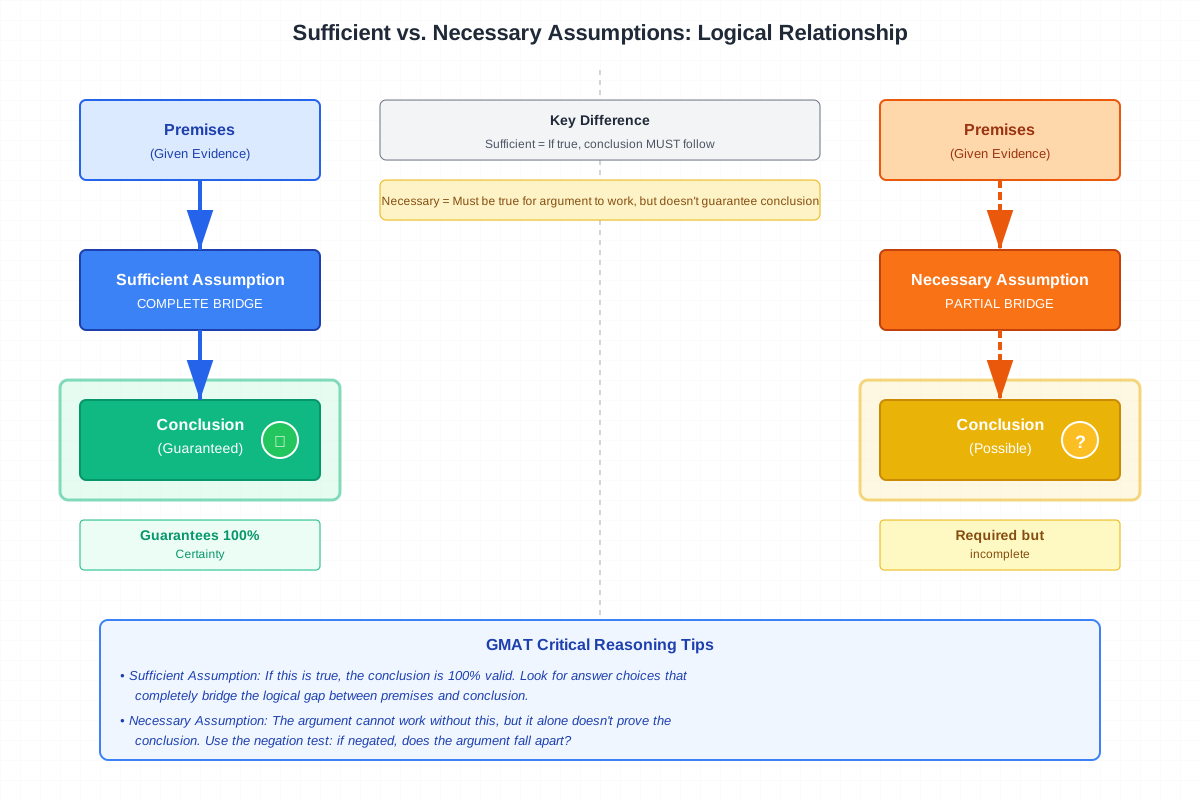
Sufficient assumption questions represent one of the most challenging and frequently tested question types in GMAT Critical Reasoning. These questions require test-takers to identify an assumption that, when added to the argument, makes the conclusion logically valid and complete. Unlike necessary assumptions (which are required for the argument to work but may not fully guarantee the conclusion), a GMAT sufficient assumption completely bridges the gap between the premises and conclusion, creating an airtight logical connection.
Understanding sufficient assumptions is essential for GMAT success because these questions test your ability to analyze logical structure, identify reasoning gaps, and recognize what information would make an argument bulletproof. Approximately 10-15% of Critical Reasoning questions on the GMAT are sufficient assumption questions, making them a high-yield topic that can significantly impact your Verbal Reasoning score. These questions typically appear with stems like "Which of the following, if assumed, allows the conclusion to be properly drawn?" or "The conclusion follows logically if which of the following is assumed?"
Sufficient assumption questions sit at the intersection of multiple Critical Reasoning skills. They require understanding of argument structure (premises, conclusions, and assumptions), logical reasoning patterns, and the ability to distinguish between what's necessary versus what's sufficient for an argument. Mastering this topic strengthens your overall Critical Reasoning abilities and improves performance on related question types including strengthen, weaken, and necessary assumption questions.
Learning Objectives
- [ ] Identify sufficient assumption questions from their question stems
- [ ] Explain the difference between sufficient and necessary assumptions
- [ ] Apply sufficient assumption strategies to GMAT questions
- [ ] Recognize common logical gaps that sufficient assumptions must fill
- [ ] Evaluate answer choices to determine which one makes the conclusion follow logically
- [ ] Distinguish between answer choices that strengthen versus those that guarantee the conclusion
- [ ] Construct the logical chain from premises through assumption to conclusion
Prerequisites
- Argument structure: Understanding how to identify premises, conclusions, and the logical flow of arguments is fundamental to recognizing what's missing
- Basic logical reasoning: Familiarity with conditional statements, cause-and-effect relationships, and logical validity enables recognition of reasoning gaps
- Assumption identification: General ability to spot unstated beliefs underlying arguments provides the foundation for distinguishing sufficient from necessary assumptions
- Critical Reasoning question types: Awareness of how different CR question types relate helps contextualize sufficient assumptions within the broader GMAT framework
Why This Topic Matters
Sufficient assumption questions test a critical real-world skill: the ability to identify what information would make an argument completely valid. In business contexts, executives must determine what conditions or facts would guarantee a strategic decision's success. In legal reasoning, attorneys identify what evidence would definitively prove their case. In scientific research, investigators determine what findings would conclusively support their hypothesis. The GMAT tests this skill because it's essential for management decision-making and analytical thinking in business school and beyond.
On the GMAT, sufficient assumption questions appear in approximately 3-5 questions per exam, representing 10-15% of the typical 12-14 Critical Reasoning questions. These questions carry the same weight as other CR questions but are often considered more challenging, with correct answer rates typically ranging from 40-60% among test-takers. This difficulty level makes them excellent opportunities for score differentiation—students who master sufficient assumptions can gain a competitive advantage.
Sufficient assumption questions commonly appear in several formats: formal logic arguments requiring conditional reasoning, causal arguments needing additional evidence to establish causation, arguments by analogy requiring the analogy to be valid, and arguments with scope shifts between premises and conclusion. The GMAT frequently tests whether students can identify assumptions that connect different concepts, bridge temporal gaps, or establish necessary conditions for the conclusion to follow with certainty.
Core Concepts
What is a Sufficient Assumption?
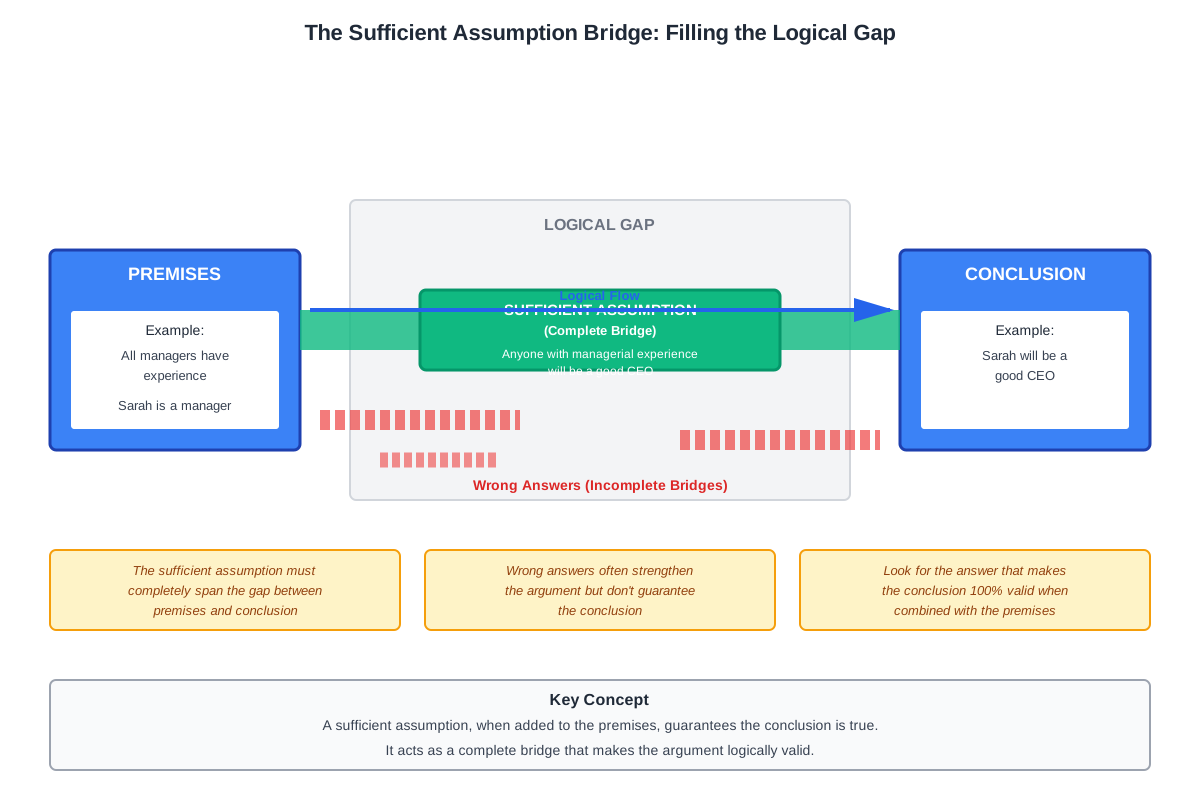
A sufficient assumption is an unstated premise that, when added to an argument, guarantees the conclusion follows logically from the stated premises. The term "sufficient" means "enough"—this assumption is enough, by itself, to make the argument valid. If you accept the premises and the sufficient assumption as true, you must accept the conclusion as true; there's no logical escape.
The key distinction lies in understanding logical sufficiency versus necessity. A sufficient assumption creates a complete logical bridge, making the conclusion inescapable. It may provide more information than strictly necessary, but it definitively closes all logical gaps. Think of it as building a bridge: a necessary assumption is like having support beams (without them, the bridge collapses), while a sufficient assumption is like having a complete, reinforced bridge that can definitely support the crossing.
Identifying Sufficient Assumption Questions
Sufficient assumption questions use distinctive question stems that signal you need to find an assumption that makes the conclusion follow with certainty:
- "Which of the following, if assumed, allows the conclusion to be properly drawn?"
- "The conclusion follows logically if which of the following is assumed?"
- "Which of the following is an assumption that would make the conclusion valid?"
- "The argument depends on assuming which of the following?"
- "Which of the following, if assumed, enables the conclusion to be properly inferred?"
The key phrases to recognize are "allows the conclusion to be properly drawn," "follows logically," "properly inferred," and "enables the conclusion." These phrases indicate you're looking for something that makes the argument airtight, not just stronger.
The Logical Structure of Sufficient Assumption Arguments
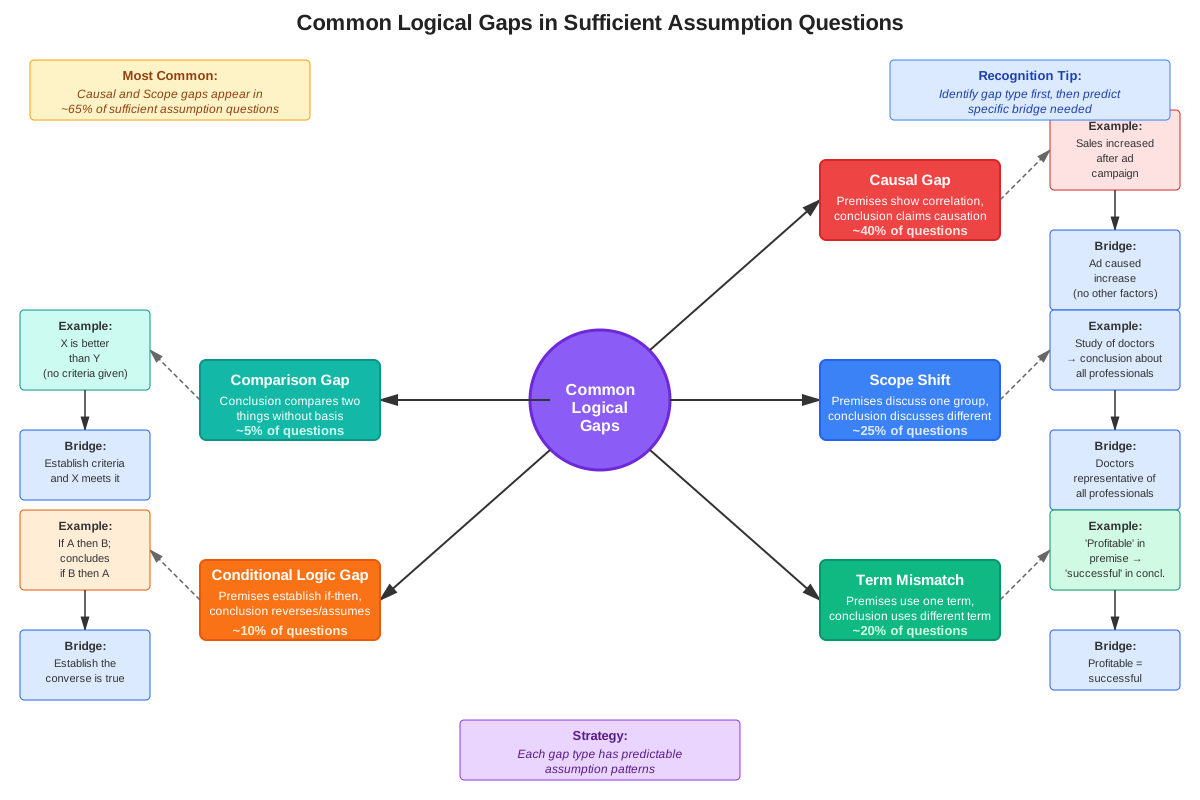
Every sufficient assumption question contains a logical gap between premises and conclusion. Understanding these gaps is crucial:
| Gap Type | Description | Example Pattern |
|---|---|---|
| Concept Shift | Conclusion introduces new terms not in premises | Premises discuss "sales"; conclusion discusses "profits" |
| Scope Shift | Conclusion broader or narrower than premises | Premises about "this company"; conclusion about "all companies" |
| Temporal Gap | Time period changes between premises and conclusion | Premises about past; conclusion about future |
| Causal Gap | Conclusion claims causation from correlation | Premises show correlation; conclusion claims cause |
| Conditional Gap | Missing link in conditional chain | If A→B stated; conclusion claims A→C (missing B→C) |
The Sufficient Assumption Test
To verify whether an answer choice is a sufficient assumption, apply this three-step test:
- Add the assumption to the premises: Treat the answer choice as an additional premise
- Check if the conclusion must follow: Does the conclusion now follow with logical certainty?
- Verify completeness: Does this assumption fully bridge the gap, or are other assumptions still needed?
If the answer to steps 2 and 3 is "yes," you've found the sufficient assumption. If the argument is merely strengthened but not guaranteed, the assumption is not sufficient.
Common Logical Patterns in Sufficient Assumptions
Conditional Logic Patterns: Many sufficient assumption questions involve conditional statements (if-then relationships). The sufficient assumption often completes a conditional chain:
- Premise: If A, then B
- Conclusion: If A, then C
- Sufficient Assumption: If B, then C
Categorical Logic Patterns: Arguments may involve categories and group membership:
- Premise: All X are Y
- Conclusion: All X are Z
- Sufficient Assumption: All Y are Z
Causal Reasoning Patterns: Arguments claiming causation require assumptions ruling out alternative explanations:
- Premise: When A occurs, B occurs
- Conclusion: A causes B
- Sufficient Assumption: No other factors cause B, and the relationship is causal, not coincidental
Sufficient vs. Necessary Assumptions
Understanding the distinction between sufficient and necessary assumptions is critical:
Necessary Assumptions:
- Required for the argument to work
- Without them, the argument falls apart
- May not be enough alone to guarantee the conclusion
- Tested by negation (if false, conclusion cannot follow)
- Often minimal—just enough to keep the argument viable
Sufficient Assumptions:
- Guarantee the conclusion follows
- Make the argument logically valid
- May include more than strictly necessary
- Tested by addition (if true, conclusion must follow)
- Often comprehensive—fully bridge all gaps
Think of necessary assumptions as the minimum requirements and sufficient assumptions as the complete package that delivers certainty.
Concept Relationships
Sufficient assumption questions build directly on fundamental argument analysis skills. The process begins with argument structure identification → which enables gap recognition → which allows sufficient assumption identification → which connects to logical validity assessment.
The relationship to other Critical Reasoning question types is hierarchical and interconnected. Necessary assumption questions test whether you can identify minimum requirements for an argument, while sufficient assumption questions test whether you can identify what would guarantee the conclusion. Both require understanding argument structure, but sufficient assumptions demand deeper analysis of logical completeness.
Strengthen questions relate closely to sufficient assumptions—a sufficient assumption is the ultimate strengthener, making the argument 100% valid rather than merely more likely. Conversely, weaken questions often target the same logical gaps that sufficient assumptions would fill. Understanding sufficient assumptions therefore improves performance across multiple question types.
The connection to formal logic is direct: sufficient assumptions often involve completing conditional chains, establishing categorical relationships, or confirming causal mechanisms. Students who understand conditional reasoning (if-then statements) and logical validity will find sufficient assumption questions more intuitive.
High-Yield Facts
⭐ A sufficient assumption makes the conclusion follow with 100% certainty, not just makes it more likely
⭐ The correct answer will often connect new terms in the conclusion to concepts in the premises
⭐ Sufficient assumptions frequently appear as conditional statements that complete a logical chain
⭐ If you can negate an answer choice and the argument still works, it's not a sufficient assumption
⭐ The correct sufficient assumption may provide more information than strictly necessary—it can be "overkill"
- Sufficient assumption questions typically use stems with phrases like "properly drawn," "follows logically," or "enables the conclusion"
- Common wrong answers include necessary-but-not-sufficient assumptions that help but don't guarantee the conclusion
- The sufficient assumption often addresses the most obvious gap between premises and conclusion
- Extreme language in answer choices is not automatically wrong for sufficient assumptions (unlike necessary assumptions)
- The correct answer will make every premise relevant to reaching the conclusion
- Sufficient assumptions can involve ruling out alternative explanations in causal arguments
- Time-efficient test-takers identify the conclusion first, then the gap, then predict the assumption type needed
- Approximately 60-70% of sufficient assumption questions involve connecting two different concepts mentioned in the argument
Quick check — test yourself on Sufficient assumption so far.
Try Flashcards →Common Misconceptions
Misconception: Sufficient assumptions must be realistic or likely to be true in the real world.
Correction: Sufficient assumptions only need to make the argument logically valid if assumed true. They can be unrealistic, extreme, or unlikely—what matters is whether they bridge the logical gap completely.
Misconception: The correct answer will always be the shortest or most minimal assumption.
Correction: Sufficient assumptions can be comprehensive and provide more than the minimum needed. Unlike necessary assumptions, sufficient assumptions can be "overkill"—they guarantee the conclusion even if they include extra information.
Misconception: If an answer choice strengthens the argument significantly, it must be the sufficient assumption.
Correction: Strengthening is not the same as guaranteeing. An answer choice might make the conclusion much more likely (90% probable) but still not make it logically certain (100% guaranteed). Only the latter qualifies as sufficient.
Misconception: Sufficient and necessary assumptions are the same thing.
Correction: These are fundamentally different. A necessary assumption is required (without it, the argument fails), while a sufficient assumption is enough (with it, the conclusion must follow). Something can be necessary without being sufficient, sufficient without being necessary, both, or neither.
Misconception: The sufficient assumption will always introduce completely new information.
Correction: While sufficient assumptions often connect concepts from the premises to the conclusion, they may also clarify relationships between existing concepts, rule out alternatives, or establish conditions using terms already present in the argument.
Misconception: Extreme language (all, every, never, only) in an answer choice means it's wrong.
Correction: Unlike necessary assumptions (where extreme language is often a red flag), sufficient assumptions can use extreme language because they're designed to guarantee the conclusion. An "all" or "only" statement might be exactly what's needed to close the logical gap completely.
Worked Examples
Example 1: Causal Reasoning Gap
Argument:
"A recent study found that employees who work from home three days per week report 30% higher job satisfaction than those who work in the office full-time. Therefore, allowing employees to work from home three days per week will increase their job satisfaction."
Question: Which of the following is an assumption that would make the conclusion properly drawn?
Analysis:
Step 1: Identify the conclusion
"Allowing employees to work from home three days per week will increase their job satisfaction."
Step 2: Identify the premises
- Study found correlation between working from home 3 days/week and 30% higher satisfaction
- Comparison is to full-time office workers
Step 3: Identify the gap
The premises show a correlation in a study, but the conclusion claims that implementing this policy will cause increased satisfaction. The gaps include:
- Correlation vs. causation (maybe satisfied people choose to work from home, not vice versa)
- Study participants vs. all employees (maybe the study group is different)
- Past observation vs. future prediction (maybe conditions will change)
Step 4: Predict the sufficient assumption
We need something that guarantees working from home causes the satisfaction increase and will work for these employees.
Answer Choices:
A) Employees who work from home are more productive than those who work in the office.
- Analysis: This addresses productivity, not satisfaction. It doesn't bridge the gap. Eliminate.
B) The employees in the study are representative of the company's employees, and the factors that caused higher satisfaction in the study will operate similarly for the company's employees.
- Analysis: This connects the study to the company's situation and establishes causation. If we assume this, the conclusion must follow—what worked in the study will work for the company. Strong candidate.
C) Job satisfaction is an important factor in employee retention.
- Analysis: This is about retention, not about whether the policy will increase satisfaction. Eliminate.
D) Most employees prefer working from home to working in the office.
- Analysis: Preference doesn't guarantee satisfaction increase. Employees might prefer something that doesn't actually increase their satisfaction. Eliminate.
E) The company has the technological infrastructure to support remote work.
- Analysis: This is necessary for implementation but doesn't guarantee satisfaction will increase. Eliminate.
Correct Answer: B
This assumption makes the conclusion follow logically because it establishes that (1) the study applies to this company's employees and (2) the relationship is causal and will replicate. With this assumption, the conclusion must follow.
Example 2: Concept Shift Gap
Argument:
"TechCorp's new software has been downloaded more times in its first month than any previous product the company has released. The marketing director concluded that the new software will generate more revenue than any previous product."
Question: The marketing director's conclusion follows logically if which of the following is assumed?
Analysis:
Step 1: Identify the conclusion
"The new software will generate more revenue than any previous product."
Step 2: Identify the premises
- New software has most downloads in first month
- Comparison is to all previous TechCorp products
Step 3: Identify the gap
The premise is about downloads; the conclusion is about revenue. These are different concepts. The gap is the connection between downloads and revenue. More downloads doesn't automatically mean more revenue (the software could be free, or previous products could have higher prices, etc.).
Step 4: Predict the sufficient assumption
We need something that guarantees that most downloads translates to most revenue.
Answer Choices:
A) The new software has more features than previous products.
- Analysis: Features don't directly connect downloads to revenue. Eliminate.
B) Each download of the new software generates at least as much revenue as each download of previous products did.
- Analysis: If each download generates at least as much revenue, and there are more downloads, then total revenue must be higher. This guarantees the conclusion. Strong candidate.
C) Customers who download the software are likely to recommend it to others.
- Analysis: Recommendations might increase downloads further, but this doesn't establish the download-to-revenue connection. Eliminate.
D) The new software received positive reviews from technology critics.
- Analysis: Reviews might explain why downloads are high, but don't connect downloads to revenue. Eliminate.
E) TechCorp spent more on marketing for the new software than for previous products.
- Analysis: Marketing spending doesn't establish that downloads translate to revenue. Eliminate.
Correct Answer: B
This assumption creates a direct mathematical relationship: more downloads × (equal or greater revenue per download) = more total revenue. The conclusion must follow if this is assumed.
Exam Strategy
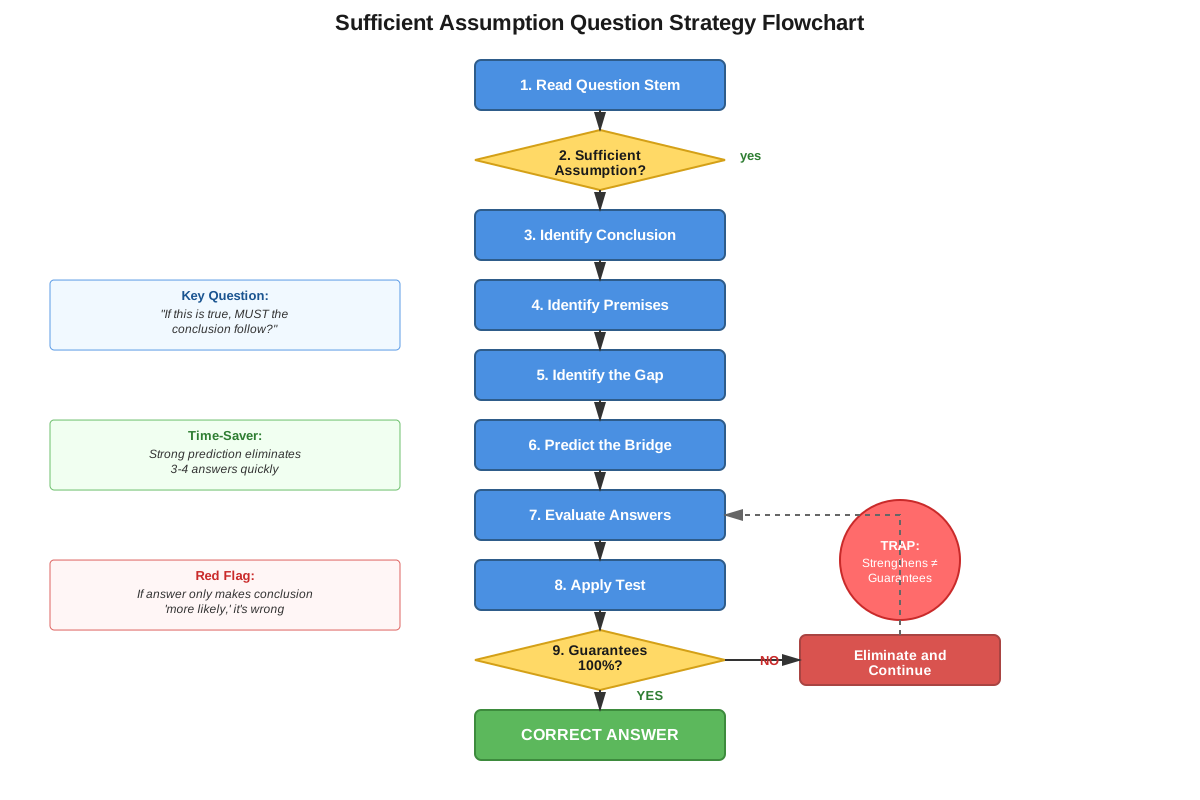
Step-by-Step Approach for Sufficient Assumption Questions:
- Identify the question type (15 seconds): Look for "properly drawn," "follows logically," "enables the conclusion"
- Find and bracket the conclusion (15 seconds): Usually signaled by "therefore," "thus," "consequently"
- Identify the premises (20 seconds): What evidence supports the conclusion?
- Spot the gap (30 seconds): What concept shift, scope change, or logical leap occurs between premises and conclusion?
- Predict the assumption type (20 seconds): What kind of statement would bridge this gap completely?
- Evaluate answer choices (60 seconds): Test each by adding it to the argument—does the conclusion now follow with certainty?
Trigger Words and Phrases to Watch:
In question stems:
- "Properly drawn" / "properly inferred"
- "Follows logically"
- "Enables the conclusion"
- "Allows the conclusion"
- "Makes the conclusion valid"
In arguments (indicating gap types):
- Concept shifts: Different terms in conclusion vs. premises
- Causal language: "causes," "leads to," "results in" (watch for correlation-causation gaps)
- Predictive language: "will," "would," "is likely to" (watch for temporal gaps)
- Categorical language: "all," "some," "most" (watch for scope shifts)
Process of Elimination Tips:
- Eliminate answer choices that only strengthen: If the conclusion becomes more likely but not certain, it's wrong
- Eliminate answer choices addressing irrelevant concepts: If the choice discusses something not in the conclusion, it probably doesn't bridge the gap
- Eliminate answer choices that are necessary but not sufficient: If the choice is required but doesn't guarantee the conclusion alone, it's wrong
- Keep answer choices that seem too strong: Unlike necessary assumptions, sufficient assumptions can be extreme
- Test remaining choices with the addition test: Add each to the premises and check if the conclusion must follow
Time Allocation:
Spend approximately 2 minutes per sufficient assumption question. These questions warrant slightly more time than average CR questions because they require careful logical analysis. Allocate:
- 30-40 seconds: Understanding the argument and identifying the gap
- 60-80 seconds: Evaluating answer choices
- 10-20 seconds: Final verification
If you're stuck after 2.5 minutes, eliminate obvious wrong answers and make an educated guess rather than spending 3+ minutes.
Memory Techniques
BRIDGE Acronym for Sufficient Assumptions:
- Bridge the gap completely
- Relate new concepts in conclusion to premises
- If assumed, conclusion must follow
- Different from merely strengthening
- Guarantees logical validity
- Extreme language is acceptable
The "Addition Test" Visualization:
Picture the argument as a bridge with a gap in the middle. The premises are one side, the conclusion is the other. The sufficient assumption is a complete bridge section that, when added, allows you to walk from premises to conclusion with absolute certainty—no jumping, no risk of falling.
Sufficient vs. Necessary Memory Device:
- Sufficient = Sufficient to Seal the deal (guarantees conclusion)
- Necessary = Needed but Not enough alone (required but may not guarantee)
Gap Type Mnemonic - "CSTC" (pronounced "see-stick"):
- Concept shift (different terms)
- Scope shift (broader/narrower)
- Temporal shift (time change)
- Causal shift (correlation to causation)
Summary
Sufficient assumption questions test the ability to identify what information would make an argument's conclusion follow with logical certainty from its premises. Unlike necessary assumptions that are merely required for an argument to work, sufficient assumptions guarantee the conclusion—they bridge logical gaps completely. These questions appear in 10-15% of GMAT Critical Reasoning sections and are identifiable by question stems asking what "allows the conclusion to be properly drawn" or makes it "follow logically." The key to mastering sufficient assumptions is recognizing the logical gap between premises and conclusion (typically concept shifts, scope changes, temporal gaps, or causal leaps), then identifying which answer choice completely closes that gap. The correct answer will make the conclusion inescapable if the premises and assumption are accepted as true. Common mistakes include confusing sufficient with necessary assumptions, selecting answers that merely strengthen rather than guarantee the conclusion, and eliminating answers with strong language that are actually correct. Success requires systematic analysis: identify the conclusion, spot the gap, predict what would bridge it completely, and test answer choices by adding them to the argument to verify the conclusion must follow.
Key Takeaways
- A sufficient assumption guarantees the conclusion follows logically—it makes the argument 100% valid, not just stronger
- Sufficient assumption questions use distinctive stems with phrases like "properly drawn," "follows logically," or "enables the conclusion"
- The correct answer typically bridges a gap between concepts in the premises and new or different concepts in the conclusion
- Unlike necessary assumptions, sufficient assumptions can use extreme language and provide more than the minimum needed
- Apply the addition test: add the assumption to the premises and verify the conclusion must follow with certainty
- Common gaps include concept shifts, scope changes, temporal leaps, and correlation-to-causation jumps
- Sufficient assumptions differ fundamentally from necessary assumptions—sufficient means "enough to guarantee," necessary means "required but may not be enough"
Related Topics
Necessary Assumption Questions: Understanding what's required for an argument to work (but may not guarantee it) complements sufficient assumption skills and helps distinguish between minimum requirements and complete guarantees.
Strengthen/Weaken Questions: These question types target the same logical gaps as sufficient assumptions but ask you to make arguments more or less likely rather than certain, building on gap-identification skills.
Formal Logic and Conditional Reasoning: Mastering if-then statements, contrapositives, and logical chains directly improves performance on sufficient assumptions involving conditional logic patterns.
Argument Structure and Conclusion Identification: Advanced skills in breaking down complex arguments enable faster gap recognition and more accurate prediction of sufficient assumptions.
Logical Validity and Soundness: Understanding the formal logic concepts of valid arguments (where conclusions follow from premises) deepens comprehension of what sufficient assumptions accomplish.
Practice CTA
Now that you understand sufficient assumptions, it's time to apply these concepts to real GMAT questions. Work through the practice questions to reinforce your ability to identify logical gaps, predict sufficient assumptions, and distinguish correct answers from tempting wrong choices. Use the flashcards to memorize key distinctions and trigger phrases. Remember: sufficient assumption questions are high-yield opportunities to demonstrate advanced reasoning skills and boost your Verbal score. Each practice question you master increases your confidence and speed for test day. Start practicing now to transform this challenging question type into a reliable strength!
Sign up free to keep reading
Create a free AnvayaPrep account to finish this GMAT guide on Sufficient assumption — plus flashcards and practice questions.