Overview
Necessary assumption questions represent one of the most critical and frequently tested question types in GMAT Critical Reasoning. These questions assess a test-taker's ability to identify unstated premises that must be true for an argument to hold together logically. Unlike sufficient assumptions (which guarantee the conclusion) or strengthen questions (which make the conclusion more likely), necessary assumptions identify the minimum logical requirements—the foundational beliefs or facts that the author must be taking for granted for their reasoning to work at all.
Understanding GMAT necessary assumption questions is essential because they appear in approximately 20-25% of all Critical Reasoning questions on the exam. These questions test sophisticated logical reasoning skills that extend beyond simple reading comprehension. They require students to recognize gaps in argumentation, identify unstated premises, and understand the logical dependencies that connect evidence to conclusions. Mastering this question type significantly improves overall Verbal Reasoning performance and demonstrates the analytical thinking skills that business schools value.
Within the broader context of Critical Reasoning, necessary assumption questions form a foundational skill set that connects to multiple other question types. They share logical structures with weaken questions (which attack necessary assumptions), strengthen questions (which support assumptions), and evaluate questions (which test whether assumptions are valid). A strong grasp of necessary assumptions enhances performance across all argument-based Critical Reasoning questions and develops the critical thinking skills essential for success in graduate business education.
Learning Objectives
- [ ] Identify necessary assumption questions from their question stems
- [ ] Explain what makes an assumption "necessary" versus "sufficient" or merely "helpful"
- [ ] Apply the negation test to verify whether an assumption is truly necessary
- [ ] Distinguish between necessary assumptions and background information or strengtheners
- [ ] Analyze argument structure to locate logical gaps that require assumptions
- [ ] Eliminate incorrect answer choices using systematic reasoning strategies
- [ ] Recognize common assumption patterns in GMAT arguments (causal, comparison, representativeness, feasibility)
Prerequisites
- Basic argument structure: Understanding premises, conclusions, and how evidence supports claims is essential because necessary assumptions bridge gaps between these elements
- Logical reasoning fundamentals: Familiarity with valid and invalid reasoning patterns helps identify where arguments require unstated support
- Reading comprehension skills: The ability to parse complex sentences and identify main ideas enables accurate identification of argument components
- Conditional reasoning basics: Understanding "if-then" relationships helps recognize when assumptions create necessary logical connections
Why This Topic Matters
Necessary assumption questions test a fundamental business skill: the ability to identify unstated premises and hidden dependencies in reasoning. In real-world business contexts, executives must constantly evaluate proposals, strategic plans, and recommendations that rely on unstated assumptions. Recognizing these assumptions allows decision-makers to assess risk, identify potential failure points, and make more informed choices. Whether analyzing a market entry strategy, evaluating a merger proposal, or assessing a new product launch, the ability to identify what must be true for a plan to succeed is invaluable.
On the GMAT, necessary assumption questions typically appear 3-5 times per exam, making them one of the highest-frequency Critical Reasoning question types. They appear in various forms, including direct necessary assumption questions, argument evaluation questions, and some strengthen/weaken variants. The GMAT tests necessary assumptions across diverse content areas—business scenarios, scientific studies, social policy debates, and historical analyses—requiring students to apply logical reasoning skills flexibly across contexts.
These questions commonly appear with specific trigger phrases in their question stems: "assumes," "depends on the assumption," "requires the assumption," or "presupposes." The arguments themselves frequently contain logical gaps in causal reasoning (assuming no alternative causes), comparison reasoning (assuming relevant similarity), statistical reasoning (assuming sample representativeness), or plan/recommendation reasoning (assuming feasibility and lack of obstacles). Recognizing these patterns accelerates question solving and improves accuracy.
Core Concepts
Definition of Necessary Assumptions
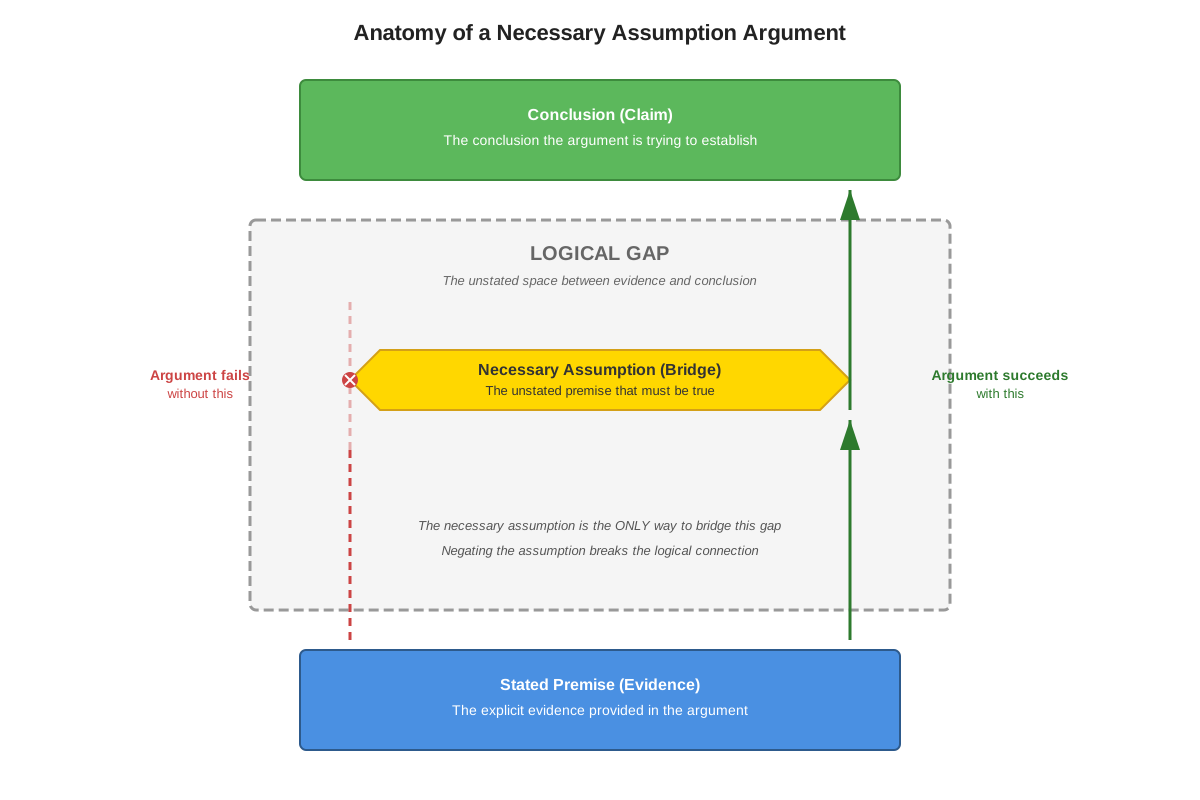
A necessary assumption is an unstated premise that must be true for an argument's conclusion to be logically valid. It represents a required condition—without it, the argument falls apart completely. The key distinction is that necessary assumptions are minimal requirements: they don't need to guarantee the conclusion (that would be a sufficient assumption), but their absence would invalidate the reasoning entirely.
Consider this simple example: "Sarah scored 750 on the GMAT, so she will be admitted to Harvard Business School." This argument assumes necessarily that scoring 750 is enough for admission, or at least that Sarah meets other admission requirements. It doesn't assume she's guaranteed admission (that would be sufficient), but it must assume that a 750 score doesn't automatically disqualify her and that other factors won't prevent admission.
The Negation Test
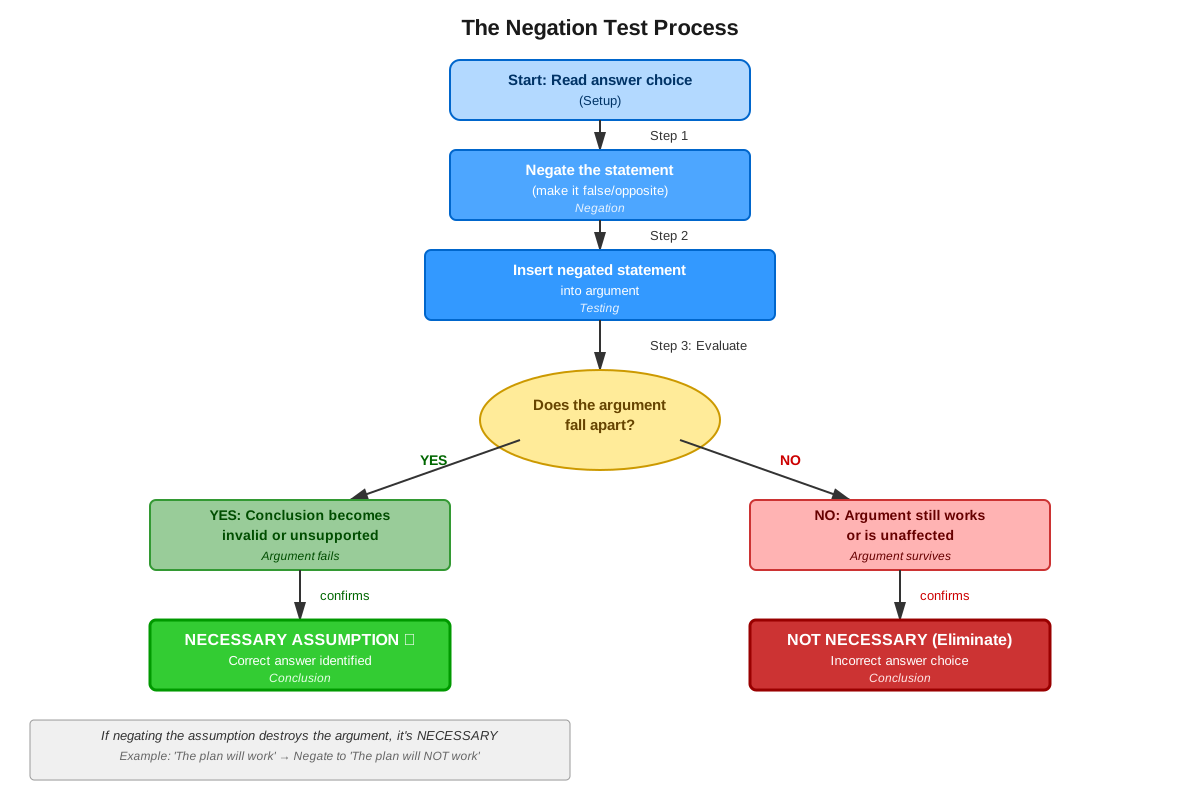
The most powerful tool for verifying necessary assumptions is the negation test (also called the "denial test"). This technique works by negating the answer choice and asking: "If this statement were false, would the argument fall apart?" If negating the statement destroys the argument, then the statement is a necessary assumption. If the argument could still potentially hold even with the negation, the statement is not necessary.
The negation test follows this process:
- Identify the conclusion and main reasoning of the argument
- Take the answer choice being tested
- Negate it (make it false or opposite)
- Ask whether the argument can still logically hold
- If the argument collapses, the original statement is necessary
For example, if an answer choice states "No alternative explanation exists for the phenomenon," its negation would be "At least one alternative explanation exists for the phenomenon." If this negation would destroy the argument's conclusion, then the original statement is a necessary assumption.
Types of Logical Gaps Requiring Assumptions
GMAT arguments contain predictable types of logical gaps that require necessary assumptions:
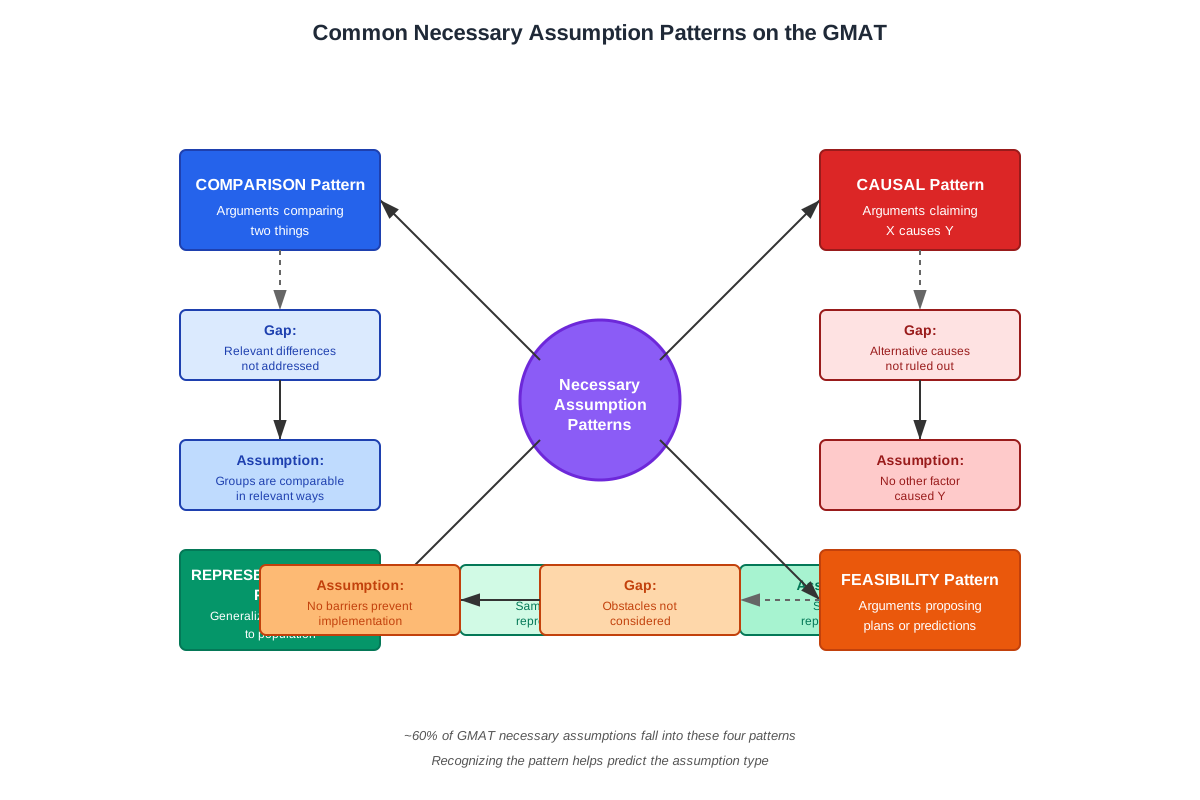
Causal Reasoning Gaps: When an argument claims X causes Y, it assumes no alternative causes exist, no reverse causation occurs, and the correlation isn't coincidental. For instance: "Sales increased after the new advertising campaign, so the campaign was effective" assumes other factors didn't cause the sales increase.
Comparison Gaps: When comparing two things, arguments assume relevant similarity between them. "Company A's strategy succeeded, so Company B should adopt it" assumes the companies are similar in relevant ways and that circumstances haven't changed.
Representativeness Gaps: Arguments using samples or examples assume those samples represent the broader population. "Survey respondents preferred Product X, so it will sell well" assumes respondents represent actual buyers.
Feasibility Gaps: Plans and recommendations assume they're practically implementable. "We should expand to Asia to increase profits" assumes expansion is financially and operationally feasible.
Term Shift Gaps: When different terms appear in premises versus conclusions, arguments assume these terms connect appropriately. "Students who study more perform better academically, so increasing library hours will improve grades" assumes students will use additional library hours for studying.
Necessary vs. Sufficient vs. Strengthening Assumptions
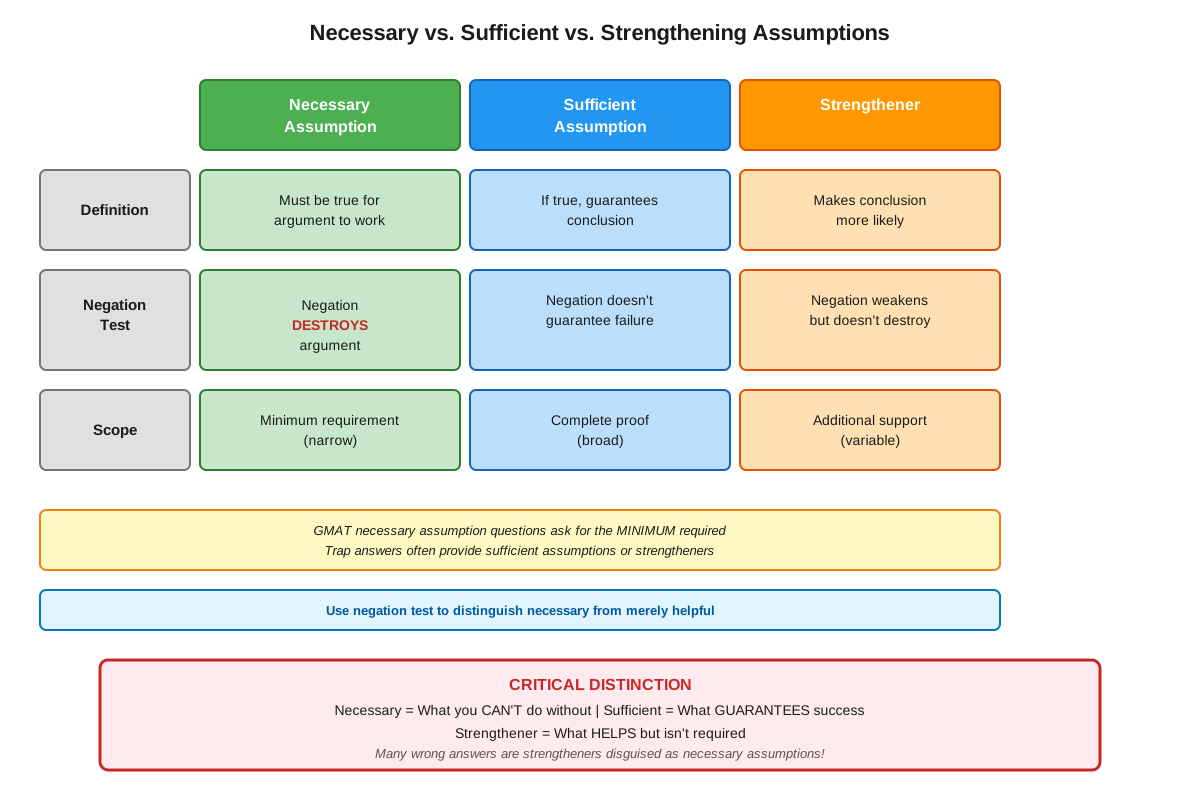
Understanding the distinctions between assumption types is crucial:
| Assumption Type | Definition | Relationship to Conclusion | GMAT Frequency |
|---|---|---|---|
| Necessary | Must be true for argument to work | Minimum requirement; absence destroys argument | Very High |
| Sufficient | If true, guarantees the conclusion | Provides complete logical support | Low |
| Strengthening | Makes conclusion more likely | Adds support but isn't required | High (different question type) |
A necessary assumption is like a foundation stone—remove it and the structure collapses. A sufficient assumption is like a complete blueprint that guarantees the building stands. A strengthening statement is like additional reinforcement that makes the building sturdier but isn't structurally required.
Common Assumption Patterns
Certain assumption patterns appear repeatedly on the GMAT:
No Alternative Cause Assumptions: "The observed effect wasn't caused by something else"
Relevant Similarity Assumptions: "The compared entities are similar in ways that matter for this conclusion"
No Obstacles Assumptions: "Nothing will prevent the proposed plan from working"
Term Connection Assumptions: "The concept mentioned in the premise relates to the concept in the conclusion"
Temporal Stability Assumptions: "Conditions that were true in the past/sample remain true now/generally"
Scope Matching Assumptions: "What's true of the sample/example applies to the broader conclusion"
Recognizing these patterns allows test-takers to predict likely assumptions before reading answer choices, significantly improving speed and accuracy.
Argument Structure Analysis
To identify necessary assumptions systematically, analyze argument structure:
- Locate the conclusion: What is the author trying to prove?
- Identify the premises: What evidence supports this conclusion?
- Find the gap: What logical leap occurs between evidence and conclusion?
- Predict the assumption: What must be true to bridge this gap?
- Evaluate answer choices: Which choice, when negated, destroys the argument?
This structured approach prevents common errors like selecting strengtheners instead of necessary assumptions or choosing statements that are merely consistent with the argument rather than required by it.
Concept Relationships
The core concepts within necessary assumption questions form an interconnected logical framework. Argument structure analysis serves as the foundation, enabling identification of premises and conclusions. This analysis reveals logical gaps, which are the spaces where necessary assumptions reside. The negation test provides the verification mechanism to confirm whether an identified assumption is truly necessary. Understanding assumption patterns (causal, comparison, representativeness, feasibility) helps predict what types of assumptions will fill specific logical gaps.
The relationship flows: Argument Structure → Logical Gap Identification → Assumption Pattern Recognition → Prediction → Negation Test Verification.
Necessary assumption questions connect to prerequisite knowledge of basic argument structure by building upon the ability to identify conclusions and premises. They extend this foundation by requiring recognition of what's unstated but logically required. The topic connects forward to weaken questions (which attack necessary assumptions), strengthen questions (which support assumptions without being necessary), and evaluate questions (which test assumption validity). Mastering necessary assumptions creates a logical framework applicable across all argument-based Critical Reasoning questions.
The distinction between necessary, sufficient, and strengthening assumptions represents a crucial conceptual relationship. These exist on a spectrum of logical support: necessary assumptions provide minimum required support (without them, the argument fails), strengthening statements provide additional support (making the conclusion more likely), and sufficient assumptions provide complete support (guaranteeing the conclusion). Understanding this spectrum prevents confusion between question types and improves answer choice evaluation.
High-Yield Facts
⭐ A necessary assumption, when negated, must destroy the argument's logical validity
⭐ Necessary assumption questions typically include trigger words: "assumes," "depends on," "requires," or "presupposes"
⭐ The correct answer to a necessary assumption question is often understated—it provides minimum required support, not maximum support
⭐ Causal arguments always assume no significant alternative causes exist for the observed effect
⭐ Comparison arguments always assume relevant similarity between the compared entities
- Arguments using surveys or samples assume the sample represents the broader population accurately
- Plan or recommendation arguments assume feasibility and absence of significant obstacles
- When terms shift between premises and conclusion, the argument assumes these terms connect logically
- Necessary assumptions are always unstated in the original argument—if stated, they're premises, not assumptions
- Extreme language in answer choices (always, never, only, must) often indicates incorrect answers, as necessary assumptions require minimum support
- The correct answer often addresses the most obvious logical gap between the final premise and the conclusion
Quick check — test yourself on Necessary assumption so far.
Try Flashcards →Common Misconceptions
Misconception: Necessary assumptions must make the argument stronger or more convincing → Correction: Necessary assumptions provide minimum required support. They don't need to strengthen the argument significantly; they simply need to be true for the argument to work at all. A necessary assumption might seem weak or obvious, but if its negation destroys the argument, it's necessary.
Misconception: The correct answer will be explicitly related to the conclusion's main topic → Correction: Necessary assumptions often address subtle logical gaps or unstated connections between concepts. They might seem tangential but are logically required. For example, an argument about increasing sales might necessarily assume that production capacity can meet increased demand—not directly about sales, but logically required.
Misconception: Strengthening the argument and providing a necessary assumption are the same thing → Correction: Strengtheners make the conclusion more likely but aren't required for the argument to work. Necessary assumptions are minimum requirements—without them, the argument completely fails. All necessary assumptions strengthen arguments, but not all strengtheners are necessary assumptions.
Misconception: The negation test means choosing the opposite extreme → Correction: Negating a statement means making it false, not necessarily making it the opposite extreme. For "Most customers prefer X," the negation is "It's not true that most customers prefer X" (meaning 50% or fewer prefer X), not "No customers prefer X" or "All customers hate X."
Misconception: Necessary assumptions must be realistic or likely to be true → Correction: The GMAT tests logical necessity, not real-world probability. An assumption can be necessary for an argument's logic even if it seems unlikely or questionable in reality. The question asks what the argument requires to be true, not what is actually true.
Misconception: If an answer choice is consistent with the argument, it's a necessary assumption → Correction: Many statements can be consistent with an argument without being necessary. The test is whether the argument requires the statement—use the negation test. If negating the statement doesn't destroy the argument, it's not necessary, even if it's consistent.
Worked Examples
Example 1: Causal Reasoning
Argument: "TechCorp's profits increased by 15% in the quarter following the implementation of its new employee wellness program. Therefore, the wellness program has been effective in improving company profitability."
Question: Which of the following is an assumption required by the argument?
Answer Choices:
A) Employee wellness programs are becoming increasingly popular among technology companies
B) No other significant changes that could affect profitability occurred during the same quarter
C) The wellness program will continue to improve profitability in future quarters
D) TechCorp's competitors have not implemented similar wellness programs
E) Employee satisfaction increased after the wellness program was implemented
Solution Process:
Step 1 - Identify the conclusion: The wellness program has been effective in improving profitability.
Step 2 - Identify the premise: Profits increased 15% after the program was implemented.
Step 3 - Identify the logical gap: The argument assumes correlation equals causation—that the program caused the profit increase rather than something else causing it or the timing being coincidental.
Step 4 - Predict the assumption: The argument must assume no alternative causes for the profit increase exist.
Step 5 - Evaluate answer choices using the negation test:
(A) Negated: "Employee wellness programs are NOT becoming increasingly popular." Does this destroy the argument? No—whether other companies adopt such programs doesn't affect whether TechCorp's program caused its profit increase. Eliminate.
(B) Negated: "Other significant changes that could affect profitability DID occur during the same quarter." Does this destroy the argument? Yes—if other major changes occurred (new product launch, market expansion, competitor bankruptcy), we can't attribute the profit increase to the wellness program alone. The argument falls apart. Keep as strong candidate.
(C) Negated: "The wellness program will NOT continue to improve profitability in future quarters." Does this destroy the argument? No—the conclusion is about whether the program has been effective (past tense), not whether it will continue to be effective. Eliminate.
(D) Negated: "TechCorp's competitors HAVE implemented similar programs." Does this destroy the argument? No—what competitors do doesn't affect whether TechCorp's program caused TechCorp's profit increase. Eliminate.
(E) Negated: "Employee satisfaction did NOT increase after the program." Does this destroy the argument? No—the argument is about profitability, not satisfaction. While satisfaction might be a mechanism, it's not necessary for the profit-program connection to hold. Eliminate.
Correct Answer: B
This exemplifies the classic "no alternative cause" assumption pattern in causal reasoning. The argument jumps from temporal correlation (program implemented, then profits increased) to causation (program caused the increase), requiring the assumption that nothing else caused the change.
Example 2: Comparison Reasoning
Argument: "City planners in Riverside should adopt the traffic management system used in Laketown. After Laketown implemented this system, traffic congestion decreased by 30%, and commute times fell significantly. Riverside faces similar traffic problems, so implementing the same system would likely produce comparable benefits."
Question: The argument depends on assuming which of the following?
Answer Choices:
A) Riverside's traffic problems are more severe than Laketown's were before implementation
B) The factors that contributed to Laketown's traffic congestion are similar to those causing Riverside's problems
C) Traffic management systems are the most cost-effective solution to urban congestion
D) Laketown's system is superior to all other available traffic management approaches
E) Riverside has sufficient budget to implement the traffic management system
Solution Process:
Step 1 - Identify the conclusion: Riverside should adopt Laketown's system and would likely see comparable benefits.
Step 2 - Identify the premise: Laketown's system reduced congestion by 30%; Riverside faces similar traffic problems.
Step 3 - Identify the logical gap: The argument compares two cities and assumes what worked in one will work in the other. This requires relevant similarity—not just similar problems, but similar underlying causes and conditions.
Step 4 - Predict the assumption: The cities must be similar in ways relevant to the solution's effectiveness.
Step 5 - Evaluate answer choices:
(A) Negated: "Riverside's problems are NOT more severe than Laketown's were." Does this destroy the argument? No—the argument claims comparable benefits, not greater benefits. If Riverside's problems are equal or less severe, the system could still work. Eliminate.
(B) Negated: "The factors causing Laketown's congestion are NOT similar to those causing Riverside's problems." Does this destroy the argument? Yes—if Laketown's congestion came from inadequate signal timing but Riverside's comes from insufficient road capacity, the same solution wouldn't address Riverside's actual problem. The argument collapses. Keep as strong candidate.
(C) Negated: "Traffic management systems are NOT the most cost-effective solution." Does this destroy the argument? No—the argument recommends this system, not necessarily the most cost-effective one. It could still work even if other solutions are more cost-effective. Eliminate.
(D) Negated: "Laketown's system is NOT superior to all other approaches." Does this destroy the argument? No—the argument recommends adopting this system, not that it's the absolute best. It could be good enough without being superior to all alternatives. Eliminate.
(E) Negated: "Riverside does NOT have sufficient budget." Does this destroy the argument? This is tempting, but the argument's conclusion is about whether the system "would likely produce comparable benefits," not whether implementation is feasible. Budget is a practical concern but not a logical requirement for the effectiveness claim. Eliminate (though this could be correct in a different argument focused on feasibility).
Correct Answer: B
This demonstrates the "relevant similarity" assumption pattern in comparison arguments. When arguing that a solution from Context A will work in Context B, the argument must assume the contexts are similar in ways that matter for the solution's mechanism of action.
Exam Strategy
Recognizing Necessary Assumption Questions: Train yourself to instantly recognize question stems that signal necessary assumptions. Key phrases include: "assumes," "assumption required," "depends on assuming," "presupposes," "takes for granted," and "relies on the assumption." These questions ask what must be true, not what would help or what follows logically.
The Pre-Phrase Strategy: Before reading answer choices, spend 10-15 seconds identifying the argument's logical gap and predicting what assumption might fill it. Ask: "What's the leap in logic here? What must the author be taking for granted?" This prediction prevents answer choice confusion and speeds evaluation. Even if your prediction doesn't match exactly, it focuses your attention on the logical gap.
Apply the Negation Test Systematically: For answer choices that seem plausible, use the negation test. Mentally negate the statement and ask whether the argument could still hold. This technique is especially valuable when choosing between two seemingly correct answers. The one whose negation more completely destroys the argument is the necessary assumption.
Eliminate Common Wrong Answer Types:
- Strengtheners that aren't necessary: These make the conclusion more likely but aren't required
- Sufficient assumptions: These guarantee the conclusion (too strong for necessary assumptions)
- Irrelevant comparisons: These discuss topics mentioned in the argument but don't bridge the logical gap
- Reverse logic: These state what the conclusion would imply rather than what it requires
- Extreme statements: These use "always," "never," "only," or "must" when the argument requires less
Time Management: Allocate approximately 2 minutes per Critical Reasoning question. For necessary assumption questions specifically: 30 seconds reading and analyzing the argument, 15 seconds predicting the assumption, 60 seconds evaluating answer choices, and 15 seconds verifying with the negation test. If stuck between two answers after 2 minutes, apply the negation test to both and choose the one whose negation more clearly destroys the argument.
Trigger Words in Arguments: Watch for language that signals logical gaps requiring assumptions: "therefore" (causal leap), "similarly" or "likewise" (comparison requiring relevant similarity), "should" or "must" (recommendation requiring feasibility), "because" (causal claim requiring no alternative causes), and "will" (prediction requiring stable conditions).
Exam Tip: The correct answer to a necessary assumption question often seems underwhelming or obvious. Test-takers frequently eliminate the correct answer because it doesn't seem to add much to the argument. Remember: necessary assumptions provide minimum required support, not maximum support. If negating it breaks the argument, it's correct, even if it seems weak.
Memory Techniques
The NEGATION Mnemonic for applying the negation test:
- Note the conclusion clearly
- Examine the answer choice
- Get the opposite (negate it)
- Ask: does the argument still work?
- Test: if it collapses, the assumption is necessary
- If it survives, eliminate the choice
- Only keep choices that destroy the argument when negated
- Narrow to the best answer
The GAPS Acronym for common assumption types:
- Gap in causation (no alternative causes)
- Analogy/comparison (relevant similarity)
- Plan feasibility (no obstacles)
- Scope shift (terms connect appropriately)
Visualization Strategy: Picture the argument as a bridge. The premise is one side, the conclusion is the other side, and the necessary assumption is a critical support beam. If you remove that beam (negate the assumption), the bridge collapses. This mental image helps distinguish necessary assumptions (structural requirements) from strengtheners (additional support cables that help but aren't required).
The "Must Be True" Mantra: When evaluating answer choices, repeatedly ask: "Must this be true for the argument to work?" Not "Could this be true?" or "Would this help?" but "Must this be true?" This simple question refocuses attention on necessity rather than sufficiency or strengthening.
Summary
Necessary assumptions represent unstated premises that must be true for an argument's reasoning to be logically valid. These assumptions bridge logical gaps between evidence and conclusions, providing minimum required support without which arguments collapse entirely. The GMAT tests necessary assumptions frequently, requiring students to identify these unstated premises across various argument types including causal reasoning, comparisons, statistical generalizations, and plans or recommendations. The negation test serves as the definitive verification method: if negating a statement destroys the argument, that statement is a necessary assumption. Common assumption patterns include "no alternative cause" assumptions in causal arguments, "relevant similarity" assumptions in comparisons, "representativeness" assumptions in statistical reasoning, and "feasibility" assumptions in recommendations. Success on these questions requires systematic argument analysis to identify logical gaps, prediction of likely assumptions before reading answer choices, and careful application of the negation test to distinguish necessary assumptions from strengtheners, sufficient assumptions, or merely consistent statements.
Key Takeaways
- Necessary assumptions are minimum requirements: They must be true for the argument to work, but they don't need to guarantee the conclusion or provide strong support
- The negation test is the gold standard: If negating a statement destroys the argument, that statement is a necessary assumption; if the argument survives negation, it's not necessary
- Identify logical gaps systematically: Analyze premise-to-conclusion structure to locate where unstated assumptions bridge reasoning leaps
- Common patterns are predictable: Causal arguments assume no alternative causes; comparisons assume relevant similarity; plans assume feasibility; statistical arguments assume representativeness
- Distinguish from strengtheners: All necessary assumptions strengthen arguments, but not all strengtheners are necessary—test with negation to verify necessity
- Pre-phrase before reading choices: Predict the assumption by identifying the logical gap, then evaluate answer choices against your prediction
- Correct answers often seem understated: Don't eliminate choices because they seem obvious or weak; necessary assumptions provide minimum support, which may appear modest
Related Topics
Weaken Questions: These questions ask test-takers to identify statements that undermine arguments, often by attacking necessary assumptions. Mastering necessary assumptions enables recognition of argument vulnerabilities, as weakeners typically negate or cast doubt on unstated assumptions.
Strengthen Questions: While strengthen questions ask for statements that make conclusions more likely (not necessarily required), understanding necessary assumptions helps distinguish between statements that are merely helpful versus those that address fundamental logical gaps.
Evaluate Questions: These questions ask what information would be most useful in assessing an argument's validity. The most valuable information typically tests whether necessary assumptions are actually true, making assumption identification crucial for evaluate questions.
Sufficient Assumption Questions: Less common on the GMAT, these questions ask for statements that, if true, would guarantee the conclusion. Understanding the distinction between necessary (minimum required) and sufficient (guarantee) assumptions is essential for both question types.
Flaw Questions: These questions ask test-takers to identify reasoning errors in arguments. Many flaws involve making unjustified assumptions, so recognizing what assumptions arguments require helps identify when those assumptions are problematic or unsupported.
Practice CTA
Now that you've mastered the conceptual framework for necessary assumption questions, it's time to apply these strategies to actual GMAT-style practice questions. The flashcards will help you internalize common assumption patterns and trigger words, while the practice questions will develop your ability to analyze arguments under timed conditions. Remember: necessary assumption questions reward systematic thinking and careful application of the negation test. With focused practice, you'll develop the pattern recognition and logical reasoning skills that make these questions manageable and even predictable. Challenge yourself to articulate why wrong answers fail the negation test—this active analysis accelerates mastery and builds the confidence needed for test day success.
Sign up free to keep reading
Create a free AnvayaPrep account to finish this GMAT guide on Necessary assumption — plus flashcards and practice questions.