Overview
Author attitude refers to the writer's perspective, tone, and emotional stance toward the subject matter discussed in a passage. On the GMAT, identifying and understanding author attitude is a critical skill that appears in approximately 15-20% of Reading Comprehension questions. These questions require test-takers to move beyond literal comprehension and analyze the subtle cues—word choice, tone markers, qualifiers, and rhetorical devices—that reveal how an author feels about their topic, whether that's a scientific theory, historical event, business practice, or social phenomenon.
Mastering GMAT author attitude questions demands more than surface-level reading. Students must develop the ability to distinguish between what an author states explicitly and what they imply through language choices. For instance, an author might present multiple viewpoints on climate policy while subtly favoring one approach through careful word selection, the amount of space devoted to each perspective, or the strength of evidence provided. The GMAT tests whether students can detect these nuanced signals and accurately characterize the author's stance using precise descriptive terms like "cautiously optimistic," "skeptical," "ambivalent," or "enthusiastically supportive."
Within the broader Verbal Reasoning framework, author attitude questions connect intimately with other Reading Comprehension skills. Understanding tone helps students identify primary purpose, distinguish between the author's view and others' opinions presented in the passage, and make inferences about unstated conclusions. Author attitude also intersects with Critical Reasoning, as recognizing bias or enthusiasm can help evaluate argument strength. This topic serves as a bridge between basic comprehension and advanced analytical reading, making it essential for achieving competitive GMAT scores.
Learning Objectives
- [ ] Identify author attitude through textual evidence and tone markers
- [ ] Explain author attitude using precise vocabulary and supporting evidence from passages
- [ ] Apply author attitude analysis to GMAT questions efficiently and accurately
- [ ] Distinguish between the author's attitude and the attitudes of other parties mentioned in the passage
- [ ] Recognize the spectrum of attitudes from strongly negative to strongly positive
- [ ] Evaluate answer choices for author attitude questions using process of elimination
- [ ] Identify common trap answers that misrepresent the intensity or direction of author attitude
Prerequisites
- Basic reading comprehension skills: Understanding literal meaning is foundational before analyzing tone and attitude
- Vocabulary knowledge: Recognizing connotations of descriptive words (e.g., "merely" vs. "significantly") enables attitude detection
- Ability to identify main ideas: Author attitude often aligns with the passage's central argument or purpose
- Understanding of passage structure: Knowing how authors organize arguments helps predict where attitude markers appear
Why This Topic Matters
Author attitude questions appear consistently on the GMAT, representing a high-yield question type that separates average scorers from top performers. These questions typically appear 1-2 times per Reading Comprehension passage set, and passages themselves vary widely—from scientific discussions to business case studies to humanities topics. The ability to quickly and accurately assess author attitude directly impacts both accuracy and timing, as students who master this skill can eliminate wrong answers rapidly and move through the Verbal section more efficiently.
In real-world applications, understanding author attitude translates to critical business and academic skills. MBA students and business professionals must constantly evaluate the credibility and bias of reports, proposals, research studies, and market analyses. Recognizing when an author is advocating versus objectively reporting, or when they're expressing reservation versus confidence, directly impacts decision-making quality. This skill proves invaluable in consulting, strategic planning, and any role requiring synthesis of complex written information.
On the GMAT specifically, author attitude questions appear in several formats: direct questions asking "The author's attitude toward X can best be described as...," inference questions requiring attitude understanding to answer correctly, and primary purpose questions where attitude helps distinguish between similar answer choices. Passages may present the author as neutral observer, passionate advocate, measured critic, or any position along the attitude spectrum. The test deliberately includes passages where attitude is subtle rather than obvious, rewarding students who can detect nuanced signals.
Core Concepts
Defining Author Attitude
Author attitude encompasses the writer's emotional and intellectual stance toward the subject matter, arguments, theories, or entities discussed in a passage. This attitude manifests through deliberate language choices, including adjectives, adverbs, qualifiers, and rhetorical questions. Unlike factual content, which states what is discussed, attitude reveals how the author feels about what they're discussing. On the GMAT, author attitude exists on a spectrum from strongly negative through neutral to strongly positive, with numerous gradations in between.
The GMAT tests attitude recognition because it requires sophisticated reading skills beyond basic comprehension. Students must synthesize multiple textual clues, weigh competing signals, and arrive at a balanced characterization. Importantly, author attitude differs from the attitudes of other parties mentioned in the passage—a critical distinction that generates many wrong answer choices.
Tone Markers and Textual Evidence
Tone markers are specific words and phrases that signal author attitude. These fall into several categories:
Evaluative adjectives and adverbs: Words like "unfortunately," "remarkably," "merely," "significantly," "surprisingly," or "regrettably" directly indicate the author's judgment. For example, "The theory unfortunately overlooks critical evidence" signals negative attitude, while "The approach remarkably addresses previous limitations" indicates positive attitude.
Qualifiers and hedging language: Phrases like "may," "might," "could," "appears to," "seems to," or "suggests" indicate tentativeness or caution. Conversely, definitive language like "clearly," "undoubtedly," or "certainly" signals confidence. The presence or absence of qualifiers helps determine attitude intensity.
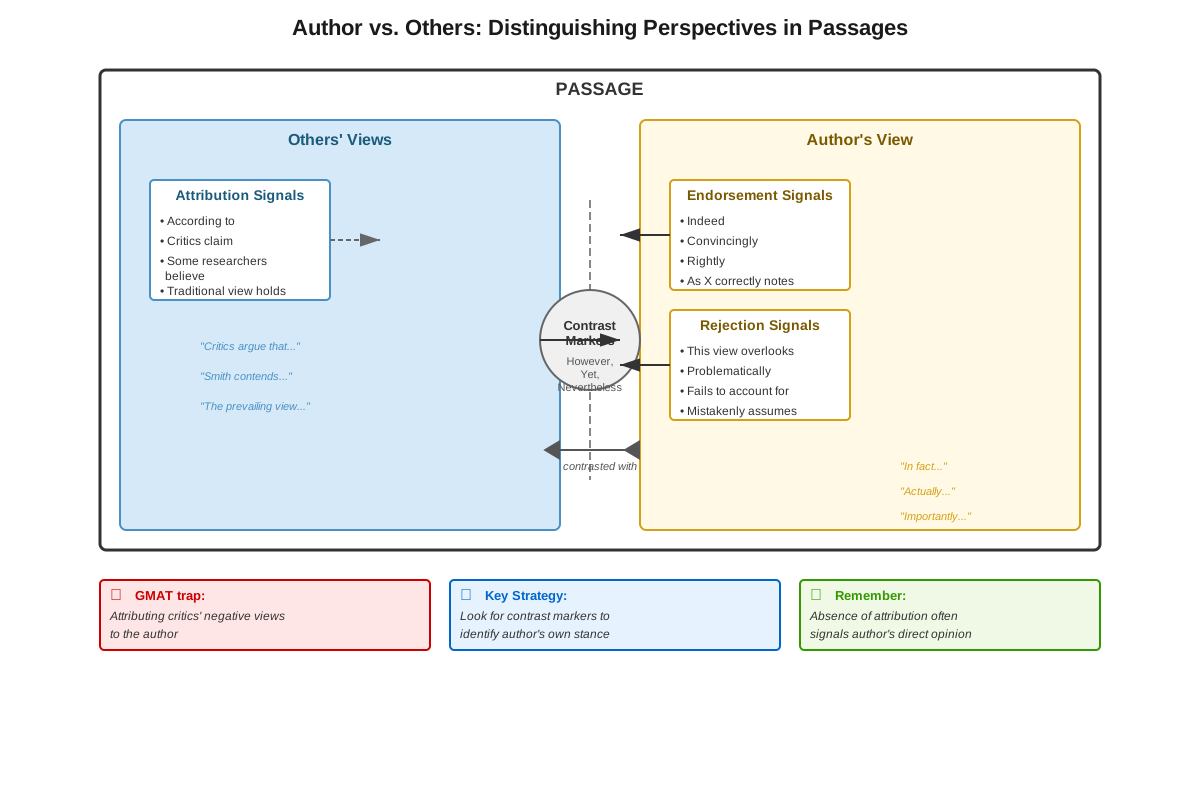
Contrast markers: Words like "however," "yet," "although," "despite," and "nevertheless" often signal where the author's true attitude lies. Authors frequently present one view then contrast it with their preferred position: "While some scholars argue X, the evidence more convincingly supports Y."
Emphasis and intensifiers: Phrases like "most importantly," "particularly significant," or "especially noteworthy" highlight what the author values. Conversely, minimizers like "somewhat," "relatively," or "to a limited extent" downplay importance.
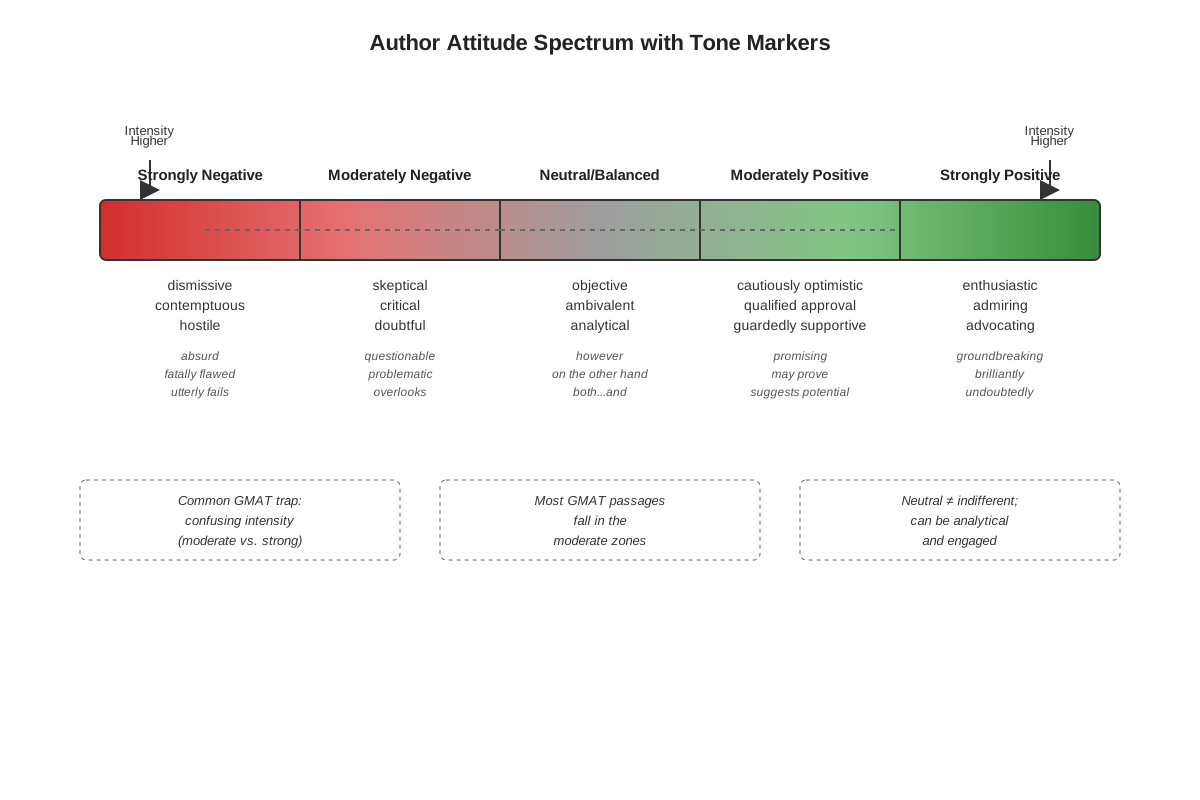
The Attitude Spectrum
Understanding the range of possible attitudes helps students select precise answer choices:
| Attitude Category | Examples | Characteristics |
|---|---|---|
| Strongly Positive | Enthusiastic, laudatory, admiring, championing | Unqualified praise, superlatives, advocacy |
| Moderately Positive | Approving, optimistic, supportive, favorable | Positive with some reservation or balance |
| Mildly Positive | Cautiously optimistic, guardedly positive | Positive but heavily qualified |
| Neutral | Objective, impartial, analytical, descriptive | Balanced presentation, minimal evaluation |
| Mildly Negative | Skeptical, questioning, doubtful | Raises concerns without outright rejection |
| Moderately Negative | Critical, disapproving, pessimistic | Clear negative judgment with reasoning |
| Strongly Negative | Dismissive, scornful, condemning | Harsh criticism, rejection of ideas |
The GMAT rarely features extreme attitudes. Most passages fall in the mildly to moderately positive or negative range, or maintain analytical neutrality. Answer choices using extreme language ("vehemently opposed," "unreservedly enthusiastic") are usually incorrect unless the passage contains correspondingly strong language.
Distinguishing Author from Others
A critical skill involves separating the author's attitude from attitudes of other parties mentioned in the passage. GMAT passages frequently present multiple viewpoints:
- Traditional view vs. new theory: The author may present an established position then introduce a challenger's view, with the author's attitude toward each differing
- Proponents vs. critics: The passage might describe supporters and detractors of a policy, with the author maintaining distance from both or favoring one side
- Historical vs. contemporary perspectives: The author may describe past beliefs while implicitly or explicitly endorsing modern understanding
Textual signals that distinguish the author's voice include:
- Attribution phrases: "According to Smith," "Critics argue," "Proponents claim" (these are others' views)
- Unattributed statements: Claims presented without attribution typically represent the author's position
- Evaluative commentary: When the author assesses others' views ("This argument fails to consider..." or "This approach successfully addresses..."), the evaluation reveals author attitude
Context and Purpose Alignment
Author attitude typically aligns with the passage's primary purpose. If the primary purpose is "to critique a theory," the author's attitude toward that theory will be negative. If the purpose is "to present a balanced analysis," the attitude will likely be neutral or analytical. This alignment provides a cross-check: if your identified attitude contradicts the primary purpose, reconsider your analysis.
However, authors can hold different attitudes toward different elements within a single passage. An author might be:
- Positive toward a new methodology but neutral toward its specific findings
- Critical of traditional approaches but skeptical of proposed alternatives
- Supportive of a theory's goals but doubtful about its implementation
Questions asking about attitude toward specific elements require careful attention to which subject the question addresses.
Intensity Calibration
Matching attitude intensity to textual evidence is crucial. The GMAT includes wrong answers that correctly identify attitude direction (positive or negative) but misrepresent intensity. For example, if an author writes, "The approach shows promise, though further research is needed," the attitude is cautiously positive—not enthusiastic or strongly supportive. Students must calibrate their answer choice to match the degree of qualification present in the passage.
Indicators of intensity include:
- Frequency of qualifiers: More hedging language = more tentative attitude
- Strength of evaluative language: "Excellent" vs. "adequate" vs. "acceptable"
- Balance of positive and negative elements: Mixed evaluation suggests moderate attitude
- Definitiveness of conclusions: Firm conclusions suggest stronger attitudes than tentative ones
Concept Relationships
Author attitude connects to multiple Reading Comprehension concepts in an integrated network. Primary purpose and author attitude are closely linked: the author's overall stance toward the subject shapes why they wrote the passage. For instance, a critical attitude typically accompanies a purpose "to challenge" or "to refute," while a positive attitude aligns with purposes "to advocate" or "to support."
Main idea identification requires understanding author attitude because the central claim often reflects the author's perspective. If the main idea is "Recent research undermines traditional assumptions about X," the author's attitude toward traditional assumptions is negative, while their attitude toward recent research is positive.
Inference questions frequently depend on attitude recognition. If asked what the author would likely agree with, understanding their attitude helps predict which statements align with their perspective. Similarly, tone questions are essentially attitude questions using different terminology.
The relationship flows as follows: Passage structure → Argument development → Evidence presentation → Language choices → Tone markers → Author attitude → Primary purpose. Each element builds upon the previous, with author attitude serving as both a product of earlier elements and a key to understanding overall purpose.
Within the topic itself, concepts connect hierarchically: Tone markers (specific textual evidence) → Attitude identification (synthesis of markers) → Intensity calibration (precise characterization) → Distinction from others' views (avoiding confusion) → Application to answer choices (selecting correct response).
High-Yield Facts
⭐ Author attitude questions appear in 15-20% of GMAT Reading Comprehension questions, making them high-yield for score improvement
⭐ The GMAT rarely features extreme attitudes; most passages show moderate, qualified, or analytical stances
⭐ Tone markers include evaluative adjectives, qualifiers, contrast words, and intensifiers that signal the author's perspective
⭐ The author's attitude often differs from the attitudes of other parties mentioned in the passage—distinguishing these is critical
⭐ Author attitude typically aligns with the passage's primary purpose, providing a useful cross-check for your analysis
- Neutral or analytical attitudes are common in scientific and technical passages where authors present research objectively
- Contrast markers (however, yet, although) often signal where the author's true attitude lies, especially after presenting opposing views
- Answer choices that misrepresent intensity (too strong or too weak) are common trap answers even when direction is correct
- Unattributed statements typically represent the author's own position, while attributed statements represent others' views
- The amount of space devoted to different viewpoints can indicate author attitude—more development often suggests greater importance or favor
- Rhetorical questions in passages usually signal the author's position, with the implied answer reflecting their attitude
- Passages presenting "old view vs. new view" structures typically show the author favoring the new view unless explicitly stated otherwise
- Qualifiers like "may," "might," "appears," and "suggests" indicate tentative or cautious attitudes rather than strong conviction
Quick check — test yourself on Author attitude so far.
Try Flashcards →Common Misconceptions
Misconception: The author's attitude is always explicitly stated in the passage.
Correction: Author attitude is typically implied through word choice, tone markers, and rhetorical structure rather than directly stated. Students must synthesize multiple textual clues to determine attitude accurately.
Misconception: If the author presents multiple viewpoints, they must be neutral toward all of them.
Correction: Authors frequently present multiple perspectives while favoring one through subtle signals like the amount of supporting evidence provided, the strength of language used, or evaluative commentary. Presenting opposing views doesn't require neutrality.
Misconception: Strong language in the passage always indicates strong author attitude.
Correction: Authors may quote others' strong language or describe passionate debates while maintaining analytical distance. Always verify whether strong language is attributed to others or represents the author's own voice.
Misconception: Author attitude remains constant throughout the passage.
Correction: Authors can hold different attitudes toward different elements. They might be positive toward a theory's goals but skeptical of its methodology, or critical of past approaches but cautiously optimistic about new developments.
Misconception: Neutral passages lack any evaluative language.
Correction: Even analytical or objective passages contain subtle evaluative elements. True neutrality is rare; most passages show at least mild attitudes. "Neutral" on the GMAT typically means "balanced and analytical" rather than "completely devoid of perspective."
Misconception: The correct answer will use the exact same words as the passage.
Correction: Correct answers typically paraphrase or characterize the attitude using different vocabulary than appears in the passage. Students must recognize synonymous expressions (e.g., "reservations" for "concerns," "endorses" for "supports").
Misconception: If the author criticizes something, their overall attitude must be negative.
Correction: Authors can acknowledge limitations or criticisms while maintaining overall positive attitudes. Phrases like "Despite some drawbacks, the approach offers significant benefits" show positive attitude despite acknowledging negatives.
Worked Examples
Example 1: Scientific Passage
Passage excerpt: "While traditional models of urban development have long emphasized centralized planning, recent research suggests that decentralized approaches may offer surprising advantages. These newer methodologies, though still requiring rigorous testing, appear to address several persistent challenges that have plagued conventional strategies. Notably, preliminary findings indicate improved resource allocation and enhanced community engagement—outcomes that centralized models have struggled to achieve consistently."
Question: The author's attitude toward decentralized approaches to urban development can best be described as:
(A) Unreservedly enthusiastic
(B) Cautiously optimistic
(C) Completely neutral
(D) Mildly skeptical
(E) Strongly critical
Analysis:
Step 1: Identify tone markers related to decentralized approaches:
- "may offer surprising advantages" (positive but qualified with "may")
- "though still requiring rigorous testing" (acknowledges limitations)
- "appear to address" (positive but tentative with "appear")
- "preliminary findings indicate" (positive results but early stage)
- "improved" and "enhanced" (positive evaluative terms)
Step 2: Note contrast with traditional models:
- Traditional models "have struggled to achieve consistently" (negative toward old approach)
- This contrast suggests relative favor toward new approach
Step 3: Assess intensity:
- Multiple qualifiers ("may," "appear," "preliminary") indicate caution
- Positive language ("surprising advantages," "improved," "enhanced") indicates optimism
- Acknowledgment of need for "rigorous testing" shows measured approach
Step 4: Eliminate answers:
- (A) Too strong—"unreservedly" contradicts the qualifiers throughout
- (C) Incorrect—clear positive language rules out neutrality
- (D) Wrong direction—overall tone is positive, not skeptical
- (E) Wrong direction—no critical language toward decentralized approaches
Answer: (B) Cautiously optimistic—The author sees promise in decentralized approaches (optimistic) but qualifies this with acknowledgments of preliminary status and need for further testing (cautiously).
Example 2: Business Passage
Passage excerpt: "Corporate social responsibility initiatives have garnered considerable attention from business leaders and academics alike. Proponents argue that such programs enhance brand reputation and employee satisfaction. However, critics contend that these initiatives often amount to little more than superficial gestures that divert resources from core business functions. A more balanced assessment reveals that while some programs indeed lack substance, others have demonstrated measurable positive impacts on both community welfare and long-term profitability. The key distinction lies in whether initiatives are integrated into fundamental business strategy or merely adopted as public relations tools."
Question: Which of the following best characterizes the author's attitude toward corporate social responsibility initiatives?
(A) Dismissive of their value
(B) Enthusiastically supportive
(C) Analytically balanced, recognizing both effective and ineffective implementations
(D) Aligned with critics who view them as superficial
(E) Neutral, presenting only others' opinions
Analysis:
Step 1: Identify whose attitudes are presented:
- "Proponents argue" (others' positive view)
- "Critics contend" (others' negative view)
- "A more balanced assessment reveals" (author's own analysis—unattributed)
Step 2: Analyze the author's unattributed statements:
- "while some programs indeed lack substance" (acknowledges critics' point has merit)
- "others have demonstrated measurable positive impacts" (acknowledges proponents' point has merit)
- "The key distinction lies in..." (author provides their own analytical framework)
Step 3: Determine overall stance:
- Author doesn't fully align with either proponents or critics
- Author provides nuanced view distinguishing between types of initiatives
- Language is analytical ("assessment," "distinction," "key") rather than evaluative
Step 4: Eliminate answers:
- (A) Too negative—author acknowledges some programs have positive impacts
- (B) Too positive—author acknowledges some programs lack substance
- (D) Misrepresents—author only partially agrees with critics
- (E) Incorrect—author provides their own analysis, not just others' views
Answer: (C) Analytically balanced, recognizing both effective and ineffective implementations—The author presents a nuanced view that acknowledges validity in both positive and negative perspectives while providing their own framework for distinguishing between types of initiatives.
Exam Strategy
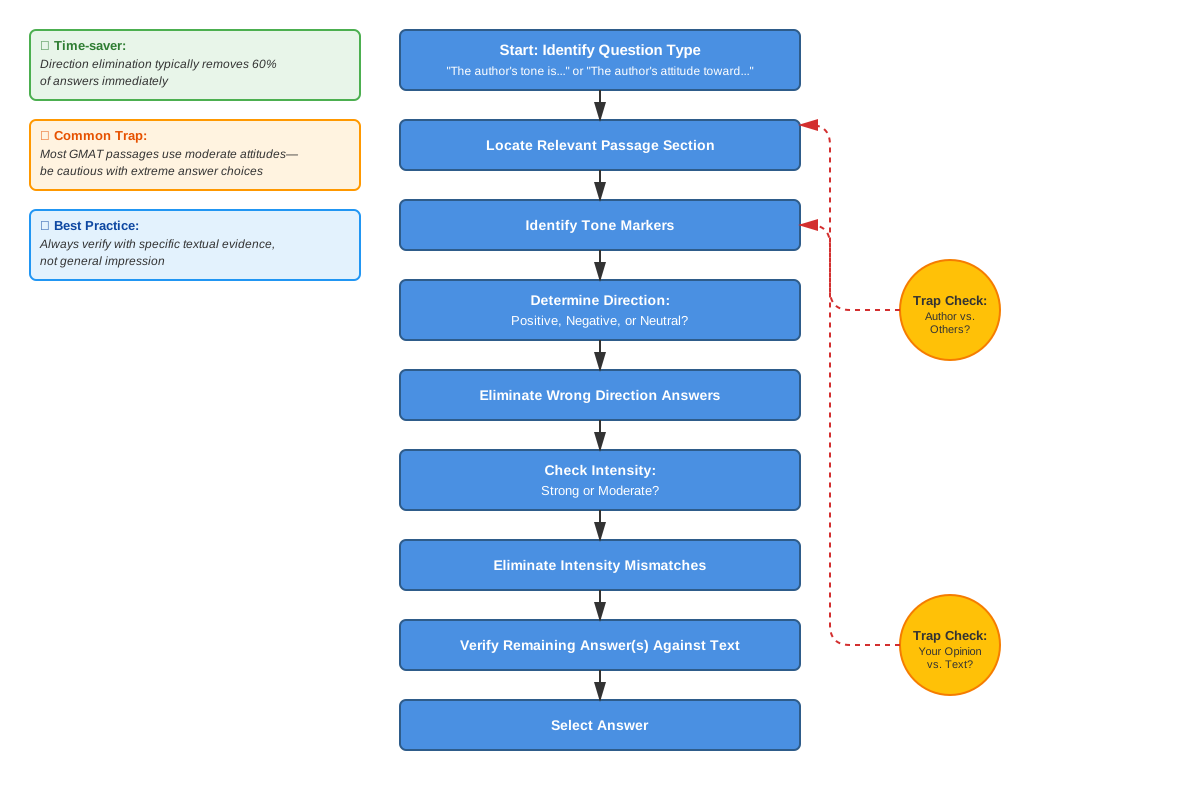
Systematic Approach to Author Attitude Questions
Step 1: Identify the specific subject of the attitude question. Is it asking about the author's attitude toward:
- The entire passage topic?
- A specific theory or approach mentioned?
- A particular group or individual?
- A piece of evidence or finding?
Step 2: Locate relevant textual evidence by scanning for:
- Evaluative language (adjectives, adverbs)
- Qualifiers and hedging words
- Contrast markers that signal the author's position
- Unattributed statements (likely the author's voice)
Step 3: Distinguish the author's voice from others mentioned:
- Circle or note attribution phrases ("According to," "Critics argue")
- Identify where the author responds to or evaluates others' views
Step 4: Calibrate intensity by counting:
- How many qualifiers appear?
- How strong is the evaluative language?
- Is there mixed positive and negative commentary?
Step 5: Pre-phrase an answer before looking at choices:
- Use your own words: "The author seems cautiously positive" or "The author is analytical and balanced"
Step 6: Eliminate systematically:
- Remove extreme answers unless passage language is correspondingly extreme
- Eliminate answers with wrong direction (positive vs. negative)
- Remove answers with correct direction but wrong intensity
- Check remaining answers against multiple pieces of textual evidence
Trigger Words and Phrases
Watch for these high-yield attitude indicators:
Positive signals: remarkably, significantly, successfully, effectively, promising, valuable, important, noteworthy, impressive, substantial
Negative signals: unfortunately, regrettably, fails to, overlooks, neglects, problematic, questionable, dubious, inadequate, limited
Caution/qualification signals: may, might, could, appears, seems, suggests, preliminary, tentative, requires further study
Contrast signals (often precede author's true position): however, yet, nevertheless, although, despite, while, in contrast, on the other hand
Emphasis signals (highlight what author values): most importantly, particularly, especially, notably, significantly, crucially
Time Management
Author attitude questions typically require 60-90 seconds. Allocate time as follows:
- 15-20 seconds: Identify what the question asks and locate relevant passage section
- 20-30 seconds: Analyze textual evidence and determine attitude
- 20-30 seconds: Evaluate answer choices and eliminate
- 10 seconds: Verify selection against passage evidence
If struggling between two answers, return to the passage and find one specific piece of evidence that definitively supports one answer over the other. Avoid spending more than 2 minutes on any single question.
Process of Elimination Strategies
Eliminate first: Answers with extreme language (unless passage is correspondingly extreme): vehemently, unreservedly, completely, entirely, absolutely, utterly
Eliminate second: Answers with wrong direction—if the author is positive, remove all negative options immediately
Eliminate third: Answers that confuse the author's attitude with others' attitudes mentioned in the passage
Choose between remaining options by finding the answer that best matches intensity level based on qualifier frequency and evaluative language strength
Memory Techniques
The ATTITUDE Acronym
Adjectives and adverbs signal evaluation
Tone markers reveal perspective
Tentative language shows caution
Intensity must match textual evidence
Third-party views differ from author's
Unattributed statements are author's voice
Direction (positive/negative) before intensity
Extreme answers are usually wrong
Visualization Strategy: The Attitude Thermometer
Visualize a thermometer with seven levels:
- Top (Hot): Strongly positive/enthusiastic
- Upper-middle: Moderately positive/supportive
- Slightly above center: Mildly positive/cautiously optimistic
- Center: Neutral/analytical
- Slightly below center: Mildly negative/skeptical
- Lower-middle: Moderately negative/critical
- Bottom (Cold): Strongly negative/dismissive
As you read, mentally place the author's attitude on this thermometer, then match your placement to answer choice language.
The "However Test"
When passages present multiple views, the author's attitude typically follows "however," "yet," or "nevertheless." Remember: "The truth comes after 'however'"—the author's real position usually appears after contrast markers.
Qualifier Counter
Create a mental tally: Count qualifiers (may, might, appears, seems, suggests, preliminary).
- 0-1 qualifiers = strong attitude
- 2-3 qualifiers = moderate attitude
- 4+ qualifiers = cautious/tentative attitude
This quick count helps calibrate intensity accurately.
Summary
Author attitude represents the writer's perspective, tone, and emotional stance toward the subject matter, revealed through deliberate language choices rather than explicit statements. On the GMAT, these questions test sophisticated reading skills by requiring students to synthesize tone markers—evaluative adjectives, qualifiers, contrast words, and intensifiers—into accurate characterizations of the author's position. Success demands distinguishing the author's voice from others mentioned in the passage, calibrating attitude intensity to match textual evidence, and avoiding trap answers that misrepresent either direction or degree of attitude. Most GMAT passages feature moderate, qualified, or analytical attitudes rather than extreme positions, and author attitude typically aligns with primary purpose, providing a useful cross-check. Mastering this skill requires systematic analysis: identifying the specific subject of the question, locating relevant textual evidence, distinguishing attribution, calibrating intensity through qualifier frequency and evaluative language strength, and eliminating answers methodically based on direction and intensity mismatches.
Key Takeaways
- Author attitude is revealed through tone markers (evaluative language, qualifiers, contrast words) rather than explicit statements, requiring synthesis of multiple textual clues
- The GMAT features primarily moderate attitudes; extreme answer choices are usually incorrect unless passage language is correspondingly strong
- Distinguishing the author's attitude from attitudes of other parties mentioned in the passage is critical—attribution phrases signal others' views
- Attitude intensity must match textual evidence: count qualifiers and assess evaluative language strength to calibrate correctly
- Author attitude typically aligns with primary purpose, providing a cross-check for your analysis
- Contrast markers (however, yet, nevertheless) often signal where the author's true position lies, especially after presenting opposing views
- Systematic elimination based on direction first, then intensity, maximizes accuracy and efficiency on these high-yield questions
Related Topics
Primary Purpose: Understanding author attitude directly supports identifying why the author wrote the passage, as attitude and purpose are closely aligned. Mastering attitude recognition makes primary purpose questions significantly easier.
Inference Questions: Many inference questions require understanding author attitude to predict what the author would agree with or how they would respond to new information. Attitude serves as the foundation for these logical extensions.
Tone Questions: These are essentially attitude questions using different terminology. The skills developed for attitude recognition transfer directly to tone identification.
Critical Reasoning - Assumption Questions: Recognizing author attitude in arguments helps identify underlying assumptions, as assumptions often reflect the arguer's perspective or bias.
Passage Structure and Organization: Understanding how authors structure arguments—particularly where they place their own views versus others' views—enhances attitude identification skills.
Practice CTA
Now that you've mastered the core concepts of author attitude, it's time to apply these skills to authentic GMAT-style questions. The practice questions and flashcards will reinforce your ability to identify tone markers, distinguish the author's voice from others, calibrate intensity accurately, and select correct answers efficiently. Remember: author attitude questions are high-yield, appearing in 15-20% of Reading Comprehension questions. Each practice question you complete strengthens the pattern recognition and systematic analysis skills that separate good scores from great scores. Approach each practice passage with the ATTITUDE acronym in mind, use the attitude thermometer to calibrate intensity, and trust the systematic elimination process. Your investment in mastering this topic will pay dividends across the entire Verbal section!
Sign up free to keep reading
Create a free AnvayaPrep account to finish this GMAT guide on Author attitude — plus flashcards and practice questions.