Overview
Primary purpose questions represent one of the most frequently tested question types in GMAT Reading Comprehension, appearing in virtually every GMAT exam. These questions ask test-takers to identify the author's main goal or overarching intent in writing a passage. Unlike detail-oriented questions that focus on specific information within a passage, primary purpose questions require students to synthesize the entire passage and understand its global structure, tone, and argumentative direction. Mastering this question type is essential because it tests critical thinking skills that business schools value: the ability to quickly grasp the main point of complex written material, distinguish between central ideas and supporting details, and understand an author's communicative intent.
The GMAT primary purpose question type directly assesses reading comprehension at the highest cognitive level. Rather than simply asking what the passage says, these questions probe why the author wrote the passage and what they hoped to accomplish. This distinction is crucial: a passage might discuss three different theories about market behavior, but the primary purpose might be to advocate for one theory over the others, to reconcile competing viewpoints, or simply to describe the evolution of economic thought. The correct answer must capture the author's overarching goal while remaining broad enough to encompass the entire passage without being so vague as to be meaningless.
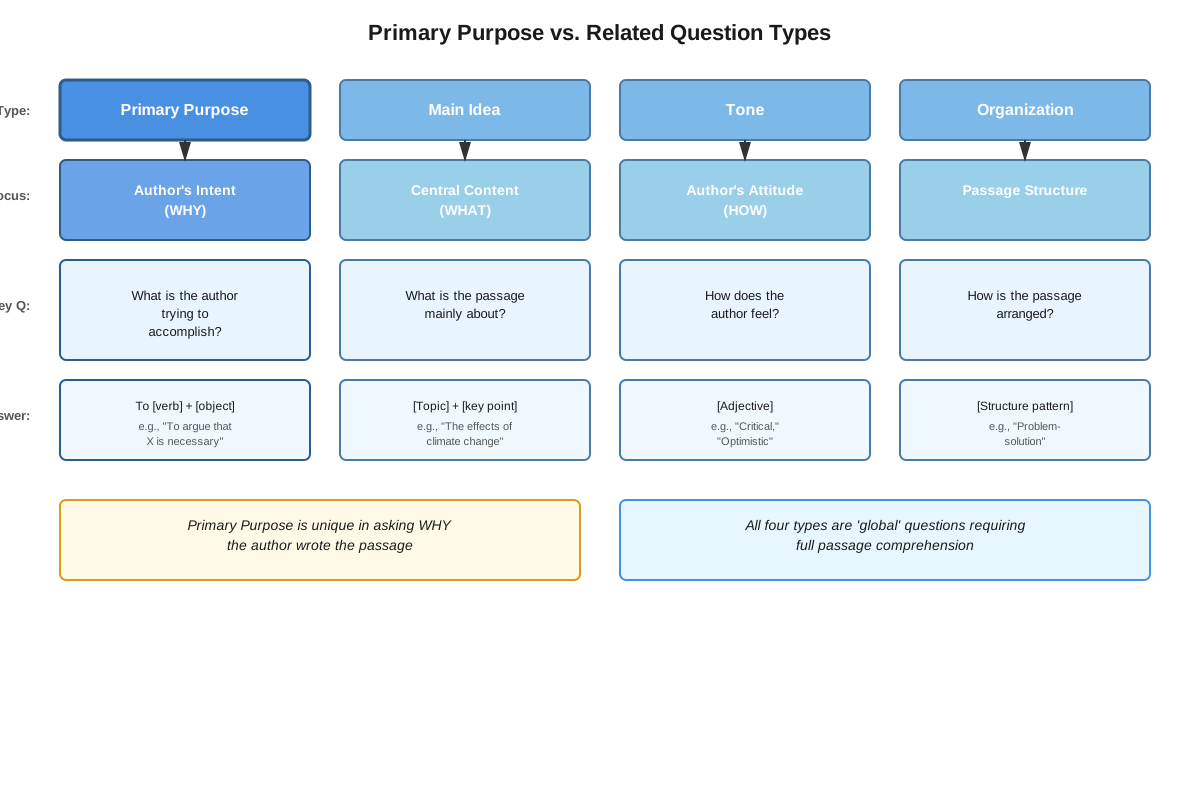
Within the broader context of Verbal Reasoning, primary purpose questions serve as a foundation for understanding passage structure and authorial intent. They connect closely to main idea questions, tone questions, and organization questions, forming a cluster of "global" question types that require holistic passage comprehension. Success with primary purpose questions often predicts success with other high-level reading comprehension tasks, making this topic a high-yield area for focused study and practice.
Learning Objectives
- [ ] Identify primary purpose questions on the GMAT by recognizing their characteristic question stems and formats
- [ ] Explain the difference between primary purpose and related concepts such as main idea, supporting details, and passage organization
- [ ] Apply primary purpose analysis to GMAT questions by systematically evaluating answer choices against passage content
- [ ] Distinguish between the author's primary purpose and secondary purposes or supporting objectives within a passage
- [ ] Predict the correct answer to primary purpose questions before reviewing answer choices by synthesizing passage structure
- [ ] Eliminate incorrect answer choices by identifying common trap patterns specific to primary purpose questions
- [ ] Analyze passage tone and scope to refine understanding of authorial intent
Prerequisites
- Basic reading comprehension skills: The ability to understand written passages at a college level is fundamental to identifying what an author intends to accomplish.
- Understanding of passage structure: Recognizing how passages are organized (introduction, body paragraphs, conclusion) helps identify the author's overall goal.
- Familiarity with common GMAT passage types: Knowledge of science passages, business passages, social science passages, and humanities passages provides context for typical authorial purposes.
- Vocabulary for describing authorial intent: Terms like "argue," "describe," "analyze," "critique," and "propose" are essential for understanding answer choices.
Why This Topic Matters
Primary purpose questions appear with remarkable consistency on the GMAT, typically comprising 20-30% of all Reading Comprehension questions. Every GMAT test-taker can expect to encounter multiple primary purpose questions across the exam's verbal section. These questions carry the same weight as other question types, making them a significant contributor to overall Verbal Reasoning scores. More importantly, they often appear as the first question following a passage, setting the tone for how test-takers approach subsequent questions about the same text.
Beyond exam performance, the skill of identifying an author's primary purpose has direct real-world applications in business and professional contexts. MBA students and business professionals must regularly synthesize lengthy reports, research papers, proposals, and analyses to extract the author's main intent. Whether reviewing a consultant's recommendation, analyzing a competitor's white paper, or evaluating a research study, the ability to quickly identify "why did they write this?" saves time and improves decision-making quality.
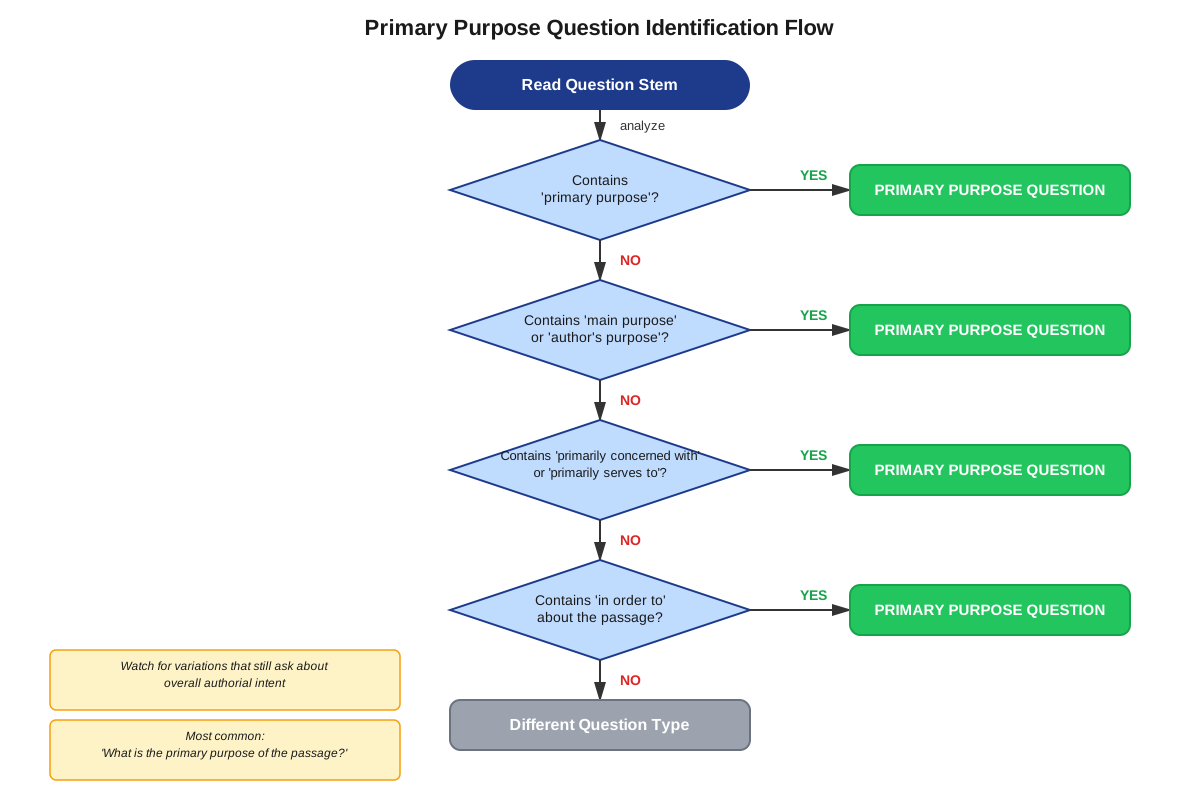
On the GMAT, primary purpose questions typically appear in several recognizable formats. The most common question stems include: "The primary purpose of the passage is to...," "The author's main goal in writing this passage is to...," "Which of the following best describes what the passage is primarily concerned with?", and "The passage is primarily concerned with which of the following?" These questions always require a holistic understanding of the entire passage rather than focusing on any single paragraph or detail. They frequently test whether students can distinguish between what the passage discusses (its content) and why the author wrote it (its purpose).
Core Concepts
Understanding Primary Purpose vs. Main Idea
While closely related, primary purpose and main idea represent distinct concepts that GMAT test-takers must differentiate. The main idea answers the question "What is this passage about?" and typically identifies the central claim or thesis. The primary purpose, by contrast, answers "Why did the author write this passage?" and identifies the author's communicative goal or intent.
Consider this distinction: A passage might have a main idea that "Recent archaeological evidence suggests earlier human migration to the Americas than previously thought." The primary purpose of that same passage might be "to present evidence that challenges an established scientific theory." The main idea focuses on content (what the passage says), while the primary purpose focuses on function (what the author aims to accomplish).
This distinction becomes particularly important when evaluating answer choices. Incorrect answers to primary purpose questions often state accurate main ideas but fail to capture the author's intent. For example, if a passage describes three competing theories and then argues for one, an answer choice stating "to describe three theories" would be incomplete—it captures content but misses the argumentative purpose.
Common Primary Purpose Categories
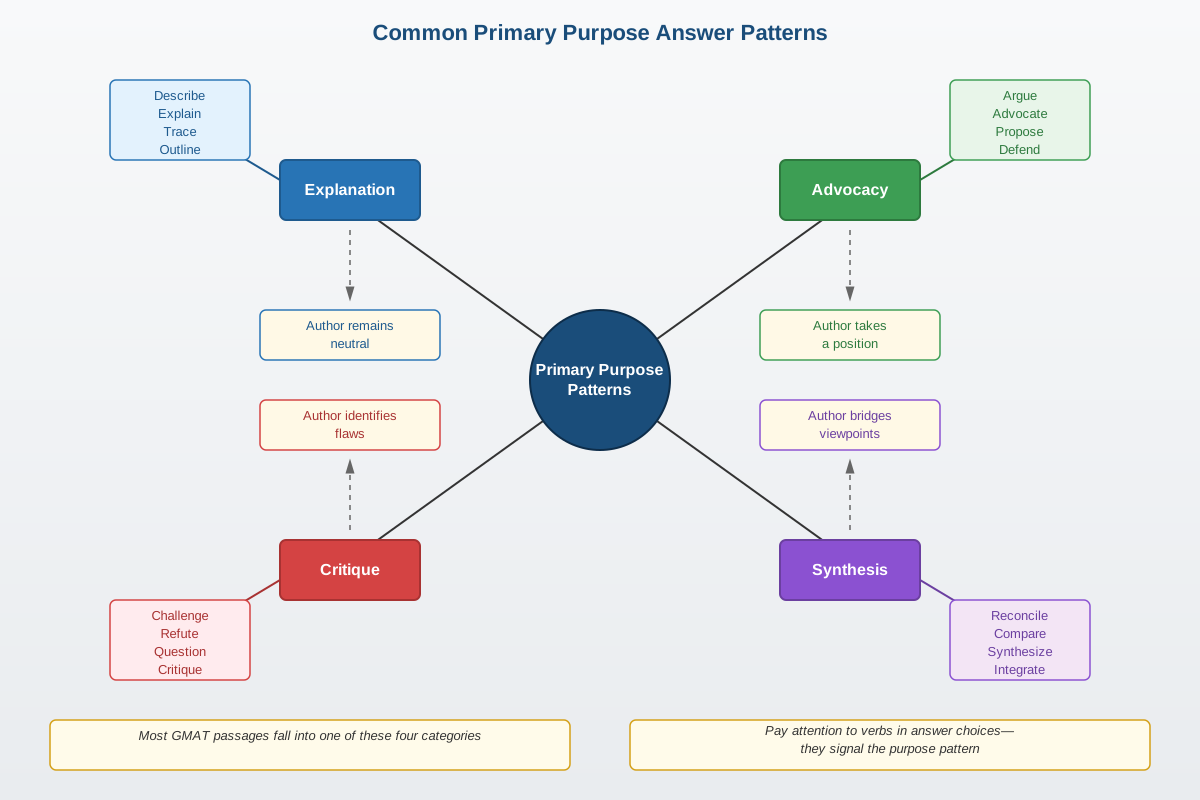
GMAT passages typically fall into several recognizable purpose categories, each with characteristic language patterns and structural features:
| Purpose Category | Typical Verbs | Passage Characteristics | Example Context |
|---|---|---|---|
| To argue/advocate | argue, advocate, contend, maintain | Presents a position with supporting evidence; may acknowledge counterarguments | Author defends a particular interpretation of historical events |
| To describe/explain | describe, explain, illustrate, outline | Provides information without taking a strong stance | Author explains how a biological process works |
| To analyze/examine | analyze, examine, investigate, explore | Breaks down a complex topic into components | Author examines factors contributing to economic trends |
| To critique/challenge | critique, challenge, question, refute | Identifies weaknesses in existing views | Author challenges assumptions in traditional literary criticism |
| To compare/contrast | compare, contrast, distinguish, differentiate | Examines similarities and differences | Author contrasts two management philosophies |
| To propose/recommend | propose, recommend, suggest, present | Offers a solution or new approach | Author proposes a new framework for understanding market behavior |
| To reconcile/synthesize | reconcile, synthesize, integrate, resolve | Brings together seemingly contradictory ideas | Author shows how two competing theories can coexist |
Understanding these categories helps test-takers quickly identify the author's likely purpose while reading. The category also determines which verbs will appear in the correct answer choice.
Identifying Purpose Through Passage Structure
The structure of a passage provides crucial clues about its primary purpose. GMAT passages typically follow predictable organizational patterns that signal authorial intent:
Argumentative Structure: When a passage presents a claim in the first paragraph, provides supporting evidence in subsequent paragraphs, and may address counterarguments, the primary purpose likely involves arguing, advocating, or contending. Key structural markers include transition words like "furthermore," "moreover," and "however" when introducing opposing views.
Descriptive Structure: When a passage systematically presents information about a topic without taking a clear stance, moving from general to specific or chronologically through developments, the primary purpose likely involves describing, explaining, or outlining. These passages often lack strong evaluative language.
Critical Structure: When a passage introduces an existing theory or viewpoint in the first paragraph and then presents problems, limitations, or alternative evidence, the primary purpose likely involves critiquing, challenging, or questioning. Look for phrases like "however," "yet," "this view overlooks," or "recent evidence suggests otherwise."
Synthetic Structure: When a passage presents multiple viewpoints or pieces of evidence and then shows how they can be integrated or reconciled, the primary purpose involves synthesizing or reconciling. These passages often use language like "both perspectives offer value" or "these seemingly contradictory findings can be understood as..."
The Role of Tone in Determining Purpose
An author's tone—their attitude toward the subject matter—provides essential information about primary purpose. Tone and purpose are intimately connected: an author who writes with an enthusiastic, supportive tone likely has a purpose of advocating or recommending, while an author with a skeptical, questioning tone likely aims to critique or challenge.
GMAT passages exhibit several common tones:
- Neutral/Objective: Suggests purposes like describing, explaining, or outlining
- Supportive/Positive: Suggests purposes like advocating, defending, or recommending
- Critical/Skeptical: Suggests purposes like critiquing, challenging, or questioning
- Analytical/Balanced: Suggests purposes like analyzing, examining, or comparing
- Enthusiastic/Promotional: Suggests purposes like proposing or advocating
Identifying tone requires attention to word choice, particularly adjectives and adverbs. Words like "unfortunately," "merely," "surprisingly," or "importantly" reveal the author's attitude and, by extension, their purpose.
Scope Considerations in Primary Purpose
The correct answer to a primary purpose question must match the passage's scope—neither too broad nor too narrow. This principle eliminates many incorrect answer choices:
Too Broad: An answer choice that could apply to dozens of different passages fails to capture the specific purpose of the passage at hand. For example, "to discuss scientific research" is too broad for a passage specifically critiquing one particular study's methodology.
Too Narrow: An answer choice that focuses on a single paragraph or supporting detail rather than the entire passage is too narrow. For example, "to describe the results of the 1998 experiment" might accurately describe paragraph two but miss the passage's overall purpose of using that experiment to challenge a broader theory.
Appropriate Scope: The correct answer encompasses the entire passage while remaining specific enough to distinguish this passage from others. It captures what makes this particular passage unique in its purpose.
The First and Last Paragraph Principle
While primary purpose requires understanding the entire passage, the first and last paragraphs carry disproportionate weight in revealing authorial intent. The opening paragraph typically establishes the topic and hints at the author's approach, while the concluding paragraph often reinforces or explicitly states the author's main goal.
Effective GMAT test-takers pay special attention to:
- The first sentence (often introduces the topic and context)
- The last sentence of the first paragraph (often signals the author's direction)
- The entire last paragraph (often summarizes the author's accomplishment)
- Any explicit statements of purpose (phrases like "this paper argues," "this analysis demonstrates," or "the following discussion examines")
Concept Relationships
Primary purpose serves as the apex concept in a hierarchy of reading comprehension skills. At the foundation lies literal comprehension—understanding what individual sentences and paragraphs say. This leads to detail recognition—identifying specific facts, examples, and supporting evidence within the passage. These details aggregate into paragraph-level understanding—grasping what each section of the passage accomplishes.
From paragraph-level understanding emerges main idea identification—recognizing the central claim or thesis of the passage. Main idea and passage structure (how the passage is organized) together inform primary purpose—understanding why the author wrote the passage and what they aimed to accomplish. Primary purpose, in turn, connects to tone analysis (the author's attitude) and inference questions (what the author implies but doesn't state directly).
This relationship can be visualized as:
Literal Comprehension → Detail Recognition → Paragraph Understanding → Main Idea + Passage Structure → Primary Purpose → Tone Analysis + Inference
Primary purpose also relates horizontally to other global question types. Organization questions (asking how the passage is structured) and title questions (asking what would be the best title) both require similar holistic understanding. Success with primary purpose questions typically predicts success with these related question types.
High-Yield Facts
⭐ Primary purpose questions appear in 20-30% of all GMAT Reading Comprehension questions, making them one of the most frequently tested question types.
⭐ The correct answer to a primary purpose question must encompass the entire passage, not just one paragraph or section.
⭐ Primary purpose focuses on the author's intent (why they wrote), while main idea focuses on content (what they wrote about).
⭐ The first and last paragraphs provide the strongest clues about primary purpose, though the entire passage must be considered.
⭐ Common wrong answer traps include answers that are too narrow (focusing on details), too broad (applying to many passages), or confusing content with purpose.
- Primary purpose answer choices typically begin with infinitive verbs (to argue, to describe, to analyze) that indicate the author's action.
- The author's tone (neutral, critical, supportive) directly correlates with their likely primary purpose.
- Passages that present a theory and then challenge it typically have purposes involving "critique," "question," or "challenge."
- Passages that present information without taking a stance typically have purposes involving "describe," "explain," or "outline."
- If a passage spends most of its length on one activity (e.g., critiquing a theory) but briefly mentions another (e.g., proposing an alternative), the primary purpose focuses on the dominant activity.
- Answer choices using extreme language ("prove," "definitively establish," "completely refute") are usually incorrect, as GMAT passages rarely make absolute claims.
- The correct answer will match the passage's scope and specificity—neither too general nor too detailed.
Quick check — test yourself on Primary purpose so far.
Try Flashcards →Common Misconceptions
Misconception: The primary purpose is always stated explicitly in the passage.
Correction: While some passages include explicit purpose statements (e.g., "This paper argues that..."), many GMAT passages require readers to infer the primary purpose from the overall structure, tone, and content. The author's purpose must often be synthesized from how they organize and present information rather than from any single sentence.
Misconception: The primary purpose is the same as the main idea.
Correction: Primary purpose and main idea are related but distinct concepts. The main idea is what the passage is about (the central claim or thesis), while the primary purpose is why the author wrote it (their communicative goal). A passage about "new evidence for early human migration" might have a primary purpose "to challenge an established theory"—the content differs from the intent.
Misconception: If a passage discusses multiple topics, it can have multiple primary purposes.
Correction: By definition, there is only one primary purpose—the overarching goal that unifies the entire passage. While a passage may have secondary purposes or accomplish multiple things, the primary purpose is singular and encompasses the author's main intent. If a passage discusses three theories, the primary purpose isn't "to discuss three theories" but rather why the author chose to discuss them (to compare them, to advocate for one, to show their evolution, etc.).
Misconception: The longest paragraph indicates the primary purpose.
Correction: While the amount of space devoted to different topics provides clues about emphasis, length alone doesn't determine primary purpose. A passage might spend three paragraphs describing a theory in detail and one paragraph critiquing it, yet the primary purpose could be "to critique" if that's the author's main goal. The function of content matters more than its quantity.
Misconception: Primary purpose questions are subjective and have multiple defensible answers.
Correction: GMAT primary purpose questions always have one clearly correct answer that can be defended by reference to the passage's structure, tone, and content. While test-takers might initially see multiple plausible answers, careful analysis reveals that only one answer accurately captures the author's overarching intent while matching the passage's scope. The GMAT is designed to have unambiguous correct answers based on objective textual evidence.
Misconception: The primary purpose is whatever the first paragraph discusses.
Correction: While the first paragraph often introduces the topic and hints at the author's direction, it doesn't always explicitly state the primary purpose. Some passages use the first paragraph to present background information or an existing viewpoint that the author will later challenge. The primary purpose must account for the entire passage, including how the argument develops and concludes.
Worked Examples
Example 1: Scientific Passage
Passage:
"For decades, scientists believed that the human brain's development was largely complete by early adulthood, with minimal neuroplasticity—the brain's ability to form new neural connections—occurring thereafter. This view shaped educational policy and rehabilitation approaches, suggesting that interventions were most effective during childhood. However, recent neuroimaging studies have revealed that significant neuroplasticity continues throughout adulthood, even into old age. Research by Merzenich and colleagues demonstrated that adult brains could reorganize in response to training, with measurable changes in neural structure occurring after just weeks of practice. Similarly, studies of stroke patients have shown remarkable recovery of function through targeted rehabilitation, indicating that adult brains retain substantial adaptive capacity. These findings suggest that the traditional view of brain development was overly pessimistic and that interventions to enhance cognitive function or recover from injury may be effective at any age."
Question: The primary purpose of the passage is to:
(A) describe the process of neuroplasticity in the human brain
(B) present research findings that challenge a long-held scientific belief
(C) argue that educational interventions are more effective in adulthood than childhood
(D) explain why stroke patients can recover function through rehabilitation
(E) compare different theories of brain development across the lifespan
Analysis:
Step 1: Identify the passage structure
- First paragraph: Introduces old belief (brain development complete by early adulthood)
- Middle section: Presents contradictory evidence (recent studies showing adult neuroplasticity)
- Final sentence: Draws conclusion (traditional view was wrong; interventions can work at any age)
This is a critical structure—the passage introduces an existing view and then presents evidence that challenges it.
Step 2: Identify the author's tone
The author uses phrases like "however," "revealed," and "overly pessimistic," indicating a tone that questions the traditional view. The author is not neutral but rather supportive of the new evidence.
Step 3: Determine scope
The passage is specifically about challenging one belief (limited adult neuroplasticity) with new evidence. It's not broadly about all brain development theories, nor is it narrowly about just one study.
Step 4: Evaluate answer choices
(A) Too narrow and wrong focus: While the passage mentions neuroplasticity, describing the process is not the author's main goal. The passage is more concerned with challenging a belief than explaining a mechanism.
(B) CORRECT: This captures the passage's structure (presenting research findings), its critical tone (challenge), and its appropriate scope (a long-held scientific belief about limited adult neuroplasticity). The entire passage serves this purpose.
(C) Too extreme and narrow: The passage never argues that adult interventions are MORE effective than childhood ones—only that they CAN be effective. This overstates the author's claim.
(D) Too narrow: Stroke patient recovery is mentioned as one example of adult neuroplasticity, but it's not the primary purpose of the entire passage. This focuses on a supporting detail.
(E) Wrong focus: The passage doesn't compare multiple theories; it presents evidence against one traditional view. "Compare" is the wrong verb for this passage's purpose.
Correct Answer: B
Example 2: Business/Social Science Passage
Passage:
"The rise of remote work has prompted considerable debate about its effects on employee productivity. Some managers argue that remote work reduces productivity due to increased distractions and reduced oversight, while others contend that it enhances productivity by eliminating commute time and allowing flexible scheduling. Recent meta-analyses of productivity studies reveal a more nuanced picture. Bloom's 2015 study of a Chinese travel agency found that remote workers were 13% more productive than office workers, but this advantage disappeared when considering only the most complex tasks requiring collaboration. Similarly, a 2020 analysis of software developers found that while individual coding productivity increased remotely, project completion times lengthened due to communication challenges. These findings suggest that remote work's impact on productivity depends heavily on task characteristics. Routine, independent tasks may benefit from remote arrangements, while complex, collaborative work may suffer. Organizations seeking to optimize productivity should therefore adopt hybrid approaches that match work arrangements to task requirements rather than implementing blanket remote or in-office policies."
Question: The primary purpose of the passage is to:
(A) advocate for remote work as a means of increasing employee productivity
(B) describe the findings of recent studies on remote work and productivity
(C) propose that organizations adopt task-based approaches to remote work policies
(D) challenge the assumption that remote work always reduces productivity
(E) compare the productivity of remote workers with that of office workers
Analysis:
Step 1: Identify the passage structure
- Opening: Presents two opposing views on remote work and productivity
- Middle: Presents research evidence showing mixed results
- Conclusion: Recommends a specific approach (hybrid, task-based policies)
This is a synthetic/proposal structure—the passage reconciles competing views and proposes a solution.
Step 2: Identify the author's tone
The author is balanced when presenting evidence but becomes prescriptive in the final sentence ("should therefore adopt"). The tone is analytical and ultimately advisory.
Step 3: Determine scope
The passage moves from debate to evidence to recommendation. The recommendation in the final sentence represents the author's ultimate goal—not just to inform but to propose a course of action.
Step 4: Evaluate answer choices
(A) Wrong direction: The passage doesn't advocate for remote work generally; it suggests matching work arrangements to tasks. This oversimplifies the author's position.
(B) Too narrow and passive: While the passage does describe study findings, this is a means to an end, not the primary purpose. This answer captures what the passage does but not why the author wrote it.
(C) CORRECT: The final sentence explicitly recommends that "organizations seeking to optimize productivity should therefore adopt hybrid approaches that match work arrangements to task requirements." The entire passage builds toward this proposal, using evidence to support the recommendation. "Propose" captures the author's intent, and "task-based approaches" accurately reflects the specific recommendation.
(D) Too narrow: While the passage does challenge the view that remote work always reduces productivity, this is only part of the passage's purpose. The author also challenges the opposite view (that remote work always increases productivity) and moves beyond challenging to proposing a solution.
(E) Wrong focus: The passage uses comparisons as evidence but doesn't exist primarily to compare. The comparisons serve the larger purpose of supporting a recommendation.
Correct Answer: C
Exam Strategy
Systematic Approach to Primary Purpose Questions
Before Reading Answer Choices:
- Identify the passage structure as you read: Is it argumentative, descriptive, critical, or synthetic? This immediately narrows the likely purpose verbs.
- Note the first and last sentences of the passage: These often contain the strongest clues about authorial intent.
- Assess the author's tone: Neutral, critical, supportive, or analytical? Tone correlates directly with purpose.
- Formulate your own answer in simple terms: "The author wants to challenge X" or "The author wants to explain Y." Having a prediction makes evaluating answer choices much faster.
Trigger Words and Phrases
In the passage, watch for:
- Purpose indicators: "This paper argues," "The following analysis demonstrates," "This discussion examines"
- Transition words signaling critique: "However," "Yet," "Nevertheless," "Despite," "Although"
- Evaluative language: "Unfortunately," "Importantly," "Surprisingly," "Significantly"
- Conclusion markers: "Therefore," "Thus," "Consequently," "These findings suggest"
In answer choices, recognize:
- Argumentative verbs: argue, advocate, contend, maintain, defend
- Descriptive verbs: describe, explain, outline, illustrate, present
- Analytical verbs: analyze, examine, investigate, explore, assess
- Critical verbs: critique, challenge, question, refute, dispute
- Synthetic verbs: reconcile, synthesize, integrate, resolve, propose
Process of Elimination Strategy
Eliminate answers that are:
- Too narrow: Focus on one paragraph, example, or detail rather than the whole passage
- Too broad: Could apply to dozens of different passages
- Factually wrong: Misstate what the passage actually discusses
- Wrong verb: Use a verb that doesn't match the author's action (e.g., "describe" when the author clearly argues)
- Wrong tone: Suggest a neutral purpose when the author is clearly critical, or vice versa
- Partial: Capture only part of what the passage does, missing the complete purpose
Exam Tip: If you're torn between two answers, one is likely too narrow (focusing on a detail or example) while the other captures the complete purpose. Choose the one that accounts for the entire passage.
Time Allocation
Primary purpose questions should take approximately 60-75 seconds to answer:
- 10-15 seconds: Recall your understanding of the passage structure and author's intent
- 30-45 seconds: Evaluate each answer choice systematically
- 10-15 seconds: Confirm your selection by checking it against the passage's scope and tone
Since primary purpose questions often appear first after a passage, answering them correctly helps orient your understanding for subsequent questions. Investing adequate time here pays dividends later.
Common Question Stem Variations
Recognize these equivalent formulations:
- "The primary purpose of the passage is to..."
- "The author's main goal in writing this passage is to..."
- "Which of the following best describes what the passage is primarily concerned with?"
- "The passage is chiefly concerned with..."
- "The main purpose of the passage is to..."
All of these ask for the same thing: the author's overarching intent in writing the passage.
Memory Techniques
The PURPOSE Acronym
Passage structure (argumentative, descriptive, critical, synthetic)
Understand the tone (neutral, critical, supportive, analytical)
Read first and last paragraphs carefully
Predict your answer before looking at choices
Overall scope (not too narrow, not too broad)
Select the verb that matches the author's action
Eliminate answers that miss the complete purpose
Verb Category Visualization
Visualize four quadrants representing purpose categories:
        NEUTRAL TONE
             |
    DESCRIBE/EXPLAIN
             |
CRITICAL ----+---- SUPPORTIVE
    CRITIQUE |  ADVOCATE/PROPOSE
             |
        ANALYTICAL
        ANALYZE/EXAMINE
As you read, mentally place the passage in one of these quadrants based on tone and approach. This immediately suggests which verbs should appear in the correct answer.
The "Why Did They Write This?" Question
After reading each passage, literally ask yourself: "Why did the author bother to write this?" Your answer should be a simple sentence starting with "To..." This forces you to think about purpose rather than content. For example:
- "To challenge the old theory about X"
- "To explain how Y works"
- "To propose a new approach to Z"
- "To analyze the factors contributing to W"
The Scope Spectrum
Visualize a spectrum from "too narrow" to "just right" to "too broad":
TOO NARROW ←→ CORRECT SCOPE ←→ TOO BROAD
(one detail)   (whole passage)   (any passage)
As you evaluate each answer choice, mentally place it on this spectrum. Only the answer in the middle zone can be correct.
Summary
Primary purpose questions test the ability to identify an author's overarching intent in writing a passage—not what the passage discusses, but why the author wrote it. These questions appear frequently on the GMAT (20-30% of Reading Comprehension questions) and require holistic understanding of passage structure, tone, and scope. The correct answer must encompass the entire passage while remaining specific enough to distinguish this passage from others. Success requires distinguishing between content (main idea) and function (primary purpose), recognizing common purpose categories (argue, describe, analyze, critique, propose, reconcile), and using passage structure and tone as clues to authorial intent. The first and last paragraphs provide particularly strong signals about purpose. Common wrong answers are too narrow (focusing on details), too broad (applying to many passages), or confuse content with purpose. Effective test-takers predict the answer before reviewing choices, systematically eliminate incorrect options, and verify that their selection matches the passage's scope and the author's tone. Mastering primary purpose questions builds a foundation for success with other global question types and reflects the critical thinking skills essential for business school success.
Key Takeaways
- Primary purpose identifies why the author wrote the passage (intent), not what the passage discusses (content)—this distinction is fundamental to answering these questions correctly.
- The correct answer must encompass the entire passage with appropriate scope—neither too narrow (focusing on details) nor too broad (applying to any passage).
- Passage structure and author's tone provide the strongest clues to primary purpose—argumentative structures suggest purposes like "argue" or "advocate," while critical structures suggest "challenge" or "critique."
- The first and last paragraphs carry disproportionate weight—they often introduce the author's direction and reinforce their ultimate goal.
- Predict your answer before reviewing choices—formulating your own understanding of the author's purpose makes evaluating answer choices faster and more accurate.
- Common wrong answer traps include answers that are too narrow, too broad, or confuse content with purpose—systematic elimination of these trap answers improves accuracy.
- Primary purpose questions appear in 20-30% of GMAT Reading Comprehension questions—making them one of the highest-yield topics for focused study and practice.
Related Topics
Main Idea Questions: While primary purpose focuses on authorial intent, main idea questions identify the central claim or thesis. Mastering primary purpose provides a foundation for distinguishing between these related question types.
Passage Organization Questions: These questions ask how a passage is structured, which directly relates to primary purpose since structure reveals intent. Understanding primary purpose helps predict organizational patterns.
Tone Questions: Identifying an author's attitude toward their subject matter connects intimately with primary purpose, as tone and intent are closely linked. Success with primary purpose questions enhances tone analysis skills.
Inference Questions: While inference questions ask what the author implies rather than states, understanding primary purpose helps identify which inferences align with the author's overall goals.
Detail Questions: Mastering primary purpose provides context for understanding why specific details appear in a passage, making detail questions easier to answer by understanding how details support the author's purpose.
Practice CTA
Now that you understand the core concepts, strategies, and common pitfalls of primary purpose questions, it's time to apply this knowledge! Attempt the practice questions to test your ability to identify authorial intent across different passage types and difficulty levels. Use the flashcards to reinforce key concepts like purpose categories, common wrong answer traps, and the distinction between primary purpose and main idea. Remember: primary purpose questions are among the most frequently tested on the GMAT, making your practice time here a high-yield investment in your score. Each practice question you complete strengthens your ability to quickly synthesize passages and identify what authors aim to accomplish—skills that will serve you not just on test day, but throughout your business school career and beyond.
Sign up free to keep reading
Create a free AnvayaPrep account to finish this GMAT guide on Primary purpose — plus flashcards and practice questions.