Overview
Author tone refers to the attitude, perspective, or emotional stance that a writer conveys toward their subject matter and audience within a passage. On the GMAT, identifying and understanding author tone is a critical skill that appears frequently in Reading Comprehension questions. The GMAT author tone questions test whether students can move beyond literal comprehension to grasp the subtle nuances of how an author presents information, arguments, or analyses.
Mastering author tone is essential for GMAT success because it directly impacts your ability to answer primary purpose questions, inference questions, and specific tone-identification questions. The GMAT frequently asks test-takers to identify whether an author is "critical," "enthusiastic," "objective," "skeptical," or employs dozens of other tonal descriptors. These questions require careful attention to word choice, qualifying language, and the overall structure of argumentation. Missing the author's tone can lead to misinterpreting the passage's main idea and selecting incorrect answers across multiple question types.
Within the broader context of Verbal Reasoning, author tone connects intimately with critical reasoning skills, argument structure analysis, and inference-making abilities. Understanding tone helps distinguish between what an author explicitly states versus what they imply, between facts they present neutrally versus claims they advocate for passionately. This skill bridges reading comprehension with the analytical thinking required throughout the GMAT Verbal section, making it a foundational competency that enhances performance across question types.
Learning Objectives
- [ ] Identify author tone in GMAT Reading Comprehension passages
- [ ] Explain author tone and its significance in understanding passage meaning
- [ ] Apply author tone recognition to GMAT questions accurately and efficiently
- [ ] Distinguish between subtle variations in tone (e.g., cautiously optimistic vs. enthusiastic)
- [ ] Recognize textual evidence that signals specific tones
- [ ] Evaluate answer choices for tone questions using elimination strategies
- [ ] Synthesize tone understanding with other passage elements (structure, purpose, main idea)
Prerequisites
- Basic reading comprehension skills: Understanding literal meaning is necessary before analyzing how that meaning is conveyed
- Vocabulary knowledge: Recognizing tone-related adjectives (skeptical, laudatory, ambivalent) is essential for selecting correct answers
- Argument structure awareness: Identifying claims, evidence, and conclusions helps determine whether an author supports or challenges ideas
- Understanding of passage types: Familiarity with scientific, historical, and business passages provides context for typical tonal ranges
Why This Topic Matters
Author tone questions appear in approximately 15-20% of GMAT Reading Comprehension questions, making them one of the most frequently tested concepts. These questions often determine whether a test-taker scores in the 70th percentile or breaks into the 90th percentile, as they require sophisticated analytical skills that separate strong readers from exceptional ones.
In real-world applications, understanding author tone is fundamental to critical reading in business, law, medicine, and academia. Executives must discern whether a consultant's report genuinely supports a recommendation or offers qualified endorsement. Lawyers must identify whether legal precedents are cited approvingly or distinguished critically. This skill translates directly to the analytical demands of graduate business education.
On the GMAT, tone questions typically appear as: "The author's attitude toward [subject] can best be described as..." or "The tone of the passage is primarily..." or "The author mentions [detail] in order to convey..." These questions test whether students can identify subtle linguistic markers—hedging language, emphatic statements, qualifying phrases, and rhetorical questions—that reveal the author's perspective. Passages may present scientific theories (where tone ranges from enthusiastic support to measured skepticism), historical analyses (where tone might be revisionist or traditional), or business case studies (where tone could be cautionary or optimistic).
Core Concepts
Defining Author Tone
Author tone represents the writer's attitude, emotional coloring, and perspective toward the subject matter discussed in a passage. Unlike mood (which describes the emotional atmosphere created for the reader), tone specifically reflects the author's stance. On the GMAT, tone exists on multiple spectrums: positive to negative, certain to uncertain, objective to subjective, and engaged to detached.
The GMAT tests tone recognition because it reveals deep comprehension. Two authors might present identical facts about a scientific discovery, but one writes with "cautious optimism" while another maintains "scholarly objectivity." These tonal differences signal important distinctions in how the information should be interpreted and what the author's purpose might be.
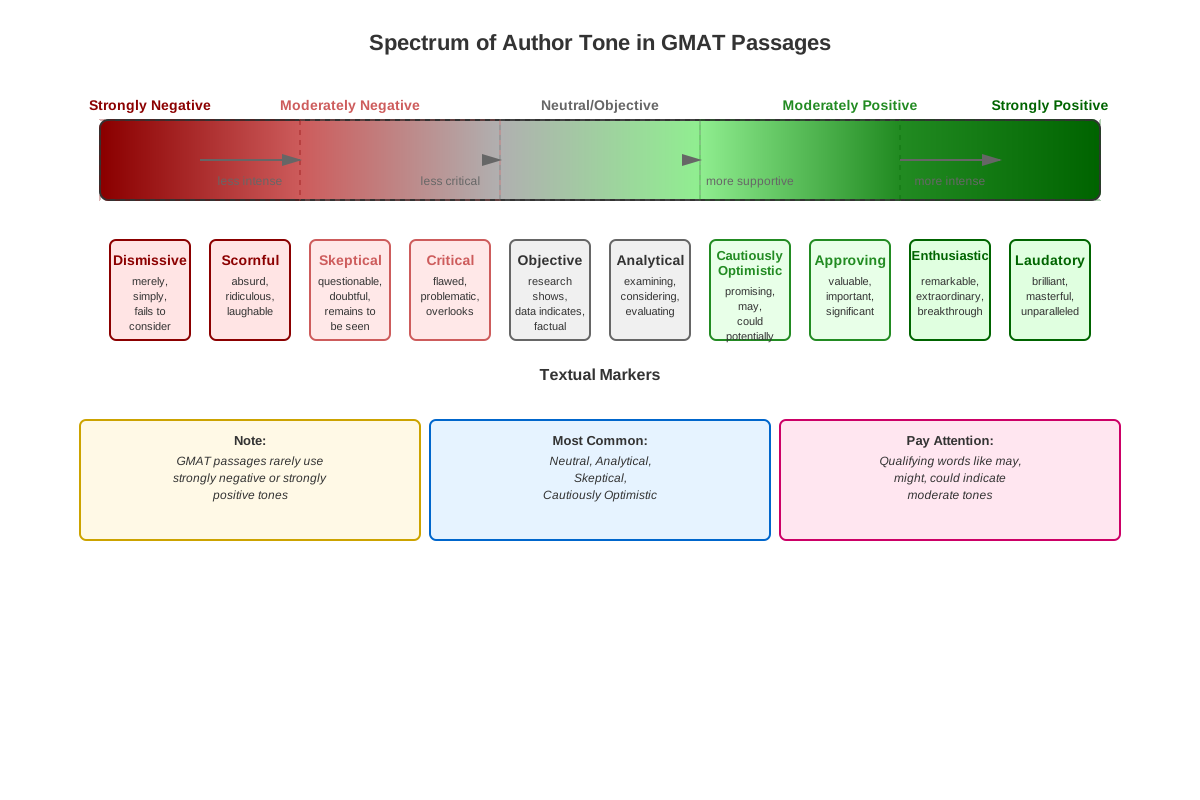
The Tone Spectrum
GMAT passages typically employ tones that fall into several categories:
Positive Tones: These include enthusiastic, optimistic, approving, laudatory, admiring, and supportive. Authors using positive tones employ language like "remarkable achievement," "significant breakthrough," "elegantly demonstrates," or "convincingly argues."
Negative Tones: These encompass critical, skeptical, dismissive, pessimistic, disapproving, and condemnatory. Markers include phrases like "fails to account for," "overlooks crucial evidence," "unfortunately neglects," or "seriously flawed."
Neutral/Objective Tones: These include analytical, objective, informative, descriptive, and explanatory. Such passages present information without obvious bias, using language like "researchers found," "the data indicates," or "the theory proposes."
Qualified/Ambivalent Tones: These include ambivalent, resigned, cautiously optimistic, guardedly positive, or tentatively critical. These tones feature hedging language: "may suggest," "appears to indicate," "while promising, requires further study," or "despite certain merits, raises questions."
Textual Evidence for Tone
Identifying tone requires analyzing specific linguistic features:
Word Choice (Diction): Strong, emotionally charged words signal subjective tone. Compare "the theory suggests" (neutral) with "the theory brilliantly illuminates" (positive) or "the theory merely asserts" (negative). Adjectives and adverbs are particularly revealing: "significant," "merely," "unfortunately," "remarkably."
Qualifying Language: Phrases like "however," "although," "despite," "while acknowledging" signal nuanced or critical tones. Absolute statements ("clearly demonstrates," "definitively proves") suggest confidence, while hedges ("may indicate," "seems to suggest") signal caution or uncertainty.
Rhetorical Questions: When authors pose questions, they often signal skepticism or challenge prevailing views. "But can we truly accept this conclusion without examining the underlying assumptions?" suggests critical tone.
Emphasis and Repetition: Repeated emphasis on certain points or the use of emphatic constructions ("indeed," "certainly," "undoubtedly") reveals the author's investment in particular claims.
Contrast and Comparison: How authors position different viewpoints reveals tone. Presenting one theory favorably while highlighting another's weaknesses demonstrates preference and evaluative tone.
Common GMAT Tone Descriptors
| Tone Category | Common Descriptors | Typical Markers |
|---|---|---|
| Strongly Positive | Enthusiastic, laudatory, admiring | "Brilliant," "revolutionary," "masterful" |
| Moderately Positive | Approving, optimistic, supportive | "Promising," "valuable," "important" |
| Neutral | Objective, analytical, informative | "Indicates," "demonstrates," "shows" |
| Moderately Negative | Skeptical, critical, questioning | "Questionable," "overlooks," "fails to" |
| Strongly Negative | Dismissive, condemnatory, scornful | "Fundamentally flawed," "seriously misguided" |
| Ambivalent | Mixed, qualified, ambivalent | "While...however," "despite...nevertheless" |
Tone vs. Purpose vs. Main Idea
Understanding the distinction between related concepts is crucial:
Tone = HOW the author feels (attitude/emotion)
Purpose = WHY the author wrote the passage (intent/goal)
Main Idea = WHAT the author's central point is (content/thesis)
A passage might have a main idea about "new archaeological findings regarding ancient trade routes," a purpose "to challenge previous theories," and a tone that is "cautiously optimistic about the new evidence while remaining critical of earlier interpretations." These three elements work together but represent distinct analytical categories.
Context-Dependent Tone
GMAT passages often feature shifting or layered tones. An author might be:
- Objective when presenting background information
- Critical when discussing one theory
- Supportive when presenting an alternative theory
- Cautiously optimistic about future research directions
Questions asking about "the author's tone toward [specific element]" require identifying tone toward that particular subject, not the passage's overall tone. This precision distinguishes high-scoring test-takers from those who make overgeneralizations.
Concept Relationships
Author tone connects to multiple Reading Comprehension skills in an integrated network. Tone identification → enables accurate inference-making because understanding an author's attitude helps predict what they would likely agree or disagree with. Similarly, tone recognition → clarifies primary purpose since an author's emotional stance often reveals their motivation for writing.
The relationship flows bidirectionally with argument structure: identifying whether an author presents counterarguments respectfully or dismissively (tone) helps map the passage's argumentative architecture, while understanding the structure (which claims receive more support) helps identify tone. Word choice analysis → reveals tone → supports main idea comprehension, creating a chain where careful attention to diction unlocks tonal understanding, which in turn illuminates the passage's central message.
Tone also connects to critical reasoning skills from other GMAT sections. The ability to identify assumptions, evaluate evidence strength, and recognize logical flaws all benefit from understanding whether an author presents information neutrally or advocates for particular positions. An author with a "skeptical" tone toward a theory likely sees its evidence as insufficient—a critical reasoning concept applied within reading comprehension.
High-Yield Facts
⭐ The GMAT rarely uses extreme tones: Passages almost never feature "angry," "ecstatic," or "sarcastic" tones; instead, expect measured academic tones like "analytical," "critical," or "cautiously optimistic"
⭐ Qualifying language is the strongest tone indicator: Words like "however," "although," "while," "despite," and "yet" signal nuanced or critical perspectives
⭐ Tone questions often include trap answers that are too extreme or too mild: If the passage is "critical," wrong answers might say "dismissive" (too strong) or "questioning" (too weak)
⭐ The author's tone toward different elements within a passage can vary: An author might be objective about background information but critical toward a specific theory
⭐ Positive tone doesn't mean uncritical: An author can be "generally supportive" while still noting limitations or areas requiring further research
- Neutral/objective tone is most common in scientific and technical passages presenting research findings
- Historical and social science passages more frequently feature evaluative tones (critical, revisionist, supportive)
- Rhetorical questions almost always signal skepticism or challenge to prevailing views
- The absence of qualifying language combined with strong positive adjectives indicates enthusiastic or laudatory tone
- When authors present multiple viewpoints, their tone toward each viewpoint may differ significantly, revealing their position through contrast
Quick check — test yourself on Author tone so far.
Try Flashcards →Common Misconceptions
Misconception: Author tone is the same as the passage's mood or the reader's emotional response.
Correction: Tone specifically refers to the author's attitude toward the subject matter, not the emotional atmosphere created for readers or how readers feel. A passage about a tragic historical event might be written in an objective, analytical tone despite the sad subject matter.
Misconception: If an author presents both sides of an argument, the tone must be neutral or objective.
Correction: Authors can present counterarguments while maintaining clear preferences. Phrases like "while proponents claim X, this view overlooks Y" show the author presenting both sides while maintaining a critical tone toward one position.
Misconception: Strong vocabulary or complex sentences indicate a positive tone toward the subject.
Correction: Sophisticated language reflects writing style, not attitude. An author can eloquently criticize a theory using complex sentences and advanced vocabulary while maintaining a negative or skeptical tone.
Misconception: The tone of the entire passage is always uniform throughout.
Correction: Authors frequently shift tone when discussing different elements. They might be objective when presenting background, critical when discussing one theory, and supportive when presenting an alternative. Tone questions often ask about attitude toward specific elements, not overall passage tone.
Misconception: Descriptive or informative passages have no tone.
Correction: Even seemingly objective passages reveal subtle tones through word choice. The difference between "the theory suggests" and "the theory merely suggests" or "the theory convincingly demonstrates" shows that even informative passages contain tonal elements.
Misconception: Hedging language (may, might, could) always indicates uncertainty or weak tone.
Correction: In academic and scientific writing, qualifying language often reflects appropriate scholarly caution rather than uncertainty. An author can be supportive of a theory while acknowledging that "further research may reveal additional applications"—this represents measured optimism, not doubt.
Worked Examples
Example 1: Scientific Discovery Passage
Passage Excerpt:
"The recent findings regarding quantum entanglement represent a significant advance in theoretical physics. While earlier experiments suggested the phenomenon's existence, the new methodology eliminates previous ambiguities and provides compelling evidence. However, practical applications remain speculative, and researchers caution against premature conclusions about technological implications. The theoretical framework, though elegant, requires substantial refinement before yielding predictive power."
Question: The author's tone toward the recent findings can best be described as:
(A) Unreservedly enthusiastic
(B) Cautiously optimistic
(C) Skeptically dismissive
(D) Completely objective
(E) Mildly disapproving
Analysis:
First, identify tone markers:
- "Significant advance" = positive language
- "Compelling evidence" = strong positive
- "However" = introduces qualification
- "Remain speculative" = limitation noted
- "Caution against premature conclusions" = tempering enthusiasm
- "Though elegant" = positive acknowledgment
- "Requires substantial refinement" = limitation
The author clearly views the findings positively ("significant advance," "compelling evidence") but consistently qualifies this enthusiasm with limitations and cautions. This pattern indicates measured support rather than unqualified praise.
Elimination Process:
- (A) Too extreme—"unreservedly" contradicts the multiple qualifications
- (B) CORRECT—combines positive view with appropriate cautions
- (C) Wrong valence—author is positive, not dismissive
- (D) Too neutral—"significant" and "compelling" show evaluation beyond objectivity
- (E) Wrong valence—author is positive overall, not disapproving
Answer: (B) Cautiously optimistic
The author supports the findings while acknowledging limitations—the hallmark of cautious optimism in academic writing.
Example 2: Historical Analysis Passage
Passage Excerpt:
"Traditional interpretations of the Industrial Revolution have emphasized technological innovation as the primary driver of economic transformation. This view, however, oversimplifies a complex historical process and neglects crucial social and political factors. Recent scholarship has convincingly demonstrated that institutional changes, particularly property rights reforms and capital market development, played equally important roles. The technological determinist narrative, while appealing in its simplicity, fails to account for why similar innovations produced vastly different outcomes in different societies."
Question: The author's attitude toward traditional interpretations can best be characterized as:
(A) Respectfully acknowledging their contribution
(B) Completely rejecting their validity
(C) Objectively presenting without evaluation
(D) Critical of their limitations
(E) Ambivalent about their accuracy
Analysis:
Tone markers toward traditional interpretations:
- "Oversimplifies" = negative evaluation
- "Neglects crucial factors" = criticism of omission
- "While appealing in its simplicity" = acknowledges attraction but implies superficiality
- "Fails to account for" = identifies significant flaw
The author doesn't completely dismiss traditional views but clearly identifies serious limitations. The phrase "while appealing" shows acknowledgment without endorsement—a classic critical tone structure.
Elimination Process:
- (A) Too positive—"respectfully acknowledging" doesn't match "oversimplifies" and "fails"
- (B) Too extreme—author doesn't say traditional views are completely wrong
- (C) Clearly evaluative, not objective—multiple critical terms used
- (D) CORRECT—identifies specific limitations while not completely dismissing
- (E) Ambivalent suggests uncertainty; author has clear critical position
Answer: (D) Critical of their limitations
The author maintains a critical tone by systematically identifying what traditional interpretations overlook while presenting alternative scholarship as superior.
Exam Strategy
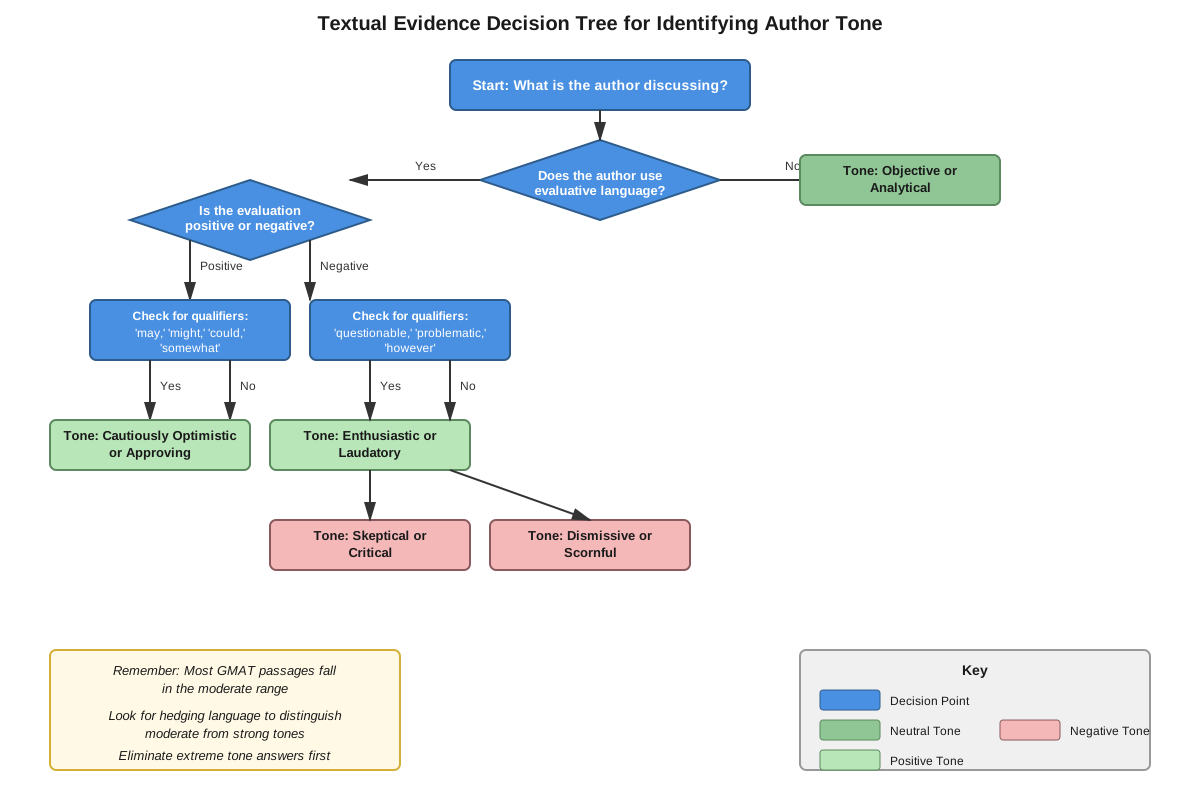
Systematic Approach to Tone Questions
Step 1: Identify the scope of the tone question. Does it ask about the author's tone toward the entire passage, a specific theory, a particular scholar's work, or a certain phenomenon? Misidentifying scope is the most common error.
Step 2: Locate relevant textual evidence before looking at answer choices. Find 3-4 specific words or phrases that reveal attitude. Look especially for:
- Adjectives and adverbs (significantly, merely, unfortunately, remarkably)
- Qualifying conjunctions (however, although, while, despite)
- Evaluative verbs (demonstrates vs. claims, proves vs. suggests)
- Emphatic or hedging language
Step 3: Determine the valence (positive, negative, or neutral) and intensity (strong, moderate, or mild). This creates a two-dimensional framework for evaluation.
Step 4: Predict an answer before reading choices. Use your own words: "The author seems supportive but notes some problems" or "The author is pretty critical of this theory."
Step 5: Eliminate systematically:
- First, eliminate wrong valence (if author is positive, eliminate all negative options)
- Second, eliminate wrong intensity (if author is moderately critical, eliminate both "dismissive" and "questioning")
- Third, choose between remaining options based on specific textual evidence
Exam Tip: When stuck between two tone descriptors, the correct answer is almost always the more moderate, qualified option. GMAT passages rarely feature extreme tones.
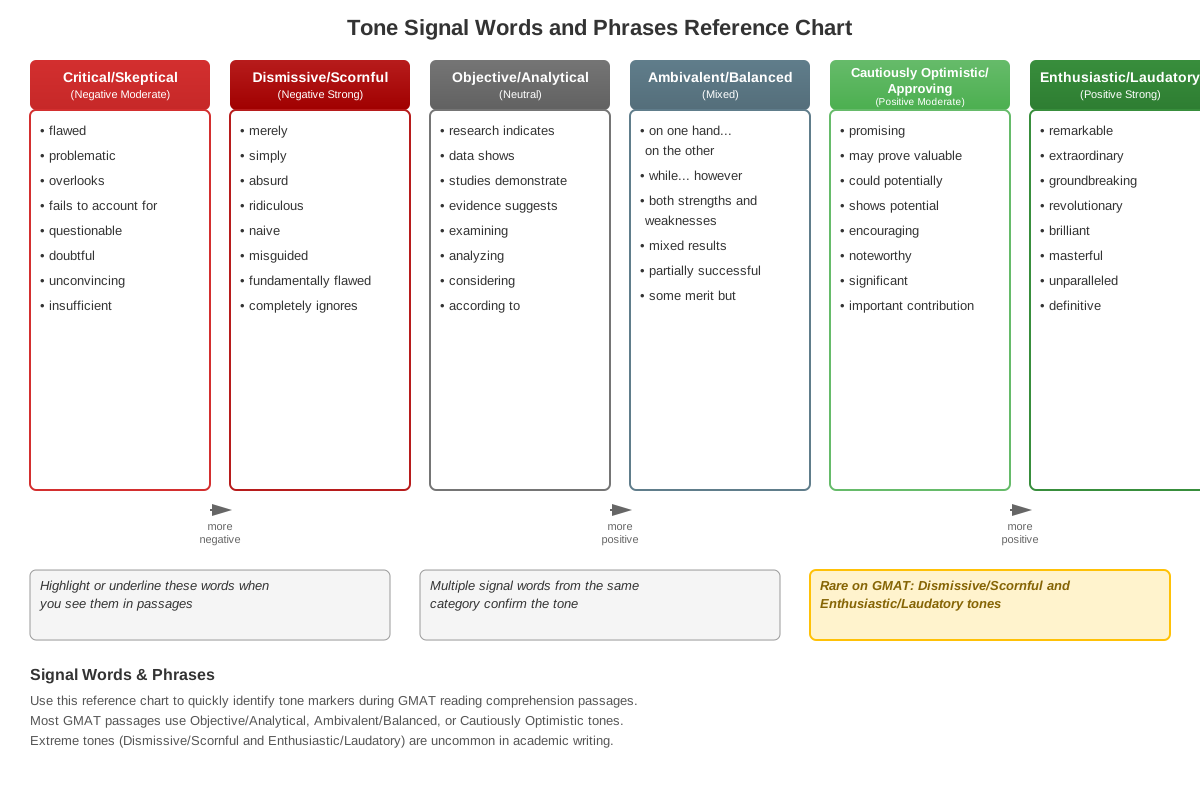
Trigger Words and Phrases
Positive Tone Triggers: significant, important, valuable, compelling, convincing, elegant, sophisticated, breakthrough, advance, successfully, effectively
Negative Tone Triggers: fails to, overlooks, neglects, unfortunately, merely, questionable, problematic, flawed, inadequate, oversimplifies
Qualifying/Cautious Tone Triggers: however, although, while, despite, yet, may, might, could, appears to, seems to, suggests, indicates
Emphatic/Confident Tone Triggers: clearly, certainly, undoubtedly, indeed, obviously, definitively, unquestionably
Time Management
Allocate approximately 30-45 seconds to tone questions. They require careful reading but shouldn't demand extensive re-reading if you've understood the passage during your initial read. If you find yourself re-reading large sections, you likely didn't adequately note tone markers during your first pass.
During initial passage reading, make mental or physical notes about tone shifts. Mark where the author transitions from presenting background (often neutral) to evaluating theories (often evaluative). This preparation makes tone questions answerable in seconds rather than requiring extensive searching.
Memory Techniques
The TONE Acronym
Textual evidence first (find specific words before choosing answers)
Overstatement elimination (remove extreme options)
Nuance matters (qualified tones are common)
Evaluate scope (tone toward what specifically?)
Tone Intensity Spectrum Visualization
Visualize tone on a number line from -5 (extremely negative) to +5 (extremely positive), with 0 as neutral:
-5: dismissive, scornful, contemptuous
-3: critical, disapproving, skeptical
-1: questioning, mildly critical, reserved
 0: objective, neutral, analytical
+1: cautiously optimistic, guardedly positive
+3: approving, supportive, optimistic
+5: enthusiastic, laudatory, admiring
Most GMAT passages fall between -3 and +3. If you're considering an answer at -5 or +5, double-check your evidence.
The "However Test"
When uncertain about tone, locate the word "however" or similar qualifiers (although, while, despite, yet). The clause after these words usually reveals the author's true position. "The theory has merit; however, it overlooks crucial evidence" = critical tone despite initial positive acknowledgment.
Qualifier Counting
Count qualifying phrases in a paragraph. Zero qualifiers + positive language = enthusiastic. Multiple qualifiers + positive language = cautiously optimistic. Multiple qualifiers + negative language = critical but not dismissive.
Summary
Author tone represents the writer's attitude and emotional stance toward subject matter, and identifying it correctly is essential for GMAT Reading Comprehension success. Tone exists on spectrums of valence (positive to negative) and intensity (strong to mild), with GMAT passages typically employing moderate, academic tones rather than extreme positions. Recognizing tone requires analyzing specific textual evidence: word choice, qualifying language, rhetorical questions, and emphatic or hedging constructions. The most common GMAT tones include objective, analytical, critical, skeptical, cautiously optimistic, and supportive—rarely extending to extremes like dismissive or enthusiastic. Tone differs from but connects to purpose and main idea, forming an integrated understanding of passage meaning. Successful tone identification involves systematic analysis: determining question scope, locating textual evidence, assessing valence and intensity, predicting answers, and eliminating options strategically. The key to mastery lies in recognizing that GMAT authors typically maintain measured, qualified positions that acknowledge complexity rather than making absolute claims.
Key Takeaways
- Author tone reflects the writer's attitude toward subject matter, revealed through word choice, qualifying language, and rhetorical devices
- GMAT passages typically feature moderate, academic tones; extreme options (dismissive, ecstatic, sarcastic) are almost always incorrect
- Qualifying words like "however," "although," and "while" are the strongest indicators of nuanced or critical tones
- Tone can vary within a passage—authors may be objective toward background information but evaluative toward specific theories
- Systematic elimination based on valence (positive/negative/neutral) and intensity (strong/moderate/mild) is the most effective strategy
- The correct answer is usually more moderate than extreme options when choosing between similar tone descriptors
- Tone questions require identifying specific textual evidence before evaluating answer choices to avoid subjective interpretation
Related Topics
Inference Questions: Understanding author tone enables more accurate inferences about what the author would likely agree or disagree with, as tone reveals underlying attitudes not explicitly stated.
Primary Purpose Questions: Recognizing whether an author writes to criticize, support, explain, or propose helps identify the passage's primary purpose, making tone analysis foundational to purpose identification.
Argument Structure Analysis: Mapping how authors present claims, evidence, and counterarguments becomes clearer when tone toward each element is understood, revealing the argumentative hierarchy.
Critical Reasoning - Strengthen/Weaken: The skills used to identify author tone—recognizing qualifying language, evaluating evidence strength, and detecting assumptions—transfer directly to Critical Reasoning questions.
Vocabulary in Context: Understanding tone helps determine whether words are used positively, negatively, or neutrally, aiding in vocabulary questions where connotation matters.
Practice CTA
Now that you've mastered the conceptual framework for identifying and analyzing author tone, it's time to apply these skills to authentic GMAT-style passages. The practice questions and flashcards will reinforce your ability to recognize subtle tonal markers, distinguish between similar tone descriptors, and eliminate incorrect answers systematically. Remember that tone recognition improves dramatically with deliberate practice—each passage you analyze strengthens your ability to quickly identify the textual evidence that reveals an author's attitude. Approach the practice materials with the systematic strategy outlined in this guide, and you'll develop the sophisticated reading skills that separate good GMAT scores from exceptional ones. Your investment in mastering author tone will pay dividends across all Reading Comprehension question types!
Sign up free to keep reading
Create a free AnvayaPrep account to finish this GMAT guide on Author tone — plus flashcards and practice questions.