Overview
The formal academic tone is a cornerstone of successful GRE Analytical Writing. This stylistic approach requires writers to adopt the conventions, vocabulary, and structural patterns expected in scholarly discourse. On the GRE, evaluators assess not only what test-takers argue but how they present their arguments. A formal academic tone demonstrates intellectual maturity, critical thinking capability, and readiness for graduate-level coursework. The distinction between casual writing and academic prose can mean the difference between a score of 3.5 and 5.5 on the 6-point scale.
Understanding and implementing GRE formal academic tone extends beyond simply avoiding contractions or slang. It encompasses precise word choice, objective presentation of ideas, sophisticated sentence structures, and appropriate hedging language that acknowledges complexity without undermining arguments. The GRE Analytical Writing section—comprising the "Analyze an Issue" and "Analyze an Argument" tasks—explicitly rewards test-takers who demonstrate command of standard written English conventions while maintaining an appropriately formal register throughout their essays.
This topic connects intimately with other Analytical Writing Style elements, including clarity, coherence, and persuasive argumentation. While formal tone provides the linguistic framework, it must work in concert with logical organization, evidence-based reasoning, and effective transitions. Mastering formal academic tone enables test-takers to present even complex or controversial positions with the credibility and authority that graduate programs seek in their candidates.
Learning Objectives
- [ ] Identify when formal academic tone is being tested in GRE Analytical Writing tasks
- [ ] Explain the core rule or strategy behind formal academic tone application
- [ ] Apply formal academic tone to GRE-style questions accurately
- [ ] Distinguish between appropriate and inappropriate register choices in academic contexts
- [ ] Transform informal expressions into academically appropriate alternatives
- [ ] Recognize and eliminate tone inconsistencies within a single essay
- [ ] Evaluate sample essays for tone appropriateness and suggest specific improvements
Prerequisites
- Basic grammar and syntax: Understanding sentence structure enables recognition of formal versus informal constructions and supports the implementation of complex sentence patterns characteristic of academic writing.
- Vocabulary fundamentals: A working vocabulary provides the foundation for selecting precise, sophisticated word choices that elevate tone without sacrificing clarity.
- Essay organization principles: Knowledge of standard essay structure (introduction, body paragraphs, conclusion) allows focus on tone refinement rather than basic compositional concerns.
- Awareness of audience and purpose: Understanding that GRE essays address an educated academic audience establishes the rationale for formal register choices.
Why This Topic Matters
Formal academic tone directly influences GRE Analytical Writing scores across multiple evaluation criteria. The official scoring rubric explicitly references "facility with the conventions of standard written English," and tone appropriateness constitutes a significant component of this assessment. Essays demonstrating consistent formal tone typically score in the 5.0–6.0 range, while those with tone inconsistencies or overly casual language rarely exceed 4.0, regardless of argument quality.
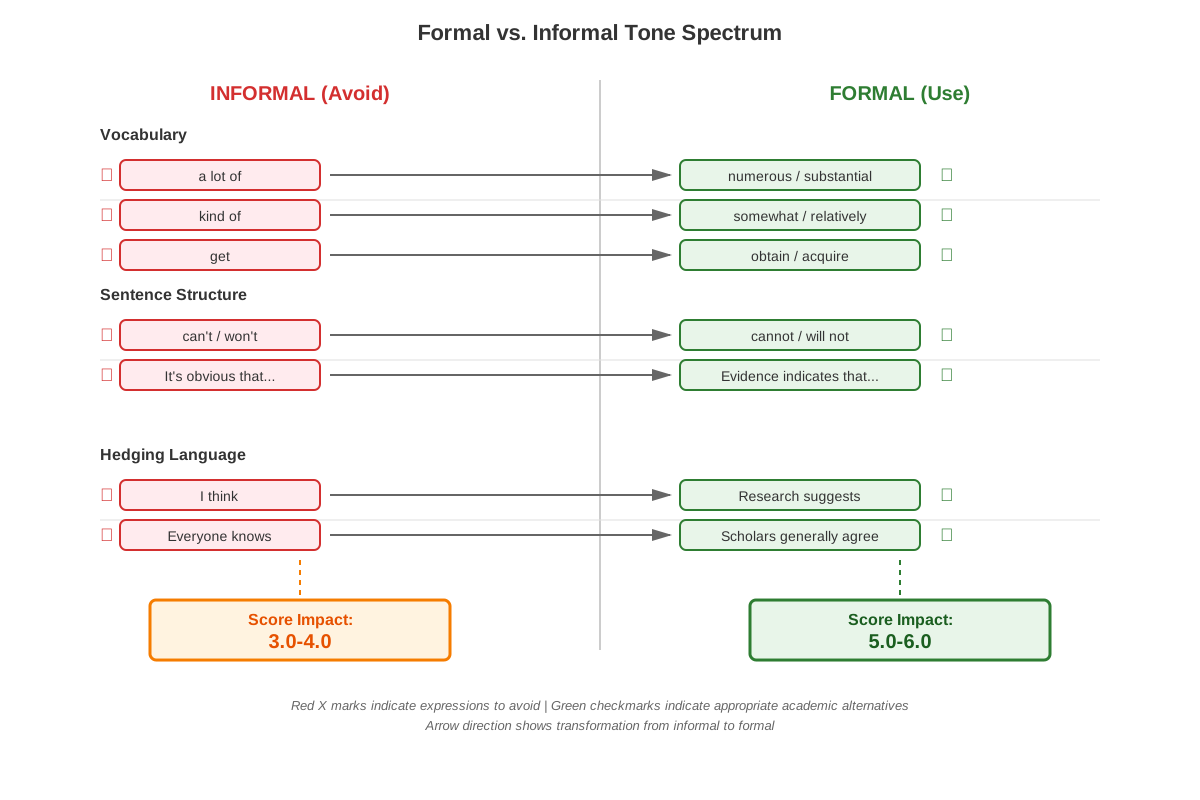
Research on GRE scoring patterns reveals that approximately 40% of score deductions in the 3.5–4.5 range relate to stylistic issues, with tone violations representing the largest subcategory. Common manifestations include conversational phrases ("a lot of," "kind of"), first-person overuse, emotional language, and colloquialisms. These elements signal to evaluators that test-takers may lack preparation for graduate-level academic discourse.
In actual GRE essays, tone assessment occurs continuously throughout the reading process. Evaluators note tone violations in margins and factor cumulative impressions into holistic scores. A single jarring informal phrase can undermine an otherwise strong argument, creating cognitive dissonance that affects overall evaluation. Conversely, maintaining consistent formal tone throughout an essay creates a "halo effect," predisposing evaluators toward favorable assessment of content and organization. Graduate programs value this skill because academic writing—from seminar papers to dissertation chapters—requires sustained formal register across extended texts.
Core Concepts
Defining Formal Academic Tone
Formal academic tone represents the linguistic register appropriate for scholarly communication, characterized by objectivity, precision, and adherence to standard written English conventions. This register avoids casual expressions, maintains emotional distance from subject matter, and employs sophisticated vocabulary and sentence structures. Unlike conversational English, which prioritizes immediacy and personal connection, academic tone emphasizes credibility, logical reasoning, and universal applicability of ideas.
The formality spectrum ranges from highly technical (research articles) to moderately formal (educated general audience). GRE essays target the moderately formal range—accessible to educated readers while demonstrating command of academic conventions. This positioning requires balance: sufficiently formal to signal academic competence without becoming stilted or inaccessible.
Key Characteristics of Formal Academic Tone
| Characteristic | Formal Academic Approach | Informal/Casual Approach |
|---|---|---|
| Contractions | Do not, cannot, will not | Don't, can't, won't |
| Personal pronouns | One might argue, researchers observe | I think, you know |
| Vocabulary | Substantial, demonstrate, facilitate | Big, show, help |
| Sentence structure | Complex and compound-complex | Simple and fragmented |
| Hedging language | May suggest, appears to indicate | Definitely proves, obviously shows |
| Colloquialisms | Avoided entirely | Common (e.g., "at the end of the day") |
| Emotional language | Restrained and objective | Emphatic and subjective |
Objectivity and Emotional Distance
Academic writing maintains analytical distance from subject matter, presenting ideas through logical reasoning rather than emotional appeal. This objectivity manifests through several techniques:
- Third-person perspective: Emphasizing ideas and evidence rather than personal opinions
- Evidence-based claims: Supporting assertions with logical reasoning, examples, or hypothetical scenarios
- Measured language: Avoiding absolute statements and hyperbole
- Balanced presentation: Acknowledging complexity and alternative viewpoints
For example, rather than writing "This argument is completely ridiculous and anyone can see it's wrong," formal academic tone requires: "This argument contains several logical flaws that undermine its persuasiveness." The revision maintains critical stance while eliminating emotional language and absolute claims.
Precision and Specificity
Formal academic tone demands precise word choice that conveys exact meaning without ambiguity. Vague qualifiers like "a lot," "things," "stuff," and "very" weaken academic prose. Instead, specific quantifiers and concrete nouns strengthen expression:
- Weak: "A lot of people think this is a very important issue."
- Strong: "Many scholars consider this a significant concern in contemporary policy debates."
Precision extends to verb choice. Academic writing favors specific action verbs over generic alternatives:
- Generic: "The author makes a point about education."
- Precise: "The author contends that education reform requires systemic intervention."
Sophisticated Sentence Structures
While clarity remains paramount, formal academic tone incorporates varied sentence structures, including complex and compound-complex constructions. This variety demonstrates linguistic sophistication and allows nuanced expression of relationships between ideas.
Simple sentences have their place for emphasis, but overreliance creates choppy, elementary-sounding prose. Consider this progression:
- All simple: "The argument has flaws. The author ignores evidence. This weakens the conclusion."
- Varied complexity: "Although the argument presents an interesting perspective, it contains several flaws. Most notably, the author ignores contradictory evidence, which significantly weakens the conclusion."
The revised version uses subordination to show logical relationships and maintains reader engagement through structural variety.
Appropriate Hedging Language
Academic discourse acknowledges uncertainty and complexity through hedging language—modal verbs and qualifying phrases that temper absolute claims. This technique demonstrates intellectual sophistication and prevents overstatement:
- Modal verbs: may, might, could, would, should
- Qualifying phrases: appears to, seems to, suggests that, indicates that
- Probability adverbs: possibly, probably, likely, potentially
However, excessive hedging undermines authority. Balance requires hedging uncertain claims while stating established facts directly:
- Appropriate hedging: "This evidence suggests that the policy may prove effective in urban contexts."
- Excessive hedging: "It might possibly seem to perhaps indicate that the policy could maybe work."
- Insufficient hedging: "This evidence proves the policy will definitely succeed everywhere."
Eliminating Informal Elements
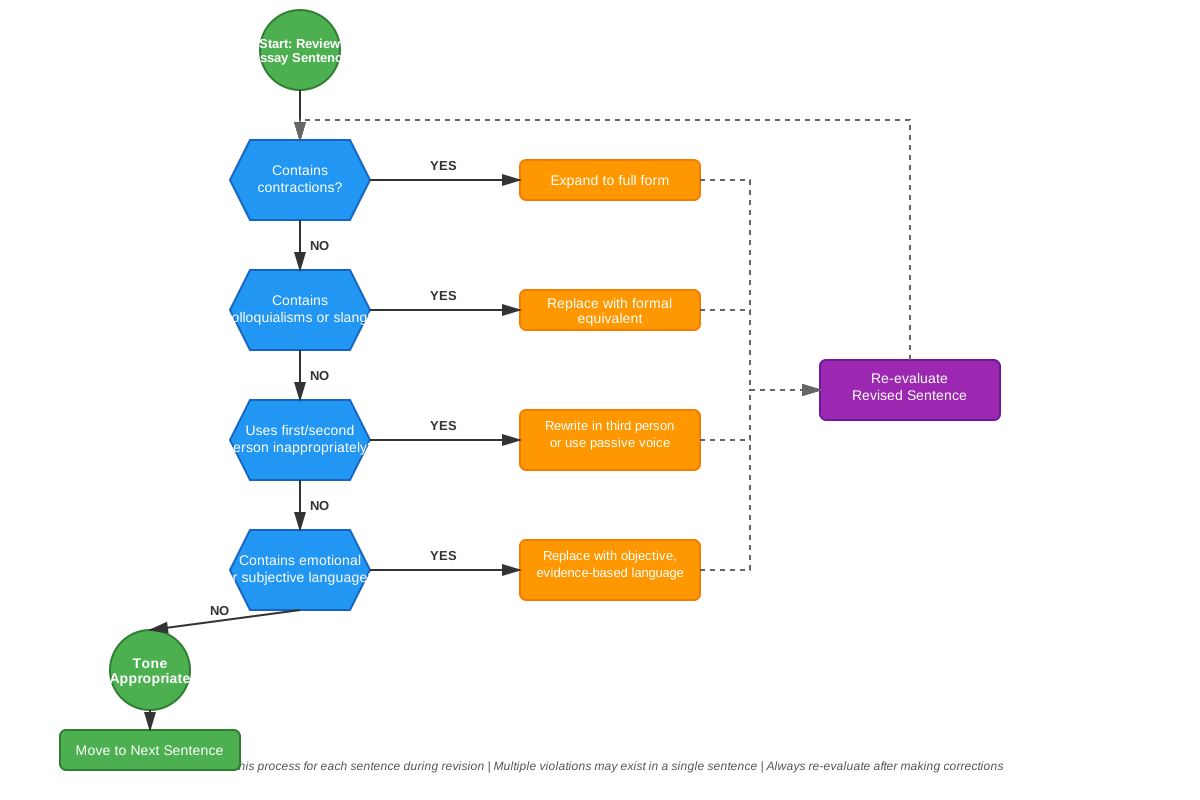
Several categories of informal language must be systematically eliminated from GRE essays:
Contractions: Always write out full forms (cannot, do not, it is) rather than contracted versions.
Colloquialisms and idioms: Phrases like "at the end of the day," "when push comes to shove," or "in a nutshell" signal casual register.
Slang and trendy language: Terms like "awesome," "totally," or "basically" undermine academic credibility.
Rhetorical questions: While occasionally acceptable in published academic writing, rhetorical questions often sound informal in GRE essays. Convert to declarative statements.
Exclamation points: Academic prose rarely requires exclamatory emphasis; periods suffice.
Abbreviations: Write out terms fully on first use, with abbreviations in parentheses if needed for subsequent references.
Maintaining Consistency
Tone consistency throughout an essay proves as important as initial tone establishment. A common error involves beginning formally but gradually shifting toward casual language as time pressure increases. Strategies for maintaining consistency include:
- Mentally reviewing tone expectations before writing each paragraph
- Avoiding first-person pronouns except when specifically discussing personal experience (rare in GRE tasks)
- Reading sentences mentally before writing to detect informal phrasing
- Reserving final minutes for tone-focused proofreading
Concept Relationships
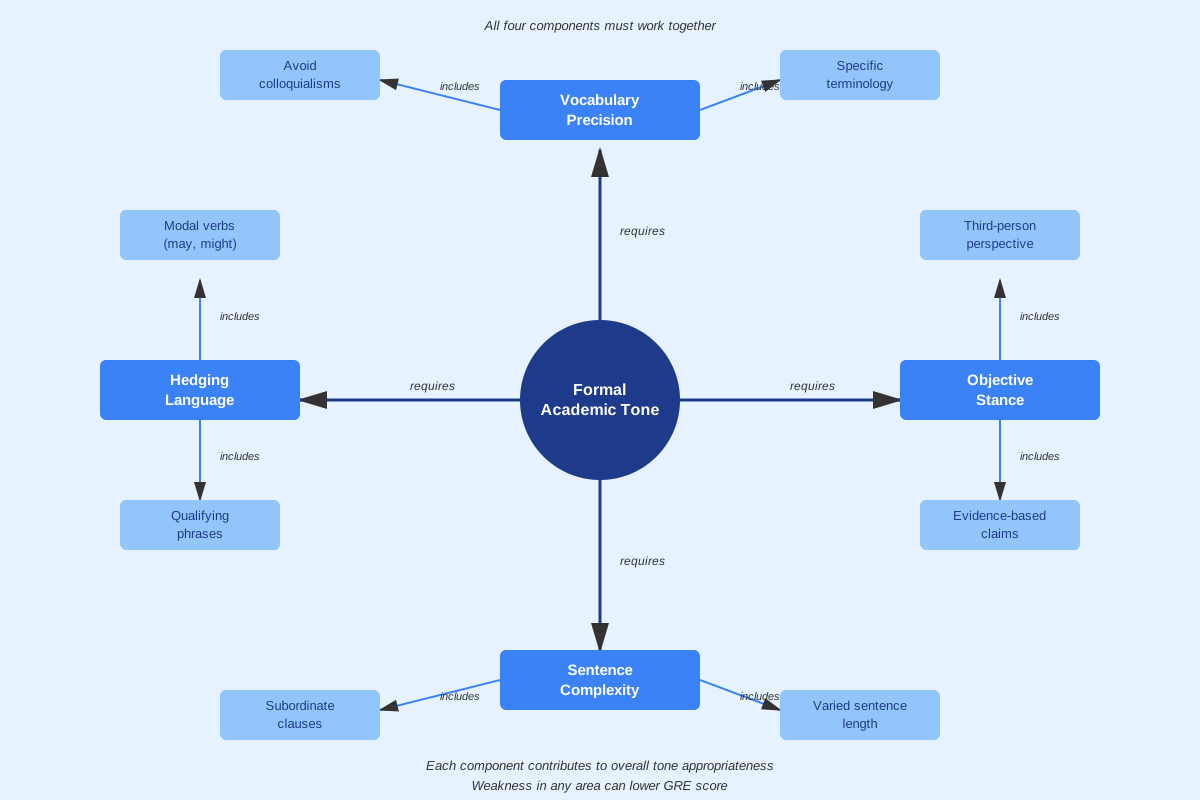
The components of formal academic tone function interdependently to create overall register appropriateness. Precision and specificity → enables → objectivity by replacing vague emotional language with concrete descriptors. Sophisticated sentence structures → supports → hedging language by providing grammatical frameworks for expressing nuanced positions. Elimination of informal elements → establishes baseline → formal register upon which other characteristics build.
Formal academic tone connects to prerequisite knowledge of grammar and vocabulary, as these provide the tools for implementing tone requirements. It also relates closely to other Analytical Writing Style elements: clarity (formal tone must not sacrifice comprehensibility), coherence (transitions and logical flow complement formal register), and persuasive argumentation (formal tone enhances credibility of claims).
The relationship flows: Grammar/Vocabulary foundation → Formal tone implementation → Enhanced credibility → Stronger persuasive impact → Higher GRE scores. Each element reinforces others, creating cumulative effect greater than individual components.
High-Yield Facts
⭐ Contractions never appear in formal academic writing; always use full forms (do not, cannot, will not).
⭐ First-person pronouns (I, me, my) should be minimized or eliminated in GRE Analytical Writing unless specifically discussing personal experience.
⭐ Colloquialisms and idioms immediately signal informal register and should be replaced with standard academic expressions.
⭐ Hedging language (may, might, suggests, appears) demonstrates intellectual sophistication by acknowledging complexity and uncertainty.
⭐ Precise vocabulary elevates tone more effectively than complex sentence structures alone; word choice carries significant weight in tone assessment.
- Rhetorical questions typically sound informal in GRE essays and should be converted to declarative statements.
- Emotional language (outrageous, ridiculous, wonderful, terrible) undermines objectivity and should be replaced with measured analytical terms.
- Exclamation points rarely appear in academic prose; periods provide appropriate sentence termination.
- Vague quantifiers (a lot, many, some) weaken precision; specific numbers or qualified terms (numerous, several, a significant proportion) strengthen academic tone.
- Sentence fragments, while occasionally used for emphasis in published writing, generally signal informal register in timed GRE essays.
Quick check — test yourself on Formal academic tone so far.
Try Flashcards →Common Misconceptions
Misconception: Formal academic tone requires using the most complex vocabulary possible, even when simpler words would be clearer.
Correction: Formal tone prioritizes precision and clarity over complexity. Appropriate academic vocabulary should be sophisticated yet accessible, never obscure or pretentious. The goal is clear communication within formal register, not vocabulary display.
Misconception: All personal pronouns must be eliminated from academic writing, including "we" and "one."
Correction: While first-person singular (I, me, my) should be minimized, "we" can be appropriate when referring to writer and reader collectively ("we can observe that..."), and "one" serves as a formal alternative to "you." The key is avoiding excessive focus on personal opinion rather than eliminating all pronouns.
Misconception: Longer sentences always sound more formal and academic than shorter ones.
Correction: Sentence length variation, not length alone, characterizes sophisticated academic prose. Strategic use of shorter sentences for emphasis, combined with longer complex sentences for nuanced ideas, creates more effective formal tone than uniformly long sentences.
Misconception: Hedging language makes arguments sound weak and uncertain.
Correction: Appropriate hedging demonstrates intellectual maturity by acknowledging complexity and avoiding overstatement. It strengthens rather than weakens arguments by showing awareness of limitations and alternative perspectives. The distinction lies between appropriate hedging of uncertain claims and excessive hedging that undermines all assertions.
Misconception: Formal academic tone means avoiding all contractions, so phrases like "it's important" should become "it is important," but other informal elements can remain.
Correction: Formal tone requires comprehensive attention to all register markers, not just contractions. Eliminating contractions while retaining colloquialisms, emotional language, or vague expressions fails to achieve consistent formal register. All elements must align with academic conventions.
Worked Examples
Example 1: Transforming Informal to Formal Tone
Original informal passage:
"I think the author's argument is pretty weak because they don't really prove their point. A lot of people would disagree with this idea, and it's kind of obvious that there are tons of problems with it. At the end of the day, this argument just doesn't work."
Analysis of tone violations:
- "I think" - first-person opinion statement
- "pretty weak" - vague qualifier and casual intensifier
- "don't really prove" - contraction and vague expression
- "A lot of people" - imprecise quantifier
- "kind of obvious" - colloquialism and hedging that weakens rather than strengthens
- "tons of problems" - casual quantifier
- "At the end of the day" - colloquialism
- "just doesn't work" - contraction and overly simple expression
Formal academic revision:
"The author's argument contains several significant weaknesses that undermine its persuasiveness. The central claim lacks sufficient evidentiary support, and many readers would likely question the underlying assumptions. Multiple logical flaws compromise the argument's validity. Ultimately, these deficiencies prevent the argument from achieving its intended purpose."
Improvements demonstrated:
- Eliminated first-person perspective
- Replaced vague qualifiers with specific terms
- Removed all contractions
- Used precise quantifiers
- Eliminated colloquialisms
- Employed sophisticated vocabulary while maintaining clarity
- Varied sentence structures for engagement
Example 2: Analyzing and Improving Tone Consistency
Original passage with mixed tone:
"Contemporary educational policy faces numerous challenges in the 21st century. Technological advancement has transformed pedagogical approaches, necessitating substantial curriculum revision. But honestly, a lot of teachers aren't really prepared for these changes. It's super important that we give them better training. The integration of digital resources into traditional classroom environments requires careful planning and implementation."
Analysis:
The passage begins with strong formal tone (first two sentences) but shifts dramatically to informal register in the middle section. The final sentence returns to formal tone, creating jarring inconsistency.
Specific violations in middle section:
- "But honestly" - conversational transition
- "a lot of teachers" - imprecise quantifier
- "aren't really prepared" - contraction and vague expression
- "It's super important" - contraction and casual intensifier
- "we give them" - first-person plural with casual phrasing
Revised passage with consistent formal tone:
"Contemporary educational policy faces numerous challenges in the 21st century. Technological advancement has transformed pedagogical approaches, necessitating substantial curriculum revision. However, many educators lack adequate preparation for these pedagogical shifts. Professional development programs must provide comprehensive training in emerging instructional technologies. The integration of digital resources into traditional classroom environments requires careful planning and implementation."
Key improvements:
- Replaced "But honestly" with "However" (formal transition)
- Changed "a lot of teachers" to "many educators" (precise quantifier, formal noun)
- Eliminated contraction and strengthened verb choice
- Transformed "It's super important that we give them" to "Professional development programs must provide" (removed contraction, casual intensifier, and first-person plural; added specific subject and strong modal verb)
- Maintained consistent formal register throughout
Exam Strategy
Approaching GRE Analytical Writing with Tone Awareness
Before beginning to write, mentally commit to maintaining formal academic tone throughout the essay. This conscious intention prevents unconscious drift toward casual register under time pressure. Allocate approximately 2 minutes at the end of the 30-minute writing period specifically for tone-focused proofreading.
Trigger Words and Phrases to Watch For
During proofreading, scan specifically for these high-frequency tone violations:
Contractions: don't, can't, won't, it's, that's, there's, isn't, aren't, wasn't, weren't
Casual intensifiers: really, very, pretty, quite, so, super, totally
Vague quantifiers: a lot, lots, tons, loads, bunch
Colloquial transitions: at the end of the day, when all is said and done, in a nutshell, bottom line
First-person overuse: I think, I believe, I feel, in my opinion, personally
Casual verbs: get, got, gotten (often replaceable with more precise alternatives)
Process-of-Elimination for Tone Issues
When proofreading under time constraints, prioritize corrections by impact:
- Highest priority: Contractions (quick fixes with significant impact)
- High priority: Colloquialisms and slang (usually require phrase-level revision)
- Medium priority: First-person pronouns (may require sentence restructuring)
- Lower priority: Vague quantifiers (important but less jarring than contractions)
This hierarchy ensures maximum tone improvement even if time runs short.
Time Allocation Advice
Within the 30-minute essay period:
- Minutes 1-3: Planning and outlining (establish formal tone intention)
- Minutes 4-26: Writing (maintain tone awareness while drafting)
- Minutes 27-28: Content and organization review
- Minutes 29-30: Tone-focused proofreading (scan for violations listed above)
Exam Tip: If time pressure forces a choice between adding more content and proofreading for tone, choose proofreading. A shorter essay with consistent formal tone typically scores higher than a longer essay with tone violations.
Pre-Writing Mental Checklist
Before writing the first sentence, mentally review:
- Avoid all contractions
- Minimize first-person pronouns
- Use precise, sophisticated vocabulary
- Maintain objectivity and emotional distance
- Vary sentence structures while prioritizing clarity
This brief mental review (15-20 seconds) establishes tone awareness that persists throughout writing.
Memory Techniques
The "CAFE" Acronym for Formal Tone
Contractions - eliminate completely
Avoid first-person and emotional language
Formal vocabulary - precise and sophisticated
Elevated sentence structures - varied and complex
Visualization Strategy: The Academic Audience
Visualize writing for a specific professor or academic committee reviewing graduate school applications. This mental image naturally elevates register and prevents casual phrasing. Imagine this audience reading each sentence and adjust language accordingly.
The "Three-Second Rule"
Before writing each sentence, pause for three seconds to mentally "hear" it. If it sounds like something spoken in casual conversation, revise mentally before writing. This brief pause prevents tone violations from reaching the page.
Mnemonic for Common Contractions to Avoid
"Don't Can't Won't It's" - memorize this phrase as a reminder of the four most common contractions that appear in GRE essays. During proofreading, scan specifically for these four, which account for approximately 70% of contraction violations.
The Formality Spectrum Image
Visualize a horizontal line with "Text message to friend" on the left and "Doctoral dissertation" on the right. GRE essays should fall at approximately 70% toward the right—formal but not inaccessibly technical. This mental image helps calibrate appropriate register.
Summary
Formal academic tone represents a critical component of GRE Analytical Writing success, directly influencing scores across multiple evaluation criteria. This register requires elimination of contractions, colloquialisms, and excessive first-person perspective while incorporating precise vocabulary, sophisticated sentence structures, and appropriate hedging language. The key to mastering formal tone lies in understanding that it encompasses comprehensive attention to all register markers, not isolated elements. Successful test-takers maintain consistent formal tone throughout essays by establishing conscious intention before writing, monitoring register during drafting, and conducting focused proofreading in final minutes. The distinction between casual and academic prose manifests through specific, identifiable features that can be systematically learned and applied. Formal academic tone enhances argument credibility, demonstrates readiness for graduate-level discourse, and creates favorable impressions that influence holistic scoring. By internalizing the characteristics of formal register and practicing their application, test-takers can reliably achieve the tone consistency that distinguishes high-scoring essays from mediocre ones.
Key Takeaways
- Formal academic tone is non-negotiable on the GRE Analytical Writing section; tone violations limit scores regardless of argument quality
- Eliminate all contractions without exception; this single change significantly elevates perceived formality
- Precision in word choice matters more than vocabulary complexity; sophisticated yet clear language demonstrates true academic competence
- Consistency throughout the essay proves as important as initial tone establishment; maintain vigilance from introduction through conclusion
- Appropriate hedging strengthens rather than weakens arguments by demonstrating intellectual sophistication and awareness of complexity
- Allocate specific time for tone-focused proofreading; the final 2 minutes should target register violations systematically
- Balance formality with accessibility; GRE essays should be formal but not impenetrably technical or pretentious
Related Topics
Clarity and Concision in Academic Writing: Building on formal tone foundations, this topic addresses how to maintain sophisticated register while ensuring ideas remain accessible and efficiently expressed. Mastering formal tone enables focus on refining clarity without sacrificing academic credibility.
Effective Transitions and Coherence: Formal academic tone provides the linguistic framework within which transitions operate. Understanding tone conventions allows selection of appropriately formal transitional phrases that maintain register consistency while guiding readers through arguments.
Evidence and Example Integration: Once formal tone is established, the next progression involves incorporating evidence and examples while maintaining register. This skill requires balancing specific details with formal expression.
Argument Analysis Techniques: Formal tone serves as the vehicle for delivering analytical insights. After mastering tone, students can focus on deepening analytical sophistication while maintaining appropriate register.
Issue Essay Development Strategies: The application of formal tone to the "Analyze an Issue" task requires understanding how to present personal positions within academic conventions, building on foundational tone competence.
Practice CTA
Now that the foundations of formal academic tone are established, the next step involves applying these principles to actual GRE-style writing tasks. The practice questions and flashcards provide opportunities to identify tone violations, transform informal passages into formal academic prose, and develop the automatic awareness that enables consistent register maintenance under timed conditions. Approach these practice materials with the same conscious intention to maintain formal tone that will guide actual test performance. Each practice attempt strengthens the mental habits that distinguish high-scoring essays. The investment in mastering formal academic tone yields returns across both Analytical Writing tasks and establishes skills valuable throughout graduate education. Begin practicing immediately to internalize these principles before test day.
Sign up free to keep reading
Create a free AnvayaPrep account to finish this GRE guide on Formal academic tone — plus flashcards and practice questions.