Overview
Logical flow is the backbone of effective analytical writing on the GRE. It refers to the coherent, sequential progression of ideas within and between sentences and paragraphs, ensuring that readers can follow the writer's argument without confusion or unnecessary effort. On the GRE Analytical Writing section, gre logical flow is not merely a stylistic preference—it is a fundamental criterion that graders evaluate when assessing both the Issue and Argument essays. Essays that demonstrate strong logical flow guide readers smoothly from thesis to supporting evidence to conclusion, making the writer's reasoning transparent and persuasive.
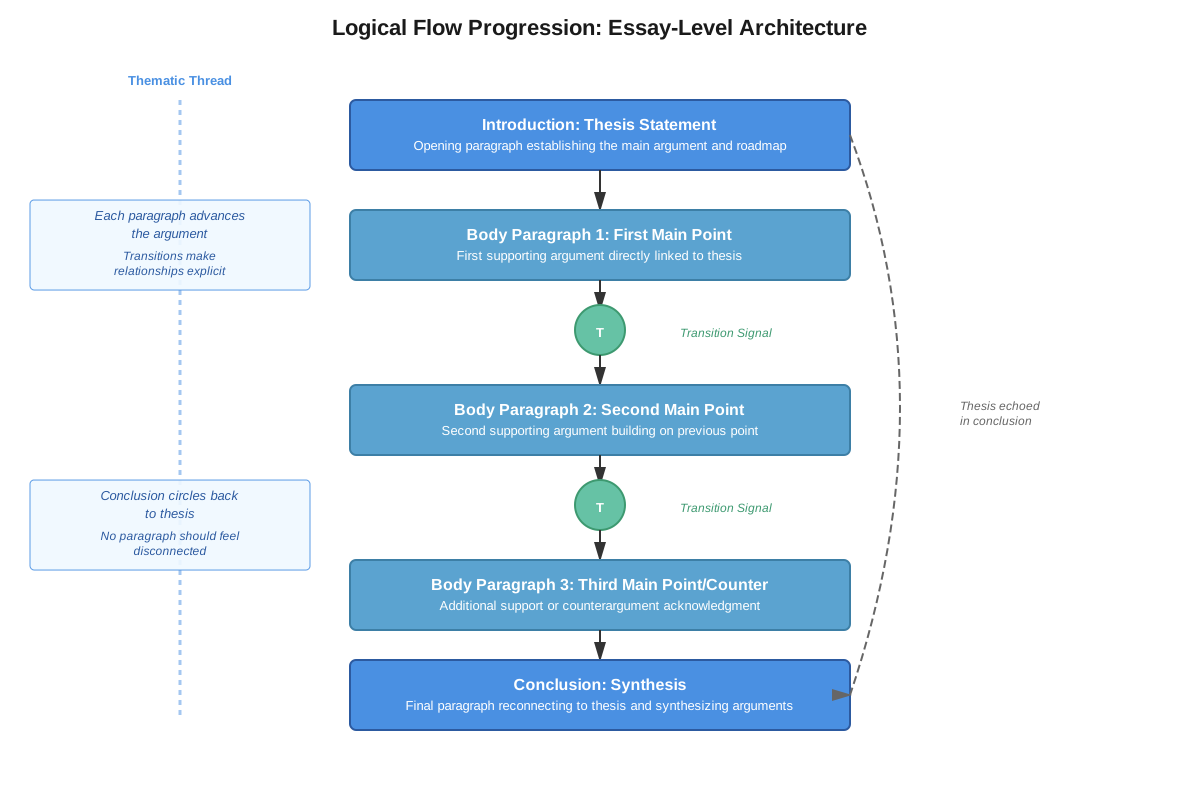
The importance of logical flow extends beyond individual sentence construction. It encompasses the strategic arrangement of paragraphs, the use of appropriate transitional devices, and the maintenance of thematic coherence throughout the essay. When logical flow is strong, each sentence naturally leads to the next, each paragraph builds upon previous ideas, and the overall argument unfolds with clarity and purpose. Conversely, essays lacking logical flow appear disjointed, confusing, and unconvincing—even when they contain valid points and sophisticated vocabulary.
Within the broader context of Analytical Writing Style, logical flow works in concert with other essential elements such as sentence variety, word choice, and grammatical precision. While these other components contribute to the sophistication and readability of an essay, logical flow serves as the organizational framework that holds everything together. Mastering logical flow enables test-takers to present complex arguments in a manner that is both intellectually rigorous and accessible to readers, directly impacting scores across multiple evaluation criteria including "organization," "development," and "coherence."
Learning Objectives
- [ ] Identify when Logical flow is being tested in GRE essay prompts and scoring criteria
- [ ] Explain the core rule or strategy behind Logical flow in analytical writing
- [ ] Apply Logical flow to GRE-style questions accurately
- [ ] Diagnose logical flow problems in sample essay passages
- [ ] Construct topic sentences that establish clear directional signals for paragraphs
- [ ] Select and implement appropriate transitional devices to connect ideas seamlessly
- [ ] Revise disjointed passages to improve coherence and sequential reasoning
Prerequisites
- Basic paragraph structure: Understanding topic sentences, supporting details, and concluding sentences is essential because logical flow operates at both the sentence and paragraph level
- Fundamental argumentation: Familiarity with claims, evidence, and reasoning enables recognition of how ideas should connect logically
- Sentence construction: Competence in writing grammatically correct sentences provides the foundation upon which logical connections are built
- GRE essay format: Knowledge of the Issue and Argument essay requirements helps contextualize where and why logical flow matters most
Why This Topic Matters
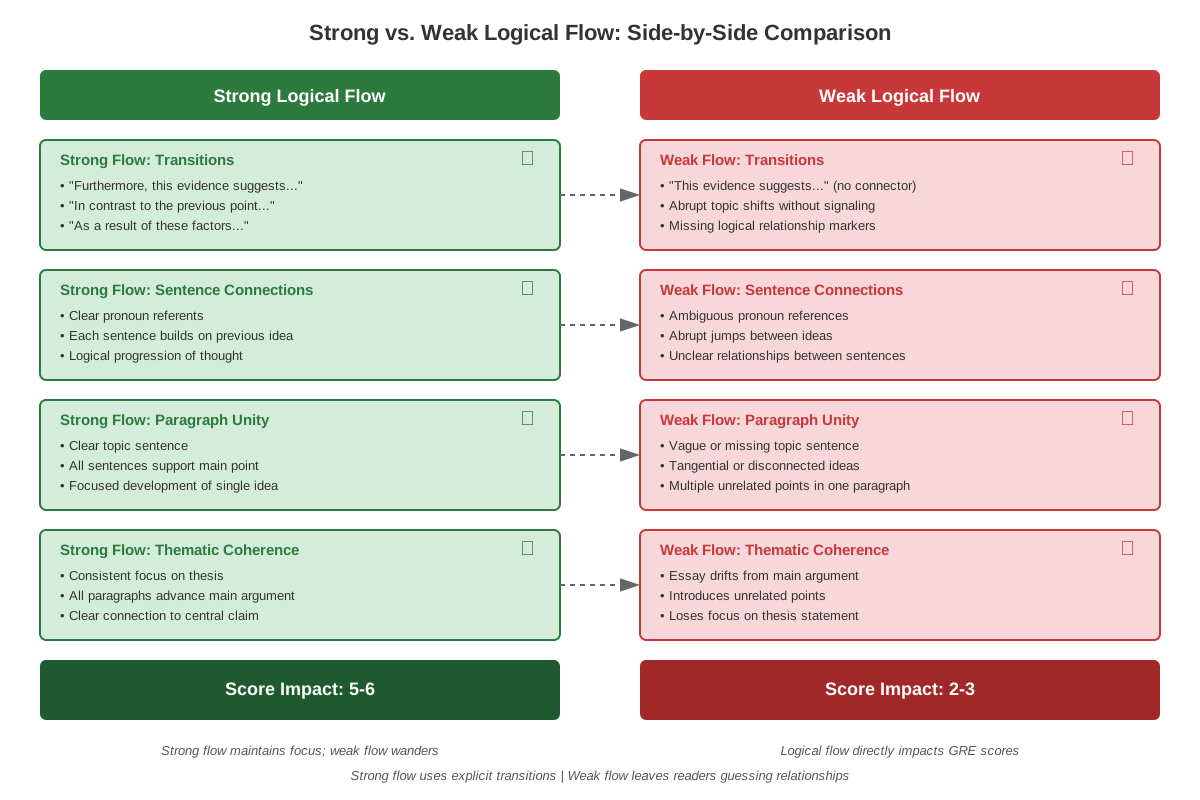
Logical flow directly impacts GRE Analytical Writing scores across multiple dimensions. According to ETS scoring guidelines, essays receiving scores of 5 or 6 (out of 6) consistently demonstrate "clear, well-organized development" and "effective transitions between ideas." In contrast, essays scoring 3 or below typically exhibit "unclear or disorganized structure" and "inadequate transitions." This means that logical flow can account for a 2-3 point difference in essay scores—a substantial margin that can significantly affect overall GRE performance and graduate school applications.
In real-world academic and professional contexts, logical flow determines whether complex arguments are understood and accepted. Graduate-level coursework requires students to construct research papers, literature reviews, and analytical reports where ideas must progress systematically. Professional environments demand clear communication in proposals, reports, and presentations. The logical flow skills developed for the GRE translate directly to these high-stakes communication scenarios, making this topic valuable far beyond test day.
On the GRE, logical flow appears in every analytical writing task. In Issue essays, graders assess whether the writer's position develops coherently through well-connected supporting paragraphs. In Argument essays, evaluators look for logical progression through the critique, with each flaw or assumption discussed in a sequence that builds the overall analysis. Common manifestations include: transitions between paragraphs that signal shifts in focus, sentences within paragraphs that follow a cause-effect or general-to-specific pattern, and conclusions that logically emerge from preceding discussion rather than introducing entirely new ideas.
Core Concepts
Definition and Components of Logical Flow
Logical flow encompasses three interconnected dimensions: coherence (the logical connection between ideas), cohesion (the linguistic devices that signal these connections), and progression (the strategic sequencing of information). Coherence ensures that each idea relates meaningfully to surrounding ideas and to the overall thesis. Cohesion involves the explicit use of transitional words, pronouns, repetition, and parallel structure to create visible links between sentences. Progression refers to the deliberate ordering of ideas—whether chronological, spatial, importance-based, or logical (cause-effect, problem-solution, general-specific).
These three components work synergistically. An essay might have coherent ideas (all relevant to the thesis) but lack cohesion (no transitional markers), resulting in a choppy reading experience. Alternatively, an essay might use abundant transitions but lack coherence (ideas don't actually connect logically), creating an illusion of flow without substance. Effective logical flow requires attention to all three dimensions simultaneously.
Paragraph-Level Logical Flow
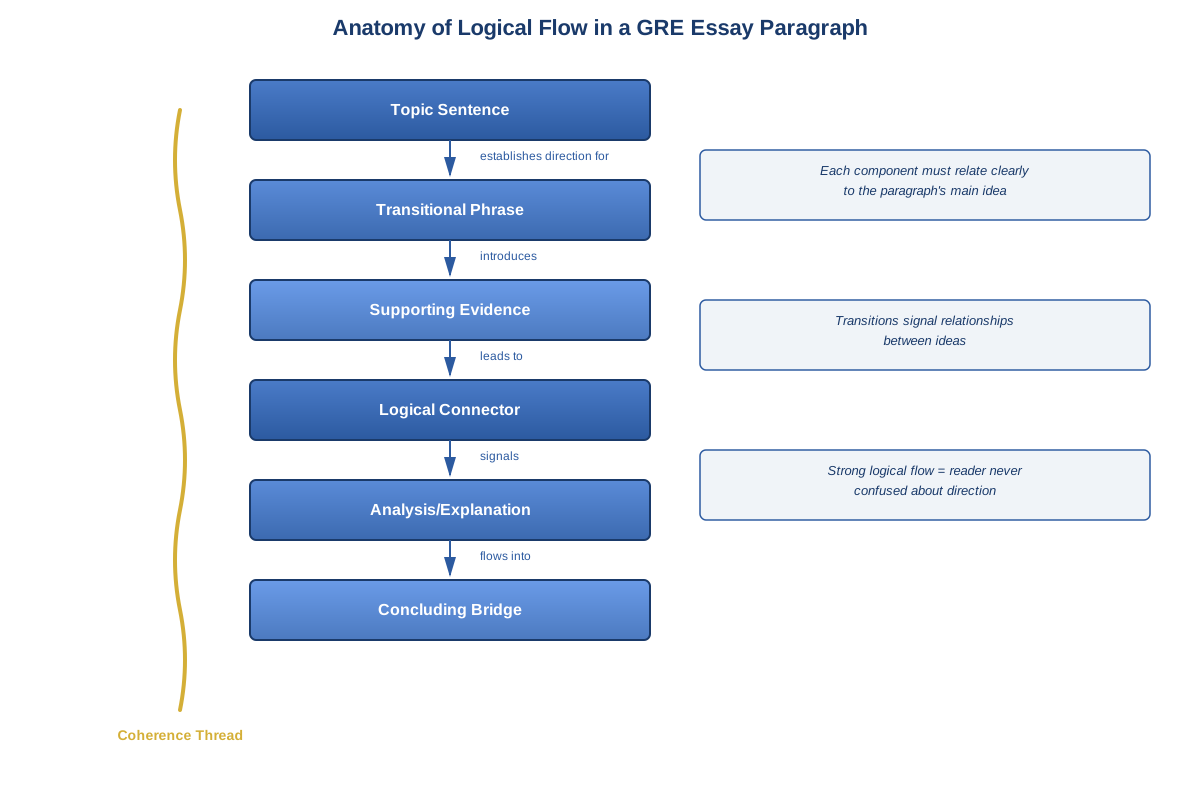
Each paragraph should function as a self-contained unit of thought while contributing to the essay's overall argument. Strong paragraph-level logical flow begins with a topic sentence that clearly states the paragraph's main idea and connects it to the thesis. Subsequent sentences should develop this idea through a recognizable pattern:
- Topic sentence: Introduces the paragraph's focus
- Explanation/elaboration: Clarifies or expands the main idea
- Evidence/examples: Provides specific support
- Analysis: Explains how the evidence supports the claim
- Transition/conclusion: Links to the next paragraph or reinforces the point
This structure creates predictability that helps readers follow complex arguments. Deviations from this pattern should be intentional and serve a specific rhetorical purpose.
Sentence-Level Logical Flow
Within paragraphs, sentences must connect through clear logical relationships. Common patterns include:
| Relationship Type | Description | Example Transitions |
|---|---|---|
| Addition | Adding similar or supporting ideas | furthermore, moreover, additionally, also |
| Contrast | Presenting opposing or different ideas | however, nevertheless, conversely, in contrast |
| Cause-Effect | Showing consequences or results | therefore, consequently, as a result, thus |
| Example | Providing specific instances | for instance, specifically, to illustrate |
| Sequence | Indicating order or steps | first, subsequently, finally, next |
| Emphasis | Highlighting importance | indeed, in fact, notably, especially |
Effective writers select transitions that accurately reflect the logical relationship between ideas. Using "however" when the relationship is actually cause-effect creates confusion, even if both sentences are individually clear.
Information Ordering Strategies
The sequence in which information appears significantly affects logical flow. Several organizational patterns serve different rhetorical purposes:
Deductive progression moves from general principles to specific applications, ideal for Issue essays where a thesis is supported by particular examples. Inductive progression moves from specific observations to general conclusions, useful when building toward a claim through accumulated evidence. Climactic order arranges points from least to most important, creating momentum and ending with the strongest argument. Problem-solution structure first establishes an issue then presents remedies, common in both essay types when discussing implications or recommendations.
Choosing the appropriate pattern depends on the essay prompt and the writer's strategic goals. However, once a pattern is established, maintaining consistency is crucial for logical flow.
Cohesive Devices Beyond Transitions
While transitional words are important, other linguistic tools contribute to logical flow. Pronoun reference creates connections by referring back to previously mentioned nouns, but requires clear antecedents to avoid confusion. Repetition of key terms reinforces thematic continuity, though excessive repetition becomes monotonous. Parallel structure signals that ideas are equivalent in importance or function, as in "The policy is ineffective, expensive, and unpopular" where the three adjectives create a cohesive list. Demonstrative pronouns (this, that, these, those) explicitly point to previous ideas, though they should typically be followed by a noun for clarity (e.g., "this assumption" rather than just "this").
Maintaining Thematic Unity
Logical flow requires that all content relates to the central thesis. Thematic unity means every paragraph, every sentence, and every example serves the essay's main argument. Tangential information, no matter how interesting or well-written, disrupts logical flow by pulling readers away from the argumentative thread. Writers should regularly ask: "How does this sentence advance my thesis?" If the connection isn't clear, the sentence likely needs revision or removal.
Signposting and Reader Guidance
Effective essays include signposts—explicit statements that orient readers to the essay's structure and direction. These might include: forecasting statements in the introduction ("This essay will examine three key assumptions"), transitional sentences between paragraphs ("Having established X, we now turn to Y"), and summary statements before conclusions ("These three examples demonstrate that..."). Signposting makes the essay's logical architecture visible, helping readers follow even complex arguments.
Concept Relationships
The concepts within logical flow form a hierarchical and interdependent system. At the foundation lies coherence—the logical connection between ideas—which determines whether an essay's content makes sense. Built upon coherence is cohesion, the linguistic mechanisms that make these logical connections explicit to readers. Together, coherence and cohesion enable progression, the strategic sequencing of information that creates forward momentum in an argument.
Paragraph-level flow depends on sentence-level flow; if individual sentences don't connect logically, the paragraph as a whole will feel disjointed. Conversely, strong sentence connections cannot compensate for poorly organized paragraphs. Both levels require appropriate information ordering strategies and cohesive devices to function effectively.
Thematic unity acts as a governing principle that constrains all other elements—it determines which ideas belong in the essay and in what order they should appear. Signposting serves as the interface between the writer's organizational decisions and the reader's comprehension, making the essay's logical structure transparent.
The relationship map flows as follows:
Thematic Unity (governs) → Coherence (enables) → Cohesion (makes visible) → Progression (creates)
↓
Paragraph-Level Flow (comprises) → Sentence-Level Flow (uses) → Cohesive Devices + Information Ordering
↓
Signposting (clarifies all of the above for readers)
This interconnected system means that weakness in any component compromises overall logical flow. Conversely, strengthening one element often improves others—for example, clarifying thematic unity naturally improves paragraph organization.
High-Yield Facts
⭐ Logical flow is explicitly evaluated in GRE scoring rubrics under "organization" and "coherence" criteria, directly impacting scores
⭐ Topic sentences should contain both the paragraph's main idea and a connection to the thesis or previous paragraph
⭐ Transitional words must accurately reflect the logical relationship between ideas; mismatched transitions confuse readers
⭐ Each paragraph should follow a recognizable internal structure: topic sentence, development, evidence, analysis, transition
⭐ The strongest essays use varied transitional devices including words, pronouns, repetition, and parallel structure—not just transitional words
- Deductive organization (general to specific) is typically most effective for GRE Issue essays
- Inductive organization (specific to general) can be effective when building toward a complex claim
- Demonstrative pronouns (this, that) should be followed by a noun for clarity (e.g., "this assumption" not just "this")
- Signposting statements in introductions and between major sections significantly improve perceived organization
- Every sentence should have a clear answer to "Why is this here?" in relation to the thesis
- Paragraphs typically should not exceed 6-8 sentences; longer paragraphs often contain multiple ideas that should be separated
- The conclusion should emerge logically from preceding discussion without introducing entirely new arguments
- Chronological organization is rarely the best choice for analytical essays unless time sequence is central to the argument
- Overuse of simple transitions (and, but, so) signals weak logical flow; more precise transitions strengthen connections
- Reading the essay's topic sentences in sequence should reveal a coherent outline of the argument
Quick check — test yourself on Logical flow so far.
Try Flashcards →Common Misconceptions
Misconception: Using many transitional words automatically creates good logical flow → Correction: Logical flow requires that ideas actually connect meaningfully; transitions only make existing connections visible. Overusing transitions without underlying coherence creates a superficial appearance of organization without substance. The logical relationship between ideas must exist first; transitions then signal this relationship to readers.
Misconception: Each paragraph should discuss only one sentence worth of ideas → Correction: Each paragraph should develop one main idea, but this development typically requires multiple sentences including explanation, evidence, and analysis. A fully developed paragraph usually contains 4-7 sentences that explore different facets of a single point.
Misconception: Logical flow means following a rigid five-paragraph essay structure → Correction: While the five-paragraph format can provide basic organization, strong logical flow adapts structure to the argument's needs. Complex GRE prompts often require more than three body paragraphs, and the most effective essays organize content according to logical relationships rather than arbitrary paragraph counts.
Misconception: Starting every paragraph with "First," "Second," "Third" creates logical flow → Correction: These simple sequential markers indicate order but don't explain logical relationships. More sophisticated transitions explain why ideas appear in a particular sequence and how each paragraph relates to the thesis (e.g., "Beyond these economic concerns, the policy also raises ethical questions").
Misconception: Repeating words is always bad for style, so synonyms should be used constantly → Correction: Strategic repetition of key terms actually strengthens logical flow by maintaining thematic continuity. While varying vocabulary prevents monotony, constantly substituting synonyms for central concepts can confuse readers about whether the writer is discussing the same idea or introducing new ones.
Misconception: Logical flow only matters between paragraphs, not within them → Correction: Sentence-level logical flow within paragraphs is equally important. Readers must follow the progression of ideas from sentence to sentence, and weak internal connections make paragraphs feel choppy and difficult to comprehend, even if paragraph-to-paragraph transitions are strong.
Misconception: The conclusion should introduce new evidence to end strongly → Correction: Introducing new arguments or evidence in the conclusion disrupts logical flow by suggesting the essay is incomplete. Conclusions should synthesize and reinforce points already made, perhaps extending implications but not presenting fresh core arguments that require development.
Worked Examples
Example 1: Improving Paragraph-Level Logical Flow
Original Passage (weak logical flow):
"Technology has changed education significantly. Online learning platforms allow students to access courses from anywhere. Traditional classrooms provide face-to-face interaction. Many universities now offer hybrid programs. Students have different learning preferences. Technology costs money to implement. Teachers need training to use new tools effectively."
Analysis: This paragraph lacks logical flow because sentences appear in random order without clear connections. The topic sentence is vague, ideas jump between different aspects of technology in education, and no transitions guide readers through the discussion.
Revised Passage (strong logical flow):
"Technology has fundamentally transformed educational delivery, creating both opportunities and challenges for institutions. Most notably, online learning platforms now allow students to access courses from anywhere, breaking down geographical barriers that once limited educational access. However, this convenience comes at the cost of face-to-face interaction, which traditional classrooms naturally provide and which many students find essential for engagement and comprehension. Recognizing the trade-offs inherent in each approach, many universities have developed hybrid programs that combine online flexibility with in-person connection. Yet implementing these technological solutions requires substantial investment—not only in infrastructure costs but also in training teachers to use new tools effectively. Thus, while technology offers promising avenues for educational innovation, institutions must carefully weigh these benefits against significant practical and financial considerations."
Improvements Explained:
- Topic sentence now clearly states the paragraph's focus (transformation with opportunities and challenges)
- Logical progression moves from benefits (access) to drawbacks (lost interaction) to solutions (hybrid) to implementation challenges
- Transitional devices ("Most notably," "However," "Recognizing," "Yet," "Thus") explicitly signal relationships between ideas
- Thematic unity maintained by connecting each sentence to the central idea of technology's complex impact
- Cohesive devices include pronoun reference ("this convenience") and parallel structure ("not only...but also")
Example 2: Applying Logical Flow to an Argument Essay Critique
Prompt: "The following appeared in a memo from the director of a large group of hospitals: 'In a laboratory study of liquid antibacterial hand soaps, a concentrated solution of UltraClean produced a 40 percent greater reduction in the bacteria population than did the liquid hand soaps currently used in our hospitals. During a subsequent test of UltraClean at our hospital in Workby, that hospital reported significantly fewer cases of patient infection than did any of the other hospitals in our group. Therefore, to prevent serious patient infections, we should supply UltraClean at all hand-washing stations throughout our hospital system.'"
Weak Logical Flow Response:
"The argument has several problems. The laboratory study might not reflect real-world conditions. The Workby hospital could have had fewer infections for other reasons. UltraClean might be expensive. The other hospitals might have different patient populations. Laboratory studies are often unreliable. The recommendation might not work."
Analysis: This response identifies relevant issues but lacks logical flow. Points appear in no particular order, connections between ideas are absent, and the critique doesn't build toward a coherent evaluation.
Strong Logical Flow Response:
"The director's recommendation to implement UltraClean throughout the hospital system rests on two key pieces of evidence: laboratory results and infection data from one hospital. However, both pieces of evidence involve questionable assumptions that undermine the argument's persuasiveness.
First, the laboratory study's findings may not translate to real-world hospital conditions. The argument notes that a 'concentrated solution' of UltraClean was tested, but provides no information about whether this concentration matches the product's actual usage in hospitals. If the laboratory used a stronger concentration than would be practical in daily hand-washing, the 40 percent greater reduction might not occur in actual implementation. Furthermore, laboratory conditions eliminate variables present in hospitals—such as varying water temperatures, different washing durations, and diverse bacterial strains—any of which could affect the soap's real-world effectiveness.
Second, even if we accept the laboratory results, attributing Workby hospital's lower infection rates solely to UltraClean requires assuming that no other factors contributed to this outcome. The argument provides no information about potential alternative explanations: Workby might have implemented additional infection-control measures, treated a less vulnerable patient population, or employed more rigorous hand-washing protocols regardless of soap type. Without ruling out these possibilities, the correlation between UltraClean use and fewer infections cannot be assumed to be causal.
These two flaws compound each other: questionable laboratory results are used to explain hospital outcomes that may have alternative causes. Therefore, before implementing this costly system-wide change, the director should conduct controlled studies in actual hospital settings and investigate other factors that might explain Workby's success."
Logical Flow Strengths:
- Clear organizational signposting: "two key pieces of evidence," "First," "Second," "These two flaws"
- Paragraph-level coherence: Each paragraph examines one assumption in depth
- Sentence-level progression: Within paragraphs, ideas build logically (claim → explanation → implications)
- Transitional phrases: "However," "Furthermore," "even if we accept," "Without ruling out," "Therefore"
- Thematic unity: Every point relates to evaluating the argument's evidence and assumptions
- Logical sequencing: Discusses evidence in the order presented, then shows how flaws interact
- Cohesive devices: Pronoun reference ("this outcome," "these possibilities"), repetition of key terms ("laboratory," "infection rates")
Exam Strategy
When approaching GRE Analytical Writing tasks, implement logical flow through a strategic process. During the planning phase (2-3 minutes), outline the essay's main points in a logical sequence before writing. This prevents the common mistake of discovering organizational problems mid-essay when time is limited. Ask: "What order will make my argument most persuasive?" and "How does each point connect to the next?"
Trigger words in prompts signal organizational approaches. Issue prompts containing "extent to which you agree or disagree" suggest a position-based organization where paragraphs represent different aspects of your stance. Argument prompts asking to "discuss what questions would need to be answered" indicate a structure organized around specific evidence gaps or assumptions. Recognizing these signals helps establish logical flow from the outset.
While writing, implement the "topic sentence test": after drafting each paragraph, read its topic sentence and ask whether it clearly states the paragraph's purpose and connects to the thesis. If not, revise before continuing. This real-time check prevents accumulating organizational problems. Similarly, use the "transition test": after completing each paragraph, write a transitional sentence or phrase that bridges to the next paragraph before drafting that paragraph's content. This ensures connections are intentional rather than forced afterward.
For time management, allocate approximately 30 seconds per paragraph for revision focused specifically on logical flow. Read each paragraph asking: "Does each sentence follow logically from the previous one?" and "Are my transitions accurate?" This targeted revision is more efficient than general proofreading and directly impacts organization scores.
Process-of-elimination applies to logical flow during revision: if a sentence doesn't clearly connect to surrounding ideas, either revise it to create that connection or eliminate it. The GRE rewards focused, coherent essays over longer essays with tangential content. When time is limited, strengthening connections between existing ideas is more valuable than adding new points.
Exam Tip: If you notice logical flow problems while writing, don't restart the entire essay. Instead, add transitional phrases to existing content and ensure each paragraph's topic sentence clearly signals its role in the argument. These targeted fixes significantly improve perceived organization without requiring complete rewrites.
Memory Techniques
TOPIC Mnemonic for paragraph structure:
- Thesis connection (topic sentence links to main argument)
- Open with main idea (state the paragraph's focus clearly)
- Proof and examples (provide supporting evidence)
- Interpretation (explain how evidence supports the claim)
- Connection forward (transition to next idea)
CRAFT Acronym for checking logical flow during revision:
- Coherence: Do ideas connect logically?
- Relationships: Are transitions accurate?
- Arrangement: Is the sequence strategic?
- Focus: Does everything relate to the thesis?
- Transitions: Are connections explicit?
Visualization Strategy: Picture your essay as a bridge where each paragraph is a support beam. If one beam doesn't connect properly to the others, the entire structure weakens. This mental image reinforces that logical flow isn't about individual paragraph quality but about how paragraphs work together to support the overall argument.
The "Because-Therefore" Test: When reviewing sentence connections, insert "because" or "therefore" between sentences mentally. If neither word makes sense, the logical relationship is unclear and needs a transition or revision. This quick test identifies weak connections during timed writing.
Color-Coding Practice: When studying sample essays, use different colors to highlight different types of transitions (one color for contrast, another for cause-effect, etc.). This visual approach helps internalize the variety of transitional relationships and makes them easier to recognize and implement during the exam.
Summary
Logical flow represents the coherent, sequential progression of ideas that enables readers to follow complex arguments without confusion. On the GRE Analytical Writing section, it encompasses three interconnected dimensions: coherence (meaningful connections between ideas), cohesion (linguistic devices that signal these connections), and progression (strategic sequencing of information). Strong logical flow operates at multiple levels simultaneously—between paragraphs, between sentences within paragraphs, and across the essay as a whole. It requires careful attention to topic sentences that establish clear direction, transitional devices that accurately reflect logical relationships, information ordering strategies appropriate to the argument's purpose, and thematic unity that ensures all content serves the central thesis. Mastering logical flow directly impacts GRE scores across multiple evaluation criteria and translates to essential skills for graduate-level academic writing and professional communication.
Key Takeaways
- Logical flow is explicitly scored in GRE rubrics under organization and coherence criteria, making it essential for achieving high essay scores
- Three dimensions work together: coherence (logical connections), cohesion (linguistic signals), and progression (strategic sequencing) must all be strong
- Topic sentences are critical: they should state the paragraph's main idea and connect it to the thesis or previous content
- Transitions must match relationships: using "however" for cause-effect or "therefore" for contrast creates confusion even when ideas are individually clear
- Multiple organizational patterns exist: deductive, inductive, climactic, and problem-solution structures serve different rhetorical purposes
- Revision should target flow specifically: allocate time to check that each sentence follows logically from the previous one and that paragraphs connect clearly
- Thematic unity governs everything: every sentence must have a clear relationship to the central thesis, or it disrupts logical flow regardless of writing quality
Related Topics
Sentence Variety and Complexity: While logical flow ensures ideas connect coherently, sentence variety determines how engaging and sophisticated those connections appear. Mastering logical flow provides the foundation for implementing varied sentence structures without sacrificing clarity.
Argumentation and Evidence: Logical flow determines how evidence is sequenced and connected to claims. Understanding argumentation principles helps identify which organizational patterns best support different types of arguments.
Transitions and Cohesive Devices: This topic explores in greater depth the specific linguistic tools that create cohesion, building on the logical flow foundation to refine the precision and variety of connections between ideas.
Essay Organization and Structure: Broader organizational principles encompass logical flow while also addressing introduction and conclusion strategies, paragraph length considerations, and overall essay architecture.
Analytical Writing Revision Strategies: Effective revision requires identifying and correcting logical flow problems under time pressure, applying the principles covered here to improve existing drafts systematically.
Practice CTA
Now that you understand the principles of logical flow, apply these concepts through targeted practice. Complete the practice questions to identify logical flow issues in sample passages and implement solutions. Use the flashcards to reinforce key concepts like transitional relationships and organizational patterns. Remember: logical flow is a skill that improves dramatically with deliberate practice. Each essay you write with attention to coherence, cohesion, and progression strengthens your ability to construct persuasive arguments that GRE graders reward with high scores. Your investment in mastering logical flow will pay dividends not only on test day but throughout your graduate studies and professional career.
Sign up free to keep reading
Create a free AnvayaPrep account to finish this GRE guide on Logical flow — plus flashcards and practice questions.