Overview
Topic sentences serve as the architectural foundation of effective analytical writing, functioning as signposts that guide readers through complex arguments and analyses. In the context of the GRE Analytical Writing section, mastering topic sentences is not merely a stylistic preference—it is a fundamental requirement for achieving high scores on both the Issue and Argument tasks. A well-crafted topic sentence introduces the main idea of a paragraph while simultaneously connecting it to the essay's thesis, creating a logical flow that evaluators specifically look for when assessing coherence and organization.
The importance of gre topic sentences extends beyond simple paragraph introductions. GRE graders evaluate essays holistically, but they pay particular attention to organizational clarity and the logical progression of ideas. Topic sentences provide the skeletal structure that makes these qualities immediately apparent to readers who must score dozens of essays daily. When topic sentences effectively preview paragraph content and establish clear relationships between ideas, they demonstrate the sophisticated analytical thinking that distinguishes essays scoring in the 5.0-6.0 range from those receiving lower marks.
Within the broader framework of Analytical Writing Style, topic sentences represent the intersection of organization, clarity, and argumentation. They work in concert with transitions, supporting evidence, and concluding statements to create cohesive body paragraphs. Understanding how to construct effective topic sentences enables writers to maintain focus, develop ideas systematically, and present complex analyses in accessible formats—skills that directly translate to higher scores on test day and more persuasive writing in academic and professional contexts.
Learning Objectives
- [ ] Identify when Topic sentences is being tested in GRE essay prompts and scoring criteria
- [ ] Explain the core rule or strategy behind Topic sentences construction and placement
- [ ] Apply Topic sentences to GRE-style questions accurately in both Issue and Argument essays
- [ ] Construct topic sentences that effectively bridge thesis statements and supporting evidence
- [ ] Evaluate and revise weak topic sentences to improve paragraph coherence and essay organization
- [ ] Distinguish between effective and ineffective topic sentences in sample GRE essays
- [ ] Integrate topic sentences seamlessly with transitional phrases and concluding statements
Prerequisites
- Basic paragraph structure: Understanding that paragraphs contain main ideas supported by evidence is essential because topic sentences function as the anchor for all subsequent sentences in a paragraph
- Thesis statement construction: Familiarity with creating clear, arguable thesis statements is necessary because topic sentences must connect back to and support the overarching thesis
- GRE essay format awareness: Knowledge of the Issue and Argument task requirements provides context for how topic sentences function differently across essay types
- Fundamental grammar and syntax: Competence in constructing complete, grammatically correct sentences ensures that topic sentences communicate ideas clearly without structural errors
Why This Topic Matters
Topic sentences represent one of the most frequently evaluated elements in GRE Analytical Writing scoring. According to ETS scoring guidelines, essays receiving scores of 5.0 or higher consistently demonstrate "clear, focused paragraphs" with "effective transitions between ideas"—qualities that directly depend on strong topic sentences. Graders typically spend only 2-3 minutes reading each essay, making the immediate clarity provided by effective topic sentences crucial for positive first impressions and accurate score assessment.
In real-world applications, the ability to craft clear topic sentences translates directly to success in graduate-level academic writing, professional communications, and research presentations. Graduate programs require students to synthesize complex information and present arguments systematically—skills that topic sentences help organize and communicate. Professional contexts such as policy briefs, business proposals, and technical reports all rely on clear organizational signposting to ensure readers can quickly grasp main points and follow logical progressions.
On the GRE specifically, topic sentences appear as a testable element in multiple ways. Graders explicitly evaluate "coherent organization" and "logical flow of ideas" as primary scoring criteria. Essays lacking clear topic sentences typically receive scores in the 3.0-4.0 range, even when they contain sophisticated vocabulary or insightful analysis, because organizational weaknesses undermine overall effectiveness. Additionally, strong topic sentences help writers maintain focus during the time-pressured writing environment, reducing the likelihood of tangential discussions or underdeveloped paragraphs that lower scores.
Core Concepts
Definition and Function of Topic Sentences
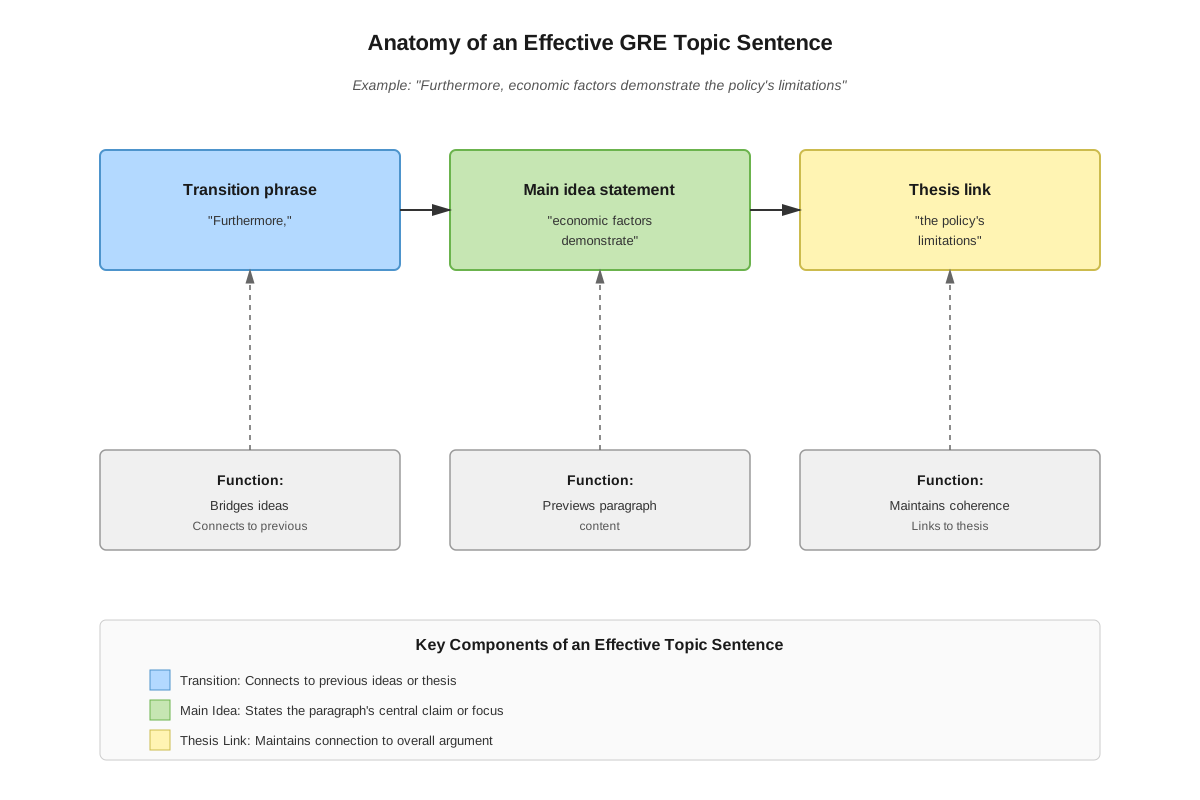
A topic sentence is a declarative statement that appears at or near the beginning of a body paragraph and accomplishes three essential functions: it introduces the paragraph's main idea, connects that idea to the essay's thesis, and previews the supporting evidence or analysis that follows. Unlike thesis statements that present the essay's overarching argument, topic sentences focus on single, manageable aspects of that larger claim.
The positioning of topic sentences matters significantly. While they most commonly appear as the first sentence of a paragraph, effective writers occasionally place them as the second sentence when a transitional phrase or contextual statement requires initial placement. However, for GRE purposes, leading with the topic sentence provides maximum clarity and reduces the risk of organizational confusion under time pressure.
Components of Effective Topic Sentences
Strong topic sentences contain several identifiable elements that work together to create clarity and coherence:
- A clear subject: The topic sentence explicitly states what the paragraph will discuss
- A controlling idea: It presents a specific claim, perspective, or analytical point about that subject
- A connection to thesis: It demonstrates how the paragraph's focus relates to the essay's main argument
- Appropriate scope: It addresses an idea substantial enough to warrant paragraph-level development but focused enough to be fully explored in 4-7 sentences
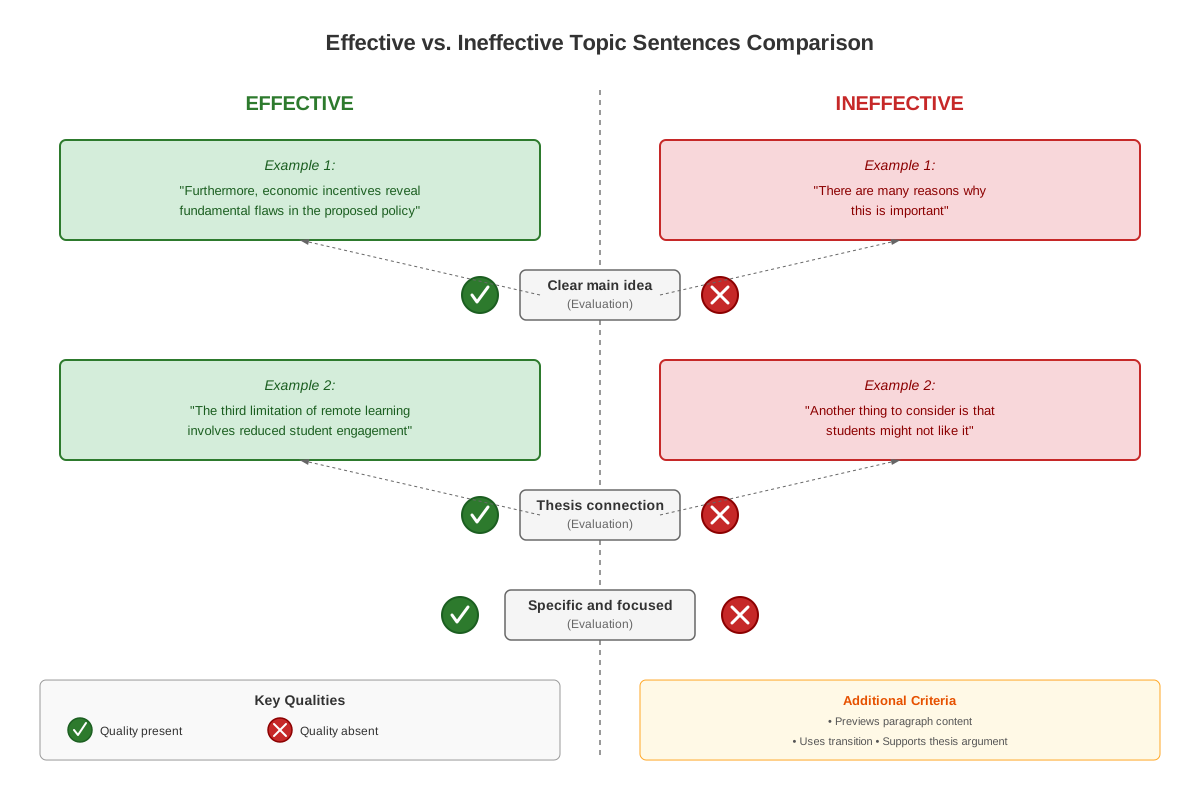
Consider this comparison:
| Weak Topic Sentence | Strong Topic Sentence | Why the Difference Matters |
|---|---|---|
| "Technology is important." | "The widespread adoption of artificial intelligence in healthcare demonstrates how technological innovation can simultaneously improve diagnostic accuracy and raise ethical concerns about patient privacy." | The strong version specifies which technology, in what context, and previews the dual perspective the paragraph will explore |
| "There are several reasons for this." | "Economic incentives provide the primary motivation for corporations to adopt sustainable practices, outweighing both regulatory pressure and public relations concerns." | The strong version identifies the specific reason and establishes its relative importance |
| "Another point to consider is education." | "Educational disparities perpetuate economic inequality by limiting access to high-paying careers for students from under-resourced communities." | The strong version presents a clear causal relationship and specific focus |
Topic Sentences in Issue Essays
In GRE Issue essays, where writers must develop a position on a broad claim or recommendation, topic sentences serve to break down the thesis into manageable supporting arguments. Each body paragraph's topic sentence should present one distinct reason, example, or perspective that supports the writer's position.
For an Issue prompt such as "The best way to teach is to praise positive actions and ignore negative ones," a thesis might argue that this approach oversimplifies effective pedagogy. Supporting topic sentences could include:
- "Exclusively praising positive behaviors fails to address harmful actions that require immediate intervention and correction."
- "Developmental psychology research demonstrates that children need explicit feedback about inappropriate behaviors to develop social awareness and self-regulation skills."
- "While positive reinforcement effectively motivates many learners, ignoring negative actions can inadvertently communicate acceptance of those behaviors."
Each topic sentence introduces a distinct supporting argument while maintaining clear connection to the thesis position.
Topic Sentences in Argument Essays
In Argument essays, where writers must critique the logical soundness of a presented argument, topic sentences function differently. They identify specific logical flaws, unstated assumptions, or evidentiary weaknesses in the original argument. Each topic sentence should pinpoint one discrete problem with the argument's reasoning.
For an Argument prompt claiming that "City X should build a new sports stadium because nearby City Y saw increased tourism after building one," effective topic sentences might include:
- "The argument assumes without justification that City X and City Y share relevant demographic and economic characteristics that would produce similar outcomes."
- "The author fails to establish a causal relationship between the stadium construction and increased tourism, ignoring alternative explanations for City Y's tourism growth."
- "Even if the stadium did increase tourism in City Y, the argument provides no evidence that tourism revenue would offset the substantial construction and maintenance costs in City X."
The Relationship Between Topic Sentences and Paragraph Unity
Paragraph unity—the principle that all sentences in a paragraph should relate to a single main idea—depends entirely on effective topic sentences. Once a topic sentence establishes the paragraph's focus, every subsequent sentence must develop, support, or elaborate on that specific idea. Sentences that introduce new topics or shift focus signal organizational problems that GRE graders penalize.
The topic sentence functions as a contract with the reader: it promises to discuss a particular idea, and the paragraph must fulfill that promise. Writers can test paragraph unity by asking whether each sentence directly relates to the topic sentence. If a sentence introduces information unrelated to the topic sentence's claim, it either belongs in a different paragraph or the topic sentence requires revision to accommodate the broader scope.
Strategies for Constructing Strong Topic Sentences
Effective topic sentence construction follows several reliable strategies:
The "Although X, Y" structure: This format acknowledges complexity while establishing the paragraph's focus: "Although social media platforms have democratized information sharing, they have simultaneously enabled the rapid spread of misinformation that undermines informed civic discourse."
The "Because X, Y" structure: This causal format works well for explanatory paragraphs: "Because standardized tests measure only narrow cognitive skills, they fail to capture the full range of abilities that predict academic and professional success."
The direct claim structure: Simple declarative statements work effectively when the relationship to the thesis is obvious: "Historical evidence contradicts the assumption that economic prosperity automatically produces democratic governance."
The comparative structure: This format establishes relationships between ideas: "Unlike traditional classroom instruction, online learning environments require students to develop greater self-direction and time management skills."
Concept Relationships
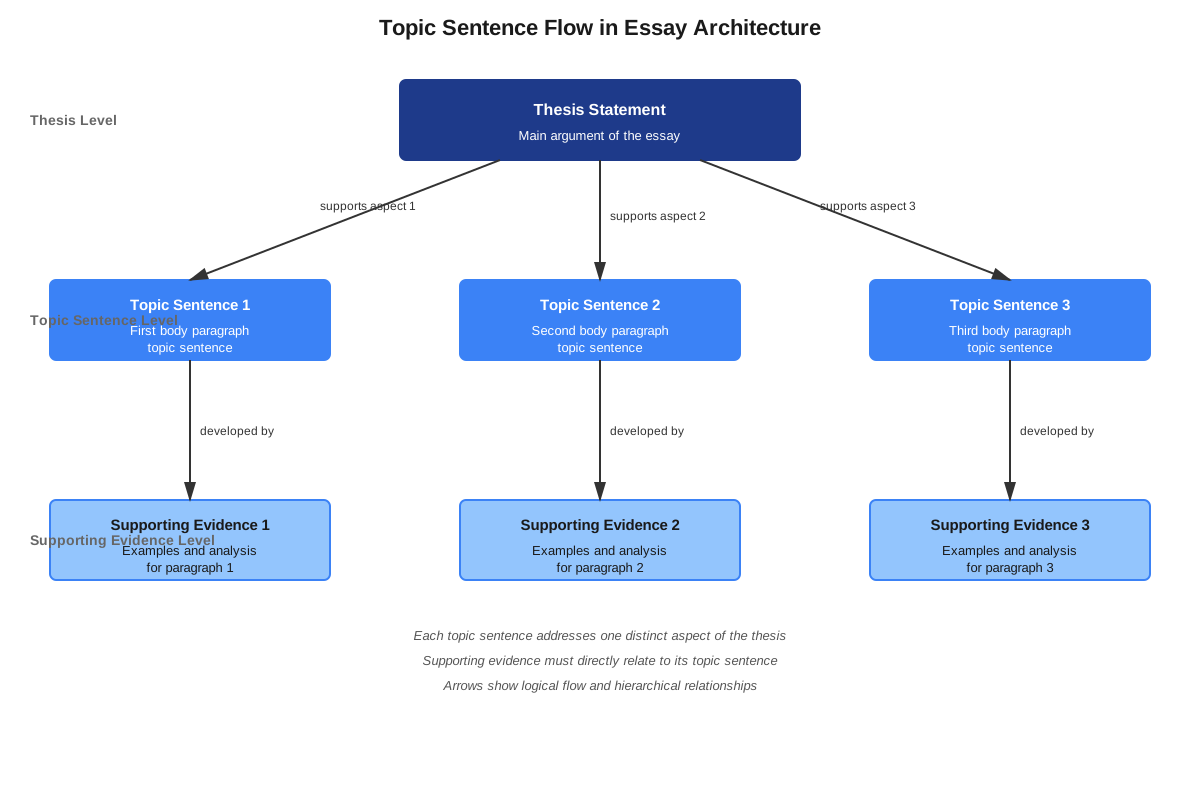
Topic sentences exist within a hierarchical relationship structure in analytical essays. At the highest level, the thesis statement presents the essay's main argument or position. Topic sentences function as subordinate claims that support this thesis, with each topic sentence introducing one supporting pillar of the overall argument. Within each paragraph, supporting sentences provide evidence, examples, and analysis that develop the topic sentence's claim, while concluding sentences synthesize the paragraph's content and transition to the next idea.
The relationship flows as follows: Thesis Statement → Topic Sentence 1 → Supporting Evidence → Topic Sentence 2 → Supporting Evidence → Topic Sentence 3 → Supporting Evidence → Conclusion. Each topic sentence must maintain logical connection to the thesis while introducing distinct content that doesn't overlap with other paragraphs.
Topic sentences also connect intimately with transitional devices. While topic sentences introduce new ideas, transitions show relationships between those ideas (contrast, causation, addition, exemplification). Effective writers often integrate transitional language into topic sentences themselves: "Beyond the economic considerations, environmental factors also argue against the proposed development."
The relationship to paragraph development strategies is equally important. Topic sentences determine whether a paragraph will develop through examples, comparison/contrast, cause/effect analysis, or problem/solution structure. The topic sentence's phrasing signals to readers what type of development to expect, creating coherence between the paragraph's introduction and its body.
Quick check — test yourself on Topic sentences so far.
Try Flashcards →High-Yield Facts
⭐ Topic sentences should appear at or near the beginning of body paragraphs to maximize organizational clarity for GRE graders
⭐ Every topic sentence must connect explicitly to the essay's thesis statement, either supporting it (Issue essays) or identifying a flaw in it (Argument essays)
⭐ Effective topic sentences contain both a subject and a controlling idea that limits the paragraph's scope
⭐ GRE essays scoring 5.0 or higher consistently demonstrate clear topic sentences that preview paragraph content
⭐ Topic sentences should be specific enough to guide paragraph development but broad enough to require 4-7 supporting sentences
- Weak topic sentences often use vague language like "There are many reasons" or "Another important point" without specifying what those reasons or points are
- Topic sentences in Argument essays should identify specific logical flaws rather than simply stating "The argument has problems"
- Effective topic sentences avoid questions, which create ambiguity about the paragraph's actual claim or focus
- The scope of a topic sentence should match the scope of available supporting evidence—overly broad topic sentences lead to underdeveloped paragraphs
- Topic sentences that merely announce topics ("This paragraph will discuss education") are less effective than those that make claims about topics ("Educational inequality perpetuates economic stratification")
Common Misconceptions
Misconception: Topic sentences must always be the first sentence of a paragraph → Correction: While topic sentences typically appear first for maximum clarity, they can occasionally appear as the second sentence when a transitional phrase or brief contextual statement requires initial placement. However, for GRE purposes, leading with the topic sentence is the safer, clearer choice.
Misconception: Topic sentences should be as general as possible to give the writer flexibility → Correction: Effective topic sentences are specific and focused, providing clear direction for both the writer and reader. Vague topic sentences lead to unfocused paragraphs that wander between multiple ideas, which GRE graders penalize as organizational weaknesses.
Misconception: Every sentence in the essay needs to explicitly reference the thesis → Correction: While topic sentences should connect to the thesis, supporting sentences within paragraphs should primarily develop the topic sentence's idea. The topic sentence serves as the bridge between thesis and evidence, eliminating the need for constant thesis repetition.
Misconception: Topic sentences and thesis statements are interchangeable terms → Correction: Thesis statements present the essay's overarching argument and appear in the introduction, while topic sentences introduce individual paragraph focuses and appear at the beginning of body paragraphs. Topic sentences support and develop the thesis but operate at a more specific level.
Misconception: Strong topic sentences require complex vocabulary and sophisticated sentence structures → Correction: Clarity trumps complexity in topic sentences. Simple, direct statements that clearly communicate the paragraph's focus are more effective than convoluted sentences that obscure meaning. GRE graders value clear communication over verbal gymnastics.
Misconception: Topic sentences in Argument essays should state whether the writer agrees or disagrees with the argument → Correction: Argument essays require critique of logical reasoning, not position-taking. Topic sentences should identify specific logical flaws, unstated assumptions, or evidentiary gaps rather than expressing agreement or disagreement with the argument's conclusion.
Worked Examples
Example 1: Issue Essay Topic Sentence Development
Prompt: "The best way to understand the character of a society is to examine how it treats its most vulnerable members."
Thesis: While examining treatment of vulnerable populations provides valuable insights into societal values, a comprehensive understanding requires analyzing multiple dimensions including cultural institutions, economic structures, and historical development.
Weak Topic Sentence: "There are other ways to understand society."
Problems: This sentence is vague, doesn't specify what "other ways" means, fails to connect clearly to the thesis, and doesn't preview specific paragraph content.
Revised Topic Sentence: "Cultural institutions such as museums, educational systems, and religious organizations reveal societal priorities and values that treatment of vulnerable populations alone cannot capture."
Why This Works:
- Specificity: Identifies exactly which "other ways" the paragraph will discuss (cultural institutions)
- Clear connection to thesis: Supports the claim that multiple dimensions are necessary
- Scope management: Lists specific examples (museums, education, religion) that can be developed in one paragraph
- Controlling idea: Makes a claim about what these institutions reveal and why they matter
- Preview function: Readers know the paragraph will discuss how cultural institutions demonstrate values
Paragraph Development: Following this topic sentence, the paragraph would provide 2-3 specific examples of how cultural institutions reveal values (e.g., a society that funds extensive public libraries demonstrates commitment to education and information access), analyze what these examples show about societal character, and conclude by reinforcing how this dimension complements rather than replaces examining treatment of vulnerable populations.
Example 2: Argument Essay Topic Sentence Development
Prompt: "The following appeared in a memo from the mayor of Brindleburg: 'Two years ago, the town of Seaside Vista built a new public swimming pool and saw a 20% increase in summer tourism. Brindleburg should build a similar pool to boost our local economy.'"
Thesis: The mayor's argument relies on several unwarranted assumptions and fails to provide evidence necessary to establish that a swimming pool would produce similar economic benefits in Brindleburg.
Weak Topic Sentence: "The argument makes assumptions."
Problems: Completely vague, doesn't identify which assumptions, fails to explain why they matter, and provides no direction for paragraph development.
Revised Topic Sentence: "The argument assumes without justification that Brindleburg and Seaside Vista share relevant characteristics—such as climate, existing tourist infrastructure, and proximity to tourist destinations—that would make a swimming pool equally attractive to visitors in both locations."
Why This Works:
- Identifies specific flaw: Pinpoints the comparison assumption
- Explains the problem: Shows why the assumption matters (different characteristics could produce different outcomes)
- Provides development direction: Lists specific characteristics (climate, infrastructure, proximity) that the paragraph will discuss
- Connects to thesis: Supports the claim that the argument relies on unwarranted assumptions
- Analytical focus: Goes beyond merely identifying the flaw to explaining its logical significance
Paragraph Development: The paragraph would elaborate on each characteristic mentioned in the topic sentence. For example, it might explain that if Brindleburg has a colder climate than Seaside Vista, a swimming pool would attract fewer visitors. It might note that if Seaside Vista already had hotels and restaurants while Brindleburg lacks such infrastructure, tourists might visit Seaside Vista's pool but not Brindleburg's. The paragraph would conclude by emphasizing that without evidence of similarity, the comparison fails to support the recommendation.
Exam Strategy
When approaching GRE Analytical Writing tasks, implement a systematic process for crafting effective topic sentences:
Pre-writing phase (2-3 minutes): Before writing the essay, outline 3-4 main points that will support your thesis. Write draft topic sentences for each point during outlining. This ensures each paragraph has clear focus and prevents organizational problems during drafting.
Trigger words to watch for: GRE prompts often contain language that signals how many body paragraphs you'll need. Words like "extent" suggest discussing multiple perspectives or degrees. Phrases like "what questions would need to be answered" in Argument prompts indicate you should dedicate one paragraph to each major question or assumption.
Exam Tip: If you find yourself struggling to write a topic sentence, your paragraph idea may be too vague or too broad. Return to your thesis and ask: "What is ONE specific reason/example/flaw that supports my thesis?" The answer becomes your topic sentence.
Time allocation strategy: Spend approximately 30 seconds crafting each topic sentence during the drafting phase. This investment pays dividends by keeping your writing focused and reducing revision time. A clear topic sentence makes the rest of the paragraph easier to write because you know exactly what content belongs.
Self-checking technique: After writing each paragraph, reread the topic sentence and ask: "Does every sentence in this paragraph relate directly to this topic sentence?" If not, either revise the topic sentence to accommodate the content or remove sentences that don't fit. This quick check prevents the organizational weaknesses that lower scores.
Process of elimination for revision: When reviewing your essay (reserve 2-3 minutes for this), check each topic sentence against these criteria:
- Does it make a specific claim rather than announcing a topic?
- Does it connect clearly to my thesis?
- Can I identify what the paragraph will discuss based on this sentence alone?
- Is it focused enough to develop in one paragraph?
If any answer is "no," revise the topic sentence before submitting.
Strategic positioning: In the high-pressure GRE environment, always place topic sentences first in body paragraphs. While more sophisticated positioning exists, leading with topic sentences maximizes clarity for graders and reduces your cognitive load during writing.
Memory Techniques
The SCCT Acronym: Remember that effective topic sentences need four elements:
- Specific (not vague or general)
- Connected (to the thesis)
- Claim-making (not just announcing)
- Targeted (appropriate scope for one paragraph)
The Bridge Visualization: Picture your essay as a bridge structure. The thesis is the main span connecting both sides. Topic sentences are the support pillars—each must connect to the main span (thesis) while standing on its own foundation (specific paragraph content). If a pillar doesn't connect to the main span, the bridge becomes unstable.
The Preview Principle: Remember that topic sentences should function like movie trailers—they preview what's coming without revealing every detail. If someone reads only your topic sentences, they should understand your essay's complete argument structure.
The "One Paragraph, One Idea" Rule: Use the acronym OPIO (One Paragraph, One Idea Only). Each topic sentence introduces that ONE idea. If you find yourself wanting to discuss multiple unrelated ideas, you need multiple paragraphs with distinct topic sentences.
The Question Test: Convert your topic sentence into a question. If the paragraph answers that question, the topic sentence is effective. For example, topic sentence: "Economic factors primarily drive corporate sustainability initiatives." Question: "What primarily drives corporate sustainability initiatives?" If your paragraph answers this question with evidence about economic factors, you've maintained unity.
Summary
Topic sentences represent the organizational backbone of effective GRE Analytical Writing, serving as the critical link between thesis statements and supporting evidence. Mastery of topic sentence construction requires understanding their three essential functions: introducing paragraph main ideas, connecting those ideas to the overarching thesis, and previewing the supporting content that follows. Effective topic sentences are specific rather than vague, make claims rather than merely announce topics, and maintain appropriate scope for single-paragraph development. In Issue essays, topic sentences present distinct supporting arguments for the writer's position, while in Argument essays, they identify specific logical flaws or unstated assumptions in the presented argument. The quality of topic sentences directly impacts GRE essay scores because graders explicitly evaluate organizational clarity and logical flow—qualities that strong topic sentences immediately demonstrate. By investing time in crafting clear, focused topic sentences during the planning and drafting phases, writers create essays that are easier to write, more coherent to read, and more likely to achieve scores in the 5.0-6.0 range.
Key Takeaways
- Topic sentences must contain both a clear subject and a controlling idea that limits the paragraph's scope to a single, developable point
- Every topic sentence should connect explicitly to the essay's thesis statement, either supporting it or identifying a flaw in it
- Effective topic sentences are specific and claim-making rather than vague and topic-announcing
- GRE essays scoring 5.0 or higher consistently demonstrate clear topic sentences at or near the beginning of each body paragraph
- The scope of a topic sentence should match available supporting evidence—broad enough to require 4-7 sentences but focused enough to maintain unity
- In Issue essays, topic sentences present distinct reasons or examples supporting your position; in Argument essays, they identify specific logical flaws
- Testing paragraph unity by ensuring every sentence relates directly to the topic sentence prevents organizational weaknesses that lower scores
Related Topics
Thesis Statement Construction: Understanding how to craft effective thesis statements is essential because topic sentences must support and connect to the thesis. Mastering topic sentences enables writers to break down complex thesis arguments into manageable supporting points.
Paragraph Development Strategies: Once a topic sentence establishes a paragraph's focus, writers must develop that idea through examples, analysis, or evidence. Strong topic sentences make paragraph development more straightforward by providing clear direction.
Transitions and Coherence: Topic sentences work in concert with transitional devices to create logical flow between paragraphs. Mastering topic sentences provides the foundation for understanding how transitions connect ideas across paragraph boundaries.
Essay Organization and Outlining: Effective outlining begins with identifying main supporting points that become topic sentences. Understanding topic sentence construction improves pre-writing efficiency and overall essay structure.
Analytical Writing Scoring Criteria: Studying how GRE graders evaluate essays reveals why topic sentences matter so significantly for scores. This knowledge helps writers prioritize organizational clarity in their writing process.
Practice CTA
Now that you understand the principles of effective topic sentence construction, it's time to apply this knowledge through deliberate practice. Attempt the practice questions to test your ability to identify strong versus weak topic sentences, construct effective topic sentences for various prompts, and revise problematic examples. Use the flashcards to reinforce key concepts and strategies until topic sentence construction becomes automatic. Remember that topic sentences are among the highest-yield elements you can master for GRE Analytical Writing—investing time in practice now will pay immediate dividends in your essay scores. Every practice essay you write is an opportunity to strengthen this crucial skill, so approach each one with intentional focus on crafting clear, specific, claim-making topic sentences that guide your reader through your analysis.
Sign up free to keep reading
Create a free AnvayaPrep account to finish this GRE guide on Topic sentences — plus flashcards and practice questions.