Overview
Essay organization is the structural backbone of effective analytical writing on the GRE. It refers to the logical arrangement and sequencing of ideas, arguments, and supporting evidence within an essay to create a coherent, persuasive response. Strong GRE essay organization transforms scattered thoughts into a compelling argument that evaluates complex issues or critiques logical reasoning. The ability to organize ideas systematically is not merely a stylistic preference—it directly impacts how graders assess clarity, coherence, and analytical depth, making it one of the most heavily weighted factors in scoring.
On the GRE Analytical Writing section, essays with superior organization consistently receive higher scores because they demonstrate critical thinking through structure itself. A well-organized essay guides readers effortlessly from introduction through body paragraphs to conclusion, with each section serving a distinct purpose and connecting logically to the next. This structural clarity allows graders to focus on the quality of arguments rather than struggling to follow disjointed reasoning. The difference between a score of 3.5 and 5.5 often hinges not on vocabulary or grammar, but on how effectively ideas are arranged and developed.
Essay organization intersects with virtually every other aspect of analytical writing style, including paragraph development, transitions, thesis construction, and evidence integration. While these elements each have distinct characteristics, they all depend on a sound organizational framework to function effectively. Without proper organization, even brilliant insights and sophisticated language cannot achieve their full impact. Mastering organizational principles provides the foundation upon which all other writing skills build, making this topic essential for achieving competitive GRE scores.
Learning Objectives
- [ ] Identify when essay organization is being tested in GRE scoring rubrics and sample essays
- [ ] Explain the core rule or strategy behind essay organization for both Issue and Argument tasks
- [ ] Apply essay organization principles to GRE-style questions accurately and efficiently
- [ ] Construct effective essay outlines within 3-5 minutes that support high-scoring responses
- [ ] Evaluate sample essays to diagnose organizational strengths and weaknesses
- [ ] Adapt organizational strategies to different prompt types and argument structures
- [ ] Implement transitional elements that enhance logical flow between ideas
Prerequisites
- Basic paragraph structure: Understanding topic sentences, supporting details, and concluding sentences provides the building blocks for larger organizational patterns
- Thesis statement construction: Knowing how to craft a clear position statement is essential because the thesis dictates the entire essay's organizational direction
- Reading comprehension skills: The ability to analyze prompts and identify key components determines what organizational approach will be most effective
- Time management fundamentals: Awareness of the 30-minute time constraint influences how elaborate organizational structures can realistically be
Why This Topic Matters
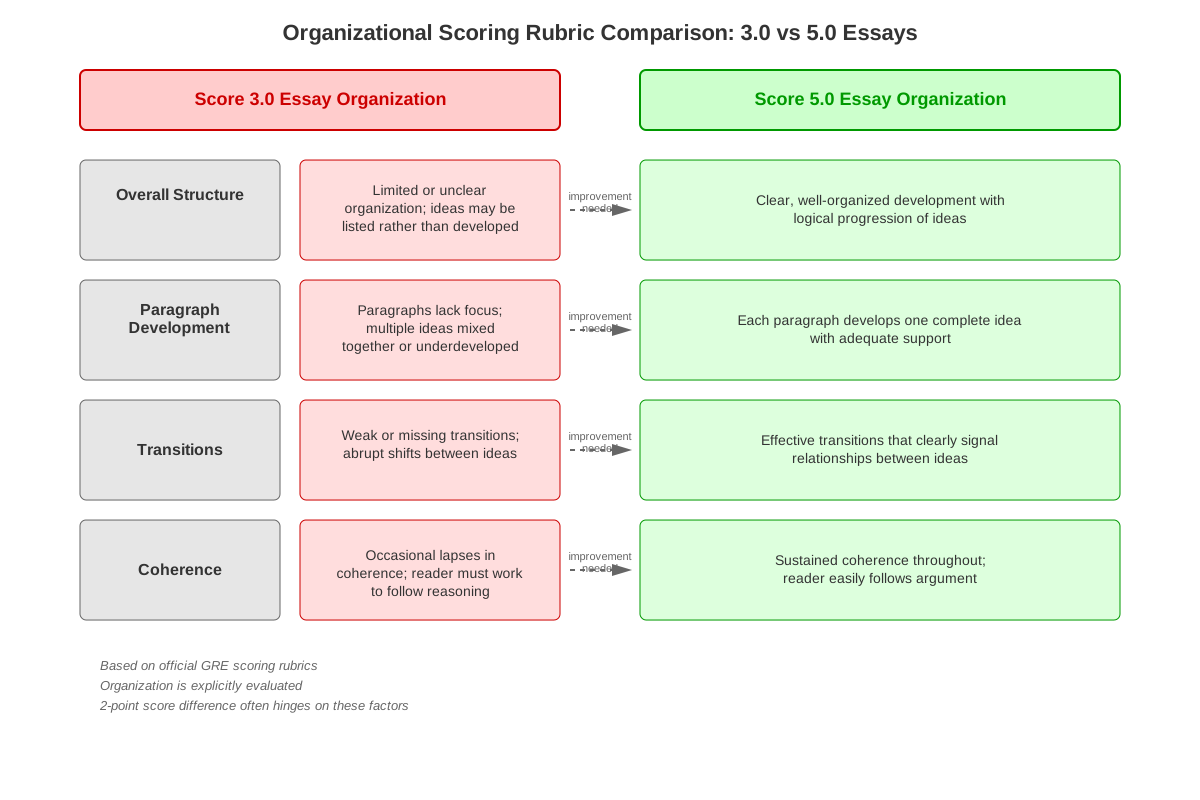
Essay organization directly determines whether GRE graders can follow and evaluate arguments effectively. Research on GRE scoring patterns reveals that organizational clarity is explicitly mentioned in the scoring rubrics for both the Issue and Argument tasks. Essays scoring 5.0 or higher consistently demonstrate "clear, well-organized development" while lower-scoring essays exhibit "unclear or disorganized structure." This makes organization one of the most reliable predictors of essay scores.
In real-world applications, the organizational skills developed for the GRE transfer directly to professional and academic writing. Graduate programs require students to structure research papers, literature reviews, and dissertations with logical coherence. Business professionals must organize reports, proposals, and presentations that guide stakeholders through complex information. The ability to arrange ideas systematically is a foundational skill across disciplines.
On the GRE specifically, organizational competence appears in approximately 100% of Analytical Writing tasks because every essay requires structure. The scoring rubric explicitly evaluates "the organization and development of ideas" as a primary criterion. Common manifestations include: assessing whether introductions establish clear positions, evaluating whether body paragraphs follow logical sequences, checking whether conclusions synthesize rather than merely repeat, and determining whether transitions create coherent flow. Graders spend only 2-3 minutes per essay, making immediate organizational clarity crucial for positive first impressions.
Core Concepts
The Three-Part Essay Structure
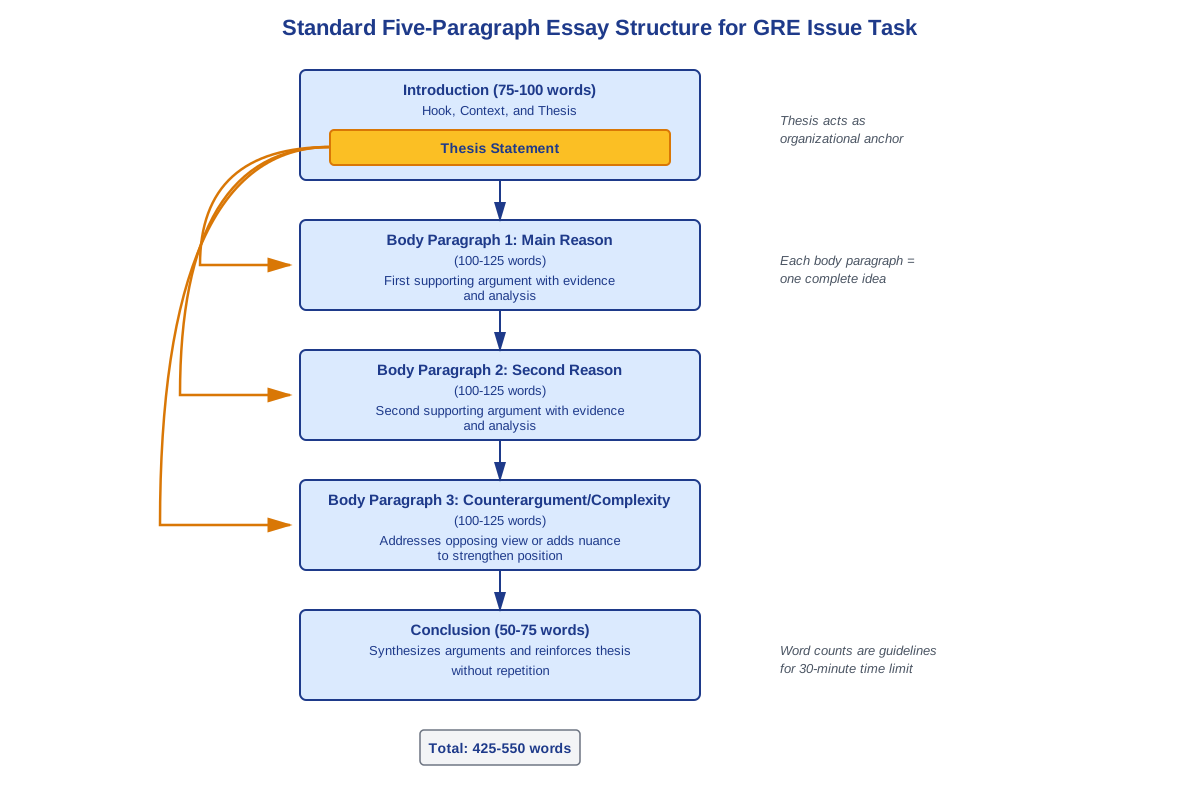
The fundamental framework for essay organization on the GRE follows a classical three-part structure: introduction, body, and conclusion. This architecture provides the skeleton upon which all effective analytical writing builds. The introduction establishes context, presents the thesis or position, and previews the analytical approach. The body develops the argument through multiple paragraphs, each focused on a distinct point or aspect of analysis. The conclusion synthesizes insights and reinforces the essay's central claim without merely repeating earlier content.
This structure succeeds on the GRE because it matches how graders evaluate essays. They look first for a clear position (introduction), then for systematic development of that position (body), and finally for analytical closure (conclusion). Deviating from this pattern—such as burying the thesis in the middle or omitting a conclusion—creates confusion that lowers scores regardless of content quality.
Issue Task Organization
For the Issue task, which asks test-takers to develop a position on a broad claim or recommendation, effective organization typically follows one of three patterns:
Pattern 1: Position-Support-Counterargument-Rebuttal
This approach states a clear position, develops 2-3 supporting reasons in separate paragraphs, acknowledges a counterargument, and explains why the position remains valid despite objections. This pattern demonstrates sophisticated thinking by showing awareness of complexity.
Pattern 2: Balanced Analysis with Qualified Position
This structure examines multiple perspectives on the issue, dedicating paragraphs to different viewpoints or contexts, then synthesizes these into a nuanced position. This works well for prompts that invite consideration of circumstances or conditions.
Pattern 3: Criteria-Based Evaluation
This organization establishes evaluative criteria in the introduction, then dedicates body paragraphs to assessing the issue against each criterion, leading to a reasoned conclusion. This approach works particularly well for recommendation-type prompts.
Argument Task Organization
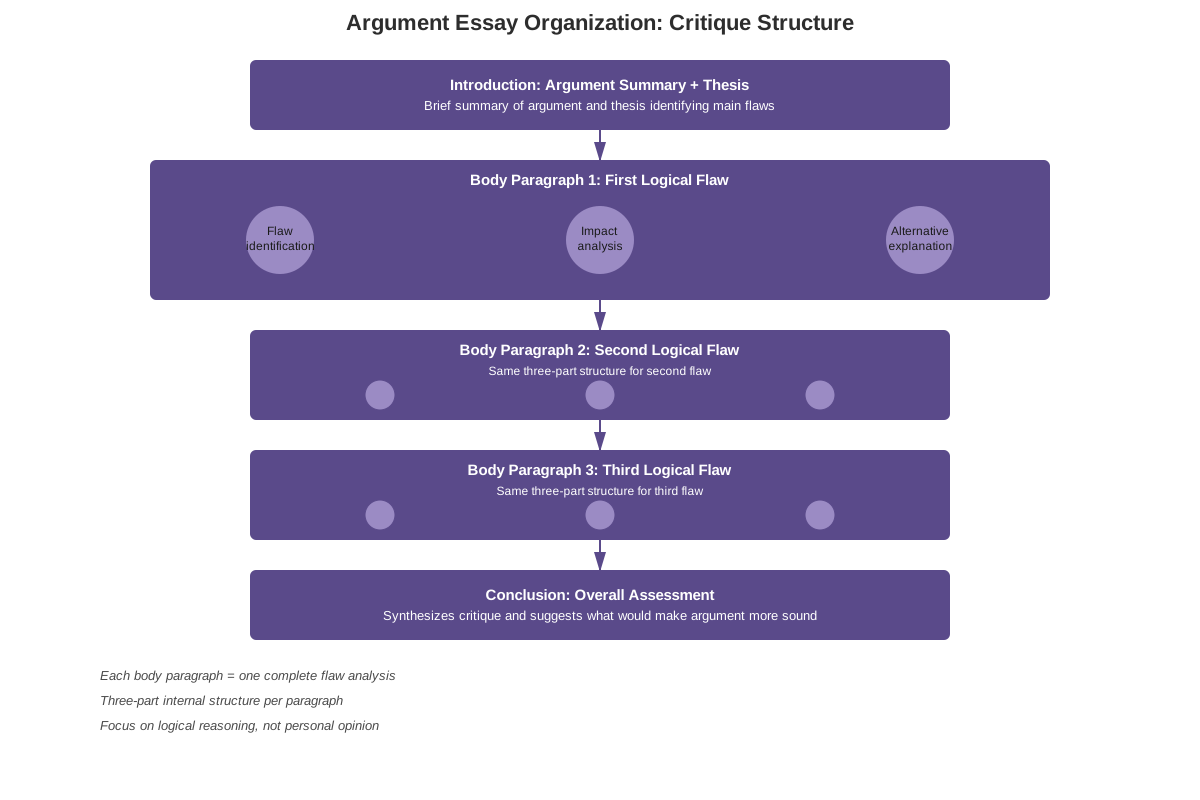
The Argument task requires analyzing the logical soundness of a given argument, making organizational demands different from the Issue task. The most effective structure follows this pattern:
Introduction: Briefly summarize the argument and state the overall evaluation (typically that the argument is flawed due to unwarranted assumptions and insufficient evidence).
Body Paragraphs (3-4): Each paragraph examines one major logical flaw, following this internal structure:
- Identify the specific claim or reasoning step
- Explain the assumption underlying it
- Describe why this assumption may be unwarranted
- Illustrate potential alternative explanations or scenarios
- Explain how this flaw weakens the argument's conclusion
Conclusion: Synthesize the analysis by explaining what additional evidence or information would be needed to properly evaluate the argument.
This organization succeeds because it systematically dismantles the argument's logic rather than randomly listing problems. Each paragraph builds on previous analysis, creating cumulative impact.
Paragraph-Level Organization
Within individual body paragraphs, effective organization follows the TEEL or PEEL structure:
- T/P (Topic/Point): Opening sentence states the paragraph's main idea and connects to the thesis
- E (Evidence/Example): Specific support, whether reasoning, examples, or analysis of the prompt
- E (Explanation): Analysis that connects evidence back to the main point
- L (Link): Closing sentence that reinforces the paragraph's contribution to the overall argument
This micro-level organization ensures each paragraph functions as a complete unit of thought while contributing to the essay's larger purpose.
Transitional Architecture
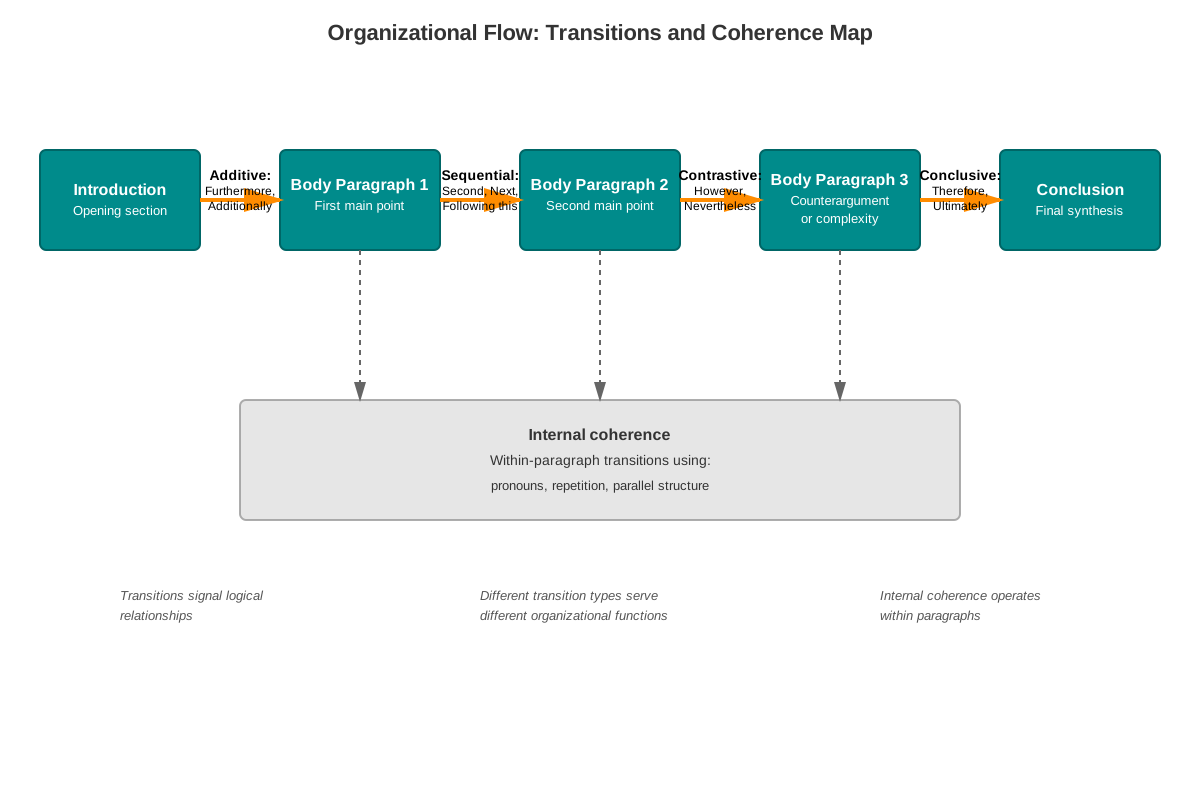
Transitions serve as the connective tissue of essay organization, signaling relationships between ideas and guiding readers through the argument's progression. Effective transitions operate at three levels:
| Transition Level | Function | Examples |
|---|---|---|
| Between sections | Signal major shifts (intro to body, body to conclusion) | "Having established the position, the analysis now turns to...", "These considerations lead to..." |
| Between paragraphs | Show logical relationships between main points | "Furthermore," "Conversely," "Another significant factor," "Despite this consideration" |
| Within paragraphs | Connect sentences and ideas smoothly | "For instance," "This suggests," "Consequently," "In contrast" |
Strategic transition placement creates organizational coherence that allows graders to follow complex reasoning effortlessly.
Outlining Strategy
Given the 30-minute time constraint, effective GRE essay organization requires rapid outlining before writing. A functional outline should take 3-5 minutes and include:
- Thesis/Position statement (one sentence capturing the main claim)
- Body paragraph topics (3-4 brief phrases identifying each paragraph's focus)
- Key examples or reasoning (1-2 words per paragraph as memory triggers)
- Conclusion approach (brief note on synthesis strategy)
This skeletal structure prevents mid-essay confusion and ensures logical progression, ultimately saving time by reducing revision needs.
Concept Relationships
The concepts within essay organization form an interconnected hierarchy. The three-part structure serves as the overarching framework that contains all other organizational elements. Within this framework, task-specific patterns (Issue vs. Argument organization) determine the strategic approach to content arrangement. These patterns are implemented through paragraph-level organization, which provides the tactical structure for individual units of thought. Transitional architecture weaves through all levels, connecting parts into a coherent whole. Finally, the outlining strategy precedes and enables all other organizational elements by providing a roadmap before writing begins.
This relationship can be visualized as: Outlining Strategy → generates → Three-Part Structure → specialized into → Task-Specific Patterns → implemented through → Paragraph-Level Organization → connected by → Transitional Architecture → resulting in → Coherent Essay.
Essay organization connects to prerequisite knowledge by building on paragraph structure (expanding single-paragraph skills to multi-paragraph coordination) and thesis construction (using the thesis as the organizational anchor). It relates to other Analytical Writing Style topics by providing the framework within which evidence integration, language precision, and rhetorical strategies operate. Without sound organization, these other elements cannot function effectively; with it, they achieve maximum impact.
High-Yield Facts
⭐ GRE essay graders spend only 2-3 minutes per essay, making immediate organizational clarity crucial for scoring
⭐ The scoring rubric explicitly evaluates "organization and development of ideas" as a primary criterion for both Issue and Argument tasks
⭐ Essays scoring 5.0+ consistently demonstrate clear organizational patterns, while essays below 4.0 typically show organizational confusion
⭐ The most effective Issue task organization includes acknowledgment of counterarguments or complexity, not just one-sided support
⭐ Argument task body paragraphs should each focus on one major logical flaw rather than listing multiple problems per paragraph
- Effective transitions between paragraphs signal logical relationships and improve perceived coherence by approximately one scoring band
- The introduction should preview the analytical approach without providing detailed evidence, which belongs in body paragraphs
- Conclusions that merely restate the introduction without synthesis or broader implications typically lower scores
- Outlining for 3-5 minutes before writing improves organizational coherence and reduces time spent on revision
- Each body paragraph should contain 4-7 sentences to provide adequate development without losing focus
- The thesis statement's position determines the entire essay's organizational logic and should be established before outlining
- Organizational patterns should be adapted to prompt specifics rather than using a rigid template for all essays
Quick check — test yourself on Essay organization so far.
Try Flashcards →Common Misconceptions
Misconception: Five-paragraph structure is mandatory for GRE essays → Correction: While five paragraphs (introduction, three body paragraphs, conclusion) is common and effective, essays with four or six paragraphs can score equally well if they demonstrate clear organization and adequate development. The key is logical structure, not paragraph count.
Misconception: The introduction must be lengthy to establish credibility → Correction: GRE introductions should be concise (3-5 sentences), establishing context and position efficiently. Lengthy introductions waste valuable time and delay the analytical content that graders prioritize. Clarity and directness outweigh elaboration.
Misconception: Each body paragraph needs multiple examples to be convincing → Correction: Quality trumps quantity in GRE essays. One well-developed example or line of reasoning per paragraph is more effective than multiple superficial examples. Depth of analysis matters more than breadth of illustration.
Misconception: Transitions are optional stylistic flourishes → Correction: Transitions are essential organizational tools that signal logical relationships and guide readers through arguments. Their absence creates choppy, disconnected prose that graders perceive as poorly organized, directly impacting scores.
Misconception: The conclusion should introduce new arguments to end strongly → Correction: Conclusions should synthesize and reflect on arguments already presented, not introduce new claims. New arguments in conclusions signal poor planning and create organizational incoherence, suggesting the writer didn't know when to stop developing ideas.
Misconception: Outlining wastes precious writing time → Correction: Spending 3-5 minutes outlining actually saves time by preventing organizational confusion, reducing the need for major revisions, and ensuring complete responses. Essays written without outlines frequently exhibit structural problems that lower scores more than slightly shorter length would.
Worked Examples
Example 1: Issue Task Organization
Prompt: "The best way to teach is to praise positive actions and ignore negative ones."
Organizational Approach: Position-Support-Counterargument-Rebuttal
Outline (3 minutes):
- Thesis: Disagree—effective teaching requires addressing both positive and negative actions appropriately
- Body 1: Praising positive actions builds confidence and reinforces desired behaviors (education research)
- Body 2: Ignoring negative actions allows problems to compound and denies learning opportunities (classroom management)
- Body 3: Counterargument—some argue negative attention reinforces bad behavior
- Body 4: Rebuttal—constructive correction differs from negative attention; ignoring serious issues is irresponsible
- Conclusion: Balanced approach using both praise and appropriate correction
Organizational Analysis: This structure demonstrates sophisticated thinking by acknowledging the prompt's partial validity (praising positive actions is valuable) while systematically explaining why the complete claim is flawed. The counterargument paragraph shows awareness of complexity, and the rebuttal demonstrates critical thinking. Each body paragraph focuses on one distinct aspect, creating clear progression. Transitions would connect these elements: "While praising positive actions certainly has merit..." (Body 1), "However, the second part of the claim—ignoring negative actions—proves problematic..." (Body 2), "Proponents of this approach might argue..." (Body 3), "Yet this counterargument conflates..." (Body 4).
Connection to Learning Objectives: This example demonstrates how to apply essay organization to an Issue task by selecting an appropriate organizational pattern, structuring body paragraphs around distinct points, and incorporating counterargument to show analytical depth.
Example 2: Argument Task Organization
Prompt: "The following appeared in a memo from the director of a large group of hospitals: 'During a recent 10-year period, the number of malpractice lawsuits filed against our hospitals decreased significantly. This shows that our staff training programs have been effective in reducing medical errors.'"
Organizational Approach: Systematic flaw analysis
Outline (4 minutes):
- Intro: Argument assumes training caused decrease; multiple unwarranted assumptions weaken conclusion
- Body 1: Assumes lawsuit decrease reflects actual error decrease (could be legal/reporting changes)
- Body 2: Assumes no other factors caused decrease (could be legal reforms, settlement practices)
- Body 3: Assumes correlation proves causation (training and decrease may be coincidental)
- Body 4: Assumes training programs were actually implemented/attended (no evidence provided)
- Conclusion: Need evidence on actual error rates, training participation, legal environment changes
Organizational Analysis: This structure systematically dismantles the argument's logic by examining each assumption in a dedicated paragraph. The organization moves from most obvious flaw (lawsuit numbers ≠ error rates) to progressively deeper issues (causation, implementation). Each paragraph follows the pattern: identify claim → explain assumption → show why assumption is questionable → describe alternatives → explain impact on conclusion. This creates cumulative analytical force rather than a scattered list of problems.
Paragraph 2 Development Example:
- Topic: "The argument assumes that changes in other factors did not contribute to the lawsuit decrease."
- Evidence: "The memo provides no information about the legal environment during this period."
- Explanation: "Tort reform legislation, caps on damages, or changes in statute of limitations could have reduced lawsuits independently of any training improvements. Similarly, changes in settlement practices or insurance policies might have affected lawsuit filing rates."
- Link: "Without ruling out these alternative explanations, the director cannot confidently attribute the decrease to training programs."
Connection to Learning Objectives: This example shows how to identify when organization is being tested (systematic vs. scattered analysis), explains the core strategy (one flaw per paragraph with complete development), and applies the principle to create a high-scoring response structure.
Exam Strategy
When approaching GRE Analytical Writing tasks, implement this organizational strategy:
Pre-Writing Phase (3-5 minutes):
- Read the prompt twice, identifying the specific task (Issue: develop position; Argument: analyze reasoning)
- Brainstorm 3-4 main points or flaws
- Select the organizational pattern that best fits the prompt type
- Create a brief outline with thesis and paragraph topics
- Note 1-2 key examples or reasoning points per paragraph
Writing Phase (20-22 minutes):
- Draft a concise introduction (3-5 sentences) establishing position and preview
- Develop each body paragraph fully (4-7 sentences) before moving to the next
- Insert transitional phrases at paragraph beginnings to signal relationships
- Maintain focus on one main idea per paragraph
- Write a synthesis-focused conclusion (3-4 sentences)
Revision Phase (3-5 minutes):
- Check that the thesis is clear and appears in the introduction
- Verify each body paragraph has a clear topic sentence
- Ensure transitions connect ideas logically
- Confirm the conclusion synthesizes rather than repeats
Trigger Words for Organizational Decisions:
For Issue tasks:
- "To what extent" → signals need for balanced analysis with qualification
- "Should" or "must" → suggests position-support-counterargument structure
- "Best way" or "most important" → indicates criteria-based evaluation may work well
For Argument tasks:
- "Evidence" in the prompt → focus organization on what's missing
- "Assumptions" mentioned → structure around identifying and questioning assumptions
- "Alternative explanations" → organize paragraphs around competing interpretations
Process-of-Elimination for Organization:
When uncertain about structure, eliminate patterns that:
- Don't match the prompt's specific task (e.g., using Issue organization for Argument task)
- Would create redundant paragraphs covering the same point
- Can't be completed within time constraints (overly complex structures)
- Don't allow for adequate development of each point
Time Allocation Advice:
Resist the urge to skip outlining to gain writing time. The 3-5 minutes spent organizing prevents the 10+ minutes often lost to mid-essay confusion, restructuring, or incomplete responses. If running short on time, prioritize completing the organizational structure (even with shorter paragraphs) over elaborating one section while leaving others undeveloped.
Memory Techniques
TOPIC Mnemonic for Paragraph Organization:
- Thesis connection (topic sentence links to main claim)
- One main idea (paragraph focuses on single point)
- Proof/examples (specific support provided)
- Interpretation (analysis explains significance)
- Closure (link sentence transitions to next idea)
3-3-3 Rule for Time Management:
- 3 minutes outlining
- 3 body paragraphs minimum
- 3 minutes revising
FLAW Acronym for Argument Task Organization:
- Focus on one logical problem per paragraph
- Link each flaw to the conclusion's weakness
- Alternatives must be described (other explanations)
- What evidence would help (address in conclusion)
Visualization Strategy:
Picture the essay as a building: the introduction is the foundation announcing what will be built, body paragraphs are distinct floors each serving a specific function, transitions are the stairways connecting floors, and the conclusion is the roof that completes and protects the structure. A building missing floors (paragraphs) or stairways (transitions) is incomplete or inaccessible.
Acronym for Issue Task Balance:
PACS - Position stated, Arguments supporting, Counterargument acknowledged, Synthesis in conclusion
Summary
Essay organization is the structural foundation of high-scoring GRE Analytical Writing responses, determining whether graders can follow and evaluate arguments effectively within their 2-3 minute reading window. The core principle involves arranging ideas in logical, predictable patterns that guide readers from introduction through systematic development to synthesis. For Issue tasks, effective organization typically follows position-support-counterargument-rebuttal or balanced analysis patterns, while Argument tasks require systematic examination of logical flaws with one major problem per paragraph. All successful essays share common organizational features: clear three-part structure (introduction-body-conclusion), focused paragraphs with topic sentences, strategic transitions signaling relationships, and synthesis-focused conclusions. The organizational process begins with 3-5 minutes of outlining to establish the essay's roadmap, preventing mid-writing confusion and ensuring complete responses. Mastery of essay organization directly impacts scores because the rubric explicitly evaluates "organization and development of ideas," making this skill essential for achieving competitive results on the GRE.
Key Takeaways
- Essay organization is explicitly scored: The GRE rubric directly evaluates organizational clarity, making it one of the most reliable predictors of essay scores
- Outlining is essential, not optional: Spending 3-5 minutes planning structure prevents confusion and saves time overall
- One idea per paragraph: Focused paragraphs with clear topic sentences create the organizational clarity graders seek
- Task-specific patterns matter: Issue and Argument tasks require different organizational approaches; using the wrong pattern lowers scores
- Transitions create coherence: Strategic transitional phrases between and within paragraphs signal logical relationships and improve perceived organization
- Conclusions must synthesize: Simply restating the introduction signals poor organization; effective conclusions reflect on implications and broader significance
- Balance depth and breadth: Three well-developed body paragraphs outperform five superficial ones; organizational quality trumps paragraph quantity
Related Topics
Paragraph Development: Building on organizational frameworks, this topic explores how to fully develop individual paragraphs with adequate support and analysis. Mastering essay organization provides the structure within which paragraph development techniques operate most effectively.
Thesis Statement Construction: The thesis serves as the organizational anchor for the entire essay. Understanding how to craft precise, defensible thesis statements enables more effective organizational planning.
Transitional Phrases and Coherence: This topic deepens the understanding of how specific transitional language creates organizational flow. Strong organizational structure provides the foundation that transitions enhance.
Evidence Integration: Once organizational patterns are mastered, this topic addresses how to incorporate examples, reasoning, and analysis within the established structure to maximize persuasive impact.
Argument Analysis Techniques: For the Argument task specifically, this topic explores advanced strategies for identifying and explaining logical flaws, building on the organizational framework for systematic analysis.
Practice CTA
Now that the principles of essay organization have been established, the next crucial step is application. Attempt the practice questions to test organizational decision-making under timed conditions, and use the flashcards to reinforce key organizational patterns and strategies. Remember that essay organization is a skill that improves dramatically with deliberate practice—each outline created and essay structured builds the automaticity needed to organize effectively under exam pressure. The difference between knowing organizational principles and applying them fluently is practice, so engage with the exercises to transform understanding into performance. Strong organization is the foundation of GRE writing success, and mastering it puts competitive scores within reach.
Sign up free to keep reading
Create a free AnvayaPrep account to finish this GRE guide on Essay organization — plus flashcards and practice questions.