Overview
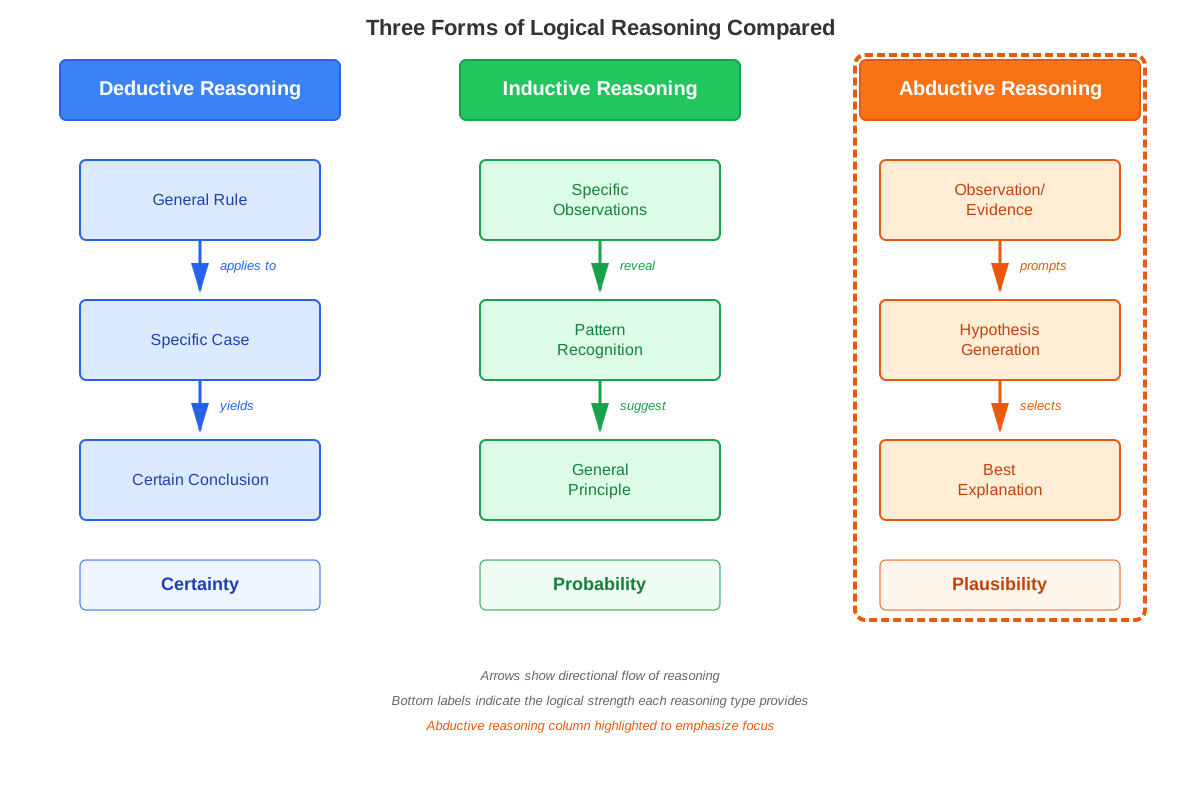
Abductive reasoning represents one of the three fundamental forms of logical inference, alongside deduction and induction. While deductive reasoning moves from general principles to specific conclusions and inductive reasoning generalizes from specific observations to broader patterns, abductive reasoning works backward from an observation to determine the most likely explanation for that observation. Often called "inference to the best explanation," abductive reasoning involves examining evidence or phenomena and proposing the hypothesis that would best account for what has been observed.
On the LSAT, lsat abductive reasoning appears frequently throughout the Logical Reasoning sections, though it is rarely labeled explicitly. Test-makers embed abductive patterns within various question types, particularly those asking students to identify assumptions, strengthen or weaken arguments, explain discrepancies, or resolve paradoxes. Understanding abductive reasoning is essential because many LSAT arguments present a conclusion that attempts to explain observed facts, and students must evaluate whether that explanation is the most reasonable one given the evidence. The ability to recognize when an argument employs abductive reasoning—and to assess its strength—directly impacts performance on 15-20% of Logical Reasoning questions.
Within the broader framework of argument fundamentals, abductive reasoning serves as a bridge between observation and explanation. While deductive arguments claim certainty and inductive arguments build probability through repetition, abductive arguments propose plausibility through explanatory power. Mastering this reasoning pattern enables students to quickly identify the logical structure underlying complex arguments, anticipate potential weaknesses, and select answer choices that appropriately address the argument's reasoning method. This foundational skill supports success across multiple question types and strengthens overall analytical capabilities essential for LSAT excellence.
Learning Objectives
- [ ] Identify how Abductive reasoning appears in LSAT questions
- [ ] Explain the reasoning pattern behind Abductive reasoning
- [ ] Apply Abductive reasoning to solve LSAT-style problems accurately
- [ ] Distinguish abductive reasoning from deductive and inductive reasoning patterns
- [ ] Evaluate the strength of abductive arguments based on alternative explanations
- [ ] Recognize common structural indicators that signal abductive reasoning in argument stems
- [ ] Predict likely answer choices for questions involving abductive reasoning patterns
Prerequisites
- Basic argument structure: Understanding premises and conclusions is essential because abductive reasoning involves moving from observed premises to explanatory conclusions
- Deductive reasoning fundamentals: Familiarity with deductive logic provides necessary contrast for recognizing when arguments use explanation-based rather than certainty-based reasoning
- Inductive reasoning patterns: Knowledge of inductive generalizations helps distinguish between pattern-based and explanation-based reasoning approaches
- Assumption identification: Recognizing unstated assumptions is crucial because abductive arguments inherently assume their explanation is superior to alternatives
Why This Topic Matters
Abductive reasoning pervades everyday decision-making and professional contexts. Medical diagnosis exemplifies abductive reasoning: physicians observe symptoms and propose the disease that best explains the constellation of findings. Criminal investigations rely on abductive inference when detectives construct theories explaining available evidence. Scientific hypothesis formation, business problem-solving, and legal argumentation all depend heavily on generating and evaluating explanatory hypotheses—the core function of abductive reasoning.
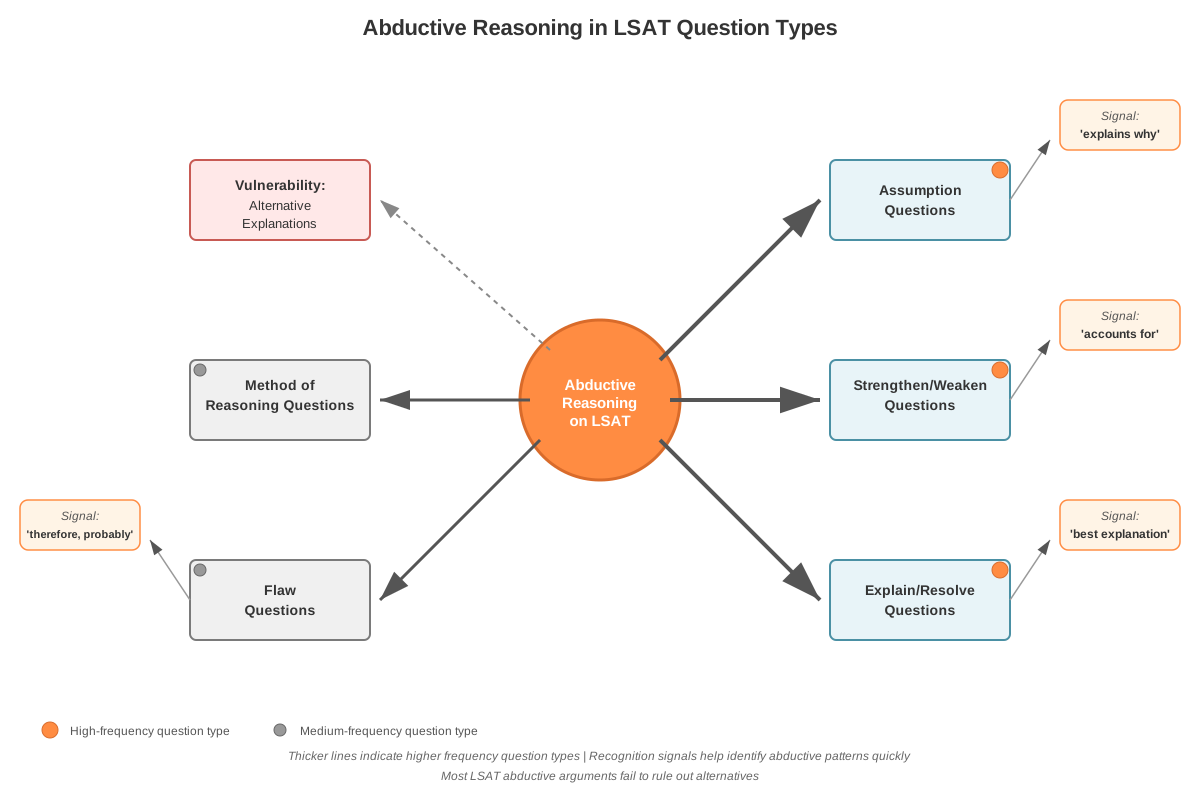
On the LSAT, abductive reasoning patterns appear in approximately 15-20% of Logical Reasoning questions across both sections. This translates to roughly 8-10 questions per test, making it a high-yield topic for score improvement. The reasoning pattern appears most frequently in:
- Assumption questions (25-30% of these questions involve abductive reasoning)
- Strengthen/Weaken questions (20-25% require evaluating explanatory hypotheses)
- Explain/Resolve questions (nearly 100% are pure abductive reasoning tasks)
- Flaw questions (15-20% involve flawed abductive inferences)
- Method of Reasoning questions (10-15% describe abductive argument structures)
Common manifestations include arguments that explain unexpected survey results, account for historical phenomena, propose causes for observed effects, or offer theories explaining apparent contradictions. The LSAT frequently tests whether students can identify when an argument has failed to consider alternative explanations—the most common weakness in abductive reasoning. Recognizing these patterns enables rapid question categorization and strategic answer choice evaluation.
Core Concepts
Definition and Structure of Abductive Reasoning
Abductive reasoning is a form of logical inference that moves from an observation or set of observations to a hypothesis that would, if true, best explain those observations. The basic structure follows this pattern:
- Observation X is made
- If hypothesis H were true, it would explain observation X
- Therefore, hypothesis H is (probably) true
Unlike deductive reasoning, which guarantees its conclusion if premises are true, abductive reasoning produces conclusions that are merely plausible or probable. The conclusion represents the "best available explanation" rather than a certain truth. This reasoning form is inherently defeasible—new evidence or better explanations can overturn abductive conclusions.
The Explanatory Power Criterion
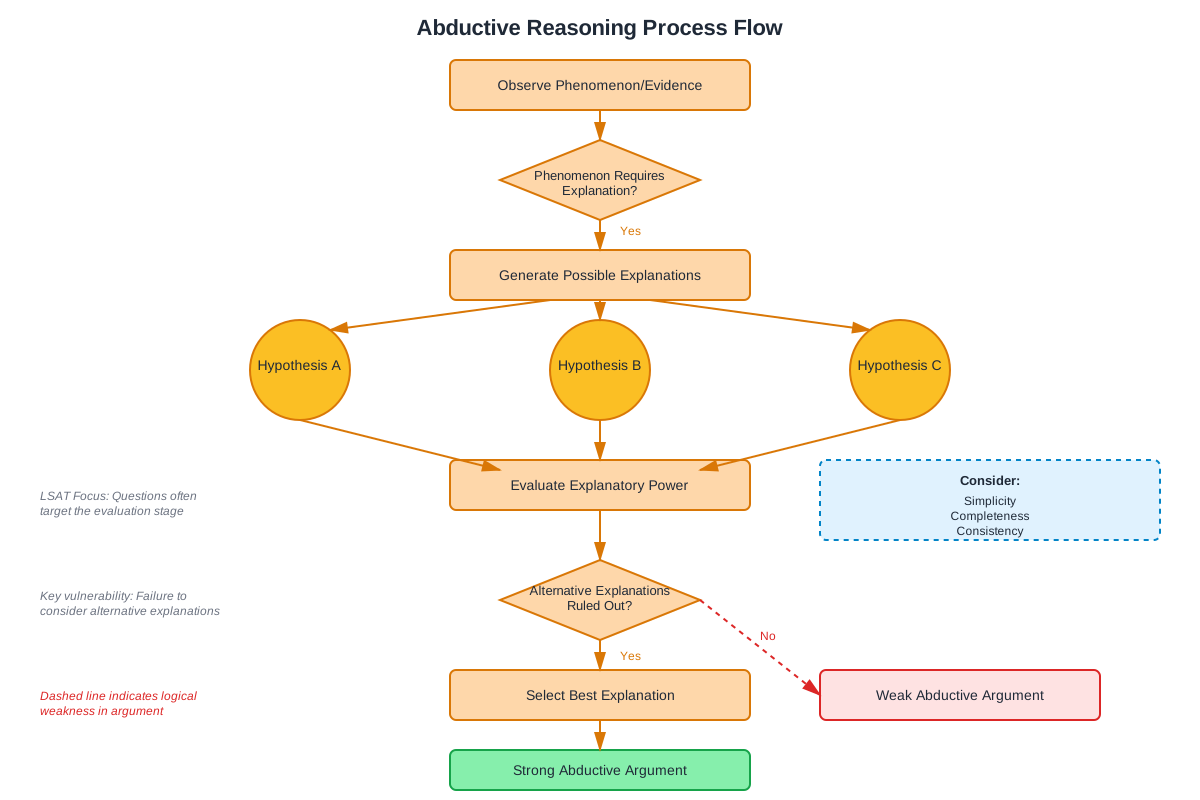
Abductive arguments succeed or fail based on explanatory power—how well the proposed hypothesis accounts for the observed phenomena. Strong abductive reasoning considers multiple potential explanations and demonstrates why the proposed hypothesis is superior. Weak abductive reasoning jumps to a single explanation without considering alternatives.
Key factors determining explanatory power include:
- Comprehensiveness: Does the explanation account for all observed facts?
- Simplicity: Does it avoid unnecessary complexity (Occam's Razor)?
- Consistency: Does it align with established knowledge?
- Predictive power: Does it suggest testable predictions?
- Lack of ad hoc elements: Does it avoid arbitrary additions created solely to save the hypothesis?
Distinguishing Abductive from Other Reasoning Types
Understanding how abductive reasoning differs from deductive and inductive reasoning is crucial for LSAT success:
| Reasoning Type | Direction | Certainty Level | Primary Function | LSAT Example |
|---|---|---|---|---|
| Deductive | General → Specific | Certain (if premises true) | Apply rules to cases | "All mammals are warm-blooded. Whales are mammals. Therefore, whales are warm-blooded." |
| Inductive | Specific → General | Probable | Identify patterns | "Every swan observed has been white. Therefore, all swans are probably white." |
| Abductive | Observation → Explanation | Plausible | Explain phenomena | "The grass is wet. Rain would explain this. Therefore, it probably rained." |
Common Abductive Patterns on the LSAT
Several recurring patterns signal abductive reasoning in LSAT arguments:
Causal Explanation Pattern: The argument observes a phenomenon and proposes a cause.
- Structure: "X occurred. Y could cause X. Therefore, Y probably caused X."
- Example: "Sales increased after the advertising campaign. Therefore, the campaign caused the sales increase."
Diagnostic Pattern: The argument identifies symptoms and proposes an underlying condition.
- Structure: "Symptoms A, B, and C are present. Condition D produces these symptoms. Therefore, condition D is present."
- Example: "The patient has fever, cough, and fatigue. These are flu symptoms. Therefore, the patient has the flu."
Motive/Intent Pattern: The argument observes behavior and infers underlying motivation.
- Structure: "Agent performed action X. Motive M would explain X. Therefore, agent had motive M."
- Example: "The company lowered prices. This would attract customers. Therefore, the company aimed to attract customers."
Historical Explanation Pattern: The argument proposes an explanation for past events.
- Structure: "Historical fact X exists. Theory T would explain X. Therefore, T is probably correct."
- Example: "Ancient structures show advanced engineering. Sophisticated knowledge would explain this. Therefore, ancient peoples possessed sophisticated knowledge."
The Alternative Explanation Problem
The most significant vulnerability in abductive reasoning is the failure to consider alternative explanations. An argument may propose a hypothesis that explains the observations, but if equally plausible alternative hypotheses exist, the argument's conclusion is weakened. The LSAT exploits this vulnerability extensively.
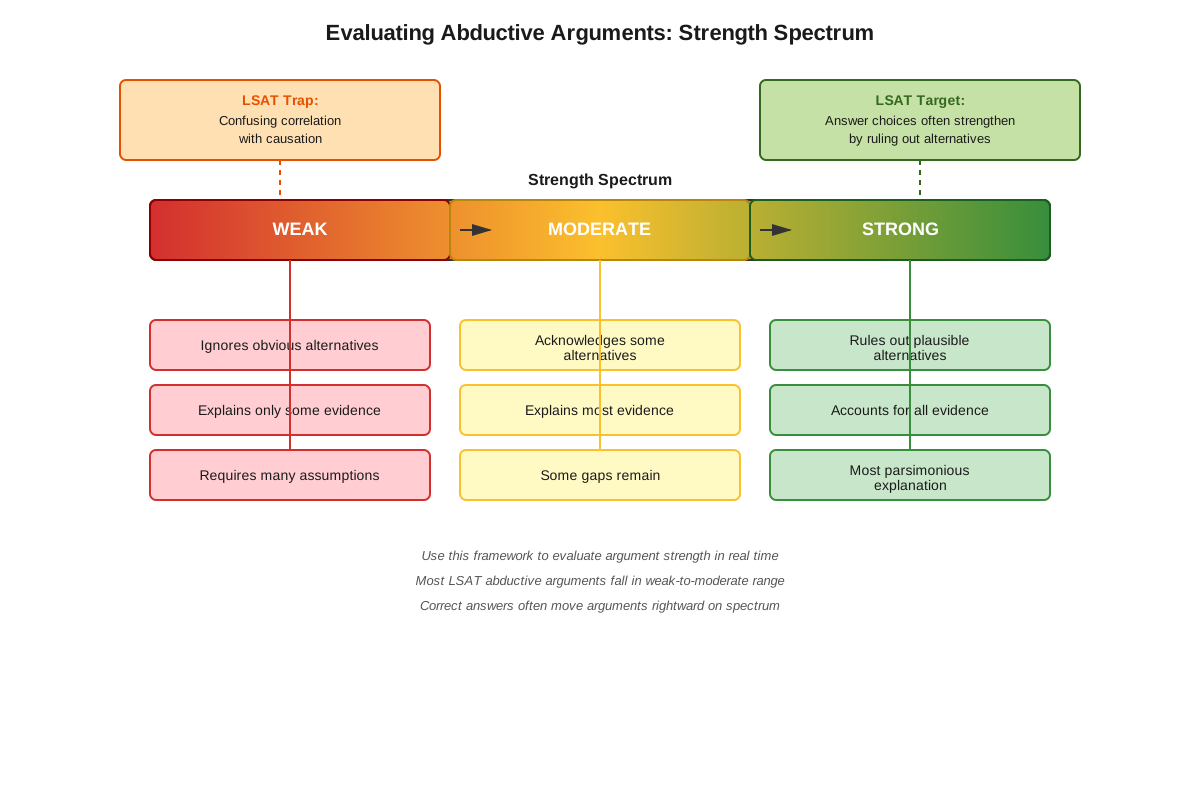
Strong abductive reasoning either:
- Explicitly rules out alternative explanations through additional evidence
- Demonstrates why the proposed explanation is superior to alternatives
- Acknowledges limitations while showing the explanation is most probable
Weak abductive reasoning:
- Assumes the proposed explanation is the only possibility
- Ignores obvious alternative explanations
- Fails to provide comparative reasoning about competing hypotheses
Assumptions in Abductive Arguments
Every abductive argument contains implicit assumptions, typically including:
- Uniqueness assumption: The proposed explanation is the only or best explanation
- Sufficiency assumption: The proposed cause/explanation is adequate to produce the observed effect
- No interference assumption: No other factors prevented or altered the proposed causal relationship
- Relevance assumption: The explanation actually addresses the observation requiring explanation
Identifying these assumptions is crucial for Assumption, Strengthen, Weaken, and Flaw questions involving abductive reasoning.
Concept Relationships
Abductive reasoning connects intimately with other argument fundamentals in logical reasoning. The reasoning pattern depends on understanding basic argument structure: observations serve as premises, while explanatory hypotheses function as conclusions. This relationship means students must first identify premises and conclusions before recognizing abductive patterns.
The relationship between abductive reasoning and assumption identification is bidirectional. Recognizing abductive reasoning helps predict what assumptions the argument makes (particularly the uniqueness assumption), while skill in finding assumptions helps evaluate abductive arguments' strength. This connection flows as: Abductive Reasoning Pattern Recognition → Assumption Prediction → Argument Evaluation.
Abductive reasoning also relates closely to causal reasoning, though they are distinct. Many abductive arguments propose causal explanations, but not all causal arguments are abductive, and not all abductive arguments are causal. The relationship is: Causal Reasoning ⊂ Abductive Reasoning (causal reasoning is a subset of abductive reasoning).
The connection to strengthen/weaken questions is direct: strengthening an abductive argument typically involves ruling out alternative explanations or providing additional evidence supporting the proposed explanation, while weakening involves introducing plausible alternatives or showing the explanation is inadequate. This creates the pathway: Abductive Reasoning Recognition → Alternative Explanation Consideration → Strengthen/Weaken Strategy Selection.
Finally, abductive reasoning connects to formal logic through its defeasible nature. Unlike deductive validity, which is binary (valid or invalid), abductive strength exists on a continuum. This relationship helps students understand why LSAT questions often ask about degrees of support rather than absolute proof: Deductive Certainty ↔ Abductive Plausibility (these exist on opposite ends of an inferential certainty spectrum).
High-Yield Facts
⭐ Abductive reasoning moves from observations to the best explanation for those observations, not from observations to general patterns (that's induction).
⭐ The primary weakness in abductive arguments is failing to consider or rule out alternative explanations.
⭐ Explain/Resolve questions almost always test abductive reasoning by asking which answer best explains an apparent discrepancy.
⭐ Strengthening an abductive argument typically requires either supporting the proposed explanation or eliminating alternative explanations.
⭐ Weakening an abductive argument typically requires introducing a plausible alternative explanation or showing the proposed explanation is inadequate.
- Abductive reasoning produces conclusions that are plausible or probable, never certain, even when premises are true.
- The phrase "best explains" or "most likely explanation" explicitly signals abductive reasoning in LSAT questions.
- Causal arguments that move from observed correlation to proposed cause are using abductive reasoning.
- Arguments that diagnose problems, attribute motives, or reconstruct past events typically employ abductive reasoning.
- An explanation can account for observations without being the correct explanation—multiple hypotheses may fit the same data.
⭐ The assumption that "no other explanation is better" underlies virtually all abductive arguments on the LSAT.
- Abductive reasoning is sometimes called "inference to the best explanation" or "retroductive reasoning."
- Scientific hypothesis formation uses abductive reasoning, making it relevant to science-themed LSAT passages.
- The strength of an abductive argument depends on the quality and quantity of alternative explanations available.
- Temporal correlation (X happened, then Y happened) often triggers abductive reasoning about causal relationships.
Quick check — test yourself on Abductive reasoning so far.
Try Flashcards →Common Misconceptions
Misconception: Abductive reasoning and inductive reasoning are the same thing because both produce probable rather than certain conclusions.
Correction: While both produce probable conclusions, they differ fundamentally in structure and purpose. Inductive reasoning generalizes from specific instances to broader patterns (observing many white swans and concluding all swans are white), while abductive reasoning proposes specific explanations for specific observations (observing wet grass and concluding it rained). Induction builds patterns; abduction explains phenomena.
Misconception: If an explanation accounts for all the observed facts, the argument is strong.
Correction: An explanation that accounts for observations may still be weak if equally plausible alternative explanations exist. The LSAT frequently presents arguments where the proposed explanation fits the facts but isn't necessarily the best explanation. Strong abductive reasoning requires comparative evaluation of competing hypotheses, not merely showing one hypothesis is consistent with observations.
Misconception: Abductive reasoning only appears in Explain/Resolve questions.
Correction: While Explain/Resolve questions explicitly test abductive reasoning, this reasoning pattern appears across multiple question types including Assumption, Strengthen, Weaken, Flaw, and Method of Reasoning questions. Any argument that proposes an explanation for observed phenomena employs abductive reasoning, regardless of question type. Recognizing the pattern matters more than the question category.
Misconception: The most complex or sophisticated explanation is usually the best explanation.
Correction: Abductive reasoning actually favors simpler explanations over complex ones, following Occam's Razor. When two hypotheses equally explain the observations, the simpler one is generally stronger. The LSAT often includes wrong answers that propose unnecessarily elaborate explanations when simpler alternatives exist. Complexity without additional explanatory power weakens rather than strengthens abductive arguments.
Misconception: Abductive reasoning is inherently flawed or weak reasoning.
Correction: Abductive reasoning is not inherently flawed; it's simply a different form of reasoning with different standards of success. While it doesn't provide deductive certainty, it's the appropriate reasoning form for explanatory contexts. The LSAT tests whether students can recognize when abductive reasoning is done well (considering alternatives, providing comparative justification) versus poorly (ignoring alternatives, jumping to conclusions). The reasoning type itself isn't the flaw—inadequate application is.
Misconception: If the proposed explanation is possible, the abductive argument is strong.
Correction: Possibility is insufficient for strong abductive reasoning; the explanation must be probable or most plausible among alternatives. Many LSAT wrong answers present possible explanations that are nonetheless implausible or inferior to other options. Strong abductive reasoning requires demonstrating that the proposed explanation is not merely possible but more likely than competing explanations given the available evidence.
Worked Examples
Example 1: Assumption Question with Abductive Reasoning
Argument: "Archaeological excavations at the ancient site revealed numerous bronze tools but no iron implements. The civilization that inhabited this site must have existed during the Bronze Age, before iron-working technology was developed."
Question: Which of the following is an assumption required by the argument?
Analysis:
Step 1: Identify the reasoning pattern
This argument uses abductive reasoning. It observes evidence (bronze tools present, iron tools absent) and proposes an explanation (the civilization existed before iron-working was developed).
Step 2: Identify the conclusion and premises
- Premise: Bronze tools found, no iron implements found
- Conclusion: The civilization existed during the Bronze Age, before iron-working technology
Step 3: Recognize the abductive structure
The argument moves from observation → explanation. It's saying "This evidence would be explained if the civilization existed before iron-working."
Step 4: Identify the key assumption
The argument assumes there's no better alternative explanation for the absence of iron tools. Specifically, it assumes the absence of iron tools indicates lack of iron-working knowledge rather than some other cause.
Step 5: Predict answer types
Correct answers might state:
- The civilization didn't have access to iron even if they knew how to work it
- The absence of iron tools wasn't due to iron tools decomposing while bronze survived
- The excavation site is representative of the civilization's technology
- Iron tools weren't deliberately removed or recycled
Sample Correct Answer: "Iron tools would not have decomposed completely while bronze tools remained intact."
This is necessary because if iron decomposes but bronze doesn't, the absence of iron tools wouldn't indicate the civilization lacked iron-working technology—it would just mean iron tools didn't survive. This represents an alternative explanation the argument must rule out.
Example 2: Explain/Resolve Question (Pure Abductive Reasoning)
Argument: "A recent study found that students who took notes by hand performed better on conceptual questions than students who took notes on laptops, despite laptop users recording significantly more information verbatim. This finding seems paradoxical since more complete notes should lead to better performance."
Question: Which of the following, if true, most helps to explain the paradoxical finding?
Analysis:
Step 1: Identify what needs explanation
The paradox: More complete notes (laptop users) correlates with worse performance on conceptual questions. This contradicts the expectation that more information → better performance.
Step 2: Recognize this as pure abductive reasoning
Explain/Resolve questions ask for the hypothesis that best explains the observations. This is the quintessential abductive reasoning task.
Step 3: Consider what a good explanation must do
The explanation must account for why MORE information led to WORSE performance. It needs to identify a mechanism that reverses the expected relationship.
Step 4: Predict explanation types
Strong explanations might involve:
- A qualitative difference in how information is processed
- A trade-off where recording more prevents deeper processing
- A difference in what "better performance" means for conceptual vs. factual questions
Step 5: Evaluate answer choices
Weak Answer: "Laptop users were generally less motivated students."
This doesn't explain the paradox—it just provides an alternative cause for poor performance without addressing why more complete notes correlated with worse outcomes.
Strong Answer: "Taking notes by hand requires summarizing and paraphrasing, which promotes deeper conceptual processing, while typing verbatim notes allows passive recording without conceptual engagement."
This explains the paradox by identifying a mechanism: the very act of recording more information (typing verbatim) prevents the deeper processing that handwriting requires. It accounts for both observations (more complete notes AND worse conceptual performance) through a single explanatory mechanism.
Step 6: Verify the explanation
The strong answer explains why laptop users recorded more information (typing is faster, allows verbatim recording) AND why they performed worse on conceptual questions (verbatim recording doesn't require conceptual processing). It resolves the apparent contradiction by showing the two outcomes share a common cause.
Exam Strategy
Recognizing Abductive Reasoning Triggers
Watch for these phrases that signal abductive reasoning:
- "explains," "accounts for," "is explained by"
- "therefore," "thus," "consequently" following observational premises
- "must have," "probably," "likely" in conclusions about causes or past events
- "because," "since," "due to" when proposing explanations rather than stating known facts
When you see these triggers, immediately shift to abductive reasoning analysis mode: identify the observation requiring explanation and evaluate whether the proposed explanation is the best available.
Question Type-Specific Approaches
For Assumption Questions with Abductive Reasoning:
- Identify the proposed explanation (conclusion)
- Ask: "What alternative explanations exist?"
- The assumption will typically rule out the most obvious alternative
- Use the negation test: if the assumption is false, does an alternative explanation become more plausible?
For Strengthen/Weaken Questions:
- Strengthen: Look for answers that either (a) provide additional evidence supporting the proposed explanation, or (b) rule out alternative explanations
- Weaken: Look for answers that either (a) introduce plausible alternative explanations, or (b) show the proposed explanation is inadequate or inconsistent with other facts
For Explain/Resolve Questions:
- Identify both facts that seem contradictory
- The correct answer will provide a mechanism or additional information that shows why both facts can be true simultaneously
- Eliminate answers that explain only one fact or that don't address the apparent contradiction
- The best explanation will be sufficient to resolve the paradox without introducing unnecessary complexity
Process of Elimination Tips
Eliminate answers that:
- Merely restate the observation without explaining it
- Provide possible but implausible explanations
- Introduce irrelevant information that doesn't address the specific observation
- Explain only part of what needs explaining
- Require additional unsupported assumptions to work
Favor answers that:
- Directly address the relationship between observation and explanation
- Provide mechanisms or processes explaining how/why
- Are consistent with all stated facts
- Follow Occam's Razor (simpler explanations preferred)
- Rule out obvious alternatives (for strengthen/assumption questions)
Time Allocation
Abductive reasoning questions, particularly Explain/Resolve types, often require more careful analysis than pure deductive questions. Allocate:
- 30-45 seconds: Identifying the reasoning pattern and what needs explanation
- 45-60 seconds: Evaluating answer choices
- Total: 1:15-1:45 per question
Don't rush these questions. The time invested in clearly understanding what observation needs explanation pays dividends in answer choice evaluation. However, if you find yourself considering multiple plausible explanations, remember that the LSAT always has one best answer—look for the explanation that most completely and simply accounts for all observations.
Memory Techniques
The "ABD" Mnemonic
Remember ABDuctive reasoning with:
- Answer: What answer/explanation is proposed?
- Best: Is this the best explanation available?
- Different: What different/alternative explanations exist?
This three-step check helps evaluate any abductive argument quickly.
The "EXPLAIN" Framework
For Explain/Resolve questions specifically:
- Evidence: What facts are observed?
- X-pectation: What would we normally expect?
- Paradox: What's contradictory or surprising?
- Link: What links/mechanism could connect the facts?
- Alternatives: What alternative explanations exist?
- Integrate: Does the answer integrate all observations?
- Necessity: Is this explanation necessary and sufficient?
Visualization Strategy
Picture abductive reasoning as a reverse arrow:
- Deductive: Rule → Case (forward arrow)
- Inductive: Cases → Rule (upward arrow)
- Abductive: Effect ← Cause (backward arrow)
Visualizing the backward arrow reminds you that abductive reasoning works from effect back to cause, from observation back to explanation.
The "Alternative Explanation Alert"
Create a mental alarm that triggers whenever you see abductive reasoning: "ALTERNATIVE?" This single-word reminder prompts you to immediately consider whether alternative explanations exist, catching the most common weakness in abductive arguments.
Summary
Abductive reasoning represents a fundamental inference pattern where arguments move from observations to explanatory hypotheses, proposing the "best explanation" for observed phenomena. Unlike deductive reasoning's certainty or inductive reasoning's pattern-building, abductive reasoning generates plausible explanations that account for specific observations. On the LSAT, this reasoning pattern appears across multiple question types but most explicitly in Explain/Resolve questions. The critical vulnerability in abductive arguments is the failure to consider or rule out alternative explanations—an argument may propose a hypothesis consistent with observations without demonstrating it's the best available explanation. Strong abductive reasoning requires comparative evaluation of competing hypotheses, consideration of explanatory power, and recognition that multiple explanations may fit the same observations. Success with LSAT questions involving abductive reasoning depends on quickly recognizing the pattern, identifying what observation requires explanation, evaluating whether the proposed explanation is superior to alternatives, and understanding the assumptions that underlie explanatory claims. Mastering this reasoning type directly impacts performance on 15-20% of Logical Reasoning questions and strengthens overall analytical capabilities essential for LSAT success.
Key Takeaways
- Abductive reasoning moves from observations to explanatory hypotheses, proposing the "best explanation" for what has been observed
- The primary weakness in abductive arguments is failing to consider or eliminate alternative explanations—always ask "what else could explain this?"
- Explain/Resolve questions test pure abductive reasoning, while Assumption, Strengthen, and Weaken questions frequently involve abductive patterns
- Strong abductive reasoning requires comparative evaluation: showing the proposed explanation is superior to alternatives, not merely consistent with observations
- Recognize abductive reasoning through trigger phrases like "explains," "accounts for," "must have," and arguments that propose causes, diagnose conditions, or reconstruct past events
- Strengthening abductive arguments typically involves ruling out alternatives or providing additional supporting evidence; weakening involves introducing plausible alternatives
- The assumption underlying most abductive arguments is that no better alternative explanation exists—this assumption is frequently tested on the LSAT
Related Topics
Causal Reasoning: Many abductive arguments propose causal explanations, making causal reasoning a natural extension. Understanding how to evaluate causal claims, distinguish correlation from causation, and identify alternative causes builds directly on abductive reasoning foundations.
Necessary and Sufficient Conditions: Abductive arguments often assume their proposed explanation is sufficient to produce the observed effect. Mastering necessary and sufficient conditions enables more sophisticated evaluation of whether explanations are adequate.
Formal Logic and Conditional Reasoning: While abductive reasoning is less formal than deductive logic, understanding conditional relationships helps evaluate whether proposed explanations logically connect to observations.
Argument Evaluation and Critique: Abductive reasoning mastery enables deeper engagement with argument evaluation questions, particularly those asking about reasoning flaws, argument vulnerabilities, and comparative argument strength.
Scientific Reasoning: Many LSAT passages involve scientific contexts where researchers propose hypotheses to explain experimental results. Abductive reasoning skills transfer directly to evaluating scientific arguments and experimental design questions.
Practice CTA
Now that you understand abductive reasoning's structure, vulnerabilities, and LSAT applications, it's time to cement this knowledge through active practice. Attempt the practice questions designed for this topic, focusing on identifying the reasoning pattern before evaluating answer choices. Use the flashcards to reinforce recognition of abductive reasoning triggers and common question patterns. Remember: recognizing abductive reasoning quickly and automatically is a skill built through repetition. Each practice question strengthens your ability to spot these patterns under timed conditions, moving you closer to your target score. The investment you make in mastering this high-yield topic will pay dividends across 15-20% of Logical Reasoning questions—that's the difference between a good score and a great one.
Sign up free to keep reading
Create a free AnvayaPrep account to finish this LSAT guide on Abductive reasoning — plus flashcards and practice questions.