Overview
Argument relevance is a foundational concept in LSAT Logical Reasoning that tests a student's ability to distinguish between information that genuinely affects an argument's validity and information that merely appears connected but provides no logical support or opposition. This skill is essential because the LSAT frequently presents arguments containing extraneous information, red herrings, or tangentially related facts designed to distract test-takers from the actual logical structure. Understanding lsat argument relevance enables students to cut through verbal clutter and focus on what truly matters in evaluating reasoning.
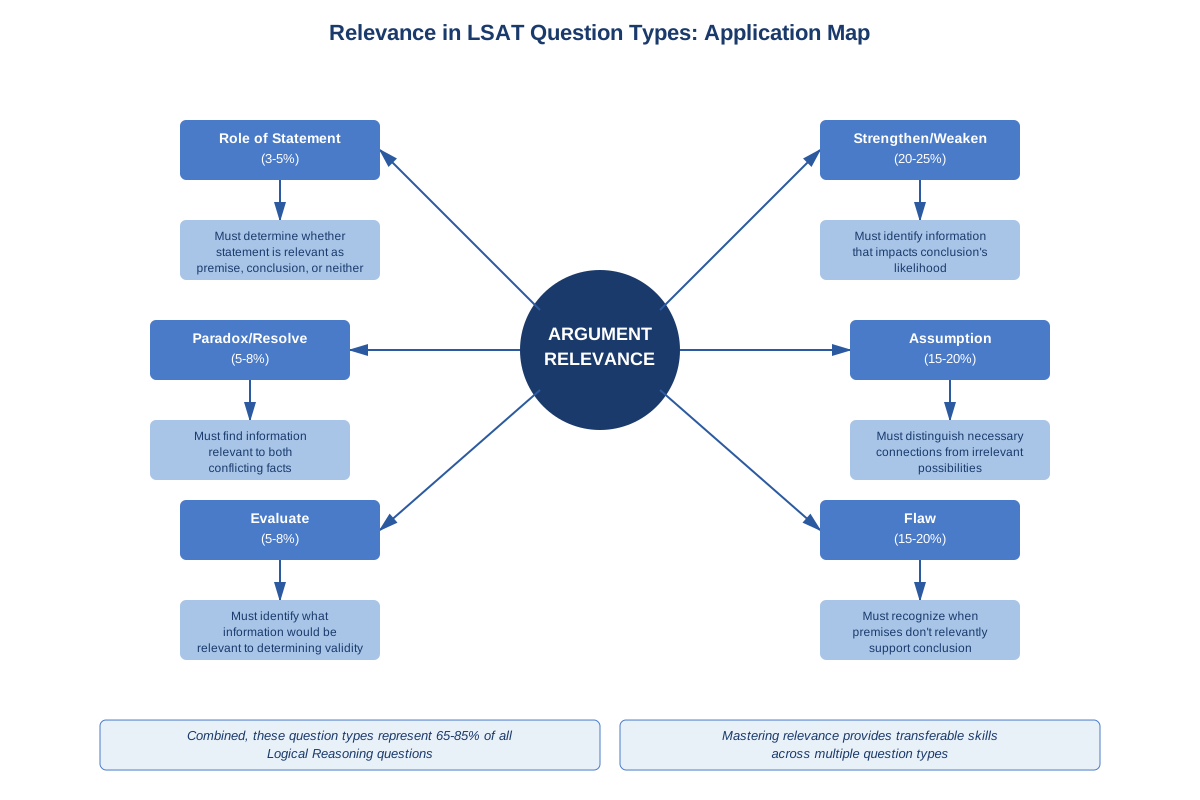
Mastering logical reasoning through the lens of relevance is critical because approximately 25-30% of Logical Reasoning questions directly or indirectly test this concept. Questions asking students to identify assumptions, strengthen or weaken arguments, evaluate reasoning, or find flaws all require the ability to determine which pieces of information are logically connected to the conclusion. Without this skill, students waste precious time analyzing irrelevant details and may select answer choices that sound plausible but fail to address the argument's actual logical gap.
Within the broader framework of argument fundamentals, relevance serves as a filtering mechanism that works alongside identifying conclusions, premises, and assumptions. While other fundamental skills help students map an argument's structure, relevance helps them evaluate whether the connections between those structural elements are logically sound. This topic bridges basic argument identification skills with more advanced tasks like recognizing sufficient and necessary conditions, causal reasoning patterns, and formal logic relationships. Students who master relevance develop a critical eye for distinguishing correlation from causation, scope mismatches, and logical gaps—skills that prove invaluable across all Logical Reasoning question types.
Learning Objectives
- [ ] Identify how Argument relevance appears in LSAT questions
- [ ] Explain the reasoning pattern behind Argument relevance
- [ ] Apply Argument relevance to solve LSAT-style problems accurately
- [ ] Distinguish between relevant and irrelevant information in complex argument passages
- [ ] Evaluate whether new information strengthens, weakens, or has no effect on an argument's conclusion
- [ ] Recognize common irrelevance patterns that appear as trap answers in Logical Reasoning questions
Prerequisites
- Basic argument structure identification: Understanding premises and conclusions is essential because relevance requires evaluating how information connects to these structural elements.
- Conditional reasoning fundamentals: Recognizing if-then relationships helps determine whether information satisfies necessary or sufficient conditions within an argument.
- Scope recognition: Identifying what an argument is and isn't claiming prevents mistaking out-of-scope information for relevant evidence.
- Causal reasoning basics: Understanding cause-and-effect claims helps evaluate whether information affects causal relationships in arguments.
Why This Topic Matters
In real-world contexts, the ability to assess argument relevance is fundamental to critical thinking in law, business, medicine, and everyday decision-making. Lawyers must distinguish relevant evidence from prejudicial but logically disconnected information. Business analysts must separate meaningful data from noise when making strategic recommendations. This cognitive skill prevents manipulation through rhetorical tactics that introduce emotionally charged but logically irrelevant information.
On the LSAT, relevance appears in multiple question types with high frequency. Strengthen/Weaken questions (approximately 20-25% of all Logical Reasoning questions) explicitly test whether students can identify information that affects an argument's validity. Assumption questions (15-20% of questions) require recognizing what unstated information is relevant and necessary for an argument to hold. Flaw questions (10-15% of questions) often feature arguments that treat irrelevant information as though it supports the conclusion. Evaluate questions directly ask students to identify what information would be relevant to assessing an argument's strength.
Common manifestations in LSAT passages include arguments that cite statistics from unrelated populations, invoke expert opinions outside their domain of expertise, confuse temporal sequence with causation, or introduce emotionally resonant but logically disconnected information. The test writers deliberately craft answer choices that sound related to the topic but fail to address the specific logical connection between premises and conclusion.
Core Concepts
Defining Argument Relevance
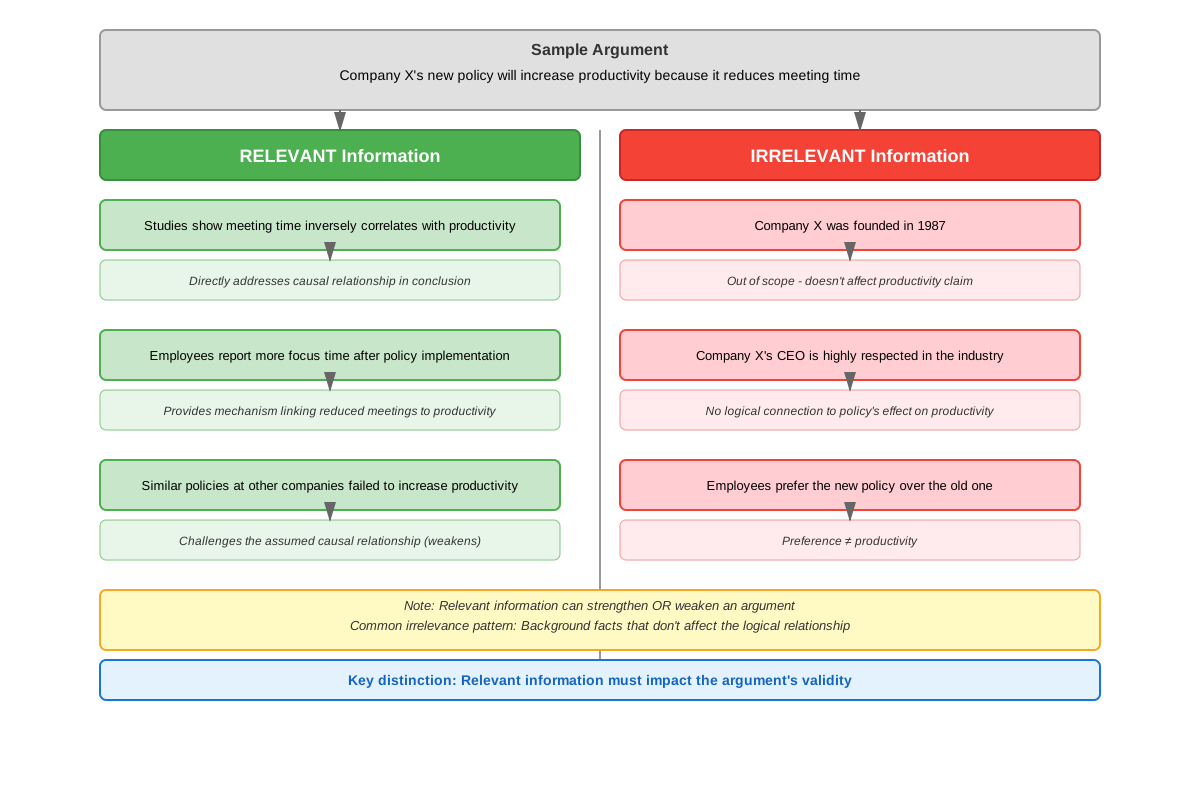
Argument relevance refers to the logical connection between a piece of information and an argument's conclusion. Information is relevant if and only if its truth or falsity would make the conclusion more or less likely to be true. This definition is precise and functional: relevance is not about topical similarity or thematic connection, but about logical impact on the conclusion's probability.
Consider the distinction between topical relevance and logical relevance. An argument concluding "The city should build a new stadium" might include information about the city's sports history. While this information is topically related to stadiums and sports, it may be logically irrelevant if the argument's reasoning concerns economic development. The LSAT exploits this distinction by presenting answer choices that discuss the same general subject matter but fail to address the specific logical gap in the reasoning.
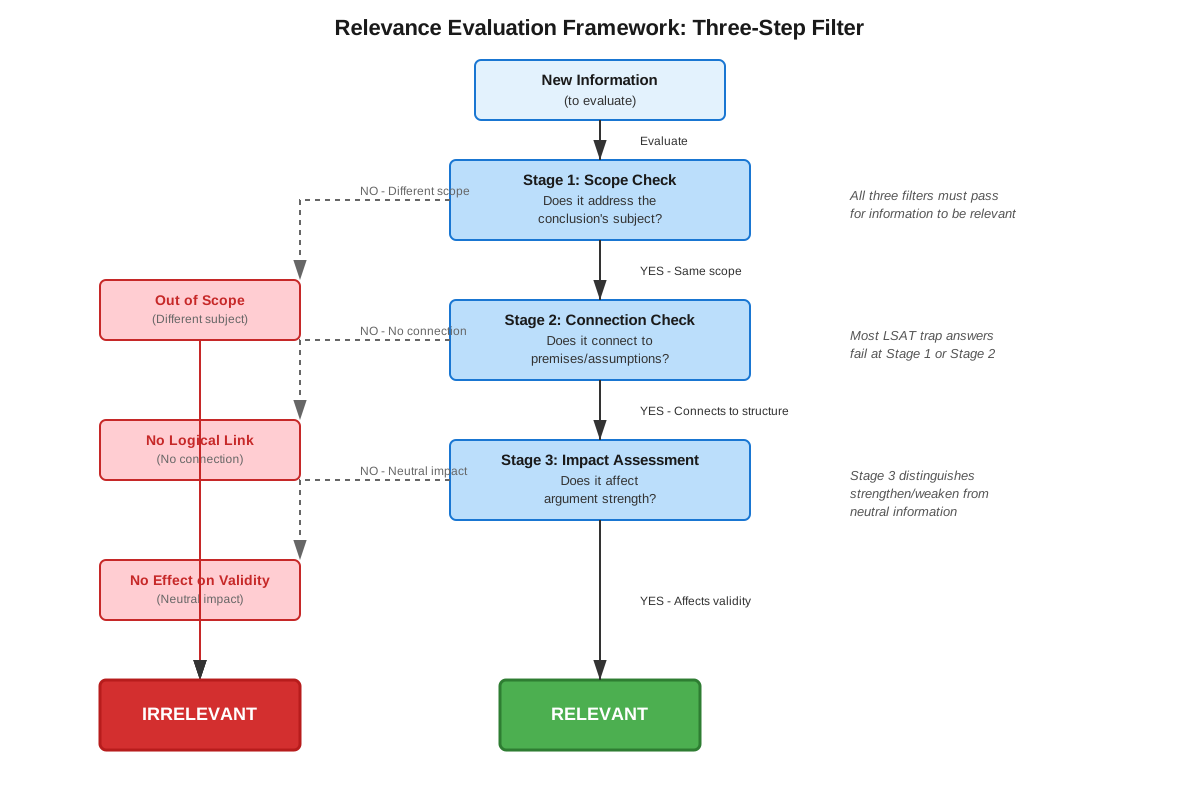
The Relevance Test
To determine whether information is relevant, apply this three-step test:
- Identify the conclusion precisely: What specific claim is being made?
- Identify the reasoning structure: What logical connection does the argument assume between premises and conclusion?
- Evaluate logical impact: Would this new information make the conclusion more likely, less likely, or have no effect on its probability?
Information passes the relevance test only if it affects the conclusion's likelihood through the argument's specific reasoning pathway. For example, if an argument concludes that "Policy X will reduce crime" based on the premise that "Policy X increases police presence," then information about whether increased police presence actually reduces crime is relevant. Information about the policy's cost, while important for decision-making, is irrelevant to this specific argument's logical validity.
Scope and Relevance
Scope mismatches represent the most common form of irrelevance on the LSAT. An argument's scope includes its subject matter boundaries, time frame, population, and degree of certainty. Information outside these boundaries cannot affect the conclusion's validity.
| Scope Dimension | Example Mismatch | Why It's Irrelevant |
|---|---|---|
| Subject matter | Argument about dogs; information about cats | Different subjects, no logical connection established |
| Time frame | Argument about future effects; information about past | Temporal scope doesn't match unless causal pattern established |
| Population | Argument about adults; information about children | Different populations may have different characteristics |
| Degree | Argument about "most"; information about "some" | Quantitative scope mismatch |
| Geography | Argument about Country A; information about Country B | Different contexts unless similarity established |
Causal Relevance
When arguments make causal claims, relevance requires information that affects the causal relationship. Three types of information are relevant to causal arguments:
- Alternative causes: Information suggesting other factors could produce the observed effect
- Correlation vs. causation: Information about whether the relationship is merely coincidental
- Mechanism information: Evidence about how the proposed cause produces the effect
For instance, if an argument claims "Increased ice cream sales cause increased drowning deaths," information about summer weather patterns is relevant because it suggests an alternative cause (hot weather) that produces both effects independently.
Conditional Relevance
In arguments involving conditional statements (if-then relationships), relevance depends on whether information addresses the sufficient condition, necessary condition, or the logical relationship between them. Information about unrelated conditions, even if topically similar, is irrelevant.
Consider: "If the company implements remote work, productivity will increase." Relevant information would address whether remote work actually leads to increased productivity, whether other factors are necessary for this relationship, or whether the company is actually implementing remote work. Information about employee satisfaction with remote work, while related to the topic, is irrelevant unless the argument explicitly connects satisfaction to productivity.
Comparative Relevance
Some arguments make comparative claims requiring information that addresses the specific comparison being made. Information about only one element of the comparison, or about a different comparison entirely, is irrelevant.
For example, an argument concluding "Electric cars are better for the environment than gas cars" requires information comparing the environmental impact of both types. Information only about electric cars' benefits, without addressing gas cars or the comparative relationship, is insufficient and therefore irrelevant to the specific conclusion.
Degree and Sufficiency
Relevance also involves whether information is sufficient in degree to affect the conclusion. Information that is directionally relevant but insufficient in magnitude may not actually impact the argument's validity. The LSAT tests this through answer choices that provide relevant information but in quantities too small to matter, or that address only part of what the argument requires.
Concept Relationships
Argument relevance serves as the central filtering mechanism connecting all other argument fundamentals. The relationship flows as follows:
Argument Structure Identification → Relevance Assessment → Assumption Recognition → Argument Evaluation
Students must first identify conclusions and premises (argument structure) before they can determine what information would affect those conclusions (relevance). Once relevance is understood, students can identify what relevant information is missing (assumptions). Finally, this enables evaluation of whether the argument succeeds or fails.
Relevance connects to scope analysis through a bidirectional relationship: understanding an argument's scope helps determine relevance, while analyzing what information is relevant helps clarify the argument's actual scope. Similarly, relevance interacts with conditional reasoning: determining whether information is relevant often requires understanding whether it satisfies necessary or sufficient conditions in the argument's logic.
The concept also relates to causal reasoning as a specialized application: in causal arguments, relevance specifically means information affecting the causal relationship. This creates a hierarchy where general relevance principles apply to all arguments, while causal relevance represents a specific subset with additional considerations.
Premise Identification → Conclusion Identification → Gap Recognition → Relevance Determination → Answer Evaluation
This sequence represents the practical workflow for applying relevance in LSAT questions, showing how relevance assessment depends on prior structural analysis but enables subsequent answer choice evaluation.
High-Yield Facts
- ⭐ Information is relevant only if its truth or falsity would affect the conclusion's probability through the argument's specific reasoning pathway
- ⭐ Topical similarity does not equal logical relevance; the LSAT frequently uses topically related but logically irrelevant information as trap answers
- ⭐ Scope mismatches (subject, time, population, degree, geography) are the most common form of irrelevance in wrong answer choices
- ⭐ In causal arguments, information about alternative causes, correlation vs. causation, or causal mechanisms is relevant
- ⭐ Comparative arguments require information addressing both elements of the comparison and their relationship
- Information about necessary conditions is relevant to whether a conclusion can occur; information about sufficient conditions is relevant to whether it will occur
- Relevant information must match the argument's degree of certainty (e.g., information about "some" is irrelevant to conclusions about "most")
- Background information or context is typically irrelevant unless it affects the logical connection between premises and conclusion
- Information about motivations or intentions is usually irrelevant unless the argument explicitly concerns motivations
- Emotional appeals or value judgments are irrelevant to arguments based on factual or logical reasoning unless values are explicitly part of the conclusion
Quick check — test yourself on Argument relevance so far.
Try Flashcards →Common Misconceptions
Misconception: If information is about the same topic as the argument, it must be relevant.
Correction: Topical similarity is neither necessary nor sufficient for logical relevance. Information must affect the conclusion's probability through the argument's specific reasoning structure, not merely discuss related subjects.
Misconception: More information is always better for evaluating an argument.
Correction: Only logically relevant information helps evaluate an argument. Irrelevant information, regardless of quantity, provides no logical value and may obscure the actual reasoning structure.
Misconception: If information would be important for making a real-world decision, it must be relevant to the argument.
Correction: Practical importance differs from logical relevance. An argument may have a narrow logical scope even if the real-world decision requires considering additional factors.
Misconception: Information that contradicts a premise is always relevant.
Correction: Information is relevant only if it affects the conclusion. Contradicting a premise is relevant only if that premise is necessary for reaching the conclusion through the argument's reasoning.
Misconception: Expert opinions are always relevant to arguments in their field.
Correction: Expert testimony is relevant only if it addresses the specific claim in the conclusion and falls within the expert's domain of expertise. General expertise in a field doesn't make all statements by that expert relevant to every argument in that field.
Misconception: Statistical information is automatically relevant to arguments involving numbers or quantities.
Correction: Statistics are relevant only if they concern the same population, time frame, and measurement as the argument's conclusion. Statistics from different contexts, even if numerically precise, may be completely irrelevant.
Misconception: If information strengthens one premise, it strengthens the entire argument.
Correction: Information strengthens an argument only if it addresses a necessary logical connection between premises and conclusion. Strengthening a premise that isn't essential to the reasoning doesn't affect the argument's overall validity.
Worked Examples
Example 1: Identifying Irrelevant Information
Argument: "The city's new recycling program will reduce landfill waste by 30% within two years. The program provides free recycling bins to all residents and offers weekly curbside pickup. Therefore, the city should expand the program to include composting services."
Question: Which of the following, if true, is LEAST relevant to evaluating the argument's conclusion?
Answer Choices:
A) Composting services would require significant additional funding beyond the current recycling budget
B) Surveys show that 85% of residents are satisfied with the current recycling program
C) Organic waste constitutes 40% of the material currently sent to landfills
D) Neighboring cities with composting programs have seen 50% reductions in landfill waste
E) The city has sufficient infrastructure to support composting collection
Analysis:
Step 1: Identify the conclusion precisely: "The city should expand the program to include composting services."
Step 2: Identify the reasoning structure: The argument presents the recycling program's success (reducing landfill waste) as evidence that expanding to composting would be beneficial. The implicit reasoning is that because recycling worked, composting will also work.
Step 3: Evaluate each answer choice's logical impact:
- Choice A: Relevant. Budget constraints directly affect whether the city should implement the program.
- Choice B: LEAST relevant. Resident satisfaction with recycling doesn't logically connect to whether composting services should be added. The argument concerns waste reduction effectiveness, not customer satisfaction. This is topically related but logically disconnected.
- Choice C: Relevant. If organic waste is a large portion of landfill material, composting would have significant impact.
- Choice D: Relevant. Evidence from similar programs directly addresses whether composting achieves the goal.
- Choice E: Relevant. Infrastructure capacity affects feasibility of the expansion.
Answer: B
The key insight is recognizing that satisfaction with one program doesn't logically connect to whether a different program should be implemented. This is a scope mismatch: the argument's scope concerns waste reduction effectiveness, not customer satisfaction metrics.
Example 2: Applying Relevance to Strengthen Questions
Argument: "Company X's new employee wellness program will increase productivity. The program includes gym memberships, healthy cafeteria options, and stress management workshops. Studies show that employees who exercise regularly are more productive than those who don't."
Question: Which of the following, if true, most strengthens the argument?
Answer Choices:
A) Company X's employees have expressed interest in wellness programs
B) Providing gym memberships causes employees to exercise more regularly
C) Stress management workshops are popular among employees at similar companies
D) Healthy cafeteria options cost less than the previous menu
E) Company X's productivity has been declining over the past year
Analysis:
Step 1: Identify the conclusion: "Company X's new wellness program will increase productivity."
Step 2: Map the reasoning structure:
- Premise: The program includes gym memberships, healthy food, and stress workshops
- Premise: Employees who exercise regularly are more productive
- Conclusion: This program will increase productivity
- Logical gap: The argument assumes that providing these program elements will cause employees to actually exercise regularly and that this will translate to productivity gains.
Step 3: Evaluate relevance and strength:
- Choice A: Irrelevant. Employee interest doesn't establish that the program will cause behavior change or productivity increases.
- Choice B: MOST RELEVANT AND STRENGTHENING. This directly addresses the logical gap by establishing a causal connection between the program element (gym memberships) and the behavior (regular exercise) that the evidence links to productivity.
- Choice C: Irrelevant. Popularity doesn't establish effectiveness for productivity.
- Choice D: Irrelevant. Cost considerations don't affect whether the program will increase productivity.
- Choice E: Irrelevant. Current productivity levels don't affect whether this program will cause increases.
Answer: B
This example demonstrates that relevance in strengthen questions requires identifying the specific logical gap and finding information that bridges it. Choice B is relevant because it connects the program's offering (gym memberships) to the behavior (regular exercise) that the evidence establishes as productivity-enhancing. The other choices, while topically related to wellness programs, don't address the causal chain necessary for the conclusion.
Exam Strategy
When approaching LSAT questions involving argument relevance, implement this systematic process:
Step 1: Isolate the conclusion with precision. Underline or mentally note the exact claim being made, including its scope, degree, and subject matter. Many relevance errors stem from misidentifying what the argument actually concludes.
Step 2: Map the logical structure. Identify not just what premises are stated, but how they're supposed to support the conclusion. What logical connection does the argument assume?
Step 3: Predict the gap. Before reading answer choices, articulate what information would be relevant. What's missing? What assumption bridges premises to conclusion?
Step 4: Apply the relevance test to each answer. Ask: "If this were true, would it make the conclusion more likely, less likely, or have no effect?" Eliminate answers that have no effect.
Exam Tip: The LSAT frequently includes answer choices that are factually true and topically related but logically irrelevant. Don't be seduced by interesting or plausible-sounding information that doesn't affect the conclusion.
Trigger words and phrases to watch for:
- "Relevant to evaluating" = requires identifying what logically affects the conclusion
- "Least relevant" = find the answer with no logical connection
- "Strengthen/Weaken" = requires relevant information that affects conclusion probability
- "Assumption" = requires identifying relevant missing information
- "Flaw" = often involves treating irrelevant information as relevant
Process-of-elimination strategy:
- Eliminate answers with scope mismatches first (different subject, population, time frame)
- Eliminate answers that address only premises without connecting to the conclusion
- Eliminate answers that would be important for practical decisions but don't affect the argument's logic
- Between remaining choices, select the one that most directly addresses the logical gap
Time allocation advice:
Spend 15-20 seconds on structural analysis before reading answer choices. This upfront investment prevents wasting time on irrelevant answers. If you find yourself reading an answer choice twice without understanding its connection to the argument, it's likely irrelevant—move on rather than overthinking.
Memory Techniques
SCOPE Mnemonic for checking relevance:
- Subject matter: Does it address the same topic?
- Conclusion connection: Does it affect the conclusion specifically?
- Outcome impact: Would it change the conclusion's probability?
- Premise pathway: Does it work through the argument's reasoning?
- Exact match: Does it match the argument's degree and certainty?
The Bridge Visualization: Picture the argument as two islands (premises and conclusion) with a bridge between them. Relevant information either strengthens the bridge, weakens it, or helps you see whether it's actually connected. Irrelevant information is like describing the water around the islands—it's part of the scenery but doesn't affect whether the bridge holds.
The Laser Test: Imagine the conclusion as a target. Relevant information is like a laser that hits the target directly. Irrelevant information misses the target, even if it lights up the area around it. Topically related but logically irrelevant information is like a laser that hits near the target but not on it.
DIRECT Acronym for causal relevance:
- Different cause possible?
- Independent correlation?
- Reverse causation?
- Evidence of mechanism?
- Confounding variables?
- Temporal sequence correct?
Summary
Argument relevance is the cornerstone skill for evaluating logical reasoning on the LSAT, requiring students to distinguish between information that genuinely affects an argument's validity and information that merely appears connected through topical similarity. Mastery involves understanding that relevance is determined by logical impact on the conclusion through the argument's specific reasoning pathway, not by subject matter overlap or practical importance. The most common form of irrelevance involves scope mismatches across subject, time, population, degree, or geography. Students must systematically identify conclusions with precision, map logical structures, recognize gaps in reasoning, and apply the relevance test to determine whether information makes conclusions more or less probable. This skill underlies performance on strengthen/weaken questions, assumption questions, flaw questions, and evaluation questions, collectively representing over 50% of Logical Reasoning content. Success requires disciplined focus on logical connections rather than topical associations, careful attention to argument scope, and recognition of common irrelevance patterns that appear as trap answers.
Key Takeaways
- Argument relevance means information that affects the conclusion's probability through the argument's specific logical pathway, not merely topical similarity
- Apply the three-step relevance test: identify the conclusion precisely, map the reasoning structure, evaluate logical impact
- Scope mismatches are the most common form of irrelevance and appear frequently in wrong answer choices
- Distinguish between practical importance and logical relevance; information can be important for decisions but irrelevant to an argument's validity
- In causal arguments, relevant information addresses alternative causes, correlation vs. causation, or causal mechanisms
- Comparative arguments require information addressing both elements of the comparison and their relationship
- Invest time in structural analysis before evaluating answer choices to avoid being distracted by irrelevant but topically related information
Related Topics
Assumption Identification: Mastering relevance enables students to recognize what relevant information is missing from arguments, which is the foundation for assumption questions. Understanding what would be relevant helps identify what the argument must assume to be true.
Strengthen and Weaken Questions: These question types directly apply relevance skills by asking students to identify information that affects argument validity. Relevance mastery is prerequisite for consistently high performance on these high-frequency question types.
Flaw Recognition: Many argument flaws involve treating irrelevant information as though it supports the conclusion, or failing to consider relevant information. Relevance skills enable students to identify these logical errors.
Sufficient and Necessary Conditions: Advanced relevance analysis requires understanding whether information satisfies necessary or sufficient conditions in an argument's logic, representing the next level of logical reasoning mastery.
Causal Reasoning Patterns: Relevance in causal arguments involves specialized considerations about alternative causes, mechanisms, and correlation vs. causation, building on foundational relevance principles.
Practice CTA
Now that you understand the principles of argument relevance, it's time to cement this knowledge through active practice. Attempt the practice questions associated with this topic, focusing on applying the systematic relevance test to each answer choice. As you work through problems, pay special attention to trap answers that are topically related but logically irrelevant—recognizing these patterns is key to avoiding common mistakes. Use the flashcards to reinforce high-yield facts and test your ability to quickly distinguish relevant from irrelevant information. Remember, relevance is a skill that improves dramatically with deliberate practice, and mastering it will elevate your performance across all Logical Reasoning question types. You're building the critical thinking skills that not only lead to LSAT success but also form the foundation of legal reasoning itself.
Sign up free to keep reading
Create a free AnvayaPrep account to finish this LSAT guide on Argument relevance — plus flashcards and practice questions.