Overview
In LSAT Logical Reasoning, the distinction between evidence versus opinion forms a critical foundation for analyzing arguments effectively. This concept requires test-takers to differentiate between objective facts, data, or observations (evidence) and subjective judgments, beliefs, or interpretations (opinions). The LSAT frequently tests whether students can identify which parts of an argument serve as factual support and which parts represent the author's conclusions or value judgments.
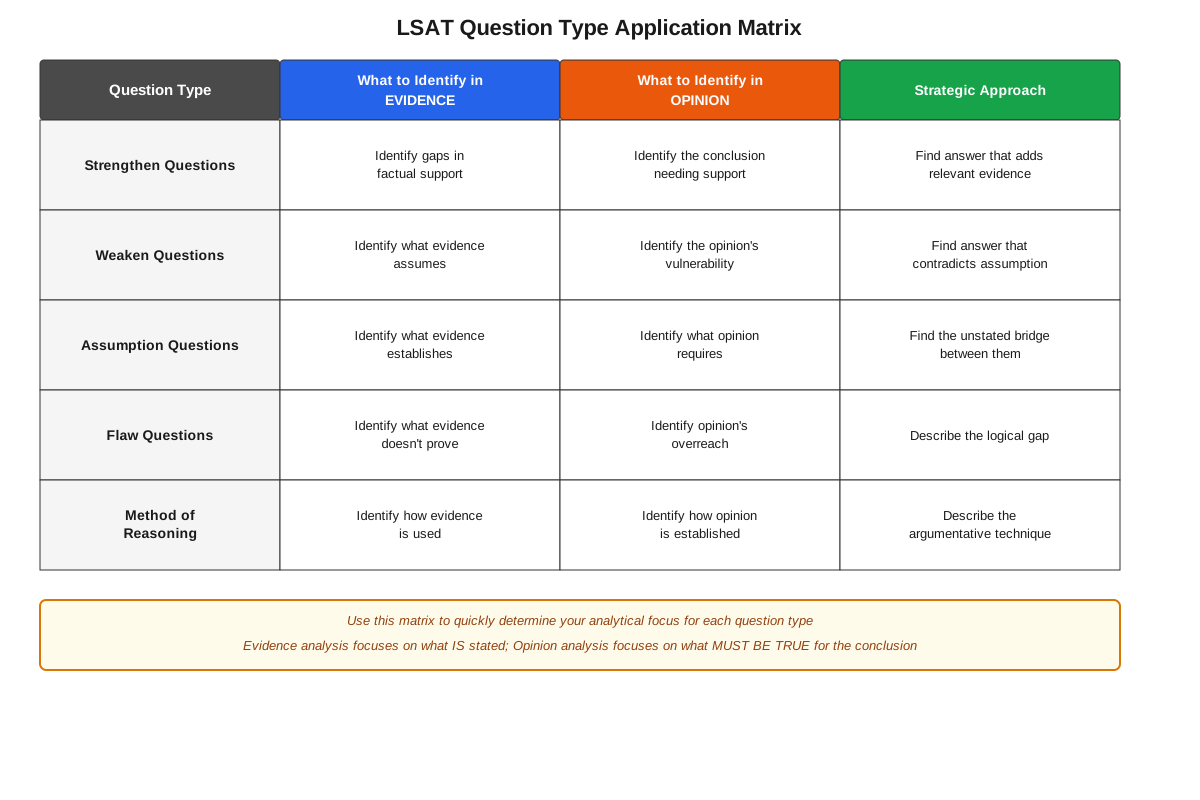
Understanding evidence versus opinion is essential because the LSAT's logical reasoning questions demand precise analysis of argument structure. Many question types—including Strengthen, Weaken, Assumption, Flaw, and Method of Reasoning questions—require students to distinguish between what an author presents as established fact versus what the author is trying to prove or persuade the reader to accept. Misidentifying evidence as opinion (or vice versa) leads to fundamental errors in argument analysis and incorrect answer choices.
This topic sits at the heart of argument fundamentals because it enables students to perform the crucial first step in argument analysis: identifying premises and conclusions. Evidence typically functions as premises—the supporting material that grounds an argument—while opinions often appear as conclusions or intermediate claims that require justification. Mastering this distinction allows students to map argument structure accurately, evaluate reasoning quality, and predict what assumptions or additional evidence would strengthen or weaken the argument's persuasive force.
Learning Objectives
- [ ] Identify how Evidence versus opinion appears in LSAT questions
- [ ] Explain the reasoning pattern behind Evidence versus opinion
- [ ] Apply Evidence versus opinion to solve LSAT-style problems accurately
- [ ] Distinguish between factual claims and value judgments in complex argument passages
- [ ] Recognize linguistic markers that signal whether a statement functions as evidence or opinion
- [ ] Evaluate how the evidence-opinion relationship affects argument validity and soundness
Prerequisites
- Basic argument structure: Understanding what constitutes a premise and conclusion is essential because evidence typically serves as premises while opinions often function as conclusions or claims requiring support.
- Indicator words: Familiarity with conclusion indicators (therefore, thus, hence) and premise indicators (because, since, given that) helps identify whether statements function as evidence or opinion within argument structure.
- Reading comprehension fundamentals: The ability to parse complex sentences and identify main ideas enables students to distinguish factual content from interpretive claims embedded in LSAT passages.
Why This Topic Matters
The evidence versus opinion distinction appears in virtually every Logical Reasoning section on the LSAT, making it one of the highest-yield topics for test preparation. Research on LSAT question distribution shows that approximately 60-70% of Logical Reasoning questions require students to analyze argument structure, and correctly identifying evidence versus opinion is the foundational skill for this analysis.
In real-world applications, distinguishing evidence from opinion is crucial for legal reasoning, critical thinking in professional contexts, and evaluating persuasive communications. Lawyers must separate factual claims (which can be proven or disproven) from legal conclusions (which represent interpretations of law and fact). This skill translates directly to law school case analysis, where students must distinguish holdings (legal conclusions) from the factual records that support them.
On the LSAT, this topic appears most commonly in:
- Strengthen/Weaken questions: Identifying what counts as evidence helps determine what additional facts would support or undermine the argument
- Assumption questions: Understanding the gap between evidence and opinion reveals unstated premises
- Flaw questions: Many logical flaws involve treating opinion as evidence or failing to provide adequate evidence for opinions
- Method of Reasoning questions: These explicitly ask students to describe how evidence and conclusions relate
- Point at Issue questions: Distinguishing factual disagreements from opinion-based disagreements is essential
Core Concepts
Defining Evidence
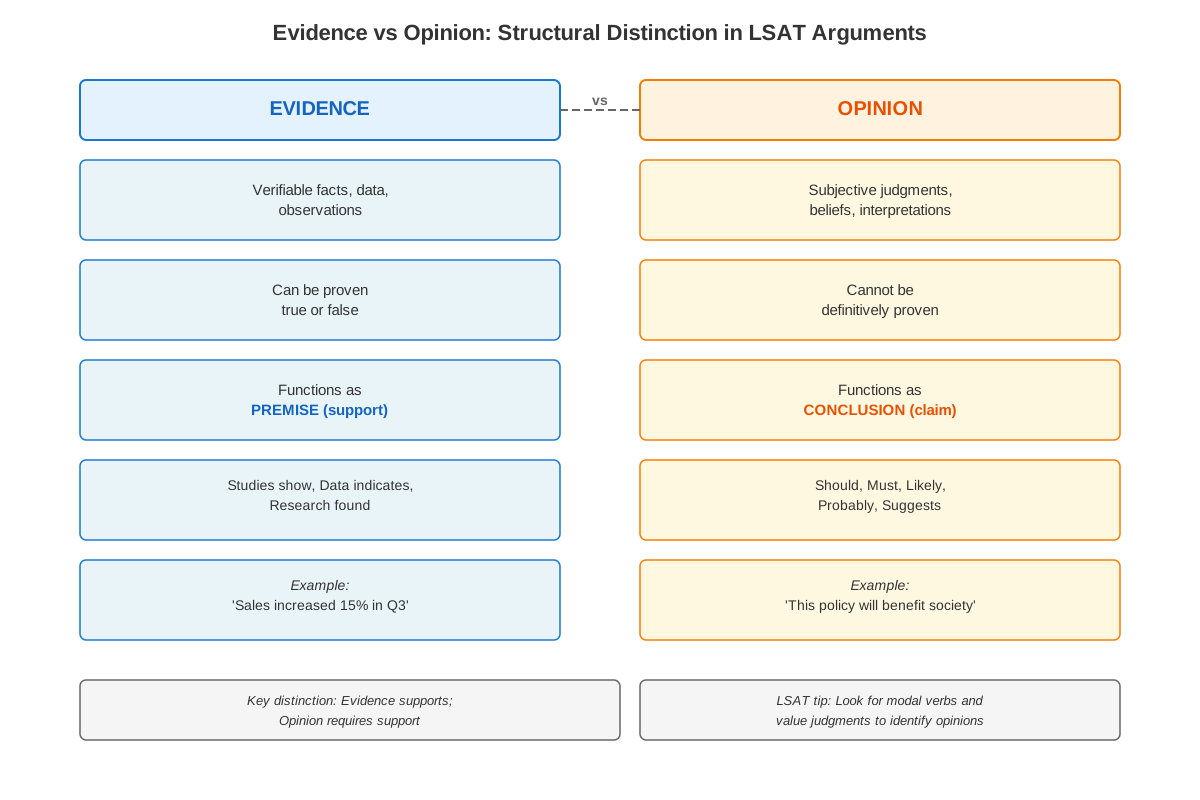
Evidence consists of factual claims, observations, data, or statements that can theoretically be verified or falsified through objective means. In LSAT evidence versus opinion analysis, evidence serves as the raw material that supports reasoning. Evidence includes:
- Empirical observations (e.g., "The temperature reached 95 degrees")
- Statistical data (e.g., "Seventy percent of respondents agreed")
- Historical facts (e.g., "The law was enacted in 1995")
- Reported events (e.g., "The company announced layoffs")
- Expert testimony presented as fact (e.g., "Dr. Smith found that...")
- Experimental results (e.g., "The treatment group showed improvement")
Evidence possesses several key characteristics. First, it is verifiable—in principle, independent observers could confirm or deny the claim through investigation. Second, evidence is descriptive rather than prescriptive; it describes what is, was, or will be, rather than what should be. Third, evidence typically lacks explicit value judgments or subjective qualifiers like "unfortunately," "surprisingly," or "wrongly."
Defining Opinion
Opinion encompasses subjective judgments, interpretations, predictions, recommendations, or conclusions that reflect the author's perspective rather than objective reality. Opinions require justification through evidence and reasoning. In LSAT arguments, opinions typically appear as:
- Conclusions (e.g., "Therefore, the policy will fail")
- Value judgments (e.g., "This approach is superior")
- Predictions (e.g., "Sales will increase next quarter")
- Recommendations (e.g., "The company should expand")
- Interpretations (e.g., "This data suggests negligence")
- Evaluative claims (e.g., "The evidence is insufficient")
Opinions are characterized by their subjective nature—reasonable people might disagree about their truth or validity. They are interpretive, requiring inference beyond the bare facts. Opinions often contain modal verbs (should, must, ought to, will, would) or evaluative language (better, worse, effective, problematic).
The Functional Relationship
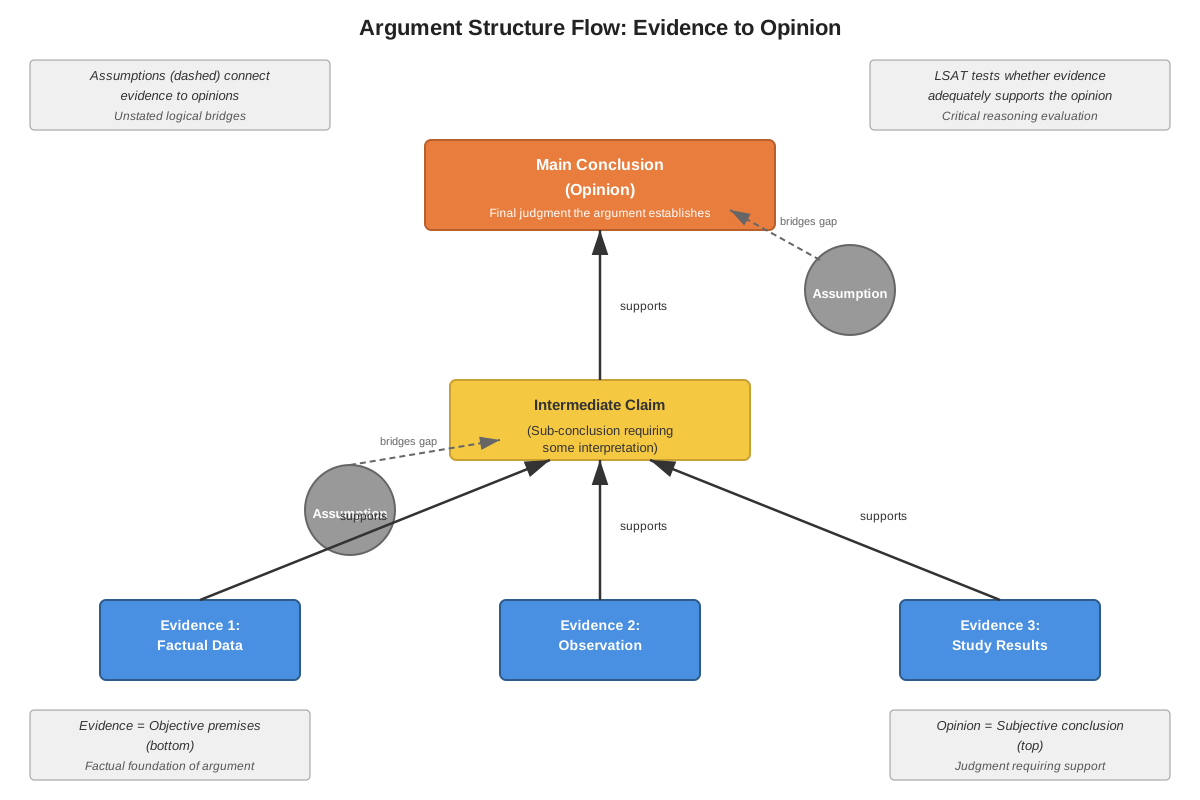
The relationship between evidence and opinion in arguments follows a directional pattern: evidence supports opinion. This support relationship defines argument structure:
Evidence (Premises) → [Reasoning Process] → Opinion (Conclusion)Understanding this flow is crucial for logical reasoning because it reveals:
- What the arguer takes as established (evidence)
- What the arguer is trying to prove (opinion/conclusion)
- The gap between them (where assumptions hide)
Linguistic Markers and Context Clues
The LSAT uses specific linguistic patterns to signal evidence versus opinion:
| Evidence Indicators | Opinion Indicators |
|---|---|
| "Studies show that..." | "Therefore..." |
| "According to..." | "This suggests..." |
| "The data reveals..." | "Clearly..." |
| "Researchers found..." | "Should..." |
| "It is the case that..." | "Probably..." |
| "X percent of..." | "It follows that..." |
| "Historically..." | "The best explanation..." |
However, context matters more than individual words. A statement like "The study concludes that X causes Y" presents the study's opinion as evidence for the author's argument. The author treats the study's conclusion as an established fact to support a further claim.
The Gray Area: Interpretive Evidence
Some statements blur the evidence-opinion boundary. Expert opinions often function as evidence in LSAT arguments. When an argument states "Economists predict inflation will rise," this prediction (an opinion) is presented as evidence for the author's conclusion. The LSAT tests whether students recognize that:
- The prediction itself is opinion (from the economists)
- The fact that economists made this prediction is evidence (for the author's argument)
- The author's conclusion based on this evidence is a separate opinion
This layering is common in LSAT passages and requires careful analysis of whose opinion is being presented and for what purpose.
Evidence Quality versus Opinion Validity
The LSAT distinguishes between:
- Evidence quality: Whether factual claims are accurate, relevant, and sufficient
- Opinion validity: Whether conclusions follow logically from evidence
Strong evidence doesn't guarantee valid opinions if the reasoning is flawed. Conversely, valid reasoning structure doesn't compensate for false or irrelevant evidence. Many LSAT questions test whether students can identify these distinct problems.
Application to Argument Analysis
When analyzing LSAT arguments, apply this systematic approach:
- Identify the main conclusion (the primary opinion being argued)
- Locate supporting premises (evidence and sub-conclusions)
- Classify each statement as evidence, opinion, or background context
- Map the support structure showing how evidence connects to opinions
- Identify gaps where opinions lack adequate evidential support
This process reveals argument vulnerabilities that LSAT questions exploit through Assumption, Flaw, Strengthen, and Weaken question types.
Concept Relationships
The evidence versus opinion distinction connects intimately with other argument fundamentals. Understanding this relationship enables mastery of the entire Logical Reasoning section.
Evidence versus opinion → Premise-Conclusion structure: Evidence typically functions as premises, while opinions serve as conclusions. Mastering evidence-opinion distinction directly improves premise-conclusion identification skills.
Evidence versus opinion → Assumption identification: Assumptions bridge gaps between evidence and opinion. By recognizing what evidence exists and what opinion the author draws, students can identify the unstated connections the argument requires.
Evidence versus opinion → Argument evaluation: Strengthen and Weaken questions target the evidence-opinion relationship. Additional evidence strengthens the connection; contradictory evidence weakens it. Understanding what counts as evidence versus opinion determines which answer choices are relevant.
Evidence versus opinion → Flaw recognition: Many logical flaws involve mishandling the evidence-opinion relationship—treating opinion as evidence, drawing opinions unsupported by evidence, or confusing correlation (evidence) with causation (opinion).
Evidence versus opinion → Method of Reasoning: These questions explicitly ask students to describe how arguments use evidence to support opinions, requiring precise understanding of this relationship.
The concept also connects forward to advanced topics like source credibility (evaluating whether evidence is reliable) and argument scope (whether opinions exceed what evidence supports).
High-Yield Facts
⭐ Evidence consists of factual claims that can theoretically be verified or falsified; opinion consists of subjective judgments, interpretations, or conclusions requiring justification.
⭐ In LSAT arguments, evidence typically functions as premises while opinions typically function as conclusions or intermediate claims.
⭐ The same statement can be evidence in one context and opinion in another, depending on its function within the argument structure.
⭐ Expert opinions, when cited in arguments, function as evidence for the author's conclusion even though they are opinions from the expert's perspective.
⭐ Modal verbs (should, must, ought, will, would) and evaluative language (better, worse, effective) typically signal opinion rather than evidence.
- Evidence describes what is, was, or will be; opinion prescribes what should be or interprets what something means.
- The LSAT frequently presents opinions as if they were evidence to test whether students can identify unsupported claims.
- Distinguishing evidence from opinion is the first step in identifying assumptions, which bridge the gap between them.
- Statistical data and research findings count as evidence, but interpretations of what that data means count as opinion.
- Background information and context, while factual, may not function as evidence if they don't directly support the conclusion.
- The strength of an argument depends both on evidence quality and on whether the opinion logically follows from that evidence.
- Many wrong answer choices in Strengthen/Weaken questions fail because they address opinion when the question requires evidence, or vice versa.
- Recognizing whether a dispute involves disagreement about evidence (facts) or opinion (interpretation) is crucial for Point at Issue questions.
Quick check — test yourself on Evidence versus opinion so far.
Try Flashcards →Common Misconceptions
Misconception: All factual statements in an argument are evidence. → Correction: Factual statements only count as evidence when they support the conclusion. Background information or context may be factual but not function as evidence if it doesn't support the argument's opinion.
Misconception: Opinions are always wrong or unreliable. → Correction: Opinions are conclusions or judgments that require support. Well-supported opinions backed by strong evidence form valid arguments. The LSAT tests whether opinions are adequately supported, not whether they are inherently problematic.
Misconception: If an expert says it, it's evidence, not opinion. → Correction: Expert statements are opinions from the expert's perspective but function as evidence when cited in someone else's argument. The LSAT tests whether students recognize this dual nature and understand that expert opinions still require underlying support.
Misconception: Evidence is always explicitly labeled with phrases like "studies show." → Correction: Evidence can be presented without explicit markers. Context and function within the argument determine whether a statement serves as evidence. Students must analyze how statements relate to the conclusion, not just look for trigger words.
Misconception: The evidence-opinion distinction is always clear-cut. → Correction: The LSAT deliberately creates ambiguity, presenting interpretive claims as if they were facts or embedding opinions within factual-sounding statements. Students must carefully analyze each statement's logical function and whether it requires further justification.
Misconception: Predictions and recommendations are evidence because they're based on facts. → Correction: Predictions and recommendations are opinions that may be supported by evidence, but they themselves are not evidence. They represent interpretations or judgments about what will or should happen, requiring justification through actual evidence.
Misconception: If a statement can be proven true, it's evidence; if it can't, it's opinion. → Correction: The distinction depends on the statement's function in the argument, not just its verifiability. A proven fact might be irrelevant background rather than evidence, while a well-supported opinion might be the conclusion the argument aims to establish.
Worked Examples
Example 1: Identifying Evidence and Opinion in a Complete Argument
Passage: "Recent studies indicate that employees who work from home three days per week report 25% higher job satisfaction than those who work in the office full-time. Additionally, companies with flexible work policies have seen a 15% reduction in employee turnover. Therefore, businesses should implement hybrid work arrangements to improve employee retention and satisfaction."
Analysis:
Step 1: Identify the main conclusion (primary opinion).
The conclusion is "businesses should implement hybrid work arrangements to improve employee retention and satisfaction." This is an opinion because it's a recommendation (should) that requires justification.
Step 2: Locate the evidence.
- Evidence 1: "employees who work from home three days per week report 25% higher job satisfaction" - This is factual data from studies, verifiable through research.
- Evidence 2: "companies with flexible work policies have seen a 15% reduction in employee turnover" - This is statistical evidence, an observable fact.
Step 3: Analyze the evidence-opinion relationship.
The argument uses two pieces of statistical evidence to support a prescriptive opinion. The evidence describes what has been observed; the opinion interprets what businesses should do based on these observations.
Step 4: Identify potential gaps.
The argument assumes that the correlation between flexible work and improved metrics means flexible work causes these improvements. It also assumes that what worked for studied companies will work for all businesses. These gaps between evidence and opinion reveal where the argument is vulnerable.
Connection to Learning Objectives: This example demonstrates how evidence versus opinion appears in LSAT questions (Objective 1), shows the reasoning pattern where evidence supports opinion (Objective 2), and provides practice applying the distinction to analyze argument structure (Objective 3).
Example 2: Complex Layering of Evidence and Opinion
Passage: "Dr. Martinez, a leading climate scientist, argues that global temperatures will rise by 2 degrees Celsius within the next decade. This prediction is based on current emission trends and historical climate data. Given Dr. Martinez's expertise and the data supporting her conclusion, it is clear that governments must take immediate action to reduce carbon emissions, or we will face catastrophic environmental consequences."
Analysis:
Step 1: Identify the layers of opinion.
- Dr. Martinez's opinion: "global temperatures will rise by 2 degrees Celsius within the next decade"
- Author's opinion: "governments must take immediate action to reduce carbon emissions, or we will face catastrophic environmental consequences"
Step 2: Identify what functions as evidence.
- Evidence for Dr. Martinez's prediction: "current emission trends and historical climate data"
- Evidence for the author's conclusion: "Dr. Martinez's expertise," "the data supporting her conclusion," and Dr. Martinez's prediction itself
Step 3: Analyze the complex relationship.
Dr. Martinez's prediction is an opinion (a forecast requiring interpretation of data), but the author treats this prediction as evidence for a further conclusion. The author's argument structure is:
Evidence (emission trends, historical data) → Dr. Martinez's opinion (temperature prediction) → [treated as evidence] → Author's opinion (governments must act)Step 4: Evaluate the reasoning.
The author commits a subtle shift: Dr. Martinez's opinion, even if well-supported, is still a prediction (opinion) rather than established fact. The author's conclusion requires assuming Dr. Martinez's prediction is correct and that the predicted temperature rise would indeed be catastrophic. These are gaps between the evidence and the author's ultimate opinion.
Step 5: Application to question types.
- A Weaken question might introduce evidence that Dr. Martinez's methodology is flawed or that other experts disagree.
- An Assumption question might ask what the argument assumes about the relationship between temperature rise and catastrophic consequences.
- A Flaw question might identify that the argument treats an expert's prediction as if it were established fact.
Connection to Learning Objectives: This example shows how LSAT passages layer opinions and evidence in complex ways (Objective 1), demonstrates the reasoning pattern where one person's opinion becomes another's evidence (Objective 2), and provides practice distinguishing these layers to solve problems accurately (Objective 3).
Exam Strategy
Approaching Evidence versus Opinion Questions
When tackling LSAT Logical Reasoning questions, follow this systematic approach:
- Read for structure first: On your first pass, identify the conclusion and major supporting claims before worrying about evidence-opinion classification.
- Mark opinion indicators: Circle or underline words like "should," "must," "will," "probably," "suggests," and "therefore" that signal opinions or conclusions.
- Identify factual claims: Look for statistics, research findings, historical facts, and observations that serve as evidence.
- Map the support relationship: Draw mental or physical arrows showing how evidence supports opinions, revealing argument structure.
Trigger Words and Phrases
Evidence triggers to watch for:
- "Studies show," "Research indicates," "Data reveals"
- "According to," "Reported," "Observed"
- Specific statistics, percentages, or measurements
- "Historically," "In the past," "Previously"
Opinion triggers to watch for:
- "Therefore," "Thus," "Hence," "Consequently"
- "Should," "Must," "Ought to," "Need to"
- "Clearly," "Obviously," "Undoubtedly" (these often signal weak reasoning)
- "Suggests," "Indicates," "Implies," "Demonstrates"
- "Will," "Would," "Likely," "Probably"
Exam Tip: When you see "clearly" or "obviously," the LSAT is often signaling that the claim is actually opinion requiring support, not self-evident fact.
Process of Elimination Strategies
For Strengthen/Weaken questions:
- Eliminate answers that address the wrong part of the argument (evidence when you need to affect opinion, or vice versa)
- Eliminate answers that provide opinion when the argument needs evidence, or evidence when it needs different opinion
- Keep answers that provide new evidence relevant to the conclusion
For Assumption questions:
- Eliminate answers that restate evidence already given
- Eliminate answers that state the conclusion in different words
- Keep answers that bridge the gap between evidence and opinion
For Flaw questions:
- Look for answers describing evidence-opinion problems: "treats opinion as fact," "draws conclusion unsupported by evidence," "confuses correlation with causation"
- Eliminate answers that describe flaws not present in the argument's evidence-opinion relationship
Time Allocation
Spend approximately:
- 20-30 seconds identifying the conclusion and main evidence
- 30-40 seconds understanding the evidence-opinion relationship and identifying gaps
- 40-50 seconds evaluating answer choices based on this analysis
Don't rush the initial analysis. Correctly identifying evidence versus opinion saves time by preventing you from considering irrelevant answer choices.
Memory Techniques
The PROOF Mnemonic for Evidence
Provable - Can it be verified or falsified?
Reported - Is it presented as observation or data?
Objective - Does it lack subjective judgment?
Observable - Could independent observers confirm it?
Factual - Does it describe what is rather than what should be?
If a statement meets these criteria, it's likely evidence rather than opinion.
The JUDGE Mnemonic for Opinion
Judgment - Does it express evaluation or interpretation?
Unsupported (initially) - Does it require justification?
Directive - Does it recommend or predict?
Gap-creating - Does it go beyond the bare facts?
Evaluative - Does it use words like "better," "should," or "will"?
If a statement meets these criteria, it's likely opinion rather than evidence.
Visualization Strategy
Picture arguments as buildings:
- Evidence = Foundation and building materials (concrete, verifiable)
- Opinion = The structure built on top (requires support, can be evaluated)
- Assumptions = Hidden supports connecting foundation to structure
This visualization helps remember that opinions need evidential support just as buildings need foundations, and that assumptions are the often-invisible connections holding arguments together.
The "Says Who?" Test
When encountering a claim, ask "Says who?" or "How do we know this?"
- If the answer is "We can observe/measure/verify it," it's evidence
- If the answer is "The author is arguing for it" or "It's an interpretation," it's opinion
Summary
The distinction between evidence versus opinion forms the cornerstone of LSAT logical reasoning analysis. Evidence consists of factual, verifiable claims that serve as premises supporting arguments, while opinions represent subjective judgments, interpretations, or conclusions requiring justification. Mastering this distinction enables students to identify argument structure, recognize unstated assumptions, and evaluate reasoning quality—skills tested across virtually all Logical Reasoning question types. The LSAT frequently creates complexity by layering opinions (treating one person's conclusion as evidence for another's argument) and by presenting opinions using factual-sounding language. Success requires analyzing each statement's function within the argument rather than relying solely on linguistic markers. Students must recognize that evidence describes what is, while opinion interprets what it means or prescribes what should be done. This fundamental skill in argument fundamentals directly improves performance on Strengthen, Weaken, Assumption, Flaw, and Method of Reasoning questions, making it one of the highest-yield topics for LSAT preparation.
Key Takeaways
- Evidence consists of verifiable factual claims; opinion consists of subjective judgments requiring support through evidence and reasoning
- The evidence-opinion distinction maps directly onto premise-conclusion structure, with evidence typically serving as premises and opinions as conclusions
- Context and function matter more than individual words—the same statement can be evidence or opinion depending on its role in the argument
- Expert opinions function as evidence when cited in arguments, even though they are opinions from the expert's perspective
- Identifying the gap between evidence and opinion reveals assumptions and argument vulnerabilities tested in LSAT questions
- Modal verbs (should, must, will) and evaluative language (better, effective, clearly) typically signal opinion rather than evidence
- Mastering evidence versus opinion improves performance across all Logical Reasoning question types, particularly Strengthen, Weaken, Assumption, and Flaw questions
Related Topics
Premise and Conclusion Identification: Building directly on evidence versus opinion, this topic teaches systematic methods for identifying argument structure using indicator words and logical relationships. Mastering evidence-opinion distinction makes premise-conclusion identification significantly easier.
Assumptions in Arguments: Understanding the gap between evidence and opinion enables identification of unstated premises that arguments require. Assumptions bridge the space between what's given as evidence and what's claimed as opinion.
Strengthen and Weaken Questions: These question types directly test the evidence-opinion relationship by asking what additional evidence would support or undermine the connection between premises and conclusion.
Logical Flaws: Many common flaws involve mishandling evidence and opinion—treating correlation as causation, drawing conclusions unsupported by evidence, or confusing opinion with fact.
Argument Evaluation: Advanced analysis of argument quality requires assessing both evidence quality (accuracy, relevance, sufficiency) and reasoning validity (whether opinions follow logically from evidence).
Practice CTA
Now that you understand the critical distinction between evidence and opinion, it's time to apply this knowledge to actual LSAT questions. The practice questions and flashcards will challenge you to identify evidence versus opinion in complex passages, analyze layered arguments, and apply this skill across different question types. Remember: this is one of the highest-yield topics for LSAT success—every minute spent mastering evidence versus opinion pays dividends across the entire Logical Reasoning section. Approach the practice materials systematically, using the strategies and techniques outlined in this guide. You've built the foundation; now strengthen it through deliberate practice!
Sign up free to keep reading
Create a free AnvayaPrep account to finish this LSAT guide on Evidence versus opinion — plus flashcards and practice questions.