Overview
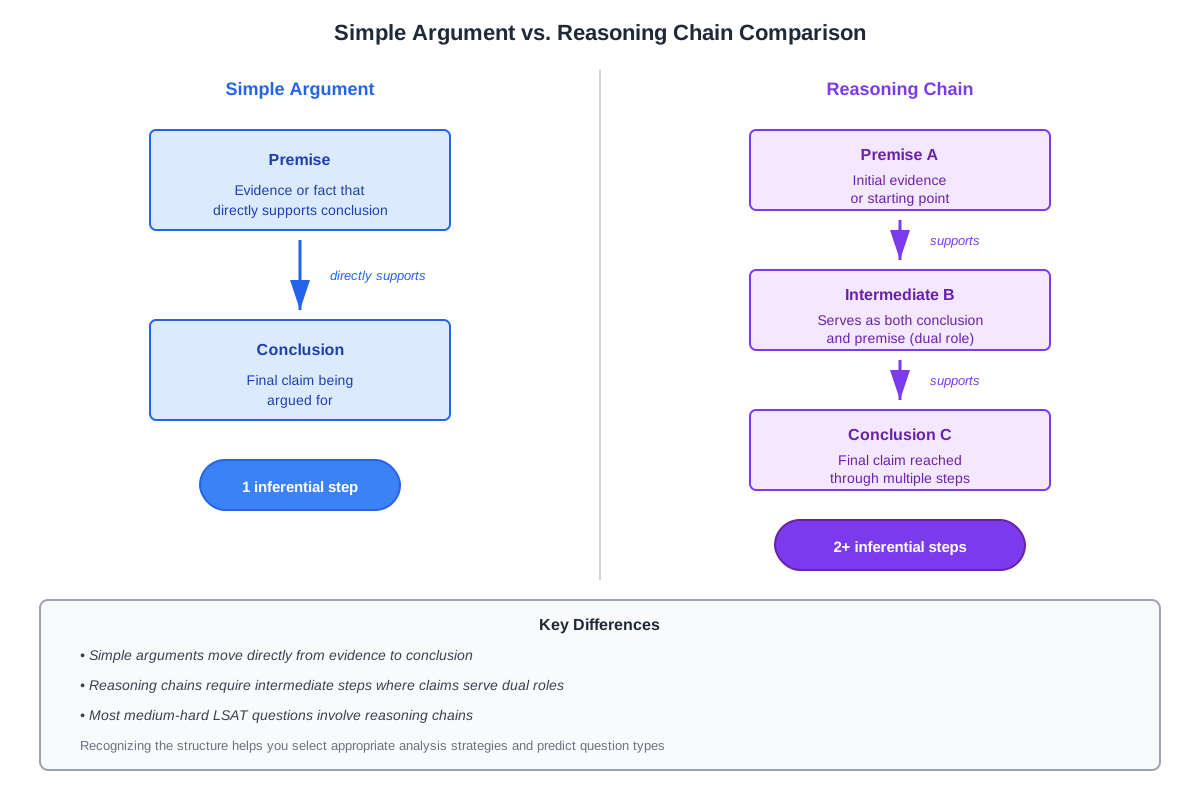
A reasoning chain is a fundamental structure in logical reasoning where multiple premises connect sequentially to support a conclusion. Unlike simple arguments that move directly from premise to conclusion, a lsat reasoning chain involves intermediate steps where one claim serves as both the conclusion of a previous statement and a premise for the next. Understanding this pattern is crucial because LSAT questions frequently test the ability to identify, analyze, and evaluate these multi-step arguments.
On the LSAT, logical reasoning questions often present complex arguments that require students to trace how evidence flows through several connected claims before reaching a final conclusion. These chains can be vulnerable at any link—a weakness in any intermediate step can undermine the entire argument. Recognizing the chain structure allows test-takers to identify where assumptions occur, where evidence gaps exist, and how to strengthen or weaken the argument effectively.
Within argument fundamentals, reasoning chains represent an advanced application of basic premise-conclusion relationships. While students must first master identifying simple arguments, understanding how multiple inferential steps connect prepares them for the majority of medium and difficult LSAT questions. This topic bridges foundational argument analysis with more complex question types including Assumption, Strengthen/Weaken, Flaw, and Method of Reasoning questions.
Learning Objectives
- [ ] Identify how Reasoning chain appears in LSAT questions
- [ ] Explain the reasoning pattern behind Reasoning chain
- [ ] Apply Reasoning chain to solve LSAT-style problems accurately
- [ ] Diagram multi-step reasoning chains using standard notation
- [ ] Locate the weakest link in a chain of reasoning
- [ ] Distinguish between parallel chains and sequential chains
- [ ] Predict common assumptions that connect links in reasoning chains
Prerequisites
- Basic premise-conclusion identification: Understanding how to distinguish evidence from claims is essential because reasoning chains build upon these fundamental components
- Indicator word recognition: Familiarity with conclusion and premise indicators helps track the flow of reasoning through multiple steps
- Simple argument structure: Knowledge of how single premises support conclusions provides the foundation for understanding how multiple steps connect
- Conditional reasoning basics: Many reasoning chains involve conditional relationships that link steps together
Why This Topic Matters
Reasoning chains appear in approximately 40-50% of Logical Reasoning questions on the LSAT, making them one of the most frequently tested patterns. Questions involving chains appear across nearly every question type, but are especially common in Assumption (both Necessary and Sufficient), Strengthen/Weaken, Flaw, and Method of Reasoning questions. The ability to quickly identify and analyze these structures directly impacts performance on a significant portion of the exam.
In real-world applications, reasoning chains mirror how complex arguments develop in legal briefs, judicial opinions, and policy debates. Attorneys regularly construct multi-step arguments where establishing one point becomes necessary for proving the next. Understanding how these chains work—and where they break—is fundamental to legal analysis and advocacy.
On the LSAT, reasoning chains typically appear in three contexts: (1) as the primary structure of stimulus arguments that students must analyze, (2) as patterns students must identify in Method of Reasoning questions, and (3) as structures students must complete or repair in Assumption and Strengthen questions. The test frequently presents chains with missing links, requiring students to identify unstated assumptions that connect the steps. Additionally, many difficult questions involve chains where one link is weak or flawed, and students must identify which specific step fails.
Core Concepts
Structure of a Reasoning Chain
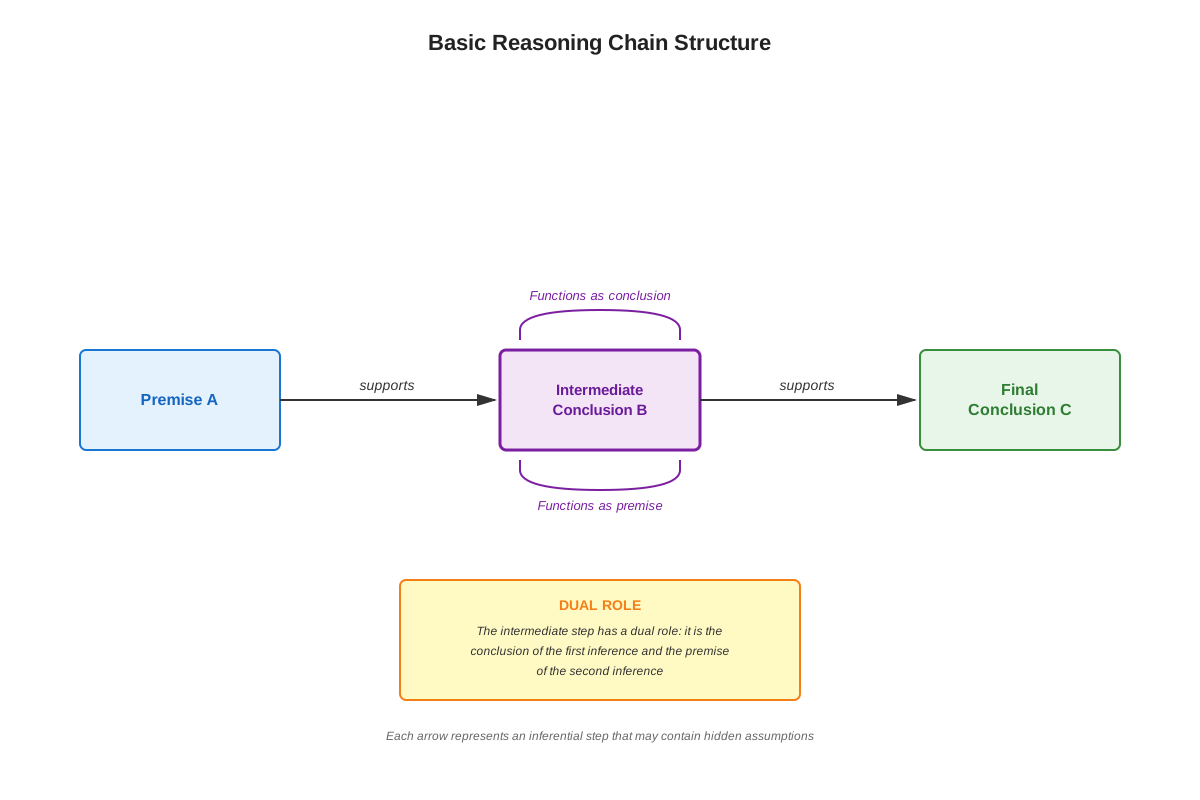
A reasoning chain consists of at least three components: an initial premise (P1), an intermediate conclusion (IC), and a final conclusion (FC). The intermediate conclusion functions dually—it serves as the conclusion drawn from P1 and simultaneously as a premise supporting FC. This creates a sequential flow: P1 → IC → FC.
Consider this basic structure:
- Premise 1: All mammals are warm-blooded
- Intermediate Conclusion: Therefore, all whales are warm-blooded (because whales are mammals)
- Final Conclusion: So whales must regulate their body temperature
The intermediate conclusion "whales are warm-blooded" is supported by the first premise but also supports the final conclusion. This dual function distinguishes chains from simple arguments.
Identifying Chain Components
To identify reasoning chains in LSAT stimuli, look for multiple conclusion indicators or a progression of claims where each builds upon the previous. Common patterns include:
- Sequential indicator words: "thus," "therefore," "so," "consequently" appearing multiple times
- Layered claims: Statements that seem to conclude something while also serving as evidence
- Explicit step markers: Phrases like "from this it follows that" or "this means that"
The key diagnostic feature is finding a statement that answers "why?" for one claim while also prompting "so what?" for the next claim.
Types of Reasoning Chains
Linear chains proceed in a single direction with each step depending on the previous one. These are the most common on the LSAT:
- P1 → IC1 → IC2 → FC
Convergent chains involve multiple independent lines of reasoning that merge:
- P1 → IC1 ↘
- P2 → IC2 → FC
Divergent chains (less common) split from a single premise:
- P1 → IC1 → FC1
- P1 → IC2 → FC2
Assumptions in Reasoning Chains
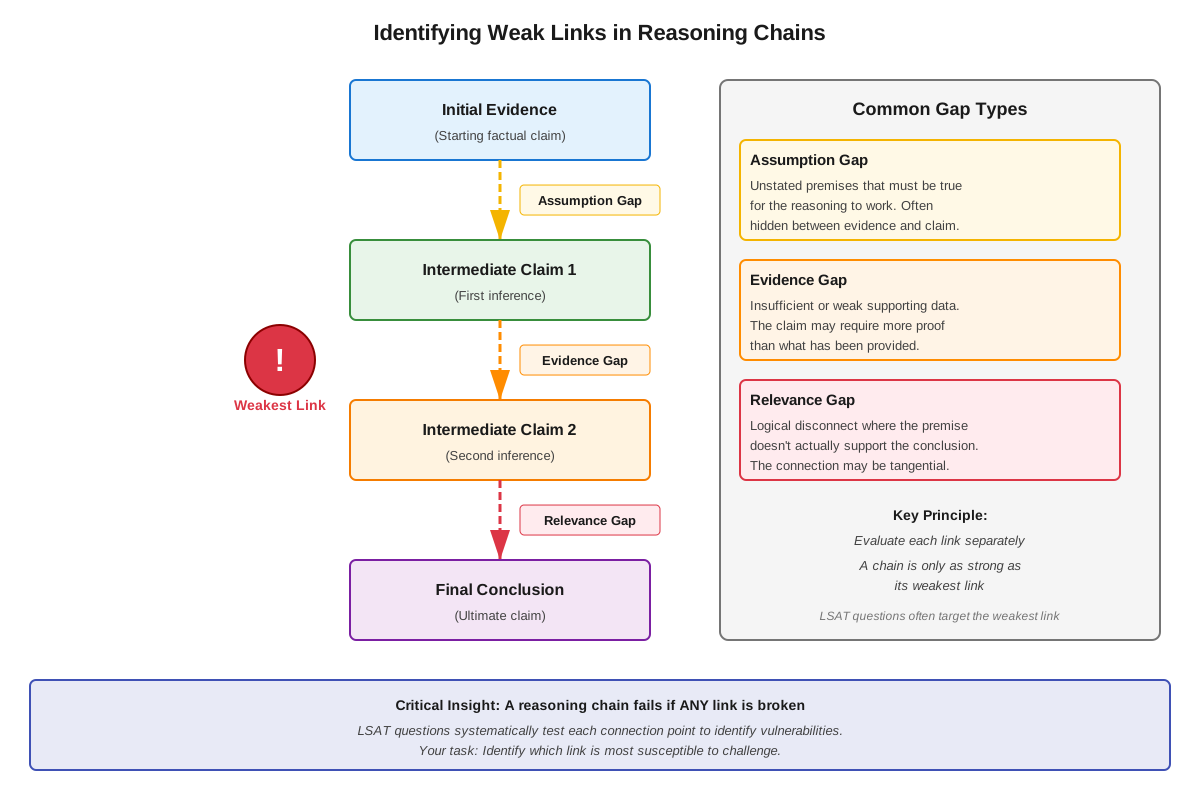
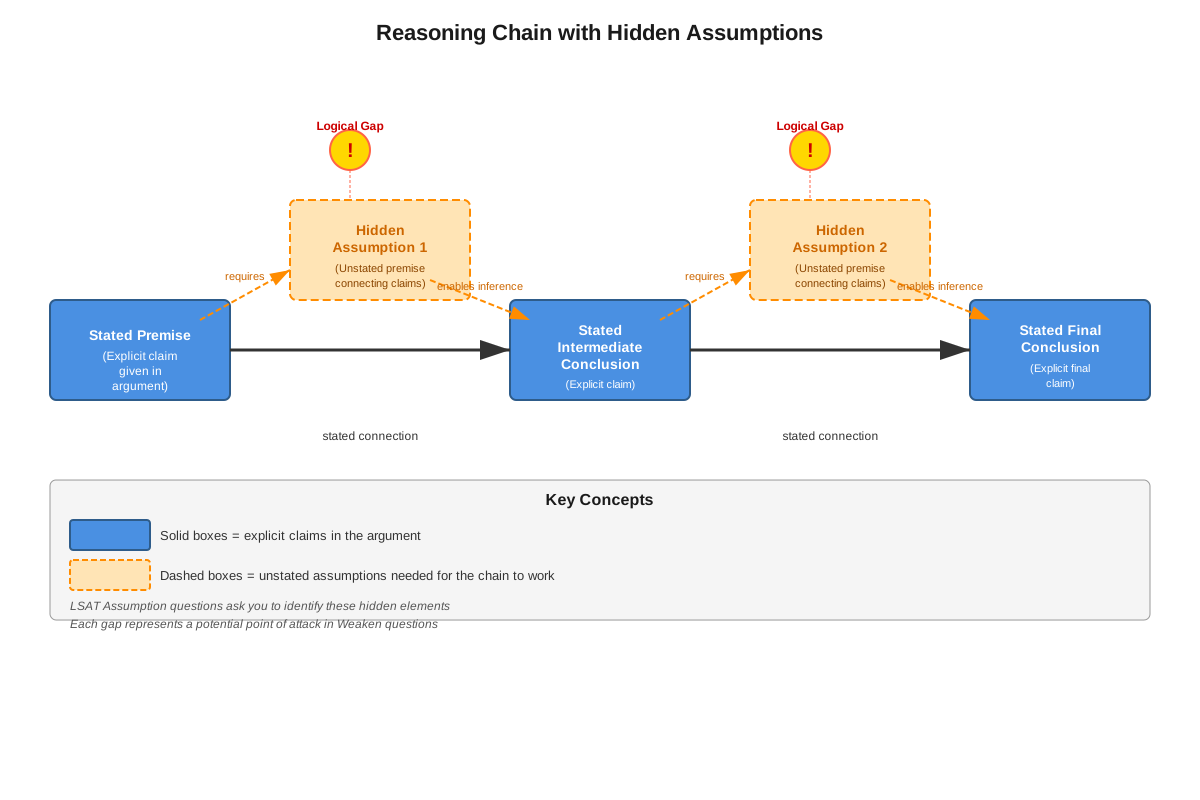
Each link in a reasoning chain requires assumptions—unstated premises that must be true for the inference to hold. LSAT questions frequently test whether students can identify these connecting assumptions. The assumption between any two steps bridges the gap between what is stated and what is concluded.
For example, in the chain "Sales increased → Profits increased → Stock price will rise," there are at least two critical assumptions:
- Between steps 1-2: Increased sales led to increased profits (not just increased costs)
- Between steps 2-3: Stock prices respond to profit increases (market efficiency assumption)
Vulnerability Points
Reasoning chains are only as strong as their weakest link. A single flawed inference can invalidate the entire argument, even if other steps are sound. When evaluating chains, examine each transition:
| Transition Type | Vulnerability | LSAT Test Method |
|---|---|---|
| Causal link | Correlation vs. causation | Weaken with alternative causes |
| Categorical link | Scope shift or equivocation | Identify assumption gaps |
| Conditional link | Mistaken reversal or negation | Test logical validity |
| Quantitative link | Unwarranted generalization | Provide counterexamples |
Diagramming Chains
Effective chain analysis often requires visual representation. Use arrows to show inferential direction and brackets to indicate assumptions:
[Evidence] → [Intermediate Claim] → [Conclusion]
         ↑                    ↑
    [Assumption 1]      [Assumption 2]
This notation helps track complex arguments and identify where support is needed.
Concept Relationships
Reasoning chains build directly upon basic argument structure—the foundational skill of identifying premises and conclusions. Once students can recognize simple P → C relationships, they can identify chains as multiple P → C relationships linked together: P1 → C1/P2 → C2.
The concept connects to conditional reasoning because many chain links involve conditional statements. When a chain includes "if...then" relationships, each link must satisfy the logical requirements of valid conditional inference. Understanding sufficient and necessary conditions helps predict what assumptions are needed to connect chain links.
Reasoning chains relate closely to assumption identification because each link in the chain typically requires unstated premises. The longer the chain, the more assumptions are needed, creating more vulnerability points. This relationship explains why Assumption questions frequently feature chain structures.
The concept also connects to argument evaluation (Strengthen/Weaken questions) because identifying the chain structure reveals where the argument is most vulnerable. Strengthening a chain means reinforcing its weakest link; weakening it means attacking any single connection.
Relationship map:
Basic Argument Structure → Reasoning Chains → Assumption Identification → Argument Evaluation → Flaw Recognition
High-Yield Facts
⭐ Reasoning chains contain at least one intermediate conclusion that serves both as a conclusion from prior premises and as a premise for subsequent claims
⭐ Each link in a reasoning chain requires assumptions to connect it to the next link, creating multiple potential vulnerability points
⭐ The weakest link in a chain determines the overall strength of the argument—a single flawed inference can invalidate the entire reasoning process
⭐ LSAT questions frequently test reasoning chains by asking students to identify necessary assumptions that connect specific links
⭐ Intermediate conclusions can be identified by their dual function: they answer "why?" for previous claims and prompt "so what?" for subsequent claims
- Reasoning chains appear in approximately 40-50% of Logical Reasoning questions across all question types
- Multiple conclusion indicators (therefore, thus, so, consequently) in a single stimulus often signal a reasoning chain
- Longer chains are more vulnerable because they require more assumptions and have more potential failure points
- Strengthening a reasoning chain requires supporting the weakest link, not necessarily adding evidence for the final conclusion
- Causal chains are particularly common on the LSAT and often involve assumptions about the absence of alternative explanations
Quick check — test yourself on Reasoning chain so far.
Try Flashcards →Common Misconceptions
Misconception: Every argument with multiple sentences is a reasoning chain → Correction: Reasoning chains specifically require intermediate conclusions that serve dual functions. Multiple premises supporting a single conclusion (convergent reasoning) is not a chain but rather parallel support.
Misconception: The final conclusion is always the most important part to analyze → Correction: In reasoning chains, the intermediate steps are often more important for LSAT questions because they contain the assumptions and potential flaws that questions target. The final conclusion may be valid if the intermediate steps are sound.
Misconception: All links in a chain are equally strong or weak → Correction: Chains typically have one weakest link that makes the entire argument vulnerable. Effective LSAT strategy involves identifying which specific transition is most questionable.
Misconception: More evidence always makes a reasoning chain stronger → Correction: Adding evidence only strengthens a chain if it supports the weakest link. Additional support for already-strong links provides minimal benefit while weak links remain vulnerable.
Misconception: Reasoning chains always proceed in chronological or temporal order → Correction: Chains represent logical progression, not temporal sequence. The order reflects inferential dependence (what must be established before what), not when events occurred.
Misconception: If the final conclusion is true, the reasoning chain must be valid → Correction: A true conclusion can result from flawed reasoning. LSAT questions test the logical connection between premises and conclusions, not merely whether conclusions happen to be true.
Worked Examples
Example 1: Identifying and Analyzing a Chain
Stimulus: "The city's water consumption has decreased by 15% over the past year. This decrease indicates that the public awareness campaign about water conservation was effective. Therefore, the city should invest more resources in public awareness campaigns for other environmental issues."
Analysis:
Step 1 - Identify the components:
- Premise 1 (P1): Water consumption decreased by 15%
- Intermediate Conclusion (IC): The public awareness campaign was effective
- Final Conclusion (FC): The city should invest more in public awareness campaigns for other issues
Step 2 - Diagram the chain:
P1: Consumption decreased → IC: Campaign was effective → FC: Should invest more in campaignsStep 3 - Identify assumptions:
- Assumption 1 (connecting P1 to IC): The decrease was caused by the campaign, not other factors (price increases, weather, economic changes)
- Assumption 2 (connecting IC to FC): Success with water conservation will translate to other environmental issues
Step 4 - Locate the weakest link:
The first link is weaker because it assumes causation from correlation. Many factors could explain decreased consumption besides the campaign.
Application to question types:
- Assumption question: "Which of the following is assumed?" → The answer would identify one of the assumptions above
- Weaken question: "Which of the following most weakens?" → Evidence that consumption decreased due to rate increases, not the campaign
- Strengthen question: "Which of the following most strengthens?" → Evidence that areas with more campaign exposure showed greater decreases
Example 2: Complex Chain with Multiple Links
Stimulus: "Recent studies show that regular meditation reduces stress hormones. Lower stress hormone levels improve immune function. Better immune function leads to fewer sick days. Fewer sick days increase workplace productivity. Therefore, companies should require employees to meditate daily."
Analysis:
Step 1 - Map the complete chain:
P1: Meditation reduces stress hormones
    ↓
IC1: Lower stress hormones improve immune function
    ↓
IC2: Better immune function leads to fewer sick days
    ↓
IC3: Fewer sick days increase productivity
    ↓
FC: Companies should require daily meditation
Step 2 - Evaluate each link:
- P1 → IC1: Assumes the stress hormone reduction is significant enough to affect immune function
- IC1 → IC2: Assumes improved immune function translates to actual illness prevention
- IC2 → IC3: Assumes sick days are a significant factor in productivity
- IC3 → FC: Assumes (a) the productivity gain justifies the time cost of meditation, and (b) required meditation would be as effective as voluntary meditation
Step 3 - Identify the weakest link:
The final link (IC3 → FC) is weakest because it makes multiple questionable assumptions, particularly that mandatory meditation would produce the same benefits as voluntary practice and that the productivity gains would exceed the time investment.
Step 4 - Predict question approaches:
- An Assumption question might ask about whether mandatory meditation is as effective as voluntary
- A Weaken question might provide evidence that forced meditation increases employee resentment
- A Flaw question might identify the shift from "meditation has benefits" to "meditation should be required"
Exam Strategy
When approaching LSAT questions involving reasoning chains, follow this systematic process:
1. Identify the conclusion first (usually signaled by "therefore," "thus," "so"). This anchors your analysis.
2. Work backward to find what directly supports that conclusion. This becomes your intermediate conclusion or final premise.
3. Continue working backward until you reach the foundational evidence. This reveals the complete chain structure.
4. Map the chain visually using arrows or shorthand notation. This external representation prevents confusion in complex arguments.
5. Examine each transition for assumptions. Ask: "What must be true for this step to follow from the previous one?"
Exam Tip: When you see multiple conclusion indicators (therefore, thus, so, consequently) in a single stimulus, immediately recognize you're dealing with a reasoning chain and shift to chain-analysis mode.
Trigger words and phrases to watch for:
- "This shows that..." (often introduces intermediate conclusions)
- "From this it follows..." (signals chain progression)
- "...and therefore..." (connects links)
- "This means that..." (indicates inferential step)
- Multiple instances of "because," "since," "thus," "so"
Process-of-elimination strategy:
- In Assumption questions, eliminate answers that support only the final conclusion without connecting intermediate steps
- In Strengthen/Weaken questions, eliminate answers that address strong links rather than weak ones
- In Flaw questions, eliminate answers that describe problems not present in the specific chain structure
Time allocation:
- Spend 15-20 seconds identifying the chain structure before reading answer choices
- For complex chains (4+ steps), invest time in diagramming—this saves time on answer evaluation
- If you cannot quickly identify the chain, move to answer choices and work backward from them
Memory Techniques
CHAIN acronym for analysis:
- Conclusion: Identify the final conclusion first
- Hierarchy: Work backward to find the hierarchy of claims
- Assumptions: Identify what connects each link
- Intermediate: Locate intermediate conclusions (dual-function statements)
- Necessity: Determine which link is necessary but weakest
Visualization strategy: Picture a physical chain where each link represents a claim. Imagine testing each link for strength—the weakest one determines whether the chain holds. This concrete image helps remember that chains are only as strong as their weakest link.
The "Domino Rule": Think of reasoning chains like dominoes. Each piece must fall (be established) before the next can fall (be concluded). If one domino doesn't fall, the sequence stops. This helps remember that every link must be valid for the conclusion to follow.
For identifying intermediate conclusions, remember: "BOTH" - an intermediate conclusion is Based on One claim and The basis for aHother. If a statement serves both functions, it's an intermediate conclusion.
Summary
Reasoning chains represent multi-step arguments where intermediate conclusions serve dual functions as both conclusions from prior premises and premises for subsequent claims. These structures appear in approximately half of all LSAT Logical Reasoning questions and are tested across virtually every question type. Understanding chains requires identifying each component, recognizing the assumptions that connect links, and evaluating where the argument is most vulnerable. The fundamental principle is that chains are only as strong as their weakest link—a single flawed inference can invalidate an entire argument regardless of how sound other steps may be. Success on chain-related questions depends on systematic analysis: identifying the conclusion, working backward to map the structure, examining each transition for assumptions, and recognizing that LSAT questions typically target the connections between links rather than the final conclusion itself. Mastering reasoning chains enables students to handle complex arguments efficiently and accurately, directly improving performance on medium and difficult questions.
Key Takeaways
- Reasoning chains involve intermediate conclusions that function both as conclusions from prior claims and as premises for subsequent claims
- Each link in a chain requires assumptions to connect it to the next link, creating multiple potential vulnerability points
- The weakest link determines the overall argument strength—effective LSAT strategy focuses on identifying and analyzing this critical point
- Systematic analysis involves working backward from the conclusion to map the complete chain structure before evaluating answer choices
- Reasoning chains appear in 40-50% of Logical Reasoning questions across all question types, making them essential for LSAT success
- Visual diagramming using arrows helps track complex multi-step arguments and prevents confusion
- Questions about chains typically test the connections between links (assumptions) rather than the validity of the final conclusion alone
Related Topics
Conditional Reasoning: Many reasoning chains incorporate conditional statements as links. Understanding sufficient and necessary conditions helps predict what assumptions connect conditional links in chains.
Causal Reasoning: Causal chains are a specific type where each link represents a cause-effect relationship. Mastering general chain analysis prepares students for the additional complexities of causal reasoning.
Argument Structure: Advanced argument structures often combine reasoning chains with other patterns like analogical reasoning or principle application. Understanding chains enables analysis of these hybrid structures.
Formal Logic: Some reasoning chains involve formal logical relationships. Understanding chain structure provides the foundation for analyzing more rigorous logical sequences.
Flaw Recognition: Many common LSAT flaws occur specifically in reasoning chains (scope shifts between links, unwarranted assumptions connecting steps). Mastering chains enables more sophisticated flaw identification.
Practice CTA
Now that you understand reasoning chains, apply this knowledge by working through the practice questions and flashcards. Focus on identifying intermediate conclusions, mapping chain structures, and locating assumptions between links. Each practice problem reinforces the systematic analysis process that leads to LSAT success. Remember: reasoning chains appear in nearly half of all Logical Reasoning questions, so mastering this topic directly translates to significant score improvement. Start practicing now to build the pattern recognition and analytical skills that make chain analysis automatic on test day.
Sign up free to keep reading
Create a free AnvayaPrep account to finish this LSAT guide on Reasoning chain — plus flashcards and practice questions.