Overview
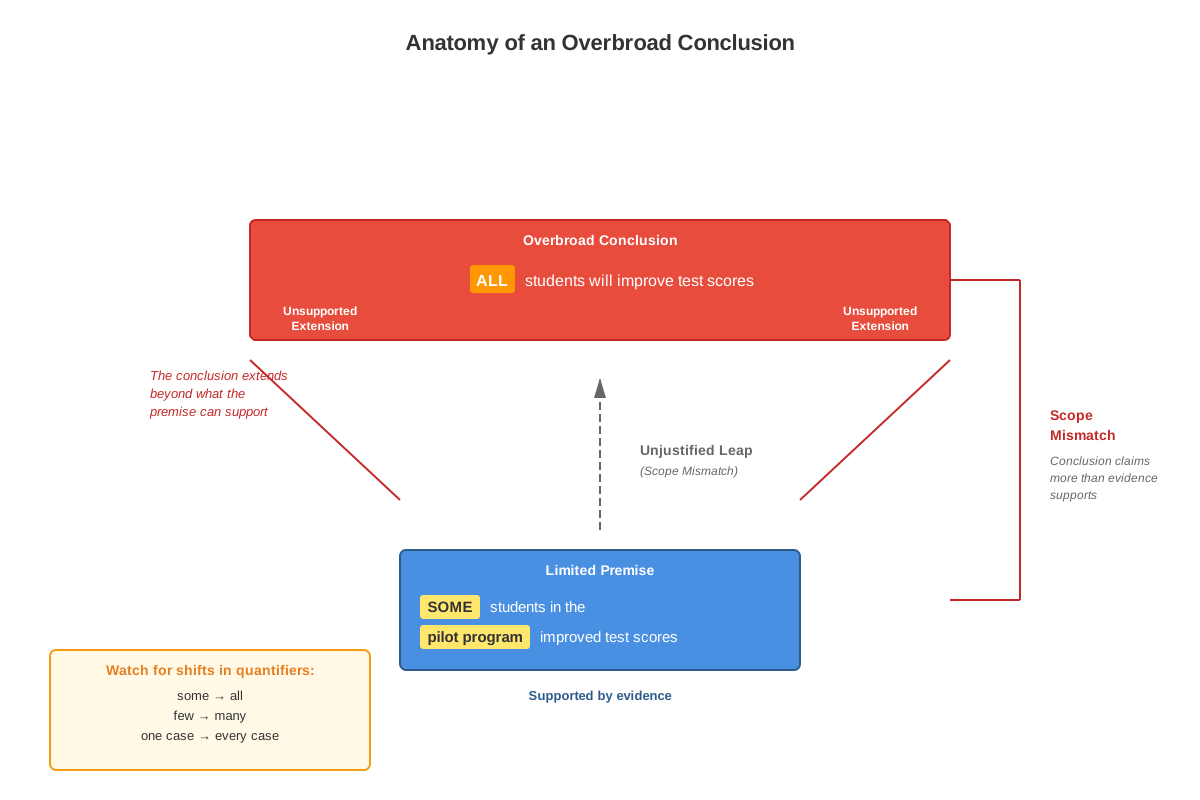
Recognizing overbroad conclusions is a fundamental skill in logical reasoning that appears frequently throughout the LSAT, particularly in Flaw, Weaken, Strengthen, and Assumption questions. An overbroad conclusion occurs when an argument's premises provide evidence for a limited claim, but the conclusion extends beyond what the evidence actually supports. This pattern represents one of the most common logical errors tested on the LSAT because it mirrors reasoning mistakes people make in everyday life—drawing sweeping generalizations from limited data or extending findings beyond their proper scope.
Understanding how to identify overbroad conclusions is essential for LSAT success because this flaw appears in approximately 15-20% of Logical Reasoning questions across various question types. The test makers frequently construct arguments where the evidence supports a narrow claim (such as "some members of a group" or "in certain circumstances"), but the conclusion inappropriately broadens the scope to "all members" or "in all circumstances." Mastering this concept enables students to quickly identify logical gaps, predict correct answer choices, and eliminate incorrect options that fail to address the scope mismatch between premises and conclusion.
Within the broader framework of argument fundamentals, recognizing overbroad conclusions connects directly to understanding argument structure, identifying assumptions, and evaluating the strength of reasoning. This skill builds upon the ability to distinguish premises from conclusions and requires careful attention to quantifiers, qualifiers, and scope indicators throughout an argument. Students who master this concept gain a significant advantage in dissecting complex arguments and recognizing when authors make unjustified logical leaps.
Learning Objectives
- [ ] Identify how recognizing overbroad conclusions appears in LSAT questions
- [ ] Explain the reasoning pattern behind recognizing overbroad conclusions
- [ ] Apply recognizing overbroad conclusions to solve LSAT-style problems accurately
- [ ] Distinguish between appropriately scoped conclusions and overbroad conclusions in complex arguments
- [ ] Recognize the specific language markers that signal scope limitations in premises versus conclusions
- [ ] Evaluate answer choices by determining whether they correctly identify or address the overbreadth issue
- [ ] Predict the gap between premises and conclusion before reviewing answer choices
Prerequisites
- Basic argument structure: Understanding the distinction between premises and conclusions is essential because recognizing overbroad conclusions requires comparing what the evidence establishes versus what the conclusion claims.
- Quantifiers and scope indicators: Familiarity with terms like "all," "some," "most," "many," "few," and "none" is necessary because overbreadth often involves inappropriate shifts in these quantifiers.
- Conditional reasoning basics: Understanding sufficient and necessary conditions helps identify when conclusions inappropriately universalize conditional relationships.
- Evidence evaluation: The ability to assess what evidence actually proves versus what it suggests is fundamental to spotting when conclusions exceed evidentiary support.
Why This Topic Matters
In real-world contexts, recognizing overbroad conclusions is crucial for evaluating research claims, policy proposals, legal arguments, and everyday reasoning. When a medical study concludes that a treatment is effective for "all patients" based on testing with only young adults, or when a policy maker argues for universal implementation based on success in a single city, these represent overbroad conclusions with potentially serious consequences. Legal reasoning particularly demands precision in scope—a precedent established in specific circumstances cannot automatically apply to all situations without careful analysis.
On the LSAT, overbroad conclusions appear in multiple question types with high frequency. Approximately 15-20% of Logical Reasoning questions involve this concept either as the primary flaw being tested or as a key consideration in evaluating arguments. Flaw questions directly ask students to identify when conclusions are too broad; Weaken questions often present answer choices that expose the gap between limited evidence and sweeping claims; Strengthen questions may require recognizing what additional evidence would justify a broader conclusion; and Assumption questions frequently test whether students can identify the unstated premise needed to bridge the scope gap.
Common manifestations in LSAT passages include: arguments that generalize from a sample to an entire population without justification; conclusions that apply findings from one context to all contexts; claims that extend temporal findings (what happened in the past) to universal or future predictions; and arguments that move from "correlation" or "some instances" to "causation" or "all instances." The test makers particularly favor arguments where the overbreadth is subtle—where the conclusion seems reasonable at first glance but careful analysis reveals it extends just beyond what the evidence supports.
Core Concepts
Definition of Overbroad Conclusions
An overbroad conclusion occurs when an argument's conclusion makes a claim that is wider in scope, more universal, or more absolute than what the premises actually establish. The logical error lies in the mismatch between the limited nature of the evidence and the expansive nature of the claim. This represents a failure of logical sufficiency—the premises may be true and relevant, but they are insufficient to support the full breadth of the conclusion.
The key to understanding overbreadth is recognizing that arguments can fail not because their evidence is false or irrelevant, but because they attempt to prove too much. An argument might have perfectly valid evidence about a subset of cases but then inappropriately conclude something about all cases. The logical gap exists in the scope dimension rather than in the truth or relevance dimensions.
Scope Indicators and Quantifiers
Recognizing overbroad conclusions requires careful attention to scope indicators—words and phrases that define the breadth of claims. These fall into several categories:
Quantifiers specify how many members of a group are included:
- Universal: all, every, each, any, always, never, none
- Majority: most, majority, usually, generally
- Substantial minority: many, often, frequently
- Limited: some, few, occasionally, sometimes, at least one
Temporal scope indicators define time boundaries:
- Universal: always, never, eternally, invariably
- Limited: sometimes, often, currently, in the past, recently
Contextual scope indicators define situational boundaries:
- Universal: in all cases, under all circumstances, everywhere
- Limited: in certain situations, under specific conditions, in this context
The most common pattern of overbreadth involves premises that use limited scope indicators (some, many, in certain cases) while the conclusion employs universal scope indicators (all, always, in every case).
Common Patterns of Overbreadth
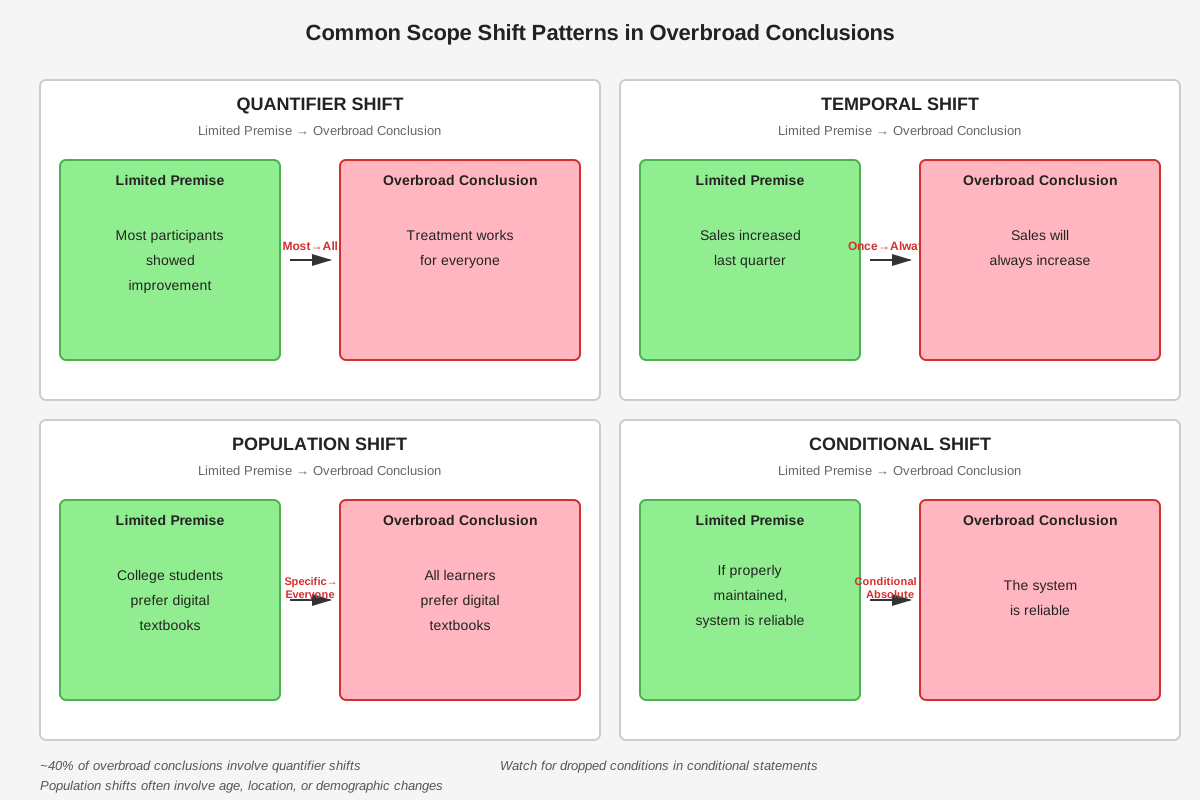
| Pattern Type | Premise Scope | Conclusion Scope | Example |
|---|---|---|---|
| Sample to Population | Some members of group X | All members of group X | "These 50 students improved" → "All students will improve" |
| Temporal Extension | Past/present observation | Universal/future claim | "This has always worked" → "This will always work" |
| Contextual Generalization | Specific circumstances | All circumstances | "Effective in urban areas" → "Effective everywhere" |
| Conditional Universalization | If X, then Y | X always causes Y | "When present, Y occurs" → "X is necessary for Y" |
| Correlation to Causation | X and Y occur together | X causes Y in all cases | "Correlated in this study" → "X always causes Y" |
The Scope Gap
The scope gap is the logical space between what the premises establish and what the conclusion claims. Identifying this gap is central to recognizing overbroad conclusions. The gap can exist along multiple dimensions:
Quantitative gap: Premises establish something about "some" or "many," but conclusion claims "all" or "most."
Temporal gap: Premises provide evidence from a limited time period, but conclusion makes claims about all time periods or the future.
Contextual gap: Premises describe specific situations or conditions, but conclusion applies to all situations regardless of conditions.
Categorical gap: Premises discuss one category or subset, but conclusion extends to broader categories or the entire set.
Effective LSAT test-takers develop the habit of actively looking for these gaps while reading arguments, asking: "Does the evidence really support a claim this broad?"
Relationship to Necessary Assumptions
Overbroad conclusions create necessary assumptions—unstated premises that must be true for the argument to work. When a conclusion is overbroad, the argument necessarily assumes that what's true for the limited evidence applies more broadly. For example, if premises discuss a sample and the conclusion addresses the entire population, the argument assumes the sample is representative.
Understanding this relationship helps in multiple question types:
- In Assumption questions, the correct answer often bridges the scope gap
- In Weaken questions, correct answers often show the assumption is false
- In Strengthen questions, correct answers often support the bridging assumption
Distinguishing Overbreadth from Other Flaws
While overbroad conclusions represent a specific type of logical error, they can appear similar to other reasoning flaws:
Overbroad vs. Unsupported: An overbroad conclusion has some evidentiary support but extends beyond it; a completely unsupported conclusion has no relevant evidence at all.
Overbroad vs. Unwarranted Assumption: Overbreadth is a specific type of unwarranted assumption focused on scope; other unwarranted assumptions might involve causation, motivation, or other logical connections.
Overbroad vs. Sampling Error: Sampling errors involve problems with how evidence was gathered; overbreadth involves problems with how far the conclusion extends regardless of evidence quality.
The distinction matters because LSAT answer choices often include these related but incorrect characterizations of the flaw.
Concept Relationships
The concept of recognizing overbroad conclusions sits at the intersection of multiple fundamental logical reasoning skills. Understanding argument structure (premises and conclusions) provides the foundation → which enables identification of scope indicators and quantifiers → which allows recognition of scope gaps between evidence and claims → which reveals overbroad conclusions → which connects to understanding necessary assumptions that would bridge those gaps.
This topic relates directly to prerequisite knowledge of quantifiers and conditional reasoning because overbreadth often involves inappropriate shifts in quantification (from "some" to "all") or improper universalization of conditional relationships (from "if X then Y" to "X always causes Y"). The skill of evaluating evidence quality, another prerequisite, becomes crucial when determining whether evidence genuinely supports a broad conclusion or only justifies a narrower claim.
Within the broader unit of argument fundamentals, recognizing overbroad conclusions connects to identifying assumptions (the scope gap creates necessary assumptions), evaluating argument strength (overbreadth weakens arguments), and understanding common reasoning patterns (many LSAT arguments follow predictable overbreadth patterns). This concept also relates to later topics in formal logic, particularly understanding the logical relationships between universal and particular statements.
The progression flows: Basic Argument Structure → Scope and Quantifiers → Recognizing Overbroad Conclusions → Identifying Assumptions → Evaluating Argument Strength → Advanced Flaw Recognition
High-Yield Facts
⭐ Overbroad conclusions occur when the conclusion's scope exceeds what the premises actually establish, creating a logical gap that weakens the argument.
⭐ The most common pattern involves premises with limited quantifiers (some, many, often) and conclusions with universal quantifiers (all, always, every).
⭐ Scope indicators include quantifiers (all, some, most), temporal markers (always, sometimes, currently), and contextual qualifiers (in all cases, under certain conditions).
⭐ Recognizing overbroad conclusions appears in approximately 15-20% of Logical Reasoning questions across multiple question types.
⭐ The scope gap between premises and conclusion creates a necessary assumption that must be true for the argument to succeed.
- Sample-to-population generalizations without justification for representativeness constitute a classic form of overbreadth.
- Temporal overbreadth occurs when past or present evidence is used to make universal or future claims without justification.
- Contextual overbreadth happens when evidence from specific circumstances is applied to all circumstances without warrant.
- Correlation-to-causation errors often involve overbreadth when limited correlational evidence is used to support universal causal claims.
- In Flaw questions, correct answers identifying overbroad conclusions often use phrases like "takes for granted," "presumes without justification," or "fails to establish."
- Weaken questions targeting overbroad conclusions typically present evidence showing the conclusion doesn't apply as broadly as claimed.
- Strengthen questions addressing overbroad conclusions often provide evidence that the limited sample or context is representative of the broader claim.
Quick check — test yourself on Recognizing overbroad conclusions so far.
Try Flashcards →Common Misconceptions
Misconception: If the premises are true, the conclusion must be appropriately scoped. → Correction: Premises can be entirely true yet insufficient to support a conclusion's full scope. Truth and sufficiency are distinct logical properties. An argument can have true premises about "some cases" while making an unjustified claim about "all cases."
Misconception: Overbroad conclusions are always obviously wrong or extreme. → Correction: The most challenging LSAT questions involve subtle overbreadth where the conclusion seems reasonable but extends just slightly beyond what the evidence supports. The conclusion might be plausible or even true in reality, but it's not logically established by the given premises.
Misconception: Any generalization from specific evidence represents overbreadth. → Correction: Not all generalizations are overbroad. If premises provide sufficient evidence (such as a representative sample, established pattern, or universal principle), broader conclusions can be justified. Overbreadth occurs specifically when the generalization exceeds what the evidence warrants.
Misconception: Overbroad conclusions and unsupported conclusions are the same thing. → Correction: Overbroad conclusions have some evidentiary support but extend beyond it, while unsupported conclusions lack relevant evidence entirely. An argument about "some students" that concludes about "all students" is overbroad; an argument about "students" that concludes about "teachers" is unsupported.
Misconception: The presence of words like "all" or "always" automatically indicates an overbroad conclusion. → Correction: Universal quantifiers in conclusions are only problematic when the premises don't support that level of universality. If premises establish something about all members of a group, a conclusion about all members is appropriately scoped.
Misconception: Recognizing overbroad conclusions only matters for Flaw questions. → Correction: This concept appears across multiple question types including Weaken, Strengthen, Assumption, Necessary Assumption, and Sufficient Assumption questions. Understanding overbreadth helps predict correct answers in all these formats.
Worked Examples
Example 1: Classic Sample-to-Population Overbreadth
Argument: "A recent study of 100 college students at an urban university found that 75% prefer online learning to in-person classes. Therefore, online learning is preferred by college students generally."
Analysis:
Step 1: Identify the conclusion
The conclusion is: "online learning is preferred by college students generally."
Step 2: Identify the premises
The premise is: A study of 100 students at one urban university found 75% prefer online learning.
Step 3: Examine scope indicators
- Premise scope: "100 college students at an urban university" (limited sample, specific context)
- Conclusion scope: "college students generally" (universal claim about all college students)
Step 4: Identify the scope gap
The evidence comes from a limited sample at one type of institution, but the conclusion extends to all college students everywhere. This is overbroad because:
- The sample size is relatively small
- The sample comes from only one university
- The university is specifically urban (may not represent rural or suburban institutions)
- No information suggests this sample is representative of all college students
Step 5: Determine the necessary assumption
The argument assumes that the preferences of students at this one urban university are representative of college students generally—an assumption that may not be warranted.
Application to question types:
- Flaw question: The correct answer would identify that the argument "generalizes from an unrepresentative sample" or "takes for granted that the sample is representative of the broader population."
- Weaken question: A correct answer might show that students at urban universities have different preferences than students at other types of institutions.
- Assumption question: A correct answer might state that "the preferences of students at urban universities are similar to those of college students generally."
Example 2: Temporal Overbreadth
Argument: "For the past three years, the city's crime rate has decreased following the implementation of increased street lighting. Therefore, increased street lighting will continue to reduce crime in the city."
Analysis:
Step 1: Identify the conclusion
The conclusion is: "increased street lighting will continue to reduce crime in the city."
Step 2: Identify the premises
The premise is: For three years, crime decreased after implementing increased street lighting.
Step 3: Examine scope indicators
- Premise scope: "for the past three years" (limited temporal scope, past observation)
- Conclusion scope: "will continue" (future prediction, ongoing claim)
Step 4: Identify the scope gap
The evidence describes what happened in the past, but the conclusion makes a claim about the future. This is overbroad because:
- Past patterns don't necessarily continue indefinitely
- Conditions that made the lighting effective might change
- Other factors might have contributed to the decrease
- The causal relationship might not be stable over time
Step 5: Determine the necessary assumption
The argument assumes that the conditions that led to crime reduction in the past three years will remain constant, and that the relationship between lighting and crime will persist.
Application to question types:
- Flaw question: The correct answer would identify that the argument "assumes without justification that a pattern observed in the past will continue in the future" or "fails to consider that conditions might change."
- Weaken question: A correct answer might present evidence that the factors making lighting effective are changing, or that crime rates are beginning to plateau or increase despite continued lighting.
- Strengthen question: A correct answer might provide evidence that the conditions supporting the lighting's effectiveness will remain stable, or that similar long-term patterns have been observed in comparable cities.
Exam Strategy
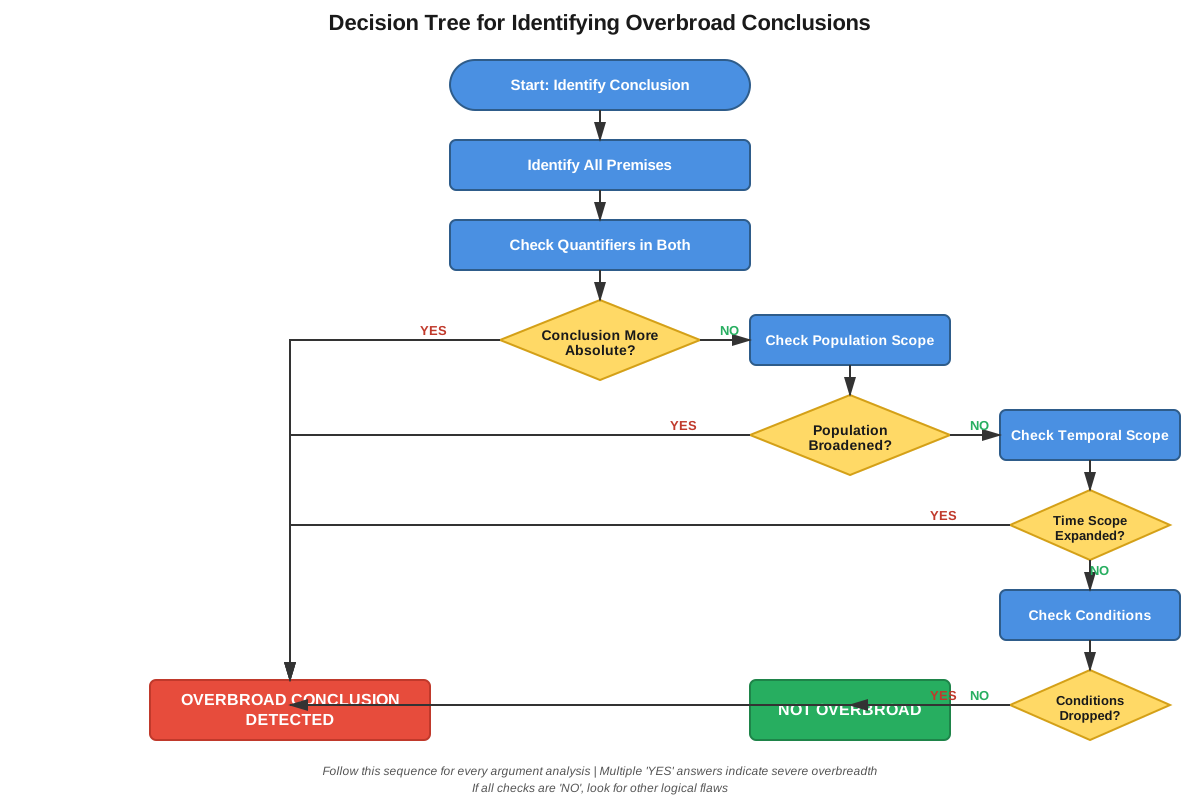
When approaching LSAT questions involving overbroad conclusions, employ this systematic process:
Step 1: Read actively for scope indicators
As you read the argument, mark or mentally note every quantifier, temporal marker, and contextual qualifier. Pay special attention to shifts between premises and conclusion. Trigger words to watch for include:
- Universal quantifiers: all, every, always, never, none, any
- Limited quantifiers: some, many, most, few, several, often
- Temporal markers: always, never, currently, in the past, will continue
- Contextual qualifiers: in all cases, under certain conditions, generally
Step 2: Compare premise scope to conclusion scope
Before looking at answer choices, explicitly ask: "Is the conclusion broader than what the premises establish?" Consider:
- Does the conclusion apply to more people/things than the evidence covers?
- Does the conclusion extend to time periods beyond what the evidence addresses?
- Does the conclusion apply to contexts or situations beyond what the evidence describes?
Step 3: Predict the scope gap
If you identify overbreadth, articulate the specific gap: "The evidence is about X, but the conclusion claims Y." This prediction helps you quickly identify correct answers and eliminate incorrect ones.
Step 4: Apply question-type-specific strategies
For Flaw questions:
- Correct answers often use phrases like "takes for granted," "presumes without justification," "fails to establish," or "treats evidence about some as if it were evidence about all"
- Eliminate answers that describe other flaws (causation, sampling method, etc.) if the primary issue is scope
- Be wary of answers that are too extreme or that describe flaws not present in the argument
For Weaken questions:
- Look for answers that show the conclusion doesn't apply as broadly as claimed
- Correct answers often present counterexamples or evidence of relevant differences between the limited evidence and the broader conclusion
- Eliminate answers that address the truth of the premises rather than the scope gap
For Strengthen questions:
- Look for answers that bridge the scope gap by showing the limited evidence is representative or applicable more broadly
- Correct answers often provide additional evidence that the pattern holds in other contexts or for other groups
For Assumption questions:
- The correct answer often explicitly states that what's true for the limited evidence applies more broadly
- Use the negation test: if negating the answer choice reveals the scope gap, it's likely correct
Time allocation: Spend 10-15 seconds identifying scope indicators and comparing premise/conclusion scope before reviewing answer choices. This upfront investment saves time by enabling faster, more confident answer selection.
Exam Tip: If you're stuck between two answer choices, check whether each one actually addresses the scope dimension of the argument. Many incorrect answers describe real logical issues but not the specific scope problem present in the argument.
Memory Techniques
Acronym for Scope Dimensions: "QTC"
- Quantitative (how many: all, some, most)
- Temporal (when: always, sometimes, past, future)
- Contextual (where/under what conditions: everywhere, in certain situations)
Check each dimension when comparing premises to conclusions.
Mnemonic for Common Overbreadth Pattern: "SAMPLE"
- Specific evidence
- Applied
- More broadly than
- Premises
- Logically
- Establish
Visualization Strategy: The Scope Funnel
Visualize premises as a narrow funnel opening and the conclusion as the wide mouth at the bottom. If the conclusion (wide mouth) is significantly wider than what flows through the premises (narrow opening), you have overbreadth. The gap between the narrow evidence and wide conclusion represents the logical flaw.
Trigger Phrase Recognition: "Some to All"
When you see limited quantifiers in premises (some, many, often) followed by universal quantifiers in conclusions (all, always, every), mentally flag "SOME TO ALL" as a likely overbreadth issue.
The Representative Question
Whenever an argument generalizes from a sample or specific case, ask: "Is it representative?" This single question captures the core issue in most sample-to-population overbreadth problems.
Summary
Recognizing overbroad conclusions is a high-yield LSAT skill that requires careful attention to the scope of both premises and conclusions. An overbroad conclusion extends beyond what the evidence actually establishes, creating a logical gap that weakens the argument. This flaw appears when quantifiers shift from limited (some, many) to universal (all, always), when temporal evidence (past observations) supports universal or future claims without justification, or when contextual evidence (specific situations) is applied to all contexts. The key to mastering this concept lies in actively identifying scope indicators while reading arguments, comparing the breadth of premises to the breadth of conclusions, and recognizing the necessary assumptions created by scope gaps. This skill applies across multiple LSAT question types including Flaw, Weaken, Strengthen, and Assumption questions, making it essential for achieving a high Logical Reasoning score. Students who develop the habit of checking for scope mismatches gain a significant advantage in quickly identifying correct answers and eliminating attractive but incorrect options.
Key Takeaways
- Overbroad conclusions occur when the conclusion's scope exceeds what the premises establish, creating a logical gap between evidence and claim
- The three primary dimensions of scope are quantitative (how many), temporal (when), and contextual (under what conditions)
- The most common pattern involves premises with limited scope indicators (some, many, in certain cases) and conclusions with universal scope indicators (all, always, in every case)
- Recognizing overbroad conclusions requires active reading for scope indicators and systematic comparison of premise scope to conclusion scope
- This concept appears in 15-20% of Logical Reasoning questions across multiple question types, making it one of the highest-yield topics to master
- The scope gap created by overbroad conclusions generates necessary assumptions that must be true for the argument to succeed
- Effective strategy involves predicting the specific scope gap before reviewing answer choices, enabling faster and more accurate answer selection
Related Topics
Identifying Necessary Assumptions: Mastering overbroad conclusions directly enables success with assumption questions because scope gaps create necessary assumptions. Understanding what must be true to bridge the gap between limited evidence and broad conclusions is central to both concepts.
Strengthening and Weakening Arguments: These question types frequently test whether students recognize that evidence addressing the scope gap strengthens arguments while evidence exposing the gap weakens them. The ability to identify overbroad conclusions predicts which answer choices will be most effective.
Sampling and Representativeness: A specialized application of overbroad conclusions involves understanding when samples justify generalizations and when they don't. This topic builds directly on the foundation of recognizing scope mismatches.
Conditional Logic and Sufficient/Necessary Conditions: Overbroad conclusions often involve inappropriate universalization of conditional relationships. Advanced study of formal logic deepens understanding of when conditional statements justify universal claims.
Causal Reasoning Flaws: Many causal arguments involve overbreadth when limited correlational evidence is used to support universal causal claims. Recognizing the scope dimension enhances the ability to evaluate causal arguments.
Practice CTA
Now that you've mastered the fundamentals of recognizing overbroad conclusions, it's time to apply this knowledge to actual LSAT-style questions. The practice questions and flashcards will help solidify your understanding and build the pattern recognition skills essential for test day success. Focus on actively identifying scope indicators, comparing premise and conclusion scope, and predicting scope gaps before reviewing answer choices. Each practice question you complete strengthens your ability to quickly spot this high-yield pattern under timed conditions. Remember: recognizing overbroad conclusions is a skill that improves dramatically with deliberate practice—you're building the foundation for significant score improvements in Logical Reasoning!
Sign up free to keep reading
Create a free AnvayaPrep account to finish this LSAT guide on Recognizing overbroad conclusions — plus flashcards and practice questions.