Overview
Separating argument from description is a foundational skill in LSAT Logical Reasoning that distinguishes between passages that present claims with supporting reasons (arguments) and passages that merely report facts, observations, or events without attempting to persuade (descriptions). This distinction is critical because the LSAT frequently tests whether students can identify when an author is making a case for a particular conclusion versus simply conveying information. Many test-takers struggle with this concept because real-world communication often blends argumentative and descriptive elements, and the LSAT deliberately crafts passages that require careful analysis to categorize correctly.
Understanding this topic is essential for success on the LSAT because it forms the bedrock of argument fundamentals. Before analyzing argument structure, identifying assumptions, or evaluating reasoning, students must first recognize whether an argument exists at all. Questions that test this skill appear directly in "Main Point" and "Method of Reasoning" question types, but the underlying ability to separate argument from description also supports performance across all Logical Reasoning question types. A student who misidentifies a description as an argument will waste time searching for premises and conclusions that don't exist, while a student who mistakes an argument for a description will miss the author's persuasive intent entirely.
This topic connects intimately with other core Logical Reasoning concepts, including premise and conclusion identification, argument structure analysis, and the distinction between facts and opinions. Mastering lsat separating argument from description enables students to approach passages with the right analytical framework from the outset, improving both accuracy and efficiency. The skill also reinforces critical thinking abilities that extend beyond the LSAT, helping students recognize when they're being presented with neutral information versus when someone is attempting to convince them of a particular viewpoint.
Learning Objectives
- [ ] Identify how Separating argument from description appears in LSAT questions
- [ ] Explain the reasoning pattern behind Separating argument from description
- [ ] Apply Separating argument from description to solve LSAT-style problems accurately
- [ ] Distinguish between factual reporting and persuasive reasoning in complex passages
- [ ] Recognize indicator words and structural patterns that signal arguments versus descriptions
- [ ] Evaluate mixed passages that contain both argumentative and descriptive elements
- [ ] Predict question types most likely to test this distinction
Prerequisites
- Basic understanding of what constitutes an argument: Relevance because students must know that arguments contain conclusions supported by premises before they can identify when these elements are absent
- Familiarity with premise and conclusion indicators: Relevance because recognizing words like "therefore," "because," and "since" helps identify argumentative passages
- Ability to identify claims and statements: Relevance because both arguments and descriptions contain statements, but only arguments arrange them in a support relationship
- Reading comprehension at college level: Relevance because distinguishing subtle differences in authorial intent requires careful textual analysis
Why This Topic Matters
In real-world contexts, the ability to separate argument from description is fundamental to critical thinking and informed decision-making. News articles, scientific reports, political speeches, and everyday conversations constantly shift between presenting facts and making arguments. Professionals in law, medicine, business, and academia must regularly distinguish between when information is being neutrally conveyed versus when a particular interpretation or action is being advocated. This skill prevents manipulation, enables better evaluation of evidence, and supports more reasoned responses to persuasive communication.
On the LSAT, this topic appears with high frequency across multiple question types. Approximately 15-20% of Logical Reasoning questions directly or indirectly test the ability to recognize whether a passage contains an argument. "Main Point" questions require identifying the conclusion of an argument, which presupposes that an argument exists. "Method of Reasoning" questions ask how an argument proceeds, again requiring recognition of argumentative structure. "Flaw" and "Strengthen/Weaken" questions only make sense when applied to arguments rather than descriptions. Even "Must Be True" questions sometimes include wrong answer choices that treat descriptive passages as if they contained arguments.
Common manifestations on the LSAT include passages that describe historical events, scientific findings, or survey results without drawing conclusions from them; passages that explain how something works without arguing that it should work differently; and passages that report multiple viewpoints without endorsing any particular position. The test makers deliberately craft passages that superficially resemble arguments—using sophisticated vocabulary, complex sentence structures, and multiple statements—but lack the essential element of a conclusion supported by reasons. Conversely, some passages present arguments so subtly that students mistake them for mere descriptions, missing the author's persuasive intent.
Core Concepts
Defining Arguments vs. Descriptions
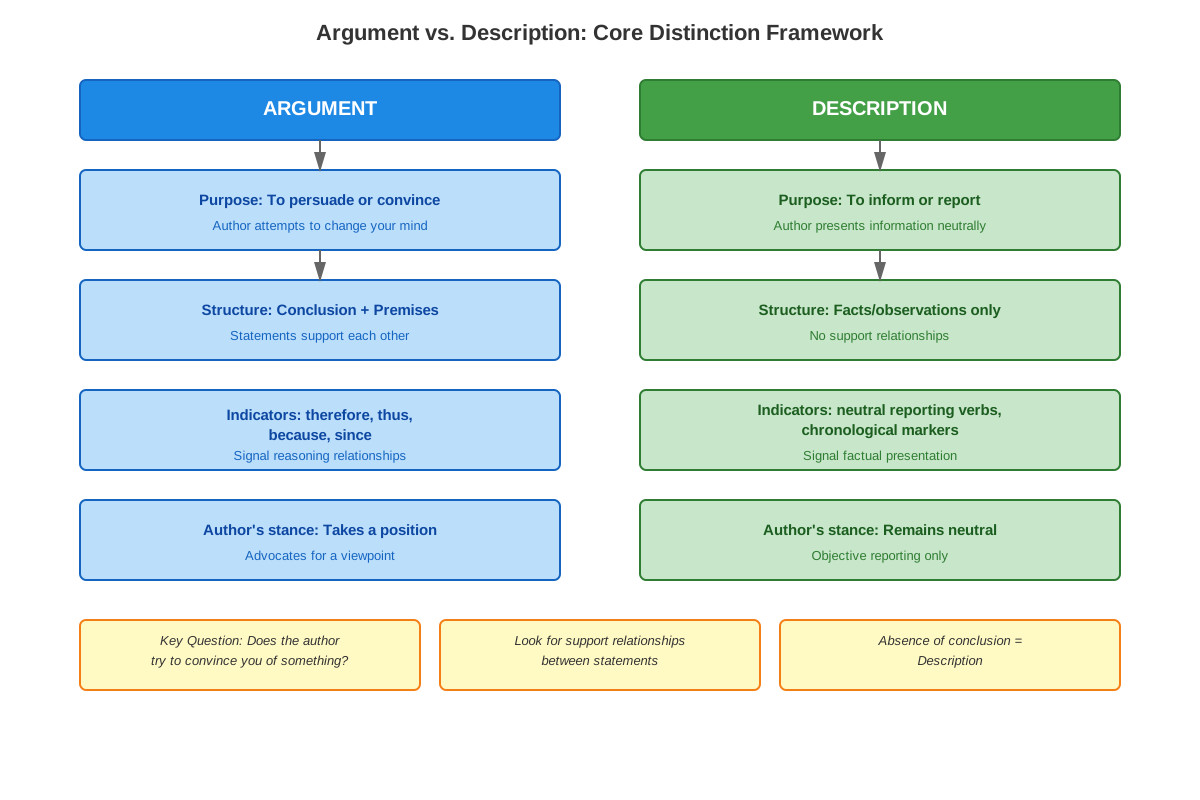
An argument consists of one or more premises offered as support for a conclusion. The defining characteristic is that the author attempts to convince the reader that something is true, should be done, or should be believed based on reasons provided. The conclusion represents the author's main claim or position, while premises provide the evidence, reasoning, or justification for accepting that conclusion. Arguments have a logical structure where some statements are meant to support others.
A description, by contrast, presents information without attempting to establish that any particular claim follows from others. Descriptions report facts, explain processes, narrate events, define terms, or convey observations. While descriptions contain statements, these statements stand independently rather than in a support relationship. The author's purpose is to inform, clarify, or convey rather than to persuade or prove.
| Feature | Argument | Description |
|---|---|---|
| Purpose | Persuade, prove, advocate | Inform, explain, report |
| Structure | Premises support conclusion | Statements stand independently |
| Logical relationship | "This follows from that" | "This is the case" |
| Author's stance | Takes a position | Remains neutral or simply conveys |
| Key question | "What is the author trying to prove?" | "What information is being conveyed?" |
Identifying Argumentative Intent
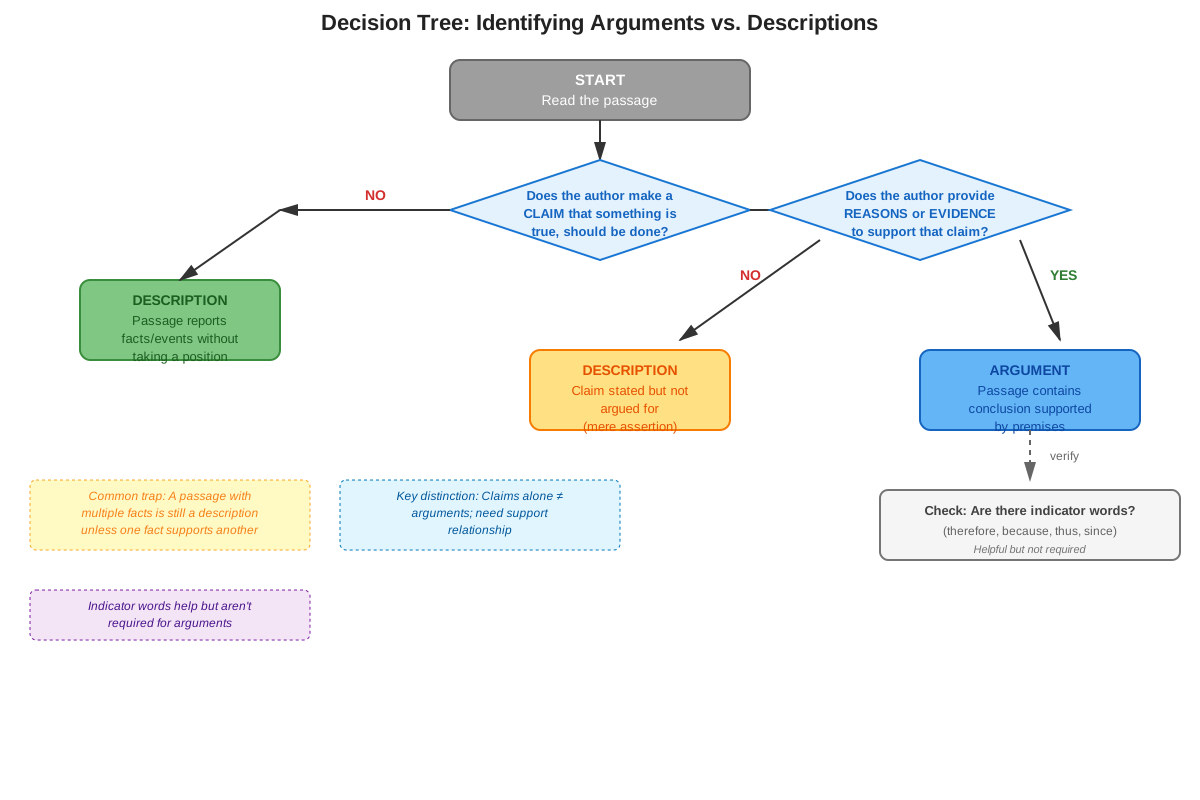
The critical skill in separating argument from description lies in recognizing authorial intent. Ask: "Is the author trying to convince me of something, or simply telling me about something?" This distinction often hinges on whether the passage contains a claim that goes beyond the information explicitly stated and requires the reader to accept it based on supporting reasons.
Consider this descriptive passage: "The company's revenue increased by 15% last quarter. Employee headcount grew from 200 to 250. Three new products were launched." This passage reports facts without suggesting any conclusion follows from them. Now consider this argumentative version: "The company's revenue increased by 15% last quarter, and employee headcount grew from 200 to 250. Therefore, the company's expansion strategy is succeeding." The addition of "therefore" and the conclusion about strategy success transforms the passage into an argument.
However, indicator words aren't always present. Some arguments lack explicit indicators, requiring students to recognize implicit support relationships. The passage "The company's expansion strategy is succeeding. Revenue increased 15% last quarter and headcount grew from 200 to 250" contains an argument even without "therefore"—the first sentence states a conclusion that the subsequent sentences support.
Recognizing Descriptive Patterns
Certain passage types typically function as descriptions rather than arguments:
Historical narratives: "In 1920, the 19th Amendment was ratified. Women gained the right to vote in federal elections. Turnout in the 1920 presidential election increased by 8 million voters." This passage narrates events without arguing for any conclusion about them.
Process explanations: "Photosynthesis converts light energy into chemical energy. Chlorophyll absorbs photons, exciting electrons. These electrons drive the synthesis of glucose from carbon dioxide and water." This explains how something works without arguing that it should work differently or that any conclusion follows.
Survey or study reports: "The survey found that 60% of respondents prefer option A, 30% prefer option B, and 10% have no preference. The margin of error was ±3%." This reports findings without drawing conclusions from them.
Definitions and classifications: "Mammals are warm-blooded vertebrates that nurse their young with milk. They include species ranging from whales to bats to humans." This categorizes and defines without arguing.
Recognizing Argumentative Patterns
Conversely, certain structures signal arguments:
Causal claims: "The new policy caused crime rates to decline" goes beyond describing correlation to asserting causation—a conclusion requiring support.
Evaluative judgments: "The plan is flawed" or "This approach is superior" express positions that require justification through premises.
Predictions: "The economy will enter recession next year" makes a claim about the future that needs supporting reasons.
Recommendations: "The city should adopt this zoning change" advocates for action based on reasons.
Mixed Passages
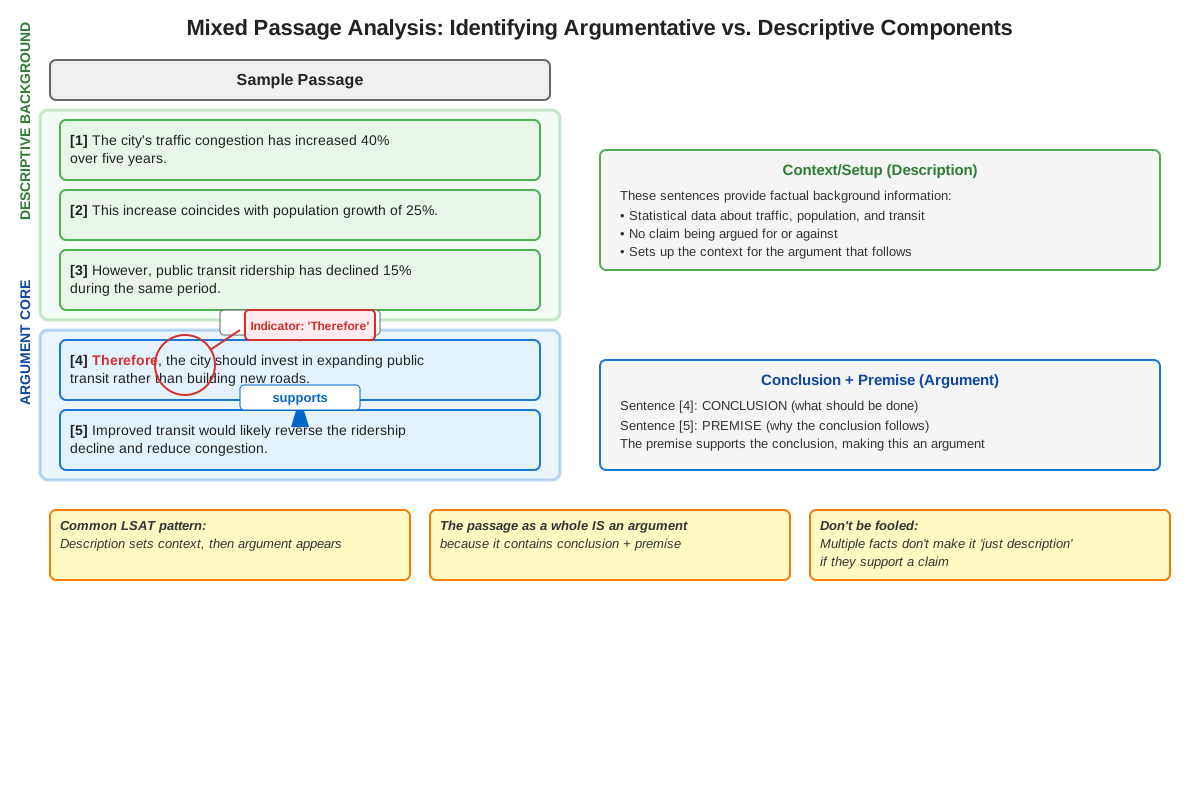
Many LSAT passages combine descriptive and argumentative elements. A passage might describe a situation, then argue for a particular interpretation or response. The key is identifying which portions serve which function. For example: "Studies show that meditation reduces stress hormones by 20% [description]. This demonstrates that meditation should be incorporated into workplace wellness programs [argument]." The first part describes research findings; the second part draws a conclusion from those findings.
When analyzing mixed passages, students should identify the argumentative core—the main conclusion and its direct support—while recognizing that surrounding descriptive material provides context but doesn't constitute part of the argument structure itself.
The Role of Context and Implication
Sometimes argumentative intent is implicit rather than explicit. An author might present information in a way that strongly suggests a conclusion without stating it directly. However, on the LSAT, true arguments contain identifiable conclusions, even if they require careful reading to locate. If no claim is being advanced as following from other claims, the passage remains descriptive regardless of how suggestive the information might be.
The LSAT tests whether students can distinguish between passages where the author takes a position (however subtly) and passages where the author merely conveys information (however complex or interesting). This requires moving beyond surface features to analyze the logical structure and purpose of the passage.
Concept Relationships
The ability to separate argument from description serves as the foundation for all subsequent argument analysis. This skill directly enables premise and conclusion identification—students must first recognize that an argument exists before they can identify its components. Once an argument is recognized, students can then analyze its structure, identifying how premises relate to the conclusion and whether the reasoning is valid.
The relationship flows as follows: Separating argument from description → Identifying conclusions and premises → Analyzing argument structure → Evaluating argument strength → Identifying assumptions and flaws. Each step depends on the previous one, making this foundational skill essential for success across all Logical Reasoning question types.
This topic also connects to fact versus opinion distinction. Descriptions typically present facts (or claims presented as facts), while arguments combine facts with opinions, interpretations, or evaluative judgments. However, the relationship isn't perfect—some descriptions include opinions (e.g., "Many critics consider this film a masterpiece" describes an opinion without arguing for it), and some arguments rely entirely on factual premises to support factual conclusions.
The concept also relates to author's purpose and tone analysis. Recognizing whether a passage is argumentative or descriptive helps students understand the author's intent and approach, which proves valuable for Reading Comprehension passages as well as Logical Reasoning.
Quick check — test yourself on Separating argument from description so far.
Try Flashcards →High-Yield Facts
⭐ An argument must contain a conclusion—a claim the author wants the reader to accept—supported by at least one premise.
⭐ A description presents information without establishing that one claim follows from or is supported by others.
⭐ The presence of multiple statements does not automatically make a passage an argument; the statements must be in a support relationship.
⭐ Indicator words like "therefore," "thus," "consequently," "because," and "since" often signal arguments, but their absence doesn't mean no argument exists.
⭐ Historical narratives, process explanations, and pure fact reporting typically function as descriptions rather than arguments.
- Causal claims ("X caused Y"), evaluative judgments ("X is better than Y"), and recommendations ("We should do X") typically appear in arguments rather than descriptions.
- Mixed passages can contain both descriptive and argumentative elements; identify which portions serve which function.
- The question "What is the author trying to prove?" helps identify arguments; if there's no answer, the passage is likely descriptive.
- Descriptions can be complex, detailed, and sophisticated without becoming arguments.
- Some arguments are so subtle that the conclusion is implied rather than stated, but on the LSAT, careful reading will reveal the argumentative structure.
- Survey results, study findings, and statistical reports are descriptive when merely reported but become part of arguments when used to support conclusions.
- Explanations of how or why something occurs can be either descriptive (explaining a mechanism) or argumentative (arguing that a particular explanation is correct).
Common Misconceptions
Misconception: Any passage with multiple sentences is an argument. → Correction: Arguments require a specific logical structure where some statements support others. Multiple statements can simply convey multiple pieces of information without any support relationship, making the passage descriptive.
Misconception: If a passage contains the word "because," it must be an argument. → Correction: "Because" can introduce a premise in an argument, but it can also explain causation in a description (e.g., "The plant died because it lacked water" might simply describe what happened without arguing for any conclusion).
Misconception: Descriptions are always simple and short, while arguments are complex and long. → Correction: Descriptions can be highly complex and detailed (e.g., explaining quantum mechanics), while arguments can be brief (e.g., "The policy failed because crime increased"). Length and complexity don't determine whether a passage is argumentative or descriptive.
Misconception: If a passage presents facts, it cannot be an argument. → Correction: Arguments frequently use factual premises to support conclusions. The presence of facts doesn't preclude argumentative structure; what matters is whether those facts are offered as support for a conclusion.
Misconception: Any passage that seems to have a point or purpose is an argument. → Correction: Descriptions have purposes too—to inform, explain, or clarify. Having a purpose doesn't make a passage argumentative; the specific purpose of convincing the reader that a conclusion follows from premises defines an argument.
Misconception: If the author expresses an opinion, the passage must be an argument. → Correction: Describing someone's opinion (including the author's) without providing reasons to accept it doesn't constitute an argument. "I believe X" is a description of a belief; "I believe X because Y and Z" is an argument.
Misconception: Scientific or technical passages are always descriptive. → Correction: While many scientific passages describe findings or processes, scientists also make arguments about interpretations, theories, and implications. A passage arguing that "Theory X better explains the data than Theory Y" is argumentative even in a scientific context.
Worked Examples
Example 1: Distinguishing Description from Argument
Passage: "The ancient city of Pompeii was buried by the eruption of Mount Vesuvius in 79 CE. Archaeologists have excavated the site since the 18th century. The preserved buildings and artifacts provide detailed information about Roman daily life. Many tourists visit the site each year."
Analysis:
Step 1: Identify potential conclusions. Ask: "What is the author trying to prove or convince me of?" Reading through the passage, each sentence presents a fact or observation. No sentence appears to be supported by the others or to serve as a claim that follows from the others.
Step 2: Look for support relationships. Does any statement serve as a reason to accept another statement? The sentence about excavations doesn't support the sentence about the eruption; it simply provides additional information. The sentence about artifacts doesn't argue for a conclusion; it describes what the artifacts do. The sentence about tourists adds another fact without drawing a conclusion.
Step 3: Check for indicator words. The passage contains no "therefore," "thus," "because," "since," or similar indicators that would signal an argument structure.
Step 4: Determine authorial intent. The author's purpose is to inform the reader about Pompeii—its history, archaeological significance, and current status. The author isn't trying to convince the reader that any particular claim follows from the information presented.
Conclusion: This passage is a description. It presents historical and factual information without establishing that any claim is supported by others. There is no argument here.
Example 2: Identifying a Subtle Argument
Passage: "The company's new marketing strategy has been in place for six months. During this period, sales have increased by 25%, customer satisfaction scores have risen from 7.2 to 8.4 out of 10, and brand recognition has improved in all target demographics. The strategy is clearly working."
Analysis:
Step 1: Identify potential conclusions. The last sentence—"The strategy is clearly working"—stands out as a claim that goes beyond mere fact reporting. This is an evaluative judgment about the strategy's success.
Step 2: Look for support relationships. The first three sentences provide evidence: increased sales, improved satisfaction scores, and better brand recognition. These facts are presented as reasons to accept the conclusion that the strategy is working. The structure is: "Here are the results [premises], therefore the strategy is working [conclusion]."
Step 3: Check for indicator words. While "clearly" isn't a standard indicator word, it signals that the author is drawing a conclusion from the evidence. The word suggests "obviously" or "evidently," indicating that the conclusion follows from what was stated.
Step 4: Determine authorial intent. The author isn't merely reporting that sales increased and satisfaction improved; the author is arguing that these facts demonstrate the strategy's success. The author wants the reader to accept this interpretation of the data.
Conclusion: This passage is an argument. The conclusion is "The strategy is clearly working," supported by premises about sales increases, satisfaction improvements, and brand recognition gains. Even though the argument is brief and the conclusion comes last, the logical structure of premises supporting a conclusion is present.
Connection to Learning Objectives: This example demonstrates how separating argument from description requires careful attention to authorial intent and logical structure, not just surface features like length or indicator words. It shows how the skill applies to LSAT-style problems where arguments can be subtle.
Exam Strategy
When approaching LSAT Logical Reasoning questions, immediately determine whether the passage contains an argument before proceeding with analysis. This initial categorization prevents wasted time and wrong answers.
Trigger words and phrases to watch for:
- Argument indicators: therefore, thus, hence, consequently, so, it follows that, this shows that, this proves that, clearly, obviously, must be, should, ought to
- Premise indicators: because, since, for, given that, as indicated by, the reason is, for the reason that
- Descriptive indicators: describes, explains, reports, according to, the study found, historically, the process involves
Process-of-elimination strategy:
For questions asking about the passage's main point or conclusion, eliminate answer choices that merely restate facts from the passage without identifying what the author is trying to prove. The correct answer will capture the claim that the rest of the passage supports.
For questions asking about the method of reasoning or argument structure, if the passage is actually descriptive rather than argumentative, all answer choices describing argumentative techniques will be wrong. Recognize this quickly to avoid confusion.
For strengthen/weaken questions, confirm that an argument exists. If the passage is purely descriptive, the question stem itself may be testing whether you recognize this (though this is rare).
Time allocation advice:
Spend 5-10 seconds on initial categorization. Ask: "Is there a conclusion here?" If yes, identify it immediately and bracket it mentally or physically. If no, recognize that you're dealing with a description and adjust your approach accordingly. This upfront investment saves time by preventing misanalysis.
For passages that seem ambiguous, look for the most controversial or evaluative statement—this is often the conclusion. Descriptions stick to facts and observations; arguments venture into interpretation, evaluation, or recommendation.
Question-specific strategies:
- Main Point questions: Only arguments have main points (conclusions). If you can't find a conclusion, reconsider whether the passage is argumentative.
- Method of Reasoning questions: These presuppose an argument exists. Identify the conclusion first, then determine how the premises support it.
- Must Be True questions: These can apply to both arguments and descriptions. Focus on what's stated or logically follows, regardless of whether the passage is argumentative.
Memory Techniques
Mnemonic for identifying arguments: "CAPS"
- Conclusion present (a claim to be proven)
- Author takes a position (not just reporting)
- Premises support the conclusion (logical structure)
- Support relationship exists (some statements justify others)
If all four elements are present, you have an argument. If any are missing, you likely have a description.
Visualization strategy: Picture arguments as buildings with a foundation (premises) supporting a structure (conclusion). Descriptions are like photographs—they show you what's there without building anything new. When reading a passage, visualize whether the author is constructing something (argument) or capturing something (description).
Acronym for descriptive passage types: "HEPS"
- Historical narratives
- Explanations of processes
- Pure fact reporting
- Survey/study results (when merely reported)
When you encounter these passage types, default to treating them as descriptions unless clear argumentative elements appear.
Memory aid for the key question: "PROVE or MOVE?" Ask whether the author is trying to prove something (argument) or just move information to you (description). This simple question captures the essential distinction.
Summary
Separating argument from description is a foundational skill in LSAT Logical Reasoning that requires distinguishing between passages that present claims supported by reasons (arguments) and passages that merely convey information without establishing support relationships (descriptions). Arguments contain conclusions that authors want readers to accept based on premises, while descriptions report facts, explain processes, or narrate events without attempting to prove any particular claim follows from others. This distinction appears throughout the LSAT in various question types, and misidentifying passage type leads to systematic errors in analysis. Success requires focusing on authorial intent and logical structure rather than surface features like length, complexity, or the presence of facts. Students must ask whether the author is trying to convince them of something or simply inform them, recognizing that this difference determines the appropriate analytical approach. Mastering this skill enables accurate identification of conclusions and premises, proper analysis of argument structure, and effective evaluation of reasoning—all essential for high performance on Logical Reasoning questions.
Key Takeaways
- Arguments contain conclusions supported by premises in a logical structure; descriptions present information without support relationships
- The critical question is authorial intent: Is the author trying to prove something or merely inform?
- Indicator words help identify arguments but aren't necessary—focus on whether statements support each other
- Historical narratives, process explanations, and pure fact reporting typically function as descriptions
- Causal claims, evaluative judgments, predictions, and recommendations typically appear in arguments
- Mixed passages can contain both elements; identify which portions serve which function
- Correctly categorizing passages as argumentative or descriptive is essential before analyzing structure or evaluating reasoning
Related Topics
Premise and Conclusion Identification: Once you've determined a passage contains an argument, the next step is identifying which statements serve as premises and which is the conclusion. This skill builds directly on separating argument from description.
Argument Structure and Diagramming: After identifying arguments and their components, analyzing how premises relate to conclusions and to each other becomes crucial. Understanding basic argument structures depends on first recognizing that an argument exists.
Assumptions in Arguments: Arguments rely on unstated assumptions that connect premises to conclusions. This advanced skill requires first identifying that an argument is present and understanding its basic structure.
Strengthen and Weaken Questions: These question types ask how to support or undermine arguments, which presupposes the ability to recognize arguments and identify their conclusions and premises.
Flaw Identification: Recognizing logical flaws requires understanding argument structure, which in turn requires distinguishing arguments from descriptions. Mastering this foundational topic enables progression to more sophisticated flaw analysis.
Practice CTA
Now that you understand how to separate argument from description, it's time to apply this skill to actual LSAT-style questions. The practice questions and flashcards will reinforce your ability to quickly and accurately categorize passages, identify argumentative structures, and avoid common pitfalls. Remember that this foundational skill supports success across all Logical Reasoning question types—every minute spent mastering it pays dividends throughout your LSAT preparation. Approach each practice question by first asking whether the passage contains an argument, then proceed with confidence based on your answer. You've built the foundation; now strengthen it through deliberate practice!
Sign up free to keep reading
Create a free AnvayaPrep account to finish this LSAT guide on Separating argument from description — plus flashcards and practice questions.