Overview
The stimulus structure is the foundational architecture of every Logical Reasoning question on the LSAT. Understanding how stimuli are constructed is essential because it determines how test-takers should approach, analyze, and ultimately answer questions. Every LSAT stimulus structure follows predictable patterns that, once mastered, allow students to quickly identify the type of reasoning presented, locate key components, and anticipate what the question will ask. This skill is not merely about reading comprehension—it's about recognizing the blueprint that underlies logical reasoning passages.
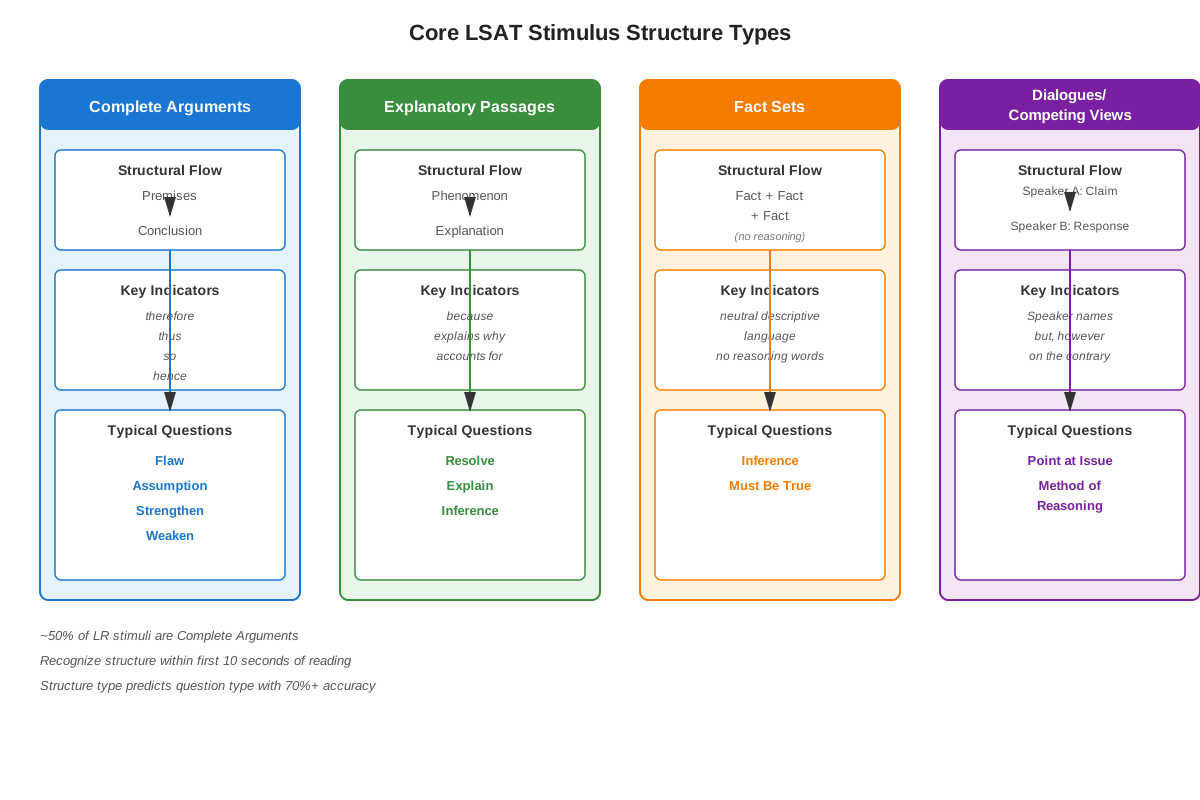
On the LSAT, stimuli can take various forms: some present complete arguments with premises and conclusions, others offer explanations or descriptions without argumentative structure, and still others present competing viewpoints or conditional reasoning chains. The ability to rapidly distinguish between these structures is what separates high scorers from average performers. Each structure type signals different vulnerabilities, different question types, and different strategic approaches. For instance, a stimulus presenting a causal argument will likely be tested differently than one presenting a conditional chain or a mere factual description.
Within the broader context of argument fundamentals, stimulus structure serves as the gateway skill. Before students can evaluate assumptions, identify flaws, or strengthen arguments, they must first understand what type of structure they're analyzing. This topic connects directly to premise and conclusion identification, argument mapping, and ultimately to every question type in the Logical Reasoning section. Mastering stimulus structure creates a mental framework that makes all subsequent Logical Reasoning skills more accessible and intuitive.
Learning Objectives
- [ ] Identify how stimulus structure appears in LSAT questions
- [ ] Explain the reasoning pattern behind stimulus structure
- [ ] Apply stimulus structure to solve LSAT-style problems accurately
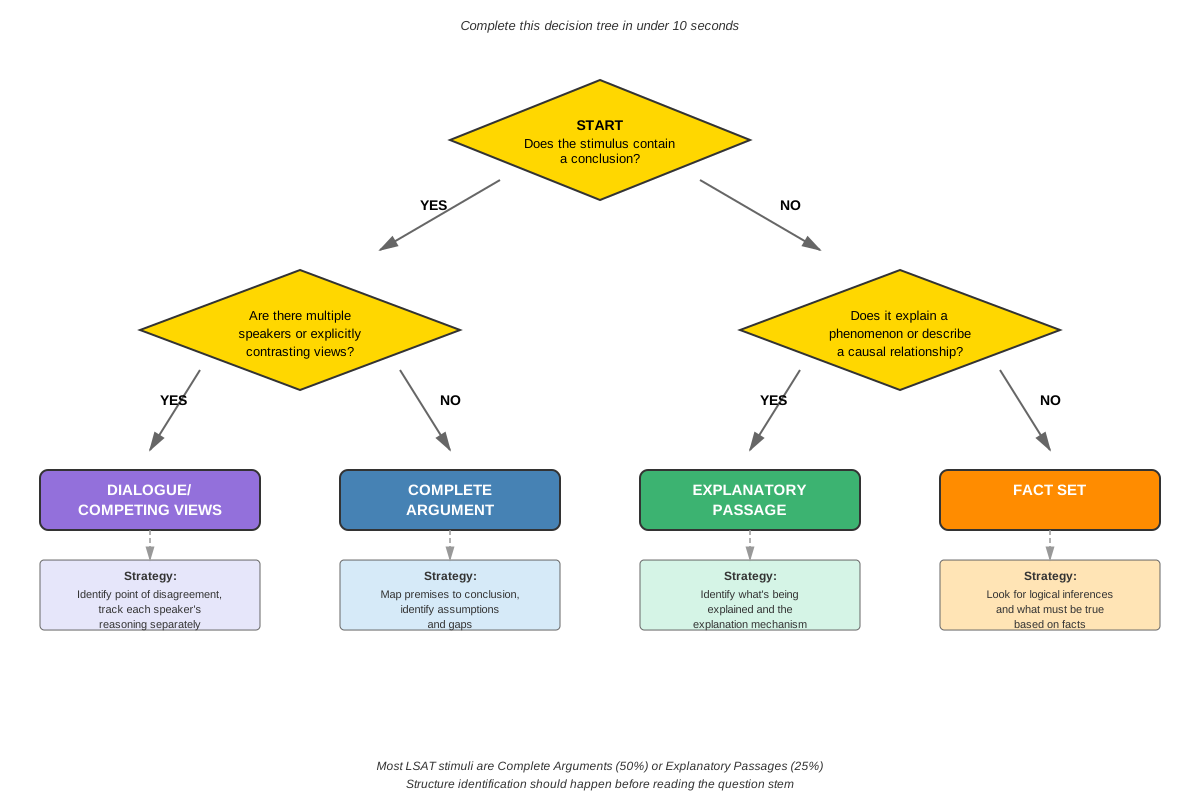
- [ ] Distinguish between argumentative and non-argumentative stimuli within 10 seconds
- [ ] Map the components of complex multi-layered arguments by identifying main conclusions, subsidiary conclusions, and supporting premises
- [ ] Predict likely question types based on stimulus structure patterns
- [ ] Recognize structural indicators and transition words that signal different argument components
Prerequisites
- Basic reading comprehension: Understanding literal meaning of sentences is necessary before analyzing their logical relationships
- Familiarity with premise and conclusion concepts: Stimulus structure builds on the ability to distinguish claims that support from claims that are supported
- Understanding of argument vs. non-argument: Recognizing when reasoning is present versus when information is merely descriptive forms the foundation for structural analysis
- Conditional reasoning basics: Many stimulus structures incorporate if-then relationships that must be recognized as structural elements
Why This Topic Matters
In real-world contexts, understanding argument structure is fundamental to critical thinking in law, business, medicine, and policy-making. Lawyers must dissect opposing counsel's arguments by identifying their structure, finding weak points in reasoning chains, and constructing counterarguments. Policy analysts evaluate proposals by examining how evidence connects to recommendations. This skill transcends test-taking and represents genuine analytical capability.
On the LSAT specifically, stimulus structure appears in every single Logical Reasoning question—typically 24-26 questions per test across two sections. This makes it the highest-frequency topic in the entire exam. Question types that heavily depend on structural understanding include Flaw questions (20-25% of LR), Assumption questions (15-20%), Strengthen/Weaken questions (25-30%), and Method of Reasoning questions (5-10%). Combined, these represent approximately 70-80% of all Logical Reasoning questions.
Common manifestations include: arguments with explicit conclusion indicators ("therefore," "thus," "consequently"), arguments with implicit conclusions requiring inference, causal reasoning structures, analogical reasoning patterns, conditional chains, explanatory hypotheses, competing viewpoints, and pure factual descriptions without argumentative content. The LSAT deliberately varies these structures to test whether students can adapt their analytical approach to different reasoning patterns. Students who fail to recognize structural differences often apply inappropriate strategies, such as looking for assumptions in non-argumentative stimuli or missing subsidiary conclusions in complex arguments.
Core Concepts
Types of Stimulus Structures
The LSAT employs several distinct stimulus structure patterns, each with unique characteristics and testing implications.
Argumentative structures contain premises (supporting evidence) and conclusions (claims being supported). These represent approximately 75-80% of all stimuli. The key feature is that the author attempts to persuade or prove something through reasoning. Within argumentative structures, several subtypes exist:
Simple arguments contain one conclusion supported by one or more premises. Example: "All mammals are warm-blooded. Whales are mammals. Therefore, whales are warm-blooded." The structure is linear and straightforward.
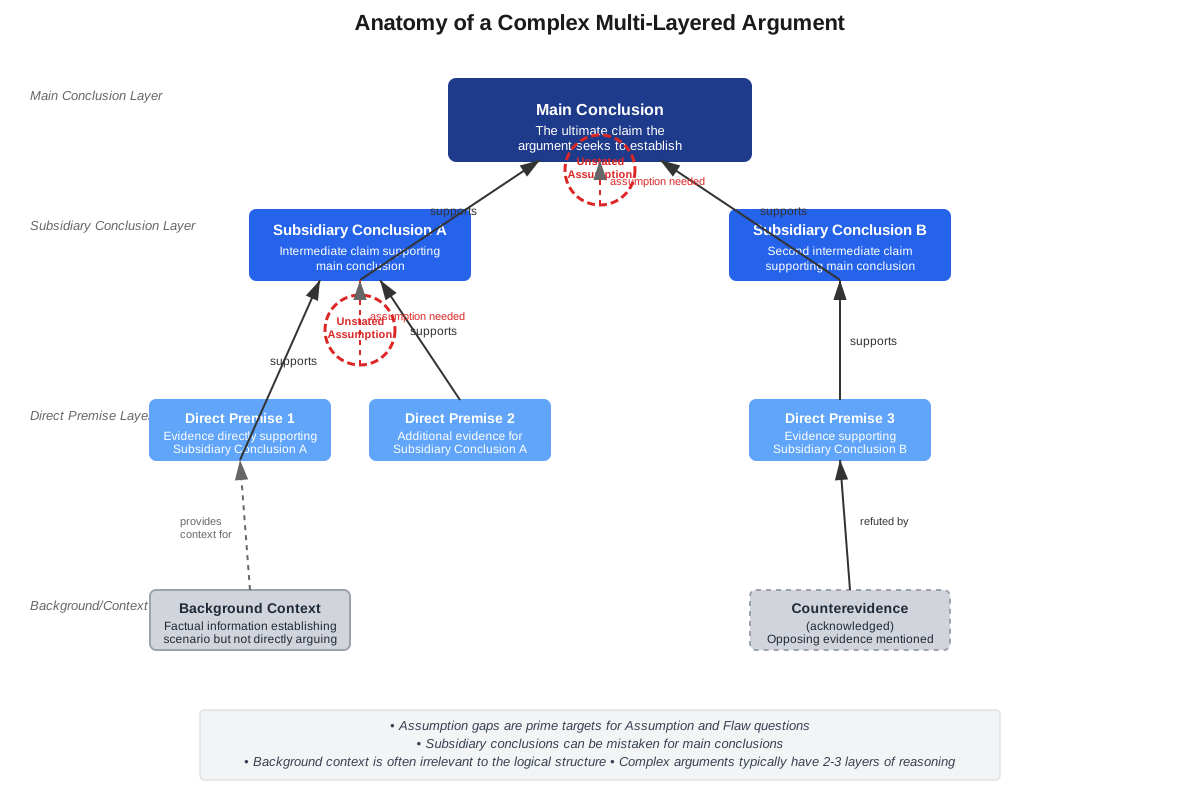
Complex arguments feature multiple layers, including a main conclusion (the ultimate claim) and subsidiary conclusions (intermediate claims that serve as both conclusions of some premises and premises for the main conclusion). Example: "Studies show exercise reduces stress. Reduced stress improves sleep quality. Therefore, exercise improves sleep quality. Since better sleep enhances productivity, people should exercise regularly." Here, "exercise improves sleep quality" is a subsidiary conclusion, while "people should exercise regularly" is the main conclusion.
Non-argumentative structures present information without attempting to prove a claim through reasoning. These include:
- Explanations: Describe why something occurred without arguing that it occurred (the occurrence is assumed)
- Descriptions: Present facts or scenarios without drawing conclusions
- Conditional statements: Present if-then relationships without asserting that conditions are met
- Narratives: Tell a story or sequence of events
Structural Indicators and Transition Words
Recognizing structural components depends heavily on indicator words that signal logical relationships:
| Function | Indicator Words | Example |
|---|---|---|
| Conclusion indicators | therefore, thus, hence, consequently, so, accordingly, it follows that | "The data is unreliable; therefore, the study's conclusions are questionable." |
| Premise indicators | because, since, for, given that, as indicated by, the reason is | "The policy will fail because it lacks funding." |
| Contrast indicators | but, however, yet, although, despite, nevertheless | "The theory is popular, but evidence contradicts it." |
| Support indicators | furthermore, moreover, additionally, in addition | "The plan is costly. Furthermore, it's impractical." |
| Counterpoint indicators | on the other hand, conversely, alternatively | "Some argue for regulation; others, conversely, favor market solutions." |
Argument Flow Patterns
Understanding how information flows through an argument is crucial for logical reasoning analysis:
Linear flow: Premises → Conclusion (straightforward support)
Convergent flow: Multiple independent premises → Single conclusion (each premise supports the conclusion separately)
Linked flow: Multiple interdependent premises → Conclusion (premises work together; removing one weakens the argument significantly)
Divergent flow: Single premise → Multiple conclusions (one piece of evidence supports several claims)
Serial flow: Premise → Subsidiary Conclusion → Main Conclusion (chain reasoning)
Position of Conclusions
Conclusions can appear anywhere in a stimulus:
- Initial position: Conclusion stated first, followed by supporting premises (common in LSAT)
- Final position: Premises build to a concluding statement (traditional essay structure)
- Middle position: Conclusion embedded between premises (tests careful reading)
- Implicit: Conclusion unstated but clearly implied by premises (rare but challenging)
Background Information vs. Argumentative Content
Many stimuli include context or background information that sets the stage but doesn't function as premises. Distinguishing these elements is critical:
Background: "In the 1950s, scientists believed X." (Historical context)
Premise: "Recent studies confirm X." (Evidence supporting a conclusion)
Students must identify which statements actually contribute to the reasoning chain versus which merely provide context. Background information typically appears at the beginning of stimuli and uses past tense or descriptive language without evaluative terms.
Counterarguments and Rebuttals
Some stimuli present opposing viewpoints before offering the author's position:
Structure: "Some people argue X. However, this view is mistaken because Y. Therefore, Z."
The counterargument (X) is not the author's position—it's presented to be refuted. The author's actual argument consists of the rebuttal (Y) and conclusion (Z). Misidentifying the counterargument as the author's position is a common error.
Conditional Structures
Arguments built on conditional reasoning follow if-then patterns:
"If A, then B. A is true. Therefore, B is true." (Valid: Modus Ponens)
"If A, then B. B is false. Therefore, A is false." (Valid: Modus Tollens)
These structures require recognizing sufficient and necessary conditions and tracking how they connect through the argument.
Concept Relationships
The concepts within stimulus structure form an interconnected system. Structural indicators serve as signposts that reveal argument flow patterns, which in turn determine the position of conclusions within the stimulus. Understanding types of stimulus structures (argumentative vs. non-argumentative) is the first analytical step, which then enables identification of specific argument flow patterns (linear, convergent, serial, etc.).
The relationship map flows as follows:
Stimulus Type Identification → determines → Analytical Approach → guides → Component Identification (premises, conclusions, background) → reveals → Argument Flow Pattern → predicts → Likely Question Type → informs → Strategic Response
This topic connects to prerequisite knowledge of premise and conclusion identification by providing the framework within which those components exist. It extends to related topics like assumption identification (which requires understanding what's missing from the structure), flaw recognition (which involves spotting structural weaknesses), and argument evaluation (which depends on understanding how components relate).
Conditional structures within stimuli connect to formal logic topics, while counterargument structures relate to critical reasoning and dialectical thinking. Background information recognition connects to reading comprehension skills, demonstrating how stimulus structure bridges multiple skill domains.
High-Yield Facts
⭐ Approximately 75-80% of LSAT stimuli contain argumentative structures with identifiable premises and conclusions
⭐ Conclusion indicators (therefore, thus, hence) are more reliable than premise indicators for quickly locating the main claim
⭐ The first sentence of a stimulus is often background information, not a premise or conclusion
⭐ Complex arguments with subsidiary conclusions appear in 30-40% of argumentative stimuli
⭐ When a stimulus presents "Some people believe X, but..." the author's position follows the "but," not before it
- Non-argumentative stimuli (explanations, descriptions) cannot have assumptions in the logical sense
- Implicit conclusions are rare (less than 5% of stimuli) but appear more frequently in difficult questions
- Conditional structures often appear in Sufficient Assumption and Parallel Reasoning questions
- The main conclusion is typically the most general or evaluative claim in the stimulus
- Subsidiary conclusions can be identified because they are both supported by some statements and support other statements
- Stimuli with multiple viewpoints typically test the ability to distinguish the author's position from others' positions
- Causal language ("causes," "leads to," "results in") signals a specific argument structure vulnerable to particular flaws
- Questions asking about "method of reasoning" or "argumentative technique" directly test stimulus structure recognition
- The length of a stimulus does not correlate with structural complexity; short stimuli can have complex structures
- Recognizing argument flow patterns reduces reading time by 20-30% for experienced test-takers
Quick check — test yourself on Stimulus structure so far.
Try Flashcards →Common Misconceptions
Misconception: Every stimulus contains an argument with premises and conclusions.
Correction: Approximately 20-25% of stimuli are non-argumentative, presenting explanations, descriptions, or conditional statements without arguing for a conclusion. These require different analytical approaches.
Misconception: The conclusion always appears at the end of the stimulus.
Correction: Conclusions can appear anywhere—beginning, middle, or end. LSAT writers deliberately vary conclusion placement to test careful reading. Conclusion indicators are more reliable than position for identification.
Misconception: All statements in an argumentative stimulus function as either premises or conclusions.
Correction: Many stimuli include background information, context, or counterarguments that don't directly support the conclusion. These elements provide setup but aren't part of the core reasoning chain.
Misconception: Longer stimuli always have more complex structures than shorter ones.
Correction: Structural complexity depends on the number of reasoning layers and relationships, not word count. A short stimulus can contain a complex serial argument, while a long stimulus might present a simple argument with extensive background information.
Misconception: If a stimulus contains "because," the statement following it is always a premise.
Correction: "Because" can introduce a premise in an argument or an explanation in a non-argumentative stimulus. Additionally, "because" might appear in a counterargument that the author will refute, meaning it's not part of the author's reasoning.
Misconception: The author's main point is always explicitly stated.
Correction: While most LSAT stimuli state conclusions explicitly, some require inference. More commonly, students mistake a subsidiary conclusion or a premise for the main conclusion, failing to identify the ultimate claim the argument supports.
Misconception: All premises equally support the conclusion.
Correction: In linked arguments, premises are interdependent and work together. In convergent arguments, premises provide independent support. Understanding this distinction is crucial for assumption and strengthen/weaken questions.
Worked Examples
Example 1: Complex Argument with Subsidiary Conclusion
Stimulus: "Recent studies indicate that regular meditation reduces cortisol levels in the bloodstream. Lower cortisol levels are associated with decreased anxiety. Therefore, meditation can help reduce anxiety. Given that anxiety impairs decision-making ability, professionals in high-stress careers should incorporate meditation into their daily routines."
Analysis:
Step 1 - Identify the type: This is an argumentative stimulus (it attempts to prove claims through reasoning).
Step 2 - Locate conclusion indicators: "Therefore" appears before "meditation can help reduce anxiety," and the final sentence contains an implicit conclusion indicator ("Given that" introduces a premise supporting the final claim).
Step 3 - Identify the main conclusion: "Professionals in high-stress careers should incorporate meditation into their daily routines" is the ultimate claim—the most general recommendation the argument supports.
Step 4 - Identify subsidiary conclusion: "Meditation can help reduce anxiety" is supported by the first two sentences but also serves as a premise for the main conclusion. This is a subsidiary conclusion.
Step 5 - Map the structure:
- Premise 1: Meditation reduces cortisol levels (evidence)
- Premise 2: Lower cortisol levels are associated with decreased anxiety (linking claim)
- Subsidiary Conclusion: Meditation can help reduce anxiety
- Premise 3: Anxiety impairs decision-making ability
- Main Conclusion: Professionals in high-stress careers should incorporate meditation
Step 6 - Identify the flow pattern: This is a serial flow argument (chain reasoning) where early premises support a subsidiary conclusion, which combines with an additional premise to support the main conclusion.
Application to questions: Understanding this structure prepares you for questions asking about the argument's main conclusion (the final recommendation, not the subsidiary conclusion about anxiety), assumptions (the link between reduced anxiety and improved professional performance), or ways to strengthen/weaken (attacking any link in the chain).
Example 2: Non-Argumentative Explanation
Stimulus: "The ancient city of Petra was abandoned in the 7th century CE. Archaeologists have proposed several explanations for this abandonment. Changes in trade routes may have reduced the city's economic importance. Additionally, a series of earthquakes could have made the area less habitable. Finally, shifts in political power in the region might have left Petra without adequate protection from raiders."
Analysis:
Step 1 - Identify the type: This appears argumentative at first glance but is actually a non-argumentative explanation. The stimulus doesn't argue that Petra was abandoned (that's stated as fact in the first sentence). Instead, it presents possible explanations for an accepted fact.
Step 2 - Look for conclusion indicators: None appear. The phrases "may have," "could have," and "might have" indicate possibilities, not claims being proven.
Step 3 - Identify the structure: This is a descriptive structure presenting multiple hypotheses without arguing for any particular one.
Step 4 - Recognize what's absent: There's no reasoning chain attempting to prove which explanation is correct. Each explanation is presented as a possibility.
Step 5 - Understand the implications: Questions following this stimulus likely won't ask about assumptions or flaws (since there's no argument). Instead, they might ask which finding would support one explanation over others, or what additional information would help determine the cause.
Application to questions: Recognizing this as non-argumentative prevents wasting time looking for assumptions or logical flaws. The structure signals that questions will likely focus on evaluating evidence for competing explanations or identifying what would strengthen/weaken individual hypotheses.
Exam Strategy
Initial Approach (First 10 Seconds)
When encountering any stimulus, immediately execute this rapid assessment:
- Scan for conclusion indicators (therefore, thus, hence, so, consequently)
- Identify the question type (this often reveals what structural elements matter most)
- Determine if the stimulus is argumentative or non-argumentative
Exam Tip: If you find a conclusion indicator, underline or bracket the conclusion immediately. This anchor point guides all subsequent analysis.
Trigger Words for Structural Recognition
Watch for these high-value signals:
Argumentative structures: "therefore," "thus," "consequently," "it follows that," "shows that," "proves that," "demonstrates that"
Non-argumentative structures: "explains why," "accounts for," "the reason is," "may have caused," "could be due to" (without arguing that something occurred)
Complex arguments: "since" or "because" appearing multiple times, suggesting multiple reasoning layers
Counterarguments: "some argue," "critics claim," "opponents suggest," followed by "however," "but," or "yet"
Background information: Past tense descriptions, historical context, "in the past," "traditionally," "for many years"
Process of Elimination Tips
When questions ask about argument structure:
- Eliminate answers that misidentify the conclusion (most common wrong answer type)
- Eliminate answers that confuse premises with conclusions or vice versa
- Eliminate answers that include background information as if it were argumentative content
- Eliminate answers that attribute counterarguments to the author
- Eliminate answers that describe reasoning patterns not present in the stimulus (e.g., claiming an analogy exists when none appears)
Time Allocation
- Simple arguments: 20-30 seconds to map structure
- Complex arguments: 40-50 seconds to identify all components
- Non-argumentative stimuli: 15-25 seconds to recognize type and key elements
Investing time upfront to understand structure saves time on the question because you've already organized the information logically.
Question-Type Specific Strategies
Main Point questions: The structure IS the question. Identify the main conclusion versus subsidiary conclusions.
Assumption questions: Map the structure to find gaps between premises and conclusion.
Flaw questions: Understand the structure to identify where reasoning breaks down.
Method of Reasoning questions: Describe the structure explicitly (these directly test structural understanding).
Parallel Reasoning questions: Abstract the structure to match it with answer choices.
Memory Techniques
PICS Mnemonic for Structural Analysis
Position: Where is the conclusion located?
Indicators: What signal words reveal structure?
Components: What are the premises, conclusions, and background?
Support: How do components support each other?
Visualization Strategy: The Building Metaphor
Think of arguments as buildings:
- Foundation: Premises (supporting evidence)
- Intermediate floors: Subsidiary conclusions
- Roof: Main conclusion
- Scaffolding: Background information (supports understanding but isn't part of the structure)
This metaphor helps visualize how components relate and which elements are load-bearing versus decorative.
The "Therefore Test"
To identify conclusions, mentally insert "therefore" before statements. If it sounds natural and the statement seems to be what the author wants you to believe, it's likely the conclusion.
Color-Coding Mental System
Develop a consistent mental (or physical, if allowed) color system:
- Conclusion: Red (the target)
- Premises: Blue (supporting foundation)
- Background: Gray (contextual but not argumentative)
- Counterarguments: Yellow (caution—not the author's view)
The "Why-Because" Chain
For complex arguments, trace the reasoning by asking "Why?" after each claim:
- Main conclusion: "Why should I believe this?" → Subsidiary conclusion
- Subsidiary conclusion: "Why should I believe this?" → Premises
This reveals the structural hierarchy.
Summary
Stimulus structure represents the architectural blueprint of every Logical Reasoning question on the LSAT. Mastery requires distinguishing argumentative from non-argumentative stimuli, identifying conclusions (main and subsidiary), recognizing premises and their support patterns, and understanding how components relate through various flow patterns (linear, convergent, serial). Structural indicators like "therefore," "because," and "however" serve as signposts, but position alone cannot determine function—conclusions appear at the beginning, middle, or end of stimuli. Complex arguments feature multiple reasoning layers with subsidiary conclusions that function as both conclusions of some premises and premises for the main conclusion. Approximately 75-80% of stimuli are argumentative, while 20-25% present explanations, descriptions, or conditional statements without arguing for conclusions. Background information provides context but doesn't participate in the reasoning chain. Recognizing structure within the first 10-15 seconds of reading enables efficient analysis, accurate question answering, and strategic time management. This foundational skill underlies success on every Logical Reasoning question type, from Main Point to Parallel Reasoning, making it the highest-yield topic in the entire Logical Reasoning curriculum.
Key Takeaways
- Stimulus structure is the foundation for all Logical Reasoning analysis—master it first, and other skills become significantly easier
- Conclusion indicators (therefore, thus, hence) are the most reliable structural signposts—locate them immediately upon reading
- Approximately 75-80% of stimuli are argumentative; 20-25% are non-argumentative—different types require different analytical approaches
- Complex arguments contain subsidiary conclusions that serve dual functions—they are both supported by some statements and support others
- Background information appears frequently but doesn't function as premises—distinguish context from argumentative content
- The main conclusion is the ultimate claim the argument supports—it's typically the most general or evaluative statement
- Structural understanding predicts question types and optimal strategies—invest time upfront to map structure for efficiency downstream
Related Topics
Premise and Conclusion Identification: Building directly on stimulus structure, this topic focuses specifically on distinguishing supporting evidence from supported claims within argumentative stimuli. Mastering structure makes premise-conclusion identification nearly automatic.
Assumption Identification: Once stimulus structure is clear, assumptions become visible as the unstated connections between premises and conclusions. Structural gaps reveal where assumptions hide.
Argument Diagramming: This advanced skill involves visually mapping stimulus structure using symbols and arrows. It's particularly valuable for complex arguments with multiple reasoning layers.
Flaw Recognition: Understanding structure enables flaw identification because flaws are structural weaknesses—breaks in the reasoning chain, unsupported leaps, or inappropriate inference patterns.
Conditional Reasoning: Many stimulus structures incorporate if-then relationships. Mastering basic structure prepares students for the more specialized analysis conditional reasoning requires.
Method of Reasoning Questions: These questions explicitly test stimulus structure understanding by asking students to describe how arguments proceed or what techniques authors employ.
Practice CTA
Now that you understand the fundamental patterns of stimulus structure, it's time to apply this knowledge. Attempt the practice questions designed for this topic, focusing on rapidly identifying structural components within the first reading. Use the flashcards to reinforce recognition of structural indicators and argument flow patterns. Remember: structural analysis is a skill that improves dramatically with deliberate practice. Each stimulus you analyze strengthens your pattern recognition, making the next one faster and more accurate. Your investment in mastering this foundational skill will pay dividends across every Logical Reasoning question you encounter. Start practicing now—your improved LSAT score awaits!
Sign up free to keep reading
Create a free AnvayaPrep account to finish this LSAT guide on Stimulus structure — plus flashcards and practice questions.